

How to Examine Surface Charge Effects with Dynamic Light Scattering
SEP 5, 20259 MIN READ
Generate Your Research Report Instantly with AI Agent
PatSnap Eureka helps you evaluate technical feasibility & market potential.
Surface Charge Analysis Background and Objectives
Surface charge analysis has evolved significantly over the past decades, transitioning from rudimentary electrophoretic techniques to sophisticated analytical methodologies. Dynamic Light Scattering (DLS) has emerged as a powerful non-invasive technique for examining surface charge effects on colloidal systems, nanoparticles, and biomolecules. The fundamental principle behind DLS involves measuring the scattered light intensity fluctuations caused by Brownian motion of particles in suspension, which can be correlated with their size, distribution, and surface properties.
The historical development of surface charge analysis techniques began with simple electrophoresis in the early 20th century, progressing through microelectrophoresis in the 1950s, to laser Doppler electrophoresis in the 1970s. The integration of DLS with electrophoretic measurements, particularly in the form of electrophoretic light scattering (ELS), represents a significant advancement in the field, enabling simultaneous determination of particle size and zeta potential.
Current technological trends indicate a growing emphasis on multi-parameter analysis, where surface charge measurements are combined with other physicochemical characterizations to provide comprehensive particle profiles. The miniaturization of DLS instruments, automation of measurement protocols, and development of specialized software for data interpretation represent key evolutionary directions in this technology domain.
The primary objective of surface charge analysis using DLS is to quantitatively determine the electrostatic properties of particles in colloidal systems, which directly influence their stability, aggregation behavior, and interactions with surrounding media. This information is crucial for formulation development, quality control, and performance prediction across various industries including pharmaceuticals, cosmetics, food, and advanced materials.
Specific technical goals include enhancing measurement sensitivity for low concentration samples, improving resolution for polydisperse systems, developing standardized protocols for complex biological samples, and establishing correlations between zeta potential measurements and functional properties of materials. Additionally, there is significant interest in extending DLS capabilities to characterize surface charge heterogeneity and mapping charge distribution on particle surfaces.
The convergence of DLS with complementary techniques such as small-angle X-ray scattering (SAXS), nuclear magnetic resonance (NMR), and advanced microscopy methods represents an emerging frontier, potentially enabling multi-dimensional characterization of surface charge effects at unprecedented resolution. These technological objectives align with broader scientific goals of understanding interfacial phenomena and controlling colloidal behavior through precise surface charge manipulation.
The historical development of surface charge analysis techniques began with simple electrophoresis in the early 20th century, progressing through microelectrophoresis in the 1950s, to laser Doppler electrophoresis in the 1970s. The integration of DLS with electrophoretic measurements, particularly in the form of electrophoretic light scattering (ELS), represents a significant advancement in the field, enabling simultaneous determination of particle size and zeta potential.
Current technological trends indicate a growing emphasis on multi-parameter analysis, where surface charge measurements are combined with other physicochemical characterizations to provide comprehensive particle profiles. The miniaturization of DLS instruments, automation of measurement protocols, and development of specialized software for data interpretation represent key evolutionary directions in this technology domain.
The primary objective of surface charge analysis using DLS is to quantitatively determine the electrostatic properties of particles in colloidal systems, which directly influence their stability, aggregation behavior, and interactions with surrounding media. This information is crucial for formulation development, quality control, and performance prediction across various industries including pharmaceuticals, cosmetics, food, and advanced materials.
Specific technical goals include enhancing measurement sensitivity for low concentration samples, improving resolution for polydisperse systems, developing standardized protocols for complex biological samples, and establishing correlations between zeta potential measurements and functional properties of materials. Additionally, there is significant interest in extending DLS capabilities to characterize surface charge heterogeneity and mapping charge distribution on particle surfaces.
The convergence of DLS with complementary techniques such as small-angle X-ray scattering (SAXS), nuclear magnetic resonance (NMR), and advanced microscopy methods represents an emerging frontier, potentially enabling multi-dimensional characterization of surface charge effects at unprecedented resolution. These technological objectives align with broader scientific goals of understanding interfacial phenomena and controlling colloidal behavior through precise surface charge manipulation.
Market Applications for DLS Surface Charge Analysis
Dynamic Light Scattering (DLS) surface charge analysis has established itself as a critical technology across multiple industries due to its ability to provide detailed insights into particle behavior in various solutions. The pharmaceutical sector represents one of the largest markets for this technology, where it plays a crucial role in drug formulation and stability testing. Surface charge characteristics directly impact drug bioavailability, cellular uptake, and overall therapeutic efficacy, making DLS an indispensable tool in pharmaceutical development pipelines.
The biotechnology industry similarly benefits from DLS surface charge analysis for protein characterization, vaccine development, and gene therapy applications. The technology enables researchers to optimize delivery systems for nucleic acids and proteins by understanding how surface charge affects cellular interactions and biodistribution profiles. This has become particularly valuable as personalized medicine advances, requiring more sophisticated delivery mechanisms with precisely controlled surface properties.
In the materials science and nanotechnology sectors, DLS surface charge analysis facilitates the development of advanced materials with tailored surface properties. Industries producing coatings, polymers, and composite materials utilize this technology to ensure product consistency and performance. The growing demand for nanomaterials in electronics, energy storage, and environmental remediation has further expanded the market for DLS instrumentation.
Environmental monitoring represents an emerging application area, where DLS surface charge analysis helps track pollutants and understand colloidal behavior in natural water systems. Regulatory agencies and environmental consulting firms increasingly rely on this technology to assess the fate and transport of nanoparticles and other potential contaminants in aquatic environments.
The food and beverage industry applies DLS surface charge analysis to optimize emulsion stability, improve texture, and extend shelf life of products. Understanding the electrostatic interactions between ingredients allows manufacturers to develop more stable formulations with enhanced sensory properties and nutritional profiles.
Academic and government research institutions constitute another significant market segment, utilizing DLS surface charge analysis across diverse scientific disciplines. These institutions often drive innovation in methodology and application, creating new market opportunities as novel techniques are commercialized.
The cosmetics and personal care industry leverages this technology to develop stable formulations with specific sensory attributes and delivery capabilities. Surface charge properties directly influence how products interact with skin and hair, making DLS an essential tool for product development and quality control in this highly competitive market.
The biotechnology industry similarly benefits from DLS surface charge analysis for protein characterization, vaccine development, and gene therapy applications. The technology enables researchers to optimize delivery systems for nucleic acids and proteins by understanding how surface charge affects cellular interactions and biodistribution profiles. This has become particularly valuable as personalized medicine advances, requiring more sophisticated delivery mechanisms with precisely controlled surface properties.
In the materials science and nanotechnology sectors, DLS surface charge analysis facilitates the development of advanced materials with tailored surface properties. Industries producing coatings, polymers, and composite materials utilize this technology to ensure product consistency and performance. The growing demand for nanomaterials in electronics, energy storage, and environmental remediation has further expanded the market for DLS instrumentation.
Environmental monitoring represents an emerging application area, where DLS surface charge analysis helps track pollutants and understand colloidal behavior in natural water systems. Regulatory agencies and environmental consulting firms increasingly rely on this technology to assess the fate and transport of nanoparticles and other potential contaminants in aquatic environments.
The food and beverage industry applies DLS surface charge analysis to optimize emulsion stability, improve texture, and extend shelf life of products. Understanding the electrostatic interactions between ingredients allows manufacturers to develop more stable formulations with enhanced sensory properties and nutritional profiles.
Academic and government research institutions constitute another significant market segment, utilizing DLS surface charge analysis across diverse scientific disciplines. These institutions often drive innovation in methodology and application, creating new market opportunities as novel techniques are commercialized.
The cosmetics and personal care industry leverages this technology to develop stable formulations with specific sensory attributes and delivery capabilities. Surface charge properties directly influence how products interact with skin and hair, making DLS an essential tool for product development and quality control in this highly competitive market.
Technical Challenges in Surface Charge Measurement
Surface charge measurement using Dynamic Light Scattering (DLS) presents several significant technical challenges that researchers and industry professionals must overcome. The primary challenge lies in the indirect nature of surface charge determination through electrophoretic mobility measurements, which requires complex mathematical models to interpret the data correctly.
The Smoluchowski approximation, commonly used to convert electrophoretic mobility to zeta potential, assumes a thin double layer compared to particle size. However, this approximation breaks down for nanoscale particles or in low ionic strength media, leading to potential measurement inaccuracies. The Henry equation offers improvements but still contains simplifications that may not fully represent complex colloidal systems.
Sample preparation introduces another layer of complexity. Surface charge measurements are highly sensitive to pH, ionic strength, and the presence of specific ions or molecules in the dispersion medium. Even minor contamination can significantly alter the electrical double layer structure and consequently affect measurement results. This sensitivity necessitates rigorous control of experimental conditions that can be difficult to maintain consistently.
Polydisperse samples present particular difficulties as particles of different sizes may exhibit varying surface charge characteristics. The DLS technique inherently gives stronger weighting to larger particles due to their higher scattering intensity, potentially masking the signal from smaller particles and creating biased results in heterogeneous systems.
Temperature fluctuations during measurement pose additional challenges, as they can affect both Brownian motion and the structure of the electrical double layer. Even small temperature gradients within the sample can lead to convection currents that interfere with the electrophoretic movement of particles, compromising measurement accuracy.
High salt concentrations in samples can cause electrode polarization and joule heating effects during electrophoretic measurements, distorting the electric field and introducing artifacts in the data. Conversely, extremely low ionic strength conditions may lead to extended double layers and surface conductance effects that complicate data interpretation.
Non-spherical particles represent another significant challenge, as most theoretical models assume spherical geometry. Elongated or irregularly shaped particles exhibit complex electrophoretic behavior that cannot be adequately described by standard models, necessitating more sophisticated approaches to data analysis.
Protein and polymer-coated particles present special difficulties due to the soft, diffuse nature of their surface layers. These materials often exhibit a gradient of charge rather than a well-defined surface, making traditional zeta potential measurements less straightforward to interpret and requiring specialized models that account for the permeable nature of the coating layer.
The Smoluchowski approximation, commonly used to convert electrophoretic mobility to zeta potential, assumes a thin double layer compared to particle size. However, this approximation breaks down for nanoscale particles or in low ionic strength media, leading to potential measurement inaccuracies. The Henry equation offers improvements but still contains simplifications that may not fully represent complex colloidal systems.
Sample preparation introduces another layer of complexity. Surface charge measurements are highly sensitive to pH, ionic strength, and the presence of specific ions or molecules in the dispersion medium. Even minor contamination can significantly alter the electrical double layer structure and consequently affect measurement results. This sensitivity necessitates rigorous control of experimental conditions that can be difficult to maintain consistently.
Polydisperse samples present particular difficulties as particles of different sizes may exhibit varying surface charge characteristics. The DLS technique inherently gives stronger weighting to larger particles due to their higher scattering intensity, potentially masking the signal from smaller particles and creating biased results in heterogeneous systems.
Temperature fluctuations during measurement pose additional challenges, as they can affect both Brownian motion and the structure of the electrical double layer. Even small temperature gradients within the sample can lead to convection currents that interfere with the electrophoretic movement of particles, compromising measurement accuracy.
High salt concentrations in samples can cause electrode polarization and joule heating effects during electrophoretic measurements, distorting the electric field and introducing artifacts in the data. Conversely, extremely low ionic strength conditions may lead to extended double layers and surface conductance effects that complicate data interpretation.
Non-spherical particles represent another significant challenge, as most theoretical models assume spherical geometry. Elongated or irregularly shaped particles exhibit complex electrophoretic behavior that cannot be adequately described by standard models, necessitating more sophisticated approaches to data analysis.
Protein and polymer-coated particles present special difficulties due to the soft, diffuse nature of their surface layers. These materials often exhibit a gradient of charge rather than a well-defined surface, making traditional zeta potential measurements less straightforward to interpret and requiring specialized models that account for the permeable nature of the coating layer.
Current DLS Methodologies for Surface Charge Examination
01 Measurement of surface charge using dynamic light scattering
Dynamic light scattering techniques can be used to measure the surface charge of particles in a solution. This approach analyzes the electrophoretic mobility of particles under an applied electric field, which is directly related to their zeta potential and surface charge. The scattered light patterns change as particles move due to their surface charge, allowing for precise measurements of charge characteristics and stability of colloidal systems.- Measurement of surface charge using dynamic light scattering: Dynamic light scattering techniques can be used to measure the surface charge of particles in solution. By analyzing the electrophoretic mobility of particles under an applied electric field, the zeta potential can be determined, which is indicative of surface charge. This approach allows for characterization of colloidal stability and surface properties of nanoparticles and other suspended materials.
- Surface charge effects on particle size distribution analysis: Surface charge significantly influences the accuracy of particle size measurements in dynamic light scattering. Electrostatic interactions between particles can cause aggregation or repulsion, affecting the apparent size distribution. Advanced algorithms and sample preparation techniques have been developed to account for these surface charge effects, improving the reliability of size measurements for charged particles in various media.
- Combined light scattering and surface charge measurement systems: Integrated systems have been developed that simultaneously measure both particle size via dynamic light scattering and surface charge properties. These systems combine optical detection with electrokinetic measurements to provide comprehensive characterization of colloidal systems. Such combined approaches offer more complete analysis of particle behavior in solution, particularly for complex formulations where both size and charge affect stability.
- Surface modification techniques to control charge effects: Various surface modification approaches can be employed to control the surface charge of particles for optimized dynamic light scattering measurements. These include coating particles with polymers, adjusting pH or ionic strength of the medium, or chemical functionalization of particle surfaces. These modifications help minimize unwanted aggregation and improve measurement reproducibility by controlling electrostatic interactions.
- Advanced data processing for charge-influenced scattering patterns: Specialized algorithms and data processing techniques have been developed to interpret dynamic light scattering data affected by surface charge. These methods can distinguish between size-related and charge-related contributions to the scattering signal, enabling more accurate characterization of complex systems. Machine learning approaches are increasingly being applied to deconvolute these complex signals and extract meaningful information about particle properties.
02 Instrumentation for dynamic light scattering with surface charge analysis
Specialized instruments have been developed to analyze surface charge effects using dynamic light scattering. These systems typically include laser light sources, detectors positioned at specific angles, and electric field generators to induce particle movement. Advanced instrumentation incorporates temperature control, automated sample handling, and sophisticated algorithms to process the scattered light data for accurate surface charge determination.Expand Specific Solutions03 Surface modification effects on light scattering measurements
The modification of particle surfaces can significantly impact dynamic light scattering measurements. Surface treatments, coatings, or functionalization can alter the electrical double layer around particles, changing their electrophoretic mobility and light scattering properties. Understanding these effects is crucial for accurate characterization of nanoparticles, biomolecules, and colloidal systems in various applications including drug delivery and material science.Expand Specific Solutions04 Environmental factors affecting surface charge measurements
Environmental conditions significantly influence surface charge measurements in dynamic light scattering. Factors such as pH, ionic strength, temperature, and solvent composition can alter the electrical double layer around particles, affecting their zeta potential and electrophoretic mobility. Controlling these parameters is essential for obtaining reproducible and accurate surface charge measurements, particularly in complex biological or industrial samples.Expand Specific Solutions05 Applications of surface charge analysis in various fields
Surface charge analysis using dynamic light scattering has diverse applications across multiple fields. In pharmaceuticals, it helps assess drug delivery system stability and interaction with biological membranes. In materials science, it aids in characterizing nanoparticles and predicting colloidal stability. Environmental applications include monitoring water quality and pollutant behavior. The technique is also valuable in biotechnology for protein characterization and in electronics for semiconductor particle analysis.Expand Specific Solutions
Leading Manufacturers and Research Institutions
Dynamic Light Scattering (DLS) for surface charge analysis is currently in a growth phase, with the market expanding due to increasing applications in nanomaterials, pharmaceuticals, and biotechnology. The global market for DLS technology is estimated to reach several hundred million dollars by 2025, driven by demand for precise particle characterization. Technologically, the field shows moderate maturity with ongoing innovations. Leading players include Malvern Panalytical, which offers advanced DLS instruments with zeta potential capabilities, Oxford University Innovation contributing significant research advancements, and Izon Science providing complementary nanoparticle analysis solutions. Other contributors include ASML and Carl Zeiss developing precision optical components, while academic institutions like MIT and Xi'an Jiaotong University are advancing fundamental research in colloidal science and surface charge dynamics.
Oxford University Innovation Ltd.
Technical Solution: Oxford University Innovation has developed a sophisticated approach to examining surface charge effects using advanced DLS methodologies. Their technology combines multi-angle DLS with phase analysis light scattering to provide detailed information about both particle size distributions and surface charge characteristics. The innovation lies in their proprietary algorithms that can decouple the effects of Brownian motion from electrophoretic mobility, allowing for more accurate zeta potential measurements even in complex media. Their system employs a reference-beam technique that enhances signal quality by heterodyning scattered light with a reference beam, significantly improving the signal-to-noise ratio for challenging samples. This approach enables researchers to detect subtle changes in surface charge that might be missed by conventional DLS systems. Additionally, their technology incorporates temperature-controlled measurements with high precision (±0.1°C) to account for the temperature dependence of electrophoretic mobility, ensuring consistent and reproducible results across different experimental conditions.
Strengths: Exceptional sensitivity for detecting small changes in surface charge; sophisticated algorithms provide more accurate analysis in complex media; temperature-controlled measurements ensure high reproducibility. Weaknesses: More complex operation requiring specialized knowledge; higher initial investment compared to standard DLS systems; may require more extensive sample preparation for optimal results.
Malvern Panalytical Ltd.
Technical Solution: Malvern Panalytical has developed advanced Dynamic Light Scattering (DLS) systems specifically designed for examining surface charge effects through zeta potential measurements. Their Zetasizer series combines DLS with electrophoretic light scattering to simultaneously measure particle size and zeta potential, providing comprehensive characterization of colloidal systems. The technology employs phase analysis light scattering (PALS) and M3-PALS (Mixed Mode Measurement) techniques that allow for high-sensitivity measurements even in high-salt conditions or non-aqueous media. Their instruments utilize a patented Non-Invasive Backscatter (NIBS) optical system that automatically adjusts the measurement position within the sample to obtain optimal signal quality while minimizing multiple scattering effects. The software incorporates adaptive correlation algorithms that can distinguish between diffusion-based motion and electrophoretic mobility, enabling accurate surface charge analysis even in complex dispersions with polydisperse particles.
Strengths: Industry-leading sensitivity for zeta potential measurements across a wide range of sample types and concentrations; automated measurement optimization reduces user error; comprehensive data analysis software with trend analysis capabilities. Weaknesses: Higher cost compared to basic DLS systems; requires careful sample preparation for accurate results; performance may be limited in extremely concentrated samples or with strongly absorbing materials.
Key Innovations in Electrophoretic Light Scattering
Measurement of particle charge
PatentActiveUS20160223492A1
Innovation
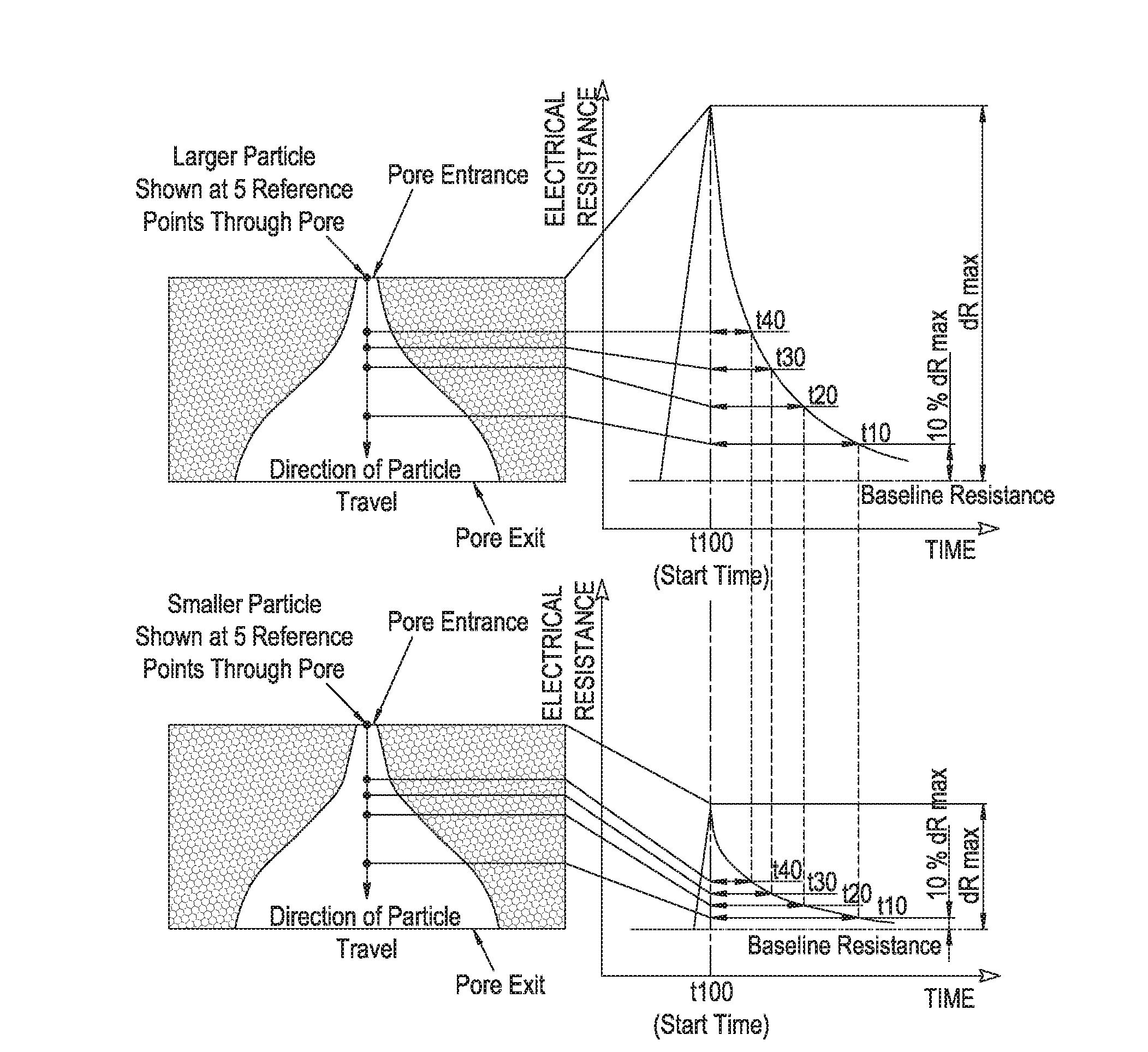
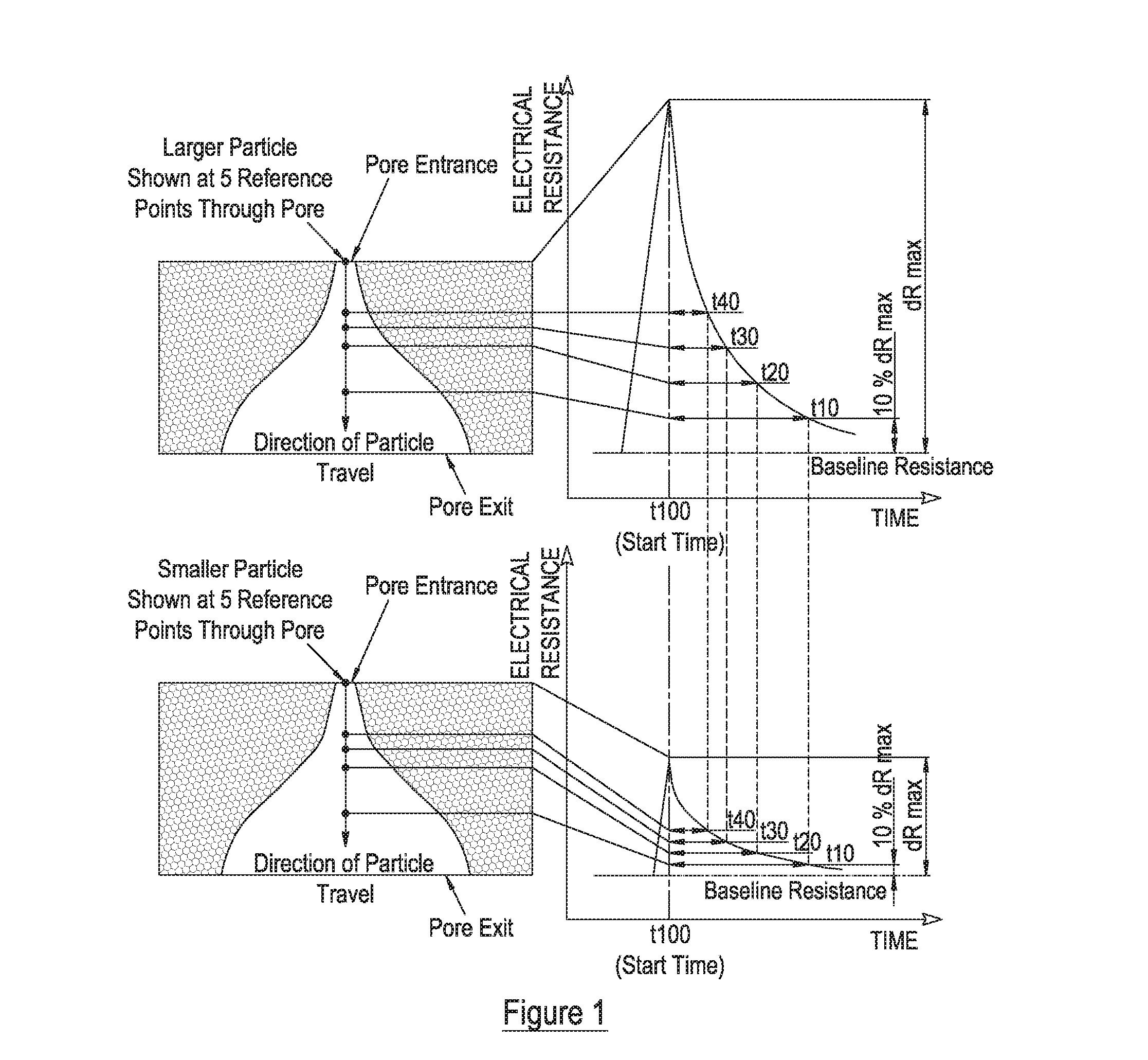
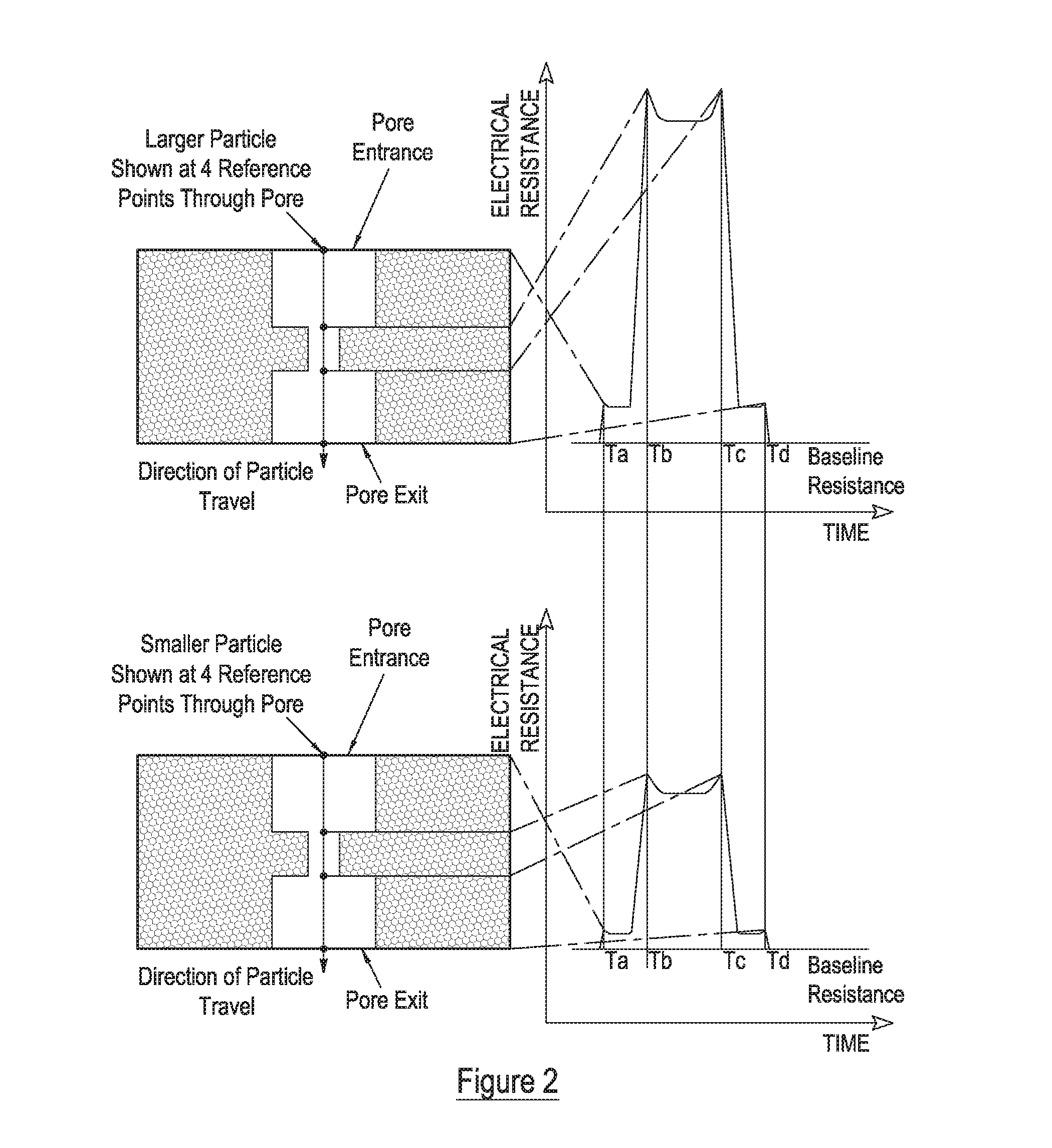
- A method that measures the surface charge of individual particles using a resistive pulse sensor, allowing for particle-by-particle analysis without requiring precise geometry knowledge, by resolving velocity components into convection, electrophoresis, and electro-osmosis, and using calibration particles to derive zeta potential, with adjustments for signal quality and pore zeta potential changes.

Mobility and effects arising from surface charge
PatentInactiveUS7217350B2
Innovation
- A method involving dual-frequency electric field reversal, where low-frequency measurements are corrected using high-frequency data to compensate for electro-osmotic flow effects, allowing for precise determination of electrophoretic mobility without the need for exact alignment at the stationary layer.


Standardization and Calibration Protocols
Standardization and calibration protocols are essential for ensuring the reliability, reproducibility, and accuracy of Dynamic Light Scattering (DLS) measurements when examining surface charge effects. These protocols establish a framework for consistent measurement practices across different laboratories and equipment, enabling meaningful comparison of results and validation of findings.
The primary calibration protocol for DLS instruments involves the use of standard reference materials with well-defined size distributions and surface charge characteristics. Polystyrene latex spheres with certified diameters (typically ranging from 50 nm to 500 nm) and known zeta potential values serve as excellent calibration standards. These materials should be traceable to national or international standards organizations such as NIST (National Institute of Standards and Technology) or ISO (International Organization for Standardization).
For surface charge measurements specifically, calibration should include verification using zeta potential transfer standards with known electrophoretic mobility values. These standards typically consist of colloidal dispersions with stable surface charge properties across a range of pH and ionic strength conditions. Regular calibration checks should be performed at least monthly, with full recalibration recommended quarterly or after any major maintenance event.
Temperature control represents another critical aspect of standardization in DLS measurements. Surface charge characteristics are highly temperature-dependent, necessitating precise temperature regulation (±0.1°C) during measurements. Calibration of the temperature control system should be verified using certified thermometers or temperature probes with appropriate traceability.
Sample preparation protocols must be standardized to minimize variability in measurements. This includes specifications for sample concentration ranges (typically 0.01-0.1% w/v for most colloidal systems), dispersion methods, equilibration times, and filtering procedures to remove dust or large aggregates. For surface charge investigations, standardized protocols for adjusting and measuring pH and ionic strength are particularly important, as these parameters significantly influence electrostatic interactions.
Measurement parameters such as scattering angle, laser power, acquisition time, and number of measurement runs should be standardized based on the specific application. For surface charge studies, multiple measurements (minimum of three) should be performed on each sample to ensure statistical significance, with automatic outlier detection algorithms applied to identify and exclude anomalous results.
Data analysis procedures require standardization through defined algorithms for cumulants analysis, distribution fitting, and zeta potential calculation. Software validation using reference materials should be performed to ensure accurate interpretation of raw correlation data and conversion to meaningful size and charge parameters.
The primary calibration protocol for DLS instruments involves the use of standard reference materials with well-defined size distributions and surface charge characteristics. Polystyrene latex spheres with certified diameters (typically ranging from 50 nm to 500 nm) and known zeta potential values serve as excellent calibration standards. These materials should be traceable to national or international standards organizations such as NIST (National Institute of Standards and Technology) or ISO (International Organization for Standardization).
For surface charge measurements specifically, calibration should include verification using zeta potential transfer standards with known electrophoretic mobility values. These standards typically consist of colloidal dispersions with stable surface charge properties across a range of pH and ionic strength conditions. Regular calibration checks should be performed at least monthly, with full recalibration recommended quarterly or after any major maintenance event.
Temperature control represents another critical aspect of standardization in DLS measurements. Surface charge characteristics are highly temperature-dependent, necessitating precise temperature regulation (±0.1°C) during measurements. Calibration of the temperature control system should be verified using certified thermometers or temperature probes with appropriate traceability.
Sample preparation protocols must be standardized to minimize variability in measurements. This includes specifications for sample concentration ranges (typically 0.01-0.1% w/v for most colloidal systems), dispersion methods, equilibration times, and filtering procedures to remove dust or large aggregates. For surface charge investigations, standardized protocols for adjusting and measuring pH and ionic strength are particularly important, as these parameters significantly influence electrostatic interactions.
Measurement parameters such as scattering angle, laser power, acquisition time, and number of measurement runs should be standardized based on the specific application. For surface charge studies, multiple measurements (minimum of three) should be performed on each sample to ensure statistical significance, with automatic outlier detection algorithms applied to identify and exclude anomalous results.
Data analysis procedures require standardization through defined algorithms for cumulants analysis, distribution fitting, and zeta potential calculation. Software validation using reference materials should be performed to ensure accurate interpretation of raw correlation data and conversion to meaningful size and charge parameters.
Environmental Factors Affecting DLS Measurements
Dynamic Light Scattering (DLS) measurements are highly sensitive to various environmental factors that can significantly influence the accuracy and reliability of surface charge assessments. Temperature stands as one of the most critical parameters affecting DLS measurements, as it directly impacts the Brownian motion of particles in suspension. Even minor temperature fluctuations can alter viscosity of the dispersing medium, thereby changing particle diffusion rates and potentially leading to misinterpretation of surface charge effects.
Solution pH represents another fundamental environmental factor that requires careful control during DLS experiments. The pH value directly influences the ionization state of surface functional groups on particles, affecting their zeta potential and electrophoretic mobility. Most colloidal systems exhibit pH-dependent surface charge characteristics, with specific isoelectric points where net surface charge approaches zero. Maintaining consistent pH throughout measurements is essential for meaningful comparisons between samples.
Ionic strength of the measurement medium substantially impacts the electrical double layer surrounding charged particles. Higher ionic concentrations compress this double layer, reducing electrostatic repulsion between particles and potentially promoting aggregation. This phenomenon, known as charge screening, can dramatically alter apparent size distributions and zeta potential values obtained through DLS, particularly for highly charged particles or those with complex surface chemistries.
Light-absorbing components present in the sample matrix can interfere with DLS measurements by attenuating the scattered light signal. Colored samples, fluorescent molecules, or high concentrations of certain proteins may absorb incident laser light or emitted scattered light, reducing signal-to-noise ratios and compromising measurement quality. These effects become particularly problematic when examining surface charge in complex biological media or environmental samples.
Sample concentration itself represents a critical parameter that must be optimized for reliable DLS measurements. Excessively dilute samples may provide insufficient scattering intensity, while overly concentrated samples can introduce multiple scattering effects and particle-particle interactions that complicate data interpretation. The optimal concentration range depends on particle size, refractive index, and the specific instrument configuration being employed.
Dissolved gases and air bubbles in the measurement medium can create spurious scattering centers that interfere with DLS measurements. Degassing samples prior to analysis and allowing temperature equilibration can minimize these effects. Additionally, the presence of large dust particles or contaminants can dominate scattering signals and mask the true surface charge characteristics of the target particles, necessitating careful sample preparation and handling protocols.
Solution pH represents another fundamental environmental factor that requires careful control during DLS experiments. The pH value directly influences the ionization state of surface functional groups on particles, affecting their zeta potential and electrophoretic mobility. Most colloidal systems exhibit pH-dependent surface charge characteristics, with specific isoelectric points where net surface charge approaches zero. Maintaining consistent pH throughout measurements is essential for meaningful comparisons between samples.
Ionic strength of the measurement medium substantially impacts the electrical double layer surrounding charged particles. Higher ionic concentrations compress this double layer, reducing electrostatic repulsion between particles and potentially promoting aggregation. This phenomenon, known as charge screening, can dramatically alter apparent size distributions and zeta potential values obtained through DLS, particularly for highly charged particles or those with complex surface chemistries.
Light-absorbing components present in the sample matrix can interfere with DLS measurements by attenuating the scattered light signal. Colored samples, fluorescent molecules, or high concentrations of certain proteins may absorb incident laser light or emitted scattered light, reducing signal-to-noise ratios and compromising measurement quality. These effects become particularly problematic when examining surface charge in complex biological media or environmental samples.
Sample concentration itself represents a critical parameter that must be optimized for reliable DLS measurements. Excessively dilute samples may provide insufficient scattering intensity, while overly concentrated samples can introduce multiple scattering effects and particle-particle interactions that complicate data interpretation. The optimal concentration range depends on particle size, refractive index, and the specific instrument configuration being employed.
Dissolved gases and air bubbles in the measurement medium can create spurious scattering centers that interfere with DLS measurements. Degassing samples prior to analysis and allowing temperature equilibration can minimize these effects. Additionally, the presence of large dust particles or contaminants can dominate scattering signals and mask the true surface charge characteristics of the target particles, necessitating careful sample preparation and handling protocols.
Unlock deeper insights with PatSnap Eureka Quick Research — get a full tech report to explore trends and direct your research. Try now!
Generate Your Research Report Instantly with AI Agent
Supercharge your innovation with PatSnap Eureka AI Agent Platform!