

How to Implement Effective Cooling in High-Density Racks
APR 3, 20269 MIN READ
Generate Your Research Report Instantly with AI Agent
PatSnap Eureka helps you evaluate technical feasibility & market potential.
High-Density Rack Cooling Background and Objectives
The evolution of data center infrastructure has witnessed a dramatic transformation over the past two decades, driven by exponential growth in computational demands and the proliferation of cloud computing services. Traditional data centers, once characterized by sparse server deployments and ample cooling margins, have evolved into highly concentrated computing environments where maximizing computational density per square foot has become paramount. This shift toward high-density rack configurations represents a fundamental paradigm change in data center design philosophy.
High-density racks, typically defined as installations exceeding 10-15 kW per rack, have emerged as the standard solution for modern enterprise and hyperscale data centers. The driving forces behind this evolution include economic pressures to maximize real estate utilization, the need to accommodate increasingly powerful processors and accelerators, and the growing demand for edge computing capabilities in space-constrained environments. Contemporary server architectures, particularly those incorporating GPUs for artificial intelligence workloads, can generate heat loads exceeding 40-50 kW per rack.
The historical development of rack cooling solutions has progressed through distinct phases, beginning with simple raised-floor air distribution systems in the 1980s, advancing to hot aisle/cold aisle containment strategies in the 2000s, and culminating in today's sophisticated liquid cooling implementations. Each evolutionary step has been necessitated by the relentless increase in power densities and the corresponding thermal management challenges.
The primary objective of effective high-density rack cooling extends beyond mere temperature control to encompass comprehensive thermal management that ensures optimal performance, reliability, and energy efficiency. Modern cooling solutions must maintain processor junction temperatures within specified operating ranges while minimizing energy consumption and operational costs. Additionally, these systems must provide uniform temperature distribution across all rack positions, prevent hotspot formation, and maintain acceptable humidity levels.
Strategic cooling implementation in high-density environments aims to achieve several critical performance metrics: maintaining inlet air temperatures between 18-27°C as specified by ASHRAE guidelines, ensuring temperature uniformity with minimal variation across rack positions, and achieving power usage effectiveness ratios below 1.3. Furthermore, effective cooling solutions must demonstrate scalability to accommodate future density increases and provide redundancy to ensure continuous operation during component failures.
The contemporary focus on sustainability and carbon footprint reduction has introduced additional objectives centered on energy efficiency optimization and waste heat recovery. Modern cooling strategies increasingly emphasize the utilization of free cooling opportunities, implementation of variable-speed control systems, and integration with building management systems to optimize overall facility performance while meeting stringent environmental regulations and corporate sustainability commitments.
High-density racks, typically defined as installations exceeding 10-15 kW per rack, have emerged as the standard solution for modern enterprise and hyperscale data centers. The driving forces behind this evolution include economic pressures to maximize real estate utilization, the need to accommodate increasingly powerful processors and accelerators, and the growing demand for edge computing capabilities in space-constrained environments. Contemporary server architectures, particularly those incorporating GPUs for artificial intelligence workloads, can generate heat loads exceeding 40-50 kW per rack.
The historical development of rack cooling solutions has progressed through distinct phases, beginning with simple raised-floor air distribution systems in the 1980s, advancing to hot aisle/cold aisle containment strategies in the 2000s, and culminating in today's sophisticated liquid cooling implementations. Each evolutionary step has been necessitated by the relentless increase in power densities and the corresponding thermal management challenges.
The primary objective of effective high-density rack cooling extends beyond mere temperature control to encompass comprehensive thermal management that ensures optimal performance, reliability, and energy efficiency. Modern cooling solutions must maintain processor junction temperatures within specified operating ranges while minimizing energy consumption and operational costs. Additionally, these systems must provide uniform temperature distribution across all rack positions, prevent hotspot formation, and maintain acceptable humidity levels.
Strategic cooling implementation in high-density environments aims to achieve several critical performance metrics: maintaining inlet air temperatures between 18-27°C as specified by ASHRAE guidelines, ensuring temperature uniformity with minimal variation across rack positions, and achieving power usage effectiveness ratios below 1.3. Furthermore, effective cooling solutions must demonstrate scalability to accommodate future density increases and provide redundancy to ensure continuous operation during component failures.
The contemporary focus on sustainability and carbon footprint reduction has introduced additional objectives centered on energy efficiency optimization and waste heat recovery. Modern cooling strategies increasingly emphasize the utilization of free cooling opportunities, implementation of variable-speed control systems, and integration with building management systems to optimize overall facility performance while meeting stringent environmental regulations and corporate sustainability commitments.
Market Demand for Data Center Thermal Management Solutions
The global data center thermal management market is experiencing unprecedented growth driven by the exponential increase in data generation, cloud computing adoption, and artificial intelligence workloads. Organizations across industries are deploying high-density computing infrastructure to maximize performance within limited physical footprints, creating substantial demand for advanced cooling solutions that can handle thermal loads exceeding traditional capacity limits.
Enterprise data centers are facing mounting pressure to support rack densities that have increased from traditional levels of 5-10 kW per rack to modern requirements of 20-50 kW per rack, with some specialized AI and HPC applications demanding even higher densities. This dramatic shift has rendered conventional air-cooling approaches insufficient, driving urgent market demand for innovative thermal management technologies including liquid cooling, immersion cooling, and hybrid cooling architectures.
Cloud service providers represent the largest segment of market demand, as they continuously expand infrastructure to meet growing digital service requirements while maintaining strict operational efficiency standards. These organizations require cooling solutions that can scale rapidly, operate reliably under varying load conditions, and deliver optimal power usage effectiveness ratios to control operational costs and meet sustainability commitments.
The financial services, telecommunications, and healthcare sectors are also generating significant demand for high-performance thermal management solutions as they deploy edge computing infrastructure and real-time processing capabilities. These industries require cooling systems that can maintain consistent performance in diverse environmental conditions while meeting stringent reliability and compliance requirements.
Emerging technologies such as machine learning, cryptocurrency mining, and high-frequency trading are creating specialized market segments with unique thermal management needs. These applications often require custom cooling solutions capable of handling extreme heat densities while maintaining precise temperature control to ensure optimal system performance and component longevity.
Geographic demand patterns show particularly strong growth in Asia-Pacific regions, where rapid digitalization and smart city initiatives are driving massive data center construction projects. North American and European markets continue to demand advanced cooling technologies as existing facilities undergo modernization to support next-generation computing workloads and meet increasingly stringent energy efficiency regulations.
Enterprise data centers are facing mounting pressure to support rack densities that have increased from traditional levels of 5-10 kW per rack to modern requirements of 20-50 kW per rack, with some specialized AI and HPC applications demanding even higher densities. This dramatic shift has rendered conventional air-cooling approaches insufficient, driving urgent market demand for innovative thermal management technologies including liquid cooling, immersion cooling, and hybrid cooling architectures.
Cloud service providers represent the largest segment of market demand, as they continuously expand infrastructure to meet growing digital service requirements while maintaining strict operational efficiency standards. These organizations require cooling solutions that can scale rapidly, operate reliably under varying load conditions, and deliver optimal power usage effectiveness ratios to control operational costs and meet sustainability commitments.
The financial services, telecommunications, and healthcare sectors are also generating significant demand for high-performance thermal management solutions as they deploy edge computing infrastructure and real-time processing capabilities. These industries require cooling systems that can maintain consistent performance in diverse environmental conditions while meeting stringent reliability and compliance requirements.
Emerging technologies such as machine learning, cryptocurrency mining, and high-frequency trading are creating specialized market segments with unique thermal management needs. These applications often require custom cooling solutions capable of handling extreme heat densities while maintaining precise temperature control to ensure optimal system performance and component longevity.
Geographic demand patterns show particularly strong growth in Asia-Pacific regions, where rapid digitalization and smart city initiatives are driving massive data center construction projects. North American and European markets continue to demand advanced cooling technologies as existing facilities undergo modernization to support next-generation computing workloads and meet increasingly stringent energy efficiency regulations.
Current Cooling Challenges in High-Density Server Environments
High-density server environments face unprecedented thermal management challenges as computing power continues to increase while physical footprints shrink. Modern data centers are experiencing heat densities exceeding 20-30 kW per rack, with some specialized configurations reaching 50 kW or higher. This dramatic increase in power density has fundamentally altered the thermal landscape, creating hotspots that traditional cooling methods struggle to address effectively.
The primary challenge stems from inadequate airflow distribution within densely packed server racks. Conventional raised-floor cooling systems often fail to deliver sufficient cold air to equipment positioned in the middle and upper sections of high-density configurations. This results in significant temperature variations across different rack positions, with some servers operating dangerously close to thermal limits while others remain adequately cooled.
Heat accumulation represents another critical obstacle in high-density environments. As servers generate substantial amounts of waste heat in confined spaces, the cooling infrastructure must work exponentially harder to maintain acceptable operating temperatures. The phenomenon of hot air recirculation exacerbates this problem, where exhaust heat from servers mixes with incoming cold air, reducing overall cooling efficiency and creating thermal instability.
Energy consumption concerns have become increasingly prominent as cooling systems struggle to keep pace with rising heat loads. Traditional cooling approaches often require excessive energy input to maintain adequate temperatures, leading to poor Power Usage Effectiveness ratios and increased operational costs. The cooling infrastructure frequently becomes the limiting factor in rack density optimization, preventing organizations from fully utilizing their available space.
Spatial constraints within existing data center facilities present additional complications. Many legacy data centers lack the infrastructure necessary to support modern high-density cooling requirements, including adequate power distribution, sufficient ceiling height for advanced cooling systems, and proper containment structures. These limitations force organizations to implement suboptimal cooling solutions that compromise both performance and efficiency.
Equipment reliability issues emerge when cooling systems fail to maintain consistent temperatures across all rack positions. Temperature fluctuations and thermal stress can significantly reduce server lifespan, increase maintenance requirements, and elevate the risk of unexpected hardware failures. The challenge becomes particularly acute during peak load conditions when both computational and thermal demands reach maximum levels simultaneously.
The primary challenge stems from inadequate airflow distribution within densely packed server racks. Conventional raised-floor cooling systems often fail to deliver sufficient cold air to equipment positioned in the middle and upper sections of high-density configurations. This results in significant temperature variations across different rack positions, with some servers operating dangerously close to thermal limits while others remain adequately cooled.
Heat accumulation represents another critical obstacle in high-density environments. As servers generate substantial amounts of waste heat in confined spaces, the cooling infrastructure must work exponentially harder to maintain acceptable operating temperatures. The phenomenon of hot air recirculation exacerbates this problem, where exhaust heat from servers mixes with incoming cold air, reducing overall cooling efficiency and creating thermal instability.
Energy consumption concerns have become increasingly prominent as cooling systems struggle to keep pace with rising heat loads. Traditional cooling approaches often require excessive energy input to maintain adequate temperatures, leading to poor Power Usage Effectiveness ratios and increased operational costs. The cooling infrastructure frequently becomes the limiting factor in rack density optimization, preventing organizations from fully utilizing their available space.
Spatial constraints within existing data center facilities present additional complications. Many legacy data centers lack the infrastructure necessary to support modern high-density cooling requirements, including adequate power distribution, sufficient ceiling height for advanced cooling systems, and proper containment structures. These limitations force organizations to implement suboptimal cooling solutions that compromise both performance and efficiency.
Equipment reliability issues emerge when cooling systems fail to maintain consistent temperatures across all rack positions. Temperature fluctuations and thermal stress can significantly reduce server lifespan, increase maintenance requirements, and elevate the risk of unexpected hardware failures. The challenge becomes particularly acute during peak load conditions when both computational and thermal demands reach maximum levels simultaneously.
Current High-Density Rack Cooling Solutions
01 Enhanced heat transfer through advanced heat exchanger designs
Cooling effectiveness can be improved by utilizing advanced heat exchanger configurations that maximize surface area contact and optimize fluid flow patterns. These designs may incorporate specialized geometries, fin structures, or multi-pass arrangements to enhance thermal transfer between cooling media and the system being cooled. The implementation of such designs results in more efficient heat dissipation and improved overall cooling performance.- Advanced heat exchanger designs for improved cooling efficiency: Innovative heat exchanger configurations and geometries can significantly enhance cooling effectiveness by optimizing heat transfer surface area and fluid flow patterns. These designs may include enhanced fin structures, microchannel configurations, and novel tube arrangements that maximize thermal conductivity while minimizing pressure drop. Advanced materials and coatings can further improve heat dissipation rates and overall system performance.
- Multi-stage and hybrid cooling system architectures: Implementing multi-stage cooling approaches or combining different cooling technologies can achieve superior cooling effectiveness compared to single-stage systems. These architectures may integrate various cooling methods in series or parallel configurations to optimize performance across different operating conditions. The hybrid approach allows for adaptive cooling strategies that respond to varying thermal loads and environmental conditions.
- Active flow control and optimization techniques: Dynamic control of coolant flow rates, distribution patterns, and circulation paths can substantially improve cooling system effectiveness. These techniques involve real-time monitoring and adjustment of flow parameters based on thermal demands and system conditions. Advanced control algorithms and valve systems enable precise regulation of cooling capacity to match instantaneous heat loads while minimizing energy consumption.
- Enhanced coolant formulations and phase-change cooling: Utilizing specialized coolant compositions with improved thermal properties or implementing phase-change cooling mechanisms can dramatically increase heat removal capabilities. These approaches leverage the latent heat of vaporization or advanced fluid properties to achieve higher cooling effectiveness. The selection of appropriate coolants and phase-change materials is critical for optimizing thermal performance across target temperature ranges.
- Integrated thermal management with smart monitoring systems: Comprehensive thermal management solutions that incorporate intelligent monitoring, predictive analytics, and automated control systems can optimize overall cooling effectiveness. These integrated approaches utilize sensors, data analytics, and feedback mechanisms to continuously assess and improve cooling performance. The systems can adapt to changing conditions and predict maintenance needs to ensure sustained cooling efficiency throughout the operational lifecycle.
02 Integration of phase change materials for thermal management
The incorporation of phase change materials into cooling systems provides enhanced thermal buffering capabilities. These materials absorb and release thermal energy during phase transitions, helping to maintain stable operating temperatures and improve cooling effectiveness during peak thermal loads. This approach is particularly effective in applications requiring temperature stabilization and extended cooling capacity.Expand Specific Solutions03 Optimized coolant flow distribution and circulation systems
Cooling effectiveness can be significantly enhanced through improved coolant distribution networks and circulation mechanisms. This includes the use of variable flow control, multi-channel distribution systems, and optimized pump configurations to ensure uniform cooling across all system components. Proper flow management reduces hot spots and improves overall thermal performance.Expand Specific Solutions04 Active cooling control systems with real-time monitoring
Implementation of intelligent control systems that actively monitor thermal conditions and adjust cooling parameters in real-time enhances cooling effectiveness. These systems utilize sensors, feedback loops, and automated control mechanisms to optimize cooling performance based on actual thermal loads and operating conditions. This dynamic approach ensures efficient cooling while minimizing energy consumption.Expand Specific Solutions05 Hybrid cooling approaches combining multiple cooling methods
Combining different cooling technologies such as liquid cooling, air cooling, and thermoelectric cooling in hybrid configurations can significantly improve overall cooling effectiveness. These integrated systems leverage the advantages of each cooling method to achieve superior thermal management performance. The synergistic effect of multiple cooling mechanisms provides enhanced cooling capacity and flexibility for various operating conditions.Expand Specific Solutions
Major Players in Data Center Cooling Industry
The high-density rack cooling market is experiencing rapid growth driven by increasing data center demands and edge computing proliferation, with the global market expanding significantly as organizations seek efficient thermal management solutions. The industry is in a mature development stage, characterized by established infrastructure providers and emerging specialized cooling technology companies competing for market share. Technology maturity varies across different cooling approaches, with traditional air-based solutions from established players like Schneider Electric IT Corp., Vertiv Corp., and Hewlett Packard Enterprise Development LP representing proven methodologies, while companies such as IBM and Fujitsu Ltd. are advancing liquid cooling innovations. The competitive landscape includes diversified technology giants like Siemens AG and specialized thermal management providers, alongside emerging players like Suzhou Inspur Intelligent Technology Co., Ltd. developing next-generation cooling architectures for high-performance computing environments.
Schneider Electric IT Corp.
Technical Solution: Schneider Electric implements comprehensive cooling solutions for high-density racks through their EcoStruxure IT platform, featuring intelligent airflow management systems with hot aisle/cold aisle containment, precision cooling units with variable speed fans, and advanced monitoring sensors. Their InRow cooling systems provide targeted cooling directly at the rack level, achieving cooling efficiency improvements of up to 40% compared to traditional room-based cooling. The solution integrates predictive analytics to optimize cooling performance based on real-time thermal mapping and power consumption data, enabling dynamic adjustment of cooling capacity to match actual heat loads.
Strengths: Market-leading energy efficiency, comprehensive monitoring capabilities, scalable modular design. Weaknesses: Higher initial investment costs, complex integration requirements for legacy systems.
Vertiv Corp.
Technical Solution: Vertiv's high-density rack cooling approach centers on their Liebert precision cooling systems combined with thermal management solutions. Their technology includes direct expansion cooling units, chilled water systems, and innovative liquid cooling solutions for extreme high-density applications exceeding 30kW per rack. The Vertiv thermal management portfolio features intelligent controls that automatically adjust cooling output based on IT load variations, achieving PUE improvements of 15-25%. Their solutions incorporate computational fluid dynamics modeling to optimize airflow patterns and eliminate hot spots, while their modular design allows for incremental capacity additions as data center requirements grow.
Strengths: Proven reliability in mission-critical environments, extensive liquid cooling expertise, flexible deployment options. Weaknesses: Limited software integration capabilities, higher maintenance complexity for liquid cooling systems.
Core Thermal Management Innovations for Dense Computing
Method for providing cooling to electronic racks using liquid cooling and air cooling
PatentActiveUS20190150326A1
Innovation
- A rack-level cooling design combining air-to-liquid (A/L) heat exchangers and liquid cooling systems, where cooling liquid is distributed through a manifold to server-level cold plates, with air recirculation within the rack to extract nearly 100% of heat generated, and a bypass mechanism for maintenance or failure scenarios.


Cooling systems for immersion cooled it equipment
PatentActiveUS20210153392A1
Innovation
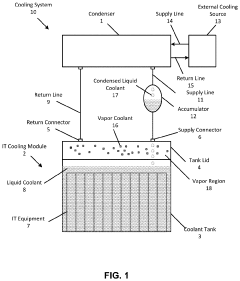
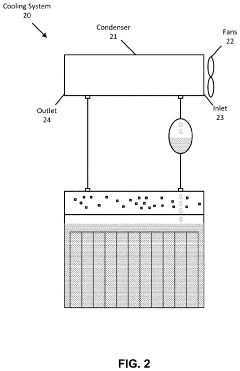
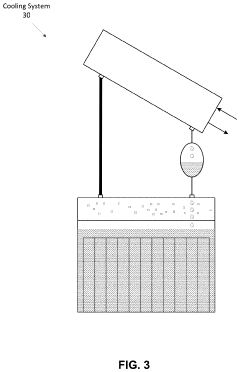
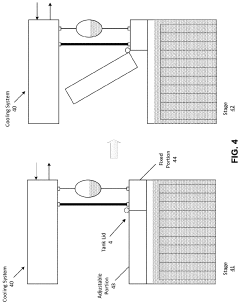
- A full-end-to-end immersion cooling system that maintains a coolant level while allowing maintenance without breaking the cooling loop, featuring a condenser positioned above the IT equipment, a return line, and a supply line, along with a valve and liquid level sensor to control coolant levels, enabling flexible deployment in existing data centers or separate modules.
Energy Efficiency Standards for Data Center Operations
Energy efficiency standards for data center operations have become increasingly critical as organizations seek to balance performance requirements with environmental sustainability and operational cost management. The implementation of effective cooling systems in high-density racks must align with established energy efficiency frameworks and regulatory requirements that govern modern data center operations.
The most prominent standard governing data center energy efficiency is the Power Usage Effectiveness (PUE) metric, developed by The Green Grid consortium. PUE measures the ratio of total facility energy consumption to IT equipment energy consumption, with values closer to 1.0 indicating higher efficiency. Leading data centers now target PUE values below 1.3, with some hyperscale facilities achieving ratios as low as 1.1. This standard directly impacts cooling system design, as cooling infrastructure typically accounts for 30-40% of total facility power consumption.
ASHRAE TC 9.9 guidelines provide comprehensive thermal management standards specifically addressing high-density computing environments. These standards define recommended and allowable temperature ranges for IT equipment operation, with current specifications allowing inlet temperatures up to 27°C (80.6°F) under recommended conditions and 35°C (95°F) under allowable conditions. These expanded temperature ranges enable more efficient cooling strategies and reduced energy consumption while maintaining equipment reliability.
The European Union's Energy Efficiency Directive and similar regulations in other regions mandate specific energy performance requirements for large data centers. These regulations often require facilities to implement energy management systems, conduct regular efficiency audits, and report energy consumption metrics. Compliance with these standards influences cooling system selection and operational parameters, favoring solutions that demonstrate measurable efficiency improvements.
ISO 50001 Energy Management Systems standard provides a framework for systematic energy management in data center operations. This standard requires organizations to establish energy policies, set efficiency targets, and implement continuous improvement processes. For cooling systems in high-density environments, this translates to requirements for monitoring, measurement, and optimization of thermal management performance.
Emerging standards such as the EU Code of Conduct for Data Centres and ENERGY STAR certification programs establish benchmarks for operational efficiency that directly influence cooling system design and implementation strategies. These standards promote adoption of advanced cooling technologies, including liquid cooling solutions and AI-driven thermal management systems, to achieve superior energy performance in high-density deployments.
The most prominent standard governing data center energy efficiency is the Power Usage Effectiveness (PUE) metric, developed by The Green Grid consortium. PUE measures the ratio of total facility energy consumption to IT equipment energy consumption, with values closer to 1.0 indicating higher efficiency. Leading data centers now target PUE values below 1.3, with some hyperscale facilities achieving ratios as low as 1.1. This standard directly impacts cooling system design, as cooling infrastructure typically accounts for 30-40% of total facility power consumption.
ASHRAE TC 9.9 guidelines provide comprehensive thermal management standards specifically addressing high-density computing environments. These standards define recommended and allowable temperature ranges for IT equipment operation, with current specifications allowing inlet temperatures up to 27°C (80.6°F) under recommended conditions and 35°C (95°F) under allowable conditions. These expanded temperature ranges enable more efficient cooling strategies and reduced energy consumption while maintaining equipment reliability.
The European Union's Energy Efficiency Directive and similar regulations in other regions mandate specific energy performance requirements for large data centers. These regulations often require facilities to implement energy management systems, conduct regular efficiency audits, and report energy consumption metrics. Compliance with these standards influences cooling system selection and operational parameters, favoring solutions that demonstrate measurable efficiency improvements.
ISO 50001 Energy Management Systems standard provides a framework for systematic energy management in data center operations. This standard requires organizations to establish energy policies, set efficiency targets, and implement continuous improvement processes. For cooling systems in high-density environments, this translates to requirements for monitoring, measurement, and optimization of thermal management performance.
Emerging standards such as the EU Code of Conduct for Data Centres and ENERGY STAR certification programs establish benchmarks for operational efficiency that directly influence cooling system design and implementation strategies. These standards promote adoption of advanced cooling technologies, including liquid cooling solutions and AI-driven thermal management systems, to achieve superior energy performance in high-density deployments.
Environmental Impact Assessment of Cooling Systems
The environmental implications of cooling systems in high-density rack deployments have become increasingly critical as data centers expand globally and energy consumption intensifies. Traditional air-based cooling methods typically consume 30-40% of total data center energy, contributing significantly to carbon emissions and operational costs. The shift toward more sustainable cooling approaches reflects both regulatory pressures and corporate environmental responsibility initiatives.
Air conditioning systems utilizing hydrofluorocarbon refrigerants present substantial environmental concerns due to their high global warming potential, often exceeding 1,400 times that of carbon dioxide. Liquid cooling solutions, while more energy-efficient, introduce considerations regarding coolant selection, with synthetic fluids requiring careful lifecycle assessment to evaluate biodegradability and toxicity profiles. Immersion cooling technologies using dielectric fluids offer superior thermal performance but necessitate comprehensive environmental impact evaluation of fluid disposal and recycling processes.
Water usage represents another critical environmental factor, particularly for evaporative cooling systems and cooling towers. These systems can consume millions of gallons annually, straining local water resources and requiring treatment chemicals that may impact surrounding ecosystems. Advanced closed-loop systems minimize water consumption but often require higher initial energy investments for manufacturing and installation.
Energy source composition significantly influences the overall environmental footprint of cooling implementations. Facilities powered by renewable energy sources demonstrate substantially lower carbon intensity compared to those relying on fossil fuel-based electricity. The integration of waste heat recovery systems presents opportunities to offset environmental impact by repurposing thermal energy for building heating or industrial processes.
Emerging technologies such as thermosiphon cooling and phase-change materials offer promising environmental benefits through reduced energy consumption and elimination of mechanical refrigeration components. These passive cooling approaches minimize ongoing environmental impact while maintaining effective thermal management in high-density configurations.
The circular economy principles increasingly guide cooling system design, emphasizing component recyclability, extended operational lifespans, and reduced material consumption. Manufacturers are developing modular cooling solutions that enable component reuse and minimize electronic waste generation at end-of-life stages.
Air conditioning systems utilizing hydrofluorocarbon refrigerants present substantial environmental concerns due to their high global warming potential, often exceeding 1,400 times that of carbon dioxide. Liquid cooling solutions, while more energy-efficient, introduce considerations regarding coolant selection, with synthetic fluids requiring careful lifecycle assessment to evaluate biodegradability and toxicity profiles. Immersion cooling technologies using dielectric fluids offer superior thermal performance but necessitate comprehensive environmental impact evaluation of fluid disposal and recycling processes.
Water usage represents another critical environmental factor, particularly for evaporative cooling systems and cooling towers. These systems can consume millions of gallons annually, straining local water resources and requiring treatment chemicals that may impact surrounding ecosystems. Advanced closed-loop systems minimize water consumption but often require higher initial energy investments for manufacturing and installation.
Energy source composition significantly influences the overall environmental footprint of cooling implementations. Facilities powered by renewable energy sources demonstrate substantially lower carbon intensity compared to those relying on fossil fuel-based electricity. The integration of waste heat recovery systems presents opportunities to offset environmental impact by repurposing thermal energy for building heating or industrial processes.
Emerging technologies such as thermosiphon cooling and phase-change materials offer promising environmental benefits through reduced energy consumption and elimination of mechanical refrigeration components. These passive cooling approaches minimize ongoing environmental impact while maintaining effective thermal management in high-density configurations.
The circular economy principles increasingly guide cooling system design, emphasizing component recyclability, extended operational lifespans, and reduced material consumption. Manufacturers are developing modular cooling solutions that enable component reuse and minimize electronic waste generation at end-of-life stages.
Unlock deeper insights with PatSnap Eureka Quick Research — get a full tech report to explore trends and direct your research. Try now!
Generate Your Research Report Instantly with AI Agent
Supercharge your innovation with PatSnap Eureka AI Agent Platform!