

How to Optimize Battery Management System Efficiency
MAR 20, 20269 MIN READ
Generate Your Research Report Instantly with AI Agent
PatSnap Eureka helps you evaluate technical feasibility & market potential.
Battery Management System Efficiency Background and Objectives
Battery Management Systems have emerged as critical components in the evolution of energy storage technologies, tracing their origins back to the early development of rechargeable battery applications in the 1970s. Initially designed for simple monitoring functions, BMS technology has undergone substantial transformation driven by the proliferation of electric vehicles, renewable energy storage systems, and portable electronic devices. The exponential growth in battery-powered applications has necessitated increasingly sophisticated management systems capable of handling complex multi-cell configurations while ensuring optimal performance and safety.
The technological evolution of BMS has been marked by several pivotal developments, beginning with basic voltage monitoring systems and progressing through current sensing capabilities, temperature management, and advanced state estimation algorithms. Modern BMS architectures have evolved from centralized designs to distributed and modular configurations, enabling scalability and enhanced reliability. The integration of digital signal processors, microcontrollers, and advanced communication protocols has transformed BMS from passive monitoring devices into intelligent systems capable of predictive analytics and adaptive control strategies.
Contemporary market demands have established efficiency optimization as a paramount objective for BMS development, driven by stringent energy density requirements and extended operational lifespan expectations. The primary technical objectives encompass maximizing energy utilization through precise state-of-charge estimation, minimizing power losses during charging and discharging cycles, and implementing dynamic load balancing across individual cells. Advanced thermal management strategies represent another critical objective, ensuring optimal operating temperatures while preventing thermal runaway conditions that compromise both efficiency and safety.
The convergence of artificial intelligence and machine learning technologies with traditional BMS architectures has opened new frontiers for efficiency optimization. Predictive algorithms now enable proactive maintenance scheduling, adaptive charging protocols, and real-time performance optimization based on usage patterns and environmental conditions. These technological advancements align with industry objectives to achieve higher energy conversion efficiencies, reduced maintenance costs, and extended battery lifecycle management.
Future-oriented objectives focus on developing autonomous BMS capabilities that can self-optimize based on application-specific requirements while maintaining robust safety margins. The integration of cloud connectivity and edge computing technologies promises to enable fleet-level optimization strategies and continuous performance enhancement through data-driven insights.
The technological evolution of BMS has been marked by several pivotal developments, beginning with basic voltage monitoring systems and progressing through current sensing capabilities, temperature management, and advanced state estimation algorithms. Modern BMS architectures have evolved from centralized designs to distributed and modular configurations, enabling scalability and enhanced reliability. The integration of digital signal processors, microcontrollers, and advanced communication protocols has transformed BMS from passive monitoring devices into intelligent systems capable of predictive analytics and adaptive control strategies.
Contemporary market demands have established efficiency optimization as a paramount objective for BMS development, driven by stringent energy density requirements and extended operational lifespan expectations. The primary technical objectives encompass maximizing energy utilization through precise state-of-charge estimation, minimizing power losses during charging and discharging cycles, and implementing dynamic load balancing across individual cells. Advanced thermal management strategies represent another critical objective, ensuring optimal operating temperatures while preventing thermal runaway conditions that compromise both efficiency and safety.
The convergence of artificial intelligence and machine learning technologies with traditional BMS architectures has opened new frontiers for efficiency optimization. Predictive algorithms now enable proactive maintenance scheduling, adaptive charging protocols, and real-time performance optimization based on usage patterns and environmental conditions. These technological advancements align with industry objectives to achieve higher energy conversion efficiencies, reduced maintenance costs, and extended battery lifecycle management.
Future-oriented objectives focus on developing autonomous BMS capabilities that can self-optimize based on application-specific requirements while maintaining robust safety margins. The integration of cloud connectivity and edge computing technologies promises to enable fleet-level optimization strategies and continuous performance enhancement through data-driven insights.
Market Demand for Advanced Battery Management Solutions
The global battery management system market is experiencing unprecedented growth driven by the rapid expansion of electric vehicles, renewable energy storage systems, and portable electronic devices. Electric vehicle adoption serves as the primary catalyst, with automotive manufacturers increasingly demanding sophisticated BMS solutions that can maximize battery life, ensure safety, and optimize charging efficiency. The transition from internal combustion engines to electric powertrains has created an urgent need for advanced battery management technologies that can handle complex multi-cell configurations and deliver real-time performance optimization.
Energy storage applications represent another significant demand driver, particularly as grid-scale battery installations proliferate to support renewable energy integration. Utility companies and commercial energy storage operators require BMS solutions capable of managing large-scale battery arrays while maintaining optimal efficiency across varying load conditions. These applications demand advanced algorithms for state-of-charge estimation, thermal management, and predictive maintenance capabilities.
Consumer electronics continue to fuel demand for compact, efficient BMS solutions as devices become more power-hungry while users expect longer battery life. Smartphones, laptops, and wearable devices require increasingly sophisticated power management to balance performance with energy efficiency. The Internet of Things expansion further amplifies this demand, with billions of connected devices requiring intelligent battery management for extended operational periods.
Industrial applications present growing opportunities for advanced BMS technologies, particularly in sectors such as material handling, backup power systems, and medical devices. These applications often require specialized features including extended temperature operation, enhanced safety protocols, and integration with existing industrial control systems.
The market increasingly values BMS solutions that incorporate artificial intelligence and machine learning capabilities for predictive analytics, adaptive charging algorithms, and autonomous optimization. Customers seek systems that can learn from usage patterns, predict maintenance needs, and automatically adjust parameters to maximize battery performance and longevity.
Safety regulations and standards continue to drive demand for more sophisticated monitoring and protection features, particularly in automotive and aerospace applications where battery failures can have severe consequences.
Energy storage applications represent another significant demand driver, particularly as grid-scale battery installations proliferate to support renewable energy integration. Utility companies and commercial energy storage operators require BMS solutions capable of managing large-scale battery arrays while maintaining optimal efficiency across varying load conditions. These applications demand advanced algorithms for state-of-charge estimation, thermal management, and predictive maintenance capabilities.
Consumer electronics continue to fuel demand for compact, efficient BMS solutions as devices become more power-hungry while users expect longer battery life. Smartphones, laptops, and wearable devices require increasingly sophisticated power management to balance performance with energy efficiency. The Internet of Things expansion further amplifies this demand, with billions of connected devices requiring intelligent battery management for extended operational periods.
Industrial applications present growing opportunities for advanced BMS technologies, particularly in sectors such as material handling, backup power systems, and medical devices. These applications often require specialized features including extended temperature operation, enhanced safety protocols, and integration with existing industrial control systems.
The market increasingly values BMS solutions that incorporate artificial intelligence and machine learning capabilities for predictive analytics, adaptive charging algorithms, and autonomous optimization. Customers seek systems that can learn from usage patterns, predict maintenance needs, and automatically adjust parameters to maximize battery performance and longevity.
Safety regulations and standards continue to drive demand for more sophisticated monitoring and protection features, particularly in automotive and aerospace applications where battery failures can have severe consequences.
Current BMS Efficiency Challenges and Technical Barriers
Battery Management Systems face significant efficiency challenges that stem from multiple interconnected technical barriers. The primary constraint lies in the inherent energy losses during charge and discharge cycles, where conversion inefficiencies can result in 5-15% energy waste depending on system design and operating conditions. These losses manifest through heat generation, voltage drops across switching components, and suboptimal power conversion algorithms.
Thermal management represents another critical barrier to BMS efficiency optimization. Current systems struggle with uneven temperature distribution across battery cells, leading to performance degradation and reduced overall system efficiency. The challenge is compounded by inadequate heat dissipation mechanisms and insufficient real-time thermal monitoring capabilities, which prevent dynamic optimization based on temperature variations.
State-of-charge estimation accuracy remains a fundamental technical hurdle. Existing algorithms often rely on simplified models that fail to account for battery aging, temperature variations, and dynamic load conditions. This inaccuracy leads to conservative safety margins, underutilization of available capacity, and suboptimal charging strategies that compromise overall system efficiency.
Cell balancing inefficiencies constitute a major technical barrier, particularly in large battery packs. Current passive balancing methods waste energy through resistive dissipation, while active balancing systems suffer from complex control requirements and additional component losses. The lack of predictive balancing algorithms further exacerbates these inefficiencies by addressing imbalances reactively rather than proactively.
Communication and control system latencies present additional challenges. Traditional CAN-bus architectures introduce delays in data transmission between cells and the central management unit, limiting the system's ability to respond rapidly to changing conditions. This latency affects real-time optimization capabilities and prevents implementation of advanced control strategies.
Power electronics integration challenges also constrain efficiency improvements. Current BMS designs often employ discrete components with suboptimal switching characteristics, leading to increased conduction and switching losses. The lack of integrated power management solutions results in redundant conversion stages and additional parasitic losses throughout the system.
Thermal management represents another critical barrier to BMS efficiency optimization. Current systems struggle with uneven temperature distribution across battery cells, leading to performance degradation and reduced overall system efficiency. The challenge is compounded by inadequate heat dissipation mechanisms and insufficient real-time thermal monitoring capabilities, which prevent dynamic optimization based on temperature variations.
State-of-charge estimation accuracy remains a fundamental technical hurdle. Existing algorithms often rely on simplified models that fail to account for battery aging, temperature variations, and dynamic load conditions. This inaccuracy leads to conservative safety margins, underutilization of available capacity, and suboptimal charging strategies that compromise overall system efficiency.
Cell balancing inefficiencies constitute a major technical barrier, particularly in large battery packs. Current passive balancing methods waste energy through resistive dissipation, while active balancing systems suffer from complex control requirements and additional component losses. The lack of predictive balancing algorithms further exacerbates these inefficiencies by addressing imbalances reactively rather than proactively.
Communication and control system latencies present additional challenges. Traditional CAN-bus architectures introduce delays in data transmission between cells and the central management unit, limiting the system's ability to respond rapidly to changing conditions. This latency affects real-time optimization capabilities and prevents implementation of advanced control strategies.
Power electronics integration challenges also constrain efficiency improvements. Current BMS designs often employ discrete components with suboptimal switching characteristics, leading to increased conduction and switching losses. The lack of integrated power management solutions results in redundant conversion stages and additional parasitic losses throughout the system.
Existing BMS Efficiency Optimization Solutions
01 Advanced state estimation and monitoring algorithms
Battery management systems can improve efficiency through sophisticated algorithms that accurately estimate state of charge (SOC), state of health (SOH), and other critical battery parameters. These algorithms utilize various techniques including Kalman filtering, neural networks, and machine learning to provide real-time monitoring and prediction of battery conditions. Enhanced state estimation enables optimal battery utilization, prevents over-discharge or overcharge conditions, and extends battery lifespan through intelligent management.- Advanced state estimation and monitoring algorithms: Battery management systems employ sophisticated algorithms to accurately estimate battery state of charge (SOC), state of health (SOH), and remaining useful life. These algorithms utilize various techniques including Kalman filtering, neural networks, and machine learning models to improve prediction accuracy and enable real-time monitoring of battery parameters. Enhanced state estimation allows for more efficient battery utilization and prevents over-discharge or overcharge conditions that can reduce battery lifespan.
- Thermal management optimization: Efficient thermal management is critical for battery performance and longevity. Systems incorporate active and passive cooling strategies, temperature sensors distributed throughout battery packs, and intelligent control algorithms that adjust cooling based on operating conditions. Thermal management optimization ensures batteries operate within optimal temperature ranges, preventing thermal runaway and degradation while maximizing energy efficiency during charging and discharging cycles.
- Cell balancing techniques: Cell balancing methods are implemented to equalize charge levels across individual cells within battery packs, preventing capacity mismatch and extending overall pack life. Both passive balancing using resistive dissipation and active balancing through charge redistribution are employed. Advanced balancing strategies consider cell impedance, temperature variations, and aging characteristics to optimize energy distribution and improve overall system efficiency.
- Power distribution and energy optimization: Battery management systems incorporate intelligent power distribution strategies to maximize energy utilization efficiency. These include dynamic load management, predictive energy allocation based on usage patterns, and optimization algorithms that balance performance requirements with energy conservation. The systems can adapt charging and discharging rates based on real-time conditions, grid availability, and user demands to achieve optimal energy throughput.
- Communication protocols and system integration: Modern battery management systems utilize standardized communication protocols and interfaces to enable seamless integration with vehicle systems, charging infrastructure, and cloud-based monitoring platforms. These systems support data logging, remote diagnostics, and over-the-air updates. Enhanced connectivity allows for fleet management, predictive maintenance scheduling, and continuous system optimization based on aggregated performance data across multiple installations.
02 Thermal management optimization
Efficient thermal management is crucial for battery system performance and longevity. Advanced cooling and heating strategies maintain batteries within optimal temperature ranges, preventing thermal runaway and degradation. Systems may incorporate active cooling mechanisms, phase change materials, or intelligent thermal control algorithms that balance energy consumption with temperature regulation. Proper thermal management significantly improves charging efficiency, discharge performance, and overall system reliability.Expand Specific Solutions03 Cell balancing techniques
Cell balancing methods ensure uniform charge distribution across battery cells, maximizing pack capacity and efficiency. Both passive and active balancing approaches can be employed, with active methods transferring energy between cells for improved performance. Advanced balancing algorithms monitor individual cell voltages and implement equalization strategies that prevent weak cells from limiting overall pack performance. Effective balancing extends battery life and maintains consistent power delivery.Expand Specific Solutions04 Communication and data management protocols
Efficient data communication architectures enable rapid information exchange between battery cells, management units, and external systems. Optimized protocols reduce latency, minimize power consumption, and ensure reliable data transmission for real-time decision making. Integration with vehicle networks or energy storage systems allows coordinated control strategies that enhance overall system efficiency. Standardized communication interfaces facilitate interoperability and system scalability.Expand Specific Solutions05 Power conversion and energy efficiency optimization
High-efficiency power electronics and conversion strategies minimize energy losses during charging and discharging operations. Advanced converter topologies, switching techniques, and control algorithms reduce heat generation and improve overall system efficiency. Intelligent power management coordinates multiple energy sources and loads, optimizing power flow based on system demands and battery conditions. These technologies are particularly important for electric vehicles and grid-scale energy storage applications.Expand Specific Solutions
Key Players in BMS and Energy Storage Industry
The battery management system optimization landscape represents a rapidly evolving market driven by the electric vehicle boom and energy storage demands. The industry is in a growth phase, with market size expanding significantly due to EV adoption and renewable energy integration. Technology maturity varies across players, with established leaders like LG Energy Solution, Samsung SDI, and Contemporary Amperex Technology demonstrating advanced BMS capabilities through extensive R&D investments. Traditional automotive manufacturers including BYD, Peugeot, and Honda are integrating sophisticated BMS technologies into their electric platforms. Technology specialists such as Zitara Technologies focus on AI-driven optimization solutions, while industrial giants like Robert Bosch and Schneider Electric leverage their automation expertise. Research institutions like CEA and University of Science & Technology of China contribute fundamental innovations. The competitive landscape shows a mix of mature battery manufacturers, emerging software-focused companies, and established automotive players, indicating a technology sector transitioning from early adoption to mainstream deployment with varying levels of technical sophistication across different market segments.
LG Energy Solution Ltd.
Technical Solution: LG Energy Solution has developed advanced Battery Management System (BMS) technologies focusing on cell balancing algorithms and thermal management optimization. Their BMS architecture incorporates machine learning algorithms for predictive battery health monitoring, enabling real-time state-of-charge (SOC) and state-of-health (SOH) estimation with accuracy rates exceeding 95%[1]. The company implements multi-level safety protocols including overvoltage, undervoltage, and thermal runaway protection systems. Their modular BMS design allows for scalable applications from residential energy storage to large-scale grid systems, with communication protocols supporting CAN, LIN, and wireless connectivity for remote monitoring and diagnostics[3].
Strengths: Industry-leading accuracy in SOC/SOH estimation, robust safety systems, scalable architecture. Weaknesses: Higher cost compared to basic BMS solutions, complex integration requirements for legacy systems.
Samsung SDI Co., Ltd.
Technical Solution: Samsung SDI has developed intelligent BMS solutions featuring advanced cell monitoring and balancing technologies. Their system utilizes proprietary algorithms for optimal charging strategies that extend battery lifespan by up to 20% compared to conventional methods[2]. The BMS incorporates real-time impedance tracking and temperature gradient monitoring across battery packs, enabling precise thermal management and preventing hotspot formation. Samsung's BMS architecture supports fast charging protocols while maintaining safety standards, with integrated fault detection systems that can identify potential issues 48 hours before critical failure occurs[4]. The system also features cloud connectivity for fleet management and predictive maintenance scheduling[5].
Strengths: Extended battery lifespan, predictive failure detection, cloud-based fleet management capabilities. Weaknesses: Proprietary protocols may limit third-party integration, requires specialized training for maintenance personnel.
Core Innovations in Advanced BMS Algorithms
Method and apparatus for optimizing battery management system
PatentActiveUS12012014B2
Innovation
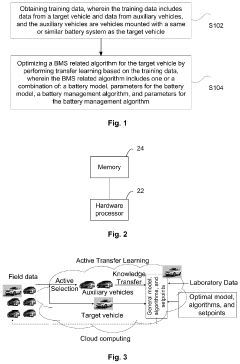
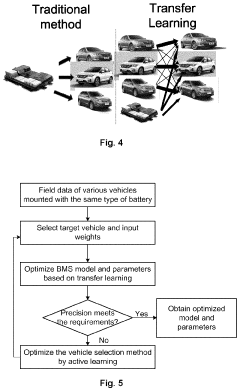
- The method employs transfer learning using training data from target and auxiliary vehicles with similar battery systems, optimizing algorithms through cloud computing and connected vehicle technology to adapt to individual driving and charging patterns, enabling the battery management system to learn from past usage and adapt to novel situations.
Method for balancing states of charge of a battery having a plurality of battery cells as well as a corresponding battery management system and a battery
PatentWO2011104044A1
Innovation
- A method that determines individual cell capacities and state of charge deviations, sets a target discharge depth based on the cell with the lowest capacity, and iteratively adjusts the state of charge to minimize deviations, allowing for simultaneous discharging or charging of cells to optimize balancing without additional hardware.


Safety Standards and Regulations for BMS Systems
Battery Management System safety standards and regulations form a comprehensive framework that governs the design, manufacturing, testing, and deployment of BMS technologies across various applications. These regulatory requirements have evolved significantly as battery technologies have advanced and their applications have expanded from consumer electronics to electric vehicles and grid-scale energy storage systems.
The International Electrotechnical Commission (IEC) provides foundational standards through IEC 62619 for lithium-ion batteries in industrial applications and IEC 62133 for portable sealed secondary cells. These standards establish fundamental safety requirements including protection against overcharge, over-discharge, short circuits, and thermal runaway conditions. The IEC 61508 functional safety standard also applies to BMS systems, requiring systematic approaches to achieve safety integrity levels appropriate for the application risk profile.
Automotive applications are governed by ISO 26262, which mandates functional safety requirements throughout the vehicle lifecycle. This standard requires BMS systems to implement redundant safety mechanisms, fail-safe operating modes, and comprehensive diagnostic capabilities. The automotive safety integrity level requirements typically demand ASIL-C or ASIL-D compliance for critical battery monitoring functions, necessitating sophisticated fault detection and mitigation strategies.
Regional regulatory frameworks add additional compliance layers. The European Union's Battery Regulation 2023/1542 establishes comprehensive requirements for battery lifecycle management, including mandatory BMS capabilities for monitoring state of health, cycle counting, and capacity fade tracking. The regulation also mandates digital battery passports for industrial and automotive batteries, requiring BMS systems to maintain detailed operational history data.
North American markets follow UL standards, particularly UL 2580 for electric vehicle battery systems and UL 1973 for stationary energy storage applications. These standards emphasize thermal management, electrical isolation, and emergency response procedures. The National Highway Traffic Safety Administration (NHTSA) provides additional automotive-specific requirements focusing on crash safety and emergency responder protocols.
Emerging regulations address cybersecurity concerns, with ISO/SAE 21434 establishing automotive cybersecurity engineering requirements. BMS systems must implement secure communication protocols, authentication mechanisms, and intrusion detection capabilities to prevent malicious attacks that could compromise battery safety or performance.
Compliance verification requires extensive testing protocols including environmental stress testing, electromagnetic compatibility validation, and accelerated aging studies. Certification bodies such as TÜV, Intertek, and Bureau Veritas provide third-party validation services to ensure regulatory compliance before market entry.
The International Electrotechnical Commission (IEC) provides foundational standards through IEC 62619 for lithium-ion batteries in industrial applications and IEC 62133 for portable sealed secondary cells. These standards establish fundamental safety requirements including protection against overcharge, over-discharge, short circuits, and thermal runaway conditions. The IEC 61508 functional safety standard also applies to BMS systems, requiring systematic approaches to achieve safety integrity levels appropriate for the application risk profile.
Automotive applications are governed by ISO 26262, which mandates functional safety requirements throughout the vehicle lifecycle. This standard requires BMS systems to implement redundant safety mechanisms, fail-safe operating modes, and comprehensive diagnostic capabilities. The automotive safety integrity level requirements typically demand ASIL-C or ASIL-D compliance for critical battery monitoring functions, necessitating sophisticated fault detection and mitigation strategies.
Regional regulatory frameworks add additional compliance layers. The European Union's Battery Regulation 2023/1542 establishes comprehensive requirements for battery lifecycle management, including mandatory BMS capabilities for monitoring state of health, cycle counting, and capacity fade tracking. The regulation also mandates digital battery passports for industrial and automotive batteries, requiring BMS systems to maintain detailed operational history data.
North American markets follow UL standards, particularly UL 2580 for electric vehicle battery systems and UL 1973 for stationary energy storage applications. These standards emphasize thermal management, electrical isolation, and emergency response procedures. The National Highway Traffic Safety Administration (NHTSA) provides additional automotive-specific requirements focusing on crash safety and emergency responder protocols.
Emerging regulations address cybersecurity concerns, with ISO/SAE 21434 establishing automotive cybersecurity engineering requirements. BMS systems must implement secure communication protocols, authentication mechanisms, and intrusion detection capabilities to prevent malicious attacks that could compromise battery safety or performance.
Compliance verification requires extensive testing protocols including environmental stress testing, electromagnetic compatibility validation, and accelerated aging studies. Certification bodies such as TÜV, Intertek, and Bureau Veritas provide third-party validation services to ensure regulatory compliance before market entry.
Environmental Impact and Sustainability in BMS Design
The environmental implications of Battery Management System design have become increasingly critical as global sustainability concerns intensify and regulatory frameworks tighten. Modern BMS architectures must balance operational efficiency with ecological responsibility, addressing the complete lifecycle impact from material sourcing through end-of-life disposal. The integration of sustainable design principles directly influences system efficiency optimization, creating synergies between environmental stewardship and performance enhancement.
Material selection represents a fundamental sustainability consideration in BMS design. Advanced systems increasingly utilize conflict-free minerals and recycled materials in circuit boards and housing components. The shift toward bio-based polymers for enclosures and connectors reduces petroleum dependency while maintaining thermal and electrical performance standards. These material choices impact system weight, thermal management requirements, and ultimately energy efficiency, demonstrating the interconnected nature of sustainability and optimization goals.
Energy harvesting capabilities within BMS designs contribute significantly to environmental sustainability. Integration of photovoltaic cells, thermoelectric generators, and kinetic energy recovery systems reduces dependency on primary power sources. These self-sustaining features minimize grid electricity consumption during standby operations and extend overall system autonomy. The implementation of ultra-low-power microcontrollers and adaptive sleep modes further reduces environmental footprint while maintaining critical monitoring functions.
Circular economy principles increasingly influence BMS architecture decisions. Modular designs facilitate component replacement and upgrade pathways, extending system lifespan and reducing electronic waste generation. Standardized interfaces enable cross-platform compatibility, promoting component reuse across different battery applications. Design for disassembly protocols ensure efficient material recovery at end-of-life, supporting closed-loop manufacturing processes and reducing raw material extraction demands.
Carbon footprint optimization throughout the BMS lifecycle requires comprehensive assessment of manufacturing processes, transportation logistics, and operational energy consumption. Advanced manufacturing techniques such as additive manufacturing reduce material waste and enable localized production, minimizing transportation-related emissions. The implementation of carbon-neutral manufacturing facilities and renewable energy integration in production processes further enhances environmental performance while potentially reducing long-term operational costs through improved efficiency metrics.
Material selection represents a fundamental sustainability consideration in BMS design. Advanced systems increasingly utilize conflict-free minerals and recycled materials in circuit boards and housing components. The shift toward bio-based polymers for enclosures and connectors reduces petroleum dependency while maintaining thermal and electrical performance standards. These material choices impact system weight, thermal management requirements, and ultimately energy efficiency, demonstrating the interconnected nature of sustainability and optimization goals.
Energy harvesting capabilities within BMS designs contribute significantly to environmental sustainability. Integration of photovoltaic cells, thermoelectric generators, and kinetic energy recovery systems reduces dependency on primary power sources. These self-sustaining features minimize grid electricity consumption during standby operations and extend overall system autonomy. The implementation of ultra-low-power microcontrollers and adaptive sleep modes further reduces environmental footprint while maintaining critical monitoring functions.
Circular economy principles increasingly influence BMS architecture decisions. Modular designs facilitate component replacement and upgrade pathways, extending system lifespan and reducing electronic waste generation. Standardized interfaces enable cross-platform compatibility, promoting component reuse across different battery applications. Design for disassembly protocols ensure efficient material recovery at end-of-life, supporting closed-loop manufacturing processes and reducing raw material extraction demands.
Carbon footprint optimization throughout the BMS lifecycle requires comprehensive assessment of manufacturing processes, transportation logistics, and operational energy consumption. Advanced manufacturing techniques such as additive manufacturing reduce material waste and enable localized production, minimizing transportation-related emissions. The implementation of carbon-neutral manufacturing facilities and renewable energy integration in production processes further enhances environmental performance while potentially reducing long-term operational costs through improved efficiency metrics.
Unlock deeper insights with PatSnap Eureka Quick Research — get a full tech report to explore trends and direct your research. Try now!
Generate Your Research Report Instantly with AI Agent
Supercharge your innovation with PatSnap Eureka AI Agent Platform!