

How to optimize blue ammonia export loading rate without vapor lock?
MAY 5, 20269 MIN READ
Generate Your Research Report Instantly with AI Agent
PatSnap Eureka helps you evaluate technical feasibility & market potential.
Blue Ammonia Export Technology Background and Objectives
Blue ammonia represents a critical advancement in the global transition toward low-carbon energy systems, emerging as a promising hydrogen carrier and clean fuel alternative. This carbon-neutral ammonia is produced through conventional synthesis processes using hydrogen derived from natural gas, with carbon dioxide emissions captured and permanently stored through carbon capture, utilization, and storage (CCUS) technologies. The blue ammonia pathway offers a pragmatic bridge between existing fossil fuel infrastructure and future green hydrogen economies.
The export of blue ammonia has gained significant momentum as countries seek to establish international hydrogen supply chains and meet ambitious decarbonization targets. Major energy-producing nations are positioning themselves as blue ammonia exporters, leveraging existing natural gas resources and developing CCUS capabilities to create new revenue streams while supporting global climate objectives. This emerging trade requires sophisticated handling and transportation infrastructure to ensure safe, efficient, and economically viable operations.
However, the export loading process faces substantial technical challenges, particularly the phenomenon of vapor lock, which significantly impacts loading rates and operational efficiency. Vapor lock occurs when liquid ammonia transitions to vapor phase due to pressure drops or temperature increases during transfer operations, creating gas pockets that impede liquid flow and reduce loading throughput. This issue becomes more pronounced in high-temperature environments and during rapid loading operations, leading to extended loading times, increased operational costs, and potential safety concerns.
The optimization of blue ammonia export loading rates without vapor lock has become a critical technical objective for the industry. Current loading operations often experience throughput limitations of 20-40% below theoretical capacity due to vapor lock incidents, directly impacting project economics and supply chain reliability. Addressing this challenge requires comprehensive understanding of thermodynamic properties, advanced process control systems, and innovative equipment design approaches.
The primary technical objectives focus on developing robust loading methodologies that maintain liquid phase stability throughout the transfer process. This includes optimizing pressure management systems, implementing advanced temperature control strategies, and designing specialized loading equipment that minimizes cavitation risks. Additionally, the integration of real-time monitoring systems and predictive control algorithms aims to prevent vapor lock conditions before they occur, ensuring consistent high-throughput operations while maintaining safety standards and product quality specifications for international blue ammonia trade.
The export of blue ammonia has gained significant momentum as countries seek to establish international hydrogen supply chains and meet ambitious decarbonization targets. Major energy-producing nations are positioning themselves as blue ammonia exporters, leveraging existing natural gas resources and developing CCUS capabilities to create new revenue streams while supporting global climate objectives. This emerging trade requires sophisticated handling and transportation infrastructure to ensure safe, efficient, and economically viable operations.
However, the export loading process faces substantial technical challenges, particularly the phenomenon of vapor lock, which significantly impacts loading rates and operational efficiency. Vapor lock occurs when liquid ammonia transitions to vapor phase due to pressure drops or temperature increases during transfer operations, creating gas pockets that impede liquid flow and reduce loading throughput. This issue becomes more pronounced in high-temperature environments and during rapid loading operations, leading to extended loading times, increased operational costs, and potential safety concerns.
The optimization of blue ammonia export loading rates without vapor lock has become a critical technical objective for the industry. Current loading operations often experience throughput limitations of 20-40% below theoretical capacity due to vapor lock incidents, directly impacting project economics and supply chain reliability. Addressing this challenge requires comprehensive understanding of thermodynamic properties, advanced process control systems, and innovative equipment design approaches.
The primary technical objectives focus on developing robust loading methodologies that maintain liquid phase stability throughout the transfer process. This includes optimizing pressure management systems, implementing advanced temperature control strategies, and designing specialized loading equipment that minimizes cavitation risks. Additionally, the integration of real-time monitoring systems and predictive control algorithms aims to prevent vapor lock conditions before they occur, ensuring consistent high-throughput operations while maintaining safety standards and product quality specifications for international blue ammonia trade.
Market Demand for Blue Ammonia Export Infrastructure
The global blue ammonia market is experiencing unprecedented growth driven by the urgent need for decarbonization across multiple industrial sectors. Blue ammonia, produced through steam methane reforming with carbon capture and storage, represents a critical transitional solution for achieving net-zero emissions targets while maintaining industrial competitiveness. The demand surge is particularly pronounced in regions with stringent environmental regulations and carbon pricing mechanisms.
Maritime transportation emerges as the primary driver for blue ammonia export infrastructure development. The International Maritime Organization's commitment to reducing greenhouse gas emissions by fifty percent by 2050 has catalyzed shipping companies to explore ammonia as a marine fuel alternative. This transition requires substantial investment in specialized loading terminals capable of handling large volumes efficiently while maintaining safety standards.
Power generation sectors across Asia-Pacific regions demonstrate significant appetite for blue ammonia imports. Japan's strategic energy policy explicitly targets ammonia co-firing in coal power plants, with plans to achieve twenty percent co-firing ratios by 2030. South Korea follows similar trajectories, establishing long-term procurement agreements that necessitate reliable export infrastructure capable of meeting consistent supply schedules.
Industrial applications, particularly in steel production and chemical manufacturing, create additional demand pressures for optimized loading systems. The steel industry's exploration of ammonia-based hydrogen production for direct reduced iron processes requires predictable supply chains with minimal operational disruptions. Vapor lock incidents during loading operations directly impact supply reliability and increase operational costs.
Export terminal operators face mounting pressure to enhance throughput capabilities while reducing loading times. Current infrastructure limitations create bottlenecks that constrain market growth potential. The economic viability of blue ammonia projects depends heavily on achieving economies of scale through high-volume, efficient loading operations.
Regional competition intensifies as multiple countries develop blue ammonia production capabilities. Australia, the Middle East, and North America compete for market share in Asian import markets. Loading rate optimization becomes a competitive differentiator, enabling producers to offer more attractive pricing through reduced logistics costs and improved supply chain reliability.
The financial implications of loading inefficiencies extend beyond immediate operational costs. Vapor lock incidents result in vessel demurrage charges, schedule disruptions, and potential safety hazards that increase insurance premiums. Market participants increasingly prioritize terminal facilities demonstrating consistent, high-rate loading capabilities without operational interruptions.
Maritime transportation emerges as the primary driver for blue ammonia export infrastructure development. The International Maritime Organization's commitment to reducing greenhouse gas emissions by fifty percent by 2050 has catalyzed shipping companies to explore ammonia as a marine fuel alternative. This transition requires substantial investment in specialized loading terminals capable of handling large volumes efficiently while maintaining safety standards.
Power generation sectors across Asia-Pacific regions demonstrate significant appetite for blue ammonia imports. Japan's strategic energy policy explicitly targets ammonia co-firing in coal power plants, with plans to achieve twenty percent co-firing ratios by 2030. South Korea follows similar trajectories, establishing long-term procurement agreements that necessitate reliable export infrastructure capable of meeting consistent supply schedules.
Industrial applications, particularly in steel production and chemical manufacturing, create additional demand pressures for optimized loading systems. The steel industry's exploration of ammonia-based hydrogen production for direct reduced iron processes requires predictable supply chains with minimal operational disruptions. Vapor lock incidents during loading operations directly impact supply reliability and increase operational costs.
Export terminal operators face mounting pressure to enhance throughput capabilities while reducing loading times. Current infrastructure limitations create bottlenecks that constrain market growth potential. The economic viability of blue ammonia projects depends heavily on achieving economies of scale through high-volume, efficient loading operations.
Regional competition intensifies as multiple countries develop blue ammonia production capabilities. Australia, the Middle East, and North America compete for market share in Asian import markets. Loading rate optimization becomes a competitive differentiator, enabling producers to offer more attractive pricing through reduced logistics costs and improved supply chain reliability.
The financial implications of loading inefficiencies extend beyond immediate operational costs. Vapor lock incidents result in vessel demurrage charges, schedule disruptions, and potential safety hazards that increase insurance premiums. Market participants increasingly prioritize terminal facilities demonstrating consistent, high-rate loading capabilities without operational interruptions.
Current Vapor Lock Challenges in Ammonia Loading Systems
Vapor lock represents one of the most critical operational challenges in ammonia loading systems, particularly affecting blue ammonia export terminals where high throughput rates are essential for commercial viability. This phenomenon occurs when liquid ammonia transitions to vapor phase within the loading lines, creating gas pockets that obstruct continuous liquid flow and significantly reduce loading efficiency.
The primary mechanism behind vapor lock in ammonia systems stems from pressure drops along the loading pipeline combined with temperature fluctuations during transfer operations. As ammonia flows through loading arms, pumps, and associated piping, frictional losses and elevation changes create localized pressure reductions. When these pressure drops coincide with ambient temperature increases or inadequate subcooling, the ammonia reaches its saturation point and begins vaporizing within the liquid stream.
Current loading systems face particular challenges during high-rate transfer operations, where increased flow velocities exacerbate pressure losses through Venturi effects and turbulent flow conditions. The situation becomes more complex in marine loading applications, where ship movement, varying cargo tank pressures, and environmental conditions create dynamic operating parameters that traditional vapor lock prevention methods struggle to address effectively.
Temperature management presents another significant challenge, as ammonia's relatively high vapor pressure makes it susceptible to flash vaporization even under modest temperature increases. Existing cooling systems often prove inadequate during peak loading periods, particularly in warmer climates where blue ammonia export facilities are frequently located. The thermal mass of large-scale loading systems creates thermal lag effects that complicate real-time temperature control strategies.
Pressure control systems in current installations typically rely on static pressure settings that fail to adapt to varying flow conditions and cargo tank configurations. This approach results in either excessive back-pressure that limits loading rates or insufficient pressure margins that allow vapor formation during peak flow periods. The lack of dynamic pressure optimization represents a fundamental limitation in existing vapor lock prevention strategies.
Detection and mitigation of vapor lock events in real-time remains problematic with conventional monitoring systems. Traditional flow meters and pressure sensors often cannot distinguish between vapor lock conditions and other flow anomalies, leading to delayed responses and extended system recovery times. This limitation directly impacts loading efficiency and creates operational uncertainties that affect export scheduling and commercial performance.
The primary mechanism behind vapor lock in ammonia systems stems from pressure drops along the loading pipeline combined with temperature fluctuations during transfer operations. As ammonia flows through loading arms, pumps, and associated piping, frictional losses and elevation changes create localized pressure reductions. When these pressure drops coincide with ambient temperature increases or inadequate subcooling, the ammonia reaches its saturation point and begins vaporizing within the liquid stream.
Current loading systems face particular challenges during high-rate transfer operations, where increased flow velocities exacerbate pressure losses through Venturi effects and turbulent flow conditions. The situation becomes more complex in marine loading applications, where ship movement, varying cargo tank pressures, and environmental conditions create dynamic operating parameters that traditional vapor lock prevention methods struggle to address effectively.
Temperature management presents another significant challenge, as ammonia's relatively high vapor pressure makes it susceptible to flash vaporization even under modest temperature increases. Existing cooling systems often prove inadequate during peak loading periods, particularly in warmer climates where blue ammonia export facilities are frequently located. The thermal mass of large-scale loading systems creates thermal lag effects that complicate real-time temperature control strategies.
Pressure control systems in current installations typically rely on static pressure settings that fail to adapt to varying flow conditions and cargo tank configurations. This approach results in either excessive back-pressure that limits loading rates or insufficient pressure margins that allow vapor formation during peak flow periods. The lack of dynamic pressure optimization represents a fundamental limitation in existing vapor lock prevention strategies.
Detection and mitigation of vapor lock events in real-time remains problematic with conventional monitoring systems. Traditional flow meters and pressure sensors often cannot distinguish between vapor lock conditions and other flow anomalies, leading to delayed responses and extended system recovery times. This limitation directly impacts loading efficiency and creates operational uncertainties that affect export scheduling and commercial performance.
Existing Solutions for Vapor Lock Prevention in Loading
01 Ammonia loading optimization in catalytic systems
Methods and systems for optimizing ammonia loading rates in catalytic processes, particularly focusing on selective catalytic reduction systems. These approaches involve controlling the injection rate and distribution of ammonia to maximize efficiency while minimizing slip and ensuring optimal catalyst performance.- Ammonia loading optimization in catalytic systems: Methods and systems for optimizing ammonia loading rates in catalytic processes, including selective catalytic reduction systems and ammonia synthesis reactors. These approaches focus on controlling feed rates, temperature conditions, and pressure parameters to maximize efficiency while maintaining stable operation. The optimization involves monitoring ammonia concentration levels and adjusting loading parameters based on real-time process conditions.
- Blue ammonia production and storage systems: Technologies for producing and storing blue ammonia with controlled loading rates in industrial facilities. These systems incorporate carbon capture and storage mechanisms while managing ammonia flow rates and storage capacity. The processes involve specialized equipment design for handling high-pressure ammonia streams and maintaining optimal loading conditions throughout the production cycle.
- Ammonia injection rate control mechanisms: Control systems and devices for regulating ammonia injection rates in various industrial applications. These mechanisms include automated dosing systems, flow control valves, and monitoring equipment that ensure precise ammonia delivery rates. The technology focuses on maintaining consistent loading rates while preventing over-injection or under-injection scenarios that could affect process efficiency.
- Reactor design for ammonia loading applications: Specialized reactor configurations and designs optimized for ammonia loading processes in blue ammonia production. These designs incorporate features such as enhanced mixing capabilities, temperature control systems, and pressure management components. The reactor systems are engineered to handle varying ammonia loading rates while maintaining optimal reaction conditions and product quality.
- Monitoring and measurement systems for ammonia loading: Advanced monitoring and measurement technologies for tracking ammonia loading rates in real-time. These systems utilize sensors, analytical instruments, and data processing capabilities to provide accurate measurements of ammonia concentration and flow rates. The monitoring solutions enable operators to maintain optimal loading conditions and detect any deviations from target parameters.
02 Blue ammonia production and storage systems
Technologies related to the production, handling, and storage of blue ammonia with specific focus on loading rate control mechanisms. These systems incorporate advanced monitoring and control features to maintain optimal loading conditions during production and transfer operations.Expand Specific Solutions03 Ammonia injection rate control devices
Specialized equipment and devices designed to control and regulate ammonia injection rates in various industrial applications. These devices feature precise metering capabilities and automated control systems to ensure consistent and accurate ammonia delivery rates.Expand Specific Solutions04 Process monitoring and measurement systems for ammonia loading
Advanced monitoring and measurement technologies for tracking ammonia loading rates in real-time. These systems provide continuous feedback and data collection capabilities to optimize loading operations and ensure compliance with operational parameters.Expand Specific Solutions05 Ammonia loading rate calculation and modeling methods
Computational methods and mathematical models for determining optimal ammonia loading rates based on various operational parameters. These approaches utilize algorithms and predictive modeling to calculate appropriate loading rates for different process conditions and requirements.Expand Specific Solutions
Key Players in Ammonia Export and Loading Equipment Industry
The blue ammonia export loading optimization market represents an emerging sector within the broader ammonia value chain, currently in its early development stage as the industry transitions toward low-carbon solutions. The market size remains relatively small but is experiencing rapid growth driven by global decarbonization initiatives and increasing demand for clean fuel alternatives. Technology maturity varies significantly across key players, with established industrial gas companies like Air Liquide SA and Air Products & Chemicals leading in ammonia handling technologies, while energy giants Saudi Arabian Oil Co. and Aramco Services Co. drive large-scale production capabilities. Catalyst and process technology specialists such as Topsoe A/S and UOP LLC contribute advanced solutions for vapor lock prevention, while automotive suppliers like Robert Bosch GmbH and Continental Automotive GmbH adapt their fluid handling expertise to ammonia applications, creating a diverse competitive landscape with varying technological readiness levels.
Topsoe A/S
Technical Solution: Topsoe has developed proprietary ammonia synthesis catalyst technology and process optimization solutions for blue ammonia production. Their technical approach focuses on advanced reactor designs with integrated heat management systems and specialized loading equipment that minimizes vapor formation during transfer operations. The company's solution includes innovative pump designs with cavitation-resistant features, temperature-controlled loading arms, and pressure optimization systems that maintain liquid phase stability during high-rate loading operations, effectively preventing vapor lock while maximizing throughput efficiency.
Strengths: Leading catalyst technology and proven process engineering expertise in ammonia production. Weaknesses: Limited direct experience in large-scale export terminal operations compared to oil majors.
Saudi Arabian Oil Co.
Technical Solution: Saudi Aramco has developed advanced blue ammonia production and export technologies, focusing on large-scale ammonia synthesis with integrated carbon capture and storage (CCS) systems. Their approach includes optimized loading terminal designs with enhanced vapor management systems, utilizing specialized pumping technologies and temperature control mechanisms to prevent vapor lock during export operations. The company has implemented multi-stage cooling systems and pressure regulation techniques specifically designed for blue ammonia handling, ensuring efficient loading rates while maintaining product quality and safety standards throughout the export process.
Strengths: Extensive experience in large-scale petrochemical operations and established global export infrastructure. Weaknesses: High capital investment requirements and dependency on CCS technology maturity.
Core Innovations in Vapor-Free Ammonia Loading Systems
Method for production of blue ammonia
PatentWO2024153795A1
Innovation
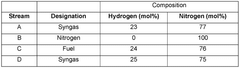
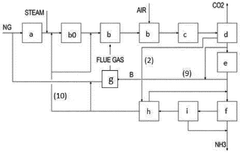
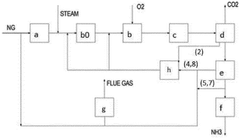
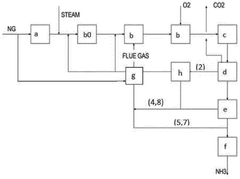
- A method involving a mixing device that separates syngas stream A and nitrogen stream B into fuel stream C and ammonia syngas stream D, with different compositions and functions, allowing for >99% CO2 recovery and nitrogen savings, while reducing adiabatic flame temperature and NOx emissions by using carbon-depleted gases as fuel.
Fuel system that prevents vapor lock in powertrains converted to run on a volatile alternative fuel
PatentWO2025075837A1
Innovation
- Modifying the high pressure fuel pump to include a fuel return pathway, which allows for a greater amount of fuel to pass through the pump than is being pumped, and configuring the low pressure outlet to ensure fuel flows from one side of the low pressure chamber to the other, facilitating rapid purge and cooling.


Safety Regulations for Ammonia Export Terminal Operations
Safety regulations for ammonia export terminal operations represent a critical framework governing the handling, storage, and transfer of ammonia in maritime export facilities. These regulations are established by multiple international and national authorities, including the International Maritime Organization (IMO), the International Gas Carrier Code (IGC Code), and various national maritime safety agencies. The regulatory landscape encompasses comprehensive requirements for equipment design, operational procedures, personnel training, and emergency response protocols specifically tailored to ammonia's unique properties as a hazardous cargo.
The IMO's International Code for the Construction and Equipment of Ships Carrying Dangerous Chemicals in Bulk (IBC Code) provides fundamental guidelines for ammonia handling systems. These regulations mandate specific material requirements for piping systems, loading arms, and storage tanks to prevent corrosion and ensure structural integrity under varying temperature and pressure conditions. Additionally, the regulations specify minimum safety distances, ventilation requirements, and gas detection systems that must be implemented throughout the terminal facility.
Personnel certification and training requirements form another cornerstone of ammonia export terminal safety regulations. Operators must obtain specialized certifications for handling anhydrous ammonia, including comprehensive training on vapor lock prevention, emergency shutdown procedures, and personal protective equipment usage. The regulations mandate regular refresher training and competency assessments to ensure operational staff maintain current knowledge of safety protocols and technological updates.
Emergency response protocols are extensively detailed within the regulatory framework, requiring terminals to maintain comprehensive emergency action plans, specialized firefighting equipment, and coordination procedures with local emergency services. These regulations also mandate regular safety drills and equipment testing schedules to ensure readiness for potential incidents.
Compliance monitoring and reporting requirements establish mandatory documentation procedures, regular safety audits, and incident reporting protocols. Terminal operators must maintain detailed records of all loading operations, equipment maintenance, and safety system performance to demonstrate ongoing regulatory compliance and support continuous safety improvement initiatives.
The IMO's International Code for the Construction and Equipment of Ships Carrying Dangerous Chemicals in Bulk (IBC Code) provides fundamental guidelines for ammonia handling systems. These regulations mandate specific material requirements for piping systems, loading arms, and storage tanks to prevent corrosion and ensure structural integrity under varying temperature and pressure conditions. Additionally, the regulations specify minimum safety distances, ventilation requirements, and gas detection systems that must be implemented throughout the terminal facility.
Personnel certification and training requirements form another cornerstone of ammonia export terminal safety regulations. Operators must obtain specialized certifications for handling anhydrous ammonia, including comprehensive training on vapor lock prevention, emergency shutdown procedures, and personal protective equipment usage. The regulations mandate regular refresher training and competency assessments to ensure operational staff maintain current knowledge of safety protocols and technological updates.
Emergency response protocols are extensively detailed within the regulatory framework, requiring terminals to maintain comprehensive emergency action plans, specialized firefighting equipment, and coordination procedures with local emergency services. These regulations also mandate regular safety drills and equipment testing schedules to ensure readiness for potential incidents.
Compliance monitoring and reporting requirements establish mandatory documentation procedures, regular safety audits, and incident reporting protocols. Terminal operators must maintain detailed records of all loading operations, equipment maintenance, and safety system performance to demonstrate ongoing regulatory compliance and support continuous safety improvement initiatives.
Environmental Impact Assessment of Blue Ammonia Export
The environmental implications of blue ammonia export operations extend beyond traditional industrial assessments, particularly when addressing vapor lock prevention and loading rate optimization. Blue ammonia, produced through steam methane reforming with carbon capture and storage, presents unique environmental considerations during maritime transport that differ significantly from conventional ammonia handling protocols.
Atmospheric emissions constitute the primary environmental concern during blue ammonia loading operations. Vapor lock prevention systems typically require continuous venting and pressure management, potentially releasing ammonia vapors into the atmosphere. These emissions contribute to nitrogen deposition in marine ecosystems and can form secondary particulate matter, affecting regional air quality. The optimization of loading rates must therefore balance operational efficiency with emission minimization strategies.
Marine ecosystem impacts represent another critical dimension of environmental assessment. Accidental releases during high-rate loading operations can cause severe localized environmental damage, as ammonia exhibits high toxicity to aquatic organisms. The implementation of vapor recovery systems and enhanced containment protocols becomes essential when pursuing accelerated loading schedules, requiring comprehensive risk assessment frameworks.
Energy consumption patterns during optimized loading operations significantly influence the overall carbon footprint of blue ammonia exports. Advanced vapor lock prevention technologies, including active cooling systems and pressure cycling equipment, demand substantial electrical power input. The environmental benefit of blue ammonia's reduced carbon intensity can be partially offset by increased energy requirements during export operations, necessitating careful lifecycle analysis.
Regulatory compliance frameworks increasingly emphasize real-time environmental monitoring during ammonia handling operations. International Maritime Organization guidelines and regional environmental standards require continuous assessment of air quality parameters, noise levels, and potential ecosystem impacts. Optimization strategies must integrate these monitoring requirements while maintaining operational efficiency targets.
The cumulative environmental impact assessment must also consider the broader implications of increased export volumes enabled by optimized loading rates. Higher throughput capabilities may encourage expanded blue ammonia production, potentially affecting regional industrial emissions profiles and infrastructure development patterns. Long-term environmental planning requires evaluation of these secondary effects alongside direct operational impacts.
Atmospheric emissions constitute the primary environmental concern during blue ammonia loading operations. Vapor lock prevention systems typically require continuous venting and pressure management, potentially releasing ammonia vapors into the atmosphere. These emissions contribute to nitrogen deposition in marine ecosystems and can form secondary particulate matter, affecting regional air quality. The optimization of loading rates must therefore balance operational efficiency with emission minimization strategies.
Marine ecosystem impacts represent another critical dimension of environmental assessment. Accidental releases during high-rate loading operations can cause severe localized environmental damage, as ammonia exhibits high toxicity to aquatic organisms. The implementation of vapor recovery systems and enhanced containment protocols becomes essential when pursuing accelerated loading schedules, requiring comprehensive risk assessment frameworks.
Energy consumption patterns during optimized loading operations significantly influence the overall carbon footprint of blue ammonia exports. Advanced vapor lock prevention technologies, including active cooling systems and pressure cycling equipment, demand substantial electrical power input. The environmental benefit of blue ammonia's reduced carbon intensity can be partially offset by increased energy requirements during export operations, necessitating careful lifecycle analysis.
Regulatory compliance frameworks increasingly emphasize real-time environmental monitoring during ammonia handling operations. International Maritime Organization guidelines and regional environmental standards require continuous assessment of air quality parameters, noise levels, and potential ecosystem impacts. Optimization strategies must integrate these monitoring requirements while maintaining operational efficiency targets.
The cumulative environmental impact assessment must also consider the broader implications of increased export volumes enabled by optimized loading rates. Higher throughput capabilities may encourage expanded blue ammonia production, potentially affecting regional industrial emissions profiles and infrastructure development patterns. Long-term environmental planning requires evaluation of these secondary effects alongside direct operational impacts.
Unlock deeper insights with PatSnap Eureka Quick Research — get a full tech report to explore trends and direct your research. Try now!
Generate Your Research Report Instantly with AI Agent
Supercharge your innovation with PatSnap Eureka AI Agent Platform!