How to Optimize Inert Gas Chromatography Techniques
FEB 12, 20269 MIN READ
Generate Your Research Report Instantly with AI Agent
Patsnap Eureka helps you evaluate technical feasibility & market potential.
Inert Gas Chromatography Background and Optimization Goals
Inert gas chromatography has evolved as a critical analytical technique since its inception in the mid-20th century, fundamentally transforming the landscape of gas analysis in industrial, environmental, and research applications. The technique emerged from the need to separate and quantify permanent gases and light hydrocarbons that are challenging to analyze using conventional chromatographic methods. Early developments focused on utilizing thermal conductivity detectors with carrier gases such as helium and argon, establishing the foundation for modern inert gas analysis systems.
The evolution of this technology has been marked by continuous improvements in column technology, detector sensitivity, and separation efficiency. Traditional packed columns gradually gave way to capillary columns and molecular sieve materials, enabling enhanced resolution of complex gas mixtures. The integration of advanced detector technologies, including pulsed discharge detectors and barrier ionization detectors, has significantly expanded the analytical capabilities and detection limits of inert gas chromatography systems.
Current optimization efforts are driven by multiple converging demands from diverse industrial sectors. The semiconductor manufacturing industry requires ultra-trace analysis of impurities in process gases, demanding detection limits in the parts-per-billion range. Environmental monitoring applications necessitate rapid, accurate quantification of atmospheric gases for climate research and pollution control. Energy sector applications, particularly in natural gas processing and hydrogen production, require robust systems capable of handling complex matrices while maintaining analytical precision.
The primary technical goals for optimizing inert gas chromatography techniques encompass several critical dimensions. First, achieving superior separation efficiency while reducing analysis time remains paramount, as traditional methods often require extended run times that limit throughput. Second, enhancing detector sensitivity and selectivity to enable trace-level detection without compromising accuracy is essential for meeting stringent quality control requirements. Third, improving system robustness and reproducibility under varying operational conditions ensures reliable performance across different application environments.
Additionally, optimization objectives include minimizing carrier gas consumption to reduce operational costs and environmental impact, developing methods compatible with emerging applications such as hydrogen economy infrastructure, and integrating automation capabilities for high-throughput screening. These goals collectively aim to establish next-generation inert gas chromatography platforms that deliver exceptional analytical performance while addressing practical constraints of modern industrial and research environments.
The evolution of this technology has been marked by continuous improvements in column technology, detector sensitivity, and separation efficiency. Traditional packed columns gradually gave way to capillary columns and molecular sieve materials, enabling enhanced resolution of complex gas mixtures. The integration of advanced detector technologies, including pulsed discharge detectors and barrier ionization detectors, has significantly expanded the analytical capabilities and detection limits of inert gas chromatography systems.
Current optimization efforts are driven by multiple converging demands from diverse industrial sectors. The semiconductor manufacturing industry requires ultra-trace analysis of impurities in process gases, demanding detection limits in the parts-per-billion range. Environmental monitoring applications necessitate rapid, accurate quantification of atmospheric gases for climate research and pollution control. Energy sector applications, particularly in natural gas processing and hydrogen production, require robust systems capable of handling complex matrices while maintaining analytical precision.
The primary technical goals for optimizing inert gas chromatography techniques encompass several critical dimensions. First, achieving superior separation efficiency while reducing analysis time remains paramount, as traditional methods often require extended run times that limit throughput. Second, enhancing detector sensitivity and selectivity to enable trace-level detection without compromising accuracy is essential for meeting stringent quality control requirements. Third, improving system robustness and reproducibility under varying operational conditions ensures reliable performance across different application environments.
Additionally, optimization objectives include minimizing carrier gas consumption to reduce operational costs and environmental impact, developing methods compatible with emerging applications such as hydrogen economy infrastructure, and integrating automation capabilities for high-throughput screening. These goals collectively aim to establish next-generation inert gas chromatography platforms that deliver exceptional analytical performance while addressing practical constraints of modern industrial and research environments.
Market Demand for Advanced Gas Chromatography Solutions
The global gas chromatography market is experiencing robust expansion driven by stringent regulatory requirements across pharmaceutical, environmental, and food safety sectors. Laboratories worldwide are increasingly seeking advanced chromatography solutions that deliver superior sensitivity, reproducibility, and operational efficiency. The optimization of inert gas chromatography techniques directly addresses critical pain points in trace-level analysis where sample integrity and detection accuracy are paramount.
Pharmaceutical and biotechnology industries represent major demand drivers, requiring ultra-clean analytical pathways for drug development and quality control applications. These sectors face mounting pressure to detect impurities at parts-per-billion levels while maintaining compliance with evolving pharmacopeial standards. Traditional gas chromatography systems often suffer from active surface interactions that compromise analytical results, creating substantial market opportunities for optimized inert pathway technologies.
Environmental monitoring agencies and contract testing laboratories constitute another significant demand segment. The analysis of volatile organic compounds, pesticide residues, and persistent organic pollutants necessitates chromatographic systems with minimal adsorption and degradation characteristics. Regulatory frameworks governing air quality, water contamination, and soil analysis continue to tighten detection limits, compelling laboratories to upgrade existing infrastructure with enhanced inert gas chromatography capabilities.
The petrochemical and energy sectors demonstrate growing interest in advanced chromatography solutions for complex hydrocarbon analysis and trace sulfur compound detection. Fuel quality specifications and refinery process optimization require analytical systems capable of handling reactive compounds without sample loss or peak distortion. This industrial demand segment values long-term system stability and reduced maintenance requirements alongside analytical performance improvements.
Emerging applications in metabolomics research, cannabis testing, and semiconductor manufacturing are expanding the addressable market for optimized gas chromatography techniques. These specialized fields demand exceptional inertness to preserve labile compounds and achieve reliable quantification of thermally sensitive analytes. Market growth projections indicate sustained investment in next-generation chromatography platforms that integrate inert flow path technologies with automation capabilities and data integrity features.
Pharmaceutical and biotechnology industries represent major demand drivers, requiring ultra-clean analytical pathways for drug development and quality control applications. These sectors face mounting pressure to detect impurities at parts-per-billion levels while maintaining compliance with evolving pharmacopeial standards. Traditional gas chromatography systems often suffer from active surface interactions that compromise analytical results, creating substantial market opportunities for optimized inert pathway technologies.
Environmental monitoring agencies and contract testing laboratories constitute another significant demand segment. The analysis of volatile organic compounds, pesticide residues, and persistent organic pollutants necessitates chromatographic systems with minimal adsorption and degradation characteristics. Regulatory frameworks governing air quality, water contamination, and soil analysis continue to tighten detection limits, compelling laboratories to upgrade existing infrastructure with enhanced inert gas chromatography capabilities.
The petrochemical and energy sectors demonstrate growing interest in advanced chromatography solutions for complex hydrocarbon analysis and trace sulfur compound detection. Fuel quality specifications and refinery process optimization require analytical systems capable of handling reactive compounds without sample loss or peak distortion. This industrial demand segment values long-term system stability and reduced maintenance requirements alongside analytical performance improvements.
Emerging applications in metabolomics research, cannabis testing, and semiconductor manufacturing are expanding the addressable market for optimized gas chromatography techniques. These specialized fields demand exceptional inertness to preserve labile compounds and achieve reliable quantification of thermally sensitive analytes. Market growth projections indicate sustained investment in next-generation chromatography platforms that integrate inert flow path technologies with automation capabilities and data integrity features.
Current Status and Challenges in Inert Gas Chromatography
Inert gas chromatography has established itself as a critical analytical technique for separating and detecting noble gases and other chemically inert compounds across various scientific and industrial applications. The technology has matured significantly over recent decades, with applications spanning environmental monitoring, semiconductor manufacturing, nuclear industry analysis, and geological research. Current implementations predominantly utilize thermal conductivity detectors and specialized column configurations designed to handle the unique properties of inert gases, including helium, neon, argon, krypton, and xenon.
Despite substantial progress, several technical challenges continue to constrain the optimization potential of inert gas chromatography. Sensitivity limitations remain a primary concern, particularly when detecting trace-level concentrations of heavier noble gases in complex matrices. The inherently low reactivity of inert gases necessitates detection methods that can distinguish minute concentration differences without chemical derivatization options available for other analytes. Additionally, achieving adequate separation resolution between gases with similar physical properties requires precise control of column temperature, carrier gas flow rates, and pressure conditions.
Column technology represents another significant challenge area. Traditional packed columns offer limited efficiency, while capillary columns, though providing improved resolution, face difficulties with sample capacity and durability under the extreme conditions sometimes required for inert gas analysis. The development of specialized stationary phases that can effectively retain and separate inert gases without excessive analysis times remains an ongoing technical hurdle.
Sample introduction and preparation present additional complications. Maintaining sample integrity during collection and injection is critical, as contamination from atmospheric gases can severely compromise analytical accuracy. Cryogenic trapping techniques, while effective, add complexity and operational costs to analytical workflows. Furthermore, the lack of standardized methodologies across different application domains has resulted in fragmented technical approaches, limiting cross-industry knowledge transfer and best practice development.
Geographically, advanced inert gas chromatography capabilities are concentrated in regions with strong nuclear, semiconductor, or environmental research infrastructure, primarily in North America, Europe, and East Asia. This distribution reflects both the specialized nature of the technology and the significant capital investment required for high-performance systems, creating accessibility barriers for emerging research communities and smaller analytical laboratories.
Despite substantial progress, several technical challenges continue to constrain the optimization potential of inert gas chromatography. Sensitivity limitations remain a primary concern, particularly when detecting trace-level concentrations of heavier noble gases in complex matrices. The inherently low reactivity of inert gases necessitates detection methods that can distinguish minute concentration differences without chemical derivatization options available for other analytes. Additionally, achieving adequate separation resolution between gases with similar physical properties requires precise control of column temperature, carrier gas flow rates, and pressure conditions.
Column technology represents another significant challenge area. Traditional packed columns offer limited efficiency, while capillary columns, though providing improved resolution, face difficulties with sample capacity and durability under the extreme conditions sometimes required for inert gas analysis. The development of specialized stationary phases that can effectively retain and separate inert gases without excessive analysis times remains an ongoing technical hurdle.
Sample introduction and preparation present additional complications. Maintaining sample integrity during collection and injection is critical, as contamination from atmospheric gases can severely compromise analytical accuracy. Cryogenic trapping techniques, while effective, add complexity and operational costs to analytical workflows. Furthermore, the lack of standardized methodologies across different application domains has resulted in fragmented technical approaches, limiting cross-industry knowledge transfer and best practice development.
Geographically, advanced inert gas chromatography capabilities are concentrated in regions with strong nuclear, semiconductor, or environmental research infrastructure, primarily in North America, Europe, and East Asia. This distribution reflects both the specialized nature of the technology and the significant capital investment required for high-performance systems, creating accessibility barriers for emerging research communities and smaller analytical laboratories.
Current Optimization Approaches for Inert Gas Chromatography
01 Inert gas as carrier gas in gas chromatography systems
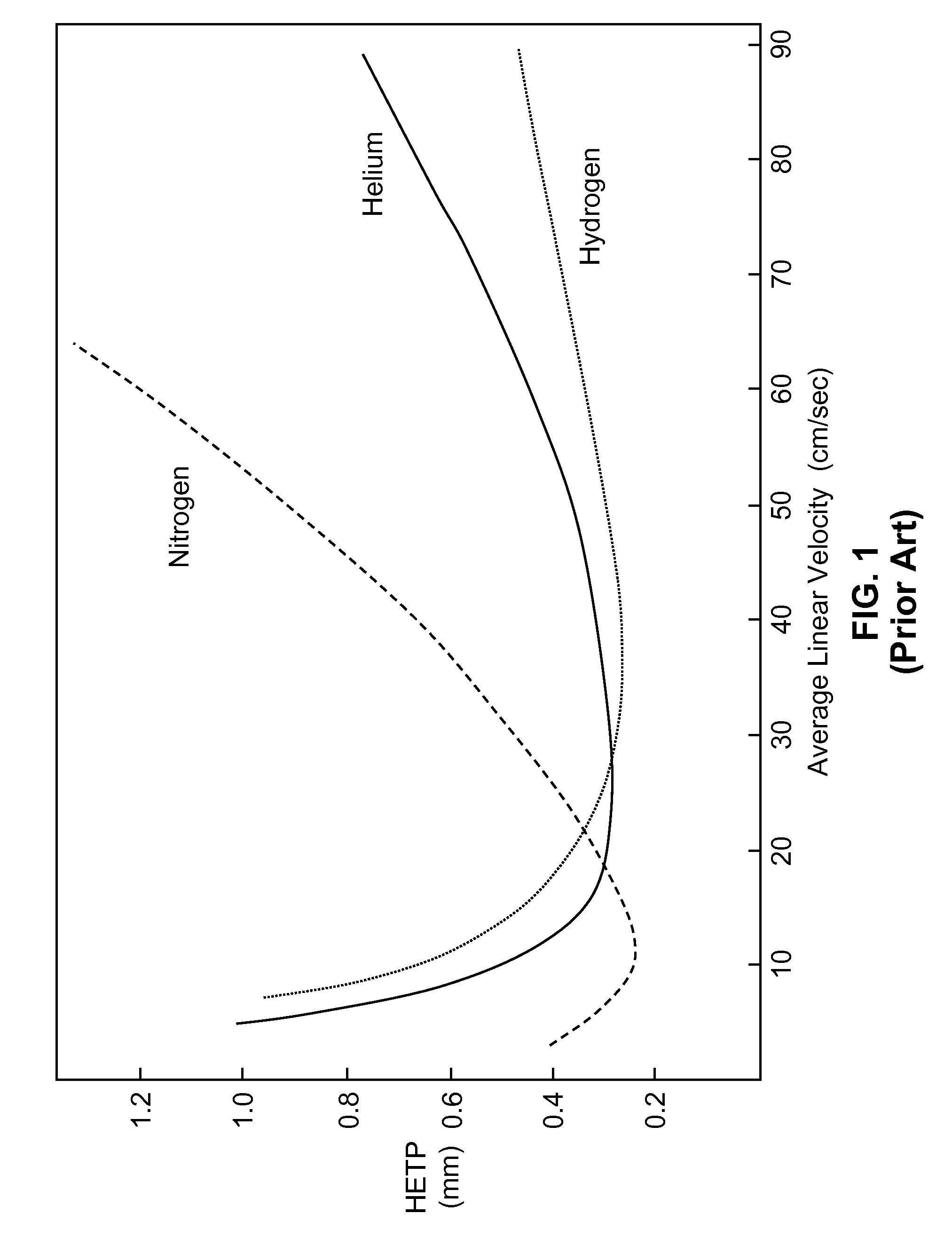
Inert gases such as helium, nitrogen, or argon are commonly used as carrier gases in gas chromatography systems. These gases transport sample components through the chromatographic column without reacting with the analytes or stationary phase. The choice of inert carrier gas affects separation efficiency, analysis time, and detector compatibility. The use of inert gases ensures stable baseline signals and prevents unwanted chemical reactions during analysis.- Inert gas as carrier gas in gas chromatography systems: Inert gases such as helium, nitrogen, or argon are commonly used as carrier gases in gas chromatography systems. These gases transport sample components through the chromatographic column without reacting with the analytes or stationary phase. The selection of appropriate inert carrier gas can improve separation efficiency, reduce analysis time, and enhance detector sensitivity. The flow rate and purity of the inert gas are critical parameters that affect chromatographic performance.
- Inert gas purification and supply systems for chromatography: Gas chromatography requires high-purity inert gases to achieve optimal performance and prevent contamination. Purification systems remove trace impurities such as oxygen, moisture, and hydrocarbons from inert gases before they enter the chromatograph. These systems may include molecular sieves, catalytic purifiers, and filtration units. Integrated gas supply systems ensure consistent pressure and flow control, which are essential for reproducible chromatographic results.
- Inert atmosphere protection during sample preparation and injection: Maintaining an inert atmosphere during sample preparation and injection prevents oxidation and degradation of sensitive compounds. Inert gas blanketing systems create a protective environment in autosamplers, injection ports, and sample vials. This technique is particularly important for analyzing oxygen-sensitive or thermally labile compounds. The use of inert gas purging can also eliminate air peaks and improve baseline stability in chromatographic analysis.
- Detector systems utilizing inert gas in gas chromatography: Various gas chromatography detectors require inert gases for operation or as makeup gas. Flame ionization detectors and thermal conductivity detectors use inert gases to optimize sensitivity and response characteristics. Makeup gas helps maintain optimal flow rates through the detector and can improve peak shape and detection limits. The choice of inert gas type and flow rate must be matched to the specific detector requirements for maximum performance.
- Inert gas applications in specialized chromatography techniques: Advanced chromatography techniques employ inert gases for specialized applications including headspace analysis, purge-and-trap methods, and pyrolysis gas chromatography. Inert gas is used to sweep volatile compounds from sample matrices, create oxygen-free pyrolysis environments, and facilitate thermal desorption processes. These techniques enable analysis of complex samples including polymers, environmental samples, and food products. Precise control of inert gas parameters is essential for method reproducibility and accuracy.
02 Gas chromatography apparatus with inert gas purging systems
Gas chromatography instruments incorporate inert gas purging mechanisms to maintain an oxygen-free environment within critical components. Purging systems use inert gases to remove air and moisture from injection ports, detectors, and column compartments. This prevents oxidation of sensitive samples and degradation of column materials. Automated purging sequences ensure consistent analytical conditions and extend the lifespan of chromatographic components.Expand Specific Solutions03 Inert gas supply and control systems for chromatography
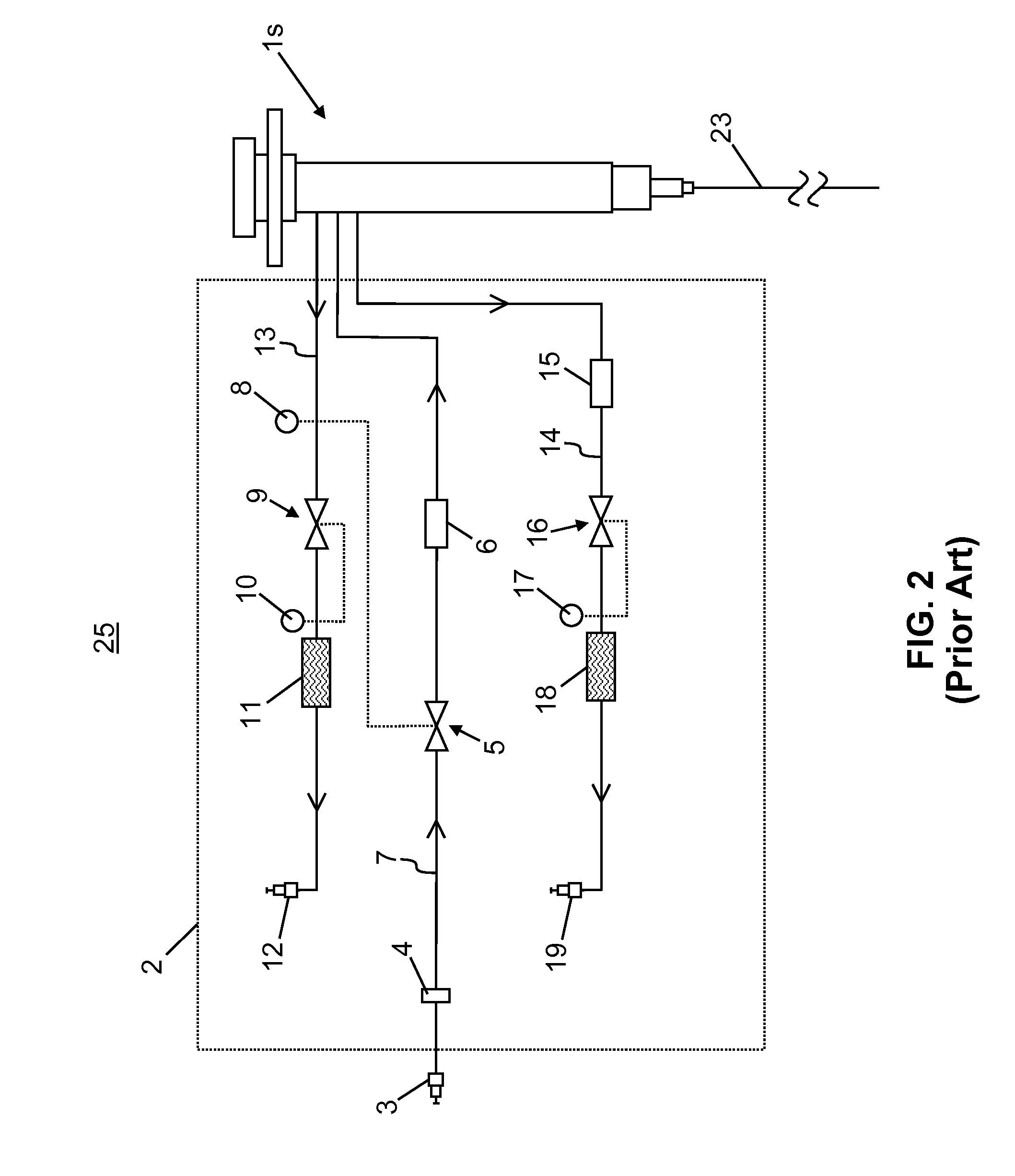
Specialized systems for supplying and controlling inert gases in chromatographic applications include pressure regulators, flow controllers, and gas purification modules. These systems maintain precise gas flow rates and pressures required for optimal separation performance. Gas control systems may incorporate sensors for monitoring gas purity, pressure stability, and flow consistency. Advanced designs include automatic switching between gas sources and safety features for leak detection.Expand Specific Solutions04 Sample preparation and injection under inert gas atmosphere
Sample introduction techniques utilize inert gas environments to prevent oxidation or degradation of sensitive compounds during injection. Inert gas blanketing protects reactive samples in autosamplers and injection systems. Specialized injection devices maintain samples under controlled inert atmospheres from preparation through introduction into the chromatographic system. These methods are particularly important for analyzing oxygen-sensitive or thermally labile compounds.Expand Specific Solutions05 Detection systems optimized for inert gas chromatography
Detector configurations specifically designed for use with inert carrier gases include thermal conductivity detectors, flame ionization detectors, and mass spectrometers. These detectors are optimized for the thermal and chemical properties of inert gases. Some detection systems require auxiliary inert gases for operation or to maintain detector stability. Detector designs account for the different heat capacities and ionization characteristics of various inert carrier gases to ensure sensitive and reproducible measurements.Expand Specific Solutions
Major Players in Gas Chromatography Instrumentation
The inert gas chromatography optimization field demonstrates a mature, competitive landscape dominated by established analytical instrumentation leaders including Agilent Technologies, Shimadzu Corp., Thermo Finnigan, and Waters Technology, alongside specialized gas analysis providers like INFICON and Servomex. The market exhibits steady growth driven by expanding applications across semiconductor manufacturing, pharmaceutical development, environmental monitoring, and petrochemical industries. Technology maturity is high, with these major players continuously advancing detector sensitivity, column efficiency, and automation capabilities. Asian research institutions, particularly Chinese entities like Beihang University and China Nuclear Power Research & Design Institute, are increasingly contributing to innovation alongside European industrial giants such as Siemens and ASML Netherlands, reflecting the technology's global strategic importance and ongoing refinement across diverse industrial applications.
Agilent Technologies, Inc.
Technical Solution: Agilent has developed advanced inert gas chromatography solutions featuring ultra-high purity gas delivery systems with integrated purifiers achieving <0.1ppb oxygen and moisture levels. Their optimization approach includes micro-flow pneumatic control technology enabling precise carrier gas flow regulation (±0.001mL/min accuracy), advanced capillary column technology with deactivated surfaces minimizing analyte interaction, and intelligent electronic pressure control (EPC) systems that automatically compensate for temperature and pressure variations. The company's GC systems incorporate split/splitless injection optimization with programmable temperature vaporization, reducing sample discrimination and improving reproducibility. Their proprietary retention time locking (RTL) technology ensures method transferability across different instruments and laboratories, while advanced detector designs (FID, TCD, ECD) are optimized for inert gas applications with enhanced sensitivity and baseline stability.
Strengths: Industry-leading precision and reproducibility, comprehensive integration capabilities, excellent technical support network. Weaknesses: Higher initial investment costs, complex system requiring specialized training for optimal operation.
Shimadzu Corp.
Technical Solution: Shimadzu's inert gas chromatography optimization focuses on their advanced flow control technology and column oven design. Their systems feature high-precision digital flow controllers (DFC) providing ±0.3% flow accuracy with real-time monitoring and automatic correction capabilities. The company has developed specialized carrier gas purification modules integrated directly into the GC system, removing oxygen, moisture, and hydrocarbon contaminants to sub-ppb levels. Their unique thermal conductivity detector (TCD) design is specifically optimized for inert gas analysis with enhanced sensitivity (>10,000mV·mL/mg) and reduced noise levels. Shimadzu's fast GC technology enables rapid temperature programming (up to 120°C/min) while maintaining separation efficiency, significantly reducing analysis time. The LabSolutions software platform provides intelligent method optimization algorithms that automatically adjust parameters including carrier gas velocity, split ratio, and temperature programs based on sample characteristics and analytical requirements.
Strengths: Excellent cost-performance ratio, user-friendly interface with intelligent optimization features, robust reliability. Weaknesses: Slightly lower maximum temperature capabilities compared to premium competitors, limited customization options for specialized applications.
Key Technologies in Inert Gas Separation and Detection
Focusing device based on bonded plate structures
PatentInactiveUS6966212B2
Innovation
- A low mass and size thermal focusing device with diffusion-bonded plates and a temperature reduction module, allowing for flexible configuration and efficient cooling and heating methods, including cryogenic zones and electro-thermal devices, to effectively narrow solute bands without the need for extensive oven cooling.


Gas Chromatograph System Employing Hydrogen Carrier Gas
PatentActiveUS20150330953A1
Innovation
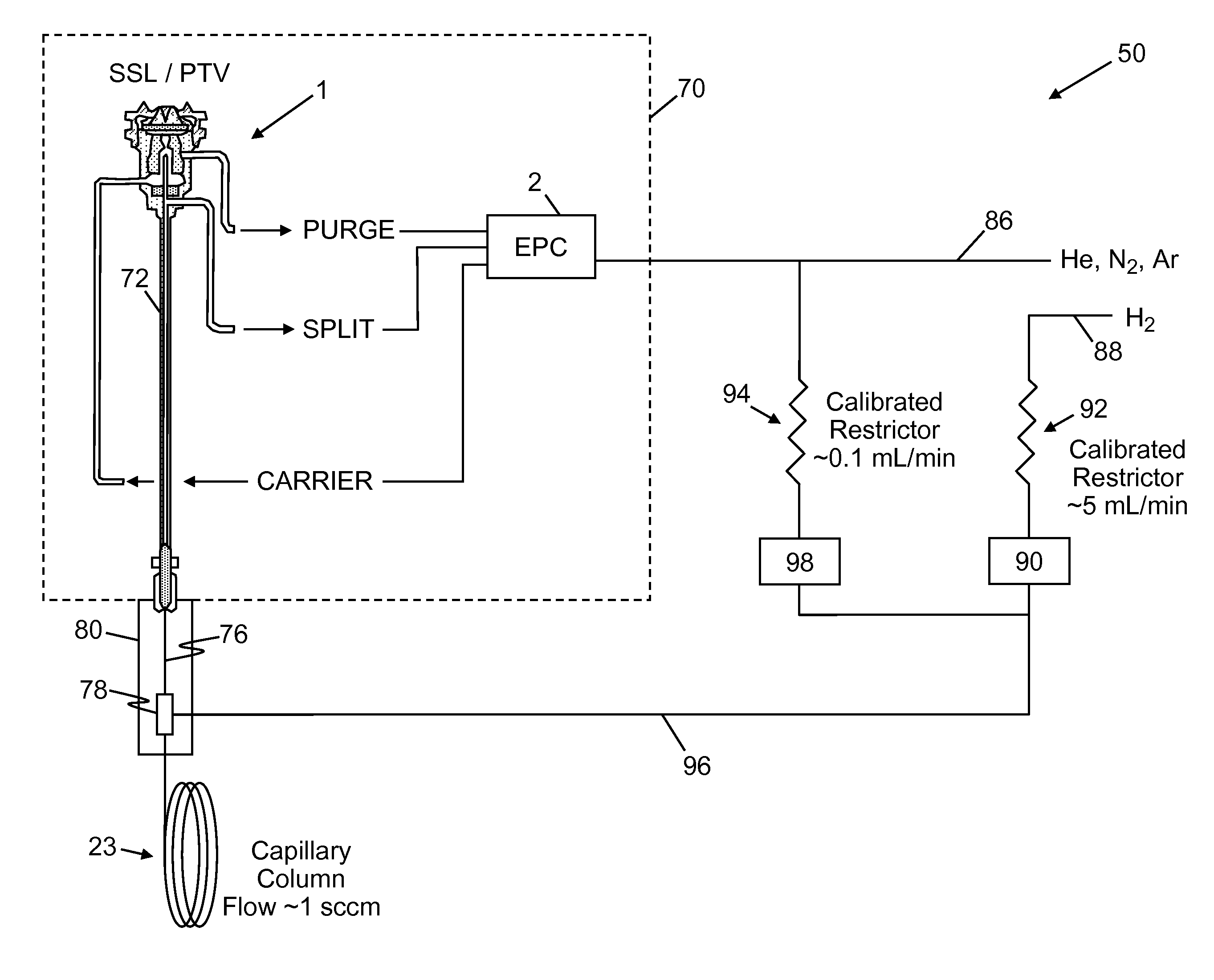
- A method where an inert gas is used for sample introduction and initial column flow, followed by hydrogen as the carrier gas during separation, with a calibrated flow restrictor to limit hydrogen flow and prevent unbounded flow, enhancing safety and reducing chemical reactivity by minimizing hydrogen exposure during sample transfer and in the injector.

Carrier Gas Purity and Supply Chain Considerations
Carrier gas purity stands as a fundamental parameter directly influencing the sensitivity, resolution, and reproducibility of inert gas chromatography systems. Ultra-high purity gases, typically exceeding 99.999% purity levels, are essential to minimize baseline noise and prevent contamination of analytical columns and detectors. Impurities such as oxygen, moisture, and hydrocarbons can cause irreversible damage to stationary phases, particularly in capillary columns, and generate spurious peaks that compromise analytical accuracy. The implementation of inline purification systems, including oxygen traps, moisture filters, and hydrocarbon scrubbers, provides an additional safeguard layer beyond supplier specifications.
The supply chain infrastructure for carrier gases presents both logistical and quality assurance challenges that require systematic management approaches. Establishing reliable supplier relationships with certified gas manufacturers ensures consistent quality standards and traceability documentation. Organizations must evaluate suppliers based on their quality control protocols, certification compliance, and delivery reliability. The choice between centralized bulk gas systems and individual cylinder supplies depends on laboratory scale, consumption rates, and budget constraints, with each option presenting distinct advantages in terms of cost efficiency and operational flexibility.
Storage and handling protocols significantly impact the maintenance of gas purity throughout the supply chain. Proper cylinder storage conditions, including temperature control and protection from contaminants, prevent degradation of gas quality. Regular pressure monitoring and timely cylinder replacement before depletion are critical to avoid drawing impurities from cylinder bottoms. The installation of two-stage regulators with appropriate pressure settings ensures stable flow rates and protects downstream components from pressure fluctuations.
Quality verification procedures must be integrated into routine laboratory operations to validate carrier gas specifications. Periodic testing using gas purity analyzers or chromatographic baseline monitoring provides empirical evidence of gas quality. Documentation systems tracking cylinder lot numbers, installation dates, and performance metrics enable trend analysis and early detection of supply chain issues. These comprehensive management practices ensure that carrier gas quality remains consistent with the stringent requirements of optimized inert gas chromatography techniques.
The supply chain infrastructure for carrier gases presents both logistical and quality assurance challenges that require systematic management approaches. Establishing reliable supplier relationships with certified gas manufacturers ensures consistent quality standards and traceability documentation. Organizations must evaluate suppliers based on their quality control protocols, certification compliance, and delivery reliability. The choice between centralized bulk gas systems and individual cylinder supplies depends on laboratory scale, consumption rates, and budget constraints, with each option presenting distinct advantages in terms of cost efficiency and operational flexibility.
Storage and handling protocols significantly impact the maintenance of gas purity throughout the supply chain. Proper cylinder storage conditions, including temperature control and protection from contaminants, prevent degradation of gas quality. Regular pressure monitoring and timely cylinder replacement before depletion are critical to avoid drawing impurities from cylinder bottoms. The installation of two-stage regulators with appropriate pressure settings ensures stable flow rates and protects downstream components from pressure fluctuations.
Quality verification procedures must be integrated into routine laboratory operations to validate carrier gas specifications. Periodic testing using gas purity analyzers or chromatographic baseline monitoring provides empirical evidence of gas quality. Documentation systems tracking cylinder lot numbers, installation dates, and performance metrics enable trend analysis and early detection of supply chain issues. These comprehensive management practices ensure that carrier gas quality remains consistent with the stringent requirements of optimized inert gas chromatography techniques.
Environmental Impact of Inert Gas Usage in Laboratories
The environmental implications of inert gas usage in chromatography laboratories have become increasingly significant as analytical testing volumes continue to expand globally. While inert gases such as helium, nitrogen, and argon are essential for achieving optimal separation and detection in gas chromatography, their production, distribution, and consumption patterns raise important sustainability concerns that laboratories must address.
Helium presents the most pressing environmental challenge due to its non-renewable nature and limited global reserves. As a byproduct of natural gas extraction, helium cannot be synthesized economically and escapes into the atmosphere when released, making it permanently lost to terrestrial use. The depletion of helium reserves has accelerated in recent decades, with current consumption rates raising concerns about long-term availability for both analytical and medical applications.
The carbon footprint associated with inert gas production and transportation constitutes another critical environmental consideration. Nitrogen generation through cryogenic air separation and pressure swing adsorption processes requires substantial energy input, contributing to greenhouse gas emissions. Similarly, the liquefaction, storage, and distribution of compressed gases involve energy-intensive operations and transportation logistics that amplify the overall environmental burden.
Laboratory ventilation systems designed to handle inert gas releases also contribute to energy consumption. Continuous exhaust requirements for safety purposes result in significant heating and cooling losses, particularly in climate-controlled facilities. This indirect environmental impact often exceeds the direct effects of gas production, yet receives less attention in sustainability assessments.
Waste generation from gas cylinder management adds another dimension to environmental concerns. The lifecycle of high-pressure cylinders involves manufacturing, testing, maintenance, and eventual disposal or recycling, each stage consuming resources and generating emissions. Single-use lecture bottles and disposable gas cartridges exacerbate this issue in laboratories with lower consumption volumes.
Emerging regulatory frameworks and institutional sustainability commitments are driving laboratories to evaluate their inert gas consumption patterns more critically. Carbon neutrality goals and environmental reporting requirements increasingly encompass scope three emissions, which include purchased gases and associated supply chain impacts. This regulatory evolution is prompting laboratories to seek optimization strategies that balance analytical performance requirements with environmental stewardship responsibilities.
Helium presents the most pressing environmental challenge due to its non-renewable nature and limited global reserves. As a byproduct of natural gas extraction, helium cannot be synthesized economically and escapes into the atmosphere when released, making it permanently lost to terrestrial use. The depletion of helium reserves has accelerated in recent decades, with current consumption rates raising concerns about long-term availability for both analytical and medical applications.
The carbon footprint associated with inert gas production and transportation constitutes another critical environmental consideration. Nitrogen generation through cryogenic air separation and pressure swing adsorption processes requires substantial energy input, contributing to greenhouse gas emissions. Similarly, the liquefaction, storage, and distribution of compressed gases involve energy-intensive operations and transportation logistics that amplify the overall environmental burden.
Laboratory ventilation systems designed to handle inert gas releases also contribute to energy consumption. Continuous exhaust requirements for safety purposes result in significant heating and cooling losses, particularly in climate-controlled facilities. This indirect environmental impact often exceeds the direct effects of gas production, yet receives less attention in sustainability assessments.
Waste generation from gas cylinder management adds another dimension to environmental concerns. The lifecycle of high-pressure cylinders involves manufacturing, testing, maintenance, and eventual disposal or recycling, each stage consuming resources and generating emissions. Single-use lecture bottles and disposable gas cartridges exacerbate this issue in laboratories with lower consumption volumes.
Emerging regulatory frameworks and institutional sustainability commitments are driving laboratories to evaluate their inert gas consumption patterns more critically. Carbon neutrality goals and environmental reporting requirements increasingly encompass scope three emissions, which include purchased gases and associated supply chain impacts. This regulatory evolution is prompting laboratories to seek optimization strategies that balance analytical performance requirements with environmental stewardship responsibilities.
Unlock deeper insights with Patsnap Eureka Quick Research — get a full tech report to explore trends and direct your research. Try now!
Generate Your Research Report Instantly with AI Agent
Supercharge your innovation with Patsnap Eureka AI Agent Platform!