

How to Optimize Tandem OLED Encapsulation for Foldable Panels
MAY 9, 20269 MIN READ
Generate Your Research Report Instantly with AI Agent
Patsnap Eureka helps you evaluate technical feasibility & market potential.
Tandem OLED Foldable Panel Technology Background and Goals
Tandem OLED technology represents a significant advancement in display engineering, utilizing a stacked architecture where two or more organic light-emitting layers are connected in series through charge generation layers (CGLs). This configuration enables higher brightness levels, improved power efficiency, and extended operational lifespan compared to conventional single-stack OLED structures. The technology has gained substantial momentum as manufacturers seek to address the inherent limitations of traditional OLEDs in demanding applications.
The integration of tandem OLED technology with foldable panel designs presents both unprecedented opportunities and complex engineering challenges. Foldable displays have emerged as a transformative form factor in consumer electronics, driven by market demand for larger screen real estate in compact devices. However, the mechanical stress induced by repeated folding operations creates critical vulnerabilities in the encapsulation systems that protect sensitive organic materials from environmental degradation.
The evolution of display technology has progressed from rigid LCD panels to flexible OLED displays, and now toward sophisticated foldable implementations. This progression reflects the industry's pursuit of enhanced user experiences while maintaining display quality and durability. Tandem OLED structures, initially developed for high-end lighting and automotive applications, are now being adapted for next-generation mobile and tablet devices where superior performance characteristics are essential.
Current market dynamics indicate strong consumer interest in foldable devices, with major manufacturers investing heavily in overcoming technical barriers. The primary challenge lies in developing encapsulation solutions that can withstand the mechanical deformation inherent in foldable designs while preserving the integrity of the tandem OLED stack. Traditional encapsulation approaches, effective for rigid displays, prove inadequate when subjected to the cyclic stress patterns characteristic of folding operations.
The technical objectives for optimizing tandem OLED encapsulation in foldable panels encompass multiple critical parameters. Primary goals include achieving water vapor transmission rates below 10^-6 g/m²/day, maintaining optical transparency exceeding 90% across the visible spectrum, and ensuring mechanical flexibility that supports over 200,000 folding cycles without performance degradation. Additionally, the encapsulation system must accommodate the thermal expansion characteristics of tandem OLED structures while providing uniform protection across the entire active display area.
These objectives drive the need for innovative materials science approaches, advanced deposition techniques, and novel architectural designs that can reconcile the competing demands of flexibility, barrier performance, and optical quality in next-generation foldable display applications.
The integration of tandem OLED technology with foldable panel designs presents both unprecedented opportunities and complex engineering challenges. Foldable displays have emerged as a transformative form factor in consumer electronics, driven by market demand for larger screen real estate in compact devices. However, the mechanical stress induced by repeated folding operations creates critical vulnerabilities in the encapsulation systems that protect sensitive organic materials from environmental degradation.
The evolution of display technology has progressed from rigid LCD panels to flexible OLED displays, and now toward sophisticated foldable implementations. This progression reflects the industry's pursuit of enhanced user experiences while maintaining display quality and durability. Tandem OLED structures, initially developed for high-end lighting and automotive applications, are now being adapted for next-generation mobile and tablet devices where superior performance characteristics are essential.
Current market dynamics indicate strong consumer interest in foldable devices, with major manufacturers investing heavily in overcoming technical barriers. The primary challenge lies in developing encapsulation solutions that can withstand the mechanical deformation inherent in foldable designs while preserving the integrity of the tandem OLED stack. Traditional encapsulation approaches, effective for rigid displays, prove inadequate when subjected to the cyclic stress patterns characteristic of folding operations.
The technical objectives for optimizing tandem OLED encapsulation in foldable panels encompass multiple critical parameters. Primary goals include achieving water vapor transmission rates below 10^-6 g/m²/day, maintaining optical transparency exceeding 90% across the visible spectrum, and ensuring mechanical flexibility that supports over 200,000 folding cycles without performance degradation. Additionally, the encapsulation system must accommodate the thermal expansion characteristics of tandem OLED structures while providing uniform protection across the entire active display area.
These objectives drive the need for innovative materials science approaches, advanced deposition techniques, and novel architectural designs that can reconcile the competing demands of flexibility, barrier performance, and optical quality in next-generation foldable display applications.
Market Demand for Foldable Display Encapsulation Solutions
The global foldable display market has experienced unprecedented growth momentum, driven by consumer demand for innovative form factors that combine portability with expanded screen real estate. Major smartphone manufacturers have accelerated their foldable device launches, creating substantial pressure on the supply chain to deliver reliable encapsulation solutions that can withstand repeated folding cycles while maintaining display integrity.
Tandem OLED technology represents a critical advancement in addressing the unique challenges of foldable displays, particularly in terms of brightness efficiency and longevity. The market demand for optimized encapsulation solutions specifically targeting tandem OLED architectures has intensified as manufacturers seek to overcome traditional limitations such as reduced lifespan and mechanical stress vulnerability at folding creases.
Consumer electronics manufacturers are increasingly prioritizing durability specifications, with industry standards now requiring foldable displays to withstand hundreds of thousands of folding cycles without degradation. This requirement has created a specialized market segment focused on advanced encapsulation technologies that can protect the complex multi-layer tandem OLED structures from moisture, oxygen, and mechanical stress.
The automotive sector presents an emerging application area where foldable tandem OLED displays are being integrated into dashboard designs and passenger entertainment systems. This market segment demands even more stringent encapsulation performance due to extreme temperature variations and extended operational lifespans, driving innovation in barrier film technologies and edge sealing methodologies.
Enterprise applications, including foldable tablets and dual-screen laptops, represent another significant demand driver. These devices require encapsulation solutions that maintain optical clarity and touch sensitivity across the folding mechanism while ensuring long-term reliability under intensive usage patterns.
Supply chain analysis reveals that current encapsulation solutions face scalability challenges in meeting the projected demand growth. Manufacturing yield rates for advanced barrier coatings on flexible substrates remain below optimal levels, creating market opportunities for breakthrough encapsulation technologies that can achieve both performance targets and cost-effectiveness at volume production scales.
Tandem OLED technology represents a critical advancement in addressing the unique challenges of foldable displays, particularly in terms of brightness efficiency and longevity. The market demand for optimized encapsulation solutions specifically targeting tandem OLED architectures has intensified as manufacturers seek to overcome traditional limitations such as reduced lifespan and mechanical stress vulnerability at folding creases.
Consumer electronics manufacturers are increasingly prioritizing durability specifications, with industry standards now requiring foldable displays to withstand hundreds of thousands of folding cycles without degradation. This requirement has created a specialized market segment focused on advanced encapsulation technologies that can protect the complex multi-layer tandem OLED structures from moisture, oxygen, and mechanical stress.
The automotive sector presents an emerging application area where foldable tandem OLED displays are being integrated into dashboard designs and passenger entertainment systems. This market segment demands even more stringent encapsulation performance due to extreme temperature variations and extended operational lifespans, driving innovation in barrier film technologies and edge sealing methodologies.
Enterprise applications, including foldable tablets and dual-screen laptops, represent another significant demand driver. These devices require encapsulation solutions that maintain optical clarity and touch sensitivity across the folding mechanism while ensuring long-term reliability under intensive usage patterns.
Supply chain analysis reveals that current encapsulation solutions face scalability challenges in meeting the projected demand growth. Manufacturing yield rates for advanced barrier coatings on flexible substrates remain below optimal levels, creating market opportunities for breakthrough encapsulation technologies that can achieve both performance targets and cost-effectiveness at volume production scales.
Current Encapsulation Challenges in Flexible OLED Displays
Flexible OLED displays face unprecedented encapsulation challenges that become exponentially more complex in tandem architectures. The fundamental issue stems from the inherent vulnerability of organic materials to moisture and oxygen, which becomes critically amplified when displays must withstand repeated mechanical stress from folding operations. Traditional rigid OLED encapsulation methods prove inadequate for flexible substrates, as conventional glass or ceramic barriers crack under mechanical deformation.
The multi-layer organic structure in tandem OLEDs presents unique permeability concerns. Each organic layer exhibits different degradation rates when exposed to environmental contaminants, creating non-uniform aging patterns that compromise display uniformity. Water vapor transmission rates must be maintained below 10^-6 g/m²/day across the entire flexible surface, a specification that becomes increasingly difficult to achieve at fold radii typically required for consumer applications.
Mechanical stress concentration at fold lines creates micro-fractures in encapsulation layers, establishing pathways for moisture ingress. These defects propagate through the encapsulation stack during repeated folding cycles, leading to accelerated device degradation. The challenge intensifies in tandem structures where multiple emission layers require protection, as failure in any single layer can cascade throughout the entire stack.
Thermal expansion mismatch between encapsulation materials and flexible substrates generates additional stress during temperature cycling. This phenomenon is particularly problematic in tandem OLEDs due to increased heat generation from multiple active layers. The encapsulation system must accommodate differential thermal expansion while maintaining hermetic sealing properties across operational temperature ranges.
Interface adhesion between encapsulation layers and organic materials presents another critical challenge. Poor adhesion leads to delamination under mechanical stress, creating voids that facilitate contaminant penetration. The problem becomes more severe in tandem architectures where multiple interfaces must maintain integrity simultaneously.
Current thin-film encapsulation approaches struggle with pinhole defects that become stress concentration points during flexing. These microscopic defects, often invisible during initial manufacturing inspection, expand under mechanical cycling and create failure pathways. The statistical nature of pinhole formation makes it difficult to predict long-term reliability in flexible tandem OLED applications.
Edge sealing represents a particularly vulnerable area where traditional encapsulation methods show limitations. The transition from flexible display area to rigid connection points creates stress gradients that challenge conventional sealing approaches, requiring innovative solutions specifically designed for tandem OLED architectures.
The multi-layer organic structure in tandem OLEDs presents unique permeability concerns. Each organic layer exhibits different degradation rates when exposed to environmental contaminants, creating non-uniform aging patterns that compromise display uniformity. Water vapor transmission rates must be maintained below 10^-6 g/m²/day across the entire flexible surface, a specification that becomes increasingly difficult to achieve at fold radii typically required for consumer applications.
Mechanical stress concentration at fold lines creates micro-fractures in encapsulation layers, establishing pathways for moisture ingress. These defects propagate through the encapsulation stack during repeated folding cycles, leading to accelerated device degradation. The challenge intensifies in tandem structures where multiple emission layers require protection, as failure in any single layer can cascade throughout the entire stack.
Thermal expansion mismatch between encapsulation materials and flexible substrates generates additional stress during temperature cycling. This phenomenon is particularly problematic in tandem OLEDs due to increased heat generation from multiple active layers. The encapsulation system must accommodate differential thermal expansion while maintaining hermetic sealing properties across operational temperature ranges.
Interface adhesion between encapsulation layers and organic materials presents another critical challenge. Poor adhesion leads to delamination under mechanical stress, creating voids that facilitate contaminant penetration. The problem becomes more severe in tandem architectures where multiple interfaces must maintain integrity simultaneously.
Current thin-film encapsulation approaches struggle with pinhole defects that become stress concentration points during flexing. These microscopic defects, often invisible during initial manufacturing inspection, expand under mechanical cycling and create failure pathways. The statistical nature of pinhole formation makes it difficult to predict long-term reliability in flexible tandem OLED applications.
Edge sealing represents a particularly vulnerable area where traditional encapsulation methods show limitations. The transition from flexible display area to rigid connection points creates stress gradients that challenge conventional sealing approaches, requiring innovative solutions specifically designed for tandem OLED architectures.
Existing Tandem OLED Encapsulation Solutions
01 Barrier layer materials and structures for tandem OLED encapsulation
Advanced barrier layer materials and multi-layer structures are employed to provide effective moisture and oxygen protection for tandem OLED devices. These structures typically involve alternating organic and inorganic layers that create tortuous paths for permeants, significantly reducing the permeation rate of water vapor and oxygen that can degrade the OLED performance.- Barrier layer materials and structures for tandem OLED encapsulation: Advanced barrier layer materials and multilayer structures are employed to prevent moisture and oxygen ingress in tandem OLED devices. These structures typically involve alternating organic and inorganic layers that provide superior protection compared to single-layer encapsulation. The barrier layers are designed to maintain flexibility while ensuring long-term device stability and performance.
- Thin film encapsulation techniques for stacked OLED architectures: Specialized thin film encapsulation methods are developed specifically for tandem OLED configurations where multiple emissive layers are stacked. These techniques involve precise deposition processes and material selection to ensure uniform coverage across the complex device architecture while maintaining optical transparency and electrical isolation between layers.
- Edge sealing and perimeter protection methods: Comprehensive edge sealing approaches are implemented to address the vulnerable perimeter areas of tandem OLED devices. These methods involve specialized sealant materials and application techniques that create robust barriers at device edges where traditional encapsulation layers may be compromised. The sealing systems are designed to accommodate thermal expansion and mechanical stress.
- Getter materials and moisture absorption systems: Active getter materials are integrated into tandem OLED encapsulation systems to continuously absorb residual moisture and reactive gases that may penetrate the primary barrier layers. These systems include desiccant materials and reactive getters that are strategically positioned within the device package to maintain ultra-low humidity levels throughout the device lifetime.
- Flexible substrate encapsulation and stress management: Specialized encapsulation solutions are developed for tandem OLED devices fabricated on flexible substrates, addressing the unique challenges of maintaining barrier integrity under mechanical deformation. These approaches incorporate stress-relief structures and flexible barrier materials that can withstand bending and stretching while preserving encapsulation effectiveness.
02 Thin film encapsulation techniques for tandem OLED devices
Thin film encapsulation methods utilize vapor deposition and coating processes to create conformal protective layers directly on the tandem OLED structure. These techniques enable the formation of dense, pinhole-free encapsulation layers that maintain the device's optical properties while providing excellent environmental protection.Expand Specific Solutions03 Edge sealing and perimeter protection methods
Specialized edge sealing techniques are implemented to prevent moisture and contaminant ingress through the perimeter of tandem OLED devices. These methods involve the application of sealants, adhesives, or mechanical barriers around the device edges to create hermetic seals that complement the primary encapsulation layers.Expand Specific Solutions04 Getter materials integration for enhanced protection
Getter materials are incorporated into the encapsulation system to actively absorb residual moisture and oxygen that may penetrate the barrier layers. These materials provide an additional level of protection by chemically binding with permeants, extending the operational lifetime of tandem OLED devices under various environmental conditions.Expand Specific Solutions05 Flexible substrate encapsulation solutions
Specialized encapsulation approaches are developed for tandem OLED devices fabricated on flexible substrates, addressing the unique challenges of maintaining barrier integrity during mechanical deformation. These solutions incorporate flexible barrier materials and stress-relief structures that accommodate bending and stretching while preserving encapsulation effectiveness.Expand Specific Solutions
Key Players in Tandem OLED and Flexible Display Industry
The tandem OLED encapsulation optimization for foldable panels represents a rapidly evolving market segment within the advanced display industry. The sector is currently in a growth phase, driven by increasing demand for flexible and foldable consumer electronics. Market size is expanding significantly as major smartphone manufacturers integrate foldable displays into flagship products. Technology maturity varies across key players, with established companies like BOE Technology Group, LG Display, and Samsung Display leading in mass production capabilities. Chinese manufacturers including Visionox Technology, Tianma Microelectronics, and China Star Optoelectronics are aggressively investing in R&D to close the technology gap. Material suppliers such as Universal Display Corporation, Merck Patent GmbH, and LG Chem provide critical encapsulation materials and phosphorescent compounds. The competitive landscape shows intense innovation focus on barrier film technologies, flexible substrates, and multi-layer encapsulation solutions to address moisture and oxygen ingress challenges specific to bendable OLED architectures.
BOE Technology Group Co., Ltd.
Technical Solution: BOE has developed advanced encapsulation technologies for tandem OLED foldable panels using multi-layer barrier films with alternating organic and inorganic layers. Their approach incorporates flexible thin-film encapsulation (TFE) with silicon nitride and aluminum oxide layers, achieving water vapor transmission rates below 10^-6 g/m²/day. The company utilizes atomic layer deposition (ALD) and plasma-enhanced chemical vapor deposition (PECVD) processes to create conformal barrier coatings that maintain integrity during repeated folding cycles. BOE's encapsulation strategy also includes edge sealing techniques using UV-curable adhesives and getter materials to absorb residual moisture and oxygen within the device structure.
Strengths: Leading market position in flexible OLED manufacturing with proven mass production capabilities and comprehensive encapsulation solutions. Weaknesses: High manufacturing costs and complexity in achieving uniform barrier properties across large panel areas during folding stress.
Hefei Visionox Technology Co., Ltd.
Technical Solution: Visionox has developed innovative encapsulation technologies for tandem OLED foldable displays using advanced barrier film structures with enhanced mechanical properties. Their approach incorporates multi-layer encapsulation with optimized thickness distribution to minimize stress concentration during folding operations. The company utilizes low-temperature processing techniques to deposit barrier layers without damaging the underlying tandem OLED stack, employing plasma-assisted deposition methods to achieve superior film quality. Visionox's encapsulation solution includes specialized edge sealing processes and integrated desiccant materials to ensure long-term reliability. Their technology addresses the specific challenges of tandem OLED structures, including managing the increased thermal load and preventing moisture ingress that could affect the performance of multiple emissive layers.
Strengths: Strong focus on flexible OLED technology development with innovative encapsulation approaches and growing market presence in foldable displays. Weaknesses: Relatively smaller scale compared to major competitors and limited global market reach affecting technology adoption and cost competitiveness.
Core Innovations in Flexible Barrier Technologies
Foldable organic light emitting diode display panel and organic light emitting diode display screen
PatentActiveUS20210408467A1
Innovation
- A foldable OLED display panel with an encapsulation layer comprising an organic layer to fill gaps in the pixel definition layer, followed by an inorganic layer, providing a flat surface and reducing crack risks during bending, and enhancing the service life.


Encapsulation method of organic light emitting diode device and encapsulation structure encapsulated using same
PatentActiveUS20200083476A1
Innovation
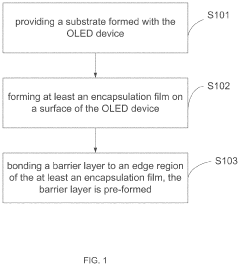
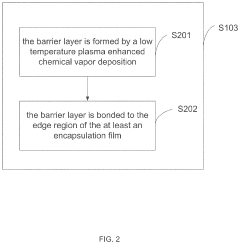
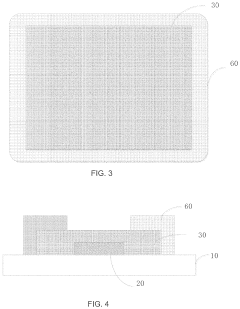
- A method involving a pre-formed ring-shaped barrier layer made of inorganic materials like silicon nitride or aluminum oxide, bonded to the edge region of the encapsulation film using low temperature plasma enhanced chemical vapor deposition and rolling or vacuum bonding processes, which improves moisture and oxygen resistance.
Environmental Impact Assessment of OLED Materials
The environmental implications of OLED materials used in tandem foldable displays present significant considerations for sustainable manufacturing and end-of-life management. Traditional OLED materials contain various organic compounds, rare earth elements, and heavy metals that pose potential ecological risks throughout their lifecycle. The complexity increases substantially in tandem architectures, where multiple emissive layers require diverse material compositions, potentially doubling the environmental footprint compared to conventional single-stack OLEDs.
Material extraction processes for OLED components, particularly indium for transparent electrodes and various rare earth elements for phosphorescent emitters, contribute to substantial carbon emissions and habitat disruption. The synthesis of organic semiconductors and host materials typically involves energy-intensive chemical processes that generate hazardous waste streams. In tandem configurations optimized for foldable applications, the increased material diversity amplifies these environmental concerns, as manufacturers must source and process a broader range of chemical compounds.
Manufacturing phase environmental impacts encompass solvent usage, energy consumption during vacuum deposition processes, and waste generation from material purification steps. The encapsulation optimization process itself introduces additional environmental considerations, as barrier materials like aluminum oxide or silicon nitride require high-temperature processing and specialized precursor chemicals. Advanced encapsulation techniques for foldable tandem OLEDs often employ multi-layer barrier stacks, increasing material consumption and processing complexity.
End-of-life disposal challenges emerge from the heterogeneous material composition in tandem OLED structures. The intimate mixing of organic and inorganic layers complicates recycling efforts, while certain phosphorescent materials contain precious metals that could be recovered through specialized processing. However, current recycling infrastructure lacks the capability to efficiently separate and recover these materials from complex multilayer structures.
Emerging sustainable alternatives focus on bio-based organic materials, solution-processable compounds that reduce energy requirements, and design strategies that minimize rare element usage. Research into recyclable encapsulation materials and modular display architectures could significantly reduce environmental impact while maintaining the performance requirements essential for foldable tandem OLED applications.
Material extraction processes for OLED components, particularly indium for transparent electrodes and various rare earth elements for phosphorescent emitters, contribute to substantial carbon emissions and habitat disruption. The synthesis of organic semiconductors and host materials typically involves energy-intensive chemical processes that generate hazardous waste streams. In tandem configurations optimized for foldable applications, the increased material diversity amplifies these environmental concerns, as manufacturers must source and process a broader range of chemical compounds.
Manufacturing phase environmental impacts encompass solvent usage, energy consumption during vacuum deposition processes, and waste generation from material purification steps. The encapsulation optimization process itself introduces additional environmental considerations, as barrier materials like aluminum oxide or silicon nitride require high-temperature processing and specialized precursor chemicals. Advanced encapsulation techniques for foldable tandem OLEDs often employ multi-layer barrier stacks, increasing material consumption and processing complexity.
End-of-life disposal challenges emerge from the heterogeneous material composition in tandem OLED structures. The intimate mixing of organic and inorganic layers complicates recycling efforts, while certain phosphorescent materials contain precious metals that could be recovered through specialized processing. However, current recycling infrastructure lacks the capability to efficiently separate and recover these materials from complex multilayer structures.
Emerging sustainable alternatives focus on bio-based organic materials, solution-processable compounds that reduce energy requirements, and design strategies that minimize rare element usage. Research into recyclable encapsulation materials and modular display architectures could significantly reduce environmental impact while maintaining the performance requirements essential for foldable tandem OLED applications.
Manufacturing Cost Analysis for Tandem OLED Encapsulation
The manufacturing cost structure for tandem OLED encapsulation in foldable panels represents a significant portion of overall production expenses, primarily driven by material complexity and specialized processing requirements. Current industry estimates indicate that encapsulation processes account for approximately 15-20% of total tandem OLED manufacturing costs, with this percentage increasing substantially for foldable applications due to enhanced barrier requirements and mechanical flexibility demands.
Material costs constitute the largest component, representing roughly 60-70% of encapsulation expenses. Ultra-thin glass substrates, specialized barrier films, and advanced adhesive materials command premium pricing due to their stringent performance specifications. The multi-layer barrier stack required for tandem structures typically involves alternating organic and inorganic layers, with each additional layer contributing incrementally to material costs while providing enhanced moisture and oxygen protection.
Equipment and processing costs account for 25-30% of total encapsulation expenses, reflecting the sophisticated deposition systems required for atomic layer deposition and plasma-enhanced chemical vapor deposition processes. The capital intensity of these systems, combined with their relatively low throughput rates, creates substantial depreciation and operational costs that must be amortized across production volumes.
Labor and overhead expenses represent the remaining 10-15% of costs, though this proportion varies significantly based on automation levels and geographic manufacturing locations. Asian manufacturing facilities typically demonstrate lower labor costs but may require higher quality control investments to maintain yield rates above 85% for complex foldable encapsulation processes.
Yield optimization presents the most critical cost reduction opportunity, as encapsulation defects often result in complete panel rejection. Current industry yield rates for foldable tandem OLED encapsulation range from 70-85%, with each percentage point improvement delivering substantial cost benefits. Process optimization through advanced metrology and real-time monitoring systems offers potential cost reductions of 10-15% through yield enhancement alone.
Scale economics significantly impact unit costs, with production volumes above 100,000 units per month enabling material cost reductions of 20-25% through supplier negotiations and waste minimization. However, the specialized nature of foldable encapsulation materials limits supplier options and maintains relatively high baseline costs compared to rigid panel alternatives.
Material costs constitute the largest component, representing roughly 60-70% of encapsulation expenses. Ultra-thin glass substrates, specialized barrier films, and advanced adhesive materials command premium pricing due to their stringent performance specifications. The multi-layer barrier stack required for tandem structures typically involves alternating organic and inorganic layers, with each additional layer contributing incrementally to material costs while providing enhanced moisture and oxygen protection.
Equipment and processing costs account for 25-30% of total encapsulation expenses, reflecting the sophisticated deposition systems required for atomic layer deposition and plasma-enhanced chemical vapor deposition processes. The capital intensity of these systems, combined with their relatively low throughput rates, creates substantial depreciation and operational costs that must be amortized across production volumes.
Labor and overhead expenses represent the remaining 10-15% of costs, though this proportion varies significantly based on automation levels and geographic manufacturing locations. Asian manufacturing facilities typically demonstrate lower labor costs but may require higher quality control investments to maintain yield rates above 85% for complex foldable encapsulation processes.
Yield optimization presents the most critical cost reduction opportunity, as encapsulation defects often result in complete panel rejection. Current industry yield rates for foldable tandem OLED encapsulation range from 70-85%, with each percentage point improvement delivering substantial cost benefits. Process optimization through advanced metrology and real-time monitoring systems offers potential cost reductions of 10-15% through yield enhancement alone.
Scale economics significantly impact unit costs, with production volumes above 100,000 units per month enabling material cost reductions of 20-25% through supplier negotiations and waste minimization. However, the specialized nature of foldable encapsulation materials limits supplier options and maintains relatively high baseline costs compared to rigid panel alternatives.
Unlock deeper insights with Patsnap Eureka Quick Research — get a full tech report to explore trends and direct your research. Try now!
Generate Your Research Report Instantly with AI Agent
Supercharge your innovation with Patsnap Eureka AI Agent Platform!