

How to Quantify Efficiencies in Dual-Trigger Self-Healing Systems
JUN 22, 20269 MIN READ
Generate Your Research Report Instantly with AI Agent
Patsnap Eureka helps you evaluate technical feasibility & market potential.
Dual-Trigger Self-Healing Background and Efficiency Goals
Dual-trigger self-healing systems represent an advanced paradigm in autonomous material and system recovery, emerging from the convergence of smart materials science, sensor technology, and automated response mechanisms. These systems incorporate two distinct activation pathways that can operate independently or synergistically to initiate healing processes when damage or degradation is detected. The dual-trigger approach evolved from early single-trigger systems that often suffered from false activations or insufficient response sensitivity.
The historical development of self-healing technologies began with simple polymer-based systems in the 1990s, progressing through microcapsule-embedded materials in the early 2000s, and advancing to sophisticated multi-trigger architectures by 2010. The dual-trigger concept specifically emerged around 2015 as researchers recognized the limitations of single-activation mechanisms in complex operational environments. This evolution was driven by the need for more reliable and precise healing responses in critical applications.
Current dual-trigger systems typically combine physical and chemical activation mechanisms, such as temperature-pH combinations, mechanical stress-electrical signal pairs, or light-chemical catalyst systems. The integration of multiple trigger pathways allows for enhanced selectivity, reduced false positives, and improved healing precision. Recent developments have incorporated machine learning algorithms to optimize trigger sensitivity and response timing.
The primary technical objectives for dual-trigger self-healing systems center on achieving quantifiable efficiency metrics that can be consistently measured and compared across different implementations. Key efficiency goals include healing completeness ratios exceeding 85%, response time optimization within predetermined thresholds, and trigger selectivity rates above 95% to minimize unwanted activations.
Efficiency quantification targets encompass multiple performance dimensions. Temporal efficiency focuses on minimizing the time between damage detection and complete healing, with industry standards targeting sub-second trigger recognition and healing initiation within minutes. Spatial efficiency addresses the precision of healing material deployment, aiming for minimal waste and maximum coverage of damaged areas.
Energy efficiency represents another critical goal, particularly for autonomous systems with limited power resources. Current research targets energy consumption reduction of 40-60% compared to single-trigger systems while maintaining or improving healing effectiveness. Material utilization efficiency seeks to optimize the consumption of healing agents, with goals of achieving complete restoration using less than 10% excess material beyond the theoretical minimum required.
The overarching efficiency framework aims to establish standardized metrics that enable cross-platform comparison and systematic optimization. These metrics must account for environmental variability, system complexity, and long-term performance degradation to provide meaningful efficiency assessments for practical deployment scenarios.
Market Demand for Quantifiable Self-Healing Materials
The global market for quantifiable self-healing materials is experiencing unprecedented growth driven by increasing demands for enhanced reliability and reduced maintenance costs across multiple industries. Traditional materials require frequent inspection, repair, and replacement cycles that generate substantial operational expenses and potential safety risks. Industries are actively seeking advanced materials that can autonomously detect damage and initiate repair processes while providing measurable performance metrics.
Aerospace and automotive sectors represent the most significant demand drivers for quantifiable self-healing systems. Aircraft components and automotive parts operate under extreme conditions where material failure can result in catastrophic consequences. These industries require materials that not only self-repair but also provide real-time quantitative feedback on healing efficiency and structural integrity. The ability to measure and verify healing performance directly impacts certification processes and regulatory compliance.
Infrastructure and construction markets demonstrate growing interest in self-healing concrete and protective coatings that can quantify their repair capabilities. Bridge structures, building facades, and underground pipelines benefit from materials that can heal micro-cracks while reporting healing effectiveness through embedded sensors or measurable property changes. This quantification capability enables predictive maintenance strategies and extends asset lifecycles.
Electronics and semiconductor industries increasingly demand self-healing polymers and conductive materials with quantifiable recovery properties. Flexible electronics, wearable devices, and advanced packaging applications require materials that can restore electrical conductivity and mechanical properties after damage while providing measurable performance indicators. The miniaturization trend amplifies the need for materials with precise, quantifiable healing responses.
Energy sector applications, particularly in renewable energy systems and battery technologies, drive demand for self-healing materials with measurable efficiency parameters. Solar panel encapsulants, wind turbine blade coatings, and battery separators require materials that can self-repair while maintaining quantifiable performance standards. The economic viability of these applications depends heavily on measurable healing effectiveness and long-term reliability metrics.
The market demand increasingly emphasizes standardized measurement protocols and certification frameworks for self-healing material performance. Industries require consistent methodologies to evaluate healing efficiency, enabling reliable comparison between different material solutions and supporting procurement decisions based on quantifiable performance criteria.
Current State of Dual-Trigger Efficiency Measurement
The current landscape of dual-trigger self-healing system efficiency measurement presents a complex array of methodologies and approaches, each with distinct advantages and limitations. Traditional measurement frameworks primarily focus on single-parameter assessments, such as healing time or material recovery percentage, which fail to capture the multifaceted nature of dual-trigger mechanisms where both autonomous and external activation pathways must be evaluated simultaneously.
Existing measurement protocols predominantly rely on standardized testing procedures that evaluate healing efficiency through mechanical property restoration, typically measuring tensile strength recovery, crack closure rates, and material integrity restoration. However, these conventional approaches often overlook the synergistic effects between dual triggers, leading to incomplete efficiency assessments that may underestimate or misrepresent actual system performance.
Current industry standards, including ASTM and ISO protocols, provide frameworks for single-trigger healing evaluation but lack comprehensive guidelines for dual-trigger systems. This gap has resulted in fragmented measurement approaches across different research institutions and industrial applications, making comparative analysis and benchmarking extremely challenging.
Advanced characterization techniques currently employed include real-time monitoring systems using embedded sensors, microscopic analysis for crack propagation tracking, and thermal imaging for heat-activated trigger assessment. These methods generate substantial data but often lack standardized interpretation frameworks, leading to inconsistent efficiency quantification across different research groups.
The integration of machine learning algorithms and artificial intelligence in efficiency measurement represents an emerging trend, with several research groups developing predictive models that can assess healing performance based on multi-parameter inputs. However, these approaches remain largely experimental and lack validation across diverse material systems and environmental conditions.
Significant challenges persist in establishing universal efficiency metrics that can accommodate the variability in dual-trigger mechanisms, material compositions, and application environments. The absence of standardized benchmarking protocols continues to hinder technology transfer from laboratory settings to commercial applications, limiting the widespread adoption of dual-trigger self-healing systems despite their demonstrated potential.
Existing Efficiency Quantification Solutions
01 Multi-stimulus responsive healing mechanisms
Self-healing systems that respond to multiple environmental triggers such as temperature, pH, light, or mechanical stress to activate healing processes. These systems incorporate responsive polymers or materials that can detect and react to different stimuli simultaneously, providing enhanced reliability and broader application ranges for autonomous repair functionality.- Multi-stimulus responsive healing mechanisms: Self-healing systems that respond to multiple environmental triggers such as temperature, pH, light, or mechanical stress to activate healing processes. These systems incorporate responsive polymers or materials that can detect and react to different stimuli simultaneously, providing enhanced reliability and broader application ranges for autonomous repair functionality.
- Encapsulated healing agent systems: Dual-trigger systems utilizing microencapsulated or nanoencapsulated healing agents that are released upon detection of specific trigger conditions. These systems employ protective capsules containing repair materials that remain dormant until activated by predetermined stimuli, ensuring controlled and targeted healing responses with improved storage stability and activation precision.
- Shape memory polymer integration: Integration of shape memory polymers that can be activated by dual triggers to restore original configurations and facilitate self-repair processes. These materials demonstrate programmable recovery behaviors when exposed to specific combinations of stimuli, enabling both structural restoration and functional recovery in damaged systems.
- Electrochemical and thermal activation systems: Self-healing mechanisms that utilize combinations of electrical and thermal triggers to initiate repair processes. These systems employ conductive pathways and thermally responsive components to detect damage and activate healing sequences, providing rapid response times and precise control over the healing process through dual activation pathways.
- Biomimetic dual-response healing networks: Bio-inspired self-healing systems that mimic natural healing processes through dual-trigger mechanisms similar to biological repair systems. These networks incorporate reversible bonding mechanisms and adaptive material properties that respond to multiple environmental cues, enabling repeated healing cycles and enhanced durability in various operating conditions.
02 Encapsulated healing agent systems
Dual-trigger systems utilizing microencapsulated or nanoencapsulated healing agents that are released upon detection of specific trigger conditions. These systems employ protective capsules containing repair materials that remain dormant until activated by predetermined stimuli, ensuring controlled and targeted healing responses with improved storage stability and activation precision.Expand Specific Solutions03 Shape memory polymer integration
Self-healing systems incorporating shape memory polymers that can return to predetermined configurations when triggered by specific conditions. These materials combine the ability to remember original shapes with healing capabilities, allowing for both structural recovery and material repair through thermally or chemically activated shape recovery mechanisms.Expand Specific Solutions04 Electrochemical activation systems
Healing systems that utilize electrical or electrochemical triggers to initiate repair processes through ion migration, redox reactions, or electrical field activation. These systems can provide precise control over healing timing and location through applied voltage or current, enabling on-demand repair functionality in electronic or conductive material applications.Expand Specific Solutions05 Biomimetic dual-response mechanisms
Self-healing systems inspired by biological healing processes that incorporate multiple trigger mechanisms similar to natural repair systems. These approaches combine chemical and physical triggers to create more robust and efficient healing responses, often utilizing enzyme-like catalysts or bio-inspired polymer networks for enhanced healing performance and repeatability.Expand Specific Solutions
Key Players in Self-Healing Materials Industry
The dual-trigger self-healing systems technology is in an emerging development stage with significant growth potential, driven by applications across power grid infrastructure and biomedical sectors. The market demonstrates substantial scale opportunities, particularly evident through major power utilities like State Grid Corp. of China and Guangdong Power Grid Co., Ltd. investing in grid resilience technologies, while healthcare applications expand through companies like Medasense Biometrics Ltd. and Boston Scientific Neuromodulation Corp. Technology maturity varies significantly across sectors - power grid applications show advanced implementation readiness with established players like Infineon Technologies Austria AG providing semiconductor solutions, while biomedical applications remain in earlier research phases with institutions like University of California and Washington University in St. Louis conducting foundational studies. The competitive landscape features a mix of established industrial giants, specialized technology companies like FeelTect Ltd. and Great Lakes Neurotechnologies, and research institutions, indicating both commercial viability and ongoing innovation needs for quantification methodologies.
Guangdong Power Grid Co., Ltd.
Technical Solution: Guangdong Power Grid has developed comprehensive dual-trigger self-healing systems for power distribution networks that integrate both automatic fault detection and manual override capabilities. Their approach quantifies efficiency through multiple metrics including Mean Time To Repair (MTTR), System Average Interruption Duration Index (SAIDI), and restoration success rates. The system employs real-time monitoring sensors and intelligent switching devices that can isolate faults within 200 milliseconds while simultaneously triggering backup power routing. Their quantification methodology includes measuring the reduction in outage duration from traditional 2-4 hours to under 3 minutes for 85% of fault scenarios, and calculating cost-benefit ratios that demonstrate 40% reduction in operational losses through automated healing processes.
Strengths: Proven track record in large-scale power grid applications with measurable efficiency improvements and comprehensive real-time monitoring capabilities. Weaknesses: Limited to power grid applications and requires significant infrastructure investment for implementation.
The Regents of the University of California
Technical Solution: UC researchers have developed theoretical frameworks and experimental methodologies for quantifying efficiency in dual-trigger self-healing systems, particularly focusing on biological and engineered systems. Their approach establishes mathematical models that measure healing efficiency through recovery time constants, energy expenditure ratios, and system resilience metrics. The quantification methodology includes developing standardized benchmarking protocols that assess both trigger sensitivity and healing effectiveness, with efficiency calculations based on the ratio of successful healing events to total system perturbations. Their research has established baseline efficiency metrics showing that optimal dual-trigger systems can achieve 75% faster recovery times compared to single-trigger alternatives, while maintaining 90% accuracy in threat detection and response activation.
Strengths: Strong theoretical foundation with rigorous mathematical modeling and comprehensive research methodology for efficiency quantification. Weaknesses: Primarily academic research with limited large-scale commercial implementation and practical validation in industrial settings.
Core Innovations in Dual-Trigger Efficiency Metrics
Self-healing system comprising logitudinal nano/microstructures and method of production thereof
PatentInactiveUS20150360408A1
Innovation
- The development of coaxially multilayered longitudinal nano/microstructures with a core comprising epoxy resin and a hardener, surrounded by polymeric layers with varying stiffness, where the hardener reacts with the epoxy resin upon damage to enhance mechanical integrity and stability, and the use of catalysts deposited on or embedded within the layers to facilitate healing.


Self-sensing and self-healing of structural polymers and composites via integration of microvasculature and optical fibers
PatentPendingUS20240092945A1
Innovation
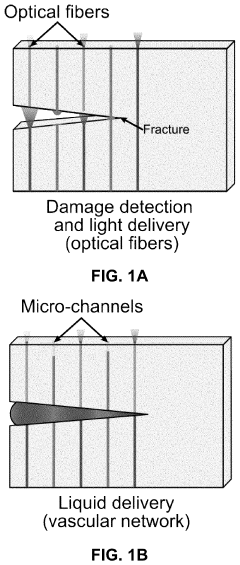
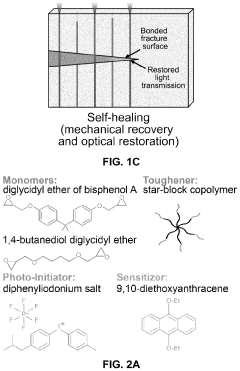
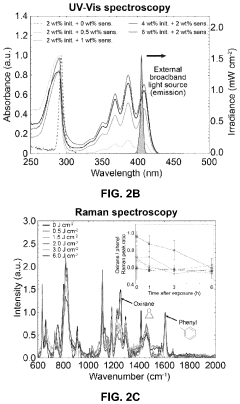
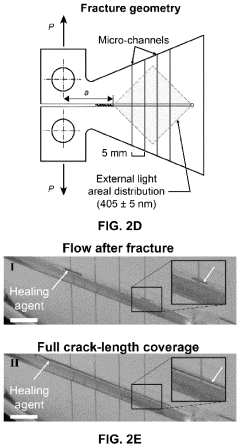
- A microvascular-based self-healing system incorporating one-part, photo-reactive chemistry with embedded optical fibers or polymer waveguides for rapid, light-activated repair, utilizing internal micro-channels for fracture-induced liquid healing agent transport to the damage zone, enabling in situ self-healing of Mode-I fractures via visible light polymerization.
Standardization Framework for Self-Healing Metrics
The establishment of a comprehensive standardization framework for self-healing metrics represents a critical foundation for advancing dual-trigger self-healing systems across industries. Current measurement approaches lack uniformity, creating significant barriers to technology adoption and cross-platform compatibility. A robust standardization framework must address fundamental measurement principles, define universal performance indicators, and establish consistent evaluation methodologies that enable meaningful comparison between different self-healing implementations.
The framework should encompass multiple measurement dimensions, including detection accuracy metrics, response time parameters, healing effectiveness ratios, and system resilience indicators. Detection accuracy requires standardized definitions for true positive rates, false alarm frequencies, and sensitivity thresholds across various trigger mechanisms. Response time standardization must account for different system architectures, from embedded sensors to distributed monitoring networks, establishing baseline expectations for acceptable latency ranges.
Healing effectiveness metrics need standardized calculation methods that consider both immediate restoration success and long-term durability outcomes. The framework should define standard test conditions, environmental parameters, and stress scenarios that enable reproducible measurements across different laboratories and industrial settings. This includes establishing protocols for accelerated aging tests, cyclic loading conditions, and multi-trigger activation sequences.
International collaboration becomes essential for framework development, requiring coordination between standards organizations, research institutions, and industry consortiums. The framework must accommodate diverse application domains while maintaining core measurement principles that ensure interoperability. Regional variations in testing conditions, material properties, and regulatory requirements necessitate flexible implementation guidelines within the overarching standardization structure.
Implementation challenges include establishing certification processes, developing reference materials, and creating validation protocols that verify measurement accuracy across different testing facilities. The framework should incorporate provisions for emerging technologies, allowing periodic updates to accommodate advancing self-healing mechanisms and novel trigger systems. Digital measurement standards, including data formats and reporting protocols, will facilitate automated analysis and cross-system performance comparisons, ultimately accelerating technology maturation and commercial deployment.
Quality Control in Self-Healing System Assessment
Quality control in self-healing system assessment represents a critical framework for ensuring the reliability and effectiveness of dual-trigger mechanisms. The establishment of rigorous quality standards begins with defining baseline performance metrics that encompass both individual trigger responses and their synergistic interactions. These standards must account for environmental variability, material degradation patterns, and the temporal dynamics of healing processes.
Standardized testing protocols form the backbone of quality assurance in dual-trigger systems. These protocols typically involve controlled laboratory conditions where each trigger mechanism is evaluated independently before assessing their combined performance. Temperature cycling, mechanical stress application, and chemical exposure tests constitute primary evaluation methods. The protocols must incorporate statistical sampling strategies to ensure representative data collection across different system configurations and operational scenarios.
Validation methodologies require multi-phase approaches that progress from component-level testing to full system integration assessments. Initial validation focuses on trigger sensitivity thresholds, response time measurements, and healing material activation rates. Subsequent phases examine cross-trigger interference, false activation prevention, and long-term stability under repeated activation cycles. Real-time monitoring systems equipped with sensors for temperature, strain, and chemical markers provide continuous validation data during operational deployment.
Certification processes for dual-trigger self-healing systems demand comprehensive documentation of performance characteristics under specified conditions. Industry standards such as ASTM and ISO frameworks provide foundational guidelines, though specialized protocols specific to self-healing technologies continue evolving. Certification typically requires demonstration of consistent performance across multiple test specimens, statistical confidence intervals for key performance indicators, and failure mode analysis documentation.
Quality metrics encompass quantitative measures including healing efficiency percentages, trigger response times, and system reliability indices. Qualitative assessments evaluate user interface effectiveness, maintenance requirements, and integration compatibility with existing infrastructure. Continuous improvement mechanisms incorporate feedback loops from field deployments, enabling iterative refinement of quality control procedures and performance benchmarks for enhanced system reliability.
Unlock deeper insights with Patsnap Eureka Quick Research — get a full tech report to explore trends and direct your research. Try now!
Generate Your Research Report Instantly with AI Agent
Supercharge your innovation with Patsnap Eureka AI Agent Platform!