

How to Reduce Cable Cross-Connection Using Color Coding Standards
AUG 6, 20269 MIN READ
Generate Your Research Report Instantly with AI Agent
Patsnap Eureka helps you evaluate technical feasibility & market potential.
Cable Cross-Connection Background and Objectives
Cable cross-connection represents a critical challenge in modern infrastructure systems, particularly in telecommunications, data centers, and industrial facilities where thousands of cables must be managed simultaneously. This issue occurs when cables are incorrectly connected to wrong terminals, ports, or equipment, leading to system failures, communication disruptions, and costly troubleshooting procedures. The complexity intensifies as network infrastructures expand, with some facilities managing over ten thousand individual cable connections. Historical data indicates that cross-connection errors account for approximately 30-40% of all network downtime incidents, resulting in significant operational losses and maintenance expenses.
The fundamental problem stems from the difficulty in visually distinguishing between numerous similar-looking cables during installation, maintenance, and troubleshooting activities. Human error becomes inevitable when technicians face dense cable bundles without clear identification systems. Traditional labeling methods using text-based tags have proven insufficient, as labels can deteriorate, become obscured, or require close inspection under poor lighting conditions. The situation worsens in emergency scenarios where rapid identification is crucial for system recovery.
Color coding standards have emerged as a promising solution to address these challenges by leveraging human visual perception capabilities. The human eye can distinguish colors more rapidly and accurately than reading text labels, especially from a distance or in suboptimal conditions. However, the effectiveness of color coding depends heavily on standardization, consistency, and proper implementation across the entire cable management lifecycle.
The primary objective of this technical research is to establish comprehensive methodologies for reducing cable cross-connection incidents through optimized color coding standards. This involves examining existing international standards, evaluating their practical effectiveness, and identifying gaps in current implementations. The research aims to develop enhanced color coding frameworks that balance visual distinctiveness, scalability for large installations, and compatibility with existing infrastructure. Additionally, the study seeks to integrate color coding with complementary technologies and establish best practices for training personnel in color-based cable identification systems, ultimately achieving measurable reductions in cross-connection error rates and associated operational costs.
Market Demand for Cable Management Solutions
The global cable management market is experiencing robust growth driven by the accelerating digital transformation across industries and the exponential expansion of data center infrastructure. Organizations worldwide are investing heavily in structured cabling systems to support increasingly complex network architectures, creating substantial demand for effective cable management solutions that prevent operational disruptions and maintain system reliability.
Cross-connection errors in cabling systems represent a critical pain point that directly impacts operational efficiency and financial performance. Misconnected cables can lead to network downtime, equipment damage, and prolonged troubleshooting periods that cost enterprises significant resources. Industries such as telecommunications, healthcare, manufacturing, and financial services are particularly vulnerable to these issues due to their reliance on continuous network availability and the complexity of their infrastructure environments.
The adoption of color coding standards has emerged as a priority solution area within the broader cable management market. End users are actively seeking standardized approaches that reduce human error during installation and maintenance activities. This demand is particularly pronounced in environments with high cable density, such as hyperscale data centers, enterprise server rooms, and telecommunications facilities where hundreds or thousands of connections must be managed simultaneously.
Regulatory compliance requirements and industry standards are further amplifying market demand for systematic cable identification methods. Organizations must adhere to standards such as TIA/EIA-606 for telecommunications infrastructure and various international standards that mandate proper cable labeling and identification. These compliance pressures are driving procurement decisions toward solutions that incorporate color coding as a fundamental component of cable management strategy.
The market is also witnessing increased demand from emerging sectors including edge computing facilities, smart building infrastructure, and industrial IoT deployments. These applications introduce new challenges in cable management due to distributed architectures and diverse equipment types, making standardized color coding systems essential for maintaining operational clarity. Service providers and system integrators are responding by developing comprehensive cable management offerings that integrate color coding standards with documentation systems and training programs to address the full spectrum of cross-connection prevention needs.
Current Cable Identification Challenges and Issues
Cable identification in modern infrastructure environments faces numerous systematic challenges that directly contribute to cross-connection incidents. The complexity of contemporary cabling systems, which often involve thousands of individual cables within a single facility, creates substantial opportunities for misidentification and improper connections. Traditional identification methods frequently prove inadequate when dealing with high-density installations where cables are bundled together in confined spaces such as cable trays, conduits, and equipment racks.
One fundamental issue stems from the inconsistent application of identification standards across different project phases and contractors. During installation, maintenance, and expansion activities, various teams may employ different labeling conventions or color schemes, leading to confusion and potential errors. This inconsistency becomes particularly problematic in facilities with legacy systems where documentation may be incomplete or outdated, forcing technicians to rely on visual inspection and interpretation of existing markings.
Environmental factors significantly compound identification difficulties. Cable jackets and labels deteriorate over time due to exposure to temperature fluctuations, moisture, UV radiation, and chemical contaminants. Fading colors, peeling labels, and physical damage to cable surfaces render original identification markings illegible or ambiguous. In industrial settings, accumulated dust, oil, and other substances can obscure color coding entirely, necessitating physical cleaning before accurate identification becomes possible.
The human factor introduces additional complexity to cable identification challenges. Color perception varies among individuals, with approximately eight percent of males experiencing some form of color vision deficiency. Under poor lighting conditions or when viewing cables from awkward angles during installation or troubleshooting, even individuals with normal color vision may struggle to distinguish between similar hues. Time pressure during critical maintenance windows further increases the likelihood of misidentification errors.
Documentation gaps represent another critical challenge. Many facilities lack comprehensive cable management databases that correlate physical cable locations with their functional purposes and termination points. When drawings and records fail to reflect field modifications or are not updated following changes, technicians must rely heavily on physical identification methods, increasing dependency on potentially compromised color coding systems and raising the risk of cross-connection incidents.
Existing Color Coding Solutions for Cable Management
01 Cross-connection structures for cable terminals and connectors
Cable cross-connection systems utilize specialized terminal structures and connector designs to enable efficient interconnection between multiple cables. These structures typically include insulation displacement contacts, terminal blocks, and modular connector assemblies that facilitate quick and reliable cross-connections. The designs focus on maintaining signal integrity while allowing flexible routing and connection configurations for telecommunications and data transmission applications.- Cross-connection structures for cable terminals and connectors: Cable cross-connection systems utilize specialized terminal structures and connector designs to enable efficient interconnection between multiple cables. These structures typically include insulation displacement contacts, terminal blocks, and modular connector assemblies that facilitate quick and reliable cross-connections. The designs focus on maintaining signal integrity while allowing flexible routing and connection configurations for telecommunications and data transmission applications.
- Cross-connection devices with improved contact mechanisms: Advanced contact mechanisms are employed in cable cross-connection devices to ensure stable electrical connections and reduce contact resistance. These mechanisms include spring-loaded contacts, pressure contact systems, and self-cleaning contact surfaces that maintain connection quality over time. The designs address issues of contact reliability, durability, and ease of maintenance in cross-connection applications.
- Modular cross-connection systems for cable management: Modular cross-connection systems provide flexible and scalable solutions for cable management in telecommunications infrastructure. These systems feature interchangeable modules, standardized interfaces, and organized cable routing pathways that simplify installation and reconfiguration. The modular approach enables efficient space utilization and facilitates future expansion or modifications to the cable network.
- Cross-connection assemblies with enhanced sealing and protection: Cable cross-connection assemblies incorporate protective features such as sealed housings, moisture barriers, and environmental protection to ensure reliable operation in various conditions. These designs include waterproof enclosures, dust-resistant covers, and strain relief mechanisms that protect the connection points from external factors. The protective measures extend the service life and maintain performance in outdoor or harsh environment applications.
- High-density cross-connection solutions for space optimization: High-density cross-connection solutions maximize the number of cable connections within limited space through compact designs and efficient layout arrangements. These solutions employ miniaturized components, multi-layer connection structures, and optimized spacing configurations to achieve higher port density. The designs are particularly suitable for data centers, telecommunications facilities, and other applications requiring numerous cable interconnections in confined areas.
02 Cross-connection devices with improved contact mechanisms
Advanced contact mechanisms are employed in cable cross-connection devices to ensure stable electrical connections and reduce contact resistance. These mechanisms include spring-loaded contacts, pressure contact systems, and self-cleaning contact surfaces that maintain connection quality over time. The designs address issues of contact reliability, insertion force reduction, and prevention of contact degradation in high-density cross-connection environments.Expand Specific Solutions03 Modular cross-connection systems for cable management
Modular cross-connection systems provide scalable and flexible solutions for cable management in telecommunications infrastructure. These systems feature interchangeable modules, standardized interfaces, and tool-less installation capabilities that simplify network reconfiguration and expansion. The modular approach enables efficient space utilization and facilitates maintenance operations in data centers and communication facilities.Expand Specific Solutions04 Cross-connection assemblies with enhanced sealing and protection
Cable cross-connection assemblies incorporate protective features such as waterproof seals, dust covers, and environmental shielding to ensure reliable operation in harsh conditions. These designs include gasket systems, protective housings, and strain relief mechanisms that prevent moisture ingress and mechanical damage. The protection features are particularly important for outdoor installations and industrial environments where cables are exposed to environmental stresses.Expand Specific Solutions05 High-density cross-connection panels and distribution frames
High-density cross-connection solutions maximize port density while maintaining accessibility and cable management efficiency. These systems employ compact connector arrangements, vertical and horizontal cable routing guides, and labeling systems that support large-scale telecommunications infrastructure. The designs optimize space utilization in equipment rooms and enable organized cable pathways for complex network topologies.Expand Specific Solutions
Key Players in Cable and Connectivity Industry
The cable cross-connection color coding standards market is experiencing steady growth driven by increasing infrastructure complexity and safety requirements across telecommunications, automotive, and power distribution sectors. The competitive landscape spans from mature technology leaders to specialized manufacturers, with market size expanding particularly in Asia-Pacific regions. Technology maturity varies significantly among players: established electronics giants like Sony Group Corp., Toshiba Corp., and Fujitsu Ltd. leverage advanced color coding systems within broader product portfolios, while specialized cable manufacturers such as Sumitomo Wiring Systems Ltd., Hitachi Cable Ltd., and Guangzhou Panyu Cable Group Co., Ltd. focus on standardized implementation. Infrastructure providers including CommScope Technologies LLC and telecommunications veterans like Nokia Telecommunications Oy and Nortel Networks Corp. integrate color coding into network solutions. The industry shows consolidation trends with semiconductor companies like Advanced Micro Devices Inc. and Socionext Inc. contributing to smart identification technologies, while regional players like CRRC Qingdao Sifang Co., Ltd. and State Grid entities drive adoption in transportation and power sectors, indicating a maturing market transitioning toward intelligent, automated cable management systems.
Sumitomo Wiring Systems Ltd.
Technical Solution: Sumitomo Wiring Systems implements comprehensive color coding standards for automotive wiring harnesses to prevent cable cross-connection errors. Their technical solution incorporates standardized color schemes aligned with international automotive standards (ISO 6722), utilizing distinct color combinations for different circuit functions such as power supply, ground, signal transmission, and safety-critical systems. The company employs dual-color striping techniques where primary and secondary colors create unique identifiable patterns for complex harness assemblies. Additionally, they integrate color-coded connector housings and terminal seals that match corresponding wire colors, creating a visual verification system throughout the assembly process. Their manufacturing process includes automated optical inspection systems that verify correct color coding before final assembly, reducing human error in high-volume production environments.
Strengths: Automotive industry expertise with proven track record in high-reliability applications; integrated approach combining wire, connector, and terminal color coordination. Weaknesses: Solutions primarily optimized for automotive applications may require adaptation for other industries; reliance on standardized colors may face limitations in extremely complex systems requiring numerous circuit distinctions.
Guangzhou Panyu Cable Group Co., Ltd
Technical Solution: Guangzhou Panyu Cable Group has developed color coding standards for power and control cables widely used in Chinese electrical infrastructure projects to reduce cross-connection errors. Their solution aligns with Chinese national standards (GB/T) while incorporating international IEC color coding principles for broader compatibility. The company implements distinct color schemes for different voltage levels and applications: low-voltage power cables use standardized phase colors (brown/black/grey for phases, blue for neutral, yellow-green for ground), while control cables employ sequential color coding for multi-core configurations. For complex installations, they utilize combination color coding where base colors are supplemented with numerical printing or tracer stripes. Their manufacturing process ensures color consistency through quality control measures including colorimetric testing to maintain uniform color appearance across production batches, which is critical for large-scale projects where cables from different production runs must be visually coordinated.
Strengths: Strong alignment with Chinese national standards making them preferred supplier for domestic infrastructure projects; cost-effective solutions suitable for large-scale deployments. Weaknesses: International market presence limited compared to global competitors; color coding systems may require adaptation when integrating with non-Chinese standard systems in international projects.
Core Innovations in Cable Identification Technologies
Color coding system for fiberoptic cables and illuminator cable ports
PatentInactiveUS7024088B1
Innovation
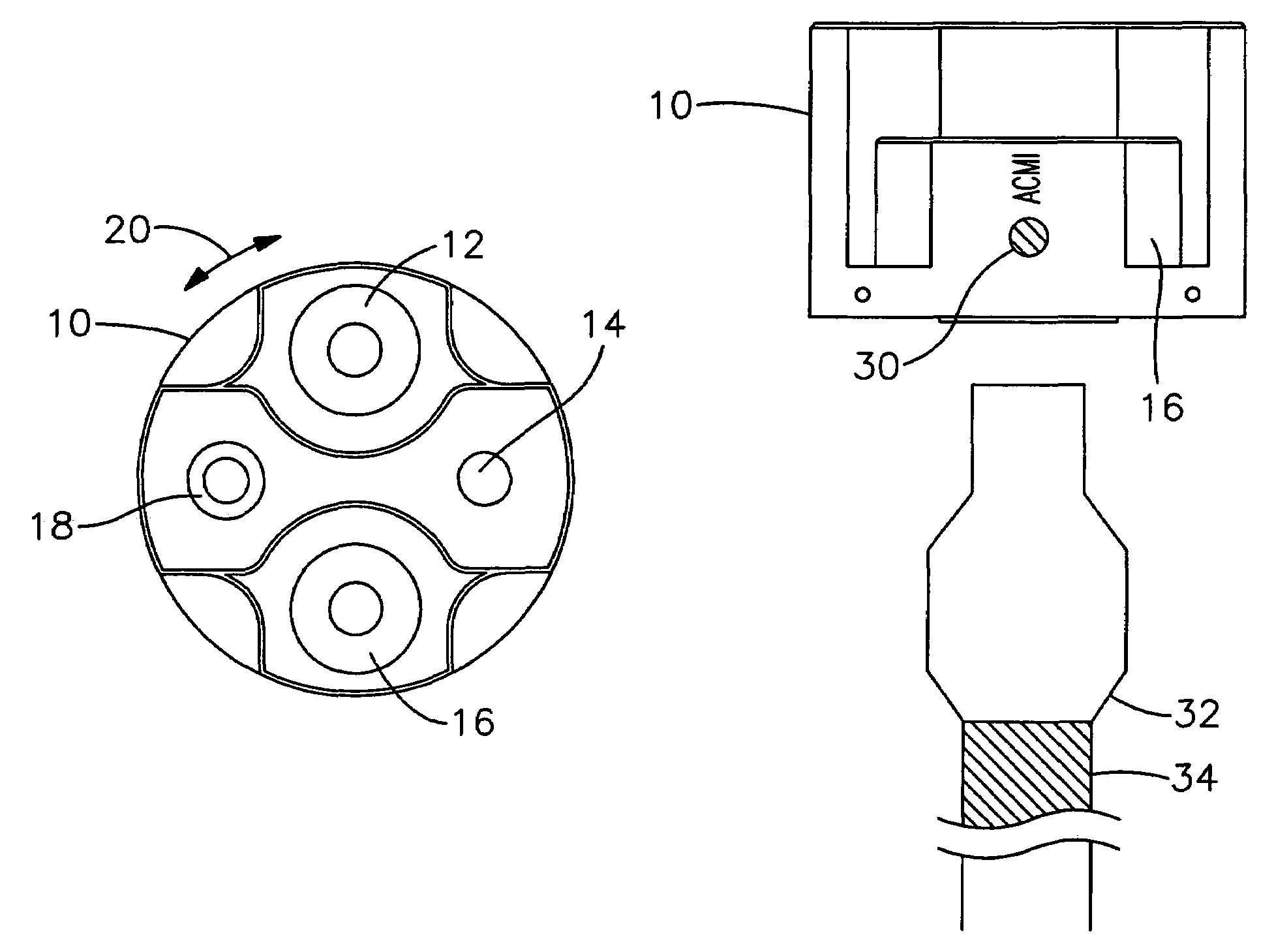
- A color coding system is implemented for both fiberoptic cable end fittings and illuminator ports, using distinct color indicators on the ports and cables to ensure correct matching, with buttons or colored sheathing/shrink-wraps indicating compatible pairs.


System and method for connecting color coded cables to a device
PatentInactiveUS5775935A
Innovation
- A color coded alignment system with a recessed portion and a color coded alignment strip that fits within or around the electrical connection ports, ensuring alignment and preventing accidental removal, using color coded cables or tags to match specific ports, facilitating easy connection by users.


Industry Standards and Compliance Requirements
The implementation of color coding standards for cable management is fundamentally governed by a comprehensive framework of industry standards and compliance requirements that span multiple jurisdictions and application domains. These standards serve as the foundation for preventing cross-connection errors by establishing universally recognized visual identification systems. The telecommunications and electrical industries have developed rigorous specifications that mandate specific color schemes for different cable types, voltage levels, and functional categories, ensuring consistency across installations and reducing the likelihood of misidentification during installation, maintenance, or troubleshooting operations.
At the international level, the International Electrotechnical Commission (IEC) provides baseline standards such as IEC 60446 and IEC 60757, which define color coding principles for conductors and cables across various applications. These standards establish fundamental requirements for color differentiation, including specifications for hue, saturation, and contrast ratios to ensure visibility under different lighting conditions. The American National Standards Institute (ANSI) and the Telecommunications Industry Association (TIA) have developed complementary standards, particularly TIA-606-C, which specifically addresses administration standards for telecommunications infrastructure, including detailed color coding schemes for horizontal and backbone cabling systems.
Regional regulatory bodies impose additional compliance requirements that must be integrated into cable management practices. The European Union's Low Voltage Directive and Construction Products Regulation mandate conformity with harmonized standards for electrical installations, while North American installations must comply with the National Electrical Code (NEC) Article 310, which specifies conductor identification requirements. These regulations carry legal weight and non-compliance can result in installation rejection, safety violations, and liability issues.
Industry-specific standards further refine color coding requirements for specialized applications. Data center operations typically follow standards from organizations such as the Uptime Institute and BICSI, which provide detailed guidelines for structured cabling systems. Healthcare facilities must adhere to additional requirements outlined in NFPA 99, which addresses medical gas systems and critical power distribution. Similarly, industrial environments reference ISA standards for instrumentation and control systems, where color coding plays a crucial role in preventing hazardous cross-connections.
Compliance verification mechanisms include third-party certification programs, mandatory inspections, and documentation requirements that ensure adherence to applicable standards throughout the cable lifecycle. Organizations must maintain detailed records demonstrating conformity with relevant standards, including cable specifications, installation procedures, and periodic audit results to satisfy regulatory obligations and industry best practices.
Human Factors in Cable Installation and Maintenance
The human element represents a critical yet often underestimated factor in cable installation and maintenance operations. Despite the existence of well-defined color coding standards, human error remains the primary cause of cable cross-connections in data centers, telecommunications facilities, and industrial environments. Research indicates that approximately 70% of cable misconnections stem from human factors rather than technical limitations of color coding systems themselves.
Installation personnel face numerous cognitive challenges during cable deployment. Visual fatigue occurs when technicians work extended hours in environments with inadequate lighting or when distinguishing between similar color shades under time pressure. The human eye's ability to differentiate colors diminishes significantly under stress, fatigue, or poor illumination conditions. Additionally, color vision deficiencies affect approximately 8% of male workers and 0.5% of female workers, creating inherent vulnerabilities in systems relying solely on color differentiation.
Training quality and consistency directly impact the effectiveness of color coding implementation. Many organizations provide insufficient initial training on color coding standards, and refresher courses are rarely conducted. Field observations reveal that experienced technicians sometimes develop informal practices that deviate from established standards, inadvertently creating confusion for other team members. The absence of standardized certification programs for cable installation personnel further exacerbates this issue.
Communication breakdowns between design teams, installation crews, and maintenance staff contribute significantly to cross-connection incidents. Documentation practices vary widely across organizations, with some relying on outdated or incomplete cable identification records. When multiple contractors participate in installation projects, inconsistent interpretation of color coding standards frequently occurs due to different training backgrounds and organizational practices.
Workplace environmental factors also influence human performance during cable operations. High-density cable environments create visual complexity that overwhelms cognitive processing capabilities. Time pressures during installation or emergency maintenance situations force technicians to make rapid decisions, increasing error probability. Furthermore, inadequate verification procedures and quality control checkpoints allow mistakes to propagate through installation phases without detection until operational failures occur.
Unlock deeper insights with Patsnap Eureka Quick Research — get a full tech report to explore trends and direct your research. Try now!
Generate Your Research Report Instantly with AI Agent
Supercharge your innovation with Patsnap Eureka AI Agent Platform!