How to Stabilize Multijunction Solar Cell Output Under UV Dose
MAY 5, 20268 MIN READ
Generate Your Research Report Instantly with AI Agent
PatSnap Eureka helps you evaluate technical feasibility & market potential.
Multijunction Solar Cell UV Stability Background and Goals
Multijunction solar cells represent a pinnacle achievement in photovoltaic technology, utilizing multiple semiconductor layers with different bandgaps to capture a broader spectrum of solar radiation. These sophisticated devices have evolved from single-junction silicon cells to complex structures incorporating III-V compound semiconductors such as gallium arsenide, indium gallium phosphide, and germanium. The layered architecture enables theoretical efficiencies exceeding 40% under concentrated sunlight, making them particularly valuable for space applications and high-performance terrestrial systems.
The development trajectory of multijunction technology spans several decades, beginning with early tandem cell concepts in the 1970s and progressing through successive generations of improved materials and manufacturing processes. Current state-of-the-art devices feature triple and quadruple junction configurations, with research extending toward five and six-junction architectures. This evolution has been driven by the fundamental limitation of single-junction cells, which can only efficiently convert photons within a narrow energy range.
However, the sophisticated material composition that enables superior efficiency also introduces vulnerability to ultraviolet radiation exposure. UV photons carry sufficient energy to create defects in semiconductor crystal structures, leading to degradation mechanisms that compromise long-term performance. Space-based applications face particularly severe UV exposure from unfiltered solar radiation, while terrestrial installations encounter cumulative UV stress over operational lifetimes spanning 20-25 years.
The primary technical challenge lies in maintaining stable electrical output characteristics despite continuous UV bombardment. Degradation manifests through multiple pathways including displacement damage in semiconductor lattices, surface passivation layer deterioration, and interconnect material degradation. These effects result in reduced short-circuit current, decreased open-circuit voltage, and increased series resistance, ultimately diminishing power conversion efficiency.
Current research objectives focus on developing comprehensive stabilization strategies that address both material-level and system-level vulnerabilities. Key goals include identifying optimal protective coating materials, developing UV-resistant semiconductor compositions, and implementing advanced encapsulation techniques. Additionally, understanding the fundamental physics of UV-induced degradation mechanisms enables predictive modeling for lifetime assessment and reliability optimization.
The strategic importance of solving UV stability challenges extends beyond performance preservation to economic viability. Enhanced durability directly impacts levelized cost of electricity calculations, making multijunction technology more competitive across diverse market segments. Furthermore, improved UV resistance enables deployment in harsh environmental conditions previously considered unsuitable for high-efficiency photovoltaic systems.
The development trajectory of multijunction technology spans several decades, beginning with early tandem cell concepts in the 1970s and progressing through successive generations of improved materials and manufacturing processes. Current state-of-the-art devices feature triple and quadruple junction configurations, with research extending toward five and six-junction architectures. This evolution has been driven by the fundamental limitation of single-junction cells, which can only efficiently convert photons within a narrow energy range.
However, the sophisticated material composition that enables superior efficiency also introduces vulnerability to ultraviolet radiation exposure. UV photons carry sufficient energy to create defects in semiconductor crystal structures, leading to degradation mechanisms that compromise long-term performance. Space-based applications face particularly severe UV exposure from unfiltered solar radiation, while terrestrial installations encounter cumulative UV stress over operational lifetimes spanning 20-25 years.
The primary technical challenge lies in maintaining stable electrical output characteristics despite continuous UV bombardment. Degradation manifests through multiple pathways including displacement damage in semiconductor lattices, surface passivation layer deterioration, and interconnect material degradation. These effects result in reduced short-circuit current, decreased open-circuit voltage, and increased series resistance, ultimately diminishing power conversion efficiency.
Current research objectives focus on developing comprehensive stabilization strategies that address both material-level and system-level vulnerabilities. Key goals include identifying optimal protective coating materials, developing UV-resistant semiconductor compositions, and implementing advanced encapsulation techniques. Additionally, understanding the fundamental physics of UV-induced degradation mechanisms enables predictive modeling for lifetime assessment and reliability optimization.
The strategic importance of solving UV stability challenges extends beyond performance preservation to economic viability. Enhanced durability directly impacts levelized cost of electricity calculations, making multijunction technology more competitive across diverse market segments. Furthermore, improved UV resistance enables deployment in harsh environmental conditions previously considered unsuitable for high-efficiency photovoltaic systems.
Market Demand for UV-Resistant Solar Technologies
The global photovoltaic market has witnessed unprecedented growth, with space applications representing one of the most demanding segments for solar cell reliability. Multijunction solar cells, particularly those deployed in satellite missions and high-altitude platforms, face severe ultraviolet radiation exposure that significantly impacts their long-term performance. The space industry's expansion, driven by increasing satellite constellations for telecommunications, Earth observation, and navigation services, has created substantial demand for UV-resistant solar technologies.
Commercial space ventures and government space programs require solar cells that maintain stable power output throughout mission lifespans extending from five to fifteen years. The degradation of solar cell performance under UV exposure directly translates to mission risk and increased operational costs. Satellite operators are increasingly prioritizing power system reliability as a critical factor in mission success, driving demand for advanced UV-resistant solutions.
The terrestrial solar market also presents significant opportunities for UV-resistant multijunction technologies. High-altitude installations, desert environments, and regions with intense solar irradiation experience accelerated UV-induced degradation. Concentrated photovoltaic systems, which utilize multijunction cells for enhanced efficiency, particularly benefit from improved UV stability as they operate under magnified solar exposure conditions.
Emerging applications in unmanned aerial vehicles, stratospheric platforms, and solar-powered aircraft represent growing market segments where UV resistance is paramount. These platforms operate at altitudes with reduced atmospheric UV filtering, creating harsh operating conditions similar to space environments. The increasing deployment of high-altitude pseudo-satellites for telecommunications and surveillance applications has generated specific demand for lightweight, efficient, and UV-stable solar solutions.
The market demand extends beyond traditional photovoltaic applications to include specialized sectors such as polar research stations, high-mountain installations, and marine environments where UV exposure is intensified by reflection from snow and water surfaces. These applications require solar technologies that maintain consistent performance despite extreme UV conditions, creating niche but valuable market opportunities for advanced multijunction solar cell technologies with enhanced UV resistance capabilities.
Commercial space ventures and government space programs require solar cells that maintain stable power output throughout mission lifespans extending from five to fifteen years. The degradation of solar cell performance under UV exposure directly translates to mission risk and increased operational costs. Satellite operators are increasingly prioritizing power system reliability as a critical factor in mission success, driving demand for advanced UV-resistant solutions.
The terrestrial solar market also presents significant opportunities for UV-resistant multijunction technologies. High-altitude installations, desert environments, and regions with intense solar irradiation experience accelerated UV-induced degradation. Concentrated photovoltaic systems, which utilize multijunction cells for enhanced efficiency, particularly benefit from improved UV stability as they operate under magnified solar exposure conditions.
Emerging applications in unmanned aerial vehicles, stratospheric platforms, and solar-powered aircraft represent growing market segments where UV resistance is paramount. These platforms operate at altitudes with reduced atmospheric UV filtering, creating harsh operating conditions similar to space environments. The increasing deployment of high-altitude pseudo-satellites for telecommunications and surveillance applications has generated specific demand for lightweight, efficient, and UV-stable solar solutions.
The market demand extends beyond traditional photovoltaic applications to include specialized sectors such as polar research stations, high-mountain installations, and marine environments where UV exposure is intensified by reflection from snow and water surfaces. These applications require solar technologies that maintain consistent performance despite extreme UV conditions, creating niche but valuable market opportunities for advanced multijunction solar cell technologies with enhanced UV resistance capabilities.
Current UV Degradation Challenges in Multijunction Cells
Multijunction solar cells face significant degradation challenges when exposed to ultraviolet radiation, particularly in space applications where UV exposure is intense and prolonged. The primary degradation mechanism involves UV-induced damage to the semiconductor materials, which manifests as decreased carrier mobility, increased recombination rates, and altered bandgap properties across different junction layers.
The top cell layer, typically composed of InGaP or similar wide-bandgap materials, experiences the most severe UV degradation due to its direct exposure to high-energy photons. UV radiation creates defect states within the crystal lattice, leading to non-radiative recombination centers that reduce photocurrent generation. These defects accumulate over time, causing progressive deterioration in cell performance that can exceed 10% power loss after extended UV exposure.
Interface degradation represents another critical challenge, where UV radiation affects the tunnel junctions between subcells. The high-energy photons can alter the doping profiles and create interface states that impede carrier transport between layers. This phenomenon is particularly problematic in InGaP/GaAs and GaAs/Ge interfaces, where UV-induced changes in band alignment can significantly impact overall cell efficiency.
Encapsulant materials and anti-reflective coatings also suffer from UV degradation, developing optical losses through discoloration, delamination, and surface roughening. These changes reduce light transmission to the active layers and alter the optical coupling between subcells, disrupting the current-matching requirements essential for optimal multijunction performance.
Temperature-accelerated degradation compounds UV-related challenges, as space environments subject cells to thermal cycling while under UV stress. This combination accelerates defect formation and migration, leading to more rapid performance degradation than either stressor alone. The differential thermal expansion between materials can also create mechanical stress that exacerbates UV-induced damage.
Current mitigation strategies show limited effectiveness against prolonged UV exposure. Traditional UV-filtering coverglass provides some protection but cannot eliminate all damaging wavelengths without compromising useful light transmission. Surface passivation techniques offer temporary improvement but often degrade under continued UV bombardment, requiring more robust and permanent solutions for long-term space missions.
The top cell layer, typically composed of InGaP or similar wide-bandgap materials, experiences the most severe UV degradation due to its direct exposure to high-energy photons. UV radiation creates defect states within the crystal lattice, leading to non-radiative recombination centers that reduce photocurrent generation. These defects accumulate over time, causing progressive deterioration in cell performance that can exceed 10% power loss after extended UV exposure.
Interface degradation represents another critical challenge, where UV radiation affects the tunnel junctions between subcells. The high-energy photons can alter the doping profiles and create interface states that impede carrier transport between layers. This phenomenon is particularly problematic in InGaP/GaAs and GaAs/Ge interfaces, where UV-induced changes in band alignment can significantly impact overall cell efficiency.
Encapsulant materials and anti-reflective coatings also suffer from UV degradation, developing optical losses through discoloration, delamination, and surface roughening. These changes reduce light transmission to the active layers and alter the optical coupling between subcells, disrupting the current-matching requirements essential for optimal multijunction performance.
Temperature-accelerated degradation compounds UV-related challenges, as space environments subject cells to thermal cycling while under UV stress. This combination accelerates defect formation and migration, leading to more rapid performance degradation than either stressor alone. The differential thermal expansion between materials can also create mechanical stress that exacerbates UV-induced damage.
Current mitigation strategies show limited effectiveness against prolonged UV exposure. Traditional UV-filtering coverglass provides some protection but cannot eliminate all damaging wavelengths without compromising useful light transmission. Surface passivation techniques offer temporary improvement but often degrade under continued UV bombardment, requiring more robust and permanent solutions for long-term space missions.
Existing UV Mitigation Solutions for Solar Cells
01 Temperature compensation and thermal management systems
Multijunction solar cells require sophisticated thermal management to maintain stable output performance across varying temperature conditions. Temperature compensation techniques involve the use of thermal sensors, heat dissipation structures, and active cooling systems to prevent performance degradation. These systems help maintain optimal operating temperatures and reduce thermal stress that can affect the stability of individual junction layers.- Temperature compensation and thermal management systems: Multijunction solar cells require sophisticated thermal management to maintain output stability across varying temperature conditions. Temperature compensation techniques involve the use of thermal sensors, heat dissipation structures, and active cooling systems to prevent performance degradation. These systems help maintain consistent electrical output by controlling the operating temperature of the solar cell junctions and preventing thermal-induced efficiency losses.
- Current matching and junction optimization: Achieving stable output in multijunction solar cells requires precise current matching between different junction layers. This involves optimizing the bandgap engineering, layer thickness, and material composition of each subcell to ensure balanced current generation. Advanced junction designs and buffer layers help minimize current mismatch losses and improve overall stability under varying illumination conditions.
- Encapsulation and protective coating technologies: Long-term output stability of multijunction solar cells depends on effective encapsulation materials and protective coatings that shield the active layers from environmental degradation. These protective systems prevent moisture ingress, UV damage, and chemical corrosion while maintaining optical transparency. Advanced encapsulation techniques include multilayer barrier films and hermetic sealing methods that preserve cell performance over extended operational periods.
- Power conditioning and maximum power point tracking: Maintaining stable output requires sophisticated power conditioning circuits and maximum power point tracking algorithms specifically designed for multijunction cells. These systems continuously monitor and adjust the operating point to extract maximum power under varying irradiance and spectral conditions. Advanced control algorithms compensate for spectral variations and ensure optimal power extraction from each junction layer.
- Spectral response optimization and anti-reflective coatings: Output stability enhancement involves optimizing the spectral response of each junction through advanced anti-reflective coatings and optical management structures. These technologies improve light coupling efficiency and reduce reflection losses across the entire solar spectrum. Specialized coating systems and surface texturing techniques help maintain consistent photon absorption and minimize spectral sensitivity variations that could affect output stability.
02 Current matching and electrical balancing techniques
Maintaining stable output requires precise current matching between different junction layers in multijunction solar cells. Electrical balancing techniques include the use of bypass circuits, current limiting devices, and impedance matching networks to ensure uniform current distribution. These methods prevent current mismatch that can lead to reduced efficiency and long-term stability issues.Expand Specific Solutions03 Anti-reflective coatings and optical optimization
Optical stability is achieved through advanced anti-reflective coatings and surface treatments that maintain consistent light absorption across the solar spectrum. These coatings are designed to resist degradation from environmental factors while optimizing light transmission to each junction layer. Surface texturing and optical enhancement techniques also contribute to maintaining stable photon absorption over time.Expand Specific Solutions04 Encapsulation and protective barrier systems
Long-term output stability depends on robust encapsulation materials and protective barriers that shield the multijunction structure from environmental degradation. These systems include moisture barriers, UV-resistant polymers, and hermetic sealing techniques that prevent contamination and material degradation. Advanced encapsulation methods also incorporate stress-relief mechanisms to accommodate thermal expansion differences between layers.Expand Specific Solutions05 Junction interface engineering and material stability
Stable output performance requires careful engineering of junction interfaces and selection of materials with long-term stability characteristics. This includes the use of buffer layers, graded compositions, and lattice-matched materials to minimize defect formation and interface degradation. Material engineering focuses on preventing interdiffusion, maintaining crystalline quality, and ensuring stable electronic properties over extended operating periods.Expand Specific Solutions
Key Players in Multijunction Solar Cell Industry
The multijunction solar cell UV stabilization market represents an emerging yet critical segment within the broader space-grade photovoltaic industry, currently in its early development phase with significant growth potential driven by increasing satellite deployment and space exploration missions. The market remains relatively niche but is expanding rapidly, with estimated values reaching hundreds of millions globally as demand for radiation-hardened solar solutions intensifies. Technology maturity varies considerably across key players, with established aerospace companies like Boeing and specialized manufacturers such as SolAero Technologies and AZUR Space demonstrating advanced capabilities in radiation-resistant cell design. Meanwhile, semiconductor leaders including Sharp, Panasonic, and various Chinese manufacturers like Xiamen Changelight are leveraging their optoelectronic expertise to develop UV-stable solutions, though most remain in R&D phases for space applications.
SolAero Technologies Corp.
Technical Solution: SolAero has developed advanced multijunction solar cell technologies specifically designed for space applications where UV radiation exposure is extreme. Their approach focuses on implementing radiation-hardened cell designs with enhanced cover glass systems and specialized anti-reflective coatings that maintain optical properties under prolonged UV exposure. The company utilizes triple-junction InGaP/GaAs/Ge cell architectures with optimized tunnel junctions that demonstrate improved stability under UV dose conditions. Their cells incorporate advanced passivation layers and surface treatments that minimize UV-induced degradation mechanisms, maintaining power output efficiency above 85% even after extended UV exposure equivalent to 15-year space missions.
Strengths: Proven space-grade radiation hardening expertise, extensive UV testing capabilities, high-efficiency cell designs. Weaknesses: High manufacturing costs, limited terrestrial applications, complex production processes.
AZUR Space Solar Power GmbH
Technical Solution: AZUR Space has developed sophisticated multijunction solar cell stabilization techniques focusing on lattice-matched and metamorphic cell structures that resist UV-induced degradation. Their technology employs advanced epitaxial growth processes to create buffer layers that absorb harmful UV radiation while maintaining electrical performance. The company's approach includes implementing graded buffer layers in their 4-junction and 6-junction cell designs, which provide enhanced UV tolerance through optimized bandgap engineering. Their cells feature specialized window layers with high aluminum content that act as UV filters, protecting the active regions from photodegradation while maintaining high conversion efficiency under standard operating conditions.
Strengths: Leading European space solar technology, advanced epitaxial capabilities, strong R&D partnerships. Weaknesses: Limited production capacity, high development costs, long qualification cycles.
Core Innovations in UV-Resistant Cell Design
Method of production of silicon heterojunction solar cells with stabilization step and production line section for the stabilizing step
PatentInactiveUS20220149225A1
Innovation
- Incorporating a stabilization step that involves heating the solar cells above 200°C combined with illumination from a light source emitting 8000 Ws/m², utilizing high-intensity light sources like LEDs or halogen lamps, to stabilize the solar cells by promoting stable bond states and hydrogen diffusion, thereby reducing degradation and enhancing efficiency.
Radiation resistant inverted metamorphic multijunction solar cell
PatentInactiveUS20180138349A1
Innovation
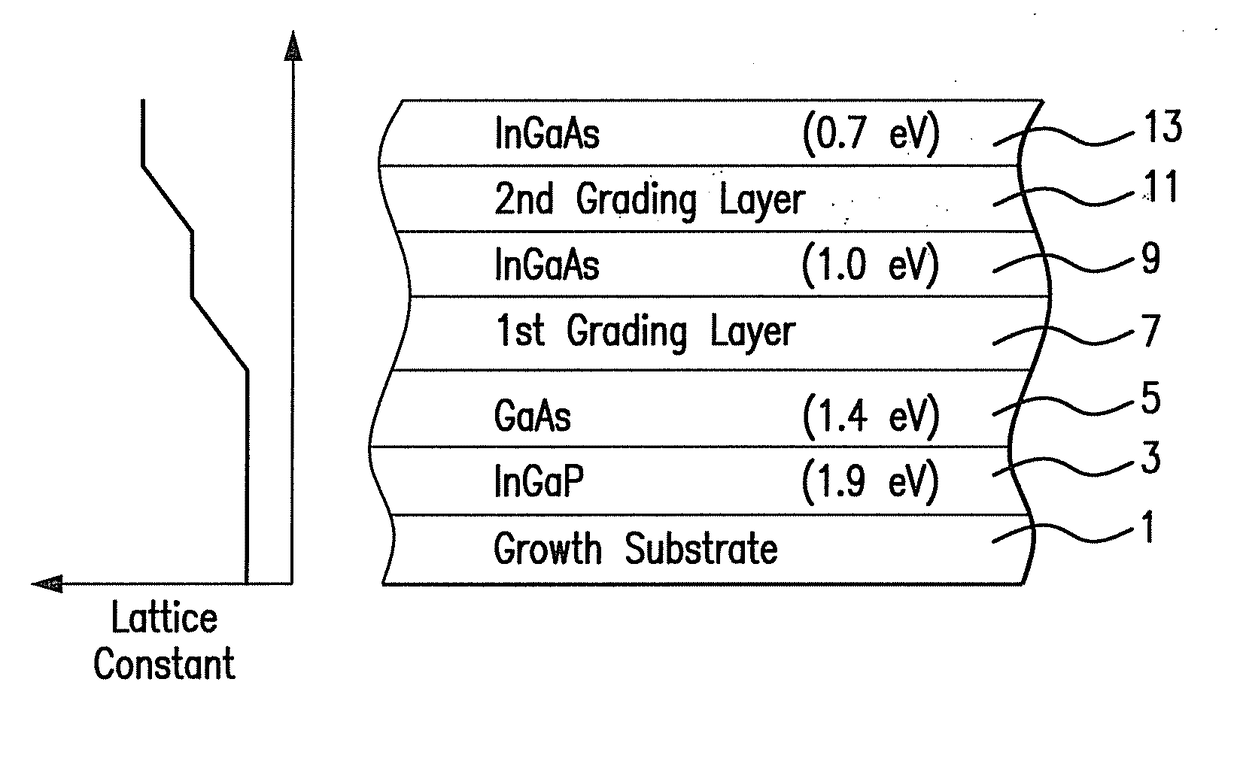
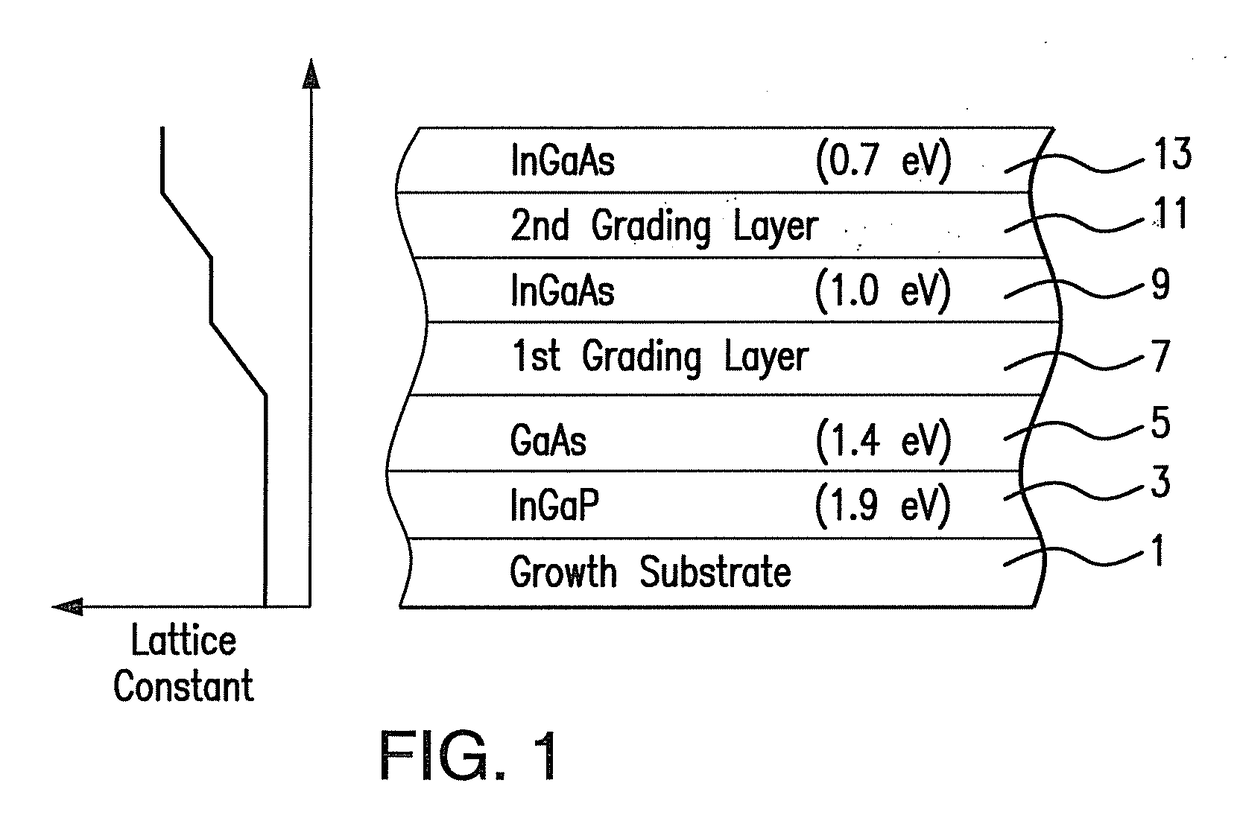
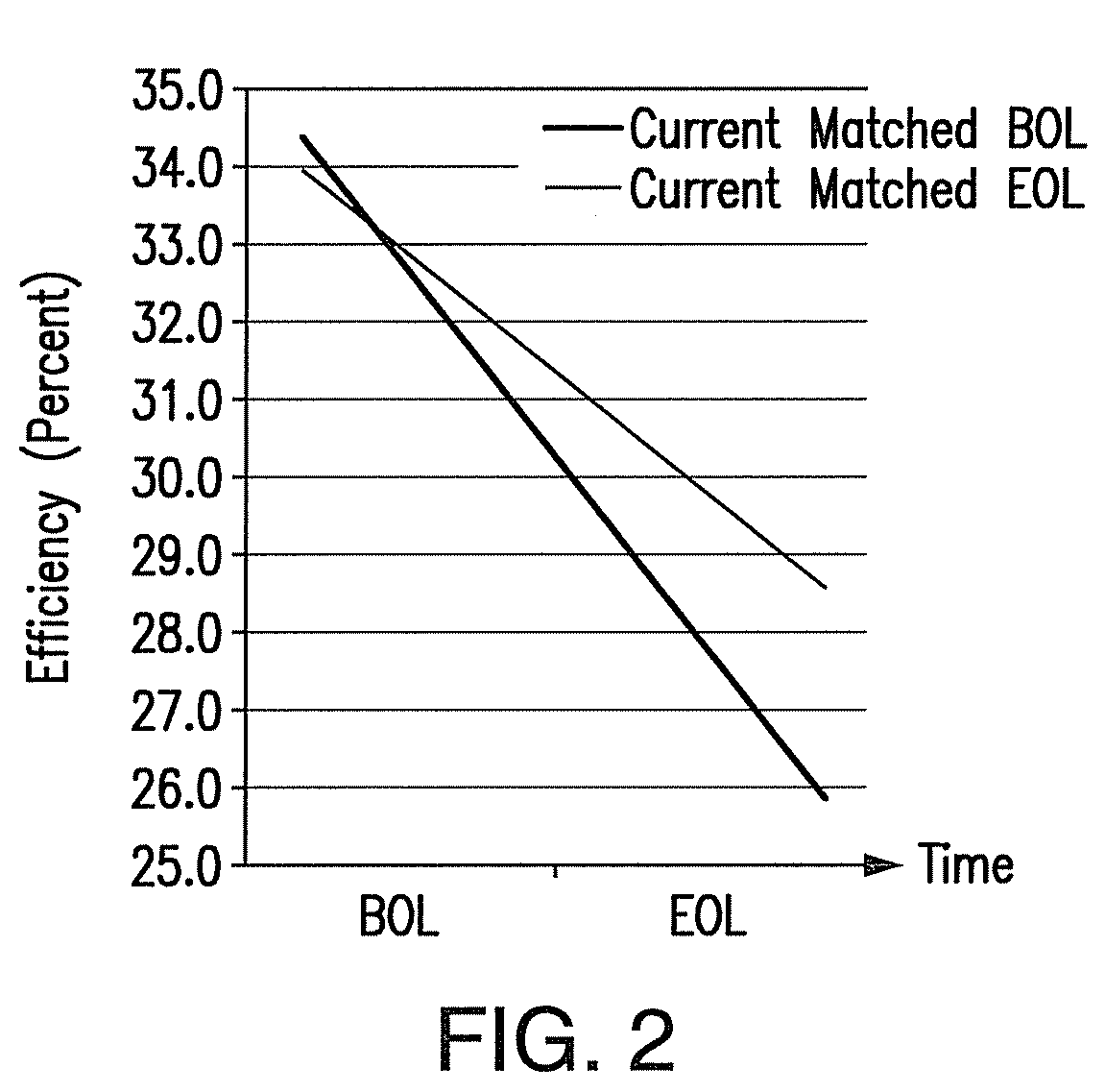
- Introducing a mismatch in the short circuit currents of the solar subcells at the beginning of life, with the lower band gap InGaAs subcell having a reduced short circuit current compared to the higher band gap InGaAs subcell, and optimizing subcell thickness and band gap to ensure matching currents by the end of life, thereby enhancing radiation resistance and overall efficiency.

Space Environment Testing Standards and Protocols
Space environment testing for multijunction solar cells requires adherence to rigorous international standards that simulate the harsh conditions encountered in orbital missions. The primary testing protocols are governed by ASTM E512, IEC 62446, and NASA-STD-4005, which establish comprehensive frameworks for evaluating photovoltaic performance under space radiation exposure. These standards specifically address ultraviolet radiation testing, thermal cycling, and particle bombardment scenarios that directly impact solar cell stability.
The European Space Agency's ECSS-E-ST-20-08C standard provides detailed methodologies for UV dose testing, requiring continuous irradiation at wavelengths between 200-400 nanometers with intensity levels ranging from 10 to 100 equivalent sun hours per day. Testing protocols mandate exposure durations extending up to 15 years equivalent mission time, with performance measurements recorded at predetermined intervals to track degradation patterns. Temperature cycling between -180°C and +120°C must be conducted simultaneously with UV exposure to replicate realistic orbital conditions.
Standardized test equipment specifications include xenon arc lamps with appropriate filtering systems to match the solar spectrum, calibrated UV radiometers for dose monitoring, and environmental chambers capable of maintaining vacuum conditions below 10^-6 Torr. The testing sequence typically involves initial baseline measurements, followed by incremental UV dose applications with intermediate performance evaluations to establish degradation curves and identify critical failure thresholds.
Quality assurance protocols require traceability to national measurement standards, with calibration certificates for all testing equipment updated annually. Statistical sampling methods must follow MIL-STD-1916 guidelines, ensuring representative sample sizes for reliable performance predictions. Documentation requirements include detailed test logs, environmental condition records, and comprehensive failure analysis reports that support mission reliability assessments and design optimization recommendations for enhanced UV radiation tolerance.
The European Space Agency's ECSS-E-ST-20-08C standard provides detailed methodologies for UV dose testing, requiring continuous irradiation at wavelengths between 200-400 nanometers with intensity levels ranging from 10 to 100 equivalent sun hours per day. Testing protocols mandate exposure durations extending up to 15 years equivalent mission time, with performance measurements recorded at predetermined intervals to track degradation patterns. Temperature cycling between -180°C and +120°C must be conducted simultaneously with UV exposure to replicate realistic orbital conditions.
Standardized test equipment specifications include xenon arc lamps with appropriate filtering systems to match the solar spectrum, calibrated UV radiometers for dose monitoring, and environmental chambers capable of maintaining vacuum conditions below 10^-6 Torr. The testing sequence typically involves initial baseline measurements, followed by incremental UV dose applications with intermediate performance evaluations to establish degradation curves and identify critical failure thresholds.
Quality assurance protocols require traceability to national measurement standards, with calibration certificates for all testing equipment updated annually. Statistical sampling methods must follow MIL-STD-1916 guidelines, ensuring representative sample sizes for reliable performance predictions. Documentation requirements include detailed test logs, environmental condition records, and comprehensive failure analysis reports that support mission reliability assessments and design optimization recommendations for enhanced UV radiation tolerance.
Material Science Advances in UV-Blocking Coatings
The development of advanced UV-blocking coatings represents a critical frontier in materials science for protecting multijunction solar cells from ultraviolet radiation damage. Recent breakthroughs in nanomaterial engineering have enabled the creation of transparent protective layers that selectively filter harmful UV wavelengths while maintaining optimal light transmission for photovoltaic conversion. These coatings typically incorporate zinc oxide nanoparticles, titanium dioxide composites, or cerium oxide structures that provide effective UV absorption without compromising the solar spectrum utilization efficiency.
Polymer-based UV-blocking systems have emerged as particularly promising solutions, utilizing advanced fluoropolymer matrices embedded with UV-absorbing chromophores. These materials demonstrate exceptional durability under prolonged solar exposure while maintaining their protective properties. The incorporation of organic UV absorbers such as benzotriazoles and triazines into polymer networks has shown significant improvements in long-term stability compared to traditional protective approaches.
Hybrid organic-inorganic coating formulations represent the current state-of-the-art in UV protection technology. These systems combine the mechanical robustness of inorganic components with the processing flexibility of organic polymers. Sol-gel derived coatings incorporating silica networks with embedded UV-blocking agents have demonstrated superior adhesion to solar cell surfaces and enhanced environmental resistance.
Recent advances in atomic layer deposition techniques have enabled the development of ultra-thin protective films with precise thickness control at the nanometer scale. These conformal coatings provide uniform UV protection across complex surface geometries while minimizing optical losses. The ability to engineer multilayer structures with alternating refractive indices has further enhanced both UV-blocking efficiency and antireflective properties.
Self-healing coating technologies represent an emerging area of innovation, incorporating microcapsules containing UV-blocking agents that can be released upon coating damage. This approach addresses the long-term maintenance challenges associated with solar installations in harsh environmental conditions, potentially extending the operational lifetime of multijunction solar cells significantly.
Polymer-based UV-blocking systems have emerged as particularly promising solutions, utilizing advanced fluoropolymer matrices embedded with UV-absorbing chromophores. These materials demonstrate exceptional durability under prolonged solar exposure while maintaining their protective properties. The incorporation of organic UV absorbers such as benzotriazoles and triazines into polymer networks has shown significant improvements in long-term stability compared to traditional protective approaches.
Hybrid organic-inorganic coating formulations represent the current state-of-the-art in UV protection technology. These systems combine the mechanical robustness of inorganic components with the processing flexibility of organic polymers. Sol-gel derived coatings incorporating silica networks with embedded UV-blocking agents have demonstrated superior adhesion to solar cell surfaces and enhanced environmental resistance.
Recent advances in atomic layer deposition techniques have enabled the development of ultra-thin protective films with precise thickness control at the nanometer scale. These conformal coatings provide uniform UV protection across complex surface geometries while minimizing optical losses. The ability to engineer multilayer structures with alternating refractive indices has further enhanced both UV-blocking efficiency and antireflective properties.
Self-healing coating technologies represent an emerging area of innovation, incorporating microcapsules containing UV-blocking agents that can be released upon coating damage. This approach addresses the long-term maintenance challenges associated with solar installations in harsh environmental conditions, potentially extending the operational lifetime of multijunction solar cells significantly.
Unlock deeper insights with PatSnap Eureka Quick Research — get a full tech report to explore trends and direct your research. Try now!
Generate Your Research Report Instantly with AI Agent
Supercharge your innovation with PatSnap Eureka AI Agent Platform!