How to Streamline Deployment in IoT Sensor Networks
MAR 27, 20269 MIN READ
Generate Your Research Report Instantly with AI Agent
PatSnap Eureka helps you evaluate technical feasibility & market potential.
IoT Sensor Network Deployment Background and Objectives
The Internet of Things (IoT) sensor networks have emerged as a cornerstone technology for digital transformation across industries, enabling unprecedented levels of data collection, monitoring, and automation. These networks consist of interconnected sensor devices that gather environmental data, transmit information wirelessly, and facilitate real-time decision-making processes. The proliferation of IoT applications spans smart cities, industrial automation, environmental monitoring, healthcare systems, and agricultural management.
The deployment of IoT sensor networks has historically been characterized by complex, time-consuming processes that require extensive technical expertise and significant resource allocation. Traditional deployment approaches often involve manual configuration of individual devices, complex network topology planning, and lengthy commissioning procedures that can extend project timelines by months. This complexity has created substantial barriers to widespread IoT adoption, particularly for organizations with limited technical resources.
The evolution of IoT sensor networks has progressed through several distinct phases, beginning with simple point-to-point sensor connections in the early 2000s, advancing to mesh networking capabilities in the 2010s, and now moving toward intelligent, self-organizing networks. Each evolutionary stage has brought improvements in connectivity, power efficiency, and data processing capabilities, yet deployment complexity has remained a persistent challenge.
Current market demands emphasize rapid deployment capabilities, reduced operational overhead, and seamless integration with existing infrastructure systems. Organizations increasingly require IoT solutions that can be deployed quickly without extensive technical expertise, while maintaining reliability and scalability. The growing emphasis on edge computing and real-time analytics has further intensified the need for streamlined deployment processes.
The primary objective of streamlining IoT sensor network deployment centers on reducing the time, cost, and complexity associated with network implementation. This encompasses developing automated configuration protocols, simplifying device provisioning processes, and creating intuitive management interfaces that enable non-technical personnel to deploy and maintain sensor networks effectively. Additionally, the goal includes establishing standardized deployment frameworks that ensure interoperability across different device manufacturers and communication protocols.
Secondary objectives focus on enhancing deployment reliability through automated testing and validation procedures, implementing robust security measures during the deployment phase, and creating scalable architectures that can accommodate future network expansion without requiring complete system redesign.
The deployment of IoT sensor networks has historically been characterized by complex, time-consuming processes that require extensive technical expertise and significant resource allocation. Traditional deployment approaches often involve manual configuration of individual devices, complex network topology planning, and lengthy commissioning procedures that can extend project timelines by months. This complexity has created substantial barriers to widespread IoT adoption, particularly for organizations with limited technical resources.
The evolution of IoT sensor networks has progressed through several distinct phases, beginning with simple point-to-point sensor connections in the early 2000s, advancing to mesh networking capabilities in the 2010s, and now moving toward intelligent, self-organizing networks. Each evolutionary stage has brought improvements in connectivity, power efficiency, and data processing capabilities, yet deployment complexity has remained a persistent challenge.
Current market demands emphasize rapid deployment capabilities, reduced operational overhead, and seamless integration with existing infrastructure systems. Organizations increasingly require IoT solutions that can be deployed quickly without extensive technical expertise, while maintaining reliability and scalability. The growing emphasis on edge computing and real-time analytics has further intensified the need for streamlined deployment processes.
The primary objective of streamlining IoT sensor network deployment centers on reducing the time, cost, and complexity associated with network implementation. This encompasses developing automated configuration protocols, simplifying device provisioning processes, and creating intuitive management interfaces that enable non-technical personnel to deploy and maintain sensor networks effectively. Additionally, the goal includes establishing standardized deployment frameworks that ensure interoperability across different device manufacturers and communication protocols.
Secondary objectives focus on enhancing deployment reliability through automated testing and validation procedures, implementing robust security measures during the deployment phase, and creating scalable architectures that can accommodate future network expansion without requiring complete system redesign.
Market Demand for Streamlined IoT Deployment Solutions
The global IoT sensor network market is experiencing unprecedented growth driven by digital transformation initiatives across multiple industries. Manufacturing sectors are increasingly adopting smart factory concepts, requiring seamless integration of thousands of sensors for real-time monitoring of production lines, equipment health, and environmental conditions. The complexity of deploying and managing these extensive sensor networks has created substantial demand for streamlined deployment solutions that can reduce implementation time and operational overhead.
Smart city initiatives represent another significant demand driver, with municipalities worldwide investing in comprehensive sensor networks for traffic management, environmental monitoring, waste management, and public safety applications. These large-scale deployments often involve heterogeneous sensor types and communication protocols, making standardized deployment frameworks essential for project success and cost control.
The healthcare industry is witnessing rapid adoption of IoT sensors for patient monitoring, asset tracking, and facility management. Hospitals and healthcare facilities require deployment solutions that ensure regulatory compliance while maintaining system reliability and data security. The COVID-19 pandemic has accelerated this trend, with increased focus on contactless monitoring and automated health screening systems.
Agricultural technology markets are driving demand for precision farming solutions that rely on extensive sensor networks for soil monitoring, crop health assessment, and irrigation management. Farmers and agricultural enterprises seek deployment solutions that can handle remote locations with limited connectivity while providing robust data collection capabilities across vast geographical areas.
Supply chain and logistics companies are implementing sensor networks for real-time tracking, cold chain monitoring, and inventory management. The complexity of managing sensors across multiple facilities, vehicles, and geographic regions has intensified the need for automated deployment and configuration tools that can scale efficiently.
Energy and utilities sectors require sensor networks for grid monitoring, predictive maintenance, and resource optimization. These critical infrastructure applications demand deployment solutions that ensure high availability and can integrate with existing operational technology systems while meeting stringent security requirements.
The convergence of edge computing and 5G technologies is creating new market opportunities for IoT sensor deployments, with enterprises seeking solutions that can leverage these advanced capabilities while maintaining backward compatibility with existing infrastructure investments.
Smart city initiatives represent another significant demand driver, with municipalities worldwide investing in comprehensive sensor networks for traffic management, environmental monitoring, waste management, and public safety applications. These large-scale deployments often involve heterogeneous sensor types and communication protocols, making standardized deployment frameworks essential for project success and cost control.
The healthcare industry is witnessing rapid adoption of IoT sensors for patient monitoring, asset tracking, and facility management. Hospitals and healthcare facilities require deployment solutions that ensure regulatory compliance while maintaining system reliability and data security. The COVID-19 pandemic has accelerated this trend, with increased focus on contactless monitoring and automated health screening systems.
Agricultural technology markets are driving demand for precision farming solutions that rely on extensive sensor networks for soil monitoring, crop health assessment, and irrigation management. Farmers and agricultural enterprises seek deployment solutions that can handle remote locations with limited connectivity while providing robust data collection capabilities across vast geographical areas.
Supply chain and logistics companies are implementing sensor networks for real-time tracking, cold chain monitoring, and inventory management. The complexity of managing sensors across multiple facilities, vehicles, and geographic regions has intensified the need for automated deployment and configuration tools that can scale efficiently.
Energy and utilities sectors require sensor networks for grid monitoring, predictive maintenance, and resource optimization. These critical infrastructure applications demand deployment solutions that ensure high availability and can integrate with existing operational technology systems while meeting stringent security requirements.
The convergence of edge computing and 5G technologies is creating new market opportunities for IoT sensor deployments, with enterprises seeking solutions that can leverage these advanced capabilities while maintaining backward compatibility with existing infrastructure investments.
Current IoT Deployment Challenges and Technical Barriers
IoT sensor network deployment faces significant scalability challenges as networks expand from hundreds to millions of connected devices. Traditional deployment methodologies struggle with the exponential complexity of managing diverse sensor types, communication protocols, and geographical distributions. The heterogeneous nature of IoT ecosystems creates compatibility issues between different vendor solutions, leading to fragmented deployment processes that require extensive manual configuration and testing phases.
Network connectivity represents a fundamental barrier in IoT deployment, particularly in remote or challenging environments where reliable communication infrastructure is limited. Sensor nodes must establish robust connections across varying distances and environmental conditions, while maintaining energy efficiency constraints. The complexity increases when dealing with multi-hop networks, mesh topologies, and dynamic routing requirements that demand sophisticated network planning and optimization strategies.
Power management and energy harvesting constraints significantly impact deployment feasibility and long-term operational sustainability. Battery-powered sensors require careful consideration of power consumption patterns, sleep cycles, and maintenance schedules. Solar-powered or energy-harvesting solutions introduce additional complexity in site selection, orientation planning, and seasonal performance variations that must be accounted for during deployment planning phases.
Security implementation presents substantial technical barriers throughout the deployment lifecycle. Establishing secure communication channels, managing cryptographic keys, and implementing authentication protocols across thousands of distributed nodes creates operational complexity. The challenge intensifies when considering over-the-air updates, certificate management, and maintaining security standards across devices with varying computational capabilities and security features.
Configuration management and device provisioning represent critical bottlenecks in large-scale deployments. Each sensor node requires unique identification, network parameters, application-specific settings, and calibration data. Manual configuration processes become impractical for large networks, while automated provisioning systems must handle device diversity, network topology variations, and site-specific requirements without compromising security or functionality.
Environmental adaptation and physical installation challenges vary significantly across deployment scenarios. Sensors must withstand harsh weather conditions, electromagnetic interference, and physical tampering while maintaining accurate measurements. Site preparation, mounting solutions, and environmental protection requirements add complexity to deployment planning and execution phases.
Data integration and interoperability issues emerge when connecting IoT networks to existing enterprise systems and cloud platforms. Protocol translation, data format standardization, and real-time processing requirements create technical barriers that impact deployment timelines and system performance. Legacy system integration often requires custom middleware solutions and extensive testing procedures.
Network connectivity represents a fundamental barrier in IoT deployment, particularly in remote or challenging environments where reliable communication infrastructure is limited. Sensor nodes must establish robust connections across varying distances and environmental conditions, while maintaining energy efficiency constraints. The complexity increases when dealing with multi-hop networks, mesh topologies, and dynamic routing requirements that demand sophisticated network planning and optimization strategies.
Power management and energy harvesting constraints significantly impact deployment feasibility and long-term operational sustainability. Battery-powered sensors require careful consideration of power consumption patterns, sleep cycles, and maintenance schedules. Solar-powered or energy-harvesting solutions introduce additional complexity in site selection, orientation planning, and seasonal performance variations that must be accounted for during deployment planning phases.
Security implementation presents substantial technical barriers throughout the deployment lifecycle. Establishing secure communication channels, managing cryptographic keys, and implementing authentication protocols across thousands of distributed nodes creates operational complexity. The challenge intensifies when considering over-the-air updates, certificate management, and maintaining security standards across devices with varying computational capabilities and security features.
Configuration management and device provisioning represent critical bottlenecks in large-scale deployments. Each sensor node requires unique identification, network parameters, application-specific settings, and calibration data. Manual configuration processes become impractical for large networks, while automated provisioning systems must handle device diversity, network topology variations, and site-specific requirements without compromising security or functionality.
Environmental adaptation and physical installation challenges vary significantly across deployment scenarios. Sensors must withstand harsh weather conditions, electromagnetic interference, and physical tampering while maintaining accurate measurements. Site preparation, mounting solutions, and environmental protection requirements add complexity to deployment planning and execution phases.
Data integration and interoperability issues emerge when connecting IoT networks to existing enterprise systems and cloud platforms. Protocol translation, data format standardization, and real-time processing requirements create technical barriers that impact deployment timelines and system performance. Legacy system integration often requires custom middleware solutions and extensive testing procedures.
Existing IoT Deployment Automation Solutions
01 Energy-efficient sensor node deployment strategies
Methods and systems for deploying IoT sensor nodes with optimized energy consumption through intelligent placement algorithms, sleep-wake scheduling mechanisms, and power management techniques. These approaches extend network lifetime by minimizing energy expenditure while maintaining adequate coverage and connectivity across the monitored area.- Energy-efficient sensor node deployment and power management: IoT sensor networks require optimized deployment strategies to minimize energy consumption and extend network lifetime. Techniques include intelligent node placement algorithms, sleep-wake scheduling mechanisms, and energy harvesting solutions. Power management protocols enable sensors to operate in low-power modes while maintaining network connectivity and data transmission capabilities.
- Network topology optimization and coverage planning: Effective sensor network deployment involves strategic planning of network topology to ensure optimal coverage and connectivity. This includes determining the number and placement of sensor nodes, gateway positioning, and mesh network configuration. Algorithms are employed to maximize area coverage while minimizing deployment costs and ensuring redundancy for network reliability.
- Data aggregation and routing protocols for sensor networks: Efficient data collection and transmission in IoT sensor networks require specialized routing protocols and data aggregation techniques. These methods reduce network traffic, minimize latency, and optimize bandwidth usage. Multi-hop communication strategies and cluster-based architectures enable scalable data forwarding from sensor nodes to central processing units or cloud platforms.
- Security and authentication mechanisms for IoT sensor deployment: Securing IoT sensor networks during deployment involves implementing authentication protocols, encryption methods, and intrusion detection systems. Security frameworks protect against unauthorized access, data tampering, and network attacks. Lightweight cryptographic algorithms suitable for resource-constrained sensor devices ensure data integrity and confidentiality throughout the network lifecycle.
- Adaptive deployment strategies and self-organizing networks: Advanced IoT sensor networks employ self-organizing and adaptive deployment capabilities to respond to changing environmental conditions and network requirements. These systems utilize machine learning algorithms and autonomous configuration protocols to dynamically adjust sensor parameters, reconfigure network topology, and optimize performance without manual intervention. Such approaches enhance network resilience and operational efficiency.
02 Adaptive network topology and dynamic reconfiguration
Techniques for establishing flexible sensor network architectures that can automatically adjust topology based on environmental conditions, node failures, or changing requirements. These systems employ self-organizing protocols and dynamic routing mechanisms to maintain network resilience and optimize data transmission paths in response to real-time conditions.Expand Specific Solutions03 Multi-sensor data fusion and aggregation frameworks
Architectures for collecting, processing, and integrating data from heterogeneous sensor types within IoT networks. These frameworks implement data aggregation algorithms, filtering techniques, and fusion methods to reduce redundancy, minimize bandwidth usage, and enhance the accuracy and reliability of collected information before transmission to central processing units.Expand Specific Solutions04 Scalable deployment planning and coverage optimization
Systems and methods for determining optimal sensor placement to achieve maximum area coverage with minimum number of nodes. These solutions utilize mathematical modeling, simulation tools, and optimization algorithms to address deployment challenges in various environments, considering factors such as terrain characteristics, communication range, and sensing radius to ensure comprehensive monitoring capabilities.Expand Specific Solutions05 Security and authentication mechanisms for sensor networks
Security protocols and authentication frameworks designed specifically for resource-constrained IoT sensor deployments. These implementations provide lightweight encryption, secure key distribution, intrusion detection, and access control mechanisms to protect sensor data integrity and prevent unauthorized access while maintaining minimal computational overhead suitable for battery-powered devices.Expand Specific Solutions
Major IoT Platform and Infrastructure Providers
The IoT sensor network deployment market is experiencing rapid growth, driven by increasing demand for connected devices across industries. The competitive landscape reveals a mature technology ecosystem dominated by established technology giants and telecommunications providers. Companies like Samsung Electronics, Sony Group, and NEC Corp leverage their extensive hardware manufacturing capabilities and R&D investments to deliver comprehensive IoT solutions. Telecommunications leaders including NTT Inc., ZTE Corp., and Royal KPN NV provide critical network infrastructure and connectivity services essential for large-scale deployments. State Grid companies demonstrate strong presence in utility-sector applications, while specialized firms like Helio Technology and Nivid Infotech focus on targeted IoT deployment solutions. The technology maturity varies significantly, with hardware components reaching commercial readiness while deployment automation and network optimization tools continue evolving. This fragmented yet collaborative ecosystem indicates a market transitioning from early adoption to mainstream implementation phases.
Samsung Electronics Co., Ltd.
Technical Solution: Samsung has developed a comprehensive IoT sensor network deployment platform that leverages their SmartThings ecosystem and Tizen OS. Their approach focuses on edge-to-cloud connectivity using lightweight protocols like CoAP and MQTT for efficient data transmission. The company implements automated device provisioning through their Knox security platform, enabling zero-touch deployment of sensor nodes. Samsung's solution includes containerized applications that can be remotely deployed and updated across distributed sensor networks, reducing deployment time by up to 60% compared to traditional methods.
Strengths: Strong ecosystem integration, robust security framework, scalable cloud infrastructure. Weaknesses: Proprietary platform limitations, higher costs for small-scale deployments.
NTT, Inc.
Technical Solution: NTT has pioneered a network-centric approach to IoT sensor deployment through their docomo IoT platform and advanced 5G infrastructure. Their solution utilizes network slicing technology to create dedicated virtual networks for different sensor applications, ensuring optimal performance and security. The platform features automated network configuration and dynamic resource allocation, allowing sensors to be deployed with minimal manual intervention. NTT's edge computing capabilities enable real-time processing and decision-making at the network edge, significantly reducing latency and bandwidth requirements for large-scale sensor deployments.
Strengths: Advanced 5G integration, excellent network infrastructure, strong carrier-grade reliability. Weaknesses: Geographic limitations outside Japan, dependency on telecom infrastructure.
Core Technologies for Automated IoT Sensor Provisioning
Model and filter deployment across IoT networks
PatentActiveUS20180375736A1
Innovation
- Implementing data filters at IoT devices to selectively transmit data to a hub device, while the hub device processes and manages data processing models, including secure and unsecure portions, to optimize network performance and reduce power consumption by deploying modifications to processing functions based on network topology and performance changes.


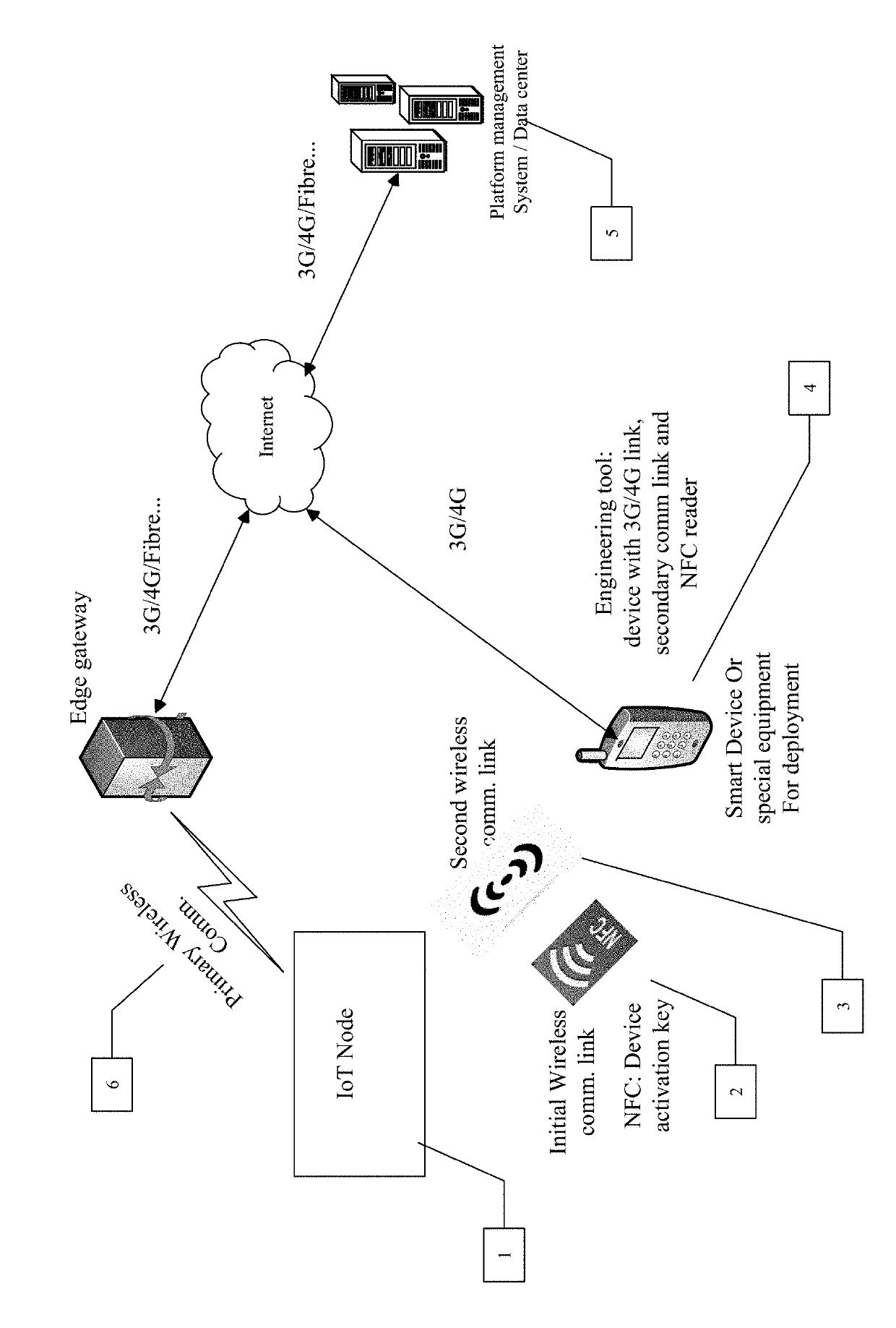
Method and system for deploying wireless IoT sensor nodes
PatentInactiveUS20190149530A1
Innovation
- A method and system that utilize a primary communication link for the IoT device node to connect with a management server and a secondary communication link for a deployment device, allowing for the exchange of keys and authentication to securely establish the device's connection within the network, using a deployment device to facilitate efficient and secure registration.


IoT Security Standards and Compliance Requirements
The deployment of IoT sensor networks operates within a complex regulatory landscape that demands adherence to multiple security standards and compliance frameworks. Organizations must navigate an intricate web of international, national, and industry-specific requirements that govern data protection, device security, and network integrity. The European Union's General Data Protection Regulation (GDPR) establishes stringent requirements for personal data handling, while the California Consumer Privacy Act (CCPA) imposes similar obligations in the United States. These regulations directly impact IoT deployments that collect, process, or transmit personal information through sensor networks.
Industry-specific compliance requirements add additional layers of complexity to IoT sensor network deployments. Healthcare organizations must comply with HIPAA regulations when deploying medical IoT devices, ensuring patient data confidentiality and integrity throughout the sensor network lifecycle. Financial institutions face PCI DSS requirements for payment-related IoT applications, while critical infrastructure sectors must adhere to NERC CIP standards for power systems and NIST Cybersecurity Framework guidelines for federal agencies and contractors.
Technical security standards provide the foundation for compliant IoT sensor network deployments. The ISO/IEC 27001 information security management standard offers a comprehensive framework for establishing security controls across IoT infrastructures. The NIST IoT Cybersecurity Capability Core Baseline defines essential security capabilities for IoT devices, including device identification, device configuration, data protection, and logical access to interfaces. IEEE 802.1X standards govern network access control mechanisms essential for secure sensor authentication and authorization.
Emerging regulatory frameworks specifically target IoT security requirements, creating new compliance obligations for sensor network deployments. The EU Cybersecurity Act establishes cybersecurity certification schemes for IoT products, while the proposed IoT Cybersecurity Improvement Act in the United States mandates minimum security standards for government-procured IoT devices. These evolving regulations require organizations to implement robust security measures including encryption, secure boot processes, regular security updates, and vulnerability management programs throughout the sensor network deployment lifecycle.
Compliance verification and audit requirements necessitate comprehensive documentation and monitoring capabilities within IoT sensor networks. Organizations must establish traceability mechanisms for data flows, maintain security event logs, and implement continuous monitoring systems to demonstrate ongoing compliance. Regular security assessments, penetration testing, and third-party audits become essential components of compliant IoT deployments, requiring integration of compliance monitoring tools and automated reporting capabilities into the sensor network infrastructure.
Industry-specific compliance requirements add additional layers of complexity to IoT sensor network deployments. Healthcare organizations must comply with HIPAA regulations when deploying medical IoT devices, ensuring patient data confidentiality and integrity throughout the sensor network lifecycle. Financial institutions face PCI DSS requirements for payment-related IoT applications, while critical infrastructure sectors must adhere to NERC CIP standards for power systems and NIST Cybersecurity Framework guidelines for federal agencies and contractors.
Technical security standards provide the foundation for compliant IoT sensor network deployments. The ISO/IEC 27001 information security management standard offers a comprehensive framework for establishing security controls across IoT infrastructures. The NIST IoT Cybersecurity Capability Core Baseline defines essential security capabilities for IoT devices, including device identification, device configuration, data protection, and logical access to interfaces. IEEE 802.1X standards govern network access control mechanisms essential for secure sensor authentication and authorization.
Emerging regulatory frameworks specifically target IoT security requirements, creating new compliance obligations for sensor network deployments. The EU Cybersecurity Act establishes cybersecurity certification schemes for IoT products, while the proposed IoT Cybersecurity Improvement Act in the United States mandates minimum security standards for government-procured IoT devices. These evolving regulations require organizations to implement robust security measures including encryption, secure boot processes, regular security updates, and vulnerability management programs throughout the sensor network deployment lifecycle.
Compliance verification and audit requirements necessitate comprehensive documentation and monitoring capabilities within IoT sensor networks. Organizations must establish traceability mechanisms for data flows, maintain security event logs, and implement continuous monitoring systems to demonstrate ongoing compliance. Regular security assessments, penetration testing, and third-party audits become essential components of compliant IoT deployments, requiring integration of compliance monitoring tools and automated reporting capabilities into the sensor network infrastructure.
Edge Computing Integration for Deployment Optimization
Edge computing represents a paradigmatic shift in IoT sensor network deployment strategies, fundamentally transforming how computational resources are distributed and utilized across network infrastructures. By positioning processing capabilities closer to data sources, edge computing architectures significantly reduce the traditional bottlenecks associated with centralized cloud-based deployment models. This distributed approach enables real-time data processing at network edges, minimizing latency issues that often plague large-scale IoT implementations.
The integration of edge computing nodes within IoT sensor networks creates a hierarchical deployment framework that optimizes resource allocation and network efficiency. Edge devices serve as intermediate processing layers, handling data aggregation, preliminary analytics, and protocol translation before transmitting refined information to central systems. This architecture reduces bandwidth requirements by up to 70% compared to traditional cloud-centric models, while simultaneously improving response times for time-critical applications.
Modern edge computing platforms leverage containerization technologies and microservices architectures to enable rapid deployment and scaling of IoT applications. Container orchestration systems facilitate automated deployment across distributed edge nodes, ensuring consistent application behavior while adapting to varying hardware configurations. This approach significantly streamlines the deployment process by abstracting underlying infrastructure complexities and enabling standardized deployment procedures across heterogeneous edge environments.
Machine learning capabilities embedded within edge computing nodes enhance deployment optimization through intelligent resource management and predictive analytics. Edge-based AI algorithms can dynamically adjust network configurations, predict maintenance requirements, and optimize data routing paths based on real-time network conditions. These capabilities enable self-healing network architectures that automatically adapt to changing deployment requirements without manual intervention.
The convergence of edge computing with software-defined networking principles creates programmable deployment environments that can be remotely configured and managed. This integration enables centralized orchestration of distributed edge resources, allowing network administrators to deploy, update, and manage IoT sensor networks through unified management interfaces while maintaining the performance benefits of distributed processing architectures.
The integration of edge computing nodes within IoT sensor networks creates a hierarchical deployment framework that optimizes resource allocation and network efficiency. Edge devices serve as intermediate processing layers, handling data aggregation, preliminary analytics, and protocol translation before transmitting refined information to central systems. This architecture reduces bandwidth requirements by up to 70% compared to traditional cloud-centric models, while simultaneously improving response times for time-critical applications.
Modern edge computing platforms leverage containerization technologies and microservices architectures to enable rapid deployment and scaling of IoT applications. Container orchestration systems facilitate automated deployment across distributed edge nodes, ensuring consistent application behavior while adapting to varying hardware configurations. This approach significantly streamlines the deployment process by abstracting underlying infrastructure complexities and enabling standardized deployment procedures across heterogeneous edge environments.
Machine learning capabilities embedded within edge computing nodes enhance deployment optimization through intelligent resource management and predictive analytics. Edge-based AI algorithms can dynamically adjust network configurations, predict maintenance requirements, and optimize data routing paths based on real-time network conditions. These capabilities enable self-healing network architectures that automatically adapt to changing deployment requirements without manual intervention.
The convergence of edge computing with software-defined networking principles creates programmable deployment environments that can be remotely configured and managed. This integration enables centralized orchestration of distributed edge resources, allowing network administrators to deploy, update, and manage IoT sensor networks through unified management interfaces while maintaining the performance benefits of distributed processing architectures.
Unlock deeper insights with PatSnap Eureka Quick Research — get a full tech report to explore trends and direct your research. Try now!
Generate Your Research Report Instantly with AI Agent
Supercharge your innovation with PatSnap Eureka AI Agent Platform!