

Hydrogen Fuel Cell Efficiency Metrics for Measuring Progress
OCT 24, 20259 MIN READ
Generate Your Research Report Instantly with AI Agent
PatSnap Eureka helps you evaluate technical feasibility & market potential.
Hydrogen Fuel Cell Technology Evolution and Objectives
Hydrogen fuel cell technology has evolved significantly since its inception in the early 19th century when Sir William Grove first demonstrated the principle in 1839. The fundamental concept remained largely experimental until NASA's space programs in the 1960s catalyzed serious development, utilizing fuel cells for spacecraft power generation. This application demonstrated the technology's potential but highlighted significant cost and durability limitations for broader commercial adoption.
The 1990s marked a pivotal shift as environmental concerns and energy security issues prompted renewed interest in hydrogen technologies. Major automakers began investing in research and development, with notable milestones including Toyota's first fuel cell vehicle prototype in 1996 and the establishment of the California Fuel Cell Partnership in 1999, which brought together industry stakeholders to advance commercialization efforts.
The early 2000s witnessed substantial technological breakthroughs, particularly in membrane electrode assembly (MEA) design and catalyst efficiency. Platinum loading requirements decreased dramatically, from approximately 4 mg/cm² in the early 1990s to less than 0.2 mg/cm² by 2010, significantly reducing production costs while maintaining performance standards.
Current technological objectives center on several key efficiency metrics that serve as benchmarks for measuring progress. These include power density (targeting >1 W/cm²), system efficiency (aiming for >60% under real-world operating conditions), durability (exceeding 5,000 hours for automotive applications and 40,000 hours for stationary systems), cold-start capability (operation at temperatures as low as -30°C), and cost reduction (below $40/kW for automotive systems).
The U.S. Department of Energy's Hydrogen and Fuel Cell Technologies Office has established specific technical targets, including increasing volumetric and gravimetric power density by 50% by 2025, reducing platinum group metal loading by 60%, and extending operational lifetimes to meet commercial viability thresholds across various applications.
International collaboration has accelerated development through initiatives like the International Partnership for Hydrogen and Fuel Cells in the Economy (IPHE) and the Hydrogen Council, established in 2017. These organizations coordinate research efforts and standardize efficiency metrics across borders, facilitating meaningful comparison of technological advancements.
Looking forward, the technology evolution trajectory aims to address remaining challenges in hydrogen production, storage, and distribution infrastructure alongside fuel cell system improvements. The integration of artificial intelligence for real-time optimization of operating parameters represents a promising frontier for maximizing efficiency metrics and accelerating commercial adoption across transportation, stationary power, and industrial applications.
The 1990s marked a pivotal shift as environmental concerns and energy security issues prompted renewed interest in hydrogen technologies. Major automakers began investing in research and development, with notable milestones including Toyota's first fuel cell vehicle prototype in 1996 and the establishment of the California Fuel Cell Partnership in 1999, which brought together industry stakeholders to advance commercialization efforts.
The early 2000s witnessed substantial technological breakthroughs, particularly in membrane electrode assembly (MEA) design and catalyst efficiency. Platinum loading requirements decreased dramatically, from approximately 4 mg/cm² in the early 1990s to less than 0.2 mg/cm² by 2010, significantly reducing production costs while maintaining performance standards.
Current technological objectives center on several key efficiency metrics that serve as benchmarks for measuring progress. These include power density (targeting >1 W/cm²), system efficiency (aiming for >60% under real-world operating conditions), durability (exceeding 5,000 hours for automotive applications and 40,000 hours for stationary systems), cold-start capability (operation at temperatures as low as -30°C), and cost reduction (below $40/kW for automotive systems).
The U.S. Department of Energy's Hydrogen and Fuel Cell Technologies Office has established specific technical targets, including increasing volumetric and gravimetric power density by 50% by 2025, reducing platinum group metal loading by 60%, and extending operational lifetimes to meet commercial viability thresholds across various applications.
International collaboration has accelerated development through initiatives like the International Partnership for Hydrogen and Fuel Cells in the Economy (IPHE) and the Hydrogen Council, established in 2017. These organizations coordinate research efforts and standardize efficiency metrics across borders, facilitating meaningful comparison of technological advancements.
Looking forward, the technology evolution trajectory aims to address remaining challenges in hydrogen production, storage, and distribution infrastructure alongside fuel cell system improvements. The integration of artificial intelligence for real-time optimization of operating parameters represents a promising frontier for maximizing efficiency metrics and accelerating commercial adoption across transportation, stationary power, and industrial applications.
Market Analysis for Hydrogen Fuel Cell Applications
The hydrogen fuel cell market is experiencing significant growth across multiple sectors, driven by increasing environmental concerns and the global push towards decarbonization. The transportation sector represents the largest application area, with passenger vehicles, buses, trucks, and material handling equipment leading adoption. According to recent market analyses, the global hydrogen fuel cell market was valued at approximately $14.3 billion in 2021 and is projected to reach $70.7 billion by 2030, growing at a CAGR of 21.4% during the forecast period.
The stationary power generation segment is emerging as another crucial market, particularly for backup power systems in telecommunications, data centers, and remote locations. This segment is expected to grow substantially as grid resilience becomes increasingly important in the face of climate change and aging infrastructure. The portable power market, though smaller, is showing promise for military applications, emergency response, and consumer electronics.
Regionally, Asia Pacific dominates the market with Japan, South Korea, and China leading in both production and adoption. These countries have implemented strong government support policies and substantial investments in hydrogen infrastructure. Europe follows closely, with Germany, France, and the UK making significant strides in fuel cell deployment across various applications. North America, particularly the United States and Canada, is also showing renewed interest with increasing investments in hydrogen technologies.
Market penetration varies significantly by application. In material handling equipment, particularly forklifts, hydrogen fuel cells have achieved notable commercial success with major retailers and warehouse operators reporting operational benefits over battery alternatives. The passenger vehicle segment faces more challenges due to limited refueling infrastructure and high costs, though premium manufacturers are increasingly incorporating fuel cells into their zero-emission vehicle strategies.
Customer demand is primarily driven by three factors: operational advantages (faster refueling times compared to batteries), environmental benefits (zero emissions at point of use), and energy security considerations. Industrial users particularly value the consistent power output and reliability of fuel cell systems compared to other renewable energy solutions.
Key market barriers include high initial capital costs, limited hydrogen infrastructure, and competition from rapidly improving battery technologies. However, recent technological advancements and economies of scale are steadily reducing costs, with fuel cell system prices decreasing by approximately 60% over the past decade. The total cost of ownership is becoming increasingly competitive in specific applications where operational advantages can be maximized.
The stationary power generation segment is emerging as another crucial market, particularly for backup power systems in telecommunications, data centers, and remote locations. This segment is expected to grow substantially as grid resilience becomes increasingly important in the face of climate change and aging infrastructure. The portable power market, though smaller, is showing promise for military applications, emergency response, and consumer electronics.
Regionally, Asia Pacific dominates the market with Japan, South Korea, and China leading in both production and adoption. These countries have implemented strong government support policies and substantial investments in hydrogen infrastructure. Europe follows closely, with Germany, France, and the UK making significant strides in fuel cell deployment across various applications. North America, particularly the United States and Canada, is also showing renewed interest with increasing investments in hydrogen technologies.
Market penetration varies significantly by application. In material handling equipment, particularly forklifts, hydrogen fuel cells have achieved notable commercial success with major retailers and warehouse operators reporting operational benefits over battery alternatives. The passenger vehicle segment faces more challenges due to limited refueling infrastructure and high costs, though premium manufacturers are increasingly incorporating fuel cells into their zero-emission vehicle strategies.
Customer demand is primarily driven by three factors: operational advantages (faster refueling times compared to batteries), environmental benefits (zero emissions at point of use), and energy security considerations. Industrial users particularly value the consistent power output and reliability of fuel cell systems compared to other renewable energy solutions.
Key market barriers include high initial capital costs, limited hydrogen infrastructure, and competition from rapidly improving battery technologies. However, recent technological advancements and economies of scale are steadily reducing costs, with fuel cell system prices decreasing by approximately 60% over the past decade. The total cost of ownership is becoming increasingly competitive in specific applications where operational advantages can be maximized.
Current Efficiency Challenges and Technical Limitations
Despite significant advancements in hydrogen fuel cell technology over the past decade, several critical efficiency challenges and technical limitations continue to impede widespread adoption. The current state-of-the-art proton exchange membrane fuel cells (PEMFCs) typically achieve system efficiencies between 40-60%, falling short of the theoretical maximum of 83%. This efficiency gap represents a substantial barrier to economic viability when competing with conventional energy technologies.
Material degradation remains one of the most persistent challenges, particularly regarding catalyst performance. Platinum-based catalysts, while highly effective, suffer from degradation mechanisms including dissolution, agglomeration, and poisoning. These processes reduce active surface area over time, leading to declining performance metrics and shortened operational lifespans that currently average 3,000-5,000 hours for automotive applications—well below the 8,000-hour target established by the U.S. Department of Energy.
Water management presents another significant technical hurdle. The delicate balance between membrane hydration and flooding conditions directly impacts proton conductivity and overall system efficiency. Current membrane technologies struggle to maintain optimal hydration levels across varying operational conditions, particularly during rapid load changes and extreme temperature scenarios.
Thermal management systems add complexity and parasitic energy losses to fuel cell systems. The narrow optimal temperature window (typically 60-80°C for PEMFCs) requires sophisticated cooling systems that consume approximately 5-10% of the generated power, reducing net system efficiency. This challenge becomes particularly acute in high-power density applications where heat generation rates exceed current cooling capabilities.
Hydrogen storage and delivery infrastructure limitations further compound efficiency challenges. Compression, liquefaction, or chemical storage methods for hydrogen transport and storage consume significant energy—between 10-15% of hydrogen's energy content—creating substantial efficiency losses before the fuel even reaches the cell. Current compression technologies require approximately 2.5-3.5 kWh of electricity per kilogram of hydrogen compressed to 700 bar.
Manufacturing scalability presents additional barriers, with current production techniques for critical components like membrane electrode assemblies (MEAs) facing yield inconsistencies and high rejection rates. The precision required for uniform catalyst deposition and membrane formation drives production costs upward while limiting manufacturing throughput to levels insufficient for mass-market adoption.
System integration inefficiencies arise from suboptimal balance-of-plant components, with current auxiliary systems (pumps, blowers, sensors) consuming 15-20% of gross power output. These parasitic losses significantly reduce net system efficiency and highlight the need for holistic system optimization approaches rather than focusing solely on cell-level improvements.
Material degradation remains one of the most persistent challenges, particularly regarding catalyst performance. Platinum-based catalysts, while highly effective, suffer from degradation mechanisms including dissolution, agglomeration, and poisoning. These processes reduce active surface area over time, leading to declining performance metrics and shortened operational lifespans that currently average 3,000-5,000 hours for automotive applications—well below the 8,000-hour target established by the U.S. Department of Energy.
Water management presents another significant technical hurdle. The delicate balance between membrane hydration and flooding conditions directly impacts proton conductivity and overall system efficiency. Current membrane technologies struggle to maintain optimal hydration levels across varying operational conditions, particularly during rapid load changes and extreme temperature scenarios.
Thermal management systems add complexity and parasitic energy losses to fuel cell systems. The narrow optimal temperature window (typically 60-80°C for PEMFCs) requires sophisticated cooling systems that consume approximately 5-10% of the generated power, reducing net system efficiency. This challenge becomes particularly acute in high-power density applications where heat generation rates exceed current cooling capabilities.
Hydrogen storage and delivery infrastructure limitations further compound efficiency challenges. Compression, liquefaction, or chemical storage methods for hydrogen transport and storage consume significant energy—between 10-15% of hydrogen's energy content—creating substantial efficiency losses before the fuel even reaches the cell. Current compression technologies require approximately 2.5-3.5 kWh of electricity per kilogram of hydrogen compressed to 700 bar.
Manufacturing scalability presents additional barriers, with current production techniques for critical components like membrane electrode assemblies (MEAs) facing yield inconsistencies and high rejection rates. The precision required for uniform catalyst deposition and membrane formation drives production costs upward while limiting manufacturing throughput to levels insufficient for mass-market adoption.
System integration inefficiencies arise from suboptimal balance-of-plant components, with current auxiliary systems (pumps, blowers, sensors) consuming 15-20% of gross power output. These parasitic losses significantly reduce net system efficiency and highlight the need for holistic system optimization approaches rather than focusing solely on cell-level improvements.
Current Methodologies for Measuring Fuel Cell Efficiency
01 Efficiency measurement and optimization methods
Various methods and techniques for measuring and optimizing the efficiency of hydrogen fuel cells. These include advanced diagnostic tools, real-time monitoring systems, and computational models that can evaluate performance metrics such as electrical efficiency, thermal efficiency, and overall system efficiency. These methods help in identifying performance bottlenecks and optimizing operating conditions to achieve maximum efficiency.- Efficiency measurement and optimization techniques: Various techniques are employed to measure and optimize hydrogen fuel cell efficiency. These include advanced monitoring systems that track performance metrics in real-time, mathematical modeling approaches to predict efficiency under different operating conditions, and experimental methods to validate theoretical efficiency calculations. These techniques help in identifying performance bottlenecks and optimizing fuel cell systems for maximum energy conversion efficiency.
- Catalyst design and materials for improved efficiency: The development of advanced catalysts plays a crucial role in enhancing hydrogen fuel cell efficiency. Novel catalyst materials, structures, and compositions can significantly reduce activation energy barriers, improve reaction kinetics, and minimize energy losses. Research focuses on platinum-group metal catalysts, non-precious metal alternatives, and hybrid catalyst systems that can maintain high activity while reducing costs and improving durability under operational conditions.
- Membrane and electrode assembly optimization: The membrane electrode assembly (MEA) is a critical component affecting fuel cell efficiency. Innovations in membrane materials, electrode structures, and assembly techniques can significantly enhance proton conductivity, reduce internal resistance, and improve water management. Advanced MEA designs focus on optimizing the interface between electrodes and membranes, controlling porosity, and enhancing mass transport properties to achieve higher power density and efficiency.
- Thermal management and operating condition optimization: Effective thermal management is essential for maintaining optimal fuel cell efficiency. Systems that regulate temperature, humidity, and pressure can significantly impact performance metrics. Advanced cooling strategies, heat recovery systems, and precise control of operating parameters help maintain ideal reaction conditions, prevent degradation, and maximize efficiency across varying load profiles. Innovations in this area focus on integrated thermal management approaches that balance efficiency with system complexity.
- System integration and balance of plant components: The overall efficiency of hydrogen fuel cell systems depends significantly on the integration and optimization of balance of plant components. This includes hydrogen storage and delivery systems, power conditioning equipment, and auxiliary power management. Advancements in system architecture, control strategies, and component integration can reduce parasitic losses, improve startup times, and enhance overall system efficiency. Holistic approaches to system design consider the interactions between components to maximize energy conversion efficiency.
02 Catalyst design and performance metrics
Development of advanced catalysts to improve hydrogen fuel cell efficiency. This includes novel catalyst materials, structures, and compositions that enhance electrochemical reactions while reducing precious metal content. Performance metrics focus on catalyst activity, stability, durability, and poison resistance, which directly impact the overall efficiency and cost-effectiveness of fuel cell systems.Expand Specific Solutions03 Membrane and electrode assembly optimization
Innovations in membrane electrode assembly (MEA) design and materials to enhance fuel cell efficiency. This includes development of high-performance proton exchange membranes, electrode structures with optimized porosity, and interface engineering between components. Efficiency metrics include ionic conductivity, gas permeability, water management capabilities, and long-term stability under various operating conditions.Expand Specific Solutions04 Thermal management and system integration
Approaches for optimizing thermal management and system integration to improve overall fuel cell efficiency. This includes heat recovery systems, cooling strategies, and balance-of-plant optimization. Efficiency metrics focus on thermal balance, waste heat utilization, system compactness, and integration with hydrogen storage and delivery systems to maximize overall energy conversion efficiency.Expand Specific Solutions05 Durability and degradation assessment
Methods and metrics for evaluating the long-term durability and degradation patterns of hydrogen fuel cells. This includes accelerated stress testing protocols, lifetime prediction models, and degradation mechanisms analysis. Efficiency metrics focus on performance retention over time, degradation rates under various operating conditions, and identification of failure modes that impact long-term efficiency and reliability.Expand Specific Solutions
Leading Organizations in Hydrogen Fuel Cell Research
The hydrogen fuel cell efficiency metrics market is in a growth phase, with increasing adoption across automotive and industrial sectors. The global market size is expanding rapidly, driven by clean energy initiatives and sustainability goals. Technologically, the field shows varying maturity levels among key players. Automotive leaders like Toyota, Hyundai, and Honda have achieved commercial deployment with advanced efficiency metrics, while Plug Power and Ballard Power Systems lead in industrial applications. BMW, GM, and Daimler Truck are accelerating R&D investments. Asian manufacturers, particularly from China and Japan, are gaining momentum with companies like Weichai Power and Toyota Industries developing proprietary measurement standards. The competitive landscape reflects a balance between established automotive giants and specialized fuel cell technology providers.
Hyundai Motor Co., Ltd.
Technical Solution: Hyundai has developed the NEXO fuel cell system with a focus on balanced efficiency metrics across multiple operating conditions. Their technology achieves 60% stack efficiency with a power density of 3.1 kW/L, representing a 50% improvement over their previous generation[2]. Hyundai's approach to efficiency measurement incorporates real-world driving cycles rather than just peak performance figures, using a proprietary Dynamic Efficiency Rating (DER) that accounts for variable load conditions. Their system architecture employs advanced bipolar plates with optimized flow channels that reduce pressure drops by 20%, improving overall system efficiency. Hyundai has also pioneered durability testing protocols that simulate 10 years of real-world operation, with performance degradation metrics showing less than 10% capacity loss over the vehicle lifetime[4]. Their latest innovations include a membrane humidification system that maintains optimal water balance without external humidifiers, reducing parasitic power losses.
Strengths: Excellent cold-weather performance metrics; comprehensive durability testing protocols; integrated system approach with reduced auxiliary power requirements. Weaknesses: Higher initial manufacturing costs; efficiency metrics still show performance gaps between laboratory and real-world conditions in extreme temperature environments.
Toyota Motor Corp.
Technical Solution: Toyota has pioneered the development of hydrogen fuel cell vehicles with their Mirai model, now in its second generation. Their approach focuses on comprehensive efficiency metrics including stack efficiency (reaching up to 65% in their latest systems), cold-start capabilities (operational at -30°C), and durability (targeting 200,000+ miles of operation). Toyota employs a proprietary catalyst technology that reduces platinum usage by 30% while maintaining performance[1]. Their fuel cell system integrates advanced humidity management and innovative flow field designs that optimize reactant distribution across the membrane electrode assembly. Toyota's efficiency measurement framework encompasses not just the fuel cell stack but the entire powertrain system, including hydrogen storage, power electronics, and thermal management, providing a holistic view of real-world efficiency that goes beyond laboratory metrics[3].
Strengths: Industry-leading durability metrics; comprehensive system efficiency approach; significant reduction in platinum catalyst loading. Weaknesses: Higher production costs compared to battery electric vehicles; limited hydrogen infrastructure remains a challenge for widespread adoption despite technical efficiency gains.
Key Patents and Breakthroughs in Efficiency Measurement
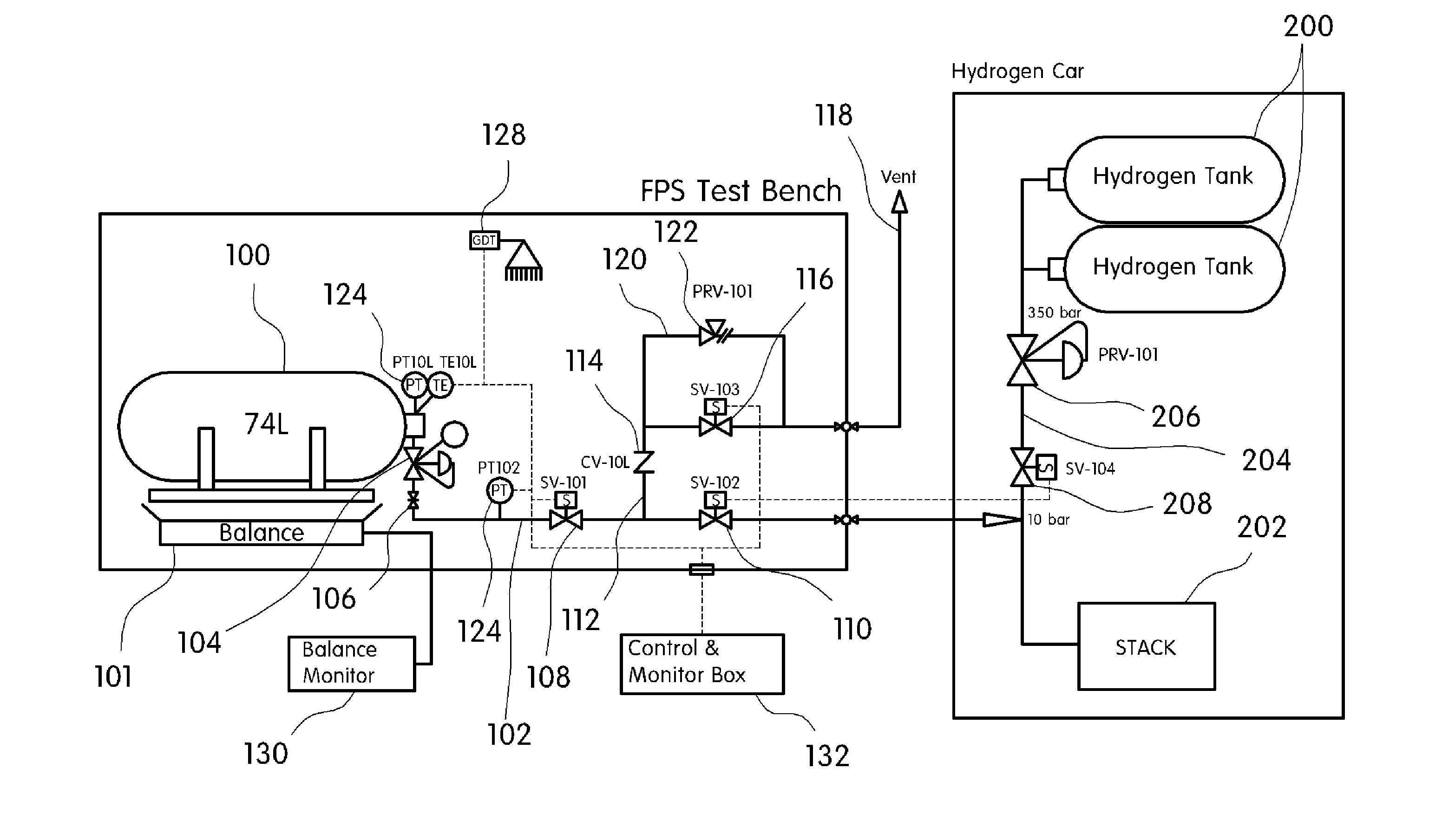
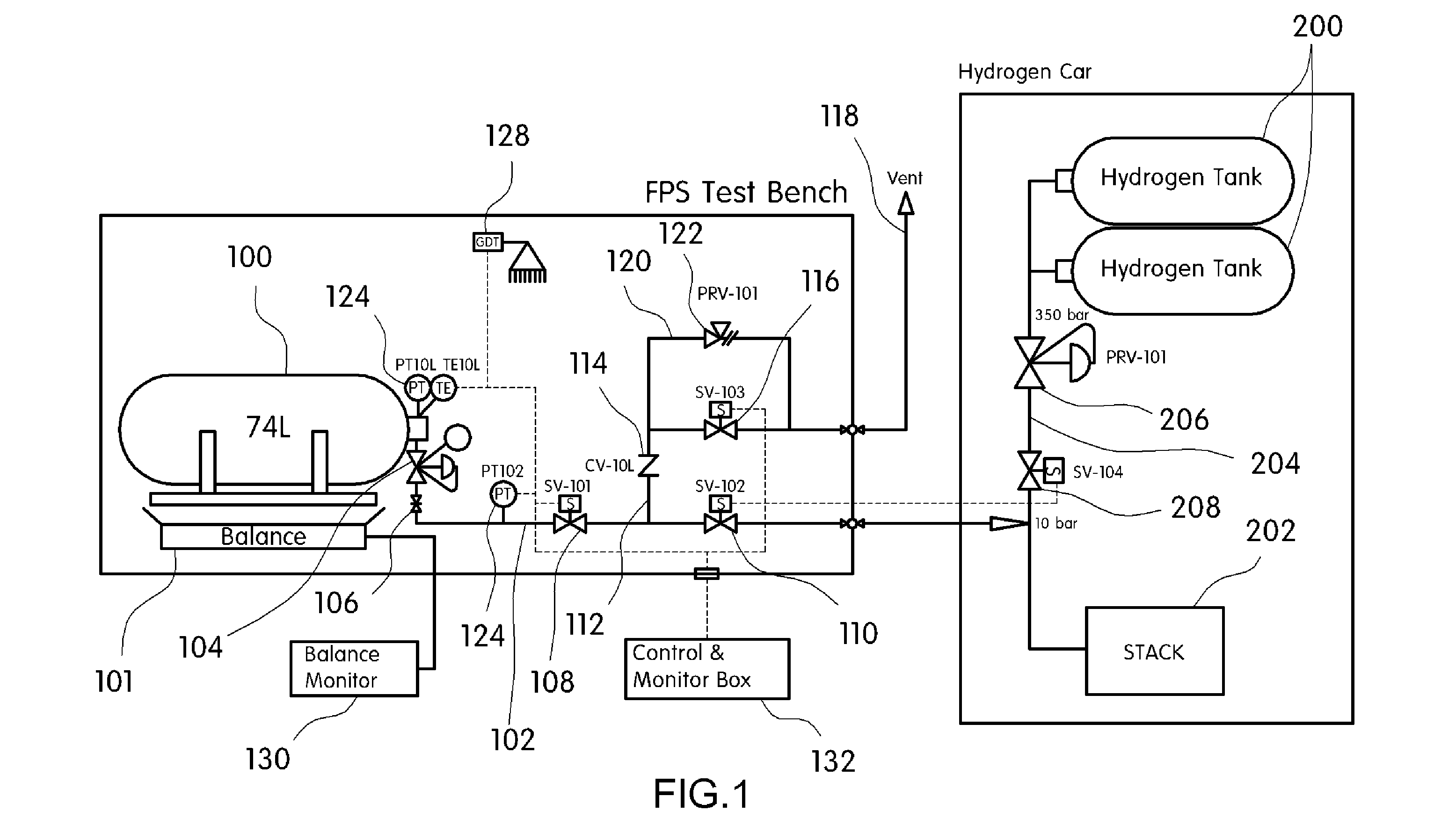
Fuel efficiency measurement system and method for fuel cell vehicle
PatentActiveUS8190354B2
Innovation
- A fuel efficiency measurement system that includes a fuel supply tank with an electronic balance to measure weight changes, a high pressure regulator, and a system control unit that calculates fuel efficiency based on vehicle driving distance and weight differences before and after driving, using hydrogen from an external tank instead of the vehicle's hydrogen tank during measurement.


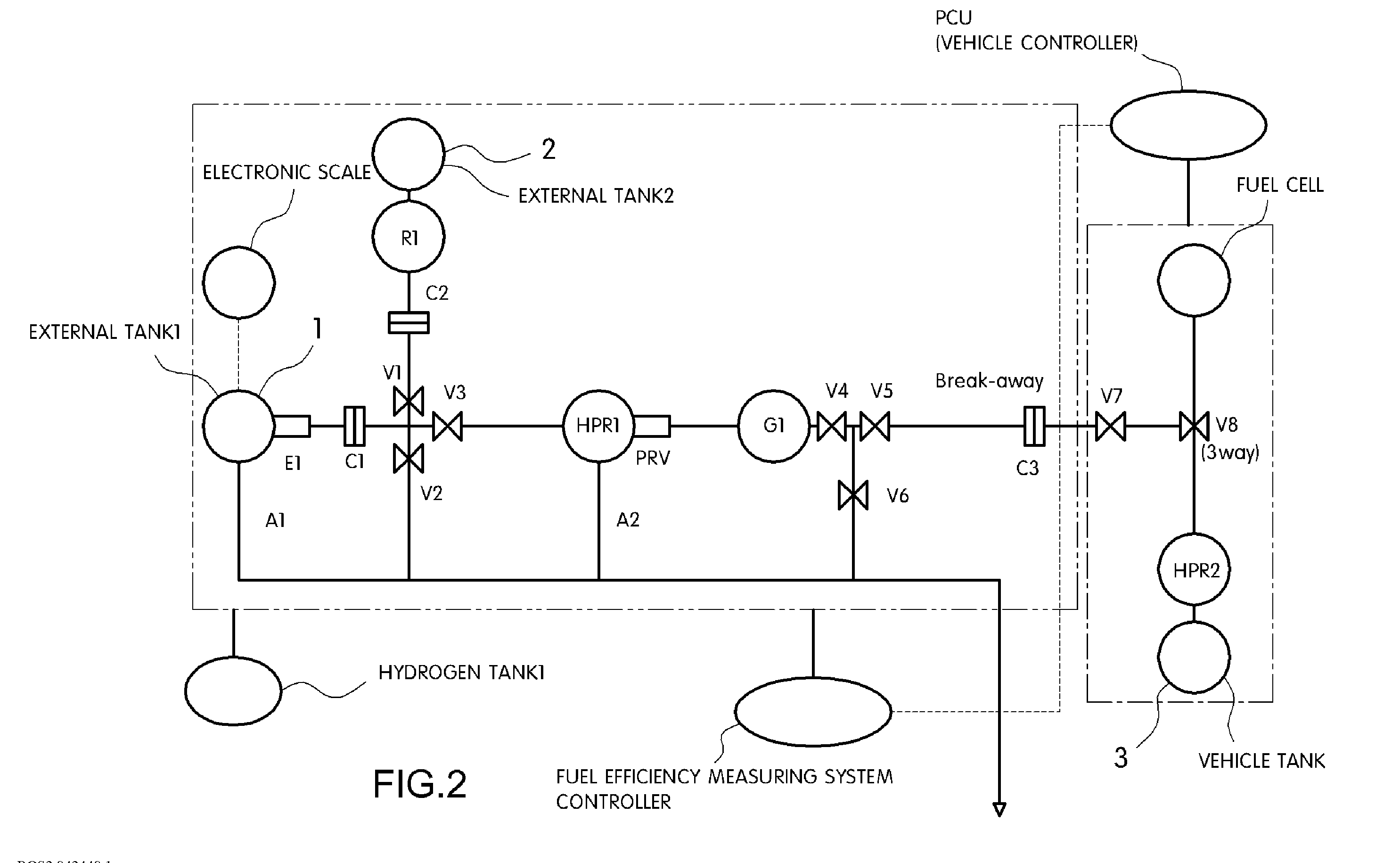
Fuel efficiency measuring system for fuel cell vehicle
PatentActiveUS20120131991A1
Innovation
- The system simplifies hydrogen supply lines by removing the purging hydrogen tank and eliminating the high-cost break-away coupler, using a vehicle-side hydrogen tank to remove residual air and reducing hydrogen pressure through a high pressure regulator, thereby simplifying valves and reducing manufacturing costs.
Standardization Efforts in Fuel Cell Performance Testing
The standardization of fuel cell performance testing has become increasingly critical as hydrogen fuel cell technology advances toward wider commercial adoption. Currently, several international organizations are leading efforts to establish unified testing protocols and efficiency metrics. The International Organization for Standardization (ISO) has developed the ISO 14687 standard for hydrogen fuel quality specifications and ISO 22734 for water electrolysis systems, both directly impacting fuel cell performance measurement.
The Society of Automotive Engineers (SAE) has contributed significantly through its J2719 standard for hydrogen fuel quality and J2615 for testing performance of fuel cell systems in vehicles. These standards provide automotive manufacturers with consistent methodologies to evaluate and report fuel cell efficiency across different vehicle platforms.
In the laboratory testing domain, the International Electrotechnical Commission (IEC) has established IEC 62282 series standards specifically addressing fuel cell technologies, with detailed protocols for measuring electrical efficiency, thermal output, and overall system performance. These standards enable meaningful comparison between different fuel cell designs and technologies.
Regional standardization bodies have also made substantial contributions. The European Committee for Standardization (CEN) has developed EN 17124 for hydrogen fuel specifications, while the Japanese Industrial Standards Committee (JISC) has established JIS C 8823 specifically for stationary fuel cell performance evaluation.
A significant challenge in standardization efforts remains the harmonization of testing conditions across different applications. Fuel cells operate in vastly different environments—from stationary power generation to mobile transportation—requiring application-specific testing protocols while maintaining cross-compatibility of core metrics.
Recent collaborative initiatives between national laboratories, including the U.S. Department of Energy's Hydrogen and Fuel Cell Technologies Office, Germany's Fraunhofer Institute, and Japan's NEDO, are working to establish round-robin testing programs. These programs aim to validate measurement techniques across different facilities and ensure reproducibility of efficiency metrics regardless of testing location.
The development of dynamic testing protocols represents the frontier of standardization efforts. While steady-state efficiency measurements are well-established, standardized methods for evaluating fuel cell performance under transient conditions—critical for automotive and grid-balancing applications—remain under development. The International Partnership for Hydrogen and Fuel Cells in the Economy (IPHE) is coordinating global efforts to address this gap through its working group on harmonized testing protocols.
The Society of Automotive Engineers (SAE) has contributed significantly through its J2719 standard for hydrogen fuel quality and J2615 for testing performance of fuel cell systems in vehicles. These standards provide automotive manufacturers with consistent methodologies to evaluate and report fuel cell efficiency across different vehicle platforms.
In the laboratory testing domain, the International Electrotechnical Commission (IEC) has established IEC 62282 series standards specifically addressing fuel cell technologies, with detailed protocols for measuring electrical efficiency, thermal output, and overall system performance. These standards enable meaningful comparison between different fuel cell designs and technologies.
Regional standardization bodies have also made substantial contributions. The European Committee for Standardization (CEN) has developed EN 17124 for hydrogen fuel specifications, while the Japanese Industrial Standards Committee (JISC) has established JIS C 8823 specifically for stationary fuel cell performance evaluation.
A significant challenge in standardization efforts remains the harmonization of testing conditions across different applications. Fuel cells operate in vastly different environments—from stationary power generation to mobile transportation—requiring application-specific testing protocols while maintaining cross-compatibility of core metrics.
Recent collaborative initiatives between national laboratories, including the U.S. Department of Energy's Hydrogen and Fuel Cell Technologies Office, Germany's Fraunhofer Institute, and Japan's NEDO, are working to establish round-robin testing programs. These programs aim to validate measurement techniques across different facilities and ensure reproducibility of efficiency metrics regardless of testing location.
The development of dynamic testing protocols represents the frontier of standardization efforts. While steady-state efficiency measurements are well-established, standardized methods for evaluating fuel cell performance under transient conditions—critical for automotive and grid-balancing applications—remain under development. The International Partnership for Hydrogen and Fuel Cells in the Economy (IPHE) is coordinating global efforts to address this gap through its working group on harmonized testing protocols.
Environmental Impact Assessment of Hydrogen Technologies
The environmental impact assessment of hydrogen technologies reveals a complex landscape of benefits and challenges. Hydrogen fuel cells offer significant environmental advantages compared to conventional fossil fuel technologies, primarily through their zero-emission operation at point of use. When powered by green hydrogen produced from renewable energy sources, the entire lifecycle can approach carbon neutrality, representing a substantial improvement over internal combustion engines and other conventional power generation methods.
Water vapor as the primary emission from hydrogen fuel cells presents minimal direct environmental concerns, unlike the greenhouse gases and particulate matter associated with fossil fuel combustion. This characteristic makes hydrogen technologies particularly valuable for improving air quality in urban environments and reducing the health impacts associated with transportation and energy production.
However, the environmental credentials of hydrogen technologies are heavily dependent on production methods. Grey hydrogen derived from natural gas reforming without carbon capture still contributes significantly to greenhouse gas emissions. Blue hydrogen, which incorporates carbon capture and storage, offers improved environmental performance but remains controversial due to methane leakage concerns and the long-term viability of carbon storage solutions.
Land use impacts vary considerably across hydrogen production methods. Wind and solar installations for green hydrogen production require substantial land area, though these can often be integrated with existing agricultural or industrial landscapes. Water consumption represents another important environmental consideration, particularly for electrolysis processes that require purified water inputs, potentially creating competition in water-stressed regions.
Life cycle assessment (LCA) studies indicate that hydrogen fuel cell vehicles can achieve 30-60% lower greenhouse gas emissions compared to conventional vehicles when using blue hydrogen, and up to 85-95% reductions when using green hydrogen. These assessments must account for energy inputs, resource extraction, manufacturing processes, operational efficiency, and end-of-life disposal or recycling.
Infrastructure development for hydrogen technologies presents additional environmental considerations, including materials usage for storage tanks, pipelines, and refueling stations. The durability and recyclability of fuel cell components, particularly platinum group metals used as catalysts, affect the overall environmental footprint of these technologies.
Regulatory frameworks are increasingly incorporating environmental impact metrics into hydrogen technology assessment, with carbon intensity becoming a key performance indicator alongside traditional efficiency measures. This holistic approach to environmental assessment is essential for guiding policy decisions and investment priorities that maximize the sustainability benefits of hydrogen fuel cell technologies while minimizing potential negative impacts.
Water vapor as the primary emission from hydrogen fuel cells presents minimal direct environmental concerns, unlike the greenhouse gases and particulate matter associated with fossil fuel combustion. This characteristic makes hydrogen technologies particularly valuable for improving air quality in urban environments and reducing the health impacts associated with transportation and energy production.
However, the environmental credentials of hydrogen technologies are heavily dependent on production methods. Grey hydrogen derived from natural gas reforming without carbon capture still contributes significantly to greenhouse gas emissions. Blue hydrogen, which incorporates carbon capture and storage, offers improved environmental performance but remains controversial due to methane leakage concerns and the long-term viability of carbon storage solutions.
Land use impacts vary considerably across hydrogen production methods. Wind and solar installations for green hydrogen production require substantial land area, though these can often be integrated with existing agricultural or industrial landscapes. Water consumption represents another important environmental consideration, particularly for electrolysis processes that require purified water inputs, potentially creating competition in water-stressed regions.
Life cycle assessment (LCA) studies indicate that hydrogen fuel cell vehicles can achieve 30-60% lower greenhouse gas emissions compared to conventional vehicles when using blue hydrogen, and up to 85-95% reductions when using green hydrogen. These assessments must account for energy inputs, resource extraction, manufacturing processes, operational efficiency, and end-of-life disposal or recycling.
Infrastructure development for hydrogen technologies presents additional environmental considerations, including materials usage for storage tanks, pipelines, and refueling stations. The durability and recyclability of fuel cell components, particularly platinum group metals used as catalysts, affect the overall environmental footprint of these technologies.
Regulatory frameworks are increasingly incorporating environmental impact metrics into hydrogen technology assessment, with carbon intensity becoming a key performance indicator alongside traditional efficiency measures. This holistic approach to environmental assessment is essential for guiding policy decisions and investment priorities that maximize the sustainability benefits of hydrogen fuel cell technologies while minimizing potential negative impacts.
Unlock deeper insights with PatSnap Eureka Quick Research — get a full tech report to explore trends and direct your research. Try now!
Generate Your Research Report Instantly with AI Agent
Supercharge your innovation with PatSnap Eureka AI Agent Platform!