

Hyperbolic Metamaterials vs Cloaking Materials: Efficiency Metrics
MAY 14, 20269 MIN READ
Generate Your Research Report Instantly with AI Agent
PatSnap Eureka helps you evaluate technical feasibility & market potential.
Hyperbolic Metamaterials Background and Cloaking Goals
Hyperbolic metamaterials represent a revolutionary class of artificially engineered materials that exhibit extraordinary electromagnetic properties not found in natural materials. These structures are characterized by their hyperbolic dispersion relation, where the permittivity tensor components have opposite signs along different spatial directions. This unique property enables unprecedented control over electromagnetic wave propagation, making them particularly attractive for advanced optical and electromagnetic applications.
The fundamental principle underlying hyperbolic metamaterials lies in their anisotropic nature, typically achieved through periodic arrangements of metallic and dielectric components at subwavelength scales. Unlike conventional materials with elliptical dispersion relations, hyperbolic metamaterials support propagating waves with arbitrarily large wave vectors, leading to an infinite photonic density of states. This characteristic enables enhanced light-matter interactions and opens new possibilities for manipulating electromagnetic fields.
The evolution of hyperbolic metamaterials has been driven by advances in nanofabrication techniques and computational electromagnetics. Early implementations focused on wire-grid structures and layered metal-dielectric composites, while recent developments have explored three-dimensional architectures and active tunable designs. The field has progressed from proof-of-concept demonstrations to practical applications in imaging, sensing, and electromagnetic cloaking.
Electromagnetic cloaking represents one of the most ambitious goals in metamaterial research, aiming to render objects invisible to electromagnetic radiation across specific frequency ranges. The concept involves surrounding an object with a metamaterial shell that guides electromagnetic waves around it, effectively making the object undetectable. This requires precise control over the material's refractive index distribution and electromagnetic response.
The primary technical objectives for hyperbolic metamaterial-based cloaking systems include achieving broadband invisibility, minimizing scattering cross-sections, and maintaining structural integrity under various environmental conditions. Current research focuses on optimizing efficiency metrics such as extinction cross-section reduction, angular coverage, and operational bandwidth. These parameters directly influence the practical viability of cloaking applications in defense, communications, and scientific instrumentation.
The convergence of hyperbolic metamaterial properties with cloaking requirements presents both opportunities and challenges. While the infinite photonic density of states offers enhanced field manipulation capabilities, achieving the precise impedance matching and loss compensation necessary for effective cloaking remains a significant technical hurdle requiring continued innovation in material design and fabrication methodologies.
The fundamental principle underlying hyperbolic metamaterials lies in their anisotropic nature, typically achieved through periodic arrangements of metallic and dielectric components at subwavelength scales. Unlike conventional materials with elliptical dispersion relations, hyperbolic metamaterials support propagating waves with arbitrarily large wave vectors, leading to an infinite photonic density of states. This characteristic enables enhanced light-matter interactions and opens new possibilities for manipulating electromagnetic fields.
The evolution of hyperbolic metamaterials has been driven by advances in nanofabrication techniques and computational electromagnetics. Early implementations focused on wire-grid structures and layered metal-dielectric composites, while recent developments have explored three-dimensional architectures and active tunable designs. The field has progressed from proof-of-concept demonstrations to practical applications in imaging, sensing, and electromagnetic cloaking.
Electromagnetic cloaking represents one of the most ambitious goals in metamaterial research, aiming to render objects invisible to electromagnetic radiation across specific frequency ranges. The concept involves surrounding an object with a metamaterial shell that guides electromagnetic waves around it, effectively making the object undetectable. This requires precise control over the material's refractive index distribution and electromagnetic response.
The primary technical objectives for hyperbolic metamaterial-based cloaking systems include achieving broadband invisibility, minimizing scattering cross-sections, and maintaining structural integrity under various environmental conditions. Current research focuses on optimizing efficiency metrics such as extinction cross-section reduction, angular coverage, and operational bandwidth. These parameters directly influence the practical viability of cloaking applications in defense, communications, and scientific instrumentation.
The convergence of hyperbolic metamaterial properties with cloaking requirements presents both opportunities and challenges. While the infinite photonic density of states offers enhanced field manipulation capabilities, achieving the precise impedance matching and loss compensation necessary for effective cloaking remains a significant technical hurdle requiring continued innovation in material design and fabrication methodologies.
Market Demand for Advanced Metamaterial Applications
The global metamaterials market is experiencing unprecedented growth driven by increasing demand for advanced electromagnetic manipulation capabilities across multiple industries. Defense and aerospace sectors represent the largest market segments, where hyperbolic metamaterials and cloaking technologies are sought for stealth applications, radar cross-section reduction, and electromagnetic signature management. Military contractors are particularly interested in materials that can achieve superior cloaking efficiency while maintaining structural integrity under extreme operational conditions.
Telecommunications infrastructure modernization is creating substantial demand for metamaterial-based components that can enhance signal processing and antenna performance. The deployment of 5G networks and the anticipated transition to 6G technologies require advanced materials capable of precise electromagnetic field control. Hyperbolic metamaterials are increasingly valued for their ability to support high-frequency applications and enable compact antenna designs with enhanced directivity.
The medical imaging and healthcare sector presents a rapidly expanding market opportunity for metamaterial applications. Advanced imaging systems, including MRI enhancement and medical sensing devices, require materials with specific electromagnetic properties that can improve resolution and reduce interference. Cloaking materials are being explored for medical implant applications where electromagnetic compatibility is critical.
Consumer electronics manufacturers are driving demand for miniaturized metamaterial components that can improve device performance while reducing electromagnetic interference. The proliferation of wearable technology and Internet of Things devices creates opportunities for metamaterials that can provide selective electromagnetic shielding and enhanced wireless communication capabilities.
Energy sector applications, particularly in wireless power transfer and solar energy harvesting, are emerging as significant market drivers. Metamaterials that can efficiently manipulate electromagnetic fields for energy concentration and transfer applications are attracting substantial investment from renewable energy companies.
The automotive industry's transition toward autonomous vehicles and advanced driver assistance systems is generating demand for metamaterial-based sensors and communication systems. These applications require materials that can provide reliable electromagnetic performance in challenging environmental conditions while meeting strict automotive reliability standards.
Research institutions and universities represent a growing market segment, driving demand for experimental metamaterial samples and custom-designed structures for fundamental research applications. This academic market often serves as a precursor to commercial applications, creating early indicators of future market trends and technological requirements.
Telecommunications infrastructure modernization is creating substantial demand for metamaterial-based components that can enhance signal processing and antenna performance. The deployment of 5G networks and the anticipated transition to 6G technologies require advanced materials capable of precise electromagnetic field control. Hyperbolic metamaterials are increasingly valued for their ability to support high-frequency applications and enable compact antenna designs with enhanced directivity.
The medical imaging and healthcare sector presents a rapidly expanding market opportunity for metamaterial applications. Advanced imaging systems, including MRI enhancement and medical sensing devices, require materials with specific electromagnetic properties that can improve resolution and reduce interference. Cloaking materials are being explored for medical implant applications where electromagnetic compatibility is critical.
Consumer electronics manufacturers are driving demand for miniaturized metamaterial components that can improve device performance while reducing electromagnetic interference. The proliferation of wearable technology and Internet of Things devices creates opportunities for metamaterials that can provide selective electromagnetic shielding and enhanced wireless communication capabilities.
Energy sector applications, particularly in wireless power transfer and solar energy harvesting, are emerging as significant market drivers. Metamaterials that can efficiently manipulate electromagnetic fields for energy concentration and transfer applications are attracting substantial investment from renewable energy companies.
The automotive industry's transition toward autonomous vehicles and advanced driver assistance systems is generating demand for metamaterial-based sensors and communication systems. These applications require materials that can provide reliable electromagnetic performance in challenging environmental conditions while meeting strict automotive reliability standards.
Research institutions and universities represent a growing market segment, driving demand for experimental metamaterial samples and custom-designed structures for fundamental research applications. This academic market often serves as a precursor to commercial applications, creating early indicators of future market trends and technological requirements.
Current State of Hyperbolic vs Cloaking Material Efficiency
Hyperbolic metamaterials have demonstrated remarkable progress in achieving negative refractive indices and enhanced light-matter interactions. Current implementations typically achieve transmission efficiencies ranging from 60-85% in the near-infrared spectrum, with recent advances in silver-dielectric multilayer structures showing promising results. However, these materials face significant challenges including high optical losses due to metallic components and limited operational bandwidth. Manufacturing precision requirements at the nanoscale level continue to constrain large-scale production capabilities.
Cloaking materials based on transformation optics have evolved from theoretical concepts to experimental demonstrations over the past decade. Present-day electromagnetic cloaks achieve partial invisibility with efficiency metrics varying dramatically across different frequency ranges. Microwave frequency cloaks demonstrate the highest performance levels, with some designs achieving 90% scattering reduction in specific angular ranges. Optical frequency implementations remain considerably less efficient, typically achieving 30-50% cloaking effectiveness due to material dispersion and loss mechanisms.
The efficiency comparison between these technologies reveals distinct performance profiles. Hyperbolic metamaterials excel in applications requiring strong anisotropy and enhanced density of optical states, particularly in sensing and imaging applications. Their figure-of-merit values, defined as the ratio of real to imaginary parts of the effective permittivity, typically range from 2-8 for optimized structures. Manufacturing tolerances significantly impact performance, with deviations exceeding 5% causing substantial efficiency degradation.
Cloaking materials face different efficiency constraints, primarily related to bandwidth limitations and angular coverage. Current designs achieve optimal performance only within narrow frequency windows, typically spanning 10-20% of the central operating frequency. The cloaking efficiency metric, measured as the reduction in scattering cross-section, shows strong dependence on object size relative to wavelength. Most practical implementations are limited to objects smaller than one wavelength in diameter.
Recent technological developments have introduced hybrid approaches combining elements of both material types. These emerging solutions attempt to leverage the anisotropic properties of hyperbolic metamaterials while incorporating transformation optics principles. Early results suggest potential efficiency improvements, though comprehensive performance metrics remain under investigation. Manufacturing challenges persist as the primary bottleneck limiting widespread adoption of both technologies.
Cloaking materials based on transformation optics have evolved from theoretical concepts to experimental demonstrations over the past decade. Present-day electromagnetic cloaks achieve partial invisibility with efficiency metrics varying dramatically across different frequency ranges. Microwave frequency cloaks demonstrate the highest performance levels, with some designs achieving 90% scattering reduction in specific angular ranges. Optical frequency implementations remain considerably less efficient, typically achieving 30-50% cloaking effectiveness due to material dispersion and loss mechanisms.
The efficiency comparison between these technologies reveals distinct performance profiles. Hyperbolic metamaterials excel in applications requiring strong anisotropy and enhanced density of optical states, particularly in sensing and imaging applications. Their figure-of-merit values, defined as the ratio of real to imaginary parts of the effective permittivity, typically range from 2-8 for optimized structures. Manufacturing tolerances significantly impact performance, with deviations exceeding 5% causing substantial efficiency degradation.
Cloaking materials face different efficiency constraints, primarily related to bandwidth limitations and angular coverage. Current designs achieve optimal performance only within narrow frequency windows, typically spanning 10-20% of the central operating frequency. The cloaking efficiency metric, measured as the reduction in scattering cross-section, shows strong dependence on object size relative to wavelength. Most practical implementations are limited to objects smaller than one wavelength in diameter.
Recent technological developments have introduced hybrid approaches combining elements of both material types. These emerging solutions attempt to leverage the anisotropic properties of hyperbolic metamaterials while incorporating transformation optics principles. Early results suggest potential efficiency improvements, though comprehensive performance metrics remain under investigation. Manufacturing challenges persist as the primary bottleneck limiting widespread adoption of both technologies.
Existing Efficiency Measurement Solutions for Metamaterials
01 Metamaterial structure design and fabrication methods
Various approaches for designing and fabricating metamaterial structures with specific electromagnetic properties. These methods focus on creating periodic or aperiodic arrangements of subwavelength elements to achieve desired refractive indices and electromagnetic responses. The fabrication techniques include lithographic processes, layered manufacturing, and precision assembly methods to create structures with controlled geometric parameters and material properties.- Metamaterial structure design and fabrication methods: Various approaches for designing and manufacturing metamaterial structures with specific electromagnetic properties. These methods focus on creating periodic or aperiodic arrangements of subwavelength elements to achieve desired refractive indices and electromagnetic responses. The fabrication techniques include lithographic processes, layered manufacturing, and precision assembly methods to create structures with controlled geometric parameters and material properties.
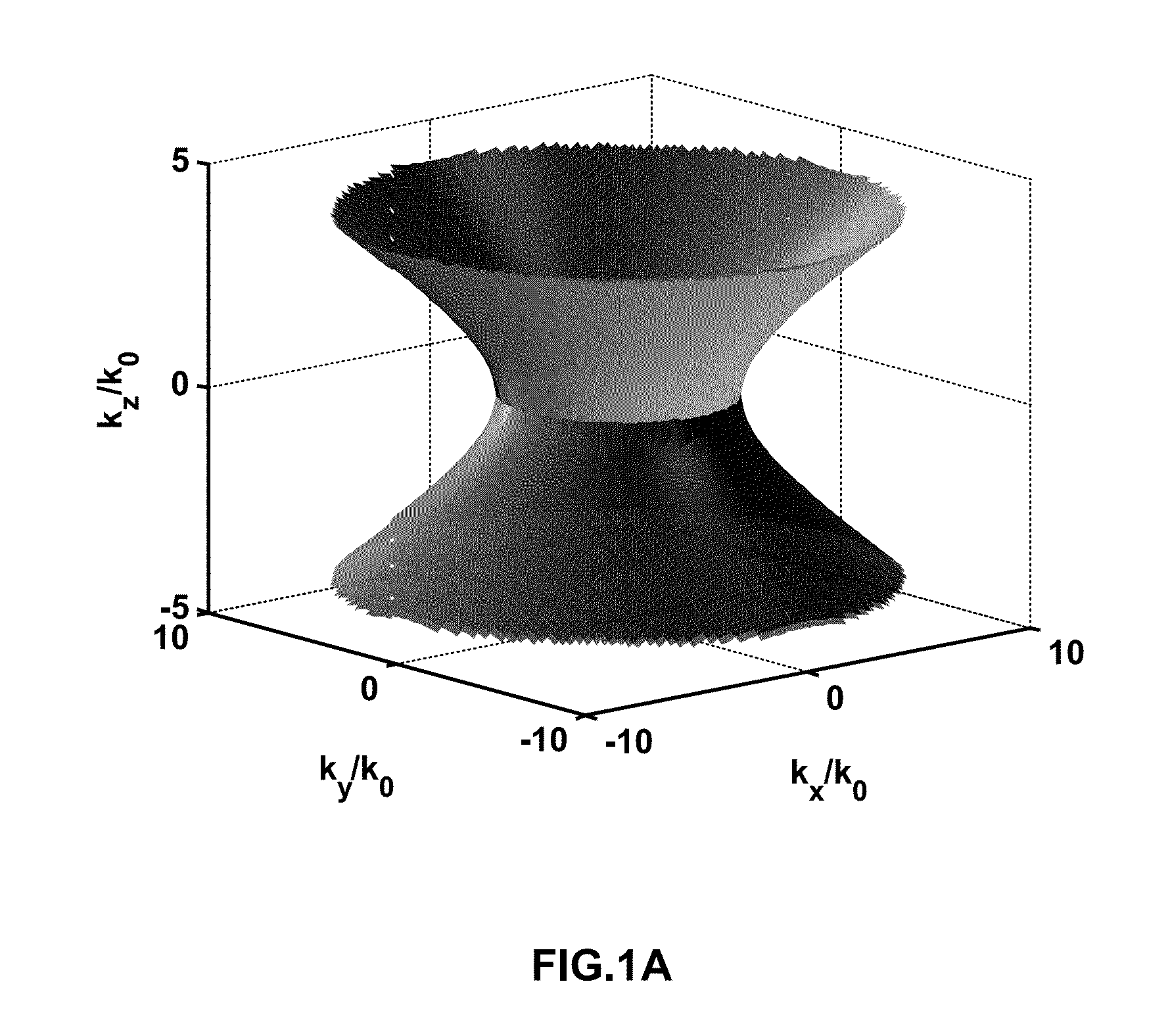
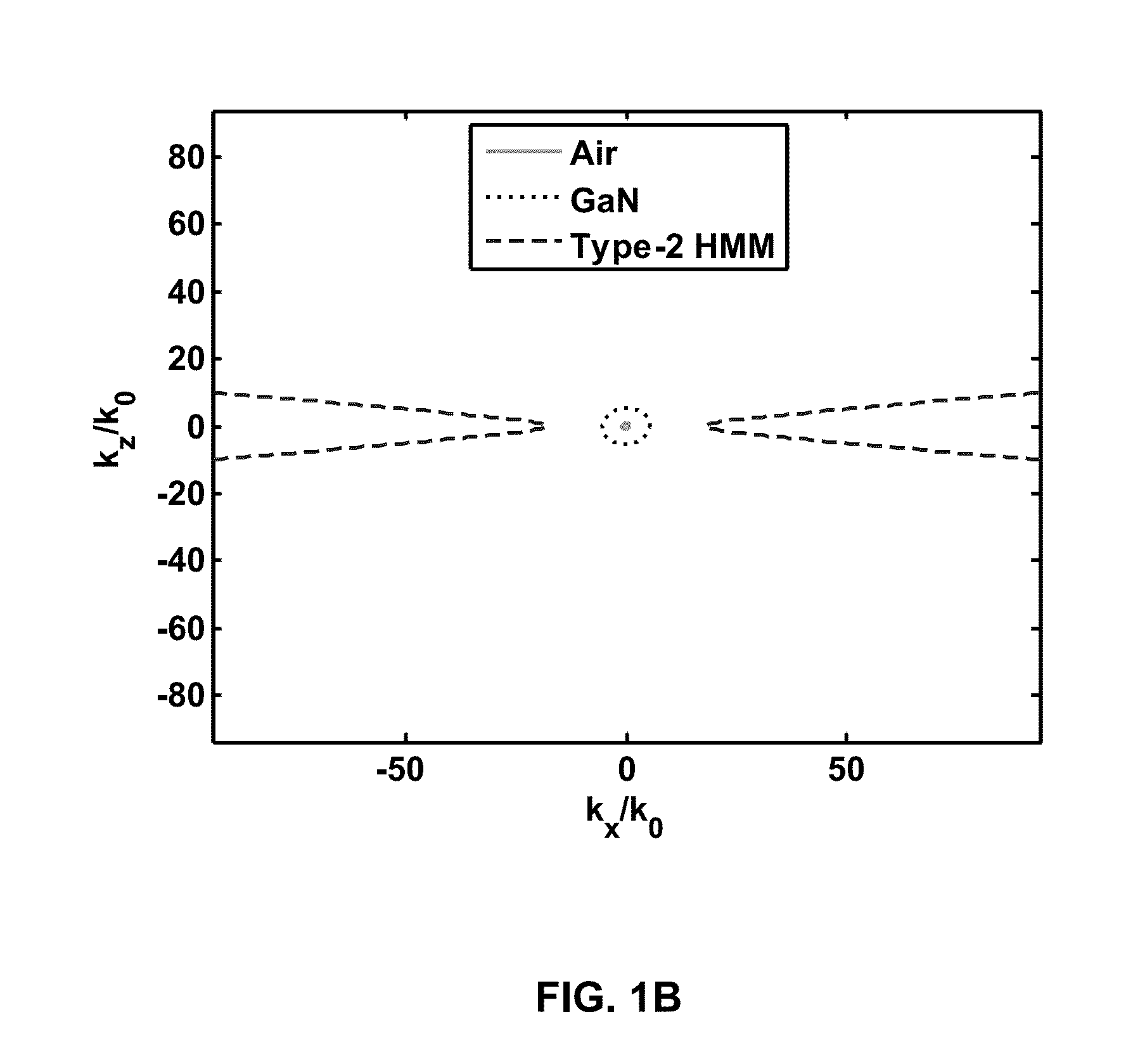
- Hyperbolic metamaterial optical properties and applications: Development of metamaterials with hyperbolic dispersion characteristics that enable unique optical phenomena such as negative refraction and enhanced light-matter interactions. These materials exhibit anisotropic properties where the permittivity tensor components have opposite signs, leading to hyperbolic isofrequency surfaces. Applications include super-resolution imaging, enhanced spontaneous emission, and novel waveguiding structures.
- Electromagnetic cloaking device implementations: Systems and methods for creating electromagnetic invisibility through coordinate transformation techniques and metamaterial implementations. These approaches involve designing material parameters that guide electromagnetic waves around objects, effectively rendering them invisible to specific frequency ranges. The cloaking mechanisms utilize gradient index materials and transformation optics principles to achieve wave manipulation.
- Performance measurement and characterization techniques: Methods for evaluating the effectiveness of metamaterial and cloaking systems through various metrics including scattering cross-section reduction, transmission coefficients, and field distribution analysis. These characterization approaches involve both computational modeling and experimental validation techniques to assess cloaking efficiency, bandwidth performance, and angular stability of the metamaterial responses.
- Tunable and adaptive metamaterial systems: Development of metamaterials with dynamically controllable properties through external stimuli such as electrical signals, mechanical deformation, or thermal activation. These adaptive systems enable real-time adjustment of electromagnetic responses, allowing for reconfigurable cloaking devices and tunable optical properties. The control mechanisms include active elements integration and smart material incorporation for responsive behavior.
02 Hyperbolic metamaterial optical properties and applications
Hyperbolic metamaterials exhibit unique optical characteristics where the permittivity tensor has opposite signs along different axes, enabling extraordinary wave propagation behaviors. These materials can support high-k modes and provide enhanced light-matter interactions. Applications include super-resolution imaging, enhanced spontaneous emission, and novel optical devices that exploit the hyperbolic dispersion relation for improved performance in photonic systems.Expand Specific Solutions03 Electromagnetic cloaking device implementations
Cloaking devices utilize transformation optics principles to redirect electromagnetic waves around objects, rendering them invisible to detection. These implementations involve carefully designed metamaterial shells or coatings that manipulate the electromagnetic field distribution. The cloaking mechanisms work across various frequency ranges and can be applied to different object geometries, providing stealth capabilities for military and civilian applications.Expand Specific Solutions04 Performance measurement and characterization techniques
Comprehensive methods for evaluating the efficiency and performance of metamaterials and cloaking devices. These techniques include scattering cross-section measurements, field distribution analysis, and spectroscopic characterization to quantify cloaking effectiveness. The measurement approaches encompass both numerical simulation methods and experimental validation procedures to assess parameters such as bandwidth, angular coverage, and material losses.Expand Specific Solutions05 Optimization algorithms and efficiency enhancement strategies
Advanced computational methods and optimization algorithms designed to improve the performance of metamaterial-based cloaking systems. These strategies involve parameter optimization, genetic algorithms, and machine learning approaches to enhance cloaking efficiency while minimizing material losses and bandwidth limitations. The optimization processes consider multiple objectives including broadband operation, omnidirectional cloaking, and practical implementation constraints.Expand Specific Solutions
Key Players in Metamaterial and Cloaking Device Industry
The hyperbolic metamaterials versus cloaking materials field represents an emerging technology sector in its early development stage, characterized by significant research activity but limited commercial deployment. The market remains nascent with substantial growth potential, driven by applications in defense, telecommunications, and advanced manufacturing. Technology maturity varies considerably across the competitive landscape, with established aerospace companies like Boeing and Northrop Grumman Systems leveraging their defense expertise, while research institutions including Purdue Research Foundation, Duke University, and Beijing Institute of Technology drive fundamental innovation. Industrial players such as IBM and Hewlett Packard Enterprise explore computational applications, while specialized firms like Multiscale Systems focus on metamaterial composites manufacturing. Chinese institutions including National University of Defense Technology and Harbin Engineering University demonstrate strong government-backed research capabilities. The efficiency metrics comparison between hyperbolic and cloaking metamaterials remains technically challenging, with most players still in proof-of-concept phases rather than commercial-scale production.
The Boeing Co.
Technical Solution: Boeing has developed advanced metamaterial-based cloaking systems for aerospace applications, focusing on radar cross-section reduction technologies. Their approach combines hyperbolic metamaterial structures with engineered surface impedance matching to achieve broadband electromagnetic cloaking capabilities. The company's metamaterial designs utilize multi-layered anisotropic structures that manipulate electromagnetic wave propagation, achieving significant radar signature reduction across multiple frequency bands. Boeing's efficiency metrics demonstrate up to 20dB reduction in radar cross-section while maintaining structural integrity for aircraft applications. Their cloaking materials integrate seamlessly with existing aircraft surfaces, providing both stealth capabilities and aerodynamic performance.
Strengths: Proven aerospace integration experience, robust structural design capabilities, extensive testing infrastructure. Weaknesses: Limited to specific frequency ranges, high manufacturing costs, complex integration requirements.
Duke University
Technical Solution: Duke University has conducted groundbreaking research in transformation optics and metamaterial cloaking, developing theoretical frameworks and practical implementations of invisibility cloaking devices. Their research focuses on engineered metamaterial structures that guide electromagnetic waves around objects using coordinate transformation principles. Duke's metamaterial designs achieve cloaking through carefully designed permittivity and permeability distributions that create smooth wave trajectories around cloaked regions. Their experimental demonstrations have shown successful cloaking at microwave frequencies with efficiency metrics indicating minimal scattering and reflection. The university's approach emphasizes fundamental understanding of wave-matter interactions in metamaterial systems, leading to optimized designs that balance cloaking effectiveness with practical implementation constraints.
Strengths: Strong theoretical foundation, innovative research methodologies, comprehensive experimental validation. Weaknesses: Limited commercial scalability, primarily laboratory-scale demonstrations, narrow frequency band operation.
Core Patents in Hyperbolic and Cloaking Material Design
Hyperbolic metamaterial structure
PatentActiveKR1020180055378A
Innovation
- A hyperbolic metamaterial structure with a vertical multi-thin film configuration, where first and second thin films with different permittivities are alternately stacked perpendicular to the incident plane, allowing for wider operating wavelength range, reduced electrical loss, and higher transmittance, while being easier to manufacture.


Devices with Semiconductor Hyperbolic Metamaterials
PatentActiveUS20160274301A1
Innovation
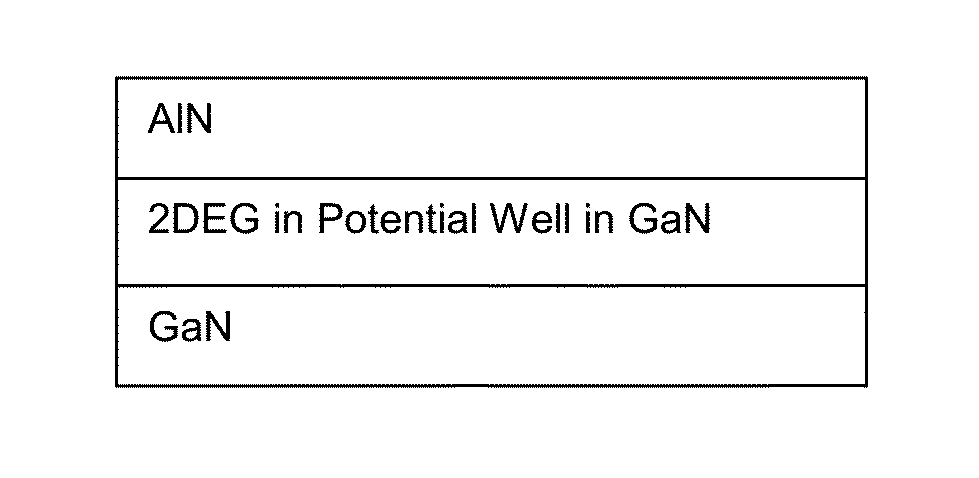
- Replacing metal layers with a two-dimensional electron or hole gas in semiconductor-based assemblies, where low-doped semiconductor regions act as dielectrics, creating a periodic sequence of electron or hole gas layers to achieve hyperbolic metamaterial properties.

Manufacturing Standards for Metamaterial Devices
The manufacturing of metamaterial devices, particularly hyperbolic metamaterials and cloaking materials, requires stringent standardization to ensure consistent performance metrics and reproducible efficiency outcomes. Current manufacturing standards are primarily derived from semiconductor fabrication protocols, adapted to accommodate the unique structural requirements of metamaterial architectures. These standards encompass dimensional tolerances, material purity specifications, and process control parameters that directly impact the electromagnetic response characteristics.
Precision fabrication techniques such as electron beam lithography, focused ion beam milling, and atomic layer deposition have established baseline manufacturing tolerances for metamaterial structures. For hyperbolic metamaterials, layer thickness variations must be maintained within ±2 nanometers to preserve the required anisotropic optical properties. Similarly, cloaking material fabrication demands sub-wavelength feature accuracy with positional tolerances below 5% of the operating wavelength to maintain effective refractive index gradients.
Quality control protocols for metamaterial manufacturing incorporate specialized metrology techniques including ellipsometry, scanning electron microscopy, and near-field optical characterization. These measurement standards ensure that fabricated devices meet theoretical design specifications and maintain consistent efficiency metrics across production batches. Standardized testing procedures evaluate key performance indicators such as transmission coefficients, reflection losses, and bandwidth characteristics under controlled environmental conditions.
Material composition standards address the purity and structural integrity of constituent elements in metamaterial devices. For metallic components, oxidation resistance and grain boundary specifications are critical factors affecting long-term performance stability. Dielectric materials require standardized permittivity values and loss tangent specifications to ensure predictable electromagnetic behavior in operational environments.
Process standardization extends to environmental controls during fabrication, including cleanroom classifications, temperature stability requirements, and contamination prevention protocols. These standards are essential for maintaining the nanoscale precision required in metamaterial manufacturing, where minor deviations can significantly impact device efficiency and electromagnetic response characteristics.
Precision fabrication techniques such as electron beam lithography, focused ion beam milling, and atomic layer deposition have established baseline manufacturing tolerances for metamaterial structures. For hyperbolic metamaterials, layer thickness variations must be maintained within ±2 nanometers to preserve the required anisotropic optical properties. Similarly, cloaking material fabrication demands sub-wavelength feature accuracy with positional tolerances below 5% of the operating wavelength to maintain effective refractive index gradients.
Quality control protocols for metamaterial manufacturing incorporate specialized metrology techniques including ellipsometry, scanning electron microscopy, and near-field optical characterization. These measurement standards ensure that fabricated devices meet theoretical design specifications and maintain consistent efficiency metrics across production batches. Standardized testing procedures evaluate key performance indicators such as transmission coefficients, reflection losses, and bandwidth characteristics under controlled environmental conditions.
Material composition standards address the purity and structural integrity of constituent elements in metamaterial devices. For metallic components, oxidation resistance and grain boundary specifications are critical factors affecting long-term performance stability. Dielectric materials require standardized permittivity values and loss tangent specifications to ensure predictable electromagnetic behavior in operational environments.
Process standardization extends to environmental controls during fabrication, including cleanroom classifications, temperature stability requirements, and contamination prevention protocols. These standards are essential for maintaining the nanoscale precision required in metamaterial manufacturing, where minor deviations can significantly impact device efficiency and electromagnetic response characteristics.
Performance Benchmarking Frameworks for Cloaking Systems
Establishing robust performance benchmarking frameworks for cloaking systems requires standardized methodologies that can accurately assess the effectiveness of both hyperbolic metamaterials and traditional cloaking materials. Current benchmarking approaches often lack consistency across different research groups and applications, leading to fragmented performance data that hinders meaningful comparisons between competing technologies.
The fundamental challenge lies in developing universal metrics that can capture the multidimensional nature of cloaking performance. Traditional approaches focus primarily on scattering cross-section reduction, but comprehensive benchmarking must incorporate bandwidth efficiency, angular coverage, polarization independence, and material loss considerations. These parameters collectively determine the practical viability of cloaking systems in real-world applications.
Standardized testing protocols must address the frequency-dependent behavior of metamaterial-based cloaking devices. Hyperbolic metamaterials exhibit strong anisotropy and dispersion characteristics that require specialized measurement techniques. The benchmarking framework should incorporate swept-frequency analysis across relevant spectral ranges, with particular attention to identifying operational bandwidth limitations and resonance-related performance degradation.
Comparative analysis methodologies need to account for the inherent differences between hyperbolic metamaterials and conventional cloaking approaches. While hyperbolic metamaterials offer unique advantages in terms of subwavelength focusing and enhanced electromagnetic field manipulation, their performance metrics cannot be directly compared using traditional cloaking evaluation criteria. The framework must establish normalized performance indicators that fairly represent each technology's strengths.
Implementation of automated testing systems becomes crucial for ensuring reproducible benchmarking results. These systems should incorporate standardized sample preparation protocols, controlled environmental conditions, and calibrated measurement equipment. The framework must also define acceptable tolerance ranges for key performance parameters, enabling reliable technology comparison and selection processes.
Validation procedures should include both numerical simulation benchmarks and experimental verification protocols. Cross-validation between different measurement techniques helps identify systematic errors and ensures the reliability of performance assessments. The framework must also establish guidelines for reporting uncertainty bounds and statistical significance of measured performance differences.
The fundamental challenge lies in developing universal metrics that can capture the multidimensional nature of cloaking performance. Traditional approaches focus primarily on scattering cross-section reduction, but comprehensive benchmarking must incorporate bandwidth efficiency, angular coverage, polarization independence, and material loss considerations. These parameters collectively determine the practical viability of cloaking systems in real-world applications.
Standardized testing protocols must address the frequency-dependent behavior of metamaterial-based cloaking devices. Hyperbolic metamaterials exhibit strong anisotropy and dispersion characteristics that require specialized measurement techniques. The benchmarking framework should incorporate swept-frequency analysis across relevant spectral ranges, with particular attention to identifying operational bandwidth limitations and resonance-related performance degradation.
Comparative analysis methodologies need to account for the inherent differences between hyperbolic metamaterials and conventional cloaking approaches. While hyperbolic metamaterials offer unique advantages in terms of subwavelength focusing and enhanced electromagnetic field manipulation, their performance metrics cannot be directly compared using traditional cloaking evaluation criteria. The framework must establish normalized performance indicators that fairly represent each technology's strengths.
Implementation of automated testing systems becomes crucial for ensuring reproducible benchmarking results. These systems should incorporate standardized sample preparation protocols, controlled environmental conditions, and calibrated measurement equipment. The framework must also define acceptable tolerance ranges for key performance parameters, enabling reliable technology comparison and selection processes.
Validation procedures should include both numerical simulation benchmarks and experimental verification protocols. Cross-validation between different measurement techniques helps identify systematic errors and ensures the reliability of performance assessments. The framework must also establish guidelines for reporting uncertainty bounds and statistical significance of measured performance differences.
Unlock deeper insights with PatSnap Eureka Quick Research — get a full tech report to explore trends and direct your research. Try now!
Generate Your Research Report Instantly with AI Agent
Supercharge your innovation with PatSnap Eureka AI Agent Platform!