

Improving Micro LED Display Uniformity for Large Screen Applications
JUN 17, 20269 MIN READ
Generate Your Research Report Instantly with AI Agent
Patsnap Eureka helps you evaluate technical feasibility & market potential.
Micro LED Display Uniformity Background and Objectives
Micro LED technology represents a revolutionary advancement in display systems, emerging from decades of semiconductor miniaturization and LED efficiency improvements. This technology involves arrays of microscopic light-emitting diodes, typically measuring less than 100 micrometers, that serve as individual pixels in display applications. The evolution from traditional LED displays to Micro LEDs has been driven by the pursuit of superior brightness, contrast ratios, and energy efficiency while maintaining exceptional color accuracy and longevity.
The development trajectory of Micro LED displays has been marked by significant milestones in semiconductor fabrication, transfer processes, and integration techniques. Early research focused on overcoming fundamental challenges in manufacturing millions of microscopic LEDs with consistent performance characteristics. The technology has progressed from laboratory demonstrations to commercial prototypes, with major breakthroughs in mass transfer techniques and yield optimization occurring over the past decade.
Display uniformity has emerged as one of the most critical technical challenges in Micro LED implementation, particularly for large screen applications. Non-uniformity manifests as visible brightness variations, color inconsistencies, and luminance gradients across the display surface, significantly impacting visual quality and user experience. These variations stem from inherent manufacturing tolerances, material property differences, and operational parameter variations among individual Micro LED elements.
The primary objective of improving Micro LED display uniformity centers on achieving consistent luminance and chromaticity across all pixels within acceptable tolerance ranges. For large screen applications, this challenge becomes exponentially more complex due to the increased number of LED elements and the extended viewing distances that make uniformity defects more perceptible. Target specifications typically require luminance uniformity within 5% variation and color coordinate differences below just-noticeable-difference thresholds.
Technical goals encompass developing comprehensive compensation algorithms, implementing real-time calibration systems, and establishing robust quality control methodologies throughout the manufacturing process. The ultimate aim is to deliver large-scale Micro LED displays that maintain visual consistency comparable to or exceeding current premium display technologies while leveraging the inherent advantages of Micro LED architecture, including superior brightness levels, extended operational lifespans, and enhanced environmental durability for demanding commercial and industrial applications.
Market Demand for Large Screen Micro LED Displays
The large screen display market is experiencing unprecedented growth driven by diverse application sectors demanding superior visual performance. Digital signage represents the largest segment, with retail environments, transportation hubs, and corporate facilities increasingly adopting large format displays for advertising and information dissemination. The transition from traditional LED and LCD technologies to Micro LED solutions is accelerating as businesses seek displays that can operate reliably in challenging environments while delivering exceptional image quality.
Entertainment and media applications constitute another significant demand driver, particularly in cinema complexes, sports venues, and broadcast studios. These environments require displays capable of delivering consistent brightness and color accuracy across expansive viewing areas. The superior contrast ratios and wide color gamut capabilities of Micro LED technology make it particularly attractive for premium entertainment applications where visual impact directly correlates with user experience and revenue generation.
Corporate and educational sectors are emerging as substantial growth markets for large screen Micro LED displays. Conference rooms, auditoriums, and collaborative workspaces increasingly demand seamless video wall solutions that can display high-resolution content without visible bezels or uniformity issues. The ability of Micro LED technology to maintain consistent performance across modular configurations addresses long-standing challenges in these professional environments.
Outdoor advertising and architectural lighting applications represent high-value market segments where display uniformity becomes critical for brand perception and aesthetic appeal. Stadium displays, building facades, and large-scale outdoor advertising installations require technology that can maintain consistent brightness and color reproduction across massive surface areas while withstanding environmental stresses.
The automotive industry is driving demand for specialized large screen applications in showrooms and manufacturing facilities. These environments require displays that can accurately represent vehicle colors and finishes, making uniformity a crucial performance parameter. Additionally, the growing trend toward immersive customer experiences in retail automotive environments is creating new opportunities for large format Micro LED installations.
Market research indicates that uniformity specifications are becoming increasingly stringent across all application segments. End users are demanding displays with brightness variation tolerances and color consistency standards that exceed the capabilities of current LED technologies, creating a clear market pull for advanced Micro LED solutions with improved uniformity characteristics.
Current Uniformity Challenges in Micro LED Technology
Micro LED displays face significant uniformity challenges that become increasingly pronounced in large screen applications. The fundamental issue stems from the inherent variability in individual LED chip characteristics, including luminance output, color coordinates, and electrical properties. Manufacturing tolerances during the epitaxial growth process create variations in quantum well thickness, indium composition, and defect density across wafers, resulting in LED chips with different emission characteristics even within the same production batch.
Wavelength uniformity represents one of the most critical challenges, particularly for RGB displays where color accuracy is paramount. Blue and green micro LEDs exhibit wavelength variations of ±2-5 nanometers across large substrates, while red LEDs face additional complications due to their different material systems. These variations translate to visible color shifts across display panels, creating patches of different hues that compromise visual quality and user experience.
Luminance uniformity presents another major obstacle, with brightness variations of 10-20% commonly observed across large displays. This non-uniformity arises from multiple sources including LED chip efficiency variations, current density differences due to resistance variations in driving circuits, and thermal gradients across the display panel. The situation becomes more complex as display sizes increase, where maintaining consistent current distribution becomes increasingly difficult.
The mass transfer process introduces additional uniformity challenges specific to micro LED technology. During the transfer of millions of micro LEDs from donor substrates to display backplanes, positional accuracy, bonding quality, and potential chip damage create localized variations in display performance. Defective transfers, incomplete bonding, or micro-cracks in LED chips contribute to dead pixels or reduced efficiency zones.
Thermal management compounds these uniformity issues, as temperature variations across large displays affect LED efficiency and wavelength stability. Hot spots created by high current densities or inadequate heat dissipation lead to localized performance degradation and accelerated aging, further compromising display uniformity over time.
Current compensation methods, including individual pixel calibration and real-time correction algorithms, provide partial solutions but introduce complexity and cost. The challenge intensifies as pixel pitches decrease and display sizes increase, making comprehensive uniformity control increasingly difficult to achieve through conventional approaches.
Existing Uniformity Enhancement Solutions
01 Brightness calibration and compensation methods
Various calibration techniques are employed to achieve uniform brightness across micro LED displays. These methods involve measuring individual LED characteristics and applying compensation algorithms to correct for brightness variations. Advanced calibration systems can dynamically adjust LED drive currents and voltages to maintain consistent luminance levels throughout the display panel.- Brightness calibration and compensation methods: Various calibration techniques are employed to achieve uniform brightness across micro LED displays. These methods involve measuring individual LED brightness characteristics and applying compensation algorithms to correct for variations. Advanced calibration systems can dynamically adjust brightness levels during operation to maintain uniformity over time and temperature changes.
- Color uniformity correction techniques: Color uniformity is achieved through sophisticated correction algorithms that address variations in color reproduction across the display panel. These techniques involve color space mapping, white point adjustment, and individual pixel color correction to ensure consistent color appearance throughout the display area.
- Manufacturing process optimization for uniformity: Manufacturing techniques are optimized to reduce inherent variations in micro LED characteristics during production. This includes precise control of epitaxial growth, chip sorting and binning processes, and advanced transfer techniques to ensure consistent LED performance across the entire display substrate.
- Driver circuit design for uniform control: Specialized driver circuits are designed to provide precise and uniform control of individual micro LEDs. These circuits incorporate current regulation, voltage compensation, and timing control mechanisms to ensure consistent operation across all pixels while minimizing variations due to electrical characteristics.
- Real-time monitoring and feedback systems: Advanced monitoring systems continuously assess display uniformity during operation and provide real-time feedback for dynamic corrections. These systems utilize optical sensors, image processing algorithms, and machine learning techniques to detect and compensate for uniformity degradation over the display lifetime.
02 Color uniformity correction techniques
Color uniformity is achieved through sophisticated correction algorithms that address variations in color temperature and chromaticity across the display. These techniques involve color space mapping, white point adjustment, and individual pixel color correction to ensure consistent color reproduction. Advanced systems utilize real-time feedback mechanisms to maintain color accuracy over the display's lifetime.Expand Specific Solutions03 Manufacturing process optimization for uniformity
Manufacturing techniques focus on improving the inherent uniformity of micro LED arrays during production. These approaches include precise placement control, substrate preparation methods, and quality control measures during the transfer and bonding processes. Advanced manufacturing systems incorporate real-time monitoring and feedback to minimize variations in LED characteristics across the display panel.Expand Specific Solutions04 Drive circuit and current control systems
Specialized drive circuits are designed to provide uniform current distribution and voltage regulation across micro LED arrays. These systems incorporate current mirrors, voltage regulators, and feedback control mechanisms to ensure consistent power delivery to each LED. Advanced drive architectures can compensate for variations in LED forward voltage and resistance to maintain display uniformity.Expand Specific Solutions05 Optical compensation and enhancement structures
Optical structures and materials are integrated into micro LED displays to improve uniformity through light management techniques. These include micro-lens arrays, light extraction structures, and optical films that help redistribute light and reduce variations in viewing angle characteristics. Advanced optical designs can also incorporate anti-reflection coatings and light recycling mechanisms to enhance overall display uniformity.Expand Specific Solutions
Key Players in Micro LED Display Industry
The Micro LED display uniformity market for large screen applications is in its early commercialization stage, with significant growth potential driven by increasing demand for high-quality large-format displays. The market remains relatively nascent but shows promising expansion as technology barriers are gradually overcome. Technology maturity varies significantly across players, with established display manufacturers like BOE Technology Group, Samsung Electronics, and Sony Group leading in foundational display technologies and manufacturing capabilities. Chinese companies including Tianma Microelectronics, China Star Optoelectronics subsidiaries, and specialized firms like Jade Bird Display and Chengdu Vistar Optoelectronics are advancing rapidly in Micro LED development. Apple represents a major potential market driver with its display innovation requirements. Semiconductor specialists like Seoul Viosys and research institutions such as MIT contribute critical component technologies and fundamental research. The competitive landscape shows a mix of traditional display giants leveraging existing infrastructure and emerging specialists focusing specifically on Micro LED uniformity solutions, indicating a transitional phase toward broader commercial adoption.
BOE Technology Group Co., Ltd.
Technical Solution: BOE has developed comprehensive micro LED display solutions focusing on large-scale manufacturing and uniformity optimization through advanced process control. Their technology platform includes precision mass transfer systems utilizing electrostatic pick-and-place mechanisms with sub-micron accuracy for LED placement. BOE implements multi-level uniformity correction including wafer-level binning, panel-level calibration, and system-level compensation algorithms. The company's approach incorporates advanced TFT backplane technology optimized for micro LED driving with individual pixel current control and temperature compensation. BOE's manufacturing process includes real-time monitoring systems for brightness and color uniformity during production, enabling immediate process adjustments to maintain consistent display quality across large screen formats.
Strengths: Large-scale manufacturing capabilities, comprehensive technology platform, strong R&D investment in display technologies. Weaknesses: Technology maturity compared to leading competitors, challenges in achieving cost-effective production for premium applications.
Apple, Inc.
Technical Solution: Apple's micro LED approach emphasizes advanced chip design and proprietary manufacturing processes to achieve superior display uniformity. The company has developed custom micro LED chips with enhanced current spreading layers and optimized mesa structures to ensure uniform light emission across individual pixels. Apple's technology incorporates sophisticated driver IC designs with individual pixel current control and real-time brightness compensation algorithms. Their manufacturing process includes advanced wafer-level testing and sorting techniques to minimize brightness variations before assembly. Apple also utilizes machine learning algorithms for predictive uniformity correction and implements advanced optical bonding techniques to reduce light scattering and improve overall display consistency across large screen applications.
Strengths: Advanced chip design capabilities, sophisticated software algorithms for uniformity control, premium product positioning. Weaknesses: Limited manufacturing scale, high development costs, dependency on external manufacturing partners.
Core Innovations in Micro LED Uniformity Control
Backlight panel
PatentActiveUS20250138363A1
Innovation
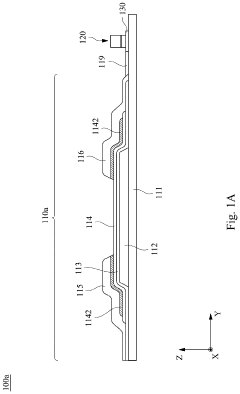
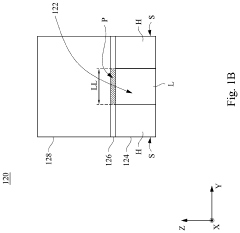
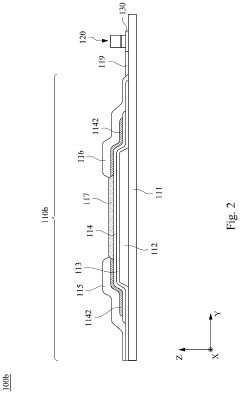
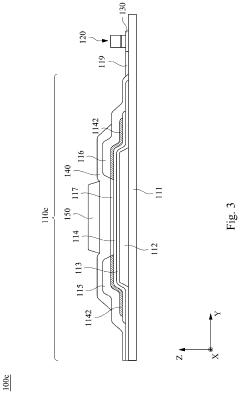
- A backlight panel design featuring a substrate with alternately arranged first and second light-emitting diodes, whose light-emitting areas intersect and are partially overlapped, improving brightness uniformity.


Micro light-emitting diode display device and micro light-emitting diode driving circuit
PatentActiveUS10680035B1
Innovation
- A micro light-emitting diode display device with a driving transistor featuring a gate insulator thickness of less than or equal to 500 angstroms and a micro light-emitting diode with a current injection channel and an active layer portion in contact with the channel, reducing the light-emitting area and avoiding surface recombination, thereby lowering the voltage required to activate the diode.
Manufacturing Standards for Micro LED Displays
The establishment of comprehensive manufacturing standards for Micro LED displays represents a critical foundation for achieving uniformity in large screen applications. Current industry efforts focus on developing standardized protocols that address the unique challenges of Micro LED production, including chip size specifications, transfer accuracy requirements, and assembly tolerances. These standards must accommodate the microscopic scale of individual LEDs, typically measuring less than 100 micrometers, while ensuring consistent performance across millions of pixels in large display arrays.
Dimensional standardization plays a pivotal role in manufacturing consistency. Industry organizations are working to establish precise specifications for chip dimensions, substrate materials, and interconnect structures. The standards define acceptable variations in LED chip height, width, and thickness, with tolerances typically maintained within ±2 micrometers to ensure uniform optical performance. Additionally, standardized substrate specifications include thermal expansion coefficients, surface roughness parameters, and electrical conductivity requirements that directly impact display uniformity.
Process control standards encompass critical manufacturing stages including epitaxial growth, chip fabrication, mass transfer, and final assembly. These standards define acceptable parameter ranges for temperature control during transfer processes, pressure specifications for bonding operations, and environmental conditions for clean room manufacturing. Quality control checkpoints are standardized at each production stage, with specific measurement protocols for luminance uniformity, color consistency, and electrical performance verification.
Testing and validation standards establish uniform methodologies for evaluating display performance across different manufacturers. Standardized test patterns, measurement equipment specifications, and environmental testing conditions ensure consistent quality assessment. These protocols include accelerated aging tests, thermal cycling requirements, and optical measurement procedures that validate uniformity performance under various operating conditions.
Emerging standards also address advanced manufacturing techniques such as selective transfer methods, repair and replacement procedures, and yield optimization protocols. Industry consortiums are developing guidelines for acceptable defect densities, repair strategies for non-functional pixels, and standardized interfaces between manufacturing equipment from different suppliers. These comprehensive standards create a framework for achieving the precision and consistency required for large-scale Micro LED display production while maintaining economic viability.
Cost-Performance Analysis of Uniformity Solutions
The cost-performance analysis of uniformity solutions for Micro LED displays reveals significant variations across different technological approaches, with each solution presenting distinct trade-offs between implementation costs and performance outcomes. Traditional binning and sorting methods represent the most cost-effective initial approach, requiring minimal additional hardware investment while achieving moderate uniformity improvements of approximately 15-20% in brightness variation reduction.
Advanced compensation algorithms utilizing real-time calibration systems demonstrate superior performance characteristics, delivering uniformity improvements exceeding 90% in optimal conditions. However, these solutions require substantial upfront investments in sophisticated sensing equipment and processing hardware, with implementation costs ranging from $50,000 to $200,000 per production line depending on display size and resolution requirements.
Hybrid approaches combining selective binning with localized compensation present compelling cost-performance ratios for medium to large-scale applications. These solutions achieve 70-80% uniformity improvement while maintaining implementation costs at approximately 60% of full algorithmic compensation systems. The reduced complexity enables faster deployment timelines and lower maintenance overhead, making them attractive for manufacturers seeking balanced solutions.
Manufacturing process optimization through improved transfer techniques and substrate preparation offers the most favorable long-term cost structure. While initial research and development investments may reach $500,000 to $1.5 million, the per-unit cost reduction and yield improvements create positive returns within 18-24 months for high-volume production scenarios. These solutions address uniformity issues at the source rather than through post-processing correction.
Economic modeling indicates that display size significantly influences optimal solution selection. Applications below 100 inches typically benefit most from algorithmic compensation due to manageable processing requirements, while larger installations exceeding 200 inches demonstrate superior economics with manufacturing process improvements. The crossover point occurs around 150-inch diagonal measurements, where hybrid solutions often provide optimal cost-performance balance.
Return on investment calculations show that uniformity improvements directly correlate with market acceptance and premium pricing capabilities. Enhanced uniformity enables manufacturers to command 15-25% price premiums in professional display markets, while consumer applications show 8-12% willingness-to-pay increases for superior visual consistency across large screen formats.
Unlock deeper insights with Patsnap Eureka Quick Research — get a full tech report to explore trends and direct your research. Try now!
Generate Your Research Report Instantly with AI Agent
Supercharge your innovation with Patsnap Eureka AI Agent Platform!