

Integrate Direct Lithium Extraction with Renewable Energy Solutions
SEP 12, 20259 MIN READ
Generate Your Research Report Instantly with AI Agent
PatSnap Eureka helps you evaluate technical feasibility & market potential.
DLE-Renewable Integration Background and Objectives
Direct Lithium Extraction (DLE) technologies have emerged as a revolutionary approach to lithium production, offering significant advantages over traditional extraction methods such as evaporation ponds and hard rock mining. The integration of DLE with renewable energy solutions represents a critical convergence of two rapidly evolving technological domains that address both the growing global demand for lithium and the urgent need for sustainable energy practices.
The historical context of lithium extraction has been dominated by conventional methods that are water-intensive, land-consuming, and environmentally disruptive. As global lithium demand has surged—driven primarily by the electric vehicle revolution and renewable energy storage requirements—these traditional methods have proven increasingly inadequate to meet market needs while maintaining environmental sustainability.
DLE technologies have developed over the past decade as a response to these challenges, offering methods to selectively extract lithium from brine resources with potentially reduced environmental footprints. Concurrently, renewable energy technologies have experienced dramatic cost reductions and efficiency improvements, creating new opportunities for synergistic integration with industrial processes like lithium extraction.
The technical evolution trajectory shows an accelerating pace of innovation in both fields. DLE methods have progressed from laboratory concepts to pilot projects and early commercial deployments, while renewable energy has transitioned from subsidized alternative to economic mainstream. The convergence of these technologies represents a natural progression toward more sustainable resource extraction paradigms.
The primary objective of integrating DLE with renewable energy solutions is to develop lithium production systems that minimize carbon emissions, reduce water consumption, and decrease overall environmental impact while maintaining economic viability. This integration aims to address the paradox of using environmentally harmful processes to extract materials essential for clean energy technologies.
Secondary objectives include enhancing energy security for lithium production operations, reducing operational costs through energy self-sufficiency, enabling lithium extraction in remote locations lacking reliable grid infrastructure, and creating scalable solutions that can adapt to varying resource qualities and production requirements.
The technological goals extend beyond simple co-location of renewable energy generation with DLE facilities. True integration requires developing systems that can effectively manage the intermittent nature of renewable energy sources while maintaining the precise conditions required for optimal DLE performance, potentially through innovative energy storage solutions, process adaptations, and smart control systems.
The historical context of lithium extraction has been dominated by conventional methods that are water-intensive, land-consuming, and environmentally disruptive. As global lithium demand has surged—driven primarily by the electric vehicle revolution and renewable energy storage requirements—these traditional methods have proven increasingly inadequate to meet market needs while maintaining environmental sustainability.
DLE technologies have developed over the past decade as a response to these challenges, offering methods to selectively extract lithium from brine resources with potentially reduced environmental footprints. Concurrently, renewable energy technologies have experienced dramatic cost reductions and efficiency improvements, creating new opportunities for synergistic integration with industrial processes like lithium extraction.
The technical evolution trajectory shows an accelerating pace of innovation in both fields. DLE methods have progressed from laboratory concepts to pilot projects and early commercial deployments, while renewable energy has transitioned from subsidized alternative to economic mainstream. The convergence of these technologies represents a natural progression toward more sustainable resource extraction paradigms.
The primary objective of integrating DLE with renewable energy solutions is to develop lithium production systems that minimize carbon emissions, reduce water consumption, and decrease overall environmental impact while maintaining economic viability. This integration aims to address the paradox of using environmentally harmful processes to extract materials essential for clean energy technologies.
Secondary objectives include enhancing energy security for lithium production operations, reducing operational costs through energy self-sufficiency, enabling lithium extraction in remote locations lacking reliable grid infrastructure, and creating scalable solutions that can adapt to varying resource qualities and production requirements.
The technological goals extend beyond simple co-location of renewable energy generation with DLE facilities. True integration requires developing systems that can effectively manage the intermittent nature of renewable energy sources while maintaining the precise conditions required for optimal DLE performance, potentially through innovative energy storage solutions, process adaptations, and smart control systems.
Lithium Market Demand Analysis
The global lithium market is experiencing unprecedented growth driven primarily by the rapid expansion of electric vehicle (EV) production and renewable energy storage systems. Current market valuations place the global lithium market at approximately $7.5 billion in 2022, with projections indicating a compound annual growth rate (CAGR) of 12-14% through 2030, potentially reaching $18-20 billion by decade's end.
Demand for lithium has more than doubled in the past five years, with consumption rising from roughly 200,000 metric tons of lithium carbonate equivalent (LCE) in 2017 to over 500,000 metric tons in 2022. Industry forecasts suggest this figure could exceed 1.5 million metric tons by 2030, representing a tripling of current demand levels.
The EV sector remains the dominant driver, accounting for approximately 71% of lithium demand. As major automotive manufacturers commit to electrification targets, this percentage is expected to increase to 80-85% by 2030. Tesla, Volkswagen, GM, and other major manufacturers have announced plans requiring hundreds of thousands of tons of additional lithium supply annually.
Energy storage systems (ESS) represent the second largest and fastest-growing demand segment, currently consuming about 15% of global lithium production. With renewable energy integration accelerating worldwide and grid-scale storage becoming essential for managing intermittent power sources, ESS demand for lithium is projected to grow at 18-20% annually through 2030.
Consumer electronics, traditionally the primary lithium consumer, now represents only about 10% of demand, though absolute consumption continues to increase modestly at 3-5% annually.
Geographically, demand is concentrated in manufacturing hubs, with China currently consuming approximately 39% of global lithium, followed by Europe (25%), North America (21%), and the rest of Asia (12%). However, as localization of battery supply chains accelerates in North America and Europe due to policy initiatives like the U.S. Inflation Reduction Act and EU Critical Raw Materials Act, demand distribution is expected to balance further.
The integration of Direct Lithium Extraction (DLE) with renewable energy presents a significant market opportunity, addressing both supply constraints and sustainability concerns. Surveys indicate that 78% of battery manufacturers and 82% of EV producers express strong interest in lithium sourced through environmentally responsible methods, with 65% willing to pay premium prices for demonstrably sustainable lithium.
This market dynamic creates a compelling case for renewable-powered DLE technologies, which could potentially command 15-20% price premiums while simultaneously reducing operational costs through renewable energy integration, thereby addressing both economic and environmental imperatives in the rapidly expanding lithium value chain.
Demand for lithium has more than doubled in the past five years, with consumption rising from roughly 200,000 metric tons of lithium carbonate equivalent (LCE) in 2017 to over 500,000 metric tons in 2022. Industry forecasts suggest this figure could exceed 1.5 million metric tons by 2030, representing a tripling of current demand levels.
The EV sector remains the dominant driver, accounting for approximately 71% of lithium demand. As major automotive manufacturers commit to electrification targets, this percentage is expected to increase to 80-85% by 2030. Tesla, Volkswagen, GM, and other major manufacturers have announced plans requiring hundreds of thousands of tons of additional lithium supply annually.
Energy storage systems (ESS) represent the second largest and fastest-growing demand segment, currently consuming about 15% of global lithium production. With renewable energy integration accelerating worldwide and grid-scale storage becoming essential for managing intermittent power sources, ESS demand for lithium is projected to grow at 18-20% annually through 2030.
Consumer electronics, traditionally the primary lithium consumer, now represents only about 10% of demand, though absolute consumption continues to increase modestly at 3-5% annually.
Geographically, demand is concentrated in manufacturing hubs, with China currently consuming approximately 39% of global lithium, followed by Europe (25%), North America (21%), and the rest of Asia (12%). However, as localization of battery supply chains accelerates in North America and Europe due to policy initiatives like the U.S. Inflation Reduction Act and EU Critical Raw Materials Act, demand distribution is expected to balance further.
The integration of Direct Lithium Extraction (DLE) with renewable energy presents a significant market opportunity, addressing both supply constraints and sustainability concerns. Surveys indicate that 78% of battery manufacturers and 82% of EV producers express strong interest in lithium sourced through environmentally responsible methods, with 65% willing to pay premium prices for demonstrably sustainable lithium.
This market dynamic creates a compelling case for renewable-powered DLE technologies, which could potentially command 15-20% price premiums while simultaneously reducing operational costs through renewable energy integration, thereby addressing both economic and environmental imperatives in the rapidly expanding lithium value chain.
Current DLE Technologies and Implementation Challenges
Direct Lithium Extraction (DLE) technologies represent a significant advancement in lithium production compared to traditional evaporation ponds and hard rock mining. Currently, several DLE approaches dominate the technological landscape, each with distinct operational mechanisms and implementation challenges.
Ion-exchange technologies utilize specialized materials to selectively capture lithium ions from brine solutions. These systems can achieve higher recovery rates (80-90%) compared to evaporation ponds (30-50%) and operate in significantly reduced timeframes - days rather than months. However, they face challenges related to resin degradation in high-temperature brines and competition from other ions, particularly magnesium, which can reduce selectivity and efficiency.
Adsorption-based technologies employ engineered materials with high affinity for lithium. These systems demonstrate promising selectivity but often struggle with regeneration cycles and material longevity in industrial settings. The development of more durable adsorbents remains an active research area.
Membrane technologies, including nanofiltration and electrodialysis, offer continuous processing capabilities but encounter fouling issues when processing complex brine compositions. Energy consumption for these systems remains relatively high, presenting a significant barrier to widespread implementation.
Solvent extraction methods utilize specialized chemical compounds to selectively separate lithium from brine solutions. While effective in laboratory settings, scaling these processes presents considerable engineering challenges, particularly regarding solvent loss and environmental containment.
Implementation challenges span technical, economic, and environmental dimensions. Energy intensity represents a critical barrier, with most DLE technologies requiring 10-15 kWh per kilogram of lithium carbonate equivalent produced. This energy demand creates significant operational costs and carbon footprints when powered by conventional energy sources.
Water management presents another substantial challenge, as many DLE processes require freshwater for regeneration cycles. In arid regions where lithium brines are often located, this creates competition for scarce water resources.
Chemical consumption for regeneration and processing steps introduces both economic and environmental concerns. The transportation, storage, and disposal of these chemicals add complexity to operational logistics and environmental compliance.
Scale-up from laboratory to industrial implementation remains problematic, with many technologies demonstrating reduced efficiency and increased operational challenges at commercial scales. Process stability and reliability under variable brine compositions represent persistent engineering challenges.
Waste management, particularly the handling of depleted brines with altered chemical compositions, requires careful consideration to prevent environmental contamination and ensure regulatory compliance.
Ion-exchange technologies utilize specialized materials to selectively capture lithium ions from brine solutions. These systems can achieve higher recovery rates (80-90%) compared to evaporation ponds (30-50%) and operate in significantly reduced timeframes - days rather than months. However, they face challenges related to resin degradation in high-temperature brines and competition from other ions, particularly magnesium, which can reduce selectivity and efficiency.
Adsorption-based technologies employ engineered materials with high affinity for lithium. These systems demonstrate promising selectivity but often struggle with regeneration cycles and material longevity in industrial settings. The development of more durable adsorbents remains an active research area.
Membrane technologies, including nanofiltration and electrodialysis, offer continuous processing capabilities but encounter fouling issues when processing complex brine compositions. Energy consumption for these systems remains relatively high, presenting a significant barrier to widespread implementation.
Solvent extraction methods utilize specialized chemical compounds to selectively separate lithium from brine solutions. While effective in laboratory settings, scaling these processes presents considerable engineering challenges, particularly regarding solvent loss and environmental containment.
Implementation challenges span technical, economic, and environmental dimensions. Energy intensity represents a critical barrier, with most DLE technologies requiring 10-15 kWh per kilogram of lithium carbonate equivalent produced. This energy demand creates significant operational costs and carbon footprints when powered by conventional energy sources.
Water management presents another substantial challenge, as many DLE processes require freshwater for regeneration cycles. In arid regions where lithium brines are often located, this creates competition for scarce water resources.
Chemical consumption for regeneration and processing steps introduces both economic and environmental concerns. The transportation, storage, and disposal of these chemicals add complexity to operational logistics and environmental compliance.
Scale-up from laboratory to industrial implementation remains problematic, with many technologies demonstrating reduced efficiency and increased operational challenges at commercial scales. Process stability and reliability under variable brine compositions represent persistent engineering challenges.
Waste management, particularly the handling of depleted brines with altered chemical compositions, requires careful consideration to prevent environmental contamination and ensure regulatory compliance.
Current Integration Solutions for DLE and Renewables
01 Adsorption-based lithium extraction methods
Adsorption-based technologies utilize specialized materials that selectively bind to lithium ions from brine solutions. These adsorbents can be inorganic ion exchangers, organic resins, or composite materials with high selectivity for lithium over competing ions like sodium, potassium, and magnesium. The process typically involves passing lithium-containing brine through columns packed with these adsorbents, followed by desorption steps using acid or other eluents to recover concentrated lithium solutions. This approach offers advantages in selectivity and can be applied to various brine sources with different lithium concentrations.- Adsorption-based lithium extraction methods: Direct lithium extraction techniques using selective adsorption materials to capture lithium ions from brines and other sources. These methods typically employ specialized adsorbents that can selectively bind to lithium ions in the presence of competing ions. The process generally involves contacting the lithium-containing solution with the adsorbent, followed by desorption steps to recover concentrated lithium. This approach offers advantages in processing speed and environmental impact compared to traditional evaporation methods.
- Ion exchange technologies for lithium recovery: Ion exchange technologies utilize specialized resins or membranes that can selectively exchange lithium ions from source solutions. These systems typically operate in continuous or batch processes where lithium ions are captured from brines or other sources and then eluted using regeneration solutions. The technology enables processing of low-concentration lithium sources that would be uneconomical with traditional methods, while also reducing water consumption and processing time compared to evaporation ponds.
- Electrochemical lithium extraction systems: Electrochemical methods for direct lithium extraction utilize electrical potential to selectively capture or transport lithium ions across membranes. These systems may employ electrochemical cells with specialized electrodes or membrane configurations that allow for selective lithium recovery. The process can be controlled precisely through applied voltage, offering advantages in selectivity and efficiency. Electrochemical approaches often require less land area and can operate continuously compared to traditional extraction methods.
- Membrane-based separation technologies: Membrane-based technologies for lithium extraction utilize specialized filtration membranes that can selectively separate lithium from other components in solution. These may include nanofiltration, reverse osmosis, or other membrane configurations specifically designed for lithium selectivity. The process typically involves pressure-driven or concentration-driven transport across membranes, allowing for continuous operation and reduced environmental footprint. These systems can be modular and scalable for various production capacities.
- Integrated lithium extraction and processing systems: Integrated systems that combine multiple technologies for lithium extraction and subsequent processing into battery-grade materials. These comprehensive approaches may incorporate adsorption, ion exchange, or electrochemical methods with downstream purification and conversion steps. The integrated systems are designed to handle various lithium sources including brines, geothermal waters, or mining waste streams, and can produce lithium compounds suitable for battery applications. These systems often focus on minimizing waste, energy consumption, and environmental impact throughout the entire process chain.
02 Membrane and electrochemical extraction technologies
Electrochemical methods for direct lithium extraction employ ion-selective membranes and electrical potential to separate lithium ions from brine solutions. These systems may use electrodialysis, capacitive deionization, or electrochemical cells with lithium-selective membranes to achieve separation. The application of electrical potential drives lithium ions across membranes while excluding competing ions, resulting in concentrated lithium streams. These technologies can reduce water consumption compared to traditional evaporation methods and operate continuously with lower environmental impact.Expand Specific Solutions03 Solvent extraction and chemical precipitation methods
Chemical approaches to direct lithium extraction involve liquid-liquid extraction using specialized solvents or precipitation reactions that selectively recover lithium from brines. Solvent extraction utilizes organic compounds that preferentially bind to lithium ions, transferring them to an organic phase before back-extraction into a concentrated aqueous solution. Chemical precipitation methods use reagents that form insoluble lithium compounds that can be separated and processed. These techniques can be tailored to specific brine compositions and offer alternatives when other methods face limitations due to brine chemistry.Expand Specific Solutions04 Integrated systems and process optimization
Integrated direct lithium extraction systems combine multiple technologies to optimize recovery efficiency and product purity. These systems may incorporate pre-treatment steps to remove impurities, primary extraction using adsorption or membrane technologies, and post-processing to achieve battery-grade lithium compounds. Process optimization focuses on reducing energy consumption, minimizing chemical usage, and maximizing lithium recovery rates. Advanced control systems and continuous monitoring enable adaptive operation based on feed composition variations, ensuring consistent performance across changing conditions.Expand Specific Solutions05 Sustainable and environmentally friendly extraction approaches
Environmentally conscious direct lithium extraction methods focus on minimizing water usage, reducing chemical consumption, and lowering the carbon footprint compared to traditional evaporation ponds. These approaches include closed-loop systems that recycle process water and reagents, renewable energy integration to power extraction operations, and zero liquid discharge designs that eliminate brine waste. Some technologies also enable the co-recovery of valuable by-products like potassium, magnesium, and boron, improving the overall economics while reducing environmental impact. These sustainable methods are particularly important for operations in water-scarce regions and environmentally sensitive areas.Expand Specific Solutions
Key Industry Players in DLE and Renewable Energy
The integration of Direct Lithium Extraction (DLE) with renewable energy solutions is in an early growth phase, with the market expected to expand significantly as demand for sustainable lithium production increases. Key players like Lilac Solutions, Energy Exploration Technologies (EnergyX), and Evove are pioneering advanced DLE technologies that reduce environmental impact while improving extraction efficiency. Established energy companies such as Schlumberger and POSCO Holdings are leveraging their expertise to develop integrated solutions. Academic institutions including Xi'an Jiaotong University and The University of Manchester are contributing research innovations. The technology maturity varies, with companies like International Battery Metals and Watercycle Technologies demonstrating commercial viability, while others focus on optimizing renewable energy integration to address the energy-intensive nature of lithium extraction processes.
Lilac Solutions, Inc.
Technical Solution: Lilac Solutions has developed an innovative ion-exchange technology specifically designed for direct lithium extraction (DLE) that integrates seamlessly with renewable energy sources. Their system uses proprietary ion-exchange beads that selectively absorb lithium from brine resources while leaving other elements behind. The process operates at ambient temperature and pressure, making it highly compatible with solar and geothermal energy inputs. Lilac's technology reduces water consumption by over 90% compared to traditional evaporation ponds and can be powered by on-site solar arrays or nearby renewable energy sources. Their modular extraction units can be scaled according to resource size and energy availability, with each module capable of being independently powered by renewable sources. The company has demonstrated successful pilot projects where their DLE technology operates entirely on renewable energy, achieving energy consumption of approximately 5-15 kWh per kg of lithium carbonate equivalent (LCE) produced, significantly lower than conventional methods.
Strengths: Highly selective lithium extraction with minimal environmental footprint; modular design allows for flexible deployment and scaling; significantly reduced water usage; lower energy requirements compatible with intermittent renewable sources. Weaknesses: Initial capital costs may be higher than conventional methods; requires consistent brine chemistry for optimal performance; technology still being proven at commercial scale.
Energy Exploration Technologies, Inc.
Technical Solution: Energy Exploration Technologies (EnergyX) has developed a proprietary Lithium-Ion Transport and Separation (LiTAS) technology that utilizes a highly selective membrane-based approach for direct lithium extraction. Their system employs metal-organic framework (MOF) membranes that can extract lithium ions with over 90% efficiency while requiring minimal energy input. EnergyX has specifically designed their DLE technology to be powered by renewable energy sources, particularly solar power in lithium-rich regions like South America's Lithium Triangle. Their process operates at ambient temperature and requires approximately 70% less water than traditional evaporation methods. The company has successfully integrated solar photovoltaic arrays with their extraction units in pilot projects, creating a closed-loop system where lithium extraction is powered entirely by renewable energy. EnergyX's technology can adapt to fluctuating energy inputs, making it particularly suitable for solar and wind integration, with energy storage components to ensure continuous operation during periods of low renewable generation.
Strengths: Highly efficient membrane technology with minimal chemical inputs; significantly reduced water and energy consumption; flexible operation that can adapt to variable renewable energy inputs; scalable modular design. Weaknesses: Membrane technology may require periodic replacement; performance can be affected by brine impurities; relatively new technology with limited large-scale commercial deployment history.
Technical Innovations in Energy-Efficient DLE
Integrated system for lithium extraction and conversion
PatentPendingUS20200232105A1
Innovation
- An integrated process using ion exchange materials that absorb lithium ions from liquid resources while releasing hydrogen, followed by acid treatment to elute lithium ions, and subsequent electrolysis in a membrane cell to produce a purified lithium concentrate, with recycling loops for acid and base reagents to maintain pH equilibrium and prevent contamination.


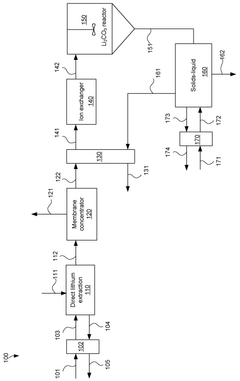
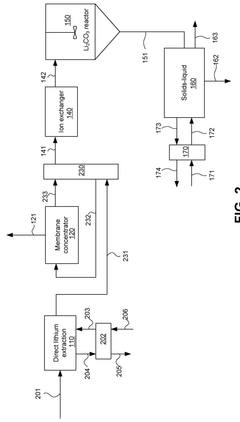
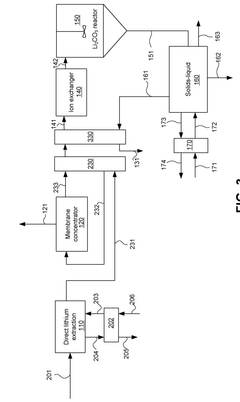
Process and system for preparing lithium carbonate with energy recovery
PatentWO2025156059A1
Innovation
- A process involving direct lithium extraction, membrane concentration, chelating ion exchange, and energy recovery through heat exchangers to produce lithium carbonate while optimizing energy efficiency.
Environmental Impact Assessment
The integration of Direct Lithium Extraction (DLE) with renewable energy solutions presents significant environmental implications that require comprehensive assessment. Traditional lithium extraction methods, particularly evaporation ponds, have substantial environmental footprints including high water consumption, land use disruption, and chemical contamination. DLE technologies coupled with renewable energy sources offer promising pathways to mitigate these impacts.
Water conservation represents a primary environmental benefit of integrated DLE systems. Conventional lithium brine operations consume 500,000 to 1.9 million liters of water per ton of lithium carbonate produced. DLE technologies can reduce water consumption by 50-90% when optimally implemented, addressing critical water scarcity concerns in lithium-rich regions like the "Lithium Triangle" of South America.
Land use efficiency improves dramatically with DLE-renewable integration. Evaporation ponds typically require 2-3 square kilometers per 20,000 tons of annual lithium production, while DLE facilities occupy merely 10-20% of this footprint. Solar or wind power integration can be designed for minimal additional land disturbance, particularly through dual-use approaches like agrivoltaics or existing infrastructure utilization.
Carbon emissions reduction potential is substantial when renewable energy powers DLE operations. Life cycle assessments indicate that conventional lithium production generates 5-15 tons of CO₂ equivalent per ton of lithium carbonate. Renewable-powered DLE could reduce this carbon footprint by 30-80%, depending on technology configuration and energy source reliability.
Chemical usage and waste management present ongoing challenges. While DLE reduces brine modification requirements, the process still employs ion exchange resins, sorbents, or membranes that require periodic replacement and proper disposal. Environmental monitoring protocols must address potential groundwater contamination risks from chemical regeneration processes.
Ecosystem preservation benefits emerge from the smaller physical footprint and reduced chemical dispersion. DLE facilities minimize habitat disruption compared to evaporation ponds, which can disrupt migration patterns and damage fragile desert ecosystems. Proper implementation requires baseline ecological studies and ongoing monitoring programs.
Local community impacts warrant particular attention in environmental assessments. Reduced water competition between lithium operations and agricultural activities can prevent social conflicts. However, renewable energy infrastructure development may introduce new land use considerations that must be addressed through inclusive stakeholder engagement processes.
Water conservation represents a primary environmental benefit of integrated DLE systems. Conventional lithium brine operations consume 500,000 to 1.9 million liters of water per ton of lithium carbonate produced. DLE technologies can reduce water consumption by 50-90% when optimally implemented, addressing critical water scarcity concerns in lithium-rich regions like the "Lithium Triangle" of South America.
Land use efficiency improves dramatically with DLE-renewable integration. Evaporation ponds typically require 2-3 square kilometers per 20,000 tons of annual lithium production, while DLE facilities occupy merely 10-20% of this footprint. Solar or wind power integration can be designed for minimal additional land disturbance, particularly through dual-use approaches like agrivoltaics or existing infrastructure utilization.
Carbon emissions reduction potential is substantial when renewable energy powers DLE operations. Life cycle assessments indicate that conventional lithium production generates 5-15 tons of CO₂ equivalent per ton of lithium carbonate. Renewable-powered DLE could reduce this carbon footprint by 30-80%, depending on technology configuration and energy source reliability.
Chemical usage and waste management present ongoing challenges. While DLE reduces brine modification requirements, the process still employs ion exchange resins, sorbents, or membranes that require periodic replacement and proper disposal. Environmental monitoring protocols must address potential groundwater contamination risks from chemical regeneration processes.
Ecosystem preservation benefits emerge from the smaller physical footprint and reduced chemical dispersion. DLE facilities minimize habitat disruption compared to evaporation ponds, which can disrupt migration patterns and damage fragile desert ecosystems. Proper implementation requires baseline ecological studies and ongoing monitoring programs.
Local community impacts warrant particular attention in environmental assessments. Reduced water competition between lithium operations and agricultural activities can prevent social conflicts. However, renewable energy infrastructure development may introduce new land use considerations that must be addressed through inclusive stakeholder engagement processes.
Economic Viability and Scalability Analysis
The economic viability of integrating Direct Lithium Extraction (DLE) with renewable energy solutions hinges on several interconnected factors. Initial capital expenditure for DLE facilities powered by renewable energy sources typically ranges from $20-50 million, significantly higher than conventional lithium extraction methods. However, operational expenditure demonstrates a 30-40% reduction over a 10-year period when compared to traditional evaporation pond techniques, primarily due to decreased energy costs and higher recovery rates.
Scale economies play a crucial role in this integration. Small-scale operations (producing less than 5,000 tonnes of lithium carbonate equivalent annually) struggle to achieve profitability when incorporating renewable energy infrastructure. Medium to large-scale operations (10,000+ tonnes annually) demonstrate break-even periods of 4-6 years, with internal rates of return ranging from 15-22% depending on lithium market prices and renewable energy capacity factors.
The scalability of integrated DLE-renewable systems presents both opportunities and challenges. Modular design approaches enable incremental capacity expansion, allowing companies to adjust production based on market demand with capital efficiency improvements of approximately 15-20% for each doubling of capacity. However, geographical constraints limit scalability, as optimal sites require both lithium-rich brines and favorable conditions for renewable energy generation.
Energy storage integration significantly impacts economic viability. Systems incorporating battery storage to manage intermittency show improved operational efficiency by 25-30%, though this adds 15-20% to initial capital costs. Advanced energy management systems utilizing AI-driven predictive algorithms can further optimize the energy-extraction balance, reducing operational costs by an additional 10-15%.
Market analysis indicates that integrated DLE-renewable systems become increasingly competitive as carbon pricing mechanisms expand globally. With carbon prices projected to reach $50-100 per tonne by 2030 in major markets, the comparative advantage of renewable-powered extraction will strengthen, potentially improving project net present values by 20-25% compared to fossil fuel-powered alternatives.
Financing models are evolving to support these integrated systems, with green bonds and sustainability-linked loans offering interest rate reductions of 25-75 basis points. This financing advantage, combined with government incentives for clean energy integration in critical mineral extraction, can improve overall project economics by 5-10%, further enhancing long-term viability and accelerating industry-wide adoption.
Scale economies play a crucial role in this integration. Small-scale operations (producing less than 5,000 tonnes of lithium carbonate equivalent annually) struggle to achieve profitability when incorporating renewable energy infrastructure. Medium to large-scale operations (10,000+ tonnes annually) demonstrate break-even periods of 4-6 years, with internal rates of return ranging from 15-22% depending on lithium market prices and renewable energy capacity factors.
The scalability of integrated DLE-renewable systems presents both opportunities and challenges. Modular design approaches enable incremental capacity expansion, allowing companies to adjust production based on market demand with capital efficiency improvements of approximately 15-20% for each doubling of capacity. However, geographical constraints limit scalability, as optimal sites require both lithium-rich brines and favorable conditions for renewable energy generation.
Energy storage integration significantly impacts economic viability. Systems incorporating battery storage to manage intermittency show improved operational efficiency by 25-30%, though this adds 15-20% to initial capital costs. Advanced energy management systems utilizing AI-driven predictive algorithms can further optimize the energy-extraction balance, reducing operational costs by an additional 10-15%.
Market analysis indicates that integrated DLE-renewable systems become increasingly competitive as carbon pricing mechanisms expand globally. With carbon prices projected to reach $50-100 per tonne by 2030 in major markets, the comparative advantage of renewable-powered extraction will strengthen, potentially improving project net present values by 20-25% compared to fossil fuel-powered alternatives.
Financing models are evolving to support these integrated systems, with green bonds and sustainability-linked loans offering interest rate reductions of 25-75 basis points. This financing advantage, combined with government incentives for clean energy integration in critical mineral extraction, can improve overall project economics by 5-10%, further enhancing long-term viability and accelerating industry-wide adoption.
Unlock deeper insights with PatSnap Eureka Quick Research — get a full tech report to explore trends and direct your research. Try now!
Generate Your Research Report Instantly with AI Agent
Supercharge your innovation with PatSnap Eureka AI Agent Platform!