

Liquid Hydrogen Vs Solid Hydrogen: Stability Under Cryogenic Conditions
JUN 14, 20269 MIN READ
Generate Your Research Report Instantly with AI Agent
PatSnap Eureka helps you evaluate technical feasibility & market potential.
Hydrogen Phase Technology Background and Cryogenic Goals
Hydrogen has emerged as a critical energy carrier in the global transition toward sustainable energy systems, with its unique properties making it indispensable for applications ranging from fuel cells to rocket propulsion. The fundamental challenge lies in hydrogen storage and handling, particularly under cryogenic conditions where the element can exist in different phases. Understanding the stability characteristics of liquid versus solid hydrogen under extreme cold conditions has become paramount for advancing space exploration, energy storage technologies, and industrial applications.
The evolution of hydrogen phase technology traces back to the early 20th century when scientists first achieved hydrogen liquefaction at 20.28 Kelvin. This breakthrough opened new possibilities for high-density hydrogen storage, offering approximately 70.8 kg/m³ density compared to gaseous hydrogen's minimal density at standard conditions. However, the discovery of solid hydrogen's properties at even lower temperatures, below 14.01 Kelvin, introduced additional complexity to the field.
Current technological objectives center on optimizing hydrogen phase stability for specific applications while minimizing energy losses and safety risks. The aerospace industry particularly demands reliable cryogenic hydrogen systems for rocket fuel applications, where phase transitions can significantly impact performance and mission success. Similarly, emerging hydrogen economy initiatives require efficient long-term storage solutions that maintain phase stability over extended periods.
The primary technical goals encompass developing advanced insulation systems that prevent unwanted phase transitions, creating predictive models for hydrogen behavior under varying cryogenic conditions, and establishing standardized protocols for safe handling of different hydrogen phases. These objectives directly address the fundamental challenge of maintaining desired hydrogen phases while minimizing boil-off losses and preventing dangerous pressure buildup.
Modern research focuses on understanding the thermodynamic properties that govern phase stability, including heat transfer mechanisms, pressure dynamics, and the role of impurities in phase transition processes. The ultimate aim is achieving controllable, predictable hydrogen phase management that enables broader adoption of hydrogen technologies across multiple industries while ensuring operational safety and economic viability.
The evolution of hydrogen phase technology traces back to the early 20th century when scientists first achieved hydrogen liquefaction at 20.28 Kelvin. This breakthrough opened new possibilities for high-density hydrogen storage, offering approximately 70.8 kg/m³ density compared to gaseous hydrogen's minimal density at standard conditions. However, the discovery of solid hydrogen's properties at even lower temperatures, below 14.01 Kelvin, introduced additional complexity to the field.
Current technological objectives center on optimizing hydrogen phase stability for specific applications while minimizing energy losses and safety risks. The aerospace industry particularly demands reliable cryogenic hydrogen systems for rocket fuel applications, where phase transitions can significantly impact performance and mission success. Similarly, emerging hydrogen economy initiatives require efficient long-term storage solutions that maintain phase stability over extended periods.
The primary technical goals encompass developing advanced insulation systems that prevent unwanted phase transitions, creating predictive models for hydrogen behavior under varying cryogenic conditions, and establishing standardized protocols for safe handling of different hydrogen phases. These objectives directly address the fundamental challenge of maintaining desired hydrogen phases while minimizing boil-off losses and preventing dangerous pressure buildup.
Modern research focuses on understanding the thermodynamic properties that govern phase stability, including heat transfer mechanisms, pressure dynamics, and the role of impurities in phase transition processes. The ultimate aim is achieving controllable, predictable hydrogen phase management that enables broader adoption of hydrogen technologies across multiple industries while ensuring operational safety and economic viability.
Market Demand for Cryogenic Hydrogen Storage Solutions
The global hydrogen economy is experiencing unprecedented growth, driven by the urgent need for clean energy solutions and decarbonization initiatives across multiple industries. This expansion has created substantial demand for efficient and reliable cryogenic hydrogen storage technologies, where the choice between liquid and solid hydrogen storage becomes critically important for various applications.
The aerospace industry represents one of the most demanding markets for cryogenic hydrogen storage, particularly for rocket propulsion systems and emerging space exploration missions. Launch service providers require storage solutions that can maintain hydrogen in stable conditions for extended periods while ensuring rapid deployment capabilities. The stability characteristics of liquid versus solid hydrogen under cryogenic conditions directly impact mission success rates and operational costs.
Industrial applications, including steel production, chemical processing, and semiconductor manufacturing, are increasingly adopting hydrogen as a clean alternative to traditional fossil fuels. These sectors require large-scale storage systems capable of maintaining consistent hydrogen supply while minimizing energy losses through boil-off or phase transitions. The stability performance of different hydrogen phases under cryogenic conditions determines the economic viability of these industrial transitions.
The transportation sector, encompassing both heavy-duty trucking and maritime shipping, presents growing demand for high-density hydrogen storage solutions. Long-haul applications require storage systems that can maintain hydrogen integrity over extended periods without significant losses, making the stability comparison between liquid and solid hydrogen phases crucial for commercial adoption.
Energy storage and grid balancing applications are emerging as significant market drivers, where hydrogen serves as a medium for storing excess renewable energy. These applications demand storage solutions that can efficiently cycle between charging and discharging states while maintaining hydrogen quality and minimizing losses during extended storage periods.
Research institutions and national laboratories worldwide are investing heavily in advanced cryogenic hydrogen storage research, creating demand for experimental and demonstration-scale systems. These facilities require precise control over hydrogen phase stability to conduct meaningful research and validate new storage technologies.
The market demand is further intensified by government policies promoting hydrogen adoption and substantial investments in hydrogen infrastructure development. National hydrogen strategies across major economies are driving requirements for reliable cryogenic storage solutions that can support large-scale hydrogen distribution networks and strategic reserves.
The aerospace industry represents one of the most demanding markets for cryogenic hydrogen storage, particularly for rocket propulsion systems and emerging space exploration missions. Launch service providers require storage solutions that can maintain hydrogen in stable conditions for extended periods while ensuring rapid deployment capabilities. The stability characteristics of liquid versus solid hydrogen under cryogenic conditions directly impact mission success rates and operational costs.
Industrial applications, including steel production, chemical processing, and semiconductor manufacturing, are increasingly adopting hydrogen as a clean alternative to traditional fossil fuels. These sectors require large-scale storage systems capable of maintaining consistent hydrogen supply while minimizing energy losses through boil-off or phase transitions. The stability performance of different hydrogen phases under cryogenic conditions determines the economic viability of these industrial transitions.
The transportation sector, encompassing both heavy-duty trucking and maritime shipping, presents growing demand for high-density hydrogen storage solutions. Long-haul applications require storage systems that can maintain hydrogen integrity over extended periods without significant losses, making the stability comparison between liquid and solid hydrogen phases crucial for commercial adoption.
Energy storage and grid balancing applications are emerging as significant market drivers, where hydrogen serves as a medium for storing excess renewable energy. These applications demand storage solutions that can efficiently cycle between charging and discharging states while maintaining hydrogen quality and minimizing losses during extended storage periods.
Research institutions and national laboratories worldwide are investing heavily in advanced cryogenic hydrogen storage research, creating demand for experimental and demonstration-scale systems. These facilities require precise control over hydrogen phase stability to conduct meaningful research and validate new storage technologies.
The market demand is further intensified by government policies promoting hydrogen adoption and substantial investments in hydrogen infrastructure development. National hydrogen strategies across major economies are driving requirements for reliable cryogenic storage solutions that can support large-scale hydrogen distribution networks and strategic reserves.
Current State and Challenges in Hydrogen Phase Stability
The current landscape of hydrogen phase stability under cryogenic conditions presents a complex array of technical challenges that significantly impact the viability of hydrogen as an energy storage medium. Liquid hydrogen, maintained at approximately 20.3 K (-252.87°C), faces persistent issues with boil-off losses, which typically range from 0.2% to 3% per day depending on storage system design and insulation effectiveness. This phenomenon occurs due to heat ingress through thermal bridges, radiation, and convection, making long-term storage economically prohibitive without active cooling systems.
Solid hydrogen stability introduces different complications, as it requires even lower temperatures around 14 K (-259°C) and exhibits complex crystalline phase transitions. The ortho-to-para hydrogen conversion process becomes critical at these temperatures, as the equilibrium shifts dramatically and can generate substantial heat if not properly managed. Current solid hydrogen research indicates that maintaining structural integrity over extended periods remains challenging due to sublimation effects and crystal defect formation.
Internationally, the United States leads in liquid hydrogen infrastructure development, primarily driven by NASA's space program requirements, while Japan focuses heavily on solid hydrogen research through institutions like RIKEN and the University of Tokyo. European efforts, particularly in Germany and France, concentrate on hybrid approaches combining both phases for different applications. China has recently intensified research in both areas, with significant investments in cryogenic storage facilities and fundamental phase stability studies.
The primary technical bottlenecks include inadequate insulation materials that can withstand extreme temperature cycling, insufficient understanding of hydrogen's quantum mechanical behavior at ultra-low temperatures, and the lack of cost-effective refrigeration systems for maintaining solid hydrogen states. Current vacuum-insulated storage systems achieve thermal conductivities as low as 0.1 mW/m·K, yet this remains insufficient for eliminating boil-off entirely.
Measurement and monitoring technologies present additional challenges, as conventional sensors often fail or provide inaccurate readings under extreme cryogenic conditions. The development of quantum sensors and advanced fiber-optic monitoring systems represents ongoing efforts to address these limitations, though widespread commercial implementation remains limited due to cost and complexity factors.
Solid hydrogen stability introduces different complications, as it requires even lower temperatures around 14 K (-259°C) and exhibits complex crystalline phase transitions. The ortho-to-para hydrogen conversion process becomes critical at these temperatures, as the equilibrium shifts dramatically and can generate substantial heat if not properly managed. Current solid hydrogen research indicates that maintaining structural integrity over extended periods remains challenging due to sublimation effects and crystal defect formation.
Internationally, the United States leads in liquid hydrogen infrastructure development, primarily driven by NASA's space program requirements, while Japan focuses heavily on solid hydrogen research through institutions like RIKEN and the University of Tokyo. European efforts, particularly in Germany and France, concentrate on hybrid approaches combining both phases for different applications. China has recently intensified research in both areas, with significant investments in cryogenic storage facilities and fundamental phase stability studies.
The primary technical bottlenecks include inadequate insulation materials that can withstand extreme temperature cycling, insufficient understanding of hydrogen's quantum mechanical behavior at ultra-low temperatures, and the lack of cost-effective refrigeration systems for maintaining solid hydrogen states. Current vacuum-insulated storage systems achieve thermal conductivities as low as 0.1 mW/m·K, yet this remains insufficient for eliminating boil-off entirely.
Measurement and monitoring technologies present additional challenges, as conventional sensors often fail or provide inaccurate readings under extreme cryogenic conditions. The development of quantum sensors and advanced fiber-optic monitoring systems represents ongoing efforts to address these limitations, though widespread commercial implementation remains limited due to cost and complexity factors.
Existing Solutions for Hydrogen Phase Management
01 Hydrogen storage materials and alloys for enhanced stability
Development of specialized materials and alloys designed to store hydrogen with improved stability characteristics. These materials focus on controlling hydrogen absorption and desorption properties while maintaining structural integrity over multiple cycles. The materials often incorporate metal hydrides and composite structures that can safely contain hydrogen under various operating conditions.- Hydrogen storage materials and alloys for enhanced stability: Development of specialized materials and alloys designed to store hydrogen with improved stability characteristics. These materials focus on optimizing the hydrogen absorption and desorption properties while maintaining structural integrity over multiple cycles. Advanced alloy compositions and material structures are employed to enhance the long-term stability of hydrogen storage systems.
- Hydrogen storage vessel and container design: Engineering solutions for hydrogen storage containers and vessels that ensure structural stability and safety. These designs incorporate advanced materials, pressure management systems, and safety features to maintain hydrogen containment under various operating conditions. The focus is on preventing hydrogen leakage and maintaining vessel integrity over extended periods.
- Hydrogen production and purification stability methods: Techniques and processes for maintaining stable hydrogen production and ensuring consistent purity levels. These methods address various aspects of hydrogen generation including electrolysis optimization, catalyst stability, and purification processes that maintain consistent output quality and system reliability over time.
- Hydrogen fuel cell stability and performance optimization: Technologies focused on improving the operational stability and longevity of hydrogen fuel cell systems. These innovations address electrode durability, membrane stability, and overall system performance consistency. The approaches include advanced materials, operating condition optimization, and system design improvements to ensure reliable long-term operation.
- Hydrogen detection and monitoring systems for safety: Safety systems and monitoring technologies designed to detect hydrogen leaks and maintain system stability through continuous monitoring. These systems incorporate sensors, alarm mechanisms, and automated safety responses to ensure safe hydrogen handling and storage. The focus is on preventing accidents and maintaining operational safety in hydrogen applications.
02 Hydrogen containment systems and pressure vessels
Design and construction of containment systems specifically engineered for hydrogen stability under high pressure conditions. These systems include specialized vessel designs, safety mechanisms, and structural reinforcements that prevent hydrogen leakage and maintain system integrity. The focus is on creating robust containment solutions that can withstand the unique challenges posed by hydrogen gas.Expand Specific Solutions03 Hydrogen purification and stabilization processes
Methods and processes for purifying hydrogen and maintaining its stability during storage and transport. These techniques involve removing impurities that could affect hydrogen stability, implementing stabilization additives, and controlling environmental factors such as temperature and humidity. The processes ensure consistent hydrogen quality and prevent degradation over time.Expand Specific Solutions04 Catalytic systems for hydrogen stability enhancement
Development of catalytic materials and systems that improve hydrogen stability through controlled chemical reactions and surface interactions. These catalysts help maintain hydrogen purity, prevent unwanted reactions, and facilitate stable hydrogen handling processes. The systems often incorporate noble metals and specialized support materials optimized for hydrogen applications.Expand Specific Solutions05 Monitoring and control systems for hydrogen stability
Advanced monitoring and control technologies designed to continuously assess and maintain hydrogen stability in various applications. These systems include sensors for detecting hydrogen concentration, pressure monitoring devices, and automated control mechanisms that respond to stability changes. The technologies provide real-time feedback and safety controls to ensure optimal hydrogen handling conditions.Expand Specific Solutions
Key Players in Hydrogen Storage and Cryogenic Industry
The liquid versus solid hydrogen stability under cryogenic conditions represents a rapidly evolving technological landscape driven by the growing hydrogen economy and clean energy transition. The industry is in an early commercialization phase with significant market expansion potential, particularly in aerospace, automotive, and energy storage applications. Technology maturity varies considerably across market segments, with established industrial gas companies like Air Liquide SA and Air Products & Chemicals demonstrating advanced cryogenic handling capabilities, while automotive manufacturers including Hyundai Motor Co. and Kia Corp. are pioneering hydrogen fuel cell integration. Aerospace leaders such as Airbus SE are exploring hydrogen propulsion systems, and energy giants like Shell-USA and China Petroleum & Chemical Corp. are investing in hydrogen infrastructure. Academic institutions including Zhejiang University and Xi'an Jiaotong University are advancing fundamental research, while specialized equipment manufacturers like Zhangjiagang Furui Hydrogen Energy Equipment and Cosmodyne LLC are developing critical storage and handling technologies for both liquid and solid hydrogen applications.
Hyundai Motor Co.
Technical Solution: Hyundai has developed hydrogen storage technologies primarily for automotive applications, focusing on high-pressure compressed hydrogen systems rather than cryogenic liquid storage. However, they have researched liquid hydrogen systems for potential future applications, investigating onboard storage solutions that could offer higher energy density. The company has explored solid hydrogen storage through metal hydride systems, particularly for stationary applications and backup power systems. Their research includes investigating advanced materials like AB5 and AB2 type alloys that can reversibly store hydrogen at moderate temperatures and pressures. Hyundai's approach emphasizes practical automotive requirements including fast refueling, operational temperature ranges, and system durability. They have also developed integrated thermal management systems to handle the heat generated during hydrogen absorption and desorption in solid storage materials.
Strengths: Automotive integration expertise, practical system design, thermal management capabilities. Weaknesses: Limited cryogenic experience, focus on mobile applications, constrained by automotive size and weight requirements.
Air Products & Chemicals, Inc.
Technical Solution: Air Products has developed advanced liquid hydrogen storage and handling systems utilizing multi-layer vacuum insulation technology and zero boil-off systems. Their cryogenic infrastructure maintains hydrogen at -253°C with minimal losses through sophisticated thermal management. The company's liquid hydrogen solutions include high-capacity storage tanks with advanced insulation materials and automated pressure control systems. They have pioneered ortho-para hydrogen conversion catalysts that enhance storage stability by converting normal hydrogen to para-hydrogen, which has lower energy content and better storage characteristics under cryogenic conditions. Their systems achieve storage densities of 70.8 kg/m³ for liquid hydrogen.
Strengths: Industry-leading cryogenic expertise, proven large-scale infrastructure, advanced insulation technology. Weaknesses: High energy consumption for liquefaction, complex handling requirements, significant infrastructure investment needed.
Core Innovations in Solid Hydrogen Stabilization
Tank feasible for cryogenic service
PatentActiveUS12111013B2
Innovation
- A tank design featuring a flexible outer shell with corrugated sections that accommodate thermal contraction, combined with a vacuum-insulated system using modular block elements and a lattice pressure vessel for the inner tank, ensuring efficient thermal insulation and maintaining airtightness across varying temperatures and sizes.
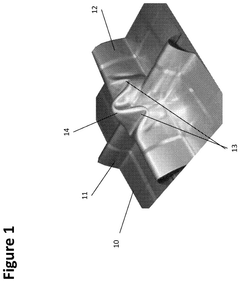
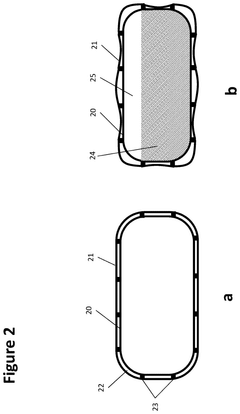
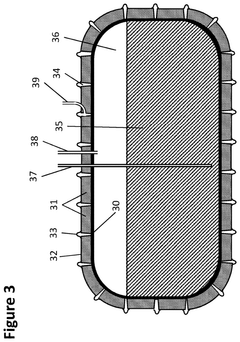
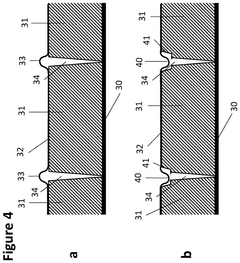
Cryogenic hydrogen pipe-in-pipe system with microporous insulation
PatentWO2023000026A1
Innovation
- A subsea pipe-in-pipe system with microporous insulation and a nickel-iron alloy inner pipe, which maintains cryogenic temperatures and reduces thermal expansion, allowing for the direct transfer of liquid hydrogen from an onshore source to an offshore terminal without a jetty, utilizing a partial vacuum in the annular volume for enhanced insulation and leak detection.


Safety Standards for Cryogenic Hydrogen Systems
The development of comprehensive safety standards for cryogenic hydrogen systems has become increasingly critical as hydrogen technologies advance toward commercial deployment. Current international frameworks primarily rely on established codes such as ISO 14687 for hydrogen fuel quality, NFPA 2 for hydrogen technologies, and IEC 62282 series for fuel cell technologies. However, these standards require significant adaptation when addressing the unique challenges posed by both liquid and solid hydrogen phases under extreme cryogenic conditions.
Liquid hydrogen safety protocols focus extensively on temperature maintenance at 20.3K and pressure management systems. The primary safety concerns include rapid phase transition risks, where sudden temperature increases can cause explosive vaporization with volume expansion ratios of approximately 1:848. Standards mandate triple-redundant temperature monitoring systems, emergency venting protocols, and specialized materials certification for components exposed to liquid hydrogen environments.
Solid hydrogen safety frameworks present more complex challenges due to limited operational experience and the metastable nature of solid phases below 14K. Current draft standards emphasize controlled phase transition management, as uncontrolled solid-to-liquid transitions can generate significant pressure spikes. Safety protocols require continuous monitoring of crystal structure stability and implementation of graduated warming systems to prevent rapid phase changes.
Material compatibility standards represent a critical convergence point for both phases. Hydrogen embrittlement concerns intensify under cryogenic conditions, necessitating specialized metallurgy requirements. Current standards specify austenitic stainless steels and aluminum alloys as preferred materials, with mandatory testing protocols including slow strain rate testing and fracture mechanics evaluation under cryogenic hydrogen exposure.
Emergency response protocols differ significantly between liquid and solid hydrogen systems. Liquid hydrogen incidents typically involve rapid dispersion and potential fire hazards, requiring immediate area evacuation and specialized firefighting foam applications. Solid hydrogen emergencies focus on controlled warming procedures and pressure relief systems to manage phase transitions safely.
Regulatory harmonization efforts are underway through international working groups, particularly within ISO/TC 197 and IEC/TC 105 committees. These initiatives aim to establish unified safety standards that accommodate both liquid and solid hydrogen applications while addressing the unique stability challenges each phase presents under cryogenic conditions.
Liquid hydrogen safety protocols focus extensively on temperature maintenance at 20.3K and pressure management systems. The primary safety concerns include rapid phase transition risks, where sudden temperature increases can cause explosive vaporization with volume expansion ratios of approximately 1:848. Standards mandate triple-redundant temperature monitoring systems, emergency venting protocols, and specialized materials certification for components exposed to liquid hydrogen environments.
Solid hydrogen safety frameworks present more complex challenges due to limited operational experience and the metastable nature of solid phases below 14K. Current draft standards emphasize controlled phase transition management, as uncontrolled solid-to-liquid transitions can generate significant pressure spikes. Safety protocols require continuous monitoring of crystal structure stability and implementation of graduated warming systems to prevent rapid phase changes.
Material compatibility standards represent a critical convergence point for both phases. Hydrogen embrittlement concerns intensify under cryogenic conditions, necessitating specialized metallurgy requirements. Current standards specify austenitic stainless steels and aluminum alloys as preferred materials, with mandatory testing protocols including slow strain rate testing and fracture mechanics evaluation under cryogenic hydrogen exposure.
Emergency response protocols differ significantly between liquid and solid hydrogen systems. Liquid hydrogen incidents typically involve rapid dispersion and potential fire hazards, requiring immediate area evacuation and specialized firefighting foam applications. Solid hydrogen emergencies focus on controlled warming procedures and pressure relief systems to manage phase transitions safely.
Regulatory harmonization efforts are underway through international working groups, particularly within ISO/TC 197 and IEC/TC 105 committees. These initiatives aim to establish unified safety standards that accommodate both liquid and solid hydrogen applications while addressing the unique stability challenges each phase presents under cryogenic conditions.
Energy Efficiency in Hydrogen Phase Transitions
Energy efficiency in hydrogen phase transitions represents a critical factor in determining the practical viability of different hydrogen storage approaches under cryogenic conditions. The thermodynamic processes involved in converting hydrogen between gaseous, liquid, and solid states require substantial energy inputs, with each transition pathway exhibiting distinct efficiency characteristics that directly impact overall system performance.
The liquefaction process from gaseous hydrogen to liquid hydrogen typically requires approximately 30-35% of the hydrogen's lower heating value, making it one of the most energy-intensive industrial processes. This high energy demand stems from hydrogen's extremely low boiling point of 20.4 K and the need for multi-stage compression and cooling systems. Modern liquefaction plants achieve theoretical efficiencies of 25-30% of the Carnot cycle limit, though practical implementations often fall below these values due to heat exchanger inefficiencies and parasitic losses.
Solidification processes present even greater energy challenges, as the transition from liquid to solid hydrogen requires additional cooling to reach temperatures below 14 K. The latent heat of fusion for hydrogen is relatively small compared to vaporization, but the energy penalty for achieving such extreme temperatures becomes prohibitive for most applications. Current solid hydrogen production methods consume approximately 40-50% of the fuel's energy content, significantly impacting the overall energy balance.
Phase transition losses during storage and handling operations further compound efficiency concerns. Liquid hydrogen systems experience continuous boil-off rates of 1-3% per day in well-insulated storage vessels, representing ongoing energy losses that accumulate over extended storage periods. Solid hydrogen, while theoretically more stable, requires active refrigeration systems to maintain sub-14 K temperatures, resulting in continuous power consumption that can exceed the energy savings from reduced sublimation losses.
Recovery efficiency during phase transitions back to usable forms also varies significantly between liquid and solid hydrogen systems. Liquid hydrogen can be directly vaporized through controlled heat addition with minimal energy penalties, while solid hydrogen requires more complex warming protocols to prevent rapid sublimation and associated safety hazards. These operational considerations significantly influence the net energy efficiency of complete hydrogen storage cycles.
Advanced heat integration strategies and waste heat recovery systems show promise for improving overall phase transition efficiency. Implementing cascade refrigeration cycles, magnetic refrigeration technologies, and process optimization through pinch analysis can potentially reduce energy consumption by 15-25% compared to conventional approaches, though these improvements require substantial capital investments and system complexity increases.
The liquefaction process from gaseous hydrogen to liquid hydrogen typically requires approximately 30-35% of the hydrogen's lower heating value, making it one of the most energy-intensive industrial processes. This high energy demand stems from hydrogen's extremely low boiling point of 20.4 K and the need for multi-stage compression and cooling systems. Modern liquefaction plants achieve theoretical efficiencies of 25-30% of the Carnot cycle limit, though practical implementations often fall below these values due to heat exchanger inefficiencies and parasitic losses.
Solidification processes present even greater energy challenges, as the transition from liquid to solid hydrogen requires additional cooling to reach temperatures below 14 K. The latent heat of fusion for hydrogen is relatively small compared to vaporization, but the energy penalty for achieving such extreme temperatures becomes prohibitive for most applications. Current solid hydrogen production methods consume approximately 40-50% of the fuel's energy content, significantly impacting the overall energy balance.
Phase transition losses during storage and handling operations further compound efficiency concerns. Liquid hydrogen systems experience continuous boil-off rates of 1-3% per day in well-insulated storage vessels, representing ongoing energy losses that accumulate over extended storage periods. Solid hydrogen, while theoretically more stable, requires active refrigeration systems to maintain sub-14 K temperatures, resulting in continuous power consumption that can exceed the energy savings from reduced sublimation losses.
Recovery efficiency during phase transitions back to usable forms also varies significantly between liquid and solid hydrogen systems. Liquid hydrogen can be directly vaporized through controlled heat addition with minimal energy penalties, while solid hydrogen requires more complex warming protocols to prevent rapid sublimation and associated safety hazards. These operational considerations significantly influence the net energy efficiency of complete hydrogen storage cycles.
Advanced heat integration strategies and waste heat recovery systems show promise for improving overall phase transition efficiency. Implementing cascade refrigeration cycles, magnetic refrigeration technologies, and process optimization through pinch analysis can potentially reduce energy consumption by 15-25% compared to conventional approaches, though these improvements require substantial capital investments and system complexity increases.
Unlock deeper insights with PatSnap Eureka Quick Research — get a full tech report to explore trends and direct your research. Try now!
Generate Your Research Report Instantly with AI Agent
Supercharge your innovation with PatSnap Eureka AI Agent Platform!