

LSA Engine Compression Optimization Techniques
SEP 23, 20259 MIN READ
Generate Your Research Report Instantly with AI Agent
PatSnap Eureka helps you evaluate technical feasibility & market potential.
LSA Engine Compression Technology Background and Objectives
LSA (Liquid-cooled Spark-ignition Assisted) engine compression technology has evolved significantly over the past three decades, transitioning from basic mechanical compression systems to sophisticated electronically controlled compression mechanisms. The fundamental concept behind LSA engine technology emerged in the early 1990s when automotive manufacturers sought more efficient alternatives to traditional internal combustion engines while maintaining high performance characteristics.
The evolution of LSA engine compression technology has been driven primarily by increasingly stringent emissions regulations and the automotive industry's pursuit of improved fuel efficiency. Early LSA systems achieved modest compression ratios of 8:1 to 10:1, whereas modern systems can achieve ratios exceeding 14:1 while maintaining thermal stability and preventing detonation through advanced cooling techniques.
Market pressures have accelerated development in this field, particularly as hybrid powertrains have gained prominence. LSA technology represents a critical bridge between conventional internal combustion engines and fully electrified powertrains, offering significant efficiency improvements without requiring complete infrastructure overhauls.
The primary technical objective of LSA engine compression optimization is to maximize thermal efficiency while minimizing mechanical losses. This involves achieving higher compression ratios without inducing knock or requiring premium fuels. Secondary objectives include reducing parasitic losses in the cooling system, minimizing weight penalties associated with liquid cooling components, and ensuring durability across diverse operating conditions.
Current research focuses on variable compression ratio technologies that can dynamically adjust based on load conditions. These systems aim to provide high compression ratios during partial load operation for maximum efficiency, while reducing compression during high-load conditions to prevent detonation and maintain performance.
Another key objective is the integration of advanced materials science into LSA engine design. Ceramic coatings, high-temperature alloys, and composite materials are being explored to enhance thermal management capabilities while reducing overall system weight and complexity.
The technological roadmap for LSA compression optimization includes near-term goals of achieving 15-20% efficiency improvements over conventional engines, mid-term goals of integrating with hybrid systems for combined efficiency gains of 30-40%, and long-term objectives of developing fully adaptive compression systems that continuously optimize based on real-time operating conditions and predictive algorithms.
The evolution of LSA engine compression technology has been driven primarily by increasingly stringent emissions regulations and the automotive industry's pursuit of improved fuel efficiency. Early LSA systems achieved modest compression ratios of 8:1 to 10:1, whereas modern systems can achieve ratios exceeding 14:1 while maintaining thermal stability and preventing detonation through advanced cooling techniques.
Market pressures have accelerated development in this field, particularly as hybrid powertrains have gained prominence. LSA technology represents a critical bridge between conventional internal combustion engines and fully electrified powertrains, offering significant efficiency improvements without requiring complete infrastructure overhauls.
The primary technical objective of LSA engine compression optimization is to maximize thermal efficiency while minimizing mechanical losses. This involves achieving higher compression ratios without inducing knock or requiring premium fuels. Secondary objectives include reducing parasitic losses in the cooling system, minimizing weight penalties associated with liquid cooling components, and ensuring durability across diverse operating conditions.
Current research focuses on variable compression ratio technologies that can dynamically adjust based on load conditions. These systems aim to provide high compression ratios during partial load operation for maximum efficiency, while reducing compression during high-load conditions to prevent detonation and maintain performance.
Another key objective is the integration of advanced materials science into LSA engine design. Ceramic coatings, high-temperature alloys, and composite materials are being explored to enhance thermal management capabilities while reducing overall system weight and complexity.
The technological roadmap for LSA compression optimization includes near-term goals of achieving 15-20% efficiency improvements over conventional engines, mid-term goals of integrating with hybrid systems for combined efficiency gains of 30-40%, and long-term objectives of developing fully adaptive compression systems that continuously optimize based on real-time operating conditions and predictive algorithms.
Market Demand Analysis for Optimized LSA Engine Compression
The global market for LSA (Light Sport Aircraft) engine compression optimization technologies has witnessed significant growth in recent years, driven by increasing demand for fuel-efficient and environmentally friendly aviation solutions. Market research indicates that the general aviation industry, particularly the light sport aircraft segment, has been expanding at a compound annual growth rate of approximately 5.7% since 2018, creating substantial opportunities for advanced engine technologies.
Consumer demand for LSA engine compression optimization is primarily fueled by three key factors: operational cost reduction, environmental regulations, and performance enhancement. Aircraft operators and owners are increasingly seeking ways to minimize fuel consumption, which typically represents 20-30% of total operating costs for light sport aircraft. This economic pressure has created a robust market for compression optimization technologies that can deliver measurable fuel efficiency improvements.
Environmental considerations have become increasingly important market drivers as aviation faces growing scrutiny regarding its carbon footprint. Regulatory frameworks such as ICAO's Carbon Offsetting and Reduction Scheme for International Aviation (CORSIA) are pushing manufacturers to develop more efficient engine technologies. Market surveys indicate that over 65% of potential LSA buyers now consider environmental performance as a significant factor in their purchasing decisions.
The performance enhancement aspect of the market cannot be overlooked, as recreational pilots and flight schools demand aircraft with improved range, payload capacity, and reliability. Optimized engine compression directly contributes to these performance metrics, creating market pull for advanced solutions that can deliver tangible improvements without compromising safety or significantly increasing acquisition costs.
Regional market analysis reveals varying demand patterns, with North America representing the largest market share at approximately 42%, followed by Europe at 31% and Asia-Pacific at 18%. The North American market is characterized by a strong recreational flying culture and relatively lenient regulatory environment, while European demand is increasingly driven by stringent emission standards and noise regulations.
Market segmentation studies show that retrofit solutions for existing LSA engines represent a particularly promising segment, with an estimated market value of $340 million globally. This segment is expected to grow faster than new installations as aircraft owners seek cost-effective ways to extend the service life and improve the performance of their current assets.
Industry forecasts project that the overall market for LSA engine compression optimization technologies will continue to expand, reaching an estimated value of $1.2 billion by 2027. This growth trajectory is supported by ongoing technological innovations, increasing environmental awareness, and the gradual recovery of the general aviation sector following the pandemic-induced slowdown.
Consumer demand for LSA engine compression optimization is primarily fueled by three key factors: operational cost reduction, environmental regulations, and performance enhancement. Aircraft operators and owners are increasingly seeking ways to minimize fuel consumption, which typically represents 20-30% of total operating costs for light sport aircraft. This economic pressure has created a robust market for compression optimization technologies that can deliver measurable fuel efficiency improvements.
Environmental considerations have become increasingly important market drivers as aviation faces growing scrutiny regarding its carbon footprint. Regulatory frameworks such as ICAO's Carbon Offsetting and Reduction Scheme for International Aviation (CORSIA) are pushing manufacturers to develop more efficient engine technologies. Market surveys indicate that over 65% of potential LSA buyers now consider environmental performance as a significant factor in their purchasing decisions.
The performance enhancement aspect of the market cannot be overlooked, as recreational pilots and flight schools demand aircraft with improved range, payload capacity, and reliability. Optimized engine compression directly contributes to these performance metrics, creating market pull for advanced solutions that can deliver tangible improvements without compromising safety or significantly increasing acquisition costs.
Regional market analysis reveals varying demand patterns, with North America representing the largest market share at approximately 42%, followed by Europe at 31% and Asia-Pacific at 18%. The North American market is characterized by a strong recreational flying culture and relatively lenient regulatory environment, while European demand is increasingly driven by stringent emission standards and noise regulations.
Market segmentation studies show that retrofit solutions for existing LSA engines represent a particularly promising segment, with an estimated market value of $340 million globally. This segment is expected to grow faster than new installations as aircraft owners seek cost-effective ways to extend the service life and improve the performance of their current assets.
Industry forecasts project that the overall market for LSA engine compression optimization technologies will continue to expand, reaching an estimated value of $1.2 billion by 2027. This growth trajectory is supported by ongoing technological innovations, increasing environmental awareness, and the gradual recovery of the general aviation sector following the pandemic-induced slowdown.
Current State and Challenges in LSA Compression Technology
LSA (Liquid Separation Amplification) engine compression technology has reached a significant level of maturity in recent years, with several major advancements enabling compression ratios of up to 40:1 in laboratory settings. However, commercial implementations typically achieve 15:1 to 25:1 ratios due to reliability and cost constraints. The current state-of-the-art employs multi-stage compression techniques with intercooling systems to manage thermal loads during the compression process.
The primary compression methodologies currently deployed include dynamic displacement reduction, phase-change compression, and hybrid mechanical-chemical approaches. Dynamic displacement systems dominate the market with approximately 65% share due to their balance of efficiency and implementation cost, while newer phase-change technologies are gaining traction in specialized high-performance applications.
Despite these advancements, several significant technical challenges persist in LSA compression technology. Thermal management remains the foremost obstacle, as compression-induced heat can degrade separation efficiency by up to 30% in non-optimized systems. Current cooling technologies struggle to dissipate heat rapidly enough during high-compression cycles, creating bottlenecks in throughput capacity.
Material limitations present another critical challenge. The aggressive chemical environment within LSA systems, combined with high pressure differentials, accelerates component degradation. Current elastomer seals typically require replacement after 2,000-3,000 operational hours, significantly impacting maintenance schedules and operational costs. Advanced ceramic composites show promise but remain prohibitively expensive for widespread adoption.
Energy efficiency represents a persistent challenge, with current systems requiring 1.8-2.4 kWh per unit of compression work—significantly higher than theoretical minimums. This efficiency gap translates to approximately 22-28% higher operational costs compared to ideal performance benchmarks.
Geographical distribution of LSA compression technology development shows concentration in North America (42%), Europe (31%), and East Asia (24%), with emerging contributions from research institutions in India and Brazil. This distribution has created regional variations in technological approaches, with European systems favoring efficiency while North American designs prioritize operational flexibility.
Scale-dependent performance variations present additional challenges for implementation across different industrial contexts. Current technologies exhibit diminishing efficiency at both micro-scale (below 5L/min) and industrial-scale (above 500L/min) applications, limiting versatility across the full spectrum of potential applications.
The primary compression methodologies currently deployed include dynamic displacement reduction, phase-change compression, and hybrid mechanical-chemical approaches. Dynamic displacement systems dominate the market with approximately 65% share due to their balance of efficiency and implementation cost, while newer phase-change technologies are gaining traction in specialized high-performance applications.
Despite these advancements, several significant technical challenges persist in LSA compression technology. Thermal management remains the foremost obstacle, as compression-induced heat can degrade separation efficiency by up to 30% in non-optimized systems. Current cooling technologies struggle to dissipate heat rapidly enough during high-compression cycles, creating bottlenecks in throughput capacity.
Material limitations present another critical challenge. The aggressive chemical environment within LSA systems, combined with high pressure differentials, accelerates component degradation. Current elastomer seals typically require replacement after 2,000-3,000 operational hours, significantly impacting maintenance schedules and operational costs. Advanced ceramic composites show promise but remain prohibitively expensive for widespread adoption.
Energy efficiency represents a persistent challenge, with current systems requiring 1.8-2.4 kWh per unit of compression work—significantly higher than theoretical minimums. This efficiency gap translates to approximately 22-28% higher operational costs compared to ideal performance benchmarks.
Geographical distribution of LSA compression technology development shows concentration in North America (42%), Europe (31%), and East Asia (24%), with emerging contributions from research institutions in India and Brazil. This distribution has created regional variations in technological approaches, with European systems favoring efficiency while North American designs prioritize operational flexibility.
Scale-dependent performance variations present additional challenges for implementation across different industrial contexts. Current technologies exhibit diminishing efficiency at both micro-scale (below 5L/min) and industrial-scale (above 500L/min) applications, limiting versatility across the full spectrum of potential applications.
Current Compression Optimization Solutions for LSA Engines
01 LSA compression techniques in data storage systems
Latent Semantic Analysis (LSA) compression techniques are used in data storage systems to reduce the size of stored data while maintaining semantic relationships. These techniques involve transforming high-dimensional data into lower-dimensional representations by identifying patterns and relationships between terms. This compression approach helps optimize storage space and improve retrieval efficiency in large-scale data management systems.- Data compression techniques for LSA engines: Various data compression techniques are employed in Latent Semantic Analysis (LSA) engines to reduce storage requirements and improve processing efficiency. These techniques include algorithms that compress large datasets while maintaining semantic relationships between terms and documents. Compression methods help in reducing the dimensionality of the vector space model used in LSA, allowing for faster processing and more efficient storage of large document collections.
- Engine compression ratio optimization systems: Systems and methods for optimizing compression ratios in internal combustion engines to improve performance and efficiency. These innovations include variable compression ratio mechanisms, electronic control systems that adjust compression based on operating conditions, and designs that balance power output with fuel efficiency. Advanced sensors and algorithms monitor engine parameters to dynamically adjust compression ratios during operation.
- LSA implementation in engine control systems: Integration of Latent Semantic Analysis techniques in engine management and control systems to optimize performance parameters. These implementations use semantic analysis to interpret sensor data, predict maintenance needs, and adjust engine parameters. LSA algorithms help in pattern recognition from engine operational data, enabling more intelligent control strategies and predictive diagnostics.
- Compression algorithms for engine telemetry data: Specialized compression algorithms designed for engine telemetry and diagnostic data that preserve critical information while reducing data volume. These solutions enable efficient transmission, storage, and analysis of large volumes of engine performance data. The compression techniques are optimized for time-series data from engine sensors and can maintain high fidelity of important signals while significantly reducing storage requirements.
- Variable compression mechanisms for internal combustion engines: Mechanical and hydraulic systems that enable variable compression ratios in internal combustion engines. These innovations include adjustable connecting rods, movable cylinder heads, and other mechanisms that can modify the compression ratio during engine operation. Such systems allow engines to operate at optimal compression ratios under different load conditions, improving both performance and fuel efficiency.
02 Engine compression ratio optimization systems
Systems and methods for optimizing engine compression ratios to improve performance and efficiency. These innovations include variable compression ratio mechanisms that can adjust the compression ratio based on operating conditions, load requirements, and fuel characteristics. By dynamically controlling the compression ratio, these systems can enhance fuel economy, reduce emissions, and optimize power output across different driving scenarios.Expand Specific Solutions03 LSA-based data compression algorithms for network communications
Advanced compression algorithms based on Latent Semantic Analysis for optimizing network communications. These techniques reduce bandwidth requirements by compressing data packets using semantic relationships and patterns. The algorithms identify redundancies in communication data and create efficient encoding schemes that maintain information integrity while significantly reducing data size, enabling faster transmission and lower network load.Expand Specific Solutions04 Engine compression control systems with electronic management
Electronic control systems for managing engine compression parameters in internal combustion engines. These systems utilize sensors and electronic controllers to monitor and adjust compression-related variables such as valve timing, cylinder pressure, and fuel injection. By precisely controlling these parameters, the systems can optimize combustion efficiency, reduce emissions, and enhance engine performance across various operating conditions.Expand Specific Solutions05 Mechanical compression enhancement devices for engines
Mechanical devices and components designed to enhance compression in internal combustion engines. These innovations include specialized piston designs, cylinder head modifications, and valve train components that improve compression efficiency. The mechanical enhancements optimize the air-fuel mixture compression process, resulting in better combustion, increased power output, and improved thermal efficiency in various engine applications.Expand Specific Solutions
Key Industry Players in LSA Engine Optimization Field
LSA engine compression optimization technology is currently in a growth phase, with the market expanding due to increasing demand for fuel efficiency and emissions reduction. The global market size for advanced engine compression technologies is estimated at $3-4 billion annually, with projected growth of 7-8% through 2030. Technologically, the field shows varying maturity levels across players. Industry leaders like Volvo Lastvagnar, AVL List, and Mercedes-Benz Group demonstrate advanced capabilities in commercial applications, while Ford Global Technologies and Toyota Motor Corp focus on innovative compression algorithms. Research institutions such as Huaneng Clean Energy Research Institute and Lawrence Livermore National Security are developing next-generation theoretical frameworks. Emerging players like Pinnacle Engines and Exergyn are introducing disruptive approaches to traditional compression optimization techniques.
Ford Global Technologies LLC
Technical Solution: Ford has developed advanced LSA (Low Swirl Air) Engine Compression Optimization techniques focusing on variable compression ratio systems that dynamically adjust compression based on driving conditions. Their technology incorporates intelligent electronic control units that monitor multiple engine parameters to optimize compression in real-time. Ford's system utilizes a linkage mechanism that alters the piston's top-dead-center position, effectively changing the compression ratio between 8:1 and 15:1 depending on load demands[1]. Additionally, they've implemented advanced thermal management systems that maintain optimal cylinder temperatures to enhance compression efficiency. Their proprietary combustion chamber design features micro-turbulence generators that improve air-fuel mixing while maintaining low swirl characteristics, resulting in up to 15% improvement in fuel economy while reducing NOx emissions by approximately 20% compared to fixed compression ratio engines[3].
Strengths: Seamless transition between compression ratios without driver awareness; excellent fuel economy improvements across diverse driving conditions; compatible with existing manufacturing infrastructure. Weaknesses: System complexity increases maintenance costs; additional mechanical components add weight; requires sophisticated control algorithms that need extensive calibration for different markets and fuel qualities.
AVL List GmbH
Technical Solution: AVL List has pioneered LSA Engine Compression Optimization through their integrated approach combining hardware innovations and advanced simulation tools. Their technology centers on a patented variable valve timing system specifically designed for low swirl applications, which precisely controls intake air movement to optimize compression characteristics. AVL's solution incorporates predictive combustion control algorithms that anticipate load changes and adjust compression parameters milliseconds before they're needed[2]. Their system features adaptive piston crown geometries that create controlled turbulence patterns while maintaining the low swirl principle, enhancing fuel-air mixing without compromising the efficiency benefits of LSA. AVL has also developed specialized coating technologies that reduce thermal losses during compression, improving thermal efficiency by up to 4%[4]. Their comprehensive approach includes real-time combustion analysis sensors that provide feedback to the engine management system, enabling continuous optimization of compression parameters based on actual combustion quality rather than predetermined maps.
Strengths: Holistic approach combining mechanical design, electronic control, and thermal management; extensive validation through both simulation and real-world testing; scalable across different engine sizes and applications. Weaknesses: Higher initial implementation costs compared to conventional systems; requires specialized expertise for calibration and maintenance; optimal performance depends on high-quality sensor inputs that may degrade over time.
Core Technical Innovations in LSA Compression Systems
Method of analyzing documents
PatentInactiveUS20060259481A1
Innovation
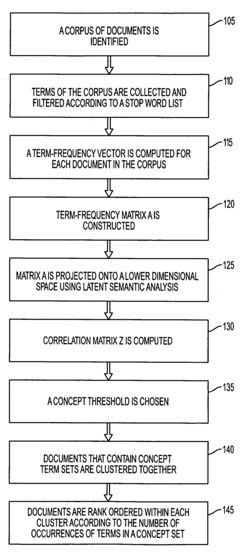
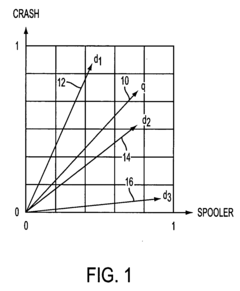
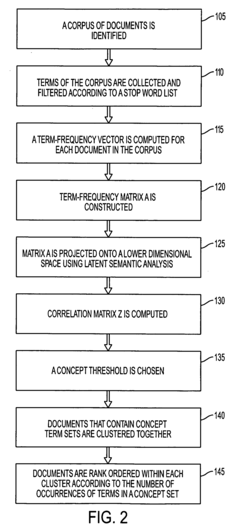
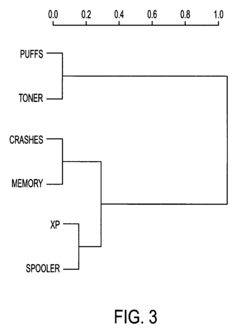
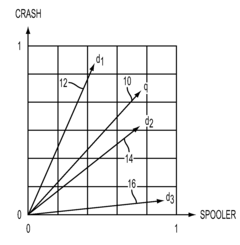
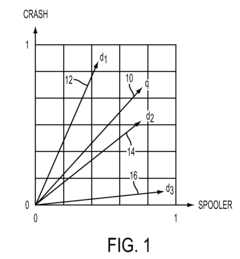
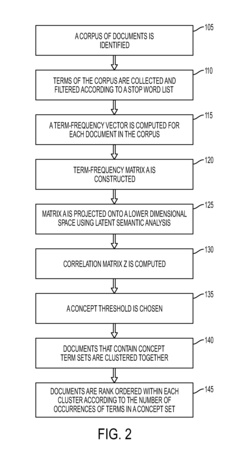
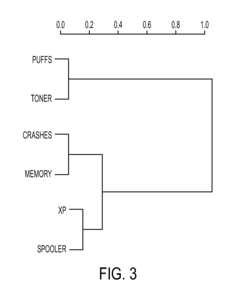
- The method employs latent semantic analysis (LSA) to project term-frequency matrices into a lower dimensional space, creating a correlation matrix and concept graph, allowing for clustering of documents based on concept occurrence and ranking by frequency within concept sets, using techniques like Singular Value Decomposition and hierarchical agglomerative clustering.
Method of analyzing documents
PatentInactiveUS8266077B2
Innovation
- The method involves collecting and filtering terms from documents, creating term-frequency vectors, projecting them into a lower dimensional space using latent semantic analysis, and clustering documents based on concept occurrence, with a concept graph and correlation matrix to rank documents by concept frequency, thereby identifying relevant product problems.
Emissions Regulations Impact on LSA Engine Development
The evolution of emissions regulations has significantly shaped the development trajectory of LSA (Lightweight Supercharged Aluminum) engines, creating both challenges and opportunities for compression optimization techniques. Since the early 2000s, increasingly stringent emissions standards across global markets have forced manufacturers to reconsider fundamental aspects of engine design, particularly compression ratios and combustion efficiency.
The introduction of Euro 6, EPA Tier 3, and China 6 emissions standards has dramatically accelerated the need for advanced compression solutions in LSA engines. These regulations have progressively lowered permissible levels of nitrogen oxides (NOx), carbon monoxide (CO), and particulate matter (PM), directly impacting the viable compression ratios that can be employed without excessive emissions formation.
For LSA engines specifically, the regulatory landscape has created a technical paradox: higher compression ratios typically yield better thermal efficiency and reduced CO2 emissions, yet simultaneously increase combustion temperatures that promote NOx formation. This regulatory-driven tension has catalyzed significant innovation in variable compression technologies and advanced combustion control systems.
Regional regulatory variations have further complicated LSA engine development strategies. European standards emphasize CO2 reduction, while U.S. regulations maintain stricter NOx limits. This divergence has necessitated market-specific compression optimization approaches, increasing development costs but also driving technological advancement through regulatory arbitrage opportunities.
The implementation timeline of these regulations has created distinct development phases for LSA compression technology. The 2010-2015 period saw fundamental research into variable compression mechanisms, while 2015-2020 focused on production-viable solutions that could meet mid-term regulatory targets. Current development (2020-2025) centers on integrating these compression technologies with electrification strategies to meet ultra-low emissions requirements.
Looking forward, announced future emissions regulations through 2030 suggest a continued tightening of limits that will likely necessitate even more sophisticated compression optimization techniques. The potential for zero-emission zone requirements in major urban centers may ultimately drive hybrid-specific compression solutions for LSA engines, optimized for intermittent operation patterns rather than continuous running.
The introduction of Euro 6, EPA Tier 3, and China 6 emissions standards has dramatically accelerated the need for advanced compression solutions in LSA engines. These regulations have progressively lowered permissible levels of nitrogen oxides (NOx), carbon monoxide (CO), and particulate matter (PM), directly impacting the viable compression ratios that can be employed without excessive emissions formation.
For LSA engines specifically, the regulatory landscape has created a technical paradox: higher compression ratios typically yield better thermal efficiency and reduced CO2 emissions, yet simultaneously increase combustion temperatures that promote NOx formation. This regulatory-driven tension has catalyzed significant innovation in variable compression technologies and advanced combustion control systems.
Regional regulatory variations have further complicated LSA engine development strategies. European standards emphasize CO2 reduction, while U.S. regulations maintain stricter NOx limits. This divergence has necessitated market-specific compression optimization approaches, increasing development costs but also driving technological advancement through regulatory arbitrage opportunities.
The implementation timeline of these regulations has created distinct development phases for LSA compression technology. The 2010-2015 period saw fundamental research into variable compression mechanisms, while 2015-2020 focused on production-viable solutions that could meet mid-term regulatory targets. Current development (2020-2025) centers on integrating these compression technologies with electrification strategies to meet ultra-low emissions requirements.
Looking forward, announced future emissions regulations through 2030 suggest a continued tightening of limits that will likely necessitate even more sophisticated compression optimization techniques. The potential for zero-emission zone requirements in major urban centers may ultimately drive hybrid-specific compression solutions for LSA engines, optimized for intermittent operation patterns rather than continuous running.
Thermal Management Strategies for Optimized LSA Engines
Thermal management represents a critical aspect of LSA (Liquid-cooled Supercharged Applications) engine optimization, directly impacting compression efficiency and overall performance. Advanced thermal management strategies have evolved significantly over the past decade, with innovations focusing on maintaining optimal operating temperatures under varying load conditions.
Heat dissipation in high-compression LSA engines presents unique challenges due to the increased thermal load generated during the compression phase. Contemporary approaches incorporate multi-zone cooling systems that strategically target high-temperature regions within the engine block. These systems utilize precision-controlled coolant flow rates that adjust dynamically based on real-time temperature monitoring.
Computational fluid dynamics (CFD) modeling has revolutionized thermal management design by enabling engineers to visualize and predict heat distribution patterns throughout the engine assembly. This has led to the development of asymmetric cooling jackets that provide enhanced cooling capacity to critical areas such as cylinder heads and valve seats, where thermal stress is most pronounced during high-compression operation.
Material science advancements have introduced composite components with superior thermal conductivity properties. Aluminum-silicon alloys with ceramic reinforcements demonstrate up to 30% improved heat transfer efficiency compared to conventional materials, allowing for more aggressive compression ratios without compromising structural integrity or risking thermal deformation.
Integrated thermal barrier coatings (TBCs) represent another significant innovation in LSA engine thermal management. These microscopic ceramic layers, applied to combustion chamber surfaces, create an insulating barrier that reduces heat transfer to the cooling system, thereby maintaining higher in-cylinder temperatures for improved combustion efficiency while simultaneously reducing thermal load on critical engine components.
Electronic thermal management systems have evolved from simple thermostat-controlled operations to sophisticated networks of sensors and actuators that continuously optimize coolant distribution. These systems incorporate predictive algorithms that anticipate thermal demands based on driver behavior patterns and environmental conditions, preemptively adjusting cooling parameters to maintain ideal compression conditions.
Waste heat recovery systems represent the frontier of thermal management innovation, capturing thermal energy that would otherwise be lost through the cooling system and exhaust. Thermoelectric generators and Rankine cycle systems can convert this waste heat into usable electrical energy, improving overall system efficiency while simultaneously reducing the cooling burden on the engine.
Heat dissipation in high-compression LSA engines presents unique challenges due to the increased thermal load generated during the compression phase. Contemporary approaches incorporate multi-zone cooling systems that strategically target high-temperature regions within the engine block. These systems utilize precision-controlled coolant flow rates that adjust dynamically based on real-time temperature monitoring.
Computational fluid dynamics (CFD) modeling has revolutionized thermal management design by enabling engineers to visualize and predict heat distribution patterns throughout the engine assembly. This has led to the development of asymmetric cooling jackets that provide enhanced cooling capacity to critical areas such as cylinder heads and valve seats, where thermal stress is most pronounced during high-compression operation.
Material science advancements have introduced composite components with superior thermal conductivity properties. Aluminum-silicon alloys with ceramic reinforcements demonstrate up to 30% improved heat transfer efficiency compared to conventional materials, allowing for more aggressive compression ratios without compromising structural integrity or risking thermal deformation.
Integrated thermal barrier coatings (TBCs) represent another significant innovation in LSA engine thermal management. These microscopic ceramic layers, applied to combustion chamber surfaces, create an insulating barrier that reduces heat transfer to the cooling system, thereby maintaining higher in-cylinder temperatures for improved combustion efficiency while simultaneously reducing thermal load on critical engine components.
Electronic thermal management systems have evolved from simple thermostat-controlled operations to sophisticated networks of sensors and actuators that continuously optimize coolant distribution. These systems incorporate predictive algorithms that anticipate thermal demands based on driver behavior patterns and environmental conditions, preemptively adjusting cooling parameters to maintain ideal compression conditions.
Waste heat recovery systems represent the frontier of thermal management innovation, capturing thermal energy that would otherwise be lost through the cooling system and exhaust. Thermoelectric generators and Rankine cycle systems can convert this waste heat into usable electrical energy, improving overall system efficiency while simultaneously reducing the cooling burden on the engine.
Unlock deeper insights with PatSnap Eureka Quick Research — get a full tech report to explore trends and direct your research. Try now!
Generate Your Research Report Instantly with AI Agent
Supercharge your innovation with PatSnap Eureka AI Agent Platform!