

Memory Expansion Challenges: DDRx Vs CXL Modules In Practical Use
JUN 3, 20269 MIN READ
Generate Your Research Report Instantly with AI Agent
PatSnap Eureka helps you evaluate technical feasibility & market potential.
Memory Expansion Technology Background and Objectives
Memory expansion technology has undergone significant evolution since the early days of computing, driven by the exponential growth in data processing requirements and the increasing complexity of modern applications. Traditional memory architectures, primarily based on DDR (Double Data Rate) SDRAM technology, have served as the backbone of system memory for decades. However, the emergence of data-intensive workloads such as artificial intelligence, machine learning, big data analytics, and high-performance computing has exposed fundamental limitations in conventional memory expansion approaches.
The historical progression from DDR to DDR5 represents incremental improvements in bandwidth and capacity, yet these enhancements have reached a plateau in addressing the growing memory wall problem. Modern processors can execute instructions faster than memory can supply data, creating bottlenecks that limit overall system performance. This challenge has intensified with the proliferation of multi-core processors and accelerated computing architectures that demand unprecedented memory bandwidth and capacity.
Compute Express Link (CXL) technology emerged as a revolutionary approach to memory expansion, introducing a paradigm shift from traditional memory architectures. CXL represents an open industry standard that enables high-speed, low-latency interconnects between processors and various types of memory and accelerator devices. This technology addresses the fundamental limitations of DDR-based systems by providing cache-coherent memory expansion capabilities that extend beyond the physical constraints of traditional DIMM slots.
The primary objective of modern memory expansion technology is to eliminate memory capacity and bandwidth bottlenecks while maintaining cost-effectiveness and energy efficiency. Organizations seek solutions that can seamlessly scale memory resources to meet dynamic workload demands without requiring complete system redesigns. The technology must support heterogeneous memory types, enable memory pooling and sharing across multiple compute nodes, and provide the flexibility to optimize memory allocation based on application-specific requirements.
Contemporary memory expansion strategies aim to achieve several critical goals: maximizing memory utilization efficiency, reducing total cost of ownership, enabling disaggregated memory architectures, and supporting emerging memory technologies such as persistent memory and high-bandwidth memory. These objectives drive the ongoing competition between evolutionary DDR improvements and revolutionary CXL-based approaches, each offering distinct advantages and facing unique implementation challenges in practical deployment scenarios.
The historical progression from DDR to DDR5 represents incremental improvements in bandwidth and capacity, yet these enhancements have reached a plateau in addressing the growing memory wall problem. Modern processors can execute instructions faster than memory can supply data, creating bottlenecks that limit overall system performance. This challenge has intensified with the proliferation of multi-core processors and accelerated computing architectures that demand unprecedented memory bandwidth and capacity.
Compute Express Link (CXL) technology emerged as a revolutionary approach to memory expansion, introducing a paradigm shift from traditional memory architectures. CXL represents an open industry standard that enables high-speed, low-latency interconnects between processors and various types of memory and accelerator devices. This technology addresses the fundamental limitations of DDR-based systems by providing cache-coherent memory expansion capabilities that extend beyond the physical constraints of traditional DIMM slots.
The primary objective of modern memory expansion technology is to eliminate memory capacity and bandwidth bottlenecks while maintaining cost-effectiveness and energy efficiency. Organizations seek solutions that can seamlessly scale memory resources to meet dynamic workload demands without requiring complete system redesigns. The technology must support heterogeneous memory types, enable memory pooling and sharing across multiple compute nodes, and provide the flexibility to optimize memory allocation based on application-specific requirements.
Contemporary memory expansion strategies aim to achieve several critical goals: maximizing memory utilization efficiency, reducing total cost of ownership, enabling disaggregated memory architectures, and supporting emerging memory technologies such as persistent memory and high-bandwidth memory. These objectives drive the ongoing competition between evolutionary DDR improvements and revolutionary CXL-based approaches, each offering distinct advantages and facing unique implementation challenges in practical deployment scenarios.
Market Demand Analysis for DDRx and CXL Memory Solutions
The global memory market is experiencing unprecedented growth driven by the exponential increase in data-intensive applications across multiple sectors. Enterprise data centers, cloud service providers, and high-performance computing facilities are facing mounting pressure to expand memory capacity while maintaining cost efficiency and performance optimization. Traditional DDR memory solutions continue to dominate mainstream applications, with DDR4 and DDR5 modules serving the majority of server and workstation deployments.
Cloud computing infrastructure represents the largest demand segment for memory expansion solutions. Major cloud providers are continuously scaling their infrastructure to support artificial intelligence workloads, machine learning training, and big data analytics. These applications require substantial memory bandwidth and capacity, creating sustained demand for both traditional DDR modules and emerging memory technologies. The shift toward memory-centric computing architectures is fundamentally altering procurement patterns and technical requirements.
High-performance computing environments, including scientific research institutions and financial trading systems, demonstrate distinct memory requirements. These applications often demand ultra-low latency and massive memory pools that exceed the limitations of traditional DDR configurations. The growing complexity of computational models and real-time processing requirements is driving exploration of alternative memory architectures and expansion technologies.
CXL technology is emerging as a transformative solution for memory expansion challenges, particularly in scenarios requiring flexible memory pooling and disaggregated architectures. Early adopters in the enterprise segment are evaluating CXL modules for specific use cases where traditional DDR limitations become apparent. The technology addresses critical pain points including memory stranding, capacity constraints, and the need for dynamic resource allocation across distributed computing environments.
The automotive and edge computing sectors are creating new demand patterns for memory solutions. Autonomous vehicle systems, industrial IoT applications, and edge AI processing require memory architectures that balance performance, power efficiency, and reliability. These emerging markets are driving innovation in memory module design and creating opportunities for both DDR and CXL technologies to address specific application requirements.
Market adoption patterns reveal a gradual transition from purely DDR-based solutions toward hybrid architectures incorporating CXL capabilities. Organizations are increasingly seeking memory solutions that provide scalability, flexibility, and future-proofing capabilities while maintaining compatibility with existing infrastructure investments.
Cloud computing infrastructure represents the largest demand segment for memory expansion solutions. Major cloud providers are continuously scaling their infrastructure to support artificial intelligence workloads, machine learning training, and big data analytics. These applications require substantial memory bandwidth and capacity, creating sustained demand for both traditional DDR modules and emerging memory technologies. The shift toward memory-centric computing architectures is fundamentally altering procurement patterns and technical requirements.
High-performance computing environments, including scientific research institutions and financial trading systems, demonstrate distinct memory requirements. These applications often demand ultra-low latency and massive memory pools that exceed the limitations of traditional DDR configurations. The growing complexity of computational models and real-time processing requirements is driving exploration of alternative memory architectures and expansion technologies.
CXL technology is emerging as a transformative solution for memory expansion challenges, particularly in scenarios requiring flexible memory pooling and disaggregated architectures. Early adopters in the enterprise segment are evaluating CXL modules for specific use cases where traditional DDR limitations become apparent. The technology addresses critical pain points including memory stranding, capacity constraints, and the need for dynamic resource allocation across distributed computing environments.
The automotive and edge computing sectors are creating new demand patterns for memory solutions. Autonomous vehicle systems, industrial IoT applications, and edge AI processing require memory architectures that balance performance, power efficiency, and reliability. These emerging markets are driving innovation in memory module design and creating opportunities for both DDR and CXL technologies to address specific application requirements.
Market adoption patterns reveal a gradual transition from purely DDR-based solutions toward hybrid architectures incorporating CXL capabilities. Organizations are increasingly seeking memory solutions that provide scalability, flexibility, and future-proofing capabilities while maintaining compatibility with existing infrastructure investments.
Current State and Challenges of Memory Expansion Technologies
Memory expansion technologies currently face a critical juncture as traditional DDR-based solutions encounter fundamental limitations while emerging CXL-based alternatives promise revolutionary capabilities. The landscape is characterized by increasing demand for memory capacity driven by artificial intelligence workloads, big data analytics, and cloud computing applications that require unprecedented memory bandwidth and capacity scaling.
DDR technology has reached maturity with DDR5 implementations becoming mainstream in enterprise environments. Current DDR5 modules support speeds up to 6400 MT/s with capacities reaching 128GB per DIMM in standard configurations. However, the technology faces inherent architectural constraints including limited channel counts per processor, distance limitations affecting signal integrity, and power consumption challenges at higher frequencies. Memory controllers typically support 8-12 DIMM slots maximum, creating a hard ceiling for system memory capacity expansion.
The primary challenge confronting DDR-based expansion lies in the fundamental trade-off between capacity, speed, and stability. As memory capacity increases through higher DIMM populations, memory controllers must reduce operating frequencies to maintain signal integrity, resulting in diminished performance. This limitation becomes particularly acute in multi-socket systems where memory access patterns create additional latency penalties.
CXL technology represents a paradigm shift in memory expansion architecture, offering cache-coherent connectivity that enables memory pooling and disaggregation. CXL 2.0 and emerging CXL 3.0 specifications support memory expansion modules that can provide terabytes of additional capacity without traditional DIMM slot constraints. These modules connect through PCIe infrastructure, enabling flexible memory topologies and dynamic capacity allocation across multiple compute nodes.
Despite its promise, CXL implementation faces significant technical hurdles. Latency characteristics differ substantially from native DDR access, with CXL memory typically exhibiting 2-3x higher access latencies. Memory management complexity increases dramatically as operating systems must intelligently allocate data between fast local DDR and slower but abundant CXL memory pools. Additionally, CXL ecosystem maturity remains limited with few production-ready solutions and uncertain long-term compatibility standards.
Current deployment scenarios reveal distinct use case optimization patterns. DDR expansion remains optimal for latency-sensitive applications requiring consistent memory performance, while CXL solutions excel in capacity-intensive workloads where memory footprint exceeds traditional DIMM limitations. The coexistence of both technologies in hybrid configurations presents new challenges in memory hierarchy management and workload optimization strategies.
DDR technology has reached maturity with DDR5 implementations becoming mainstream in enterprise environments. Current DDR5 modules support speeds up to 6400 MT/s with capacities reaching 128GB per DIMM in standard configurations. However, the technology faces inherent architectural constraints including limited channel counts per processor, distance limitations affecting signal integrity, and power consumption challenges at higher frequencies. Memory controllers typically support 8-12 DIMM slots maximum, creating a hard ceiling for system memory capacity expansion.
The primary challenge confronting DDR-based expansion lies in the fundamental trade-off between capacity, speed, and stability. As memory capacity increases through higher DIMM populations, memory controllers must reduce operating frequencies to maintain signal integrity, resulting in diminished performance. This limitation becomes particularly acute in multi-socket systems where memory access patterns create additional latency penalties.
CXL technology represents a paradigm shift in memory expansion architecture, offering cache-coherent connectivity that enables memory pooling and disaggregation. CXL 2.0 and emerging CXL 3.0 specifications support memory expansion modules that can provide terabytes of additional capacity without traditional DIMM slot constraints. These modules connect through PCIe infrastructure, enabling flexible memory topologies and dynamic capacity allocation across multiple compute nodes.
Despite its promise, CXL implementation faces significant technical hurdles. Latency characteristics differ substantially from native DDR access, with CXL memory typically exhibiting 2-3x higher access latencies. Memory management complexity increases dramatically as operating systems must intelligently allocate data between fast local DDR and slower but abundant CXL memory pools. Additionally, CXL ecosystem maturity remains limited with few production-ready solutions and uncertain long-term compatibility standards.
Current deployment scenarios reveal distinct use case optimization patterns. DDR expansion remains optimal for latency-sensitive applications requiring consistent memory performance, while CXL solutions excel in capacity-intensive workloads where memory footprint exceeds traditional DIMM limitations. The coexistence of both technologies in hybrid configurations presents new challenges in memory hierarchy management and workload optimization strategies.
Current Memory Expansion Technical Solutions
01 DDR memory module architecture and interface design
Memory modules utilize advanced DDR architectures with optimized interface designs to enhance data transfer rates and system performance. These designs focus on improving signal integrity, reducing latency, and supporting higher bandwidth requirements through innovative pin configurations and electrical characteristics.- DDR memory module architecture and interface design: Memory modules utilize advanced DDR architectures with optimized interface designs to enhance data transfer rates and system performance. These designs focus on improving signal integrity, reducing latency, and supporting higher bandwidth requirements through innovative module configurations and interface protocols.
- CXL protocol implementation for memory expansion: Compute Express Link protocol enables efficient memory expansion by providing high-speed interconnect solutions between processors and memory devices. This technology allows for disaggregated memory architectures, improved memory pooling, and enhanced system scalability through standardized communication protocols.
- Memory controller and management systems: Advanced memory controllers manage data flow, error correction, and power optimization in expanded memory systems. These controllers implement sophisticated algorithms for memory allocation, bandwidth management, and system reliability while supporting multiple memory types and configurations.
- Memory module packaging and thermal management: Innovative packaging solutions address thermal challenges and space constraints in high-density memory modules. These approaches include advanced heat dissipation techniques, compact form factors, and materials engineering to maintain optimal operating temperatures while maximizing memory capacity.
- System integration and compatibility solutions: Memory expansion solutions focus on seamless integration with existing system architectures while maintaining backward compatibility. These implementations address timing synchronization, power delivery, and protocol translation to ensure reliable operation across diverse computing platforms and applications.
02 CXL protocol implementation for memory expansion
Compute Express Link protocol enables efficient memory expansion by providing high-speed interconnect solutions between processors and memory devices. This technology allows for disaggregated memory architectures and supports cache-coherent memory access across multiple computing nodes.Expand Specific Solutions03 Memory controller and buffer management systems
Advanced memory controllers and buffer management systems optimize data flow and memory access patterns in expandable memory configurations. These systems include intelligent caching mechanisms, error correction capabilities, and dynamic memory allocation strategies to maximize system efficiency.Expand Specific Solutions04 Multi-channel memory expansion techniques
Multi-channel memory expansion approaches enable parallel data processing and increased memory capacity through sophisticated channel management and interleaving techniques. These methods support scalable memory architectures that can adapt to varying computational demands.Expand Specific Solutions05 Power management and thermal optimization for memory modules
Power management solutions for memory expansion focus on reducing energy consumption while maintaining performance levels. Thermal optimization techniques ensure stable operation under high-density memory configurations through advanced cooling strategies and power distribution methods.Expand Specific Solutions
Major Players in DDRx and CXL Memory Module Industry
The memory expansion landscape between DDRx and CXL modules represents a rapidly evolving market in its growth phase, driven by increasing AI and data center demands. The market demonstrates significant scale with established memory giants like Samsung Electronics, Micron Technology, and KIOXIA leading traditional DDR development, while emerging players such as Enfabrica and Panmnesia pioneer CXL innovations. Technology maturity varies considerably - DDR technologies show high maturity across companies like Samsung China Semiconductor and Xi'an Sinochip Semiconductors, whereas CXL represents an emerging standard with companies like Netlist and specialized firms developing next-generation solutions. Chinese players including Huawei, Alibaba, and Inspur are heavily investing in both technologies, while infrastructure providers like Dell and Lenovo integrate these solutions into enterprise systems, creating a competitive ecosystem spanning from semiconductor design to system integration.
Samsung Electronics Co., Ltd.
Technical Solution: Samsung has developed advanced DDR5 memory modules with speeds up to 7200 MT/s and is actively working on CXL-enabled memory solutions. Their approach focuses on high-density memory modules using advanced process nodes, including 1α (1-alpha) DRAM technology that provides 20% better power efficiency compared to previous generations. Samsung's CXL memory expanders leverage their proven DRAM technology combined with CXL controllers to provide seamless memory expansion capabilities for data center applications, offering both volatile and persistent memory options.
Strengths: Leading DRAM manufacturing capabilities, proven high-speed DDR technology, strong R&D investment. Weaknesses: Higher cost compared to traditional solutions, complex integration requirements for CXL implementations.
Micron Technology, Inc.
Technical Solution: Micron offers comprehensive memory expansion solutions including high-performance DDR5 modules and CXL-based memory expansion products. Their DDR5 solutions provide up to 50% better performance per watt compared to DDR4, while their CXL memory expansion modules enable memory pooling and disaggregation in data centers. Micron's approach combines their advanced DRAM and emerging memory technologies with intelligent memory controllers that optimize data placement and access patterns, supporting both near-memory and far-memory configurations for different workload requirements.
Strengths: Comprehensive memory portfolio, strong enterprise relationships, proven reliability in mission-critical applications. Weaknesses: Limited CXL ecosystem compared to traditional memory, potential latency issues in far-memory configurations.
Core Technology Analysis of DDRx vs CXL Architectures
Storage expansion device and computing device
PatentActiveCN117992374A
Innovation
- Design a storage expansion device that uses two CXL controllers. The interface of each controller is divided into two parts to connect multiple DIMMs respectively. It provides cable interfaces and PCIE interfaces to ensure that any interface can access the memory of all DIMMs. Space, implements the forking function of the interface and the use of mapping tables so that the server can access all memory through different interfaces.
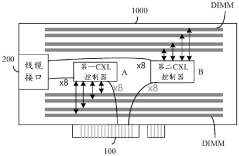
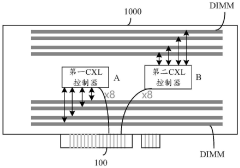
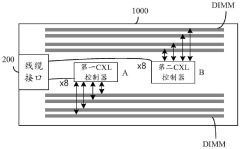
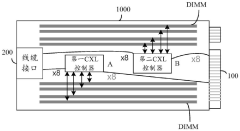
Capacity-based memory scheduling method and device, equipment and medium
PatentPendingCN118093182A
Innovation
- Obtain and initialize pre-configured memory environment variables through the dynamic memory allocator, determine the scheduling strategy of local memory and CXL memory based on the memory environment variables, allocate memory in combination with non-uniform memory access control tools, ensure the memory allocation capacity and usage type, and achieve reasonable Memory allocation and switching.


Performance Benchmarking and Compatibility Assessment
Performance benchmarking between DDRx and CXL memory modules reveals significant differences in latency, bandwidth, and system-level efficiency metrics. Standard DDR5 modules typically achieve latencies of 10-15 nanoseconds for local memory access, while CXL memory modules exhibit higher latencies ranging from 100-300 nanoseconds due to the additional protocol overhead and potential network traversal. However, CXL modules demonstrate superior aggregate bandwidth capabilities when multiple modules are deployed across distributed nodes, achieving theoretical throughput exceeding 64 GB/s per CXL 3.0 link.
Memory-intensive workloads such as in-memory databases and high-performance computing applications show varying performance characteristics depending on access patterns. Sequential read operations favor CXL modules due to their ability to leverage prefetching mechanisms and sustained bandwidth, while random access patterns typically perform better with traditional DDR modules. Real-world testing indicates that applications with working sets exceeding local DDR capacity can achieve 15-25% performance improvements when utilizing CXL memory expansion compared to traditional storage-backed virtual memory systems.
Compatibility assessment reveals critical considerations for system integration and deployment strategies. CXL memory modules require specific CPU support, currently limited to Intel Sapphire Rapids and newer architectures, along with compatible motherboard designs featuring CXL slots. BIOS and firmware compatibility represents another crucial factor, as proper CXL memory detection and configuration depend on updated system firmware supporting CXL 2.0 or 3.0 specifications.
Operating system compatibility varies significantly across different platforms and kernel versions. Linux distributions with kernel versions 5.18 and above provide native CXL support, while Windows Server 2022 and newer versions offer limited CXL functionality. Memory management policies and NUMA topology recognition require careful configuration to optimize performance across hybrid DDR-CXL memory architectures.
Application-level compatibility assessment indicates that most existing software can utilize CXL memory transparently through standard memory allocation APIs. However, performance-critical applications may require optimization to account for the heterogeneous memory hierarchy and varying access latencies between DDR and CXL memory regions.
Memory-intensive workloads such as in-memory databases and high-performance computing applications show varying performance characteristics depending on access patterns. Sequential read operations favor CXL modules due to their ability to leverage prefetching mechanisms and sustained bandwidth, while random access patterns typically perform better with traditional DDR modules. Real-world testing indicates that applications with working sets exceeding local DDR capacity can achieve 15-25% performance improvements when utilizing CXL memory expansion compared to traditional storage-backed virtual memory systems.
Compatibility assessment reveals critical considerations for system integration and deployment strategies. CXL memory modules require specific CPU support, currently limited to Intel Sapphire Rapids and newer architectures, along with compatible motherboard designs featuring CXL slots. BIOS and firmware compatibility represents another crucial factor, as proper CXL memory detection and configuration depend on updated system firmware supporting CXL 2.0 or 3.0 specifications.
Operating system compatibility varies significantly across different platforms and kernel versions. Linux distributions with kernel versions 5.18 and above provide native CXL support, while Windows Server 2022 and newer versions offer limited CXL functionality. Memory management policies and NUMA topology recognition require careful configuration to optimize performance across hybrid DDR-CXL memory architectures.
Application-level compatibility assessment indicates that most existing software can utilize CXL memory transparently through standard memory allocation APIs. However, performance-critical applications may require optimization to account for the heterogeneous memory hierarchy and varying access latencies between DDR and CXL memory regions.
Cost-Benefit Analysis for Enterprise Memory Deployment
The total cost of ownership for DDR memory modules remains significantly lower in traditional enterprise deployments, with DDR5 modules priced between $8-15 per GB compared to CXL modules ranging from $25-40 per GB. This price differential stems from DDR's mature manufacturing ecosystem and economies of scale achieved through decades of market penetration. However, the cost analysis extends beyond initial procurement to encompass infrastructure requirements, power consumption, and operational expenses.
CXL modules demonstrate superior cost efficiency in memory-intensive applications requiring substantial capacity expansion. While the per-gigabyte cost remains higher, CXL's pooling capabilities enable organizations to achieve 40-60% better memory utilization rates compared to traditional DDR configurations. This efficiency translates to reduced total memory requirements and lower infrastructure footprint, particularly beneficial in data center environments where rack space commands premium pricing.
Power consumption analysis reveals DDR5 modules consuming approximately 1.1-1.35 watts per GB during active operations, while CXL modules operate at 1.8-2.2 watts per GB. However, CXL's dynamic allocation capabilities allow enterprises to power down unused memory pools, potentially achieving 20-30% overall power savings in variable workload scenarios. The thermal management costs associated with CXL's higher power density must be factored into cooling infrastructure investments.
Deployment complexity introduces additional cost considerations, with DDR implementations requiring minimal specialized expertise while CXL deployments demand advanced system integration knowledge. Training costs for technical staff range from $5,000-15,000 per engineer for CXL competency development. Conversely, CXL's flexibility reduces future upgrade costs by enabling incremental capacity additions without system redesign.
Return on investment calculations favor DDR for stable, predictable workloads with established memory requirements. CXL demonstrates superior ROI in dynamic environments experiencing 30% or greater memory utilization variance, where its adaptive capabilities justify the premium pricing through improved resource efficiency and reduced overprovisioning costs.
CXL modules demonstrate superior cost efficiency in memory-intensive applications requiring substantial capacity expansion. While the per-gigabyte cost remains higher, CXL's pooling capabilities enable organizations to achieve 40-60% better memory utilization rates compared to traditional DDR configurations. This efficiency translates to reduced total memory requirements and lower infrastructure footprint, particularly beneficial in data center environments where rack space commands premium pricing.
Power consumption analysis reveals DDR5 modules consuming approximately 1.1-1.35 watts per GB during active operations, while CXL modules operate at 1.8-2.2 watts per GB. However, CXL's dynamic allocation capabilities allow enterprises to power down unused memory pools, potentially achieving 20-30% overall power savings in variable workload scenarios. The thermal management costs associated with CXL's higher power density must be factored into cooling infrastructure investments.
Deployment complexity introduces additional cost considerations, with DDR implementations requiring minimal specialized expertise while CXL deployments demand advanced system integration knowledge. Training costs for technical staff range from $5,000-15,000 per engineer for CXL competency development. Conversely, CXL's flexibility reduces future upgrade costs by enabling incremental capacity additions without system redesign.
Return on investment calculations favor DDR for stable, predictable workloads with established memory requirements. CXL demonstrates superior ROI in dynamic environments experiencing 30% or greater memory utilization variance, where its adaptive capabilities justify the premium pricing through improved resource efficiency and reduced overprovisioning costs.
Unlock deeper insights with PatSnap Eureka Quick Research — get a full tech report to explore trends and direct your research. Try now!
Generate Your Research Report Instantly with AI Agent
Supercharge your innovation with PatSnap Eureka AI Agent Platform!