

Microchannel Reactor Efficiency under Tighter Emission Regulations
SEP 25, 20259 MIN READ
Generate Your Research Report Instantly with AI Agent
PatSnap Eureka helps you evaluate technical feasibility & market potential.
Microchannel Reactor Technology Evolution and Objectives
Microchannel reactors represent a significant advancement in chemical processing technology, emerging in the late 1980s through pioneering work at Pacific Northwest National Laboratory. These reactors feature channels with diameters ranging from tens to hundreds of micrometers, offering revolutionary advantages in heat and mass transfer efficiency compared to conventional reactors. The evolution of this technology has been driven by increasing demands for process intensification and environmental sustainability across various industries.
The development trajectory of microchannel reactors has seen three distinct phases. The initial research phase (1985-2000) focused on fundamental principles and proof-of-concept designs. The second phase (2000-2015) witnessed commercialization efforts and expansion into various applications including fuel processing, fine chemicals synthesis, and pharmaceuticals. The current phase (2015-present) is characterized by advanced integration with digital technologies and adaptation to increasingly stringent emission regulations.
A critical evolutionary aspect has been the materials science advancements enabling these reactors. Early designs relied primarily on stainless steel and aluminum, while contemporary versions incorporate advanced materials such as silicon carbide, specialized alloys, and ceramic composites that offer enhanced durability under extreme conditions and catalytic performance.
Fabrication techniques have similarly progressed from conventional machining to advanced manufacturing methods including 3D printing, laser etching, and precision microfabrication. These innovations have dramatically reduced production costs while improving design flexibility and precision, allowing for increasingly complex channel geometries optimized for specific reactions.
Catalyst integration represents another significant evolutionary milestone. Modern microchannel reactors feature sophisticated catalyst deposition techniques including washcoating, chemical vapor deposition, and in-situ growth methods that maximize catalytic surface area while minimizing flow resistance.
The primary technological objectives for microchannel reactors under tighter emission regulations include achieving near-complete conversion of reactants to minimize waste streams, reducing energy consumption through improved heat management, and enabling precise control over reaction parameters to minimize byproduct formation. Additionally, there are focused efforts on developing real-time monitoring capabilities through integrated sensors and predictive modeling to ensure compliance with evolving regulatory standards.
Future development goals include enhancing modularity for scalable applications, improving resistance to catalyst deactivation, and developing self-cleaning mechanisms to maintain optimal performance over extended operational periods. These advancements aim to position microchannel reactors as a cornerstone technology in the transition toward more sustainable chemical processing with minimal environmental impact.
The development trajectory of microchannel reactors has seen three distinct phases. The initial research phase (1985-2000) focused on fundamental principles and proof-of-concept designs. The second phase (2000-2015) witnessed commercialization efforts and expansion into various applications including fuel processing, fine chemicals synthesis, and pharmaceuticals. The current phase (2015-present) is characterized by advanced integration with digital technologies and adaptation to increasingly stringent emission regulations.
A critical evolutionary aspect has been the materials science advancements enabling these reactors. Early designs relied primarily on stainless steel and aluminum, while contemporary versions incorporate advanced materials such as silicon carbide, specialized alloys, and ceramic composites that offer enhanced durability under extreme conditions and catalytic performance.
Fabrication techniques have similarly progressed from conventional machining to advanced manufacturing methods including 3D printing, laser etching, and precision microfabrication. These innovations have dramatically reduced production costs while improving design flexibility and precision, allowing for increasingly complex channel geometries optimized for specific reactions.
Catalyst integration represents another significant evolutionary milestone. Modern microchannel reactors feature sophisticated catalyst deposition techniques including washcoating, chemical vapor deposition, and in-situ growth methods that maximize catalytic surface area while minimizing flow resistance.
The primary technological objectives for microchannel reactors under tighter emission regulations include achieving near-complete conversion of reactants to minimize waste streams, reducing energy consumption through improved heat management, and enabling precise control over reaction parameters to minimize byproduct formation. Additionally, there are focused efforts on developing real-time monitoring capabilities through integrated sensors and predictive modeling to ensure compliance with evolving regulatory standards.
Future development goals include enhancing modularity for scalable applications, improving resistance to catalyst deactivation, and developing self-cleaning mechanisms to maintain optimal performance over extended operational periods. These advancements aim to position microchannel reactors as a cornerstone technology in the transition toward more sustainable chemical processing with minimal environmental impact.
Market Demand Analysis for Low-Emission Reactor Systems
The global market for microchannel reactor systems is experiencing significant growth driven by increasingly stringent emission regulations across major industrial economies. Recent regulatory frameworks, particularly in the European Union with its European Green Deal and in the United States with the Clean Air Act amendments, have established progressively lower emission thresholds for industrial processes, creating substantial demand for more efficient reactor technologies.
Market research indicates that the industrial sector accounts for approximately 24% of global greenhouse gas emissions, with chemical processing and petroleum refining being major contributors. This regulatory pressure has transformed emission reduction from a compliance issue to a strategic business imperative, with companies actively seeking technologies that can deliver both environmental and economic benefits.
The market for low-emission reactor systems is projected to grow at a compound annual growth rate of 8.7% through 2030, reaching a market value significantly higher than traditional reactor technologies. This growth is particularly pronounced in regions with mature industrial bases and strict environmental regulations, including Western Europe, North America, and increasingly in East Asia, where China's latest Five-Year Plan has emphasized green manufacturing initiatives.
Key market segments driving demand include petrochemical processing, fine chemical manufacturing, pharmaceutical production, and renewable fuel synthesis. Each of these sectors requires specialized microchannel reactor configurations optimized for their specific processes while meeting emission standards. The pharmaceutical sector, in particular, shows the highest willingness to invest in premium solutions that offer both emission reductions and enhanced product quality.
Customer requirements analysis reveals three primary demand drivers: regulatory compliance capabilities, operational efficiency improvements, and total cost of ownership. End-users increasingly evaluate reactor systems based on their ability to reduce multiple pollutants simultaneously, including NOx, SOx, particulate matter, and volatile organic compounds, while maintaining or improving process yields.
Market surveys indicate that industrial customers are willing to accept payback periods of 3-5 years for advanced microchannel reactor systems that deliver substantial emission reductions, representing a shift from historical expectations of 1-2 year returns on process equipment investments. This extended ROI tolerance reflects the strategic importance of emission compliance to business continuity.
The competitive landscape shows growing demand for turnkey solutions that integrate advanced catalysts, precise thermal management, and sophisticated control systems. Customers increasingly seek vendors who can provide not only the reactor technology but also implementation expertise, performance guarantees, and ongoing optimization services to ensure sustained compliance with tightening emission standards.
Market research indicates that the industrial sector accounts for approximately 24% of global greenhouse gas emissions, with chemical processing and petroleum refining being major contributors. This regulatory pressure has transformed emission reduction from a compliance issue to a strategic business imperative, with companies actively seeking technologies that can deliver both environmental and economic benefits.
The market for low-emission reactor systems is projected to grow at a compound annual growth rate of 8.7% through 2030, reaching a market value significantly higher than traditional reactor technologies. This growth is particularly pronounced in regions with mature industrial bases and strict environmental regulations, including Western Europe, North America, and increasingly in East Asia, where China's latest Five-Year Plan has emphasized green manufacturing initiatives.
Key market segments driving demand include petrochemical processing, fine chemical manufacturing, pharmaceutical production, and renewable fuel synthesis. Each of these sectors requires specialized microchannel reactor configurations optimized for their specific processes while meeting emission standards. The pharmaceutical sector, in particular, shows the highest willingness to invest in premium solutions that offer both emission reductions and enhanced product quality.
Customer requirements analysis reveals three primary demand drivers: regulatory compliance capabilities, operational efficiency improvements, and total cost of ownership. End-users increasingly evaluate reactor systems based on their ability to reduce multiple pollutants simultaneously, including NOx, SOx, particulate matter, and volatile organic compounds, while maintaining or improving process yields.
Market surveys indicate that industrial customers are willing to accept payback periods of 3-5 years for advanced microchannel reactor systems that deliver substantial emission reductions, representing a shift from historical expectations of 1-2 year returns on process equipment investments. This extended ROI tolerance reflects the strategic importance of emission compliance to business continuity.
The competitive landscape shows growing demand for turnkey solutions that integrate advanced catalysts, precise thermal management, and sophisticated control systems. Customers increasingly seek vendors who can provide not only the reactor technology but also implementation expertise, performance guarantees, and ongoing optimization services to ensure sustained compliance with tightening emission standards.
Current Challenges in Microchannel Reactor Efficiency
Microchannel reactors represent a significant advancement in chemical processing technology, offering enhanced heat and mass transfer capabilities through their unique microscale channel designs. However, as global emission regulations become increasingly stringent, these reactors face several critical challenges that limit their efficiency and widespread adoption.
The primary technical challenge lies in catalyst deactivation and fouling within the microchannels. Due to the extremely narrow channel dimensions (typically 10-500 micrometers), even minor catalyst degradation or particulate deposition can significantly impair flow dynamics and reaction efficiency. This issue becomes particularly pronounced when processing feedstocks containing impurities or when operating under conditions that promote coking or sintering.
Heat management presents another substantial hurdle. While microchannel reactors excel at heat transfer compared to conventional reactors, achieving uniform temperature distribution across all channels remains problematic. Temperature gradients can lead to uneven reaction rates and potentially dangerous hotspots, especially in exothermic reactions. These thermal management issues become more critical when operating at the higher temperatures often required to meet stricter emission standards.
Manufacturing precision and scalability constitute significant barriers to widespread implementation. The fabrication of microchannel reactors demands extremely tight tolerances and sophisticated manufacturing techniques. As emission regulations drive the need for larger processing capacities, scaling up these reactors while maintaining uniform channel dimensions and flow distribution becomes increasingly challenging.
Material limitations further constrain performance improvements. Current materials struggle to simultaneously provide the necessary chemical resistance, thermal stability, and mechanical integrity required under the more extreme operating conditions needed to achieve lower emissions. Advanced materials capable of withstanding these conditions often come with prohibitive costs or manufacturing difficulties.
Control system complexity represents another major challenge. The rapid reaction kinetics within microchannels necessitate sophisticated real-time monitoring and control systems. As emission targets become more demanding, the need for precise control of residence time, temperature profiles, and pressure differentials increases substantially, requiring more advanced sensors and control algorithms.
Finally, integration challenges with existing infrastructure impede adoption. Many industrial facilities are designed around conventional reactor technologies, making the transition to microchannel systems technically complex and financially burdensome. This retrofit challenge is particularly acute in industries facing rapid regulatory changes that demand quick adaptation to new emission standards.
The primary technical challenge lies in catalyst deactivation and fouling within the microchannels. Due to the extremely narrow channel dimensions (typically 10-500 micrometers), even minor catalyst degradation or particulate deposition can significantly impair flow dynamics and reaction efficiency. This issue becomes particularly pronounced when processing feedstocks containing impurities or when operating under conditions that promote coking or sintering.
Heat management presents another substantial hurdle. While microchannel reactors excel at heat transfer compared to conventional reactors, achieving uniform temperature distribution across all channels remains problematic. Temperature gradients can lead to uneven reaction rates and potentially dangerous hotspots, especially in exothermic reactions. These thermal management issues become more critical when operating at the higher temperatures often required to meet stricter emission standards.
Manufacturing precision and scalability constitute significant barriers to widespread implementation. The fabrication of microchannel reactors demands extremely tight tolerances and sophisticated manufacturing techniques. As emission regulations drive the need for larger processing capacities, scaling up these reactors while maintaining uniform channel dimensions and flow distribution becomes increasingly challenging.
Material limitations further constrain performance improvements. Current materials struggle to simultaneously provide the necessary chemical resistance, thermal stability, and mechanical integrity required under the more extreme operating conditions needed to achieve lower emissions. Advanced materials capable of withstanding these conditions often come with prohibitive costs or manufacturing difficulties.
Control system complexity represents another major challenge. The rapid reaction kinetics within microchannels necessitate sophisticated real-time monitoring and control systems. As emission targets become more demanding, the need for precise control of residence time, temperature profiles, and pressure differentials increases substantially, requiring more advanced sensors and control algorithms.
Finally, integration challenges with existing infrastructure impede adoption. Many industrial facilities are designed around conventional reactor technologies, making the transition to microchannel systems technically complex and financially burdensome. This retrofit challenge is particularly acute in industries facing rapid regulatory changes that demand quick adaptation to new emission standards.
Current Technical Solutions for Emission Reduction in Microreactors
01 Design optimization for enhanced heat and mass transfer
Microchannel reactors can achieve higher efficiency through optimized channel geometry and configuration. Specific design features such as channel dimensions, surface patterns, and flow distributors significantly improve heat and mass transfer rates. These optimizations reduce diffusion limitations and enhance mixing, leading to more uniform temperature distribution and improved reaction kinetics. Advanced computational modeling helps predict and optimize flow patterns to maximize contact between reactants and catalysts.- Design optimization for enhanced heat and mass transfer: Microchannel reactor efficiency can be significantly improved through optimized design features that enhance heat and mass transfer. These designs include specific channel geometries, flow distributors, and integrated heat exchangers that maximize contact between reactants and catalysts while ensuring uniform temperature distribution. Such optimizations reduce reaction times, increase conversion rates, and improve overall energy efficiency by minimizing heat losses and maximizing transfer coefficients.
- Advanced catalyst integration and coating techniques: Efficiency of microchannel reactors is heavily dependent on catalyst performance and integration methods. Advanced techniques for catalyst coating, including washcoating, sol-gel methods, and direct growth of catalytic structures within microchannels, significantly improve reaction rates and selectivity. These methods ensure optimal catalyst distribution, increased active surface area, and enhanced stability during operation, leading to higher conversion efficiency and extended operational lifetimes.
- Process intensification and flow optimization: Process intensification strategies in microchannel reactors focus on optimizing flow patterns and reaction conditions to maximize efficiency. This includes precise control of residence time, pressure distribution, and flow regimes to enhance mixing and reaction kinetics. Advanced flow distributors, structured packings, and engineered turbulence promoters ensure uniform distribution of reactants and prevent channeling or dead zones, resulting in higher throughput and improved yield while reducing energy consumption.
- Monitoring and control systems for performance optimization: Sophisticated monitoring and control systems are essential for maintaining optimal efficiency in microchannel reactors. These systems incorporate advanced sensors, real-time analytics, and feedback control mechanisms to continuously monitor reaction parameters such as temperature, pressure, and concentration profiles. Integrated diagnostic tools enable rapid detection of performance deviations, allowing for immediate adjustments to operating conditions and preventing efficiency losses due to fouling, catalyst deactivation, or flow maldistribution.
- Scale-up strategies and modular designs: Effective scale-up strategies are crucial for maintaining the high efficiency of microchannel reactors at industrial scales. Modular designs that allow for numbering-up rather than traditional scale-up preserve the advantageous heat and mass transfer characteristics of microchannels. These approaches include parallel arrangement of reactor units, standardized connection interfaces, and distributed flow systems that ensure uniform performance across multiple modules while facilitating maintenance and operational flexibility.
02 Catalyst integration and surface modification techniques
Efficiency in microchannel reactors can be significantly improved through innovative catalyst integration methods. Techniques include coating channel walls with catalytic materials, embedding catalyst particles in structured supports, and creating hierarchical catalyst structures. Surface modifications that increase the active surface area while maintaining low pressure drop are particularly effective. These approaches maximize catalyst utilization, improve selectivity, and extend catalyst lifetime, resulting in higher conversion rates and reduced energy consumption.Expand Specific Solutions03 Process intensification and reaction control strategies
Advanced control strategies enable significant efficiency improvements in microchannel reactors. Real-time monitoring systems coupled with precise flow control allow for optimal reaction conditions to be maintained throughout the process. Techniques such as distributed sensing, adaptive control algorithms, and model-predictive control help manage exothermic reactions safely while maximizing yield. Process intensification approaches combine multiple unit operations within the microchannel architecture, reducing equipment footprint and improving overall energy efficiency.Expand Specific Solutions04 Scale-up and parallelization methodologies
Efficient scale-up of microchannel reactors involves parallelization of multiple channels while maintaining uniform flow distribution. Numbering-up approaches preserve the advantageous heat and mass transfer characteristics of single channels while increasing throughput. Advanced manifold designs ensure balanced flow across parallel channels, preventing hotspots and maintaining consistent residence times. Modular construction techniques allow for flexible capacity adjustment and simplified maintenance, making industrial implementation more practical and cost-effective.Expand Specific Solutions05 Energy integration and sustainable operation
Microchannel reactors can achieve superior energy efficiency through innovative heat recovery systems and integration with renewable energy sources. Countercurrent flow arrangements and integrated heat exchangers capture and reuse thermal energy from exothermic reactions. Advanced materials with enhanced thermal conductivity improve heat transfer efficiency while reducing energy requirements. Hybrid systems combining microreactors with sustainable energy inputs optimize resource utilization and minimize environmental impact, making these reactors particularly suitable for green chemistry applications.Expand Specific Solutions
Leading Companies and Research Institutions in Microchannel Technology
Microchannel reactor technology is currently in a growth phase, with the market expanding due to increasing emission regulations driving demand for more efficient chemical processing solutions. The global market size is estimated to reach $500-700 million by 2025, growing at 8-10% annually. From a technological maturity perspective, companies like Velocys, Air Liquide, and BASF have achieved commercial deployment, while research institutions such as KIST, Stevens Institute of Technology, and Forschungszentrum Jülich are advancing fundamental innovations. Chinese players including China Petroleum & Chemical Corp. and Shandong Qingchuang Chemical are rapidly scaling up capabilities, while established manufacturers like Mitsubishi Gas Chemical and Ehrfeld Mikrotechnik BTS maintain strong positions through specialized applications and process optimization under stricter environmental standards.
Velocys, Inc.
Technical Solution: Velocys has developed proprietary Fischer-Tropsch (FT) microchannel reactor technology specifically designed to address emission challenges. Their FT microchannel reactors feature precisely engineered channels with dimensions in the millimeter range that dramatically enhance heat and mass transfer rates. This design enables optimal temperature control during highly exothermic reactions, preventing hotspots that lead to catalyst deactivation and unwanted byproducts. Velocys' technology incorporates advanced catalyst formulations directly integrated into the microchannel structure, creating a highly efficient system that converts synthesis gas (CO and H2) from various feedstocks into clean liquid fuels. Their reactors achieve conversion efficiencies exceeding 70% in a single pass, significantly higher than conventional systems, while reducing CO2 emissions by up to 90% compared to fossil fuels when using sustainable feedstocks.
Strengths: Superior heat management capabilities allow for precise temperature control, preventing catalyst deactivation and extending operational life. Compact design enables distributed production and modular scaling. Weaknesses: Higher initial capital costs compared to conventional reactors, and potential challenges with catalyst replacement in the integrated microchannel structure.
Ehrfeld Mikrotechnik BTS GmbH
Technical Solution: Ehrfeld Mikrotechnik BTS has developed specialized modular microchannel reactor technology designed specifically to address emission challenges in fine chemical and pharmaceutical manufacturing. Their Miprowa® (Microstructured Professional Flow Apparatus) system features precision-engineered microchannels with dimensions ranging from 100-500 micrometers, creating exceptional surface-to-volume ratios that enhance mass and heat transfer rates by factors of 10-100 compared to conventional reactors. The company's innovative "FlowPlate" design enables rapid reconfiguration of reactor parameters without system redesign, allowing manufacturers to quickly adapt to changing regulatory requirements. Ehrfeld's technology incorporates specialized catalyst integration methods including washcoating, direct impregnation, and exchangeable catalyst cartridges that maintain high activity while facilitating replacement when needed. Their microchannel reactors achieve residence time distributions with coefficients of variation below 5%, enabling precise reaction control that minimizes unwanted byproducts. The system's modular architecture allows for straightforward scaling from laboratory to production volumes while maintaining consistent performance characteristics, a critical advantage for meeting emission standards across different production scales.
Strengths: Exceptional modularity and flexibility enable rapid adaptation to changing requirements and straightforward scaling. Specialized expertise in fine chemical applications provides targeted solutions for high-value products. Weaknesses: Focus on smaller-scale applications may limit applicability in very large industrial processes, and higher per-unit production costs compared to mass-produced systems.
Key Patents and Innovations in Microchannel Reactor Design
Systems and methods for thermally actuated flow control
PatentActiveUS20180038513A1
Innovation
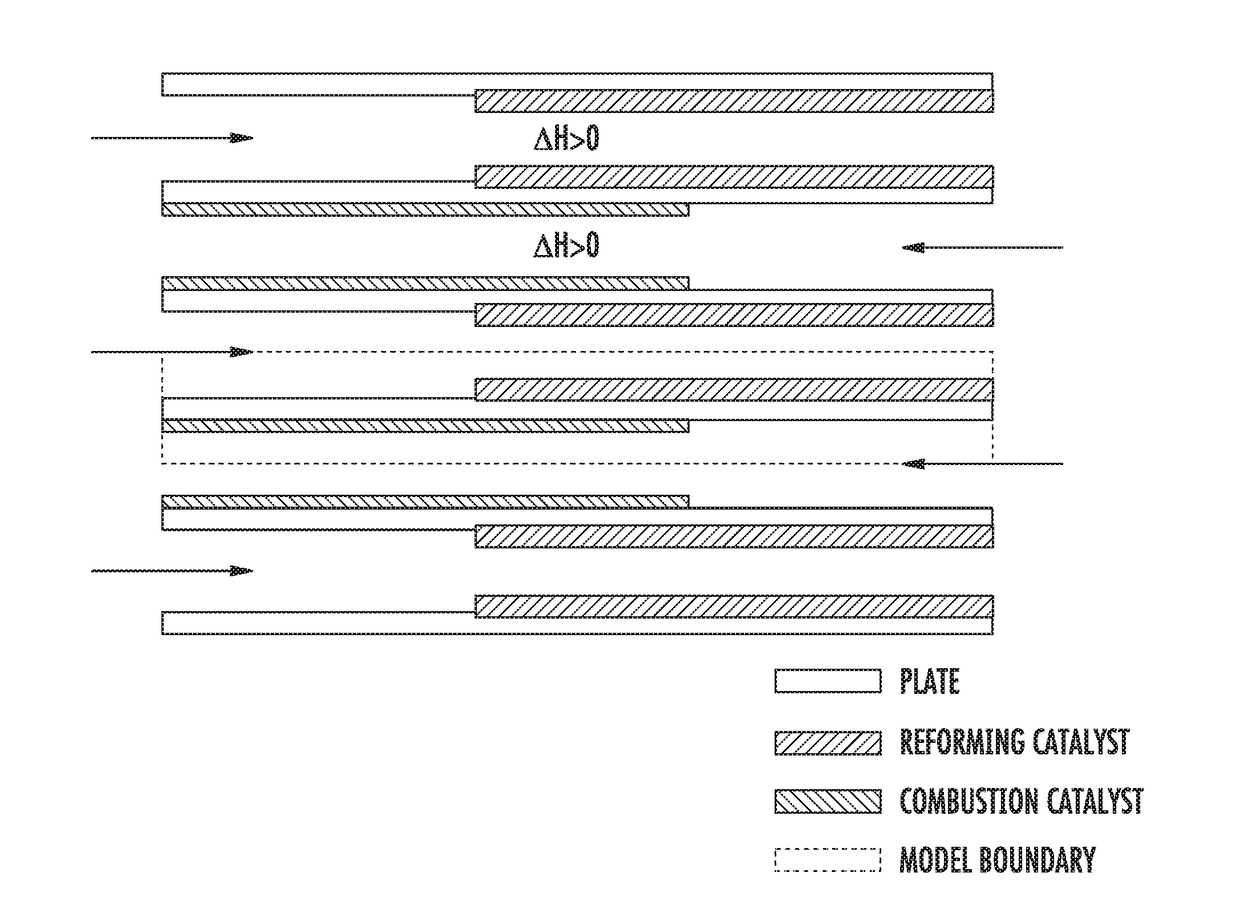
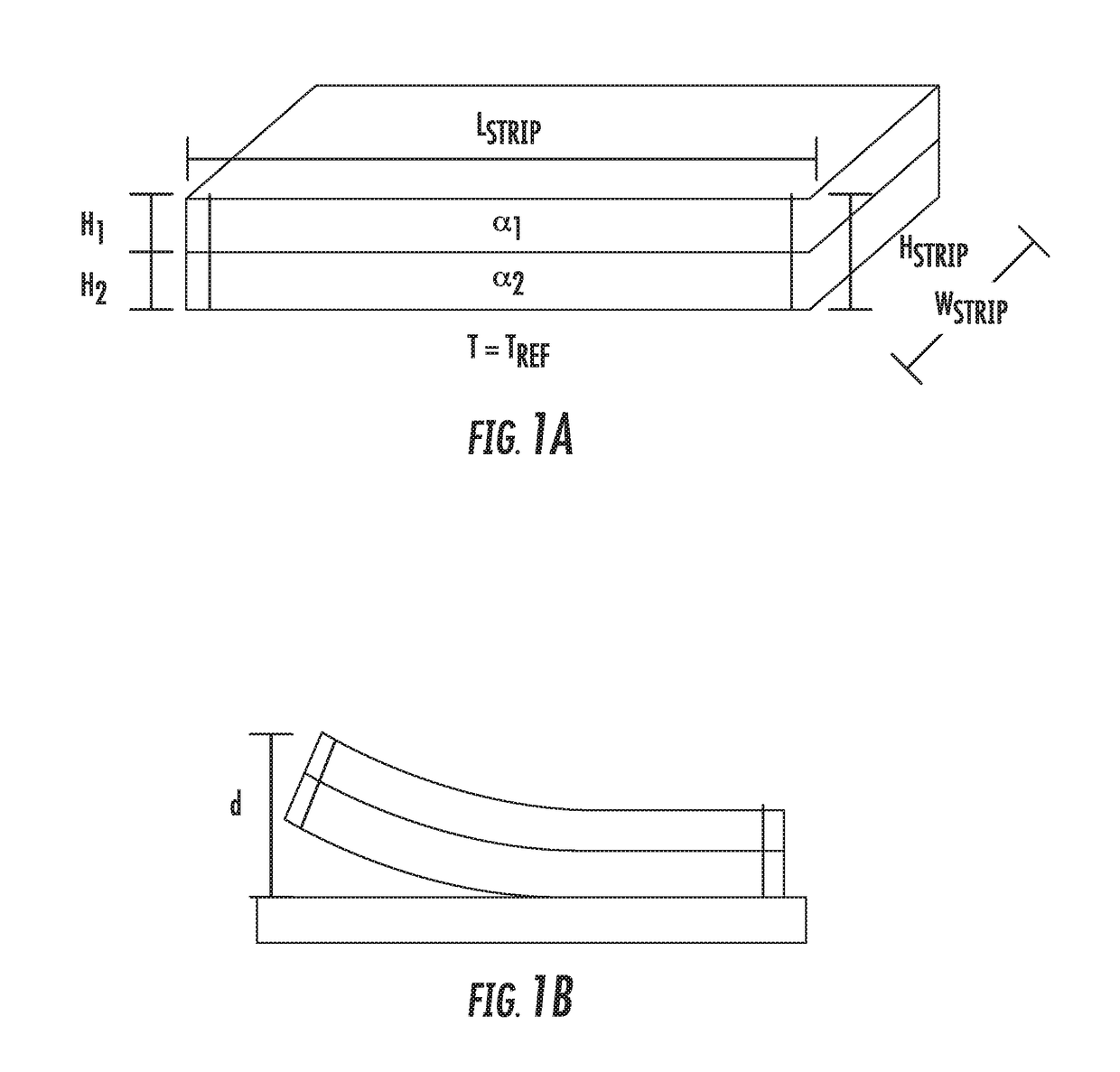
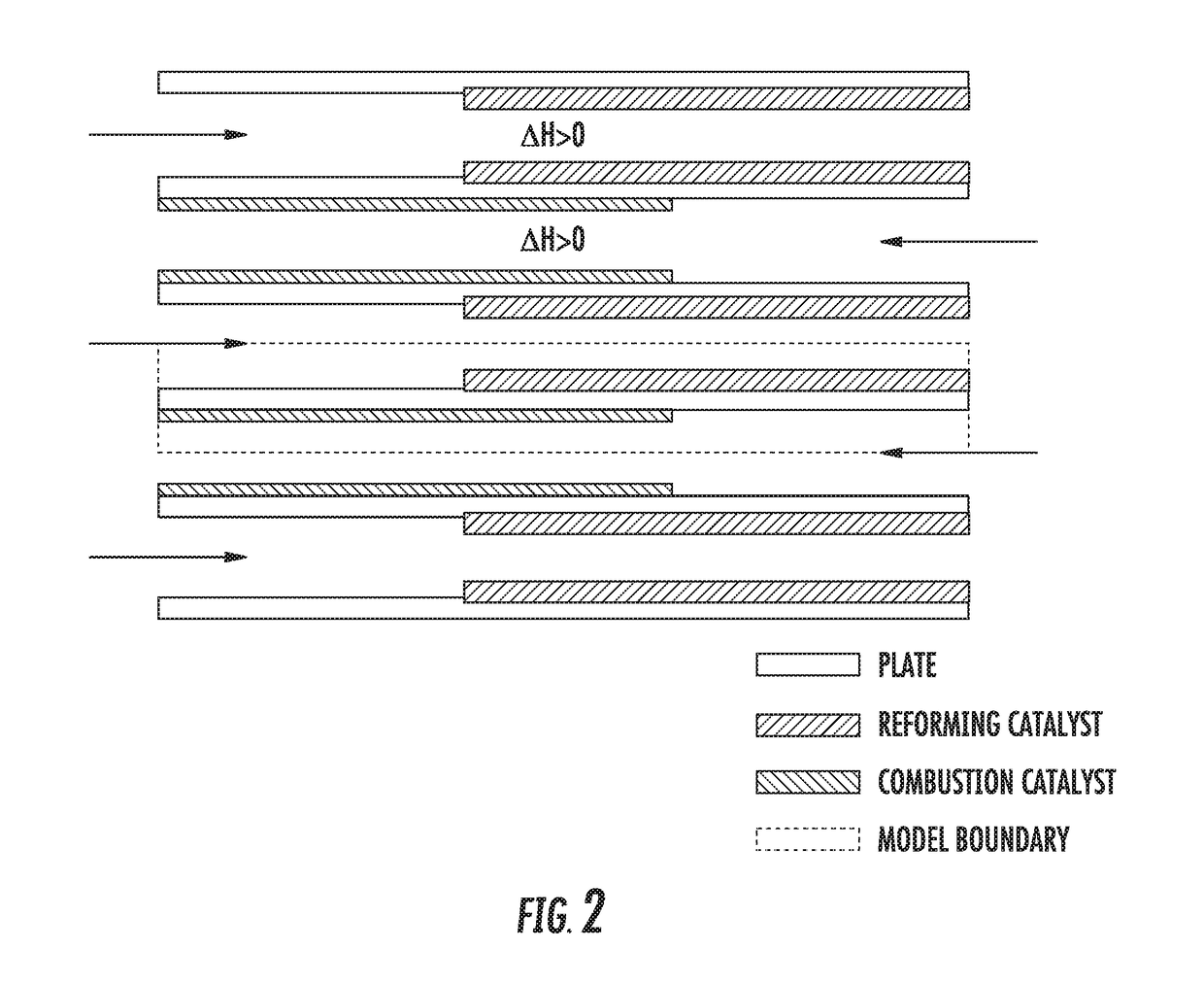
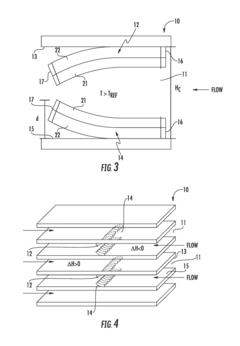
- Incorporating bimetallic strips within the combustion channel to create a thermally-actuated valve that regulates fluid flow based on temperature changes, restricting heat generation by deflecting as temperature increases, thereby controlling heat flux coordination between exothermic and endothermic reactions.
Process for the production of hydrogen peroxide from hydrogen and oxygen
PatentWO2006113676A8
Innovation
- A process using a microreactor system with a catalyst comprising platinum group metals on an acidified support, operating at low pressure and in the presence of an acid or halogen, to facilitate the direct combination of hydrogen and oxygen, enhancing safety, efficiency, and catalyst activity.
Regulatory Framework Impact on Microchannel Reactor Development
The evolution of environmental regulations has significantly shaped the development trajectory of microchannel reactor technology. Since the early 2000s, increasingly stringent emission standards across major industrial economies have accelerated research and investment in more efficient reactor designs. The Paris Agreement of 2015 marked a pivotal moment, establishing global commitments to emissions reduction that directly influenced industrial process technologies, including microchannel reactors.
Regulatory frameworks have evolved from simple emission caps to sophisticated performance-based standards that consider lifecycle emissions and energy efficiency. The European Union's Industrial Emissions Directive (IED) and the United States Environmental Protection Agency's New Source Performance Standards (NSPS) have been particularly influential in setting benchmarks that microchannel reactor developers must meet or exceed.
These regulations have created both challenges and opportunities for microchannel reactor technology. On one hand, compliance requirements have increased development costs and technical complexity. Manufacturers must now incorporate advanced monitoring systems, emission control mechanisms, and demonstrate performance across a wider range of operating conditions. This has extended development timelines and raised barriers to market entry for smaller technology providers.
Conversely, tighter regulations have stimulated innovation in reactor design. The need to achieve higher conversion efficiencies while reducing emissions has driven advances in catalyst formulations, channel geometries, and process intensification techniques. Companies that have successfully navigated these regulatory challenges have emerged with more competitive and versatile reactor technologies.
Regional variations in regulatory frameworks have created a complex landscape for global technology deployment. China's rapid implementation of stricter industrial emissions standards has created a significant market for advanced reactor technologies, while differences between EU and US regulations have necessitated region-specific design modifications. This regulatory fragmentation has influenced commercialization strategies, with some companies developing modular designs that can be adapted to different regulatory environments.
Looking forward, anticipated regulatory trends toward carbon pricing, zero-emission targets, and circular economy principles will continue to shape microchannel reactor development. Technologies that can demonstrate superior lifecycle environmental performance, particularly in carbon-intensive industries, will likely receive preferential treatment under emerging regulatory frameworks. This suggests that future development efforts should focus not only on reaction efficiency but also on broader environmental performance metrics.
Regulatory frameworks have evolved from simple emission caps to sophisticated performance-based standards that consider lifecycle emissions and energy efficiency. The European Union's Industrial Emissions Directive (IED) and the United States Environmental Protection Agency's New Source Performance Standards (NSPS) have been particularly influential in setting benchmarks that microchannel reactor developers must meet or exceed.
These regulations have created both challenges and opportunities for microchannel reactor technology. On one hand, compliance requirements have increased development costs and technical complexity. Manufacturers must now incorporate advanced monitoring systems, emission control mechanisms, and demonstrate performance across a wider range of operating conditions. This has extended development timelines and raised barriers to market entry for smaller technology providers.
Conversely, tighter regulations have stimulated innovation in reactor design. The need to achieve higher conversion efficiencies while reducing emissions has driven advances in catalyst formulations, channel geometries, and process intensification techniques. Companies that have successfully navigated these regulatory challenges have emerged with more competitive and versatile reactor technologies.
Regional variations in regulatory frameworks have created a complex landscape for global technology deployment. China's rapid implementation of stricter industrial emissions standards has created a significant market for advanced reactor technologies, while differences between EU and US regulations have necessitated region-specific design modifications. This regulatory fragmentation has influenced commercialization strategies, with some companies developing modular designs that can be adapted to different regulatory environments.
Looking forward, anticipated regulatory trends toward carbon pricing, zero-emission targets, and circular economy principles will continue to shape microchannel reactor development. Technologies that can demonstrate superior lifecycle environmental performance, particularly in carbon-intensive industries, will likely receive preferential treatment under emerging regulatory frameworks. This suggests that future development efforts should focus not only on reaction efficiency but also on broader environmental performance metrics.
Sustainability and Green Chemistry Applications
Microchannel reactors represent a significant advancement in sustainable chemical processing technologies, offering enhanced efficiency and reduced environmental impact compared to conventional reactor designs. As emission regulations become increasingly stringent worldwide, these reactors are positioned as critical tools for industries seeking to maintain productivity while meeting new environmental standards.
The integration of microchannel reactors into green chemistry frameworks provides multiple sustainability benefits. Their precise control over reaction parameters enables significant reductions in waste generation—a core principle of green chemistry. Studies indicate that properly optimized microchannel systems can reduce byproduct formation by 30-45% compared to batch processes, directly contributing to pollution prevention at the source.
Energy efficiency represents another crucial sustainability advantage of microchannel technology. The enhanced heat and mass transfer characteristics of these reactors allow operations at lower temperatures or with reduced energy inputs. Recent implementations in pharmaceutical manufacturing have demonstrated energy consumption reductions of up to 60% for certain synthesis processes, directly translating to lower carbon footprints across production cycles.
Water conservation benefits emerge from the microchannel reactor's inherent design efficiency. The reduced solvent requirements and improved separation processes minimize water usage in both reaction and cleaning phases. This aspect becomes increasingly valuable as water scarcity concerns intensify globally, particularly in regions with concentrated chemical manufacturing activities.
From a circular economy perspective, microchannel reactors facilitate the implementation of continuous flow chemistry principles that support material recirculation and recovery. Their precision control enables more effective catalyst utilization, with some systems demonstrating 3-5 times longer catalyst lifetimes compared to conventional reactors, reducing resource consumption and waste generation.
The adaptability of microchannel technology to renewable feedstocks further enhances its sustainability profile. Recent applications have successfully demonstrated efficient processing of bio-based raw materials, including lignocellulosic biomass derivatives and waste oils, creating pathways for petroleum-alternative chemical production that aligns with carbon neutrality goals.
As regulatory frameworks continue to evolve toward stricter emission controls, microchannel reactors offer scalable solutions that can be implemented across various industry sectors. Their modular nature supports gradual technology adoption, allowing companies to transition production methods while maintaining compliance with emerging environmental standards and advancing sustainability objectives.
The integration of microchannel reactors into green chemistry frameworks provides multiple sustainability benefits. Their precise control over reaction parameters enables significant reductions in waste generation—a core principle of green chemistry. Studies indicate that properly optimized microchannel systems can reduce byproduct formation by 30-45% compared to batch processes, directly contributing to pollution prevention at the source.
Energy efficiency represents another crucial sustainability advantage of microchannel technology. The enhanced heat and mass transfer characteristics of these reactors allow operations at lower temperatures or with reduced energy inputs. Recent implementations in pharmaceutical manufacturing have demonstrated energy consumption reductions of up to 60% for certain synthesis processes, directly translating to lower carbon footprints across production cycles.
Water conservation benefits emerge from the microchannel reactor's inherent design efficiency. The reduced solvent requirements and improved separation processes minimize water usage in both reaction and cleaning phases. This aspect becomes increasingly valuable as water scarcity concerns intensify globally, particularly in regions with concentrated chemical manufacturing activities.
From a circular economy perspective, microchannel reactors facilitate the implementation of continuous flow chemistry principles that support material recirculation and recovery. Their precision control enables more effective catalyst utilization, with some systems demonstrating 3-5 times longer catalyst lifetimes compared to conventional reactors, reducing resource consumption and waste generation.
The adaptability of microchannel technology to renewable feedstocks further enhances its sustainability profile. Recent applications have successfully demonstrated efficient processing of bio-based raw materials, including lignocellulosic biomass derivatives and waste oils, creating pathways for petroleum-alternative chemical production that aligns with carbon neutrality goals.
As regulatory frameworks continue to evolve toward stricter emission controls, microchannel reactors offer scalable solutions that can be implemented across various industry sectors. Their modular nature supports gradual technology adoption, allowing companies to transition production methods while maintaining compliance with emerging environmental standards and advancing sustainability objectives.
Unlock deeper insights with PatSnap Eureka Quick Research — get a full tech report to explore trends and direct your research. Try now!
Generate Your Research Report Instantly with AI Agent
Supercharge your innovation with PatSnap Eureka AI Agent Platform!