

Modeling Ionic Conductivity in Molten Carbonate Electrolytes
OCT 11, 20259 MIN READ
Generate Your Research Report Instantly with AI Agent
PatSnap Eureka helps you evaluate technical feasibility & market potential.
Molten Carbonate Electrolytes Background and Research Objectives
Molten carbonate electrolytes have emerged as critical components in high-temperature fuel cells and advanced energy storage systems since their initial development in the mid-20th century. These electrolytes, typically composed of lithium, sodium, and potassium carbonates, operate at temperatures between 500-650°C, where they exhibit exceptional ionic conductivity properties essential for efficient electrochemical performance. The historical evolution of molten carbonate technology began with fundamental research in the 1960s, followed by significant advancements in the 1980s and 1990s that established their viability in commercial applications.
The unique properties of molten carbonates, particularly their high ionic conductivity and excellent chemical stability at elevated temperatures, have positioned them as preferred electrolytes in Molten Carbonate Fuel Cells (MCFCs). These systems have demonstrated remarkable efficiency in converting chemical energy directly into electrical energy while offering advantages in fuel flexibility and reduced emissions compared to conventional power generation technologies.
Recent technological developments have expanded the potential applications of molten carbonate electrolytes beyond traditional fuel cells to include carbon capture systems, electrolysis processes, and novel energy storage configurations. This diversification reflects the growing recognition of their versatility and performance capabilities across multiple energy-related domains.
Despite their established presence in industrial applications, fundamental understanding of ionic transport mechanisms within molten carbonate systems remains incomplete. Current modeling approaches often rely on empirical correlations or simplified theoretical frameworks that fail to capture the complex interactions between different ionic species and their surrounding environment under varying operational conditions.
The primary objective of this research is to develop comprehensive, physics-based models that accurately predict ionic conductivity in molten carbonate electrolytes across a wide range of compositions and operating conditions. These models aim to bridge the gap between molecular-level phenomena and macroscopic transport properties, providing a robust foundation for optimizing electrolyte formulations and system designs.
Secondary objectives include identifying key factors influencing conductivity performance, establishing quantitative relationships between composition and transport properties, and developing predictive tools that can accelerate the design and implementation of next-generation molten carbonate systems. The research also seeks to elucidate the fundamental mechanisms governing ion transport, including the roles of ion association, local structure formation, and interfacial phenomena.
By advancing the theoretical understanding and modeling capabilities for molten carbonate electrolytes, this research aims to enable significant improvements in energy efficiency, operational stability, and cost-effectiveness of related technologies, ultimately contributing to broader goals of sustainable energy development and carbon emission reduction.
The unique properties of molten carbonates, particularly their high ionic conductivity and excellent chemical stability at elevated temperatures, have positioned them as preferred electrolytes in Molten Carbonate Fuel Cells (MCFCs). These systems have demonstrated remarkable efficiency in converting chemical energy directly into electrical energy while offering advantages in fuel flexibility and reduced emissions compared to conventional power generation technologies.
Recent technological developments have expanded the potential applications of molten carbonate electrolytes beyond traditional fuel cells to include carbon capture systems, electrolysis processes, and novel energy storage configurations. This diversification reflects the growing recognition of their versatility and performance capabilities across multiple energy-related domains.
Despite their established presence in industrial applications, fundamental understanding of ionic transport mechanisms within molten carbonate systems remains incomplete. Current modeling approaches often rely on empirical correlations or simplified theoretical frameworks that fail to capture the complex interactions between different ionic species and their surrounding environment under varying operational conditions.
The primary objective of this research is to develop comprehensive, physics-based models that accurately predict ionic conductivity in molten carbonate electrolytes across a wide range of compositions and operating conditions. These models aim to bridge the gap between molecular-level phenomena and macroscopic transport properties, providing a robust foundation for optimizing electrolyte formulations and system designs.
Secondary objectives include identifying key factors influencing conductivity performance, establishing quantitative relationships between composition and transport properties, and developing predictive tools that can accelerate the design and implementation of next-generation molten carbonate systems. The research also seeks to elucidate the fundamental mechanisms governing ion transport, including the roles of ion association, local structure formation, and interfacial phenomena.
By advancing the theoretical understanding and modeling capabilities for molten carbonate electrolytes, this research aims to enable significant improvements in energy efficiency, operational stability, and cost-effectiveness of related technologies, ultimately contributing to broader goals of sustainable energy development and carbon emission reduction.
Market Applications and Demand Analysis for Ionic Conductivity Models
The market for ionic conductivity models in molten carbonate electrolytes has experienced significant growth driven by the expanding clean energy sector. Molten carbonate fuel cells (MCFCs) represent a primary application area, with the global MCFC market projected to grow at a compound annual growth rate of 9.2% through 2030. This growth is primarily fueled by increasing demand for efficient, high-temperature fuel cell technologies in stationary power generation applications.
Energy storage systems constitute another substantial market segment. As grid-scale storage becomes increasingly critical for renewable energy integration, molten salt batteries and thermal energy storage systems utilizing carbonate electrolytes are gaining traction. The thermal energy storage market alone is expected to reach $7.5 billion by 2025, with molten carbonate technologies capturing an expanding share.
Industrial applications represent a third major market segment. Aluminum smelting, glass manufacturing, and metallurgical processes all utilize molten carbonate electrolytes, creating demand for accurate conductivity models to optimize these energy-intensive processes. The global industrial electrolysis market, valued at $24.3 billion in 2022, continues to seek efficiency improvements through better electrolyte modeling.
Regional analysis reveals distinct market patterns. North America and Europe lead in research and development of advanced modeling techniques, while Asia-Pacific demonstrates the fastest implementation growth, particularly in China, South Korea, and Japan. This regional disparity creates opportunities for technology transfer and collaborative development.
Market drivers include increasing pressure for decarbonization across industries, rising energy costs, and government policies supporting clean energy technologies. The European Green Deal and similar initiatives worldwide have accelerated investment in technologies that improve energy efficiency, including better electrolyte modeling capabilities.
Customer segments span from energy utilities and independent power producers to industrial manufacturers and research institutions. Each segment presents unique requirements for ionic conductivity models, ranging from real-time monitoring capabilities to integration with existing industrial control systems.
The value proposition of advanced ionic conductivity models centers on operational efficiency improvements, extended equipment lifespan, and reduced maintenance costs. Industry reports suggest that optimized electrolyte management can improve overall system efficiency by 5-8% while reducing maintenance costs by up to 15%, representing significant value in energy-intensive applications.
Energy storage systems constitute another substantial market segment. As grid-scale storage becomes increasingly critical for renewable energy integration, molten salt batteries and thermal energy storage systems utilizing carbonate electrolytes are gaining traction. The thermal energy storage market alone is expected to reach $7.5 billion by 2025, with molten carbonate technologies capturing an expanding share.
Industrial applications represent a third major market segment. Aluminum smelting, glass manufacturing, and metallurgical processes all utilize molten carbonate electrolytes, creating demand for accurate conductivity models to optimize these energy-intensive processes. The global industrial electrolysis market, valued at $24.3 billion in 2022, continues to seek efficiency improvements through better electrolyte modeling.
Regional analysis reveals distinct market patterns. North America and Europe lead in research and development of advanced modeling techniques, while Asia-Pacific demonstrates the fastest implementation growth, particularly in China, South Korea, and Japan. This regional disparity creates opportunities for technology transfer and collaborative development.
Market drivers include increasing pressure for decarbonization across industries, rising energy costs, and government policies supporting clean energy technologies. The European Green Deal and similar initiatives worldwide have accelerated investment in technologies that improve energy efficiency, including better electrolyte modeling capabilities.
Customer segments span from energy utilities and independent power producers to industrial manufacturers and research institutions. Each segment presents unique requirements for ionic conductivity models, ranging from real-time monitoring capabilities to integration with existing industrial control systems.
The value proposition of advanced ionic conductivity models centers on operational efficiency improvements, extended equipment lifespan, and reduced maintenance costs. Industry reports suggest that optimized electrolyte management can improve overall system efficiency by 5-8% while reducing maintenance costs by up to 15%, representing significant value in energy-intensive applications.
Current Challenges in Modeling Ionic Conductivity of Molten Carbonates
Despite significant advancements in computational methods, modeling ionic conductivity in molten carbonate electrolytes remains challenging due to the complex interplay of multiple physical and chemical phenomena. One of the primary obstacles is the accurate representation of the high-temperature dynamics of these systems, where traditional molecular dynamics simulations struggle to capture the rapid ion movements and interactions that occur at temperatures exceeding 500°C.
The multi-component nature of molten carbonate mixtures (typically containing Li2CO3, Na2CO3, and K2CO3) introduces additional complexity, as each species exhibits different mobility characteristics and interaction potentials. Current models often fail to accurately predict how these components influence each other's transport properties, particularly at varying mixture compositions that are relevant for industrial applications.
Quantum mechanical effects, which become increasingly important at elevated temperatures, are frequently oversimplified or neglected entirely in conventional modeling approaches. The polarization of carbonate ions and their interactions with metal cations involve subtle electronic structure considerations that require sophisticated quantum chemical treatments, which are computationally expensive and difficult to integrate into large-scale simulations.
The interfacial phenomena between molten carbonates and electrode materials present another significant modeling challenge. The electrochemical double layer formation and charge transfer processes at these interfaces critically influence overall conductivity but are poorly understood at the molecular level. Current models typically treat these interfaces as idealized boundaries, failing to capture the complex structural reorganization that occurs in real systems.
Time-scale limitations pose a fundamental challenge to simulation accuracy. The relevant processes for ionic conductivity span multiple time scales, from femtosecond electronic transitions to microsecond diffusion events. Bridging these disparate time scales within a unified computational framework remains an unsolved problem in the field.
Experimental validation of computational models is hindered by the extreme conditions under which molten carbonates operate. The corrosive nature and high temperatures of these materials make precise conductivity measurements difficult, leading to significant uncertainties in the experimental data used to benchmark theoretical predictions.
The development of accurate force fields for molecular dynamics simulations represents another critical challenge. Existing force fields often fail to reproduce the temperature dependence of transport properties, particularly near phase transitions where the structure of the melt undergoes significant changes. Machine learning approaches to force field development show promise but require extensive training data that is not always available for these specialized systems.
The multi-component nature of molten carbonate mixtures (typically containing Li2CO3, Na2CO3, and K2CO3) introduces additional complexity, as each species exhibits different mobility characteristics and interaction potentials. Current models often fail to accurately predict how these components influence each other's transport properties, particularly at varying mixture compositions that are relevant for industrial applications.
Quantum mechanical effects, which become increasingly important at elevated temperatures, are frequently oversimplified or neglected entirely in conventional modeling approaches. The polarization of carbonate ions and their interactions with metal cations involve subtle electronic structure considerations that require sophisticated quantum chemical treatments, which are computationally expensive and difficult to integrate into large-scale simulations.
The interfacial phenomena between molten carbonates and electrode materials present another significant modeling challenge. The electrochemical double layer formation and charge transfer processes at these interfaces critically influence overall conductivity but are poorly understood at the molecular level. Current models typically treat these interfaces as idealized boundaries, failing to capture the complex structural reorganization that occurs in real systems.
Time-scale limitations pose a fundamental challenge to simulation accuracy. The relevant processes for ionic conductivity span multiple time scales, from femtosecond electronic transitions to microsecond diffusion events. Bridging these disparate time scales within a unified computational framework remains an unsolved problem in the field.
Experimental validation of computational models is hindered by the extreme conditions under which molten carbonates operate. The corrosive nature and high temperatures of these materials make precise conductivity measurements difficult, leading to significant uncertainties in the experimental data used to benchmark theoretical predictions.
The development of accurate force fields for molecular dynamics simulations represents another critical challenge. Existing force fields often fail to reproduce the temperature dependence of transport properties, particularly near phase transitions where the structure of the melt undergoes significant changes. Machine learning approaches to force field development show promise but require extensive training data that is not always available for these specialized systems.
State-of-the-Art Computational Methods and Simulation Approaches
01 Composition of molten carbonate electrolytes
Molten carbonate electrolytes typically consist of a mixture of alkali metal carbonates such as lithium, sodium, and potassium carbonates. The composition of these mixtures significantly affects the ionic conductivity of the electrolyte. Various ratios of these carbonates can be optimized to achieve desired conductivity properties at different operating temperatures. The melting point and stability of the electrolyte are also influenced by the specific composition used.- Composition of molten carbonate electrolytes: Molten carbonate electrolytes typically consist of a mixture of alkali metal carbonates such as lithium, sodium, and potassium carbonates. The composition of these mixtures significantly affects the ionic conductivity of the electrolyte. Various ratios of these carbonates can be optimized to achieve desired conductivity properties at different operating temperatures. The melting point and stability of the electrolyte are also influenced by the specific composition used.
- Additives for enhancing ionic conductivity: Various additives can be incorporated into molten carbonate electrolytes to enhance their ionic conductivity. These include metal oxides, alkaline earth carbonates, and other inorganic compounds that can modify the structure and transport properties of the electrolyte. Some additives work by creating additional pathways for ion transport, while others may stabilize the carbonate melt or reduce the operating temperature required for optimal conductivity.
- Temperature effects on ionic conductivity: The ionic conductivity of molten carbonate electrolytes is highly temperature-dependent. As temperature increases, the mobility of ions generally increases, leading to higher conductivity. However, excessive temperatures can lead to degradation of the electrolyte or other components in the system. Research focuses on developing electrolyte compositions that provide adequate ionic conductivity at lower operating temperatures to improve efficiency and extend the lifespan of fuel cells and batteries using these electrolytes.
- Matrix materials for molten carbonate electrolytes: Molten carbonate electrolytes are often contained within a porous ceramic matrix to provide mechanical support while maintaining ionic conductivity. The properties of these matrix materials, including porosity, tortuosity, and chemical stability, significantly impact the overall conductivity of the electrolyte system. Advanced matrix materials can enhance ion transport while preventing electrolyte leakage and providing structural integrity at high operating temperatures.
- Novel molten carbonate electrolyte systems: Recent developments in molten carbonate electrolytes include novel systems that incorporate advanced materials such as nanomaterials, composite structures, or alternative carbonate formulations. These innovative approaches aim to overcome traditional limitations of molten carbonate electrolytes, such as corrosion issues or limited temperature ranges for optimal conductivity. Some novel systems also focus on improving the interface between the electrolyte and electrodes to enhance overall performance in energy conversion and storage applications.
02 Additives for enhancing ionic conductivity
Various additives can be incorporated into molten carbonate electrolytes to enhance their ionic conductivity. These include metal oxides, rare earth compounds, and other inorganic materials that can modify the structure and transport properties of the electrolyte. Some additives work by creating additional pathways for ion transport, while others may stabilize the carbonate matrix or reduce interfacial resistance. The concentration and distribution of these additives play crucial roles in determining the overall conductivity enhancement.Expand Specific Solutions03 Temperature effects on ionic conductivity
The ionic conductivity of molten carbonate electrolytes is highly temperature-dependent. As temperature increases, the mobility of ions generally increases, leading to higher conductivity. The relationship between temperature and conductivity follows an Arrhenius-type behavior in most cases. Operating temperature ranges must be carefully selected to balance high conductivity with practical considerations such as material stability and energy efficiency. Temperature cycling can also affect the long-term stability and conductivity of these electrolytes.Expand Specific Solutions04 Microstructure and interface engineering
The microstructure of molten carbonate electrolytes and their interfaces with electrodes significantly impact ionic conductivity. Techniques such as pore engineering, grain boundary modification, and surface treatments can be employed to optimize ion transport pathways. The wetting behavior of the molten carbonate on support materials affects the effective conductivity of composite electrolytes. Creating hierarchical structures or controlled porosity can enhance ionic conductivity by providing efficient transport channels while maintaining mechanical stability.Expand Specific Solutions05 Composite and supported molten carbonate electrolytes
Composite systems combining molten carbonates with solid oxide materials can achieve enhanced ionic conductivity and stability. These systems often utilize ceramic supports or matrices that provide mechanical strength while the molten carbonate phase provides high ionic conductivity. The interaction between the solid and liquid phases creates unique conduction mechanisms that can be tailored for specific applications. The distribution and connectivity of the molten phase within the solid matrix are critical factors affecting the overall ionic conductivity of these composite electrolytes.Expand Specific Solutions
Leading Research Institutions and Industrial Players
The molten carbonate electrolyte market is in a growth phase, driven by increasing demand for high-temperature fuel cells and energy storage applications. The global market size is expanding steadily, with projections indicating significant growth potential as clean energy technologies gain traction. Technologically, the field is moderately mature but experiencing innovation waves, particularly in computational modeling approaches. Leading players include established corporations like Sony, Panasonic, and LG Energy Solution focusing on commercial applications, while research institutions such as MIT, Carnegie Mellon, and ITRI drive fundamental advancements. Japanese companies (Hitachi, Murata, Sumitomo Chemical) maintain strong positions through materials expertise, while newer entrants like Blue Current and Shenzhen Xinjie are introducing disruptive approaches to ionic conductivity modeling and implementation.
Centre National de la Recherche Scientifique
Technical Solution: CNRS has pioneered a comprehensive modeling framework for ionic conductivity in molten carbonate electrolytes that combines ab initio molecular dynamics (AIMD) with classical MD simulations. Their approach focuses on accurately representing the complex interplay between different carbonate species (CO3²⁻, Li⁺, Na⁺, K⁺) and their impact on ionic transport. CNRS researchers have developed specialized force fields that capture the polarization effects and dynamic bond formation/breaking in molten carbonates, which are crucial for accurate conductivity predictions. Their models incorporate temperature-dependent structural changes and account for the effects of additives and impurities on ionic mobility. CNRS has also established methodologies to calculate activation energies for ion migration and correlate them with macroscopic conductivity measurements, providing insights into the fundamental mechanisms of ion transport in these complex electrolytes.
Strengths: Extensive experience in computational chemistry and physics of molten salts; strong integration between theoretical models and experimental validation; sophisticated treatment of many-body interactions. Weaknesses: Models may be computationally intensive; some parameters require periodic refinement based on new experimental data.
Toyota Motor Corp.
Technical Solution: Toyota has developed proprietary modeling techniques for ionic conductivity in molten carbonate electrolytes as part of their broader research into advanced energy storage and conversion technologies. Their approach combines thermodynamic modeling with electrochemical impedance spectroscopy to predict ionic transport properties under various operating conditions. Toyota's models incorporate the effects of temperature gradients, pressure variations, and electrochemical cycling on the long-term stability and conductivity of molten carbonate systems. They have created digital twins of molten carbonate fuel cells that simulate real-time changes in ionic conductivity during operation, enabling predictive maintenance and optimization. Toyota researchers have also developed models that account for interfacial phenomena between molten carbonates and electrode materials, which significantly impact overall system performance and durability.
Strengths: Integration of models with practical engineering applications; extensive validation using industrial-scale systems; consideration of long-term durability and performance degradation factors. Weaknesses: Some proprietary aspects limit academic collaboration; models may be optimized for specific applications rather than fundamental understanding.
Key Scientific Breakthroughs in Ionic Transport Mechanisms
High-ionic conductivity electrolyte compositions comprising semi-interpenetrating polymer networks and their composites
PatentWO2014147648A1
Innovation
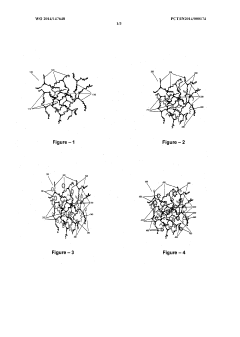
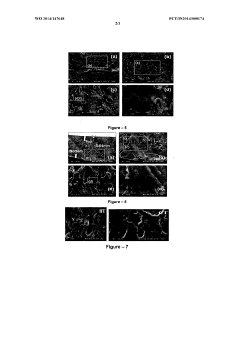
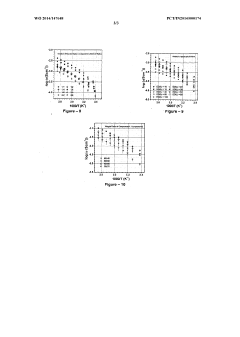
- Development of high-ionic conductivity electrolyte compositions using semi-interpenetrating polymer networks (semi-IPNs) and their nanocomposites, incorporating a polyether backbone, low molecular weight polymers, electrolyte salts, and surface-functionalized nanoparticles to enhance ionic conductivity, thermal stability, and film-forming capabilities.
Materials Compatibility and Stability Considerations
The compatibility of materials with molten carbonate electrolytes presents significant challenges in developing durable and efficient systems. Molten carbonates, typically operating at temperatures between 600-700°C, create a highly corrosive environment that accelerates degradation of containment materials and electrodes. Nickel-based alloys have emerged as the primary choice for cathode materials due to their relative stability, yet they still experience gradual dissolution through oxidation processes, particularly in lithium-rich carbonate mixtures. This dissolution not only compromises structural integrity but also introduces metal ions into the electrolyte, potentially altering ionic conductivity models through unexpected interactions.
Ceramic materials, particularly those based on lithium aluminate (LiAlO2), serve as matrix supports for molten carbonate fuel cells but face challenges related to phase stability during prolonged exposure. Research indicates that after 10,000 hours of operation, significant microstructural changes occur, affecting porosity and tortuosity parameters critical to accurate ionic conductivity modeling. These physical alterations necessitate time-dependent correction factors in conductivity equations to maintain predictive accuracy over system lifetime.
Gas-phase interactions further complicate material stability considerations. The presence of CO2 and O2 at the cathode interface creates complex equilibria that influence carbonate composition over time. Studies have demonstrated that fluctuations in gas composition can shift the Li/Na/K ratios in ternary carbonate mixtures, subsequently altering ionic mobility pathways and conductivity values by up to 15% from baseline predictions.
Impurity accumulation represents another critical factor affecting long-term stability and model accuracy. Silicon-containing compounds from seals and insulation materials gradually dissolve into the melt, forming complex silicates that increase viscosity and create localized regions of altered conductivity. These heterogeneities challenge the fundamental assumption of uniform electrolyte properties in most conductivity models, necessitating spatial distribution considerations in advanced simulations.
Temperature cycling introduces additional stress factors through differential thermal expansion between electrolyte components and containment materials. This cycling can lead to microcrack formation in ceramic components and accelerated corrosion at metal interfaces. Computational models incorporating these degradation mechanisms have shown that conductivity predictions may deviate by up to 25% from experimental values after multiple thermal cycles if material compatibility factors are not adequately addressed.
Ceramic materials, particularly those based on lithium aluminate (LiAlO2), serve as matrix supports for molten carbonate fuel cells but face challenges related to phase stability during prolonged exposure. Research indicates that after 10,000 hours of operation, significant microstructural changes occur, affecting porosity and tortuosity parameters critical to accurate ionic conductivity modeling. These physical alterations necessitate time-dependent correction factors in conductivity equations to maintain predictive accuracy over system lifetime.
Gas-phase interactions further complicate material stability considerations. The presence of CO2 and O2 at the cathode interface creates complex equilibria that influence carbonate composition over time. Studies have demonstrated that fluctuations in gas composition can shift the Li/Na/K ratios in ternary carbonate mixtures, subsequently altering ionic mobility pathways and conductivity values by up to 15% from baseline predictions.
Impurity accumulation represents another critical factor affecting long-term stability and model accuracy. Silicon-containing compounds from seals and insulation materials gradually dissolve into the melt, forming complex silicates that increase viscosity and create localized regions of altered conductivity. These heterogeneities challenge the fundamental assumption of uniform electrolyte properties in most conductivity models, necessitating spatial distribution considerations in advanced simulations.
Temperature cycling introduces additional stress factors through differential thermal expansion between electrolyte components and containment materials. This cycling can lead to microcrack formation in ceramic components and accelerated corrosion at metal interfaces. Computational models incorporating these degradation mechanisms have shown that conductivity predictions may deviate by up to 25% from experimental values after multiple thermal cycles if material compatibility factors are not adequately addressed.
Energy Storage and Conversion Applications
Molten carbonate electrolytes have emerged as critical components in various energy storage and conversion technologies, particularly in molten carbonate fuel cells (MCFCs) and advanced battery systems. These electrolytes offer exceptional ionic conductivity at elevated temperatures, typically operating between 600-700°C, which enables efficient electrochemical reactions and energy conversion processes.
In the realm of fuel cells, MCFCs utilize molten carbonate electrolytes to facilitate the conversion of chemical energy directly into electrical energy with higher efficiency than conventional combustion processes. The high operating temperatures allow for internal reforming of hydrocarbon fuels, eliminating the need for expensive catalysts and enabling the use of diverse fuel sources including natural gas, biogas, and syngas derived from coal or biomass.
For grid-scale energy storage applications, molten carbonate systems present promising solutions for addressing intermittency issues associated with renewable energy sources. These systems can store excess energy during periods of low demand and release it during peak consumption, thereby enhancing grid stability and reliability. The high energy density and long cycle life of molten carbonate-based storage systems make them particularly attractive for large-scale deployment.
Carbon capture technologies have also benefited from molten carbonate electrolytes. Dual-function systems combining energy generation with CO2 separation have been developed, where molten carbonates selectively transport carbonate ions while capturing CO2 from flue gases. This integration of energy conversion with carbon capture represents a significant advancement toward more sustainable industrial processes.
In high-temperature electrolysis applications, molten carbonate electrolytes facilitate the production of hydrogen and syngas through the electrolysis of water and CO2. This approach offers higher efficiency compared to low-temperature electrolysis methods and provides a pathway for converting renewable electricity into chemical energy carriers.
The thermal properties of molten carbonate systems also enable their integration with waste heat recovery systems in industrial settings. By utilizing waste heat to maintain operating temperatures, these systems can achieve higher overall energy efficiency while reducing primary energy consumption and associated emissions.
Recent advancements in materials science have led to the development of composite electrolytes that combine molten carbonates with solid oxide materials, creating hybrid systems with enhanced performance characteristics. These innovations are expanding the application range of molten carbonate technologies and addressing previous limitations related to corrosion and material degradation.
In the realm of fuel cells, MCFCs utilize molten carbonate electrolytes to facilitate the conversion of chemical energy directly into electrical energy with higher efficiency than conventional combustion processes. The high operating temperatures allow for internal reforming of hydrocarbon fuels, eliminating the need for expensive catalysts and enabling the use of diverse fuel sources including natural gas, biogas, and syngas derived from coal or biomass.
For grid-scale energy storage applications, molten carbonate systems present promising solutions for addressing intermittency issues associated with renewable energy sources. These systems can store excess energy during periods of low demand and release it during peak consumption, thereby enhancing grid stability and reliability. The high energy density and long cycle life of molten carbonate-based storage systems make them particularly attractive for large-scale deployment.
Carbon capture technologies have also benefited from molten carbonate electrolytes. Dual-function systems combining energy generation with CO2 separation have been developed, where molten carbonates selectively transport carbonate ions while capturing CO2 from flue gases. This integration of energy conversion with carbon capture represents a significant advancement toward more sustainable industrial processes.
In high-temperature electrolysis applications, molten carbonate electrolytes facilitate the production of hydrogen and syngas through the electrolysis of water and CO2. This approach offers higher efficiency compared to low-temperature electrolysis methods and provides a pathway for converting renewable electricity into chemical energy carriers.
The thermal properties of molten carbonate systems also enable their integration with waste heat recovery systems in industrial settings. By utilizing waste heat to maintain operating temperatures, these systems can achieve higher overall energy efficiency while reducing primary energy consumption and associated emissions.
Recent advancements in materials science have led to the development of composite electrolytes that combine molten carbonates with solid oxide materials, creating hybrid systems with enhanced performance characteristics. These innovations are expanding the application range of molten carbonate technologies and addressing previous limitations related to corrosion and material degradation.
Unlock deeper insights with PatSnap Eureka Quick Research — get a full tech report to explore trends and direct your research. Try now!
Generate Your Research Report Instantly with AI Agent
Supercharge your innovation with PatSnap Eureka AI Agent Platform!