

Modular Electrolyzer for Water Electrolysis Efficiency Improvement
OCT 13, 20259 MIN READ
Generate Your Research Report Instantly with AI Agent
PatSnap Eureka helps you evaluate technical feasibility & market potential.
Modular Electrolyzer Technology Evolution and Objectives
Water electrolysis technology has evolved significantly since its discovery in the early 19th century. Initially, simple electrolytic cells were used primarily for laboratory demonstrations and small-scale hydrogen production. The mid-20th century saw the development of industrial-scale alkaline electrolyzers, which became the standard for hydrogen production in various industries. However, these systems were characterized by low efficiency, high energy consumption, and limited scalability.
The late 20th century marked a turning point with the introduction of proton exchange membrane (PEM) electrolyzers, offering higher efficiency and more compact designs. This innovation laid the groundwork for modular approaches to water electrolysis. The concept of modularity in electrolyzers began gaining traction in the early 2000s as renewable energy integration and distributed hydrogen production became increasingly important.
Modular electrolyzer technology represents a paradigm shift from traditional monolithic systems to flexible, scalable units that can be combined or operated independently. This approach allows for incremental capacity expansion, redundancy for improved reliability, and optimization of individual modules for specific operating conditions. The evolution has been driven by the need for more efficient hydrogen production systems that can respond dynamically to fluctuating renewable energy inputs.
Recent technological advancements have focused on improving the efficiency of modular electrolyzers through innovations in electrode materials, catalyst development, and system architecture. High-temperature solid oxide electrolyzers (SOECs) and anion exchange membrane (AEM) technologies have emerged as promising approaches for next-generation modular systems, offering potential efficiency improvements of 10-20% compared to conventional designs.
The primary objectives of current modular electrolyzer development include reducing energy consumption to below 45 kWh/kg H₂, increasing current density to over 2 A/cm², extending operational lifetimes beyond 80,000 hours, and achieving capital cost reductions of 50-70%. Additionally, researchers aim to develop systems capable of rapid response to variable power inputs, with ramp rates exceeding 10% per second, enabling better integration with intermittent renewable energy sources.
Another critical objective is improving the modularity itself, developing standardized interfaces and control systems that allow for plug-and-play functionality across different manufacturers' components. This standardization would facilitate easier system scaling and maintenance while reducing overall system complexity and installation costs. The ultimate goal is to create a flexible hydrogen production infrastructure that can be deployed at various scales, from distributed energy storage systems to centralized industrial hydrogen production facilities.
The late 20th century marked a turning point with the introduction of proton exchange membrane (PEM) electrolyzers, offering higher efficiency and more compact designs. This innovation laid the groundwork for modular approaches to water electrolysis. The concept of modularity in electrolyzers began gaining traction in the early 2000s as renewable energy integration and distributed hydrogen production became increasingly important.
Modular electrolyzer technology represents a paradigm shift from traditional monolithic systems to flexible, scalable units that can be combined or operated independently. This approach allows for incremental capacity expansion, redundancy for improved reliability, and optimization of individual modules for specific operating conditions. The evolution has been driven by the need for more efficient hydrogen production systems that can respond dynamically to fluctuating renewable energy inputs.
Recent technological advancements have focused on improving the efficiency of modular electrolyzers through innovations in electrode materials, catalyst development, and system architecture. High-temperature solid oxide electrolyzers (SOECs) and anion exchange membrane (AEM) technologies have emerged as promising approaches for next-generation modular systems, offering potential efficiency improvements of 10-20% compared to conventional designs.
The primary objectives of current modular electrolyzer development include reducing energy consumption to below 45 kWh/kg H₂, increasing current density to over 2 A/cm², extending operational lifetimes beyond 80,000 hours, and achieving capital cost reductions of 50-70%. Additionally, researchers aim to develop systems capable of rapid response to variable power inputs, with ramp rates exceeding 10% per second, enabling better integration with intermittent renewable energy sources.
Another critical objective is improving the modularity itself, developing standardized interfaces and control systems that allow for plug-and-play functionality across different manufacturers' components. This standardization would facilitate easier system scaling and maintenance while reducing overall system complexity and installation costs. The ultimate goal is to create a flexible hydrogen production infrastructure that can be deployed at various scales, from distributed energy storage systems to centralized industrial hydrogen production facilities.
Hydrogen Market Demand Analysis
The global hydrogen market is experiencing unprecedented growth, driven by the increasing focus on decarbonization and sustainable energy solutions. Current estimates value the global hydrogen market at approximately 150 billion USD, with projections indicating growth to reach 600 billion USD by 2050. This substantial market expansion underscores the critical importance of efficient water electrolysis technologies.
Industrial sectors represent the primary demand drivers for hydrogen, with chemical manufacturing, particularly ammonia production and petroleum refining, accounting for over 60% of current hydrogen consumption. However, emerging applications in transportation, power generation, and energy storage are rapidly expanding the demand landscape.
The transportation sector shows particularly promising growth potential, with fuel cell electric vehicles (FCEVs) gaining traction in both passenger and commercial segments. Major automotive manufacturers have committed to hydrogen vehicle production, while heavy-duty transport, shipping, and aviation industries are increasingly exploring hydrogen as a viable alternative to conventional fuels.
Energy storage applications represent another significant growth area, with hydrogen offering solutions for long-duration storage capabilities that complement intermittent renewable energy sources. Grid-scale hydrogen storage projects are being developed worldwide, with capacity expected to increase tenfold by 2030.
Regional analysis reveals distinct market characteristics. Asia-Pacific, particularly China, Japan, and South Korea, leads in hydrogen technology adoption and infrastructure development. Europe demonstrates strong policy support through initiatives like the European Hydrogen Strategy, while North America shows increasing investment in hydrogen production technologies.
Market forecasts indicate that green hydrogen, produced through water electrolysis powered by renewable energy, will experience the most substantial growth rate among all hydrogen production methods. Current green hydrogen production costs range from 3-8 USD/kg, significantly higher than conventional methods. This cost differential highlights the critical need for efficiency improvements in electrolysis technologies.
The modular electrolyzer market segment is projected to grow at a CAGR of 25% through 2030, driven by advantages in scalability, deployment flexibility, and reduced capital requirements. Industries requiring distributed hydrogen production capabilities show particular interest in modular solutions that can be incrementally expanded.
Efficiency improvements in water electrolysis represent a primary market demand, as energy consumption typically accounts for 60-70% of hydrogen production costs. Market analysis indicates that a 10% improvement in electrolysis efficiency could reduce production costs by approximately 7-8%, significantly enhancing commercial viability across multiple application sectors.
Industrial sectors represent the primary demand drivers for hydrogen, with chemical manufacturing, particularly ammonia production and petroleum refining, accounting for over 60% of current hydrogen consumption. However, emerging applications in transportation, power generation, and energy storage are rapidly expanding the demand landscape.
The transportation sector shows particularly promising growth potential, with fuel cell electric vehicles (FCEVs) gaining traction in both passenger and commercial segments. Major automotive manufacturers have committed to hydrogen vehicle production, while heavy-duty transport, shipping, and aviation industries are increasingly exploring hydrogen as a viable alternative to conventional fuels.
Energy storage applications represent another significant growth area, with hydrogen offering solutions for long-duration storage capabilities that complement intermittent renewable energy sources. Grid-scale hydrogen storage projects are being developed worldwide, with capacity expected to increase tenfold by 2030.
Regional analysis reveals distinct market characteristics. Asia-Pacific, particularly China, Japan, and South Korea, leads in hydrogen technology adoption and infrastructure development. Europe demonstrates strong policy support through initiatives like the European Hydrogen Strategy, while North America shows increasing investment in hydrogen production technologies.
Market forecasts indicate that green hydrogen, produced through water electrolysis powered by renewable energy, will experience the most substantial growth rate among all hydrogen production methods. Current green hydrogen production costs range from 3-8 USD/kg, significantly higher than conventional methods. This cost differential highlights the critical need for efficiency improvements in electrolysis technologies.
The modular electrolyzer market segment is projected to grow at a CAGR of 25% through 2030, driven by advantages in scalability, deployment flexibility, and reduced capital requirements. Industries requiring distributed hydrogen production capabilities show particular interest in modular solutions that can be incrementally expanded.
Efficiency improvements in water electrolysis represent a primary market demand, as energy consumption typically accounts for 60-70% of hydrogen production costs. Market analysis indicates that a 10% improvement in electrolysis efficiency could reduce production costs by approximately 7-8%, significantly enhancing commercial viability across multiple application sectors.
Global Electrolyzer Technology Status and Barriers
Water electrolysis technology has evolved significantly over the past century, with three main technologies dominating the market: alkaline electrolysis (AEL), proton exchange membrane electrolysis (PEMEL), and solid oxide electrolysis (SOEL). Currently, alkaline electrolysis represents approximately 61% of global installed capacity due to its maturity and cost-effectiveness, while PEMEL accounts for 31% and is growing rapidly due to its higher efficiency and operational flexibility. SOEL remains primarily in the demonstration phase at about 8% of installations.
The global electrolyzer market is experiencing unprecedented growth, with installed capacity projected to increase from 0.3 GW in 2020 to potentially 850 GW by 2030 according to the International Energy Agency's Net Zero Emissions scenario. This represents a compound annual growth rate exceeding 100%, driven primarily by decarbonization initiatives and the expanding green hydrogen economy.
Despite this promising trajectory, several significant technical barriers impede widespread adoption of electrolysis technology. Energy efficiency remains a primary concern, with current commercial systems operating at 65-75% efficiency (LHV basis), well below the theoretical maximum of 94%. This efficiency gap translates directly into higher operational costs and reduced economic viability.
Durability presents another major challenge, particularly for PEMEL systems where expensive catalyst degradation occurs under dynamic operating conditions. Current systems typically demonstrate 60,000-90,000 operating hours for alkaline and 30,000-50,000 hours for PEM technology, falling short of the 80,000+ hours required for competitive economics in many applications.
Cost reduction represents perhaps the most significant barrier to widespread adoption. Current capital expenditure ranges from $500-1,500/kW for alkaline systems and $700-2,000/kW for PEM systems, substantially higher than the U.S. Department of Energy's target of $300/kW by 2030 necessary for economic hydrogen production.
Scale-up challenges persist across all technologies. While individual stack sizes have increased to 10-20 MW for alkaline and 5-10 MW for PEM systems, manufacturing capacity remains limited. The industry faces a critical materials bottleneck, particularly regarding platinum group metals for PEM catalysts and specialized membranes.
Geographically, electrolyzer technology development shows distinct regional patterns. Europe leads in research and development with approximately 40% of global patents, followed by China (25%), Japan (15%), and the United States (12%). However, manufacturing capacity is shifting rapidly toward China, which now accounts for over 60% of global production capacity, primarily in alkaline technology.
The global electrolyzer market is experiencing unprecedented growth, with installed capacity projected to increase from 0.3 GW in 2020 to potentially 850 GW by 2030 according to the International Energy Agency's Net Zero Emissions scenario. This represents a compound annual growth rate exceeding 100%, driven primarily by decarbonization initiatives and the expanding green hydrogen economy.
Despite this promising trajectory, several significant technical barriers impede widespread adoption of electrolysis technology. Energy efficiency remains a primary concern, with current commercial systems operating at 65-75% efficiency (LHV basis), well below the theoretical maximum of 94%. This efficiency gap translates directly into higher operational costs and reduced economic viability.
Durability presents another major challenge, particularly for PEMEL systems where expensive catalyst degradation occurs under dynamic operating conditions. Current systems typically demonstrate 60,000-90,000 operating hours for alkaline and 30,000-50,000 hours for PEM technology, falling short of the 80,000+ hours required for competitive economics in many applications.
Cost reduction represents perhaps the most significant barrier to widespread adoption. Current capital expenditure ranges from $500-1,500/kW for alkaline systems and $700-2,000/kW for PEM systems, substantially higher than the U.S. Department of Energy's target of $300/kW by 2030 necessary for economic hydrogen production.
Scale-up challenges persist across all technologies. While individual stack sizes have increased to 10-20 MW for alkaline and 5-10 MW for PEM systems, manufacturing capacity remains limited. The industry faces a critical materials bottleneck, particularly regarding platinum group metals for PEM catalysts and specialized membranes.
Geographically, electrolyzer technology development shows distinct regional patterns. Europe leads in research and development with approximately 40% of global patents, followed by China (25%), Japan (15%), and the United States (12%). However, manufacturing capacity is shifting rapidly toward China, which now accounts for over 60% of global production capacity, primarily in alkaline technology.
Current Efficiency Enhancement Solutions for Modular Electrolyzers
01 Electrode design and materials for enhanced efficiency
Advanced electrode designs and materials significantly impact electrolyzer efficiency. Innovations include specialized catalysts, electrode surface treatments, and novel material compositions that reduce energy requirements. These improvements minimize activation losses at electrode interfaces and enhance electron transfer rates, leading to higher hydrogen production rates per unit of energy input. Optimized electrode spacing and configurations also contribute to reduced ohmic losses within the system.- Electrode materials and configurations for enhanced efficiency: Advanced electrode materials and configurations play a crucial role in improving electrolyzer efficiency. Innovations include specialized catalysts, electrode surface treatments, and optimized geometries that reduce energy losses during electrolysis. These developments focus on minimizing activation overpotentials and enhancing electron transfer rates, resulting in higher hydrogen production efficiency with lower energy input requirements.
- Modular stack design and scalability: Modular electrolyzer designs allow for flexible scaling and improved operational efficiency. These systems feature standardized components that can be easily assembled, replaced, or expanded based on production requirements. The modular approach enables optimization of individual units while maintaining system integrity, facilitating maintenance, and allowing for incremental capacity increases without complete system redesign.
- Thermal management and heat recovery systems: Effective thermal management significantly impacts electrolyzer efficiency. Advanced systems incorporate heat recovery mechanisms that capture and reuse waste heat generated during electrolysis. Temperature control systems maintain optimal operating conditions, while integrated cooling circuits prevent efficiency losses from overheating. These thermal management solutions reduce overall energy consumption and improve the system's energy conversion efficiency.
- Power electronics and control systems: Sophisticated power electronics and control systems optimize electrolyzer performance under varying conditions. These include advanced power conditioning units, dynamic response controllers, and intelligent monitoring systems that adjust operational parameters in real-time. By precisely controlling current density, voltage, and other parameters, these systems maximize efficiency across different load profiles and input power conditions.
- Integration with renewable energy sources: Specialized designs enable efficient integration of electrolyzers with intermittent renewable energy sources. These systems incorporate buffer technologies, rapid response capabilities, and adaptive operational modes that optimize hydrogen production despite fluctuating power inputs. Advanced power management algorithms and hybrid energy systems ensure continuous operation while maximizing the utilization of renewable energy, improving overall system efficiency.
02 Modular stack architecture and scalability
Modular electrolyzer designs feature stackable units that can be configured according to production needs. This architecture allows for efficient scaling, simplified maintenance, and reduced downtime as individual modules can be serviced without shutting down the entire system. The modular approach enables standardized manufacturing processes while maintaining flexibility for different deployment scenarios. Innovations in cell interconnection and fluid distribution systems within these stacks optimize overall system performance and energy utilization.Expand Specific Solutions03 Thermal management and energy recovery systems
Effective thermal management is crucial for electrolyzer efficiency. Advanced systems incorporate heat exchangers, thermal integration with external processes, and waste heat recovery mechanisms. These innovations maintain optimal operating temperatures while recapturing thermal energy that would otherwise be lost. Some designs feature integrated cooling channels, phase-change materials, or thermal storage components that stabilize temperature fluctuations and improve overall system efficiency by reducing parasitic energy consumption.Expand Specific Solutions04 Pressure management and gas separation techniques
Innovations in pressure management and gas separation significantly enhance electrolyzer efficiency. Advanced differential pressure systems, specialized membranes, and optimized flow field designs improve gas purity while reducing energy requirements. These technologies minimize gas crossover, enhance collection efficiency, and maintain appropriate pressure gradients across the system. Some designs incorporate novel separation techniques that operate at higher pressures, eliminating the need for downstream compression and thereby improving overall system efficiency.Expand Specific Solutions05 Control systems and operational optimization
Sophisticated control systems significantly improve electrolyzer efficiency through real-time monitoring and adaptive operation. These systems incorporate advanced sensors, predictive algorithms, and feedback mechanisms that optimize operating parameters based on changing conditions. Machine learning approaches enable continuous improvement by identifying optimal operating points for different scenarios. Integrated power management systems also help manage variable renewable energy inputs, allowing electrolyzers to operate efficiently despite fluctuating power supplies and maximizing hydrogen production during periods of excess renewable energy availability.Expand Specific Solutions
Leading Electrolyzer Manufacturers and Competitive Landscape
The modular electrolyzer market for water electrolysis efficiency improvement is currently in a growth phase, with increasing adoption driven by the global push for green hydrogen production. The market size is expanding rapidly, projected to reach significant scale as hydrogen economies develop worldwide. Technologically, the field shows varying maturity levels, with established players like Robert Bosch GmbH and Toyota Motor Corp. focusing on industrial-scale applications, while innovative companies such as Electric Hydrogen Co. and McPhy Energy SA are advancing novel modular designs. Academic institutions including Zhejiang University and Central South University are contributing fundamental research, while specialized manufacturers like Bulane SAS and Wuhan Lihui New Technology are developing niche solutions. The competitive landscape features both traditional industrial conglomerates and agile startups competing to improve efficiency metrics and reduce production costs.
Toyota Motor Corp.
Technical Solution: Toyota has developed an innovative modular solid polymer electrolyte (SPE) water electrolyzer system that leverages their extensive fuel cell expertise. Their approach focuses on high-efficiency hydrogen production through advanced catalyst technology and optimized cell architecture. Toyota's system features proprietary electrode designs with ultra-low platinum group metal (PGM) loading while maintaining high catalytic activity. Their modular stack design incorporates advanced flow field patterns that ensure uniform reactant distribution and efficient product removal, minimizing concentration polarization losses. A distinctive feature is Toyota's integrated thermal management system that recovers waste heat for improved overall system efficiency. The company has achieved approximately 82% efficiency (HHV) in their latest prototypes, representing a significant improvement over conventional designs. Toyota's modular approach allows for scalable deployment from distributed to centralized applications, with each module capable of independent operation or integration into larger arrays.
Strengths: Leverages Toyota's extensive experience in fuel cell technology and manufacturing; achieves high efficiency with reduced precious metal catalyst loading; robust design with automotive-grade reliability standards. Weaknesses: Technology still primarily in development/demonstration phase rather than wide commercial deployment; higher complexity compared to conventional alkaline systems; requires high-purity water input.
McPhy Energy SA
Technical Solution: McPhy Energy has developed the "Augmented McLyzer" platform, a modular and scalable PEM electrolyzer technology focused on efficiency improvement. Their system features a unique modular architecture that allows for flexible capacity expansion from MW to GW scale. The McLyzer technology incorporates advanced electrode designs with optimized catalyst distribution and loading, achieving efficiency rates of up to 75% (LHV). A key innovation is their "Dynamic Response" capability, which enables rapid power modulation (0-100% in seconds) to accommodate fluctuating renewable energy inputs without efficiency degradation. McPhy's electrolyzers employ a patented cell compression system that maintains optimal contact between components while minimizing electrical resistance across the stack. Their latest generation incorporates advanced bipolar plates with optimized flow field designs that improve gas separation and reduce energy losses, contributing to overall system efficiency improvements of approximately 15% compared to previous generations.
Strengths: Highly modular design allows for flexible deployment and scaling; rapid response capability makes it ideal for grid balancing applications; proven technology with multiple commercial installations across Europe. Weaknesses: Higher capital costs compared to traditional alkaline systems; requires specialized maintenance expertise; performance degradation over time requires periodic stack replacement.
Key Patents and Innovations in Electrolyzer Efficiency
Water electrolysis system
PatentActiveJP2021063280A
Innovation
- A water electrolysis system with a control circuit that delays gate signals between modules, incorporates a capacitor for smoothing, and includes a switch element to manage power distribution, optimizing voltage and current flow to match solar cell output.


Water electrolyzer system
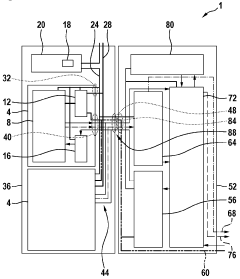
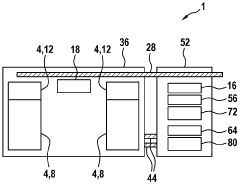
PatentWO2023222741A2
Innovation
- A modular water electrolyzer system comprising electrolyzer, process, and control modules, designed for automated production, with standardized plug and flange connections, and a common busbar for electrical supply, allowing for faster and more cost-effective assembly and scalability.
Green Hydrogen Policy Frameworks and Incentives
The global policy landscape for green hydrogen has evolved significantly in recent years, with governments worldwide implementing frameworks and incentives to accelerate the adoption of water electrolysis technologies, particularly modular electrolyzers that improve efficiency. The European Union leads with its comprehensive Hydrogen Strategy, which allocates €430 billion for green hydrogen development by 2030 and establishes a target of 40GW electrolyzer capacity. This framework specifically incentivizes modular designs through capital expenditure subsidies of up to 50% for innovative electrolysis systems that demonstrate efficiency improvements.
In North America, the United States has introduced the Hydrogen Shot initiative under the Department of Energy, aiming to reduce clean hydrogen costs to $1 per kilogram within a decade. The 2022 Inflation Reduction Act provides production tax credits of up to $3/kg for green hydrogen, with additional bonuses for modular systems that achieve efficiency ratings above 70%. These incentives directly support the commercialization of advanced modular electrolyzer technologies that can demonstrate scalability and improved performance metrics.
Asian markets present varying approaches, with Japan's Green Innovation Fund allocating ¥2 trillion ($14.6 billion) toward hydrogen technologies, including specific funding streams for modular electrolysis systems. China's 14th Five-Year Plan emphasizes hydrogen as a frontier industry, offering manufacturers of high-efficiency electrolyzers reduced corporate tax rates (15% versus standard 25%) and import duty exemptions on critical components.
Regulatory frameworks are increasingly standardizing performance metrics for water electrolysis systems. The International Organization for Standardization (ISO) has developed ISO 22734 specifically for water electrolyzers, while the EU's CertifHy program establishes certification schemes that reward higher efficiency systems. These standards create market recognition for modular designs that demonstrate superior performance.
Financial mechanisms beyond direct subsidies include green bonds specifically targeting hydrogen infrastructure, with global issuance reaching $18.3 billion in 2022. Multilateral development banks have established dedicated hydrogen financing facilities, with the World Bank's Clean Hydrogen Fund providing $1.5 billion in concessional financing for projects in developing economies that implement advanced electrolysis technologies.
The policy landscape continues to evolve toward performance-based incentives rather than technology-specific subsidies, creating favorable conditions for modular electrolyzer innovations that can demonstrate measurable efficiency improvements. This shift emphasizes the importance of standardized testing protocols and certification systems that can validate the performance claims of new modular designs entering the market.
In North America, the United States has introduced the Hydrogen Shot initiative under the Department of Energy, aiming to reduce clean hydrogen costs to $1 per kilogram within a decade. The 2022 Inflation Reduction Act provides production tax credits of up to $3/kg for green hydrogen, with additional bonuses for modular systems that achieve efficiency ratings above 70%. These incentives directly support the commercialization of advanced modular electrolyzer technologies that can demonstrate scalability and improved performance metrics.
Asian markets present varying approaches, with Japan's Green Innovation Fund allocating ¥2 trillion ($14.6 billion) toward hydrogen technologies, including specific funding streams for modular electrolysis systems. China's 14th Five-Year Plan emphasizes hydrogen as a frontier industry, offering manufacturers of high-efficiency electrolyzers reduced corporate tax rates (15% versus standard 25%) and import duty exemptions on critical components.
Regulatory frameworks are increasingly standardizing performance metrics for water electrolysis systems. The International Organization for Standardization (ISO) has developed ISO 22734 specifically for water electrolyzers, while the EU's CertifHy program establishes certification schemes that reward higher efficiency systems. These standards create market recognition for modular designs that demonstrate superior performance.
Financial mechanisms beyond direct subsidies include green bonds specifically targeting hydrogen infrastructure, with global issuance reaching $18.3 billion in 2022. Multilateral development banks have established dedicated hydrogen financing facilities, with the World Bank's Clean Hydrogen Fund providing $1.5 billion in concessional financing for projects in developing economies that implement advanced electrolysis technologies.
The policy landscape continues to evolve toward performance-based incentives rather than technology-specific subsidies, creating favorable conditions for modular electrolyzer innovations that can demonstrate measurable efficiency improvements. This shift emphasizes the importance of standardized testing protocols and certification systems that can validate the performance claims of new modular designs entering the market.
Techno-Economic Assessment of Modular Electrolyzer Systems
The techno-economic assessment of modular electrolyzer systems reveals significant potential for cost reduction and efficiency improvement in hydrogen production. Current economic analyses indicate that modular systems can reduce capital expenditure by 15-25% compared to traditional centralized electrolyzers, primarily through standardization of components and economies of scale in manufacturing rather than operation.
Investment costs for modular electrolyzers range from $800-1,500/kW depending on technology type (PEM, alkaline, or solid oxide), with projections suggesting a decrease to $500-700/kW by 2030 as manufacturing processes mature and supply chains develop. Operating costs are dominated by electricity consumption, representing 60-80% of the levelized cost of hydrogen production.
The economic viability of modular systems is highly sensitive to electricity prices, with break-even points occurring at approximately $40-50/MWh for green hydrogen to compete with conventional production methods. Capacity utilization rates significantly impact unit economics, with optimal operation above 4,000 hours annually to amortize fixed costs effectively.
Modular designs offer compelling flexibility advantages that translate to economic benefits, including reduced site preparation costs (15-30% savings), faster deployment timelines (reducing time-to-market by 40-60%), and the ability to incrementally scale production capacity to match demand growth. This phased investment approach can improve project IRR by 2-4 percentage points compared to single large-scale installations.
Lifecycle cost analysis demonstrates that while initial capital costs for modular systems may be marginally higher on a per-unit basis than large centralized facilities, the total cost of ownership over a 20-year period is typically 10-18% lower when accounting for maintenance optimization, component replacement efficiency, and operational flexibility benefits.
Regional economic factors significantly influence viability, with modular systems showing particular promise in remote locations, island communities, and regions with distributed renewable energy resources. The integration with variable renewable energy sources creates additional value streams through grid balancing services, potentially generating supplementary revenue of $50-150/kW annually depending on local market structures and regulatory frameworks.
Investment costs for modular electrolyzers range from $800-1,500/kW depending on technology type (PEM, alkaline, or solid oxide), with projections suggesting a decrease to $500-700/kW by 2030 as manufacturing processes mature and supply chains develop. Operating costs are dominated by electricity consumption, representing 60-80% of the levelized cost of hydrogen production.
The economic viability of modular systems is highly sensitive to electricity prices, with break-even points occurring at approximately $40-50/MWh for green hydrogen to compete with conventional production methods. Capacity utilization rates significantly impact unit economics, with optimal operation above 4,000 hours annually to amortize fixed costs effectively.
Modular designs offer compelling flexibility advantages that translate to economic benefits, including reduced site preparation costs (15-30% savings), faster deployment timelines (reducing time-to-market by 40-60%), and the ability to incrementally scale production capacity to match demand growth. This phased investment approach can improve project IRR by 2-4 percentage points compared to single large-scale installations.
Lifecycle cost analysis demonstrates that while initial capital costs for modular systems may be marginally higher on a per-unit basis than large centralized facilities, the total cost of ownership over a 20-year period is typically 10-18% lower when accounting for maintenance optimization, component replacement efficiency, and operational flexibility benefits.
Regional economic factors significantly influence viability, with modular systems showing particular promise in remote locations, island communities, and regions with distributed renewable energy resources. The integration with variable renewable energy sources creates additional value streams through grid balancing services, potentially generating supplementary revenue of $50-150/kW annually depending on local market structures and regulatory frameworks.
Unlock deeper insights with PatSnap Eureka Quick Research — get a full tech report to explore trends and direct your research. Try now!
Generate Your Research Report Instantly with AI Agent
Supercharge your innovation with PatSnap Eureka AI Agent Platform!