Neuromorphic Computing Material Patents and Intellectual Property
OCT 27, 20259 MIN READ
Generate Your Research Report Instantly with AI Agent
Patsnap Eureka helps you evaluate technical feasibility & market potential.
Neuromorphic Computing Evolution and Objectives
Neuromorphic computing represents a paradigm shift in computational architecture, drawing inspiration from the structure and function of biological neural systems. The evolution of this field began in the late 1980s when Carver Mead introduced the concept of using analog circuits to mimic neurobiological architectures. This pioneering work established the foundation for hardware systems that could emulate the brain's parallel processing capabilities and energy efficiency.
Throughout the 1990s and early 2000s, neuromorphic computing remained primarily in academic research domains, with limited practical applications due to manufacturing constraints and insufficient understanding of neural mechanisms. The field experienced a renaissance around 2010, coinciding with the deep learning revolution and advances in material science, particularly in memristive devices and phase-change materials that could better mimic synaptic behavior.
The technical objectives of neuromorphic computing have evolved significantly over time. Initially focused on creating brain-inspired circuits, the field now encompasses broader goals including developing ultra-low power computing systems, enabling edge intelligence for IoT devices, creating fault-tolerant computing architectures, and supporting real-time processing of sensory data without the latency issues inherent in traditional computing systems.
Material innovation represents a critical aspect of neuromorphic computing advancement. Traditional CMOS technology, while versatile, faces fundamental limitations in emulating neural functions efficiently. Consequently, research has intensified around novel materials including resistive random-access memory (RRAM), phase-change memory (PCM), spin-transfer torque magnetic RAM (STT-MRAM), and various oxide-based memristive systems that can more naturally implement synaptic plasticity mechanisms.
The intellectual property landscape in neuromorphic materials has become increasingly competitive, with major technology corporations and specialized startups securing patent portfolios covering both fundamental material properties and specific implementations. These patents typically address challenges in scalability, reliability, and integration with conventional electronics, reflecting the field's progression toward commercial viability.
Current research trajectories aim to overcome persistent challenges including device variability, limited endurance of novel materials, and the development of standardized programming models that can effectively utilize neuromorphic hardware. The ultimate objective remains creating computing systems that approach the human brain's remarkable energy efficiency of approximately 20 watts while performing complex cognitive tasks that would require megawatts of power in conventional computing architectures.
Throughout the 1990s and early 2000s, neuromorphic computing remained primarily in academic research domains, with limited practical applications due to manufacturing constraints and insufficient understanding of neural mechanisms. The field experienced a renaissance around 2010, coinciding with the deep learning revolution and advances in material science, particularly in memristive devices and phase-change materials that could better mimic synaptic behavior.
The technical objectives of neuromorphic computing have evolved significantly over time. Initially focused on creating brain-inspired circuits, the field now encompasses broader goals including developing ultra-low power computing systems, enabling edge intelligence for IoT devices, creating fault-tolerant computing architectures, and supporting real-time processing of sensory data without the latency issues inherent in traditional computing systems.
Material innovation represents a critical aspect of neuromorphic computing advancement. Traditional CMOS technology, while versatile, faces fundamental limitations in emulating neural functions efficiently. Consequently, research has intensified around novel materials including resistive random-access memory (RRAM), phase-change memory (PCM), spin-transfer torque magnetic RAM (STT-MRAM), and various oxide-based memristive systems that can more naturally implement synaptic plasticity mechanisms.
The intellectual property landscape in neuromorphic materials has become increasingly competitive, with major technology corporations and specialized startups securing patent portfolios covering both fundamental material properties and specific implementations. These patents typically address challenges in scalability, reliability, and integration with conventional electronics, reflecting the field's progression toward commercial viability.
Current research trajectories aim to overcome persistent challenges including device variability, limited endurance of novel materials, and the development of standardized programming models that can effectively utilize neuromorphic hardware. The ultimate objective remains creating computing systems that approach the human brain's remarkable energy efficiency of approximately 20 watts while performing complex cognitive tasks that would require megawatts of power in conventional computing architectures.
Market Analysis for Neuromorphic Computing Solutions
The neuromorphic computing market is experiencing significant growth, driven by increasing demand for AI applications and the limitations of traditional computing architectures. Current market valuations place the global neuromorphic computing sector at approximately $3.2 billion in 2023, with projections indicating a compound annual growth rate (CAGR) of 24.7% through 2030, potentially reaching $19.8 billion. This remarkable growth trajectory reflects the expanding recognition of neuromorphic solutions' potential across multiple industries.
Healthcare represents one of the most promising markets for neuromorphic computing, particularly in medical imaging analysis, patient monitoring systems, and drug discovery processes. The ability of neuromorphic systems to process complex patterns in real-time while consuming minimal power makes them ideal for portable medical devices and continuous health monitoring applications.
Autonomous vehicles constitute another significant market segment, where neuromorphic computing offers advantages in real-time sensor data processing, object recognition, and decision-making under uncertain conditions. Major automotive manufacturers and technology companies are investing heavily in neuromorphic solutions to enhance the safety and reliability of autonomous driving systems.
The industrial automation sector is increasingly adopting neuromorphic computing for predictive maintenance, quality control, and process optimization. These applications benefit from the technology's ability to learn from operational data and adapt to changing conditions without requiring constant retraining or human intervention.
Edge computing applications represent a rapidly growing market segment for neuromorphic solutions. As IoT devices proliferate, the need for efficient, low-power computing at the network edge becomes critical. Neuromorphic chips, with their energy efficiency and ability to process sensory data locally, are well-positioned to address this demand.
Market barriers include high development costs, technical complexity in implementation, and the need for specialized expertise. Additionally, the lack of standardized development tools and frameworks slows adoption across industries. However, these barriers are gradually diminishing as more commercial neuromorphic solutions become available and development ecosystems mature.
Customer demand is increasingly focused on energy efficiency, with organizations seeking computing solutions that can deliver high performance while minimizing power consumption. This trend aligns perfectly with neuromorphic computing's inherent advantages, positioning it as a potential successor to traditional computing architectures in specific application domains.
Healthcare represents one of the most promising markets for neuromorphic computing, particularly in medical imaging analysis, patient monitoring systems, and drug discovery processes. The ability of neuromorphic systems to process complex patterns in real-time while consuming minimal power makes them ideal for portable medical devices and continuous health monitoring applications.
Autonomous vehicles constitute another significant market segment, where neuromorphic computing offers advantages in real-time sensor data processing, object recognition, and decision-making under uncertain conditions. Major automotive manufacturers and technology companies are investing heavily in neuromorphic solutions to enhance the safety and reliability of autonomous driving systems.
The industrial automation sector is increasingly adopting neuromorphic computing for predictive maintenance, quality control, and process optimization. These applications benefit from the technology's ability to learn from operational data and adapt to changing conditions without requiring constant retraining or human intervention.
Edge computing applications represent a rapidly growing market segment for neuromorphic solutions. As IoT devices proliferate, the need for efficient, low-power computing at the network edge becomes critical. Neuromorphic chips, with their energy efficiency and ability to process sensory data locally, are well-positioned to address this demand.
Market barriers include high development costs, technical complexity in implementation, and the need for specialized expertise. Additionally, the lack of standardized development tools and frameworks slows adoption across industries. However, these barriers are gradually diminishing as more commercial neuromorphic solutions become available and development ecosystems mature.
Customer demand is increasingly focused on energy efficiency, with organizations seeking computing solutions that can deliver high performance while minimizing power consumption. This trend aligns perfectly with neuromorphic computing's inherent advantages, positioning it as a potential successor to traditional computing architectures in specific application domains.
Global Neuromorphic Material Development Status
Neuromorphic computing materials have seen significant global development in recent years, with research centers and companies across different regions making substantial contributions. The United States maintains a leading position with major research initiatives at institutions like MIT, Stanford, and IBM's neuromorphic computing labs. These organizations focus on developing novel materials for brain-inspired computing architectures, particularly memristive devices and phase-change materials that can mimic synaptic functions.
Europe has established strong research clusters, particularly in Germany, Switzerland, and the UK. The European Commission has funded several large-scale neuromorphic projects under Horizon 2020 and Horizon Europe frameworks, emphasizing material science innovations for energy-efficient computing. The BrainScaleS and SpiNNaker projects represent significant European investments in neuromorphic hardware development.
In Asia, Japan, South Korea, and China have emerged as key players in neuromorphic material development. Japan's RIKEN Brain Science Institute and South Korea's Samsung Advanced Institute of Technology have made notable advancements in memristor technology and neuromorphic chip design. China has rapidly increased its research output and patent filings in this domain, with substantial government backing through initiatives like the "Brain Project" and "China 2025" strategic plan.
Material development has focused on several key categories: resistive switching materials (including metal oxides like HfO2 and TiO2), phase-change materials (particularly chalcogenide compounds), ferroelectric materials, and emerging 2D materials such as graphene and transition metal dichalcogenides. These materials exhibit properties that enable spike-timing-dependent plasticity and other neuromorphic behaviors essential for brain-inspired computing.
The global distribution of intellectual property in neuromorphic materials shows interesting patterns, with the United States holding approximately 40% of patents, followed by China (25%), South Korea (15%), Japan (10%), and Europe (8%). Recent years have seen China's share growing most rapidly, particularly in applications combining neuromorphic materials with AI systems.
Collaboration patterns reveal increasing international cooperation, with cross-border research partnerships becoming more common. University-industry partnerships have accelerated material development, with companies like Intel, IBM, Samsung, and Huawei actively collaborating with academic institutions to translate fundamental material science into practical neuromorphic computing devices.
Europe has established strong research clusters, particularly in Germany, Switzerland, and the UK. The European Commission has funded several large-scale neuromorphic projects under Horizon 2020 and Horizon Europe frameworks, emphasizing material science innovations for energy-efficient computing. The BrainScaleS and SpiNNaker projects represent significant European investments in neuromorphic hardware development.
In Asia, Japan, South Korea, and China have emerged as key players in neuromorphic material development. Japan's RIKEN Brain Science Institute and South Korea's Samsung Advanced Institute of Technology have made notable advancements in memristor technology and neuromorphic chip design. China has rapidly increased its research output and patent filings in this domain, with substantial government backing through initiatives like the "Brain Project" and "China 2025" strategic plan.
Material development has focused on several key categories: resistive switching materials (including metal oxides like HfO2 and TiO2), phase-change materials (particularly chalcogenide compounds), ferroelectric materials, and emerging 2D materials such as graphene and transition metal dichalcogenides. These materials exhibit properties that enable spike-timing-dependent plasticity and other neuromorphic behaviors essential for brain-inspired computing.
The global distribution of intellectual property in neuromorphic materials shows interesting patterns, with the United States holding approximately 40% of patents, followed by China (25%), South Korea (15%), Japan (10%), and Europe (8%). Recent years have seen China's share growing most rapidly, particularly in applications combining neuromorphic materials with AI systems.
Collaboration patterns reveal increasing international cooperation, with cross-border research partnerships becoming more common. University-industry partnerships have accelerated material development, with companies like Intel, IBM, Samsung, and Huawei actively collaborating with academic institutions to translate fundamental material science into practical neuromorphic computing devices.
Current Neuromorphic Material Implementation Approaches
01 Phase-change materials for neuromorphic computing
Phase-change materials exhibit properties that make them suitable for neuromorphic computing applications. These materials can switch between amorphous and crystalline states, mimicking the behavior of biological synapses. The resistance changes in these materials can be used to store and process information, enabling the development of energy-efficient neuromorphic computing systems that can perform complex cognitive tasks with lower power consumption compared to traditional computing architectures.- Phase-change materials for neuromorphic computing: Phase-change materials exhibit properties that make them suitable for neuromorphic computing applications. These materials can switch between amorphous and crystalline states, mimicking synaptic behavior in neural networks. The resistance changes in these materials can be used to store and process information, enabling the development of energy-efficient neuromorphic computing systems that more closely resemble biological neural networks.
- Memristive materials and devices: Memristive materials and devices are fundamental components in neuromorphic computing systems. These materials can retain memory of past electrical signals, allowing them to function similarly to biological synapses. By incorporating memristive materials into computing architectures, researchers can develop systems that perform brain-like parallel processing and learning. These materials offer advantages in terms of power efficiency, scalability, and the ability to implement learning algorithms directly in hardware.
- 2D materials for neuromorphic applications: Two-dimensional materials, such as graphene and transition metal dichalcogenides, show promising properties for neuromorphic computing applications. These atomically thin materials exhibit unique electronic and optical properties that can be leveraged to create artificial synapses and neurons. Their flexibility, scalability, and compatibility with existing semiconductor fabrication techniques make them attractive candidates for next-generation neuromorphic computing systems.
- Ferroelectric and magnetic materials: Ferroelectric and magnetic materials offer unique properties that can be utilized in neuromorphic computing systems. These materials can maintain polarization or magnetization states without continuous power, making them suitable for non-volatile memory applications in neuromorphic architectures. Their ability to switch between different states with low energy consumption enables the development of energy-efficient neural network implementations that can perform complex computational tasks.
- Organic and biomimetic materials: Organic and biomimetic materials represent an emerging class of materials for neuromorphic computing that more closely mimic biological neural systems. These materials can include conducting polymers, protein-based structures, and other organic compounds that exhibit properties similar to biological neurons and synapses. Their biocompatibility, flexibility, and potential for self-assembly make them promising candidates for creating more brain-like computing systems that can adapt and learn from their environment.
02 Memristive materials and devices
Memristive materials are fundamental to neuromorphic computing as they can maintain a state of internal resistance based on the history of applied voltage and current. These materials can be used to create artificial synapses and neurons that mimic the behavior of biological neural networks. Memristive devices offer advantages such as non-volatility, scalability, and compatibility with conventional semiconductor fabrication processes, making them promising candidates for next-generation neuromorphic computing systems.Expand Specific Solutions03 2D materials for neuromorphic applications
Two-dimensional materials, such as graphene, transition metal dichalcogenides, and hexagonal boron nitride, offer unique properties for neuromorphic computing applications. These materials provide excellent electrical conductivity, flexibility, and scalability, making them suitable for developing artificial neural networks. The atomically thin nature of these materials allows for the creation of highly efficient synaptic devices that can operate at low power while maintaining high performance and reliability.Expand Specific Solutions04 Spintronic materials for brain-inspired computing
Spintronic materials utilize electron spin for information processing, offering a promising approach for neuromorphic computing. These materials can be used to create magnetic tunnel junctions and other spintronic devices that mimic the behavior of biological neurons and synapses. Spintronic-based neuromorphic systems can achieve high energy efficiency, non-volatility, and parallel processing capabilities, making them suitable for implementing artificial neural networks that can perform complex cognitive tasks.Expand Specific Solutions05 Organic and polymer materials for flexible neuromorphic systems
Organic and polymer materials offer unique advantages for neuromorphic computing, including flexibility, biocompatibility, and low-cost fabrication. These materials can be used to create artificial synapses and neurons that operate similarly to their biological counterparts. The ability to tune the electrical properties of these materials through chemical modification makes them versatile for different neuromorphic applications. Additionally, their mechanical flexibility enables the development of wearable and implantable neuromorphic devices for human-machine interfaces.Expand Specific Solutions
Leading Companies and Research Institutions
Neuromorphic computing material patents and intellectual property landscape is evolving rapidly, currently positioned in the early growth phase with an estimated market size of $69 million in 2023, projected to reach $8.3 billion by 2033. The competitive field features established technology giants like Samsung, IBM, Intel, and Qualcomm leading patent portfolios, alongside specialized players such as Syntiant. Academic institutions including Tsinghua University and UC Regents contribute significant research innovations. Technical maturity varies across implementations, with companies like IBM demonstrating commercial neuromorphic chips while others focus on material innovations. Asian companies, particularly Samsung and Huawei, are aggressively expanding their patent portfolios, suggesting intensifying global competition in this emerging technology domain.
Samsung Electronics Co., Ltd.
Technical Solution: Samsung has established a significant patent portfolio in neuromorphic computing materials, focusing primarily on resistive random-access memory (RRAM) and phase-change memory (PCM) technologies. Their neuromorphic material innovations center around chalcogenide-based PCM cells that can maintain multiple resistance states, enabling analog-like synaptic weight storage. Samsung's patents cover specialized germanium-antimony-tellurium (GST) compounds with precisely engineered dopants that improve retention and switching characteristics critical for neuromorphic applications. They've developed proprietary fabrication techniques for creating high-density crossbar arrays of these memory elements, allowing for efficient implementation of neural network architectures. Samsung has also patented novel electrode materials and interface engineering approaches that enhance the reliability and endurance of their neuromorphic devices. Their intellectual property extends to three-dimensional stacking technologies for these specialized materials, significantly increasing connection density while maintaining manufacturing compatibility with existing semiconductor processes. Samsung's neuromorphic material patents also include innovations in hafnium oxide-based ferroelectric materials that enable non-volatile, low-power synaptic elements suitable for edge AI applications.
Strengths: Extensive manufacturing infrastructure and expertise in memory technologies; vertical integration capabilities from materials to systems; strong commercialization pathway for neuromorphic technologies. Weaknesses: Less public demonstration of working neuromorphic systems compared to competitors; some material approaches face scalability challenges; potential intellectual property conflicts with other major memory manufacturers.
International Business Machines Corp.
Technical Solution: IBM has pioneered neuromorphic computing materials through its TrueNorth architecture, which implements a non-von Neumann computing paradigm mimicking the brain's neural structure. Their neuromorphic chips utilize specialized materials and phase-change memory (PCM) technology to create artificial synapses and neurons. IBM's patents cover novel chalcogenide-based materials that can switch between amorphous and crystalline states, enabling analog-like memory capabilities essential for neuromorphic systems. Their research extends to carbon nanotube-based synaptic devices and three-dimensional crossbar arrays that significantly increase connection density. IBM has developed specialized magnetic tunnel junction (MTJ) materials that can maintain synaptic weights with minimal power consumption, addressing one of the key challenges in neuromorphic computing. Their intellectual property portfolio includes over 100 patents specifically focused on neuromorphic materials and circuit designs that enable massively parallel, event-driven computation with orders of magnitude better energy efficiency than conventional systems.
Strengths: Industry-leading expertise in materials science combined with neuromorphic architecture design; extensive patent portfolio covering multiple material approaches; proven scalability with working prototypes. Weaknesses: High manufacturing complexity for specialized materials; some approaches require extreme operating conditions; commercialization challenges for transitioning from research to mass production.
Key Patents and Intellectual Property Landscape
Neuromorphic computing
PatentPendingUS20240070446A1
Innovation
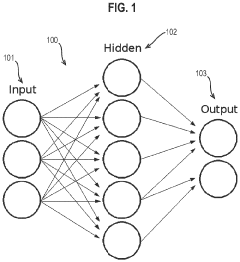
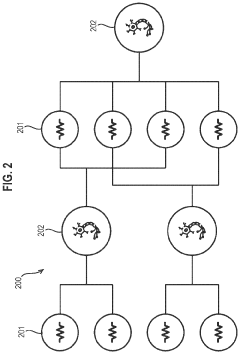
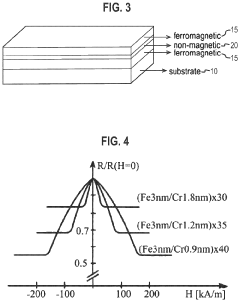
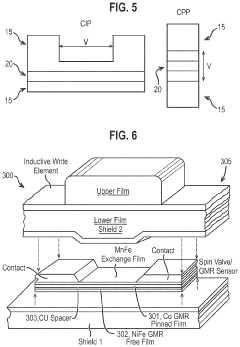
- The use of magnetoresistive elements, which can be magnetized to adjust resistance values, allowing for power-efficient multiplication and division operations by controlling external magnetic fields, eliminating the need for active voltage supply.
Neuromorphic computing device and method of designing the same
PatentActiveUS11881260B2
Innovation
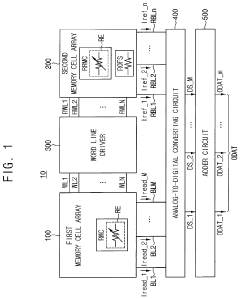
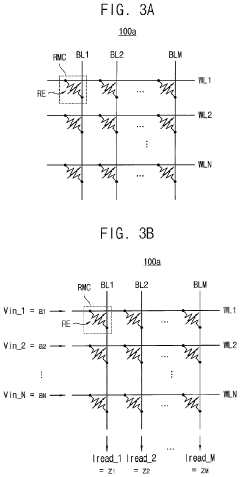
- Incorporating a second memory cell array with offset resistors connected in parallel, using the same resistive material as the first memory cell array, to convert read currents into digital signals, thereby mitigating temperature and time dependency, and ensuring consistent resistance across offset resistors for enhanced sensing performance.
IP Protection Strategies for Neuromorphic Computing
Protecting intellectual property in the rapidly evolving field of neuromorphic computing requires strategic approaches tailored to this unique technological domain. Companies must develop comprehensive IP protection frameworks that address both hardware materials and algorithmic innovations. The primary protection mechanisms include patents for novel neuromorphic materials, circuit designs, and system architectures; trade secrets for manufacturing processes that are difficult to reverse engineer; and copyrights for software implementations and firmware.
For material innovations specifically, companies should implement a multi-layered protection strategy. This begins with careful patent portfolio development focusing on core material compositions, manufacturing methods, and unique physical properties that enable neuromorphic functionality. Strategic patent filing across multiple jurisdictions is essential, prioritizing regions with strong semiconductor and advanced materials industries such as the United States, China, Europe, Japan, and South Korea.
Defensive publication represents another valuable strategy, particularly for incremental innovations that may not warrant full patent protection. By publicly disclosing certain aspects of neuromorphic materials technology, companies can prevent competitors from patenting similar innovations while maintaining their freedom to operate.
Cross-licensing agreements have emerged as a practical necessity in the neuromorphic computing ecosystem due to the interdisciplinary nature of the technology. These agreements allow companies to access complementary IP while protecting their core innovations, facilitating collaborative development without compromising competitive advantages.
Material characterization documentation serves as critical evidence in potential IP disputes. Companies should maintain detailed records of material properties, performance metrics, and development processes to establish clear provenance of innovations and strengthen IP enforcement capabilities.
Open innovation models are increasingly being adopted, with companies strategically determining which aspects of their neuromorphic material technologies to protect rigorously and which to share with the broader community. This balanced approach can accelerate ecosystem development while maintaining competitive differentiation in key technological areas.
As the neuromorphic computing landscape continues to evolve, companies must regularly audit their IP portfolios to ensure alignment with technological developments and market opportunities, adapting protection strategies to maintain competitive advantage in this transformative field.
For material innovations specifically, companies should implement a multi-layered protection strategy. This begins with careful patent portfolio development focusing on core material compositions, manufacturing methods, and unique physical properties that enable neuromorphic functionality. Strategic patent filing across multiple jurisdictions is essential, prioritizing regions with strong semiconductor and advanced materials industries such as the United States, China, Europe, Japan, and South Korea.
Defensive publication represents another valuable strategy, particularly for incremental innovations that may not warrant full patent protection. By publicly disclosing certain aspects of neuromorphic materials technology, companies can prevent competitors from patenting similar innovations while maintaining their freedom to operate.
Cross-licensing agreements have emerged as a practical necessity in the neuromorphic computing ecosystem due to the interdisciplinary nature of the technology. These agreements allow companies to access complementary IP while protecting their core innovations, facilitating collaborative development without compromising competitive advantages.
Material characterization documentation serves as critical evidence in potential IP disputes. Companies should maintain detailed records of material properties, performance metrics, and development processes to establish clear provenance of innovations and strengthen IP enforcement capabilities.
Open innovation models are increasingly being adopted, with companies strategically determining which aspects of their neuromorphic material technologies to protect rigorously and which to share with the broader community. This balanced approach can accelerate ecosystem development while maintaining competitive differentiation in key technological areas.
As the neuromorphic computing landscape continues to evolve, companies must regularly audit their IP portfolios to ensure alignment with technological developments and market opportunities, adapting protection strategies to maintain competitive advantage in this transformative field.
Standardization Efforts in Neuromorphic Materials
The standardization landscape for neuromorphic materials is currently fragmented, with various organizations working independently on different aspects of this emerging technology. The IEEE has established working groups focused on neuromorphic computing standards, particularly through its Rebooting Computing initiative, which addresses material specifications, testing protocols, and performance metrics. These efforts aim to create a unified framework for evaluating and comparing different neuromorphic materials and devices.
The International Electrotechnical Commission (IEC) has also begun developing standards specific to neuromorphic computing materials, focusing on reliability testing, safety requirements, and environmental considerations. Their Technical Committee 113 on nanotechnology standardization has incorporated neuromorphic materials into their scope, recognizing the critical role these materials play in next-generation computing architectures.
Industry consortia have emerged as significant drivers of standardization efforts. The Neuromorphic Computing Industry Consortium (NCIC), comprising major semiconductor manufacturers, research institutions, and end-users, is working to establish common interfaces and protocols for neuromorphic materials and devices. Their Material Characterization Working Group has published preliminary guidelines for testing memristive materials and phase-change materials used in neuromorphic systems.
Academic-industry partnerships are contributing substantially to standardization through open-source initiatives. The Neuromorphic Materials Open Standard Project (NeuroMOSP) has created a repository of standardized testing procedures and material specifications that researchers and companies can freely access and contribute to, accelerating consensus-building across the field.
Regional differences in standardization approaches present challenges to global harmonization. While European efforts through the European Committee for Standardization (CEN) emphasize sustainability and circular economy principles for neuromorphic materials, American standards through NIST focus more on performance benchmarking and interoperability. Meanwhile, Asian standards organizations, particularly in Japan and South Korea, have prioritized miniaturization and energy efficiency metrics.
The intellectual property landscape significantly impacts standardization efforts, with patent holders sometimes reluctant to contribute their technologies to open standards. Several standard-essential patents have emerged, requiring careful licensing frameworks to ensure broad adoption while protecting innovators' rights. Cross-licensing agreements among major players have begun to address these challenges, creating patent pools that facilitate standardization while maintaining commercial viability.
The International Electrotechnical Commission (IEC) has also begun developing standards specific to neuromorphic computing materials, focusing on reliability testing, safety requirements, and environmental considerations. Their Technical Committee 113 on nanotechnology standardization has incorporated neuromorphic materials into their scope, recognizing the critical role these materials play in next-generation computing architectures.
Industry consortia have emerged as significant drivers of standardization efforts. The Neuromorphic Computing Industry Consortium (NCIC), comprising major semiconductor manufacturers, research institutions, and end-users, is working to establish common interfaces and protocols for neuromorphic materials and devices. Their Material Characterization Working Group has published preliminary guidelines for testing memristive materials and phase-change materials used in neuromorphic systems.
Academic-industry partnerships are contributing substantially to standardization through open-source initiatives. The Neuromorphic Materials Open Standard Project (NeuroMOSP) has created a repository of standardized testing procedures and material specifications that researchers and companies can freely access and contribute to, accelerating consensus-building across the field.
Regional differences in standardization approaches present challenges to global harmonization. While European efforts through the European Committee for Standardization (CEN) emphasize sustainability and circular economy principles for neuromorphic materials, American standards through NIST focus more on performance benchmarking and interoperability. Meanwhile, Asian standards organizations, particularly in Japan and South Korea, have prioritized miniaturization and energy efficiency metrics.
The intellectual property landscape significantly impacts standardization efforts, with patent holders sometimes reluctant to contribute their technologies to open standards. Several standard-essential patents have emerged, requiring careful licensing frameworks to ensure broad adoption while protecting innovators' rights. Cross-licensing agreements among major players have begun to address these challenges, creating patent pools that facilitate standardization while maintaining commercial viability.
Unlock deeper insights with Patsnap Eureka Quick Research — get a full tech report to explore trends and direct your research. Try now!
Generate Your Research Report Instantly with AI Agent
Supercharge your innovation with Patsnap Eureka AI Agent Platform!