Neuromorphic Computing Materials Enhancing Electronic Device Performance
OCT 27, 20259 MIN READ
Generate Your Research Report Instantly with AI Agent
Patsnap Eureka helps you evaluate technical feasibility & market potential.
Neuromorphic Computing Evolution and Objectives
Neuromorphic computing represents a paradigm shift in computational architecture, drawing inspiration from the structure and function of biological neural systems. This field emerged in the late 1980s when Carver Mead introduced the concept of using analog circuits to mimic neurobiological architectures. Since then, neuromorphic computing has evolved through several distinct phases, each marked by significant technological breakthroughs and shifting objectives.
The initial phase focused primarily on understanding and replicating basic neural functions through electronic components. Researchers concentrated on developing artificial neurons and synapses that could emulate the fundamental computational units of the brain. This period was characterized by exploratory research rather than practical applications, laying the theoretical groundwork for future developments.
The second evolutionary phase, beginning in the early 2000s, saw increased emphasis on scalability and integration. As semiconductor technology advanced, researchers began developing more complex neuromorphic systems capable of implementing larger neural networks. During this period, the field's objectives expanded beyond biological mimicry to include practical computational advantages such as energy efficiency and parallel processing capabilities.
The current phase, which began around 2010, has been marked by material innovation and the integration of novel electronic materials to enhance neuromorphic device performance. The development of memristors, phase-change materials, and other nanoscale components has enabled significant advances in synaptic density, energy efficiency, and learning capabilities. These materials have become central to addressing the limitations of traditional CMOS-based approaches.
Looking forward, the field's objectives have crystallized around several key goals. First, achieving ultra-low power consumption comparable to or better than biological systems remains paramount, particularly for edge computing applications. Second, researchers aim to develop systems with true online learning capabilities that can adapt to new information without explicit training phases. Third, there is growing interest in creating neuromorphic hardware that can seamlessly integrate with biological systems for advanced brain-computer interfaces.
The convergence of material science and neuromorphic computing represents a particularly promising direction. Novel materials that can exhibit multiple stable resistance states, demonstrate spike-timing-dependent plasticity, or facilitate efficient neuromodulation are being actively researched to overcome current performance bottlenecks. These materials are expected to enable the next generation of neuromorphic devices with significantly enhanced computational capabilities while maintaining minimal energy footprints.
The initial phase focused primarily on understanding and replicating basic neural functions through electronic components. Researchers concentrated on developing artificial neurons and synapses that could emulate the fundamental computational units of the brain. This period was characterized by exploratory research rather than practical applications, laying the theoretical groundwork for future developments.
The second evolutionary phase, beginning in the early 2000s, saw increased emphasis on scalability and integration. As semiconductor technology advanced, researchers began developing more complex neuromorphic systems capable of implementing larger neural networks. During this period, the field's objectives expanded beyond biological mimicry to include practical computational advantages such as energy efficiency and parallel processing capabilities.
The current phase, which began around 2010, has been marked by material innovation and the integration of novel electronic materials to enhance neuromorphic device performance. The development of memristors, phase-change materials, and other nanoscale components has enabled significant advances in synaptic density, energy efficiency, and learning capabilities. These materials have become central to addressing the limitations of traditional CMOS-based approaches.
Looking forward, the field's objectives have crystallized around several key goals. First, achieving ultra-low power consumption comparable to or better than biological systems remains paramount, particularly for edge computing applications. Second, researchers aim to develop systems with true online learning capabilities that can adapt to new information without explicit training phases. Third, there is growing interest in creating neuromorphic hardware that can seamlessly integrate with biological systems for advanced brain-computer interfaces.
The convergence of material science and neuromorphic computing represents a particularly promising direction. Novel materials that can exhibit multiple stable resistance states, demonstrate spike-timing-dependent plasticity, or facilitate efficient neuromodulation are being actively researched to overcome current performance bottlenecks. These materials are expected to enable the next generation of neuromorphic devices with significantly enhanced computational capabilities while maintaining minimal energy footprints.
Market Analysis for Brain-Inspired Computing Solutions
The neuromorphic computing market is experiencing significant growth, driven by increasing demand for AI applications and the limitations of traditional computing architectures. Current market valuations place the global neuromorphic computing sector at approximately $3.2 billion in 2023, with projections indicating a compound annual growth rate of 24.7% through 2030, potentially reaching $19.8 billion by the end of the decade.
The demand for brain-inspired computing solutions stems primarily from five key sectors. First, the automotive industry is rapidly adopting neuromorphic systems for advanced driver-assistance systems and autonomous vehicles, where real-time processing of sensory data is critical. Second, healthcare applications are expanding, particularly in medical imaging analysis, patient monitoring systems, and drug discovery processes that benefit from pattern recognition capabilities.
Third, the telecommunications sector is leveraging neuromorphic computing for network optimization and security applications. Fourth, consumer electronics manufacturers are incorporating these technologies into smartphones, wearables, and smart home devices to enable edge computing capabilities. Finally, defense and aerospace industries are investing heavily in neuromorphic solutions for surveillance, target recognition, and autonomous systems.
Market analysis reveals several driving factors behind this growth trajectory. Power efficiency stands as a primary advantage, with neuromorphic chips demonstrating energy consumption reductions of up to 1000x compared to traditional GPU architectures for certain AI workloads. This efficiency makes them particularly attractive for edge computing applications where power constraints are significant.
The ability to process unstructured data in real-time represents another substantial market driver. Traditional computing architectures struggle with the continuous streams of sensory information required for applications like autonomous vehicles or industrial automation, whereas neuromorphic systems excel in this domain.
Regional analysis indicates North America currently leads the market with approximately 42% share, followed by Europe at 28% and Asia-Pacific at 24%. However, the Asia-Pacific region is expected to demonstrate the fastest growth rate over the next five years due to substantial investments in AI infrastructure by countries like China, Japan, and South Korea.
Customer adoption patterns show varying levels of market readiness across industries. Early adopters include research institutions, defense contractors, and technology giants with substantial R&D budgets. Mainstream commercial adoption faces challenges related to software ecosystem development, integration with existing systems, and the need for specialized programming paradigms that differ from traditional computing approaches.
The demand for brain-inspired computing solutions stems primarily from five key sectors. First, the automotive industry is rapidly adopting neuromorphic systems for advanced driver-assistance systems and autonomous vehicles, where real-time processing of sensory data is critical. Second, healthcare applications are expanding, particularly in medical imaging analysis, patient monitoring systems, and drug discovery processes that benefit from pattern recognition capabilities.
Third, the telecommunications sector is leveraging neuromorphic computing for network optimization and security applications. Fourth, consumer electronics manufacturers are incorporating these technologies into smartphones, wearables, and smart home devices to enable edge computing capabilities. Finally, defense and aerospace industries are investing heavily in neuromorphic solutions for surveillance, target recognition, and autonomous systems.
Market analysis reveals several driving factors behind this growth trajectory. Power efficiency stands as a primary advantage, with neuromorphic chips demonstrating energy consumption reductions of up to 1000x compared to traditional GPU architectures for certain AI workloads. This efficiency makes them particularly attractive for edge computing applications where power constraints are significant.
The ability to process unstructured data in real-time represents another substantial market driver. Traditional computing architectures struggle with the continuous streams of sensory information required for applications like autonomous vehicles or industrial automation, whereas neuromorphic systems excel in this domain.
Regional analysis indicates North America currently leads the market with approximately 42% share, followed by Europe at 28% and Asia-Pacific at 24%. However, the Asia-Pacific region is expected to demonstrate the fastest growth rate over the next five years due to substantial investments in AI infrastructure by countries like China, Japan, and South Korea.
Customer adoption patterns show varying levels of market readiness across industries. Early adopters include research institutions, defense contractors, and technology giants with substantial R&D budgets. Mainstream commercial adoption faces challenges related to software ecosystem development, integration with existing systems, and the need for specialized programming paradigms that differ from traditional computing approaches.
Neuromorphic Materials: Current Landscape and Barriers
The neuromorphic computing materials landscape is currently dominated by several key material categories, each with distinct properties and limitations. Traditional CMOS-based implementations, while benefiting from established manufacturing processes, face fundamental limitations in power efficiency and neural network mimicry. These silicon-based approaches struggle to replicate the brain's parallel processing capabilities and energy efficiency, creating a significant barrier to advancement.
Emerging memristive materials represent a promising alternative, with resistive random-access memory (RRAM), phase-change memory (PCM), and spin-transfer torque magnetic RAM (STT-MRAM) leading development. These materials can maintain states without constant power, mimicking biological synaptic behavior. However, they face challenges in reliability, endurance, and manufacturing scalability. Device-to-device variability remains particularly problematic, with performance inconsistencies hampering large-scale implementation.
Two-dimensional materials such as graphene and transition metal dichalcogenides (TMDs) offer exceptional electronic properties and scalability potential. Their atomic thinness provides unique advantages for neuromorphic applications, yet they present significant fabrication challenges, particularly in creating uniform, defect-free layers at scale. Integration with existing semiconductor processes remains complex and costly.
Organic and polymer-based materials introduce flexibility and biocompatibility advantages, potentially enabling novel form factors for neuromorphic systems. However, these materials typically suffer from slower switching speeds, limited durability, and performance degradation over time, restricting their practical applications despite their theoretical promise.
Ferroelectric materials have gained attention for their non-volatile properties and low power consumption, but face challenges in scaling down to nanometer dimensions while maintaining their ferroelectric properties. Material fatigue and retention loss over repeated cycling present additional barriers to long-term reliability.
The integration of these diverse materials with conventional CMOS technology represents perhaps the most significant barrier. Creating hybrid systems that leverage both neuromorphic materials and traditional computing architectures requires complex fabrication processes and novel design approaches that have yet to be fully realized at commercial scale.
Standardization remains another critical challenge, with no universally accepted benchmarks for neuromorphic material performance. This hampers meaningful comparison between different material solutions and slows industry-wide progress toward optimal implementations.
Emerging memristive materials represent a promising alternative, with resistive random-access memory (RRAM), phase-change memory (PCM), and spin-transfer torque magnetic RAM (STT-MRAM) leading development. These materials can maintain states without constant power, mimicking biological synaptic behavior. However, they face challenges in reliability, endurance, and manufacturing scalability. Device-to-device variability remains particularly problematic, with performance inconsistencies hampering large-scale implementation.
Two-dimensional materials such as graphene and transition metal dichalcogenides (TMDs) offer exceptional electronic properties and scalability potential. Their atomic thinness provides unique advantages for neuromorphic applications, yet they present significant fabrication challenges, particularly in creating uniform, defect-free layers at scale. Integration with existing semiconductor processes remains complex and costly.
Organic and polymer-based materials introduce flexibility and biocompatibility advantages, potentially enabling novel form factors for neuromorphic systems. However, these materials typically suffer from slower switching speeds, limited durability, and performance degradation over time, restricting their practical applications despite their theoretical promise.
Ferroelectric materials have gained attention for their non-volatile properties and low power consumption, but face challenges in scaling down to nanometer dimensions while maintaining their ferroelectric properties. Material fatigue and retention loss over repeated cycling present additional barriers to long-term reliability.
The integration of these diverse materials with conventional CMOS technology represents perhaps the most significant barrier. Creating hybrid systems that leverage both neuromorphic materials and traditional computing architectures requires complex fabrication processes and novel design approaches that have yet to be fully realized at commercial scale.
Standardization remains another critical challenge, with no universally accepted benchmarks for neuromorphic material performance. This hampers meaningful comparison between different material solutions and slows industry-wide progress toward optimal implementations.
Contemporary Neuromorphic Material Integration Approaches
01 Phase-change materials for neuromorphic computing
Phase-change materials exhibit properties that make them suitable for neuromorphic computing applications. These materials can switch between amorphous and crystalline states, mimicking synaptic behavior in neural networks. The ability to control these state transitions enables the implementation of memory and computational functions in neuromorphic systems, leading to improved energy efficiency and performance in artificial neural networks.- Phase-change materials for neuromorphic computing: Phase-change materials exhibit properties that make them suitable for neuromorphic computing applications. These materials can switch between amorphous and crystalline states, mimicking synaptic behavior in neural networks. Their ability to store multiple resistance states enables efficient implementation of artificial neural networks with improved performance metrics such as speed, energy efficiency, and data retention. These materials provide a promising platform for developing brain-inspired computing architectures.
- Memristive devices for neuromorphic systems: Memristive devices are key components in neuromorphic computing systems due to their ability to mimic synaptic plasticity. These devices can change their resistance based on the history of applied voltage or current, enabling them to store and process information simultaneously. The performance of memristive materials significantly impacts system efficiency, power consumption, and computational capabilities. Advanced memristive materials are being developed to enhance stability, endurance, and switching characteristics for more efficient neuromorphic computing.
- 2D materials for energy-efficient neuromorphic hardware: Two-dimensional materials offer unique properties that make them excellent candidates for neuromorphic computing applications. Their atomic thinness, tunable electronic properties, and compatibility with existing fabrication techniques enable the development of highly energy-efficient neuromorphic hardware. These materials demonstrate superior performance metrics including low switching energy, high on/off ratios, and fast switching speeds. Implementation of 2D materials in neuromorphic systems has shown significant improvements in power efficiency and computational density.
- Spintronic materials for brain-inspired computing: Spintronic materials utilize electron spin properties to process information, making them suitable for neuromorphic computing applications. These materials enable the development of magnetic tunnel junctions and spin-orbit torque devices that can emulate neuronal and synaptic functions. Spintronic-based neuromorphic systems offer advantages such as non-volatility, high endurance, and fast operation speeds. The performance of these materials significantly impacts the energy efficiency and computational capabilities of neuromorphic hardware.
- Performance metrics and evaluation frameworks: Standardized performance metrics and evaluation frameworks are essential for assessing neuromorphic computing materials. These frameworks consider factors such as energy efficiency, computational density, switching speed, endurance, and reliability. Benchmarking methodologies enable comparison between different material systems and architectures to identify optimal solutions for specific applications. Advanced characterization techniques help in understanding the fundamental properties of materials and their impact on neuromorphic computing performance, guiding the development of next-generation neuromorphic hardware.
02 Memristive materials and devices
Memristive materials and devices are fundamental components in neuromorphic computing systems. These materials can retain memory of past electrical signals, allowing them to function similarly to biological synapses. By incorporating memristive materials into neuromorphic architectures, researchers have achieved significant improvements in power consumption, processing speed, and learning capabilities compared to traditional computing paradigms.Expand Specific Solutions03 2D materials for neuromorphic applications
Two-dimensional materials offer unique properties that enhance neuromorphic computing performance. Their atomic-scale thickness, tunable electronic properties, and compatibility with existing fabrication techniques make them ideal for building efficient neuromorphic systems. These materials enable the development of ultra-thin, flexible devices with improved synaptic functions, faster switching speeds, and lower energy consumption compared to conventional materials.Expand Specific Solutions04 Performance metrics and evaluation methods
Specialized metrics and evaluation methods have been developed to assess the performance of neuromorphic computing materials. These include measurements of energy efficiency, switching speed, endurance, retention time, and synaptic plasticity. Standardized testing protocols enable researchers to compare different materials and architectures objectively, facilitating the development of more efficient neuromorphic systems for various applications.Expand Specific Solutions05 Integration of biological materials with neuromorphic systems
The integration of biological materials with neuromorphic computing systems represents an innovative approach to enhance performance. Biomolecules and biologically-inspired materials can be incorporated into neuromorphic architectures to achieve more brain-like functionality. These hybrid systems demonstrate improved adaptability, self-organization, and learning capabilities while maintaining energy efficiency, potentially leading to more advanced artificial intelligence applications.Expand Specific Solutions
Leading Organizations in Neuromorphic Computing Research
Neuromorphic computing materials are evolving rapidly in a market transitioning from early research to commercial applications. The global market is projected to reach significant scale by 2030, driven by demand for energy-efficient AI processing. Technology maturity varies across players: IBM, Samsung, and TDK lead with established research programs and commercial prototypes, while specialized firms like Syntiant and Polyn Technology offer targeted neuromorphic solutions. Academic institutions (Tsinghua, Peking University) collaborate with industry to bridge fundamental research and applications. The competitive landscape features both established semiconductor giants investing in long-term development and agile startups focusing on specific applications, creating a dynamic ecosystem balancing innovation with practical implementation.
Samsung Electronics Co., Ltd.
Technical Solution: Samsung has developed a comprehensive neuromorphic computing strategy centered around their Advanced Memory-Centric Computing (AMCC) architecture. Their approach leverages specialized materials in both memory and processing elements to create energy-efficient neuromorphic systems. Samsung's technology utilizes resistive RAM (RRAM) based on hafnium oxide materials and phase-change memory (PCM) using germanium-antimony-tellurium (GST) compounds to implement artificial synapses and neurons. Their neuromorphic chips incorporate 3D stacking technology that integrates these specialized memory materials with processing elements, achieving remarkable computational density. Samsung has demonstrated neuromorphic systems capable of processing complex neural networks while consuming less than 20mW of power, representing a 40-60x improvement over conventional computing architectures for similar tasks. Their latest research focuses on enhancing the reliability and endurance of these materials, with recent demonstrations showing devices capable of over 10^9 switching cycles while maintaining distinct resistance states. Samsung has also pioneered the use of 2D materials like MoS2 as channel materials in their neuromorphic transistors, enabling ultra-thin devices with excellent electrical properties.
Strengths: Vertical integration capabilities from materials research to mass production; extensive experience in memory technologies; strong patent portfolio in neuromorphic materials; ability to leverage existing semiconductor manufacturing infrastructure. Weaknesses: Higher initial costs compared to conventional computing solutions; challenges in programming paradigms for neuromorphic systems; competition from specialized AI chip manufacturers.
International Business Machines Corp.
Technical Solution: IBM has pioneered neuromorphic computing through its TrueNorth and subsequent Brain-inspired Computing architectures. Their approach focuses on creating chips that mimic the brain's neural structure and function. IBM's neuromorphic systems utilize phase-change memory (PCM) materials and memristive devices that enable analog computation with significantly reduced power consumption. Their latest neuromorphic chips incorporate specialized materials like metal-oxide memristors and phase-change chalcogenides that facilitate spike-timing-dependent plasticity (STDP) learning mechanisms. IBM has demonstrated neuromorphic systems achieving 100x improvement in energy efficiency compared to conventional von Neumann architectures while maintaining comparable computational capabilities for specific AI workloads. Their research has shown that these specialized materials can achieve sub-nanosecond switching times and retention periods exceeding 10 years, making them suitable for both temporary processing and long-term storage functions.
Strengths: Industry-leading research team with decades of experience in neuromorphic computing; extensive patent portfolio in specialized materials; proven energy efficiency gains; integration capabilities with existing computing infrastructure. Weaknesses: Higher manufacturing costs compared to traditional CMOS; challenges in scaling production; requires specialized programming paradigms that differ from conventional computing approaches.
Critical Patents in Neuromorphic Material Science
Semiconductor device including ferroelectric material, neuromorphic circuit including the semiconductor device, and neuromorphic computing apparatus including the neuromorphic circuit
PatentActiveUS11887989B2
Innovation
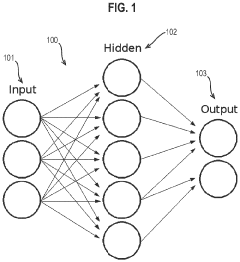
- The development of semiconductor devices and neuromorphic circuits incorporating ferroelectric materials, which enable efficient data processing by simulating synaptic functions, allowing for parallel processing and improved data storage and retrieval, thereby enhancing the accuracy and speed of data processing.
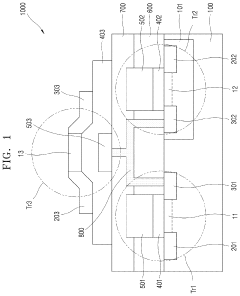
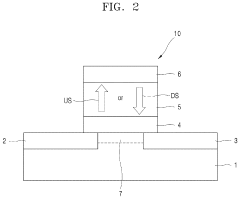
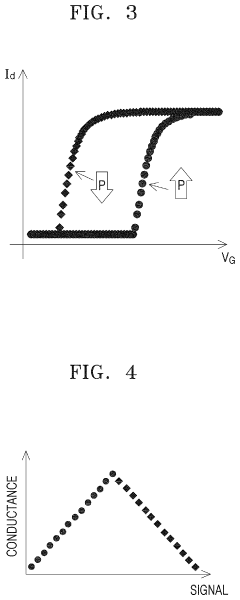
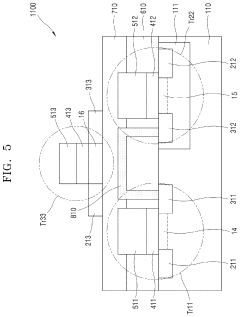
Neuromorphic computing
PatentPendingUS20240070446A1
Innovation
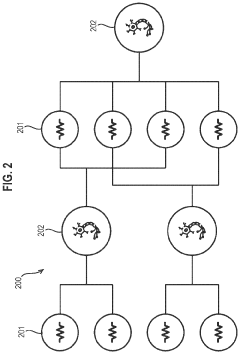
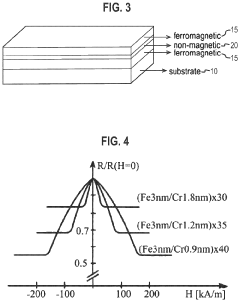
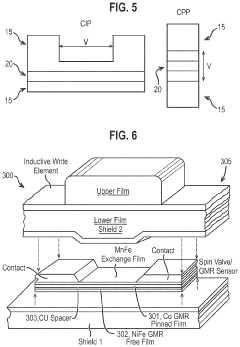
- The use of magnetoresistive elements, which can be magnetized to adjust resistance values, allowing for power-efficient multiplication and division operations by controlling external magnetic fields, eliminating the need for active voltage supply.
Energy Efficiency Implications of Neuromorphic Computing
Neuromorphic computing represents a paradigm shift in computational architecture, drawing inspiration from the human brain's neural networks to create more efficient computing systems. When examining the energy efficiency implications of neuromorphic computing, we observe a significant departure from traditional von Neumann architectures that suffer from the memory-processor bottleneck.
Traditional computing systems consume substantial energy during data transfer between memory and processing units. Neuromorphic systems, by integrating memory and processing functions within the same physical components, dramatically reduce this energy expenditure. Current estimates suggest neuromorphic chips can achieve energy efficiency improvements of 2-3 orders of magnitude compared to conventional computing platforms for certain workloads, particularly those involving pattern recognition and sensory processing.
The materials science advancements in neuromorphic computing further enhance these efficiency gains. Memristive devices, phase-change materials, and spintronic components enable persistent state changes with minimal energy input. For instance, memristors can maintain their resistance state without continuous power application, allowing for ultra-low standby power consumption. This characteristic is particularly valuable for edge computing applications where devices operate on limited power budgets.
Neuromorphic systems also excel in event-driven processing, activating computational resources only when necessary rather than through continuous clock-driven operations. This approach mirrors biological neural networks, which are inherently energy-efficient despite their complex computational capabilities. IBM's TrueNorth neuromorphic chip demonstrates this principle, consuming merely 70 milliwatts while simulating one million neurons and 256 million synapses.
The scaling potential of neuromorphic architectures presents another dimension of energy efficiency. As these systems grow in complexity, their energy consumption increases sub-linearly compared to traditional computing architectures. This characteristic becomes increasingly important as computing demands continue to rise across various sectors, from data centers to mobile devices.
Looking forward, the integration of novel materials like 2D semiconductors and carbon nanotubes into neuromorphic computing platforms promises to further reduce energy requirements. These materials exhibit exceptional electronic properties at nanoscale dimensions, potentially enabling computing elements that operate at the theoretical limits of energy efficiency. Some research prototypes have demonstrated switching energies approaching the femtojoule range, representing a significant advancement toward brain-like energy efficiency.
Traditional computing systems consume substantial energy during data transfer between memory and processing units. Neuromorphic systems, by integrating memory and processing functions within the same physical components, dramatically reduce this energy expenditure. Current estimates suggest neuromorphic chips can achieve energy efficiency improvements of 2-3 orders of magnitude compared to conventional computing platforms for certain workloads, particularly those involving pattern recognition and sensory processing.
The materials science advancements in neuromorphic computing further enhance these efficiency gains. Memristive devices, phase-change materials, and spintronic components enable persistent state changes with minimal energy input. For instance, memristors can maintain their resistance state without continuous power application, allowing for ultra-low standby power consumption. This characteristic is particularly valuable for edge computing applications where devices operate on limited power budgets.
Neuromorphic systems also excel in event-driven processing, activating computational resources only when necessary rather than through continuous clock-driven operations. This approach mirrors biological neural networks, which are inherently energy-efficient despite their complex computational capabilities. IBM's TrueNorth neuromorphic chip demonstrates this principle, consuming merely 70 milliwatts while simulating one million neurons and 256 million synapses.
The scaling potential of neuromorphic architectures presents another dimension of energy efficiency. As these systems grow in complexity, their energy consumption increases sub-linearly compared to traditional computing architectures. This characteristic becomes increasingly important as computing demands continue to rise across various sectors, from data centers to mobile devices.
Looking forward, the integration of novel materials like 2D semiconductors and carbon nanotubes into neuromorphic computing platforms promises to further reduce energy requirements. These materials exhibit exceptional electronic properties at nanoscale dimensions, potentially enabling computing elements that operate at the theoretical limits of energy efficiency. Some research prototypes have demonstrated switching energies approaching the femtojoule range, representing a significant advancement toward brain-like energy efficiency.
Fabrication Challenges and Manufacturing Scalability
The manufacturing of neuromorphic computing materials presents significant challenges that currently limit widespread commercial adoption. Traditional semiconductor fabrication techniques often struggle with the unique requirements of neuromorphic materials, particularly those involving complex oxide structures, phase-change materials, and memristive elements. The precise deposition of these materials requires exceptional control over stoichiometry, crystallinity, and interface quality, which existing manufacturing equipment may not adequately provide.
Scaling neuromorphic devices from laboratory prototypes to mass production introduces additional complications. The inherent variability in memristive and phase-change materials can lead to inconsistent device performance across wafers and batches. This device-to-device variability remains one of the most significant obstacles to commercial viability, as neuromorphic systems require predictable behavior to function effectively as neural network implementations.
Integration with conventional CMOS technology presents another manufacturing hurdle. While leveraging existing semiconductor infrastructure would accelerate adoption, the processing conditions for many neuromorphic materials (such as high temperatures or specialized atmospheres) are often incompatible with standard CMOS processes. This necessitates the development of novel back-end-of-line integration techniques that preserve the functionality of both conventional and neuromorphic components.
Yield management represents a critical challenge for neuromorphic hardware manufacturing. The complex multi-layer structures in these devices create numerous opportunities for defects, with each additional material interface increasing failure probability. Current defect detection and quality control methods require adaptation to identify the unique failure modes of neuromorphic materials and devices.
Cost considerations further complicate manufacturing scalability. Many promising neuromorphic materials incorporate rare or expensive elements, making them economically prohibitive for mass-market applications. Additionally, specialized deposition equipment and processing steps increase production costs compared to conventional semiconductor devices.
Recent advances in atomic layer deposition and precision etching techniques show promise for addressing some fabrication challenges. Several research institutions and companies have demonstrated improved control over material interfaces and reduced variability through modified deposition processes. However, these improvements typically come at the expense of throughput, creating a trade-off between quality and production volume that must be resolved for commercial viability.
Scaling neuromorphic devices from laboratory prototypes to mass production introduces additional complications. The inherent variability in memristive and phase-change materials can lead to inconsistent device performance across wafers and batches. This device-to-device variability remains one of the most significant obstacles to commercial viability, as neuromorphic systems require predictable behavior to function effectively as neural network implementations.
Integration with conventional CMOS technology presents another manufacturing hurdle. While leveraging existing semiconductor infrastructure would accelerate adoption, the processing conditions for many neuromorphic materials (such as high temperatures or specialized atmospheres) are often incompatible with standard CMOS processes. This necessitates the development of novel back-end-of-line integration techniques that preserve the functionality of both conventional and neuromorphic components.
Yield management represents a critical challenge for neuromorphic hardware manufacturing. The complex multi-layer structures in these devices create numerous opportunities for defects, with each additional material interface increasing failure probability. Current defect detection and quality control methods require adaptation to identify the unique failure modes of neuromorphic materials and devices.
Cost considerations further complicate manufacturing scalability. Many promising neuromorphic materials incorporate rare or expensive elements, making them economically prohibitive for mass-market applications. Additionally, specialized deposition equipment and processing steps increase production costs compared to conventional semiconductor devices.
Recent advances in atomic layer deposition and precision etching techniques show promise for addressing some fabrication challenges. Several research institutions and companies have demonstrated improved control over material interfaces and reduced variability through modified deposition processes. However, these improvements typically come at the expense of throughput, creating a trade-off between quality and production volume that must be resolved for commercial viability.
Unlock deeper insights with Patsnap Eureka Quick Research — get a full tech report to explore trends and direct your research. Try now!
Generate Your Research Report Instantly with AI Agent
Supercharge your innovation with Patsnap Eureka AI Agent Platform!