

Nickel-Iron Battery Grid Integration: Path Forward
APR 1, 20269 MIN READ
Generate Your Research Report Instantly with AI Agent
PatSnap Eureka helps you evaluate technical feasibility & market potential.
Nickel-Iron Battery Grid Integration Background and Objectives
Nickel-iron batteries, originally invented by Thomas Edison in 1901, represent one of the most durable and environmentally sustainable energy storage technologies available today. These batteries utilize nickel oxyhydroxide as the positive electrode and iron as the negative electrode, operating in an alkaline electrolyte solution. Despite their lower energy density compared to lithium-ion alternatives, nickel-iron batteries offer exceptional longevity, with operational lifespans exceeding 20-30 years and minimal performance degradation over thousands of charge-discharge cycles.
The resurgence of interest in nickel-iron battery technology stems from the urgent need for reliable, long-duration energy storage solutions to support grid modernization and renewable energy integration. As power grids worldwide transition toward higher penetrations of intermittent renewable sources like solar and wind, the demand for robust storage systems capable of providing grid stabilization services has intensified significantly.
Current grid integration challenges include managing voltage fluctuations, frequency regulation, peak shaving, and providing backup power during outages. Traditional grid infrastructure struggles to accommodate the variable nature of renewable energy generation, creating opportunities for advanced battery storage systems to bridge this gap. Nickel-iron batteries present unique advantages in this context due to their tolerance to deep discharge cycles, resistance to thermal runaway, and minimal maintenance requirements.
The primary objective of advancing nickel-iron battery grid integration involves developing scalable deployment strategies that leverage the technology's inherent strengths while addressing its limitations. Key technical goals include optimizing power conversion systems, enhancing round-trip efficiency, and establishing standardized grid interconnection protocols. Additionally, the integration pathway must demonstrate economic viability through reduced lifecycle costs and improved grid reliability metrics.
Strategic objectives encompass creating a comprehensive framework for utility-scale nickel-iron battery deployment, establishing performance benchmarks for grid services, and developing regulatory compliance standards. The ultimate goal is positioning nickel-iron batteries as a complementary technology within diverse energy storage portfolios, particularly for applications requiring ultra-long duration storage and exceptional reliability in harsh operating environments.
The resurgence of interest in nickel-iron battery technology stems from the urgent need for reliable, long-duration energy storage solutions to support grid modernization and renewable energy integration. As power grids worldwide transition toward higher penetrations of intermittent renewable sources like solar and wind, the demand for robust storage systems capable of providing grid stabilization services has intensified significantly.
Current grid integration challenges include managing voltage fluctuations, frequency regulation, peak shaving, and providing backup power during outages. Traditional grid infrastructure struggles to accommodate the variable nature of renewable energy generation, creating opportunities for advanced battery storage systems to bridge this gap. Nickel-iron batteries present unique advantages in this context due to their tolerance to deep discharge cycles, resistance to thermal runaway, and minimal maintenance requirements.
The primary objective of advancing nickel-iron battery grid integration involves developing scalable deployment strategies that leverage the technology's inherent strengths while addressing its limitations. Key technical goals include optimizing power conversion systems, enhancing round-trip efficiency, and establishing standardized grid interconnection protocols. Additionally, the integration pathway must demonstrate economic viability through reduced lifecycle costs and improved grid reliability metrics.
Strategic objectives encompass creating a comprehensive framework for utility-scale nickel-iron battery deployment, establishing performance benchmarks for grid services, and developing regulatory compliance standards. The ultimate goal is positioning nickel-iron batteries as a complementary technology within diverse energy storage portfolios, particularly for applications requiring ultra-long duration storage and exceptional reliability in harsh operating environments.
Grid Energy Storage Market Demand Analysis
The global energy storage market is experiencing unprecedented growth driven by the accelerating transition toward renewable energy sources and grid modernization initiatives. Wind and solar power generation's inherent intermittency creates substantial demand for reliable, long-duration energy storage solutions that can provide grid stability and ensure continuous power supply during periods of low renewable generation.
Utility-scale energy storage deployment has become a critical infrastructure priority as governments worldwide implement ambitious carbon neutrality targets. The increasing frequency of extreme weather events and aging grid infrastructure further amplify the need for resilient energy storage systems capable of providing backup power and grid stabilization services.
Nickel-iron batteries present unique advantages in addressing specific market segments within the broader energy storage landscape. Their exceptional cycle life, tolerance to deep discharge cycles, and minimal degradation over extended periods make them particularly suitable for applications requiring decades of reliable operation with minimal maintenance intervention.
The market demand for long-duration energy storage solutions is intensifying as utilities seek alternatives to traditional lithium-ion systems for applications exceeding four-hour discharge durations. Industrial and commercial sectors are increasingly recognizing the value proposition of robust energy storage systems that can withstand harsh operating conditions while maintaining consistent performance over extended operational lifespans.
Rural electrification projects and off-grid applications represent emerging market opportunities where nickel-iron battery characteristics align well with operational requirements. These applications often demand storage systems capable of operating in challenging environmental conditions with limited maintenance access, creating natural market niches for this technology.
Grid operators are actively seeking energy storage solutions that can provide multiple value streams including frequency regulation, voltage support, peak shaving, and renewable energy integration. The growing emphasis on grid resilience and energy security is driving demand for storage technologies that offer superior reliability and longevity compared to conventional alternatives.
Market analysis indicates increasing interest from utilities and independent power producers in diversifying their energy storage portfolios beyond lithium-ion technologies. This diversification strategy aims to mitigate supply chain risks while optimizing total cost of ownership across different application scenarios and operational requirements.
Utility-scale energy storage deployment has become a critical infrastructure priority as governments worldwide implement ambitious carbon neutrality targets. The increasing frequency of extreme weather events and aging grid infrastructure further amplify the need for resilient energy storage systems capable of providing backup power and grid stabilization services.
Nickel-iron batteries present unique advantages in addressing specific market segments within the broader energy storage landscape. Their exceptional cycle life, tolerance to deep discharge cycles, and minimal degradation over extended periods make them particularly suitable for applications requiring decades of reliable operation with minimal maintenance intervention.
The market demand for long-duration energy storage solutions is intensifying as utilities seek alternatives to traditional lithium-ion systems for applications exceeding four-hour discharge durations. Industrial and commercial sectors are increasingly recognizing the value proposition of robust energy storage systems that can withstand harsh operating conditions while maintaining consistent performance over extended operational lifespans.
Rural electrification projects and off-grid applications represent emerging market opportunities where nickel-iron battery characteristics align well with operational requirements. These applications often demand storage systems capable of operating in challenging environmental conditions with limited maintenance access, creating natural market niches for this technology.
Grid operators are actively seeking energy storage solutions that can provide multiple value streams including frequency regulation, voltage support, peak shaving, and renewable energy integration. The growing emphasis on grid resilience and energy security is driving demand for storage technologies that offer superior reliability and longevity compared to conventional alternatives.
Market analysis indicates increasing interest from utilities and independent power producers in diversifying their energy storage portfolios beyond lithium-ion technologies. This diversification strategy aims to mitigate supply chain risks while optimizing total cost of ownership across different application scenarios and operational requirements.
Current Ni-Fe Battery Grid Integration Status and Challenges
Nickel-iron batteries currently occupy a niche position in grid-scale energy storage applications, representing less than 2% of the global stationary battery storage market. Despite their exceptional longevity and robust operational characteristics, these systems face significant deployment challenges that limit widespread adoption in modern electrical grids. The technology's integration status remains largely confined to specialized applications where durability outweighs efficiency considerations.
The primary technical challenge hindering nickel-iron battery grid integration lies in their inherently low energy efficiency, typically ranging from 65-75% round-trip efficiency compared to 85-95% for lithium-ion alternatives. This efficiency gap translates directly into higher operational costs and increased energy losses during charge-discharge cycles, making them economically disadvantageous for frequent cycling applications common in grid stabilization services.
Power density limitations present another substantial obstacle, with nickel-iron systems delivering approximately 100-150 W/kg compared to 300-500 W/kg for competing technologies. This constraint necessitates larger installation footprints and higher infrastructure costs, particularly problematic in urban grid applications where space availability is limited. The technology's slow charge acceptance rates further compound integration difficulties, limiting rapid response capabilities essential for grid frequency regulation and peak shaving services.
Current grid integration efforts face significant standardization challenges, as existing power conversion systems and grid interface protocols are predominantly optimized for lithium-ion and lead-acid technologies. The unique voltage characteristics and charging profiles of nickel-iron batteries require specialized power electronics and control algorithms, increasing system complexity and integration costs. Many existing grid codes and interconnection standards lack specific provisions for nickel-iron battery characteristics, creating regulatory barriers for deployment.
Economic viability remains the most pressing challenge, with capital costs for nickel-iron battery systems ranging from $800-1200 per kWh compared to $300-600 per kWh for lithium-ion alternatives. While the technology offers superior cycle life exceeding 10,000 cycles and operational lifespans of 20-30 years, the higher upfront investment and lower efficiency create unfavorable economics under current market conditions and utility procurement practices.
Despite these challenges, emerging applications in long-duration energy storage and off-grid systems demonstrate growing interest in nickel-iron technology. Recent pilot projects in renewable energy integration and microgrid applications have shown promising results, particularly in scenarios prioritizing reliability and longevity over peak performance metrics.
The primary technical challenge hindering nickel-iron battery grid integration lies in their inherently low energy efficiency, typically ranging from 65-75% round-trip efficiency compared to 85-95% for lithium-ion alternatives. This efficiency gap translates directly into higher operational costs and increased energy losses during charge-discharge cycles, making them economically disadvantageous for frequent cycling applications common in grid stabilization services.
Power density limitations present another substantial obstacle, with nickel-iron systems delivering approximately 100-150 W/kg compared to 300-500 W/kg for competing technologies. This constraint necessitates larger installation footprints and higher infrastructure costs, particularly problematic in urban grid applications where space availability is limited. The technology's slow charge acceptance rates further compound integration difficulties, limiting rapid response capabilities essential for grid frequency regulation and peak shaving services.
Current grid integration efforts face significant standardization challenges, as existing power conversion systems and grid interface protocols are predominantly optimized for lithium-ion and lead-acid technologies. The unique voltage characteristics and charging profiles of nickel-iron batteries require specialized power electronics and control algorithms, increasing system complexity and integration costs. Many existing grid codes and interconnection standards lack specific provisions for nickel-iron battery characteristics, creating regulatory barriers for deployment.
Economic viability remains the most pressing challenge, with capital costs for nickel-iron battery systems ranging from $800-1200 per kWh compared to $300-600 per kWh for lithium-ion alternatives. While the technology offers superior cycle life exceeding 10,000 cycles and operational lifespans of 20-30 years, the higher upfront investment and lower efficiency create unfavorable economics under current market conditions and utility procurement practices.
Despite these challenges, emerging applications in long-duration energy storage and off-grid systems demonstrate growing interest in nickel-iron technology. Recent pilot projects in renewable energy integration and microgrid applications have shown promising results, particularly in scenarios prioritizing reliability and longevity over peak performance metrics.
Current Grid Integration Solutions for Ni-Fe Batteries
01 Electrode material composition and preparation
Nickel-iron batteries utilize specific electrode materials to enhance performance. The positive electrode typically contains nickel-based active materials, while the negative electrode uses iron-based materials. Various preparation methods and material compositions are employed to optimize the electrochemical properties, including the use of additives, dopants, and specific manufacturing processes to improve conductivity, capacity, and cycle life.- Electrode material composition and preparation: Nickel-iron batteries utilize specific electrode materials to enhance performance. The positive electrode typically contains nickel-based active materials, while the negative electrode uses iron-based materials. Various preparation methods and material compositions are employed to optimize the electrochemical properties, including the use of additives, dopants, and specific manufacturing processes to improve conductivity, capacity, and cycle life.
- Electrolyte formulation and optimization: The electrolyte plays a crucial role in nickel-iron battery performance. Alkaline electrolytes, typically potassium hydroxide solutions, are commonly used. Various formulations and additives are incorporated to improve ionic conductivity, reduce internal resistance, and enhance battery stability. The optimization of electrolyte concentration and composition directly affects the battery's efficiency and longevity.
- Battery structure and design improvements: Innovations in battery structure focus on enhancing energy density and operational efficiency. This includes improvements in cell configuration, separator design, electrode arrangement, and housing materials. Advanced structural designs aim to minimize internal resistance, improve heat dissipation, and optimize space utilization while maintaining mechanical stability and safety.
- Manufacturing processes and production methods: Various manufacturing techniques are employed to produce nickel-iron batteries with improved quality and consistency. These include electrode fabrication methods, assembly processes, activation procedures, and quality control measures. Advanced production methods focus on scalability, cost-effectiveness, and ensuring uniform performance characteristics across battery units.
- Performance enhancement and application optimization: Technologies for improving battery performance include methods to increase energy capacity, extend cycle life, enhance charge-discharge efficiency, and improve low-temperature performance. Various approaches address specific application requirements such as energy storage systems, electric vehicles, and renewable energy integration. These innovations focus on practical implementation and real-world performance optimization.
02 Electrolyte formulation and optimization
The electrolyte plays a crucial role in nickel-iron battery performance. Alkaline electrolytes, typically potassium hydroxide solutions, are commonly used. Various formulations and additives are incorporated to improve ionic conductivity, reduce internal resistance, and enhance battery stability. The optimization of electrolyte concentration and composition helps to extend battery life and improve charge-discharge efficiency.Expand Specific Solutions03 Battery structure and design improvements
Innovations in battery structure and design focus on improving energy density, power output, and overall performance. This includes optimizations in electrode spacing, separator materials, cell configuration, and housing design. Advanced manufacturing techniques and structural modifications help to reduce internal resistance, improve heat dissipation, and enhance mechanical stability of the battery system.Expand Specific Solutions04 Charging and discharging control methods
Advanced charging and discharging control strategies are developed to optimize battery performance and longevity. These methods include pulse charging techniques, multi-stage charging protocols, and intelligent battery management systems. The control methods aim to prevent overcharging, reduce polarization effects, and maintain optimal operating conditions throughout the battery lifecycle.Expand Specific Solutions05 Performance enhancement and cycle life extension
Various techniques are employed to enhance battery performance and extend cycle life. These include surface treatment of electrodes, incorporation of conductive additives, optimization of active material particle size, and development of protective coatings. These improvements help to reduce capacity fade, improve charge retention, and increase the number of charge-discharge cycles the battery can withstand.Expand Specific Solutions
Major Players in Ni-Fe Battery Grid Storage Market
The nickel-iron battery grid integration market represents an emerging sector within the broader energy storage landscape, currently in its early commercialization phase with significant growth potential driven by increasing demand for sustainable grid-scale storage solutions. The market remains relatively niche compared to lithium-ion alternatives, but shows promise due to nickel-iron batteries' inherent safety, longevity, and environmental advantages. Technology maturity varies significantly across market participants, with established players like LG Energy Solution, DENSO Corp., and GM Global Technology Operations leveraging their extensive R&D capabilities and manufacturing expertise to advance integration solutions. Meanwhile, specialized companies such as EnerVenue Holdings and Encell Technology focus specifically on nickel-iron battery applications, while Chinese manufacturers including Guangdong Bangpu Recycling Technology and Zhuhai CosMX Battery contribute recycling and production capabilities. Academic institutions like Central South University, Beijing Institute of Technology, and University of Southern California provide crucial research foundations, indicating strong innovation pipeline potential for future technological breakthroughs and commercial viability improvements.
Johnson Controls Technology Co.
Technical Solution: Johnson Controls has developed comprehensive nickel-iron battery grid integration solutions focusing on industrial and commercial applications. Their technology platform includes advanced battery management systems specifically optimized for nickel-iron chemistry, featuring real-time monitoring, predictive maintenance capabilities, and grid synchronization protocols. The company's approach emphasizes seamless integration with existing grid infrastructure through standardized communication protocols and power electronics. Their solution incorporates intelligent load management, demand response capabilities, and renewable energy integration features. The system is designed to provide grid services including frequency regulation, voltage support, and backup power during outages while maintaining high reliability and safety standards.
Strengths: Strong industrial expertise, reliable system performance, and comprehensive service support network. Weaknesses: Limited scalability for utility-scale applications and higher maintenance requirements compared to newer technologies.
EnerVenue Holdings Ltd.
Technical Solution: EnerVenue has developed a proprietary nickel-iron battery technology specifically designed for grid-scale energy storage applications. Their solution features a unique electrolyte formulation and advanced cell design that enables seamless integration with renewable energy sources and grid infrastructure. The company's batteries offer exceptional cycle life exceeding 30,000 cycles with minimal degradation, making them ideal for daily charge-discharge operations required in grid applications. Their system includes sophisticated battery management systems (BMS) and power conversion equipment optimized for grid frequency regulation, peak shaving, and renewable energy integration. The technology addresses key grid integration challenges including voltage stability, frequency response, and load balancing through intelligent control algorithms.
Strengths: Ultra-long cycle life, excellent safety profile, and cost-effective for long-duration storage applications. Weaknesses: Lower energy density compared to lithium-ion alternatives and slower charge/discharge rates.
Core Patents in Ni-Fe Battery Grid Connection Technologies
Methods and systems for managing vehicle-grid integration
PatentActiveUS12038726B2
Innovation
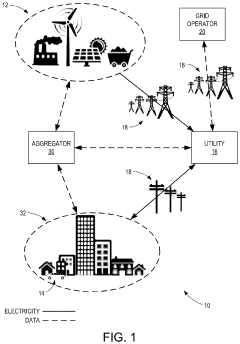
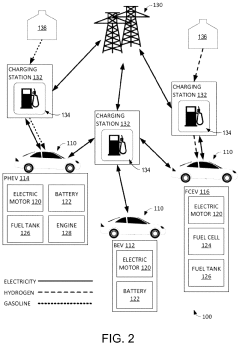
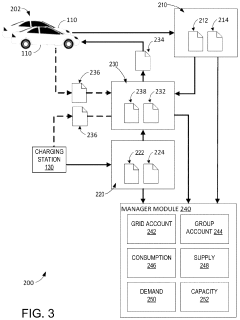
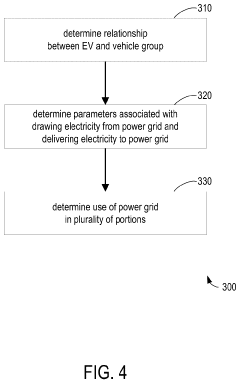
- A vehicle-grid integration (VGI) management system that includes computer storage media and processors to determine the use of the power grid by EVs in a dual multi-part rate structure, allowing for organized and controllable participation of EVs in power and energy management, enabling strategic dispatching to balance supply and demand, and equitably attribute costs and benefits.
Vehicle-Solar-Grid Integration for Back up Power
PatentInactiveUS20200031238A1
Innovation
- A method and apparatus that utilize both Direct Current (DC) and Alternating Current (AC) connections to an electric vehicle's battery pack, allowing bidirectional power flow through a combination of on-board and ground-based inverters, enabling the vehicle to serve as a backup power source and provide ancillary services to the grid, while integrating with solar photovoltaic systems for extended power availability during outages.


Grid Code Compliance and Safety Standards
Grid code compliance represents a fundamental prerequisite for nickel-iron battery integration into modern electrical networks. These regulatory frameworks establish mandatory technical specifications that energy storage systems must satisfy to ensure safe and reliable grid operation. For nickel-iron batteries, compliance encompasses voltage regulation capabilities, frequency response characteristics, and power quality standards that differ significantly from conventional lithium-ion systems due to their unique electrochemical properties.
The voltage regulation requirements pose particular challenges for nickel-iron battery systems. Grid codes typically mandate precise voltage control within ±5% of nominal values during normal operation and ±10% during contingency conditions. Nickel-iron batteries exhibit distinct voltage profiles during charge and discharge cycles, requiring sophisticated power conditioning systems to meet these stringent requirements. Advanced inverter technologies with real-time voltage regulation capabilities become essential components for achieving compliance.
Frequency response standards demand rapid power output adjustments to maintain grid stability at 50Hz or 60Hz depending on regional specifications. Nickel-iron batteries demonstrate excellent cycling durability, making them well-suited for frequent charge-discharge operations required by frequency regulation services. However, their relatively slower response times compared to lithium-ion systems necessitate optimized control algorithms to meet sub-second response requirements specified in most grid codes.
Safety standards encompass multiple layers of protection systems designed to prevent hazardous conditions during normal operation and fault scenarios. IEEE 1547 and IEC 61727 standards define critical safety functions including anti-islanding protection, ground fault detection, and emergency shutdown procedures. Nickel-iron batteries require specialized safety protocols due to their alkaline electrolyte composition and hydrogen gas generation during overcharge conditions.
Fire safety considerations differ substantially from other battery technologies due to nickel-iron batteries' inherently safer chemistry. Unlike lithium-ion systems, nickel-iron batteries do not experience thermal runaway, significantly reducing fire risk. However, proper ventilation systems remain crucial to manage hydrogen gas emissions, particularly in enclosed installation environments.
Electromagnetic compatibility standards ensure that battery systems do not interfere with grid communication networks or nearby electronic equipment. Nickel-iron battery installations must demonstrate compliance with EMC requirements through comprehensive testing protocols that verify acceptable levels of electromagnetic emissions and immunity to external interference.
The voltage regulation requirements pose particular challenges for nickel-iron battery systems. Grid codes typically mandate precise voltage control within ±5% of nominal values during normal operation and ±10% during contingency conditions. Nickel-iron batteries exhibit distinct voltage profiles during charge and discharge cycles, requiring sophisticated power conditioning systems to meet these stringent requirements. Advanced inverter technologies with real-time voltage regulation capabilities become essential components for achieving compliance.
Frequency response standards demand rapid power output adjustments to maintain grid stability at 50Hz or 60Hz depending on regional specifications. Nickel-iron batteries demonstrate excellent cycling durability, making them well-suited for frequent charge-discharge operations required by frequency regulation services. However, their relatively slower response times compared to lithium-ion systems necessitate optimized control algorithms to meet sub-second response requirements specified in most grid codes.
Safety standards encompass multiple layers of protection systems designed to prevent hazardous conditions during normal operation and fault scenarios. IEEE 1547 and IEC 61727 standards define critical safety functions including anti-islanding protection, ground fault detection, and emergency shutdown procedures. Nickel-iron batteries require specialized safety protocols due to their alkaline electrolyte composition and hydrogen gas generation during overcharge conditions.
Fire safety considerations differ substantially from other battery technologies due to nickel-iron batteries' inherently safer chemistry. Unlike lithium-ion systems, nickel-iron batteries do not experience thermal runaway, significantly reducing fire risk. However, proper ventilation systems remain crucial to manage hydrogen gas emissions, particularly in enclosed installation environments.
Electromagnetic compatibility standards ensure that battery systems do not interfere with grid communication networks or nearby electronic equipment. Nickel-iron battery installations must demonstrate compliance with EMC requirements through comprehensive testing protocols that verify acceptable levels of electromagnetic emissions and immunity to external interference.
Environmental Impact Assessment of Ni-Fe Grid Systems
Nickel-iron battery grid integration presents a compelling environmental profile compared to conventional energy storage technologies. The fundamental chemistry of Ni-Fe systems eliminates the use of toxic heavy metals such as lead, cadmium, or cobalt, significantly reducing environmental hazards throughout the battery lifecycle. The primary materials—iron and nickel—are abundant, recyclable metals with established recovery processes, minimizing resource depletion concerns and supporting circular economy principles.
Life cycle assessment studies indicate that Ni-Fe batteries demonstrate superior environmental performance in long-term grid applications. The exceptional longevity of these systems, often exceeding 20-30 years of operational life, substantially reduces the frequency of replacement cycles compared to lithium-ion or lead-acid alternatives. This extended lifespan translates to lower cumulative environmental impact per unit of energy stored over the system's operational period.
Manufacturing processes for Ni-Fe batteries generate relatively low carbon emissions due to simplified production techniques and reduced energy-intensive material processing requirements. The absence of complex cathode materials and electrolyte additives common in other battery chemistries minimizes manufacturing-related environmental burdens. Additionally, the robust construction of Ni-Fe cells reduces packaging requirements and associated material consumption.
End-of-life management represents a significant environmental advantage for Ni-Fe grid systems. The straightforward material composition facilitates efficient recycling processes, with iron and nickel recovery rates exceeding 95% using conventional metallurgical techniques. The alkaline electrolyte, typically potassium hydroxide, can be neutralized and processed without generating hazardous waste streams, contrasting favorably with the complex disposal requirements of other battery technologies.
Grid-scale deployment of Ni-Fe systems contributes to broader environmental benefits through enhanced renewable energy integration. The technology's tolerance to deep discharge cycles and temperature variations enables more effective utilization of intermittent renewable sources, potentially reducing reliance on fossil fuel-based backup generation. However, the lower energy density of Ni-Fe batteries may require larger installation footprints, presenting land use considerations that must be balanced against their environmental advantages in comprehensive sustainability assessments.
Life cycle assessment studies indicate that Ni-Fe batteries demonstrate superior environmental performance in long-term grid applications. The exceptional longevity of these systems, often exceeding 20-30 years of operational life, substantially reduces the frequency of replacement cycles compared to lithium-ion or lead-acid alternatives. This extended lifespan translates to lower cumulative environmental impact per unit of energy stored over the system's operational period.
Manufacturing processes for Ni-Fe batteries generate relatively low carbon emissions due to simplified production techniques and reduced energy-intensive material processing requirements. The absence of complex cathode materials and electrolyte additives common in other battery chemistries minimizes manufacturing-related environmental burdens. Additionally, the robust construction of Ni-Fe cells reduces packaging requirements and associated material consumption.
End-of-life management represents a significant environmental advantage for Ni-Fe grid systems. The straightforward material composition facilitates efficient recycling processes, with iron and nickel recovery rates exceeding 95% using conventional metallurgical techniques. The alkaline electrolyte, typically potassium hydroxide, can be neutralized and processed without generating hazardous waste streams, contrasting favorably with the complex disposal requirements of other battery technologies.
Grid-scale deployment of Ni-Fe systems contributes to broader environmental benefits through enhanced renewable energy integration. The technology's tolerance to deep discharge cycles and temperature variations enables more effective utilization of intermittent renewable sources, potentially reducing reliance on fossil fuel-based backup generation. However, the lower energy density of Ni-Fe batteries may require larger installation footprints, presenting land use considerations that must be balanced against their environmental advantages in comprehensive sustainability assessments.
Unlock deeper insights with PatSnap Eureka Quick Research — get a full tech report to explore trends and direct your research. Try now!
Generate Your Research Report Instantly with AI Agent
Supercharge your innovation with PatSnap Eureka AI Agent Platform!