

Optimize Battery Management System Design: Energy Efficiency
MAR 20, 20269 MIN READ
Generate Your Research Report Instantly with AI Agent
PatSnap Eureka helps you evaluate technical feasibility & market potential.
Battery Management System Energy Efficiency Background and Goals
Battery Management Systems have evolved from simple voltage monitoring circuits in early electric vehicles to sophisticated multi-layered control architectures that govern every aspect of battery operation. The historical development began in the 1990s with basic cell balancing techniques and has progressed through several generations of technological advancement. Early systems focused primarily on safety protection, preventing overcharge and over-discharge conditions through rudimentary cutoff mechanisms.
The evolution accelerated significantly with the proliferation of lithium-ion battery technology in consumer electronics and later in automotive applications. Modern BMS architectures incorporate advanced algorithms for state estimation, predictive analytics, and real-time optimization. The integration of machine learning capabilities and cloud connectivity has transformed these systems from reactive protection devices into proactive energy management platforms.
Current technological trends indicate a shift toward distributed BMS architectures, where intelligence is embedded at the cell level rather than centralized. This distributed approach enables more granular control and improved fault tolerance. Additionally, the integration of artificial intelligence and edge computing capabilities is enabling predictive maintenance and adaptive optimization strategies that continuously improve system performance.
The primary technical objectives for next-generation BMS energy efficiency optimization encompass several critical areas. State-of-charge estimation accuracy must achieve precision levels below 2% error margins across diverse operating conditions and battery aging states. This requires sophisticated algorithms that can adapt to changing battery characteristics over the system lifecycle.
Thermal management optimization represents another crucial goal, targeting temperature uniformity within 3°C across battery packs while minimizing cooling energy consumption. Advanced thermal modeling and predictive control strategies are essential to achieve these targets without compromising battery longevity or safety margins.
Energy harvesting and power conversion efficiency improvements aim to reduce parasitic losses to below 0.5% of total system capacity. This involves optimizing switching frequencies, implementing advanced power electronics topologies, and developing ultra-low-power monitoring circuits that maintain functionality while minimizing energy consumption during standby operations.
Real-time optimization algorithms must demonstrate the capability to extend battery life by 15-20% through intelligent charge-discharge scheduling and cell balancing strategies. These systems should adapt dynamically to usage patterns, environmental conditions, and aging characteristics to maximize both immediate efficiency and long-term performance retention.
The evolution accelerated significantly with the proliferation of lithium-ion battery technology in consumer electronics and later in automotive applications. Modern BMS architectures incorporate advanced algorithms for state estimation, predictive analytics, and real-time optimization. The integration of machine learning capabilities and cloud connectivity has transformed these systems from reactive protection devices into proactive energy management platforms.
Current technological trends indicate a shift toward distributed BMS architectures, where intelligence is embedded at the cell level rather than centralized. This distributed approach enables more granular control and improved fault tolerance. Additionally, the integration of artificial intelligence and edge computing capabilities is enabling predictive maintenance and adaptive optimization strategies that continuously improve system performance.
The primary technical objectives for next-generation BMS energy efficiency optimization encompass several critical areas. State-of-charge estimation accuracy must achieve precision levels below 2% error margins across diverse operating conditions and battery aging states. This requires sophisticated algorithms that can adapt to changing battery characteristics over the system lifecycle.
Thermal management optimization represents another crucial goal, targeting temperature uniformity within 3°C across battery packs while minimizing cooling energy consumption. Advanced thermal modeling and predictive control strategies are essential to achieve these targets without compromising battery longevity or safety margins.
Energy harvesting and power conversion efficiency improvements aim to reduce parasitic losses to below 0.5% of total system capacity. This involves optimizing switching frequencies, implementing advanced power electronics topologies, and developing ultra-low-power monitoring circuits that maintain functionality while minimizing energy consumption during standby operations.
Real-time optimization algorithms must demonstrate the capability to extend battery life by 15-20% through intelligent charge-discharge scheduling and cell balancing strategies. These systems should adapt dynamically to usage patterns, environmental conditions, and aging characteristics to maximize both immediate efficiency and long-term performance retention.
Market Demand Analysis for Advanced BMS Solutions
The global battery management system market is experiencing unprecedented growth driven by the accelerating adoption of electric vehicles and renewable energy storage systems. Electric vehicle manufacturers are increasingly demanding sophisticated BMS solutions that can maximize energy efficiency while ensuring safety and longevity of battery packs. This demand stems from consumer expectations for longer driving ranges and faster charging capabilities, making energy-efficient BMS design a critical competitive differentiator.
Industrial energy storage applications represent another significant demand driver for advanced BMS technologies. Grid-scale battery installations require precise energy management to optimize charge-discharge cycles and minimize energy losses during storage operations. Utility companies and renewable energy developers are actively seeking BMS solutions that can enhance overall system efficiency and reduce operational costs over extended deployment periods.
Consumer electronics manufacturers continue to push for miniaturized yet powerful BMS solutions that can extend device battery life while maintaining compact form factors. The proliferation of IoT devices, wearables, and portable electronics has created substantial demand for intelligent battery management systems capable of adaptive energy optimization based on usage patterns and environmental conditions.
The automotive sector shows particularly strong demand for BMS solutions incorporating advanced algorithms for predictive energy management and thermal optimization. Original equipment manufacturers are prioritizing systems that can dynamically adjust charging strategies, balance cell voltages efficiently, and implement sophisticated state-of-charge estimation to maximize vehicle performance and battery lifespan.
Emerging applications in aerospace, marine, and stationary backup power systems are generating new market segments for specialized BMS solutions. These applications require highly reliable energy management systems capable of operating under extreme conditions while maintaining optimal efficiency throughout extended operational cycles.
Market research indicates growing preference for BMS solutions featuring machine learning capabilities and cloud connectivity for remote monitoring and optimization. End users increasingly value systems that can continuously improve energy efficiency through data analytics and predictive maintenance algorithms, driving demand for next-generation intelligent battery management platforms.
Industrial energy storage applications represent another significant demand driver for advanced BMS technologies. Grid-scale battery installations require precise energy management to optimize charge-discharge cycles and minimize energy losses during storage operations. Utility companies and renewable energy developers are actively seeking BMS solutions that can enhance overall system efficiency and reduce operational costs over extended deployment periods.
Consumer electronics manufacturers continue to push for miniaturized yet powerful BMS solutions that can extend device battery life while maintaining compact form factors. The proliferation of IoT devices, wearables, and portable electronics has created substantial demand for intelligent battery management systems capable of adaptive energy optimization based on usage patterns and environmental conditions.
The automotive sector shows particularly strong demand for BMS solutions incorporating advanced algorithms for predictive energy management and thermal optimization. Original equipment manufacturers are prioritizing systems that can dynamically adjust charging strategies, balance cell voltages efficiently, and implement sophisticated state-of-charge estimation to maximize vehicle performance and battery lifespan.
Emerging applications in aerospace, marine, and stationary backup power systems are generating new market segments for specialized BMS solutions. These applications require highly reliable energy management systems capable of operating under extreme conditions while maintaining optimal efficiency throughout extended operational cycles.
Market research indicates growing preference for BMS solutions featuring machine learning capabilities and cloud connectivity for remote monitoring and optimization. End users increasingly value systems that can continuously improve energy efficiency through data analytics and predictive maintenance algorithms, driving demand for next-generation intelligent battery management platforms.
Current BMS Energy Efficiency Status and Technical Challenges
Current Battery Management System (BMS) energy efficiency levels vary significantly across different applications and manufacturers. In electric vehicle applications, modern BMS typically achieve operational efficiency rates between 95-98%, while consumer electronics applications often demonstrate efficiency levels ranging from 92-96%. Industrial and grid-scale energy storage systems generally operate at efficiency levels of 94-97%. These variations stem from different design priorities, cost constraints, and performance requirements across market segments.
The primary technical challenge facing BMS energy efficiency optimization lies in power consumption during standby and active monitoring modes. Conventional BMS architectures consume 0.1-0.5% of total battery capacity during standby operations, primarily due to continuous cell voltage monitoring, temperature sensing, and communication protocols. Active balancing operations can increase power consumption to 1-2% of battery capacity, creating significant efficiency losses during charge equalization processes.
Thermal management represents another critical efficiency bottleneck in current BMS designs. Inadequate thermal regulation leads to increased internal resistance, reduced charge acceptance rates, and accelerated capacity degradation. Current thermal management solutions often rely on passive cooling methods or energy-intensive active cooling systems, both contributing to overall system efficiency losses of 2-5% under extreme operating conditions.
Cell balancing algorithms present substantial technical challenges for energy efficiency optimization. Passive balancing methods, while cost-effective, dissipate excess energy as heat, resulting in efficiency losses of 3-8% during balancing operations. Active balancing systems, though more efficient in energy transfer, introduce complexity and additional power consumption through switching circuits and control electronics, limiting net efficiency gains to 60-75% compared to passive methods.
Communication and data processing overhead continues to constrain BMS efficiency improvements. Real-time monitoring requirements necessitate continuous operation of microcontrollers, analog-to-digital converters, and wireless communication modules. These subsystems typically consume 50-200mW continuously, representing 0.2-0.8% of total system capacity in typical applications.
Aging battery cells compound efficiency challenges through increased internal resistance and capacity mismatch. As battery packs age, BMS systems must compensate through more frequent balancing operations and conservative charging profiles, reducing overall system efficiency by 5-15% over the battery lifecycle. Current BMS architectures lack adaptive algorithms capable of optimizing efficiency parameters based on real-time cell degradation assessment.
Integration complexity with power electronics and charging systems creates additional efficiency constraints. Interface losses between BMS control signals and power conversion circuits typically account for 1-3% efficiency reduction, while communication delays and control loop optimization challenges further impact overall system performance.
The primary technical challenge facing BMS energy efficiency optimization lies in power consumption during standby and active monitoring modes. Conventional BMS architectures consume 0.1-0.5% of total battery capacity during standby operations, primarily due to continuous cell voltage monitoring, temperature sensing, and communication protocols. Active balancing operations can increase power consumption to 1-2% of battery capacity, creating significant efficiency losses during charge equalization processes.
Thermal management represents another critical efficiency bottleneck in current BMS designs. Inadequate thermal regulation leads to increased internal resistance, reduced charge acceptance rates, and accelerated capacity degradation. Current thermal management solutions often rely on passive cooling methods or energy-intensive active cooling systems, both contributing to overall system efficiency losses of 2-5% under extreme operating conditions.
Cell balancing algorithms present substantial technical challenges for energy efficiency optimization. Passive balancing methods, while cost-effective, dissipate excess energy as heat, resulting in efficiency losses of 3-8% during balancing operations. Active balancing systems, though more efficient in energy transfer, introduce complexity and additional power consumption through switching circuits and control electronics, limiting net efficiency gains to 60-75% compared to passive methods.
Communication and data processing overhead continues to constrain BMS efficiency improvements. Real-time monitoring requirements necessitate continuous operation of microcontrollers, analog-to-digital converters, and wireless communication modules. These subsystems typically consume 50-200mW continuously, representing 0.2-0.8% of total system capacity in typical applications.
Aging battery cells compound efficiency challenges through increased internal resistance and capacity mismatch. As battery packs age, BMS systems must compensate through more frequent balancing operations and conservative charging profiles, reducing overall system efficiency by 5-15% over the battery lifecycle. Current BMS architectures lack adaptive algorithms capable of optimizing efficiency parameters based on real-time cell degradation assessment.
Integration complexity with power electronics and charging systems creates additional efficiency constraints. Interface losses between BMS control signals and power conversion circuits typically account for 1-3% efficiency reduction, while communication delays and control loop optimization challenges further impact overall system performance.
Current BMS Energy Optimization Technical Solutions
01 Advanced battery state estimation and monitoring algorithms
Battery management systems employ sophisticated algorithms to accurately estimate state of charge (SOC), state of health (SOH), and remaining useful life. These estimation techniques utilize various methods including Kalman filtering, neural networks, and machine learning approaches to optimize energy efficiency by providing precise battery status information. Accurate state estimation enables better charge/discharge control strategies and prevents over-charging or deep discharge conditions that waste energy.- Advanced battery state estimation and monitoring algorithms: Battery management systems employ sophisticated algorithms to accurately estimate state of charge (SOC), state of health (SOH), and remaining useful life. These estimation techniques utilize various methods including Kalman filtering, neural networks, and machine learning approaches to optimize energy efficiency by providing precise battery status information. Accurate state estimation enables better charge/discharge control strategies and prevents over-charging or deep discharge conditions that waste energy.
- Intelligent charge and discharge control strategies: Energy efficiency is enhanced through optimized charging and discharging control methods that adapt to battery conditions and usage patterns. These strategies include pulse charging techniques, multi-stage charging protocols, and dynamic current limiting based on temperature and voltage thresholds. The control algorithms minimize energy losses during power conversion and reduce heat generation, thereby improving overall system efficiency.
- Thermal management and temperature optimization: Effective thermal management systems maintain batteries within optimal temperature ranges to maximize energy efficiency. These systems incorporate active cooling or heating mechanisms, temperature sensors distributed throughout battery packs, and predictive thermal models. By preventing excessive temperature variations and maintaining ideal operating conditions, energy losses due to increased internal resistance are minimized and battery performance is optimized.
- Cell balancing techniques for energy optimization: Battery management systems implement various cell balancing methods to equalize charge levels across individual cells in a battery pack. Both passive and active balancing techniques are employed to prevent energy waste from cell mismatch and ensure all cells operate at similar voltage levels. This balancing improves pack-level energy utilization efficiency and extends overall battery life by preventing premature capacity fade in weaker cells.
- Power conversion efficiency and loss reduction: Energy efficiency improvements are achieved through optimized power electronics and conversion circuits within the battery management system. These include high-efficiency DC-DC converters, synchronous rectification, and reduced switching losses. The systems also incorporate energy recovery mechanisms and minimize parasitic power consumption of monitoring circuits. Advanced semiconductor devices and circuit topologies reduce conversion losses during charging and discharging operations.
02 Intelligent charge and discharge control strategies
Energy efficiency is enhanced through optimized charging and discharging control methods that adapt to battery conditions and usage patterns. These strategies include pulse charging techniques, multi-stage charging protocols, and dynamic current limiting based on temperature and voltage thresholds. The control algorithms minimize energy losses during power conversion and reduce heat generation, thereby improving overall system efficiency.Expand Specific Solutions03 Thermal management and temperature optimization
Effective thermal management systems maintain batteries within optimal temperature ranges to maximize energy efficiency. These systems incorporate active cooling or heating mechanisms, temperature sensors distributed throughout battery packs, and predictive thermal models. By preventing excessive temperature variations and maintaining ideal operating conditions, energy losses due to increased internal resistance are minimized and battery performance is optimized.Expand Specific Solutions04 Cell balancing techniques for uniform energy distribution
Battery management systems implement cell balancing methods to equalize charge levels across individual cells within a battery pack. Both passive and active balancing techniques are employed to redistribute energy from higher-charged cells to lower-charged ones, preventing capacity degradation and energy waste. This ensures all cells operate at similar voltage levels, maximizing usable capacity and improving overall energy efficiency of the battery system.Expand Specific Solutions05 Power conversion efficiency optimization
Energy efficiency improvements are achieved through optimized power conversion circuits and switching strategies within the battery management system. These include high-efficiency DC-DC converters, synchronous rectification techniques, and adaptive switching frequency control. The power electronics are designed to minimize conversion losses during charging and discharging operations, reducing heat dissipation and improving the round-trip efficiency of energy storage and delivery.Expand Specific Solutions
Major Players in BMS and Energy Storage Industry
The battery management system optimization for energy efficiency represents a rapidly evolving market driven by the global shift toward electrification and renewable energy storage. The industry is in a growth phase, with market expansion fueled by electric vehicle adoption and grid-scale energy storage demands. Technology maturity varies significantly across players, with established automotive manufacturers like Toyota Motor Corp. and BMW AG leveraging decades of hybrid/EV experience, while specialized battery companies such as Contemporary Amperex Technology and Cadenza Innovation focus on cutting-edge cell chemistry and architecture innovations. Industrial giants including Siemens AG, Honeywell International, and Robert Bosch GmbH bring sophisticated control systems expertise, while energy management specialists like GridPoint and Enphase Energy contribute smart grid integration capabilities. The competitive landscape spans from mature automotive OEMs to emerging battery technology startups, indicating a dynamic ecosystem where traditional boundaries between sectors are blurring as companies race to optimize battery performance, safety, and lifecycle management.
Toyota Motor Corp.
Technical Solution: Toyota has developed a sophisticated BMS for their hybrid and electric vehicle platforms that focuses on maximizing energy efficiency through advanced power electronics and intelligent control algorithms. Their system features proprietary battery balancing technology that maintains cell voltage differences within 10mV, significantly improving overall pack efficiency and longevity. The BMS incorporates Toyota's decades of hybrid vehicle experience, implementing predictive energy management that optimizes power flow between battery, motor, and regenerative braking systems to achieve maximum energy recovery. Their latest BMS generation includes solid-state battery compatibility and advanced thermal modeling that can predict and prevent thermal runaway while maintaining optimal operating conditions for maximum energy density and efficiency.
Strengths: Extensive hybrid vehicle experience, proven reliability in mass production, advanced regenerative energy recovery systems. Weaknesses: Primarily focused on automotive applications, limited availability for third-party integration, conservative approach to cutting-edge technologies.
Contemporary Amperex Technology Co., Ltd.
Technical Solution: CATL has developed advanced Battery Management System (BMS) technology featuring cell-to-pack (CTP) architecture that eliminates traditional modules to improve energy density by 10-15% while reducing system complexity. Their BMS incorporates AI-driven algorithms for real-time state-of-charge (SOC) and state-of-health (SOH) estimation, achieving over 95% accuracy in battery state prediction. The system utilizes advanced thermal management with liquid cooling technology and implements dynamic load balancing across battery cells to optimize energy efficiency. CATL's BMS also features predictive maintenance capabilities using machine learning algorithms to extend battery lifespan by up to 20% through optimized charging protocols and temperature control strategies.
Strengths: Market-leading energy density improvements, advanced AI integration for battery optimization, proven scalability in automotive applications. Weaknesses: High development costs, complex system integration requirements, dependency on proprietary algorithms.
Core BMS Energy Efficiency Innovation Technologies
Smart battery management system and method, and electronic device and readable storage medium
PatentPendingEP4583356A1
Innovation
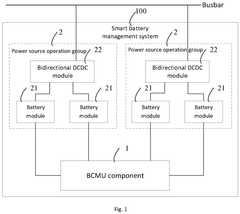
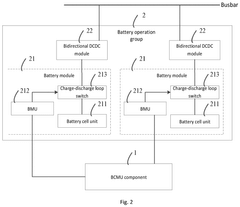
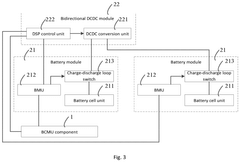
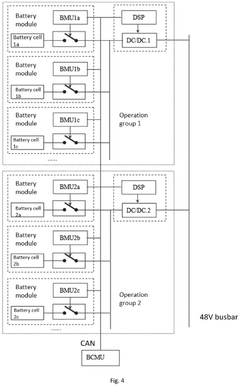
- A smart battery management system with a BCMU component and power source operation groups, where battery modules reuse bidirectional DCDC modules through polling, allowing flexible configuration and optimal energy efficiency by determining the optimal operation group starting number using an efficiency optimization algorithm.
Intelligent Battery Management System and Method for Optimizing Battery Set to the Best Performance
PatentInactiveUS20140356656A1
Innovation
- An intelligent battery management system that automatically recombines batteries in various connection configurations, allowing for individual cell monitoring and charging/discharging optimization using a connection controller, micro-processor, measurement meters, and thermal management apparatus.


Safety Standards and Regulations for BMS Design
Battery Management System design must comply with a comprehensive framework of international and regional safety standards to ensure reliable operation and prevent hazardous incidents. The primary international standard IEC 62619 establishes fundamental safety requirements for lithium-ion batteries in industrial applications, while IEC 61508 provides the functional safety framework for electronic systems. These standards mandate specific design criteria including overvoltage protection, undervoltage cutoff, overcurrent detection, and thermal management protocols.
Regional regulatory frameworks impose additional compliance requirements that vary significantly across markets. The European Union's Battery Regulation 2023/1542 introduces stringent lifecycle requirements including carbon footprint declarations and recycling obligations. In North America, UL 2580 certification is essential for automotive applications, while UL 1973 governs stationary energy storage systems. The standard requires comprehensive testing protocols including abuse testing, environmental stress testing, and electromagnetic compatibility verification.
Automotive BMS applications face particularly rigorous safety requirements under ISO 26262 functional safety standards. This framework mandates Automotive Safety Integrity Level classification ranging from ASIL-A to ASIL-D, with most BMS functions requiring ASIL-C or ASIL-D compliance. The standard necessitates systematic hazard analysis, risk assessment, and implementation of redundant safety mechanisms including independent monitoring circuits and fail-safe operational modes.
Emerging regulatory trends focus increasingly on cybersecurity and data protection aspects of connected BMS systems. The ISO/SAE 21434 standard addresses automotive cybersecurity engineering, requiring secure communication protocols, intrusion detection capabilities, and over-the-air update security measures. Additionally, environmental regulations such as RoHS and REACH compliance affect component selection and material specifications.
Compliance verification requires extensive documentation including design failure mode and effects analysis, safety case development, and third-party certification processes. Testing protocols must demonstrate performance under extreme conditions including thermal runaway scenarios, mechanical stress, and electromagnetic interference. The certification process typically involves multiple validation phases including component-level testing, system integration verification, and field validation studies.
Regional regulatory frameworks impose additional compliance requirements that vary significantly across markets. The European Union's Battery Regulation 2023/1542 introduces stringent lifecycle requirements including carbon footprint declarations and recycling obligations. In North America, UL 2580 certification is essential for automotive applications, while UL 1973 governs stationary energy storage systems. The standard requires comprehensive testing protocols including abuse testing, environmental stress testing, and electromagnetic compatibility verification.
Automotive BMS applications face particularly rigorous safety requirements under ISO 26262 functional safety standards. This framework mandates Automotive Safety Integrity Level classification ranging from ASIL-A to ASIL-D, with most BMS functions requiring ASIL-C or ASIL-D compliance. The standard necessitates systematic hazard analysis, risk assessment, and implementation of redundant safety mechanisms including independent monitoring circuits and fail-safe operational modes.
Emerging regulatory trends focus increasingly on cybersecurity and data protection aspects of connected BMS systems. The ISO/SAE 21434 standard addresses automotive cybersecurity engineering, requiring secure communication protocols, intrusion detection capabilities, and over-the-air update security measures. Additionally, environmental regulations such as RoHS and REACH compliance affect component selection and material specifications.
Compliance verification requires extensive documentation including design failure mode and effects analysis, safety case development, and third-party certification processes. Testing protocols must demonstrate performance under extreme conditions including thermal runaway scenarios, mechanical stress, and electromagnetic interference. The certification process typically involves multiple validation phases including component-level testing, system integration verification, and field validation studies.
Environmental Impact Assessment of BMS Technologies
The environmental implications of Battery Management System technologies have become increasingly critical as the global transition toward electrification accelerates. Modern BMS designs directly influence the environmental footprint of energy storage systems through their impact on battery lifecycle, resource utilization, and end-of-life management. Advanced BMS architectures that optimize energy efficiency contribute significantly to reducing overall carbon emissions by extending battery operational life and minimizing energy waste during charging and discharging cycles.
Contemporary BMS technologies demonstrate varying degrees of environmental sustainability depending on their design philosophy and implementation approach. Centralized BMS architectures typically require fewer electronic components and simplified wiring harnesses, resulting in reduced material consumption and lower manufacturing emissions. However, these systems may exhibit higher energy losses due to longer current paths and centralized monitoring limitations, potentially offsetting their material advantages over extended operational periods.
Distributed and modular BMS designs present a different environmental profile, utilizing more electronic components but offering superior energy efficiency through localized cell monitoring and control. The increased component count raises concerns about rare earth element consumption and electronic waste generation, yet the enhanced battery performance and longevity often result in net positive environmental outcomes. These systems enable more precise state-of-charge estimation and thermal management, reducing premature battery degradation and extending useful life cycles.
The manufacturing phase of BMS technologies contributes substantially to their environmental impact through semiconductor production, printed circuit board fabrication, and component assembly processes. Energy-efficient BMS designs increasingly incorporate advanced power management integrated circuits and low-power microcontrollers, which require sophisticated manufacturing processes but deliver significant operational energy savings. The environmental cost-benefit analysis must consider both the embedded carbon footprint of these advanced components and their long-term efficiency gains.
End-of-life considerations for BMS technologies reveal additional environmental challenges and opportunities. Modern BMS designs with enhanced diagnostic capabilities can facilitate more effective battery recycling by providing detailed degradation histories and remaining capacity assessments. This information enables recyclers to optimize material recovery processes and identify batteries suitable for second-life applications, thereby extending the overall environmental value of energy storage systems and reducing the demand for virgin materials in new battery production.
Contemporary BMS technologies demonstrate varying degrees of environmental sustainability depending on their design philosophy and implementation approach. Centralized BMS architectures typically require fewer electronic components and simplified wiring harnesses, resulting in reduced material consumption and lower manufacturing emissions. However, these systems may exhibit higher energy losses due to longer current paths and centralized monitoring limitations, potentially offsetting their material advantages over extended operational periods.
Distributed and modular BMS designs present a different environmental profile, utilizing more electronic components but offering superior energy efficiency through localized cell monitoring and control. The increased component count raises concerns about rare earth element consumption and electronic waste generation, yet the enhanced battery performance and longevity often result in net positive environmental outcomes. These systems enable more precise state-of-charge estimation and thermal management, reducing premature battery degradation and extending useful life cycles.
The manufacturing phase of BMS technologies contributes substantially to their environmental impact through semiconductor production, printed circuit board fabrication, and component assembly processes. Energy-efficient BMS designs increasingly incorporate advanced power management integrated circuits and low-power microcontrollers, which require sophisticated manufacturing processes but deliver significant operational energy savings. The environmental cost-benefit analysis must consider both the embedded carbon footprint of these advanced components and their long-term efficiency gains.
End-of-life considerations for BMS technologies reveal additional environmental challenges and opportunities. Modern BMS designs with enhanced diagnostic capabilities can facilitate more effective battery recycling by providing detailed degradation histories and remaining capacity assessments. This information enables recyclers to optimize material recovery processes and identify batteries suitable for second-life applications, thereby extending the overall environmental value of energy storage systems and reducing the demand for virgin materials in new battery production.
Unlock deeper insights with PatSnap Eureka Quick Research — get a full tech report to explore trends and direct your research. Try now!
Generate Your Research Report Instantly with AI Agent
Supercharge your innovation with PatSnap Eureka AI Agent Platform!