

Optimize Durability in Vanadium Redox Flow Batteries
APR 27, 20269 MIN READ
Generate Your Research Report Instantly with AI Agent
PatSnap Eureka helps you evaluate technical feasibility & market potential.
Vanadium Flow Battery Durability Background and Objectives
Vanadium Redox Flow Batteries (VRFBs) have emerged as a critical energy storage technology since their initial development in the 1980s by Maria Skyllas-Kazacos at the University of New South Wales. The technology leverages the unique property of vanadium's ability to exist in multiple oxidation states, enabling reversible electrochemical reactions that store and release electrical energy. This fundamental characteristic has positioned VRFBs as a promising solution for large-scale energy storage applications, particularly in renewable energy integration and grid stabilization.
The evolution of VRFB technology has been driven by the increasing global demand for reliable, long-duration energy storage systems. Unlike conventional battery technologies, VRFBs offer the distinct advantage of decoupled power and energy capacity, allowing for flexible system design and scalability. However, the widespread commercial adoption of VRFBs has been significantly hindered by durability challenges that directly impact their economic viability and operational reliability.
Current durability limitations in VRFBs manifest through multiple degradation mechanisms that collectively reduce system performance and lifespan. Electrolyte degradation represents a primary concern, where vanadium species undergo irreversible side reactions, leading to capacity fade and efficiency losses. Membrane degradation poses another critical challenge, as ion-exchange membranes suffer from chemical attack, mechanical stress, and fouling, resulting in increased crossover rates and reduced selectivity.
The carbon-based electrode materials, while providing necessary electrochemical activity, experience surface oxidation, corrosion, and structural changes that diminish their catalytic properties over extended operation periods. Additionally, system components including pumps, seals, and piping face corrosion challenges due to the acidic electrolyte environment, contributing to maintenance requirements and operational costs.
The primary objective of optimizing VRFB durability centers on extending operational lifespan from current industry standards of 10-15 years to target lifespans exceeding 20-25 years. This enhancement directly correlates with improved economic competitiveness against alternative energy storage technologies. Key performance targets include maintaining electrolyte stability with minimal capacity degradation over thousands of charge-discharge cycles, achieving membrane longevity with sustained selectivity and low resistance, and ensuring electrode materials retain their electrochemical activity throughout extended operation.
Furthermore, the durability optimization efforts aim to reduce total cost of ownership by minimizing maintenance requirements, extending component replacement intervals, and improving overall system reliability. These objectives align with the broader goal of establishing VRFBs as a mainstream energy storage solution capable of supporting the global transition toward renewable energy systems and enhanced grid resilience.
The evolution of VRFB technology has been driven by the increasing global demand for reliable, long-duration energy storage systems. Unlike conventional battery technologies, VRFBs offer the distinct advantage of decoupled power and energy capacity, allowing for flexible system design and scalability. However, the widespread commercial adoption of VRFBs has been significantly hindered by durability challenges that directly impact their economic viability and operational reliability.
Current durability limitations in VRFBs manifest through multiple degradation mechanisms that collectively reduce system performance and lifespan. Electrolyte degradation represents a primary concern, where vanadium species undergo irreversible side reactions, leading to capacity fade and efficiency losses. Membrane degradation poses another critical challenge, as ion-exchange membranes suffer from chemical attack, mechanical stress, and fouling, resulting in increased crossover rates and reduced selectivity.
The carbon-based electrode materials, while providing necessary electrochemical activity, experience surface oxidation, corrosion, and structural changes that diminish their catalytic properties over extended operation periods. Additionally, system components including pumps, seals, and piping face corrosion challenges due to the acidic electrolyte environment, contributing to maintenance requirements and operational costs.
The primary objective of optimizing VRFB durability centers on extending operational lifespan from current industry standards of 10-15 years to target lifespans exceeding 20-25 years. This enhancement directly correlates with improved economic competitiveness against alternative energy storage technologies. Key performance targets include maintaining electrolyte stability with minimal capacity degradation over thousands of charge-discharge cycles, achieving membrane longevity with sustained selectivity and low resistance, and ensuring electrode materials retain their electrochemical activity throughout extended operation.
Furthermore, the durability optimization efforts aim to reduce total cost of ownership by minimizing maintenance requirements, extending component replacement intervals, and improving overall system reliability. These objectives align with the broader goal of establishing VRFBs as a mainstream energy storage solution capable of supporting the global transition toward renewable energy systems and enhanced grid resilience.
Market Demand for Long-Duration Energy Storage Systems
The global energy storage market is experiencing unprecedented growth driven by the urgent need for grid stabilization and renewable energy integration. Long-duration energy storage systems, particularly those capable of storing energy for 4-12 hours or longer, have emerged as critical infrastructure components for modern power grids. This demand stems from the inherent intermittency challenges posed by solar and wind power generation, which require robust storage solutions to ensure continuous electricity supply during periods of low renewable output.
Utility-scale applications represent the largest market segment for long-duration energy storage, where grid operators seek reliable solutions for peak shaving, load balancing, and frequency regulation. The increasing penetration of renewable energy sources has created substantial market opportunities for technologies that can provide sustained power output over extended periods. Vanadium redox flow batteries are particularly well-positioned to address this demand due to their ability to decouple power and energy capacity, allowing for flexible system sizing based on specific duration requirements.
Industrial and commercial sectors are driving additional demand for long-duration storage systems, particularly in regions with high electricity costs or unreliable grid infrastructure. Manufacturing facilities, data centers, and critical infrastructure operators increasingly require backup power systems that can operate for extended periods without degradation. The durability challenges in vanadium redox flow batteries directly impact their competitiveness in these applications, where system reliability and operational longevity are paramount considerations for investment decisions.
Emerging markets in developing countries present significant growth opportunities for long-duration energy storage, particularly in off-grid and microgrid applications. These markets often lack established electrical infrastructure and rely heavily on diesel generators, creating substantial demand for clean, reliable energy storage solutions. The ability to optimize durability in vanadium redox flow batteries could unlock these markets by reducing maintenance requirements and extending system lifespans in challenging operating environments.
The market demand is further amplified by supportive policy frameworks and financial incentives promoting energy storage deployment. Government initiatives worldwide are establishing storage mandates and providing subsidies for grid-scale energy storage projects, creating a favorable environment for advanced battery technologies that can demonstrate superior durability and performance characteristics.
Utility-scale applications represent the largest market segment for long-duration energy storage, where grid operators seek reliable solutions for peak shaving, load balancing, and frequency regulation. The increasing penetration of renewable energy sources has created substantial market opportunities for technologies that can provide sustained power output over extended periods. Vanadium redox flow batteries are particularly well-positioned to address this demand due to their ability to decouple power and energy capacity, allowing for flexible system sizing based on specific duration requirements.
Industrial and commercial sectors are driving additional demand for long-duration storage systems, particularly in regions with high electricity costs or unreliable grid infrastructure. Manufacturing facilities, data centers, and critical infrastructure operators increasingly require backup power systems that can operate for extended periods without degradation. The durability challenges in vanadium redox flow batteries directly impact their competitiveness in these applications, where system reliability and operational longevity are paramount considerations for investment decisions.
Emerging markets in developing countries present significant growth opportunities for long-duration energy storage, particularly in off-grid and microgrid applications. These markets often lack established electrical infrastructure and rely heavily on diesel generators, creating substantial demand for clean, reliable energy storage solutions. The ability to optimize durability in vanadium redox flow batteries could unlock these markets by reducing maintenance requirements and extending system lifespans in challenging operating environments.
The market demand is further amplified by supportive policy frameworks and financial incentives promoting energy storage deployment. Government initiatives worldwide are establishing storage mandates and providing subsidies for grid-scale energy storage projects, creating a favorable environment for advanced battery technologies that can demonstrate superior durability and performance characteristics.
Current Durability Challenges in VRFB Technology
Vanadium Redox Flow Batteries face significant durability challenges that limit their widespread commercial deployment and long-term operational viability. The primary constraint stems from membrane degradation, where ion-exchange membranes experience chemical and mechanical deterioration under continuous exposure to vanadium ions and acidic electrolytes. This degradation manifests as increased vanadium crossover rates, reduced coulombic efficiency, and eventual membrane failure, typically occurring within 5-10 years of operation.
Electrolyte stability represents another critical durability bottleneck. Vanadium electrolytes undergo precipitation reactions at elevated temperatures and concentrations, leading to the formation of V2O5 and other insoluble compounds. These precipitates can clog flow channels, damage pumps, and reduce active material availability. Temperature fluctuations exacerbate this issue, with precipitation becoming particularly problematic above 40°C, severely limiting operational temperature ranges.
Carbon electrode degradation poses substantial challenges to long-term performance. Carbon felt and graphite electrodes experience oxidation and corrosion in the highly acidic vanadium environment, particularly at the positive electrode where V5+ species create strongly oxidizing conditions. This degradation results in reduced surface area, decreased electrochemical activity, and increased resistance, leading to capacity fade and efficiency losses over time.
Corrosion of metallic components, including current collectors, bipolar plates, and flow field structures, significantly impacts system durability. Despite protective coatings, these components face continuous exposure to corrosive vanadium electrolytes, leading to material degradation, contamination of electrolytes with metal ions, and potential system failure. Titanium and carbon-based materials show better resistance but remain susceptible to long-term degradation.
Thermal management challenges compound durability issues, as VRFB systems generate heat during operation while requiring temperature control to prevent electrolyte precipitation. Inadequate thermal management accelerates all degradation mechanisms, creating a cascade effect that reduces overall system lifespan.
Capacity fade represents the cumulative effect of these degradation mechanisms, with typical VRFB systems experiencing 2-5% annual capacity loss. This degradation rate significantly impacts the economic viability of long-duration energy storage applications, where 20-25 year operational lifespans are essential for cost-effectiveness.
Electrolyte stability represents another critical durability bottleneck. Vanadium electrolytes undergo precipitation reactions at elevated temperatures and concentrations, leading to the formation of V2O5 and other insoluble compounds. These precipitates can clog flow channels, damage pumps, and reduce active material availability. Temperature fluctuations exacerbate this issue, with precipitation becoming particularly problematic above 40°C, severely limiting operational temperature ranges.
Carbon electrode degradation poses substantial challenges to long-term performance. Carbon felt and graphite electrodes experience oxidation and corrosion in the highly acidic vanadium environment, particularly at the positive electrode where V5+ species create strongly oxidizing conditions. This degradation results in reduced surface area, decreased electrochemical activity, and increased resistance, leading to capacity fade and efficiency losses over time.
Corrosion of metallic components, including current collectors, bipolar plates, and flow field structures, significantly impacts system durability. Despite protective coatings, these components face continuous exposure to corrosive vanadium electrolytes, leading to material degradation, contamination of electrolytes with metal ions, and potential system failure. Titanium and carbon-based materials show better resistance but remain susceptible to long-term degradation.
Thermal management challenges compound durability issues, as VRFB systems generate heat during operation while requiring temperature control to prevent electrolyte precipitation. Inadequate thermal management accelerates all degradation mechanisms, creating a cascade effect that reduces overall system lifespan.
Capacity fade represents the cumulative effect of these degradation mechanisms, with typical VRFB systems experiencing 2-5% annual capacity loss. This degradation rate significantly impacts the economic viability of long-duration energy storage applications, where 20-25 year operational lifespans are essential for cost-effectiveness.
Existing Durability Enhancement Technologies for VRFBs
01 Electrolyte composition optimization for enhanced durability
Optimization of vanadium electrolyte compositions through the use of specific additives, stabilizers, and concentration adjustments to improve the chemical stability and reduce degradation over extended cycling periods. These formulations help maintain consistent performance and extend the operational lifespan of the battery system by preventing unwanted side reactions and electrolyte deterioration.- Electrolyte composition optimization for enhanced durability: Optimization of vanadium electrolyte compositions through the use of specific additives, stabilizers, and concentration adjustments to improve the chemical stability and reduce degradation over extended cycling periods. These formulations help maintain consistent performance and extend the operational lifespan of the battery system by preventing unwanted side reactions and electrolyte deterioration.
- Membrane materials and ion exchange improvements: Development of advanced membrane technologies and ion exchange materials that provide better selectivity, reduced crossover, and enhanced chemical resistance. These improvements focus on maintaining membrane integrity under harsh operating conditions while ensuring optimal ion transport properties throughout the battery's operational lifetime.
- Electrode and current collector durability enhancement: Innovations in electrode materials and current collector designs that resist corrosion, maintain electrical conductivity, and provide stable electrochemical performance over numerous charge-discharge cycles. These developments include surface treatments, material coatings, and structural modifications to prevent degradation in the acidic vanadium electrolyte environment.
- System design and operational parameter optimization: Comprehensive approaches to battery system design including flow management, temperature control, and operational parameter optimization to minimize stress on components and extend overall system durability. These methods focus on maintaining optimal operating conditions and preventing conditions that could lead to premature component failure or performance degradation.
- Monitoring and maintenance strategies for longevity: Advanced monitoring systems and maintenance protocols designed to track battery health, predict component degradation, and implement preventive measures to extend operational life. These approaches include real-time diagnostics, predictive analytics, and automated maintenance procedures that help maintain optimal performance and prevent unexpected failures.
02 Membrane materials and modifications for improved longevity
Development of advanced ion-exchange membranes and membrane modification techniques to enhance chemical resistance, reduce vanadium crossover, and maintain structural integrity during long-term operation. These improvements focus on membrane durability under acidic conditions and high vanadium concentrations to ensure stable battery performance over thousands of charge-discharge cycles.Expand Specific Solutions03 Electrode design and materials for extended cycle life
Innovation in electrode materials, surface treatments, and structural designs to improve electrochemical stability and reduce degradation during repeated charging and discharging cycles. These advancements focus on enhancing the catalytic activity while maintaining electrode integrity and preventing corrosion or mechanical failure over extended periods of operation.Expand Specific Solutions04 System design and operational strategies for durability enhancement
Implementation of advanced battery management systems, flow control mechanisms, and operational protocols to optimize battery performance and extend service life. These approaches include temperature management, flow rate optimization, and charge-discharge control strategies that minimize stress on battery components and prevent conditions that could lead to premature degradation.Expand Specific Solutions05 Corrosion resistance and component protection methods
Development of corrosion-resistant materials, protective coatings, and component designs to withstand the harsh acidic environment of vanadium redox flow batteries. These solutions address the degradation of metallic components, current collectors, and other structural elements that are exposed to corrosive vanadium electrolytes, ensuring long-term structural integrity and electrical conductivity.Expand Specific Solutions
Key Players in VRFB Manufacturing and Research
The vanadium redox flow battery (VRFB) durability optimization sector represents an emerging but rapidly maturing market segment within the broader energy storage industry. The industry is transitioning from early research phases to commercial deployment, with market growth driven by increasing demand for long-duration energy storage solutions. Key players demonstrate varying levels of technological maturity: established companies like Sumitomo Electric Industries and LG Chem leverage extensive manufacturing capabilities, while specialized firms such as VFlowTech and VRB Energy focus exclusively on VRFB technology development. Research institutions including Dalian Institute of Chemical Physics and Central South University contribute fundamental materials science advances, particularly in electrolyte and membrane technologies. The competitive landscape shows a mix of Asian dominance, with Chinese companies like Dalian Rongke Power leading commercialization efforts, alongside established Japanese and Korean industrial giants integrating VRFB solutions into broader energy portfolios, indicating strong technological maturation potential.
Dalian Institute of Chemical Physics of CAS
Technical Solution: The institute has pioneered research in vanadium electrolyte chemistry optimization and membrane development for enhanced durability. Their work focuses on novel ion-exchange membranes with improved selectivity and chemical stability under acidic conditions. Research includes development of modified carbon electrodes with enhanced catalytic activity and corrosion resistance. The institute has also developed advanced electrolyte purification techniques and stabilization methods to prevent vanadium precipitation and maintain electrolyte quality over thousands of charge-discharge cycles, significantly extending battery operational lifetime.
Strengths: Leading research institution with deep fundamental knowledge and innovative membrane technologies. Weaknesses: Academic focus may limit commercial scalability and market deployment speed.
Sumitomo Electric Industries Ltd.
Technical Solution: Sumitomo Electric has developed advanced redox flow battery systems with focus on durability through improved cell stack design and electrolyte circulation systems. Their technology incorporates high-performance carbon electrodes with enhanced surface treatments and optimized pore structures for improved electrochemical performance. The company has developed sophisticated electrolyte management systems with automated monitoring and maintenance protocols. Their approach includes advanced sealing technologies and corrosion-resistant materials for critical components, ensuring long-term operational stability and reduced maintenance requirements in industrial applications.
Strengths: Strong industrial manufacturing base with proven reliability in power systems and extensive material science expertise. Weaknesses: Diversified business focus may limit dedicated VRFB development resources compared to specialized companies.
Core Innovations in VRFB Component Longevity
Chloride-free electrolyte composition for prolonged operation at high temperatures (>40°c) in vanadium redox flow batteries
PatentPendingUS20240136558A1
Innovation
- An electrolyte composition comprising vanadium ions, sulfate ions, and phosphoric acid, with specific concentration ranges and ratios, providing high conductivity and thermal stability from 0°C to 60°C without the need for chloride additives, achieved by adjusting sulfuric acid and phosphoric acid concentrations in the electrolyte solution.
Redox flow battery
PatentWO2011136256A1
Innovation
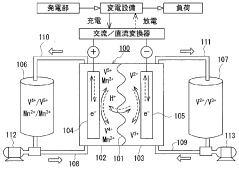
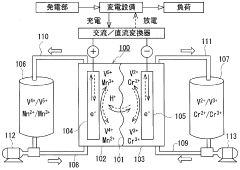
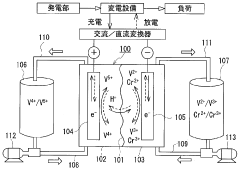
- Incorporating vanadium ions with metal ions having nobler or less noble oxidation-reduction potentials into the electrolyte solutions of redox flow batteries, specifically at the positive and negative electrodes, to suppress side reactions and increase the utilization rate of vanadium ions.
Environmental Impact Assessment of VRFB Lifecycle
The environmental impact assessment of Vanadium Redox Flow Battery (VRFB) lifecycle reveals a complex interplay between manufacturing processes, operational efficiency, and end-of-life management. Unlike conventional lithium-ion batteries, VRFBs demonstrate superior environmental performance through their extended operational lifespan and recyclability characteristics, which directly correlate with durability optimization efforts.
Manufacturing phase analysis indicates that vanadium extraction and electrolyte preparation constitute the primary environmental burden, accounting for approximately 60-70% of total lifecycle carbon emissions. The production of high-purity vanadium pentoxide requires energy-intensive processes, generating significant CO2 emissions ranging from 15-25 kg CO2 equivalent per kWh of installed capacity. However, the environmental cost per unit energy throughput decreases substantially with enhanced battery durability.
Operational environmental benefits become pronounced through extended cycle life capabilities. VRFBs optimized for durability can achieve over 20,000 charge-discharge cycles with minimal capacity degradation, compared to 3,000-5,000 cycles for conventional batteries. This longevity translates to reduced replacement frequency and lower cumulative environmental impact per unit of energy stored and delivered throughout the system's operational lifetime.
Water consumption represents another critical environmental consideration, particularly in electrolyte preparation and system cooling. Advanced durability optimization strategies, including improved membrane technologies and electrolyte management systems, can reduce water usage by 30-40% while maintaining performance standards. These improvements also minimize the risk of electrolyte leakage and associated soil contamination.
End-of-life environmental impact assessment reveals significant advantages for durable VRFB systems. The vanadium electrolyte maintains its chemical properties throughout the battery's operational life, enabling near-complete recovery and reuse. Studies indicate that over 95% of vanadium can be recovered and reprocessed, substantially reducing the need for virgin material extraction and associated environmental impacts.
Comparative lifecycle assessments demonstrate that durability-optimized VRFBs exhibit 40-60% lower environmental impact per MWh delivered compared to conventional energy storage technologies. The extended operational lifespan effectively amortizes the initial manufacturing environmental burden across a larger energy throughput, resulting in improved overall sustainability metrics and supporting the economic viability of long-duration energy storage applications.
Manufacturing phase analysis indicates that vanadium extraction and electrolyte preparation constitute the primary environmental burden, accounting for approximately 60-70% of total lifecycle carbon emissions. The production of high-purity vanadium pentoxide requires energy-intensive processes, generating significant CO2 emissions ranging from 15-25 kg CO2 equivalent per kWh of installed capacity. However, the environmental cost per unit energy throughput decreases substantially with enhanced battery durability.
Operational environmental benefits become pronounced through extended cycle life capabilities. VRFBs optimized for durability can achieve over 20,000 charge-discharge cycles with minimal capacity degradation, compared to 3,000-5,000 cycles for conventional batteries. This longevity translates to reduced replacement frequency and lower cumulative environmental impact per unit of energy stored and delivered throughout the system's operational lifetime.
Water consumption represents another critical environmental consideration, particularly in electrolyte preparation and system cooling. Advanced durability optimization strategies, including improved membrane technologies and electrolyte management systems, can reduce water usage by 30-40% while maintaining performance standards. These improvements also minimize the risk of electrolyte leakage and associated soil contamination.
End-of-life environmental impact assessment reveals significant advantages for durable VRFB systems. The vanadium electrolyte maintains its chemical properties throughout the battery's operational life, enabling near-complete recovery and reuse. Studies indicate that over 95% of vanadium can be recovered and reprocessed, substantially reducing the need for virgin material extraction and associated environmental impacts.
Comparative lifecycle assessments demonstrate that durability-optimized VRFBs exhibit 40-60% lower environmental impact per MWh delivered compared to conventional energy storage technologies. The extended operational lifespan effectively amortizes the initial manufacturing environmental burden across a larger energy throughput, resulting in improved overall sustainability metrics and supporting the economic viability of long-duration energy storage applications.
Safety Standards for Industrial VRFB Applications
Industrial vanadium redox flow battery applications require comprehensive safety standards to ensure reliable operation and protect personnel, equipment, and the environment. Current safety frameworks for VRFB systems encompass multiple regulatory domains, including electrical safety codes, chemical handling protocols, and fire protection standards. The International Electrotechnical Commission (IEC) 62933 series provides foundational guidelines for electrical energy storage systems, while specific VRFB safety considerations are addressed through emerging standards such as UL 1973 and IEEE 1679.
Electrical safety standards for industrial VRFB installations focus on system grounding, arc fault protection, and emergency shutdown procedures. These requirements mandate redundant safety systems, including ground fault detection circuits, thermal monitoring systems, and automated isolation mechanisms. Power conversion equipment must comply with IEEE 519 harmonic distortion limits and maintain proper electrical clearances as specified in NFPA 70 National Electrical Code.
Chemical safety protocols address the handling, storage, and containment of vanadium electrolyte solutions. Industrial installations must implement secondary containment systems capable of holding 110% of the largest electrolyte tank volume. Ventilation systems require compliance with ASHRAE standards to manage potential hydrogen gas emissions during charging cycles. Personnel protection equipment specifications include acid-resistant materials and emergency eyewash stations positioned within immediate reach of electrolyte handling areas.
Fire safety standards for VRFB systems differ significantly from lithium-ion battery requirements due to the non-flammable nature of vanadium electrolytes. However, installations must address potential risks from electrical components and auxiliary systems. NFPA 855 provides guidance for energy storage system fire protection, emphasizing detection systems, suppression methods, and emergency response procedures tailored to flow battery characteristics.
Environmental safety standards govern electrolyte disposal, recycling protocols, and spill response procedures. Industrial VRFB installations must maintain Material Safety Data Sheets for all vanadium compounds and implement waste management procedures compliant with EPA regulations. Regular environmental monitoring ensures compliance with discharge limits and groundwater protection requirements.
Emerging safety standards specifically address VRFB operational characteristics, including electrolyte crossover detection, membrane integrity monitoring, and long-term system degradation assessment. These evolving requirements reflect growing industrial deployment experience and aim to establish comprehensive safety frameworks that support widespread VRFB adoption while maintaining rigorous protection standards.
Electrical safety standards for industrial VRFB installations focus on system grounding, arc fault protection, and emergency shutdown procedures. These requirements mandate redundant safety systems, including ground fault detection circuits, thermal monitoring systems, and automated isolation mechanisms. Power conversion equipment must comply with IEEE 519 harmonic distortion limits and maintain proper electrical clearances as specified in NFPA 70 National Electrical Code.
Chemical safety protocols address the handling, storage, and containment of vanadium electrolyte solutions. Industrial installations must implement secondary containment systems capable of holding 110% of the largest electrolyte tank volume. Ventilation systems require compliance with ASHRAE standards to manage potential hydrogen gas emissions during charging cycles. Personnel protection equipment specifications include acid-resistant materials and emergency eyewash stations positioned within immediate reach of electrolyte handling areas.
Fire safety standards for VRFB systems differ significantly from lithium-ion battery requirements due to the non-flammable nature of vanadium electrolytes. However, installations must address potential risks from electrical components and auxiliary systems. NFPA 855 provides guidance for energy storage system fire protection, emphasizing detection systems, suppression methods, and emergency response procedures tailored to flow battery characteristics.
Environmental safety standards govern electrolyte disposal, recycling protocols, and spill response procedures. Industrial VRFB installations must maintain Material Safety Data Sheets for all vanadium compounds and implement waste management procedures compliant with EPA regulations. Regular environmental monitoring ensures compliance with discharge limits and groundwater protection requirements.
Emerging safety standards specifically address VRFB operational characteristics, including electrolyte crossover detection, membrane integrity monitoring, and long-term system degradation assessment. These evolving requirements reflect growing industrial deployment experience and aim to establish comprehensive safety frameworks that support widespread VRFB adoption while maintaining rigorous protection standards.
Unlock deeper insights with PatSnap Eureka Quick Research — get a full tech report to explore trends and direct your research. Try now!
Generate Your Research Report Instantly with AI Agent
Supercharge your innovation with PatSnap Eureka AI Agent Platform!