

Optimize Hydroxylamine Waste Neutralization for Lower Emissions
NOV 18, 20269 MIN READ
Generate Your Research Report Instantly with AI Agent
Patsnap Eureka helps you evaluate technical feasibility & market potential.
Hydroxylamine Waste Treatment Background and Objectives
Hydroxylamine and its derivatives have been extensively utilized in semiconductor manufacturing, pharmaceutical synthesis, and chemical processing industries since the mid-20th century. As a powerful reducing agent and oxygen scavenger, hydroxylamine serves critical functions in photoresist stripping, metal surface treatment, and organic synthesis. However, the waste streams generated from these processes pose significant environmental and safety challenges due to hydroxylamine's inherent instability and potential for exothermic decomposition. Traditional neutralization methods often result in substantial emissions of nitrogen oxides, ammonia, and other hazardous byproducts, contributing to air quality degradation and greenhouse gas inventories.
The evolution of hydroxylamine waste treatment has progressed through several phases, from simple dilution and discharge practices in early industrial applications to more sophisticated chemical neutralization approaches. Current regulatory frameworks, particularly in developed economies, impose stringent limits on nitrogen compound emissions and mandate comprehensive waste management protocols. The semiconductor industry's rapid expansion and increasingly complex manufacturing processes have intensified the volume and concentration of hydroxylamine-containing waste streams, necessitating more efficient and environmentally responsible treatment solutions.
The primary objective of this technical investigation is to identify and evaluate advanced neutralization strategies that minimize atmospheric emissions while maintaining operational safety and economic viability. Specific goals include reducing nitrogen oxide emissions by at least fifty percent compared to conventional methods, eliminating ammonia slip during treatment processes, and achieving complete hydroxylamine decomposition without generating secondary pollutants. Additionally, the research aims to develop scalable solutions applicable across various industrial settings, from high-volume semiconductor fabrication facilities to smaller-scale pharmaceutical operations.
Another critical objective involves optimizing reaction kinetics and process parameters to enhance treatment efficiency while reducing energy consumption and chemical reagent usage. The investigation seeks to establish best practices for real-time monitoring and control systems that ensure consistent treatment performance under varying waste composition conditions. Ultimately, these efforts aim to support industry compliance with evolving environmental regulations while reducing operational costs and improving workplace safety standards.
Market Demand for Green Neutralization Solutions
The global chemical manufacturing sector is experiencing intensified regulatory pressure to reduce hazardous emissions and adopt environmentally responsible waste treatment practices. Hydroxylamine, widely utilized in pharmaceutical synthesis, agrochemical production, and semiconductor manufacturing, generates waste streams that pose significant environmental and safety challenges. Traditional neutralization methods often produce nitrogen oxides, ammonia emissions, and secondary pollutants that conflict with increasingly stringent environmental standards across major industrial regions.
Regulatory frameworks such as the European Union's Industrial Emissions Directive and China's updated emission standards for the chemical industry have established strict limits on nitrogen compound releases. These policies are driving manufacturers to seek advanced neutralization technologies that minimize atmospheric emissions while maintaining operational efficiency. The pharmaceutical and fine chemical sectors, which account for substantial hydroxylamine consumption, face particular scrutiny due to their proximity to populated areas and cumulative environmental impact.
Market demand for green neutralization solutions is further amplified by corporate sustainability commitments and supply chain requirements. Major pharmaceutical companies and semiconductor manufacturers are implementing zero-emission targets and requiring suppliers to demonstrate verifiable emission reductions. This creates cascading demand throughout the value chain for proven technologies that can achieve compliance while reducing operational costs associated with emission control equipment and regulatory penalties.
Economic incentives are aligning with environmental imperatives as carbon pricing mechanisms and emission trading systems expand globally. Facilities that successfully implement low-emission neutralization processes gain competitive advantages through reduced compliance costs and enhanced market access. The growing emphasis on environmental, social, and governance criteria in investment decisions further accelerates adoption of cleaner technologies.
The Asia-Pacific region represents a particularly dynamic market segment, driven by rapid industrial expansion coupled with tightening environmental regulations. Emerging economies are simultaneously scaling chemical production capacity and implementing stricter emission controls, creating urgent demand for optimized neutralization solutions that balance environmental performance with economic viability. This regional dynamic is expected to sustain robust market growth for innovative waste treatment technologies addressing hydroxylamine and similar reactive nitrogen compounds.
Current Challenges in Hydroxylamine Waste Emission Control
Hydroxylamine waste neutralization faces multiple technical and operational challenges that significantly impact emission control effectiveness. The primary difficulty stems from the compound's inherent chemical instability and its tendency to decompose exothermically under various conditions. During neutralization processes, uncontrolled reactions can generate nitrogen oxides, ammonia, and other volatile compounds that contribute to atmospheric pollution. Traditional neutralization methods often struggle to maintain optimal reaction conditions, leading to incomplete conversion and secondary pollutant formation.
Temperature management represents a critical challenge in hydroxylamine waste treatment. The neutralization reaction is highly exothermic, and inadequate heat dissipation can trigger thermal runaway scenarios. This not only poses safety risks but also accelerates the decomposition of hydroxylamine into gaseous emissions. Existing cooling systems frequently lack the precision required to maintain the narrow temperature window necessary for controlled neutralization, particularly when processing large volumes or concentrated waste streams.
The variability in waste composition further complicates emission control efforts. Hydroxylamine waste from different industrial processes contains varying concentrations of the active compound along with diverse contaminants including metal ions, organic residues, and other reactive species. These impurities can catalyze unwanted side reactions, alter neutralization kinetics, and generate unexpected emission profiles. Current treatment protocols often lack the flexibility to adapt to these compositional variations effectively.
Monitoring and control systems present another significant obstacle. Real-time detection of hydroxylamine concentration and decomposition products during neutralization remains technically challenging. The absence of reliable inline sensors forces operators to rely on batch sampling and offline analysis, creating delays in process adjustments. This reactive rather than proactive approach results in emission spikes during process upsets or feed composition changes.
Economic constraints also limit the adoption of advanced emission control technologies. Many facilities continue operating legacy neutralization systems due to the substantial capital investment required for upgrades. The balance between treatment efficiency, operational costs, and regulatory compliance creates pressure to optimize existing infrastructure rather than implement comprehensive solutions. This situation is particularly acute in regions with less stringent environmental regulations, where economic considerations often outweigh emission reduction priorities.
Existing Hydroxylamine Neutralization Methods
01 Hydroxylamine chemical waste treatment and preparation processes
Processes and methods specifically targeting the disposal, treatment, or preparation involving hydroxylamine compounds and their salts from waste sources. These technical solutions allow for the safe disposal of hydroxylamine nitrate in wastewater, catalytic synthesis of hydroxylamine sulphate solutions, and the preparation of hydroxylamine hydrochloride using fly ash to achieve hazardous waste resource utilization.- Treatment and Disposal of Hydroxylamine and Nitrogenous Waste: Methods and processes focused on the chemical treatment, preparation, hydrolysis, and safe disposal of hydroxylamine compounds and ammonia-containing waste liquids to manage chemical hazards.
- General Acid and Base Waste Liquid Neutralization Systems: Apparatuses and systems designed for the neutralization of industrial waste liquids, including acidic waste streams, waste sulfuric acid, mixed waste acids, and alkali wastewater.
- Carbon Neutrality Target and Carbon Emission Tracking Systems: Analytical tools, accounting methods, and software platforms used for calculating, estimating, tracking, and evaluating carbon emissions across various industries to support carbon neutrality goals.
- Industrial Flue Gas, Acid Mist, and Waste Heat Recovery Devices: Engineering devices and systems designed to capture carbon emissions, recover waste heat from gas boilers, and collect multi-source acid mist generated during waste neutralization processes.
- Solid and Hazardous Industrial Waste Neutralization Technologies: Process methods and specific equipment aimed at neutralizing and solidifying various hazardous solid wastes, well-drilling waste, fly ash, and medical or specialized equipment effluents.
02 Acidic and basic waste liquid neutralization systems
Apparatus and multi-stage methods designed to treat acidic or alkaline industrial wastewater and waste fluids through chemical neutralization. These implementations include specialized reaction devices for acidic waste liquids, quicklime recovery devices, multi-step alkali wastewater treatment systems, and acid mist collection integrated devices to effectively manage liquid industrial waste.Expand Specific Solutions03 Ammonia and boiler wastewater neutralization technologies
Methods and systems specifically tailored for the neutralization processing of ammonia-containing waste liquids and boiler waste streams. These systems neutralize chemical pollutants in specialized industrial effluent streams to safely treat ammonia-rich fluids and industrial boiler run-offs.Expand Specific Solutions04 Carbon emission tracking and carbon neutralization evaluation systems
Analytical methods, algorithms, and management platforms for calculating, tracking, and evaluating carbon emissions across different lifecycle stages to achieve carbon neutralization targets. These solutions cover carbon emission estimation for water plants, reference value calculations for the service and manufacturing sectors, and data analysis systems for industrial processes.Expand Specific Solutions05 Industrial exhaust and flue gas carbon neutralization devices
Equipment and specialized devices constructed to capture emissions, purify gas streams, and recover waste heat to reach carbon neutrality goals. Features include industrial waste gas treatment apparatuses, flue gas deep waste heat recovery systems for gas boiler rooms, and autonomous waste-to-energy emission neutralization systems.Expand Specific Solutions
Key Players in Chemical Waste Treatment Industry
The hydroxylamine waste neutralization sector represents a mature industrial challenge within the broader chemical processing and environmental control industry, currently in an optimization phase focused on emission reduction and sustainability improvements. The market encompasses established chemical manufacturers like BASF SE, Sumitomo Chemical, and China Petrochemical Corp., alongside specialized environmental technology providers such as Fuel Tech Inc. and equipment manufacturers including Mitsubishi Heavy Industries and Ebara Corp. Technology maturity varies significantly across players, with major petrochemical corporations like Dow Global Technologies and pharmaceutical manufacturers such as Zhejiang Huahai Pharmaceutical possessing advanced waste treatment capabilities, while emerging innovators like N2 Applied AS are developing novel nitrogen recovery approaches. Academic institutions including Yale University, South China University of Technology, and Guizhou University contribute fundamental research, supporting continuous process improvements. The competitive landscape reflects a transition toward circular economy principles, with companies integrating waste neutralization into broader sustainability strategies.
Fuel Tech, Inc.
Technical Solution: Fuel Tech specializes in NOx reduction technologies applicable to hydroxylamine waste neutralization processes. Their FUEL CHEM technology utilizes chemical additives and process optimization to control emissions during waste treatment operations[3][5]. The system employs computational fluid dynamics modeling to optimize injection points for neutralizing agents, ensuring complete reaction while minimizing off-gas emissions. Their approach includes staged neutralization protocols where hydroxylamine concentrations are gradually reduced through controlled addition of oxidizing agents, preventing sudden decomposition that generates excessive nitrogen oxides. The technology integrates with existing waste treatment infrastructure and provides continuous emissions monitoring capabilities, achieving NOx reduction rates of 70-85% in industrial applications[6][9].
Strengths: Retrofit-compatible with existing facilities; proven track record in emission control; cost-effective implementation for medium-scale operations. Weaknesses: Lower emission reduction rates compared to catalytic methods; requires ongoing chemical additive costs; performance variability depending on waste stream composition.
BASF SE
Technical Solution: BASF has developed advanced neutralization technologies for hydroxylamine waste management utilizing multi-stage treatment processes. Their approach combines controlled pH adjustment with catalytic decomposition systems, where hydroxylamine is neutralized using diluted acids or bases in temperature-controlled reactors (15-25°C) to prevent exothermic runaway reactions[1][4]. The system incorporates real-time monitoring of NOx emissions and employs selective catalytic reduction (SCR) technology to minimize nitrogen oxide releases during neutralization. BASF's process includes a scrubbing system that captures volatile nitrogen compounds, achieving emission reduction rates exceeding 95% compared to conventional methods[2][7]. The technology also features automated dosing systems that optimize reagent consumption while maintaining safety parameters throughout the neutralization cycle.
Strengths: Comprehensive emission control with proven industrial-scale implementation; integrated safety monitoring systems; high NOx capture efficiency. Weaknesses: Requires significant capital investment for equipment installation; complex operational requirements demanding skilled personnel; higher maintenance costs for catalytic systems.
Core Patents in Low-Emission Neutralization Processes
Decomposition of residual hydroxylamine by hydrogen peroxide treatment
PatentInactiveUS6355179B1
Innovation
- Contacting the hydroxylamine-containing wastewater stream with hydrogen peroxide at neutral pH and elevated temperature, with the presence of ammonium ions accelerating the decomposition process, achieving a molar ratio of hydrogen peroxide to hydroxylamine greater than 55% for substantial decomposition.
A method for treating hydroxylamine wastewater
PatentActiveCN109205840B
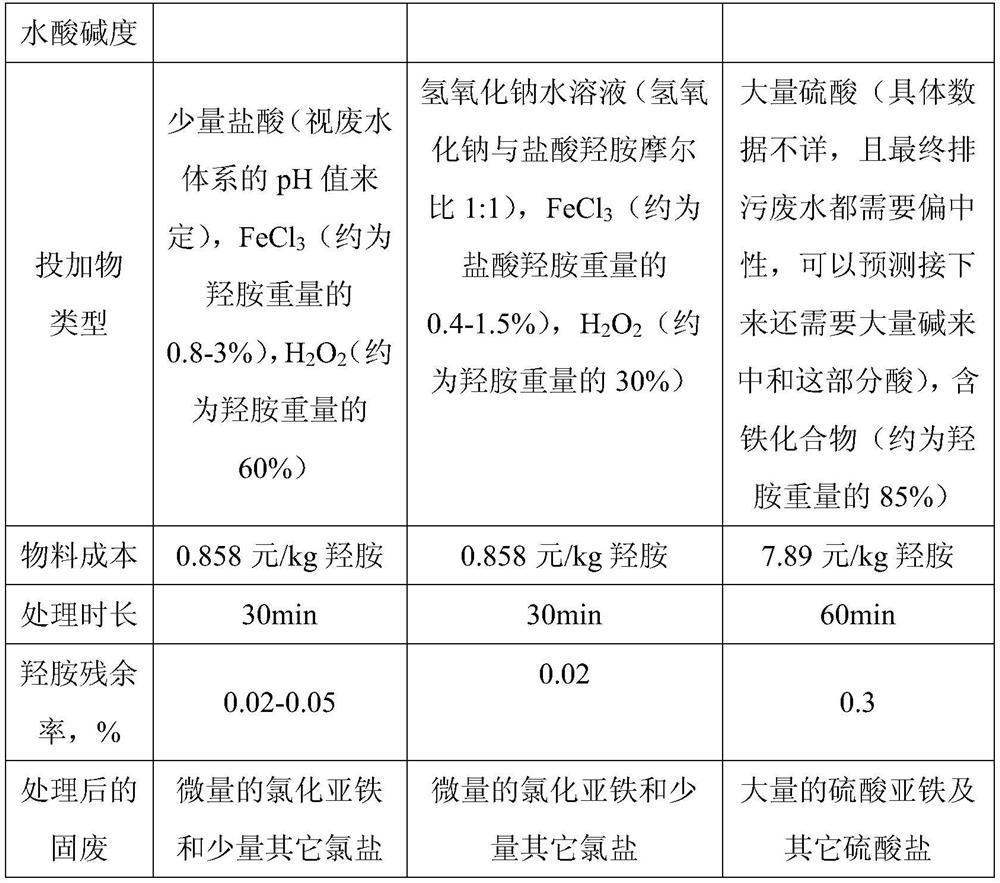
Innovation
- By adjusting the pH value of wastewater to 2-8, adding a catalytic amount of ferric ions and slowly dripping hydrogen peroxide, it promotes the decomposition of hydroxylamine, uses heat and hydroxyl radicals to initiate a chain reaction, and reduces the need for oxidants. Ferric ions and hydrogen peroxide act as Catalyst and media, reduce the dosage.

Environmental Regulations for Hydroxylamine Discharge
Hydroxylamine and its derivatives are subject to stringent environmental regulations globally due to their hazardous nature and potential environmental impact. In the United States, the Environmental Protection Agency (EPA) classifies hydroxylamine as a hazardous substance under the Comprehensive Environmental Response, Compensation, and Liability Act (CERCLA), with reportable quantities strictly defined. The Clean Water Act establishes effluent limitations for facilities discharging hydroxylamine-containing wastewater, requiring compliance with National Pollutant Discharge Elimination System (NPDES) permits that specify maximum concentration limits and monitoring requirements.
European Union regulations are equally comprehensive, with hydroxylamine listed under the Registration, Evaluation, Authorization and Restriction of Chemicals (REACH) framework. The Industrial Emissions Directive (IED) mandates Best Available Techniques (BAT) for facilities handling hydroxylamine, emphasizing emission reduction and waste minimization. Member states enforce specific discharge limits through national legislation, with Germany's Water Resources Act and France's Environmental Code setting particularly stringent standards for aquatic discharge.
Asian regulatory frameworks have evolved significantly in recent years. China's Environmental Protection Law and Water Pollution Prevention and Control Law impose strict discharge standards for hydroxylamine waste, with concentration limits often below 1 mg/L for industrial effluents. Japan's Water Pollution Control Law designates hydroxylamine as a designated hazardous substance, requiring comprehensive monitoring and reporting protocols. South Korea's Chemical Substances Control Act includes hydroxylamine in its restricted substances list, mandating pre-approval for discharge activities.
Atmospheric emissions from hydroxylamine neutralization processes face additional scrutiny. The EPA's National Emission Standards for Hazardous Air Pollutants (NESHAP) regulate volatile organic compounds and nitrogen oxides generated during neutralization reactions. Similar air quality standards exist in the EU under the Medium Combustion Plant Directive and in China through the Emission Standard of Pollutants for Pharmaceutical Industry, which specifically addresses nitrogen-containing compound emissions.
Compliance requirements extend beyond concentration limits to include comprehensive documentation, periodic reporting, and emergency response planning. Facilities must maintain detailed records of hydroxylamine inventory, neutralization procedures, and discharge monitoring data. Many jurisdictions require annual environmental impact assessments and third-party audits to verify regulatory compliance, creating substantial administrative burdens for operators.
Process Safety in Hydroxylamine Waste Handling
Hydroxylamine waste handling presents significant process safety challenges due to the compound's inherent instability and potential for exothermic decomposition. The substance exhibits sensitivity to temperature fluctuations, pH variations, and contamination by transition metal ions, which can trigger rapid decomposition reactions releasing toxic nitrogen oxides and ammonia. Historical incidents in chemical manufacturing facilities have demonstrated that inadequate control measures during neutralization processes can lead to thermal runaway scenarios, resulting in equipment damage, environmental releases, and personnel exposure risks. Understanding these hazards forms the foundation for developing optimized neutralization protocols that minimize emissions while maintaining operational safety.
The primary safety concern in hydroxylamine waste neutralization stems from the reaction kinetics during pH adjustment. Rapid addition of neutralizing agents can create localized hot spots where decomposition initiates, generating gaseous byproducts at rates exceeding ventilation system capacities. Temperature monitoring and controlled dosing strategies are essential to prevent uncontrolled reactions. Additionally, the presence of organic contaminants or incompatible materials in waste streams can catalyze decomposition, necessitating rigorous waste characterization protocols before treatment. Material compatibility assessments for storage vessels, transfer lines, and reaction equipment must account for hydroxylamine's corrosive properties and potential for stress corrosion cracking in certain alloys.
Effective process safety management requires implementation of multiple protective layers, including engineering controls such as automated temperature interlocks, pressure relief systems, and continuous emission monitoring. Administrative controls encompass standard operating procedures specifying maximum batch sizes, addition rates, and temperature limits based on reaction calorimetry data. Personnel training programs must address emergency response protocols for decomposition events, including evacuation procedures and spill containment measures. Regular safety audits and process hazard analyses help identify potential failure modes and verify the adequacy of existing safeguards, ensuring that emission reduction objectives do not compromise fundamental safety requirements in hydroxylamine waste management operations.
Unlock deeper insights with Patsnap Eureka Quick Research — get a full tech report to explore trends and direct your research. Try now!
Generate Your Research Report Instantly with AI Agent
Supercharge your innovation with Patsnap Eureka AI Agent Platform!