Optimize IoT Sensor Deployment for Real-Time Data Capture
MAR 27, 20268 MIN READ
Generate Your Research Report Instantly with AI Agent
Patsnap Eureka helps you evaluate technical feasibility & market potential.
IoT Sensor Deployment Background and Optimization Goals
The Internet of Things (IoT) has emerged as a transformative technology paradigm that connects physical devices, sensors, and systems to enable seamless data exchange and intelligent decision-making. Since its conceptual inception in the late 1990s, IoT has evolved from simple machine-to-machine communication to sophisticated networks of interconnected devices capable of autonomous operation and real-time data processing.
The evolution of IoT sensor deployment has progressed through distinct phases, beginning with basic wireless sensor networks in the early 2000s, advancing to cloud-connected devices in the 2010s, and now entering an era of edge computing and artificial intelligence integration. This progression has been driven by advances in miniaturization, wireless communication protocols, battery technology, and computational capabilities at the device level.
Contemporary IoT ecosystems face unprecedented demands for real-time data capture across diverse applications including smart cities, industrial automation, environmental monitoring, healthcare systems, and autonomous vehicles. The exponential growth in connected devices, projected to reach over 75 billion by 2025, has created complex challenges in sensor placement, network optimization, and data management that require sophisticated deployment strategies.
Traditional sensor deployment approaches often rely on uniform distribution patterns or expert intuition, which frequently result in suboptimal coverage, redundant data collection, and inefficient resource utilization. These conventional methods struggle to address the dynamic nature of modern IoT environments where data requirements, network conditions, and operational constraints continuously evolve.
The primary optimization goals for IoT sensor deployment encompass maximizing spatial and temporal coverage while minimizing deployment costs and energy consumption. Achieving comprehensive data capture requires strategic positioning of sensors to eliminate coverage gaps, reduce data latency, and ensure redundancy for critical monitoring areas. Simultaneously, deployment strategies must optimize network connectivity, minimize interference, and maintain reliable communication pathways under varying environmental conditions.
Energy efficiency represents another crucial optimization objective, as many IoT sensors operate on battery power in remote or inaccessible locations. Deployment optimization must balance sensing frequency, transmission power, and computational load to extend operational lifetime while maintaining data quality standards. Additionally, scalability considerations require deployment frameworks that can accommodate network expansion and adapt to changing monitoring requirements without complete system redesign.
Real-time data capture optimization also involves minimizing end-to-end latency from sensor detection to data processing and decision-making. This requires careful consideration of communication protocols, data routing paths, edge computing capabilities, and cloud integration strategies to ensure timely response to critical events and maintain system responsiveness across the entire IoT infrastructure.
The evolution of IoT sensor deployment has progressed through distinct phases, beginning with basic wireless sensor networks in the early 2000s, advancing to cloud-connected devices in the 2010s, and now entering an era of edge computing and artificial intelligence integration. This progression has been driven by advances in miniaturization, wireless communication protocols, battery technology, and computational capabilities at the device level.
Contemporary IoT ecosystems face unprecedented demands for real-time data capture across diverse applications including smart cities, industrial automation, environmental monitoring, healthcare systems, and autonomous vehicles. The exponential growth in connected devices, projected to reach over 75 billion by 2025, has created complex challenges in sensor placement, network optimization, and data management that require sophisticated deployment strategies.
Traditional sensor deployment approaches often rely on uniform distribution patterns or expert intuition, which frequently result in suboptimal coverage, redundant data collection, and inefficient resource utilization. These conventional methods struggle to address the dynamic nature of modern IoT environments where data requirements, network conditions, and operational constraints continuously evolve.
The primary optimization goals for IoT sensor deployment encompass maximizing spatial and temporal coverage while minimizing deployment costs and energy consumption. Achieving comprehensive data capture requires strategic positioning of sensors to eliminate coverage gaps, reduce data latency, and ensure redundancy for critical monitoring areas. Simultaneously, deployment strategies must optimize network connectivity, minimize interference, and maintain reliable communication pathways under varying environmental conditions.
Energy efficiency represents another crucial optimization objective, as many IoT sensors operate on battery power in remote or inaccessible locations. Deployment optimization must balance sensing frequency, transmission power, and computational load to extend operational lifetime while maintaining data quality standards. Additionally, scalability considerations require deployment frameworks that can accommodate network expansion and adapt to changing monitoring requirements without complete system redesign.
Real-time data capture optimization also involves minimizing end-to-end latency from sensor detection to data processing and decision-making. This requires careful consideration of communication protocols, data routing paths, edge computing capabilities, and cloud integration strategies to ensure timely response to critical events and maintain system responsiveness across the entire IoT infrastructure.
Market Demand for Real-Time IoT Data Solutions
The global market for real-time IoT data solutions is experiencing unprecedented growth driven by digital transformation initiatives across multiple industries. Organizations are increasingly recognizing the strategic value of instantaneous data collection and processing capabilities, particularly in sectors where operational efficiency and rapid decision-making directly impact profitability and safety outcomes.
Manufacturing industries represent one of the largest demand segments, where real-time sensor data enables predictive maintenance, quality control, and production optimization. The shift toward Industry 4.0 has created substantial market pull for solutions that can capture and process sensor data with minimal latency, allowing manufacturers to prevent equipment failures and optimize production workflows in real-time.
Smart city initiatives constitute another significant demand driver, encompassing traffic management, environmental monitoring, and public safety applications. Municipal governments worldwide are investing heavily in IoT infrastructure that requires sophisticated sensor deployment strategies to ensure comprehensive coverage while maintaining cost-effectiveness. The demand extends beyond basic data collection to include advanced analytics capabilities that can process multiple data streams simultaneously.
Healthcare and remote patient monitoring markets are generating substantial demand for real-time IoT solutions, particularly following recent global health challenges. Medical device manufacturers and healthcare providers require sensor networks capable of continuous monitoring with immediate alert capabilities, creating specific requirements for low-latency data transmission and high reliability standards.
The energy sector, including renewable energy management and smart grid applications, represents a rapidly expanding market segment. Utility companies require real-time monitoring of distributed energy resources, grid stability parameters, and consumption patterns to optimize energy distribution and prevent system failures.
Supply chain and logistics industries are driving demand for real-time tracking and monitoring solutions, particularly for temperature-sensitive goods, high-value assets, and time-critical deliveries. The complexity of global supply chains necessitates sophisticated sensor deployment strategies that can provide continuous visibility across multiple geographic regions and operational environments.
Agricultural technology markets are increasingly adopting precision farming approaches that rely heavily on real-time environmental and crop monitoring data. Farmers and agricultural enterprises require cost-effective sensor deployment solutions that can cover large geographic areas while providing actionable insights for irrigation, fertilization, and pest management decisions.
Manufacturing industries represent one of the largest demand segments, where real-time sensor data enables predictive maintenance, quality control, and production optimization. The shift toward Industry 4.0 has created substantial market pull for solutions that can capture and process sensor data with minimal latency, allowing manufacturers to prevent equipment failures and optimize production workflows in real-time.
Smart city initiatives constitute another significant demand driver, encompassing traffic management, environmental monitoring, and public safety applications. Municipal governments worldwide are investing heavily in IoT infrastructure that requires sophisticated sensor deployment strategies to ensure comprehensive coverage while maintaining cost-effectiveness. The demand extends beyond basic data collection to include advanced analytics capabilities that can process multiple data streams simultaneously.
Healthcare and remote patient monitoring markets are generating substantial demand for real-time IoT solutions, particularly following recent global health challenges. Medical device manufacturers and healthcare providers require sensor networks capable of continuous monitoring with immediate alert capabilities, creating specific requirements for low-latency data transmission and high reliability standards.
The energy sector, including renewable energy management and smart grid applications, represents a rapidly expanding market segment. Utility companies require real-time monitoring of distributed energy resources, grid stability parameters, and consumption patterns to optimize energy distribution and prevent system failures.
Supply chain and logistics industries are driving demand for real-time tracking and monitoring solutions, particularly for temperature-sensitive goods, high-value assets, and time-critical deliveries. The complexity of global supply chains necessitates sophisticated sensor deployment strategies that can provide continuous visibility across multiple geographic regions and operational environments.
Agricultural technology markets are increasingly adopting precision farming approaches that rely heavily on real-time environmental and crop monitoring data. Farmers and agricultural enterprises require cost-effective sensor deployment solutions that can cover large geographic areas while providing actionable insights for irrigation, fertilization, and pest management decisions.
Current IoT Deployment Challenges and Technical Barriers
The deployment of IoT sensors for real-time data capture faces significant technical barriers that impede optimal performance and scalability. Network connectivity remains one of the most persistent challenges, particularly in environments where traditional wireless infrastructure is limited or unreliable. Many deployment scenarios require sensors to operate in remote locations, underground facilities, or dense urban environments where signal propagation is compromised by physical obstacles and electromagnetic interference.
Power management presents another critical constraint, especially for battery-operated sensors in inaccessible locations. Current power solutions often fail to balance energy consumption with data transmission frequency requirements, leading to premature battery depletion or reduced sensing capabilities. The challenge intensifies when sensors must maintain continuous operation while supporting high-frequency data sampling and transmission protocols.
Scalability issues emerge when organizations attempt to deploy large-scale sensor networks. Current deployment methodologies struggle with efficient sensor placement optimization, often resulting in coverage gaps or redundant sensing areas. The lack of standardized deployment frameworks makes it difficult to achieve uniform performance across diverse environmental conditions and application requirements.
Data synchronization and latency problems significantly impact real-time applications. Existing IoT architectures frequently experience timing inconsistencies between distributed sensors, creating challenges for applications requiring precise temporal coordination. Network congestion and protocol overhead further exacerbate latency issues, particularly in dense sensor deployments where multiple devices compete for limited bandwidth resources.
Environmental adaptation represents a substantial technical barrier, as sensors must operate reliably across varying temperature ranges, humidity levels, and exposure conditions. Current sensor technologies often lack robust environmental protection mechanisms, leading to degraded performance or premature failure in harsh operating conditions.
Integration complexity with existing infrastructure systems creates additional deployment challenges. Legacy systems often lack compatibility with modern IoT protocols, requiring costly middleware solutions or complete system overhauls. The absence of unified communication standards across different sensor manufacturers further complicates integration efforts and increases deployment complexity.
Security vulnerabilities in current IoT deployments pose significant risks to data integrity and system reliability. Many existing sensor networks lack adequate encryption protocols and authentication mechanisms, making them susceptible to cyber attacks and unauthorized access attempts that can compromise entire deployment operations.
Power management presents another critical constraint, especially for battery-operated sensors in inaccessible locations. Current power solutions often fail to balance energy consumption with data transmission frequency requirements, leading to premature battery depletion or reduced sensing capabilities. The challenge intensifies when sensors must maintain continuous operation while supporting high-frequency data sampling and transmission protocols.
Scalability issues emerge when organizations attempt to deploy large-scale sensor networks. Current deployment methodologies struggle with efficient sensor placement optimization, often resulting in coverage gaps or redundant sensing areas. The lack of standardized deployment frameworks makes it difficult to achieve uniform performance across diverse environmental conditions and application requirements.
Data synchronization and latency problems significantly impact real-time applications. Existing IoT architectures frequently experience timing inconsistencies between distributed sensors, creating challenges for applications requiring precise temporal coordination. Network congestion and protocol overhead further exacerbate latency issues, particularly in dense sensor deployments where multiple devices compete for limited bandwidth resources.
Environmental adaptation represents a substantial technical barrier, as sensors must operate reliably across varying temperature ranges, humidity levels, and exposure conditions. Current sensor technologies often lack robust environmental protection mechanisms, leading to degraded performance or premature failure in harsh operating conditions.
Integration complexity with existing infrastructure systems creates additional deployment challenges. Legacy systems often lack compatibility with modern IoT protocols, requiring costly middleware solutions or complete system overhauls. The absence of unified communication standards across different sensor manufacturers further complicates integration efforts and increases deployment complexity.
Security vulnerabilities in current IoT deployments pose significant risks to data integrity and system reliability. Many existing sensor networks lack adequate encryption protocols and authentication mechanisms, making them susceptible to cyber attacks and unauthorized access attempts that can compromise entire deployment operations.
Current IoT Sensor Deployment Strategies
01 Wireless sensor network architecture for IoT data collection
Implementation of distributed wireless sensor networks that enable efficient deployment of multiple IoT sensors across various locations. These architectures facilitate seamless communication between sensors and central data collection systems, utilizing protocols optimized for low-power consumption and reliable data transmission. The network topology can be configured to support mesh networking, star topology, or hybrid configurations depending on deployment requirements.- Wireless sensor network architecture for IoT data collection: Implementation of distributed wireless sensor networks that enable efficient deployment of multiple IoT sensors across various locations. These architectures facilitate seamless communication between sensors and central data collection systems, utilizing protocols optimized for low-power consumption and reliable data transmission. The network topology can be configured to support mesh networking, star topology, or hybrid configurations depending on deployment requirements and environmental constraints.
- Real-time data processing and edge computing integration: Systems that incorporate edge computing capabilities at the sensor level or gateway nodes to process data in real-time before transmission to cloud platforms. This approach reduces latency, minimizes bandwidth requirements, and enables immediate decision-making based on sensor readings. The processing includes data filtering, aggregation, and preliminary analysis to extract actionable insights from raw sensor data streams.
- Multi-sensor fusion and data synchronization techniques: Methods for integrating data from multiple heterogeneous sensors deployed across different locations to create comprehensive monitoring systems. These techniques ensure temporal synchronization of data streams, handle varying sampling rates, and merge information from different sensor types to provide unified real-time situational awareness. The fusion algorithms account for sensor accuracy variations and environmental factors affecting measurements.
- Adaptive sensor deployment optimization and coverage management: Intelligent systems for determining optimal sensor placement and density to maximize coverage while minimizing deployment costs and power consumption. These solutions utilize algorithms that consider environmental characteristics, monitoring objectives, and communication constraints to recommend sensor locations. Dynamic reconfiguration capabilities allow the network to adapt to changing conditions or requirements over time.
- Secure data transmission and authentication protocols for IoT sensors: Security frameworks designed specifically for IoT sensor networks that ensure data integrity, confidentiality, and authenticity during real-time capture and transmission. These protocols implement lightweight encryption suitable for resource-constrained devices, secure key management, and authentication mechanisms to prevent unauthorized access. The systems also include anomaly detection to identify potential security breaches or sensor tampering.
02 Real-time data processing and edge computing integration
Systems that incorporate edge computing capabilities at the sensor level or gateway nodes to process data in real-time before transmission to cloud servers. This approach reduces latency, minimizes bandwidth requirements, and enables immediate decision-making based on sensor readings. The processing includes data filtering, aggregation, and preliminary analysis at the edge of the network.Expand Specific Solutions03 Multi-sensor data fusion and synchronization techniques
Methods for coordinating multiple heterogeneous sensors to capture synchronized data streams from different sources. These techniques ensure temporal alignment of data from various sensor types, implement data fusion algorithms to combine information from multiple sources, and maintain data integrity during concurrent capture operations. The systems handle different sampling rates and data formats across diverse sensor types.Expand Specific Solutions04 Energy-efficient sensor deployment and power management
Strategies for optimizing power consumption in deployed IoT sensors to extend operational lifetime and reduce maintenance requirements. These include adaptive sampling rates based on environmental conditions, sleep-wake cycle management, energy harvesting integration, and intelligent duty cycling. The approaches balance data capture frequency with power conservation to ensure long-term autonomous operation.Expand Specific Solutions05 Secure data transmission and sensor authentication protocols
Security frameworks designed to protect data integrity during capture and transmission from IoT sensors. These implementations include encryption mechanisms for data in transit, authentication protocols to verify sensor identity, secure boot processes, and intrusion detection systems. The security measures ensure that captured real-time data remains protected from unauthorized access and tampering throughout the data pipeline.Expand Specific Solutions
Core Technologies for Real-Time Data Optimization
Optimizing processing of data in an internet of things set-up
PatentInactiveIN202011036578A
Innovation
- A computer-implemented method and system that uses deep learning models to determine the relevance of data from sensors at various stages of the IoT setup, allocating weightage to data within defined ranges based on historical data, allowing for optimized processing before the server, utilizing intermediate nodes for data processing and reducing the load on the server.


Dynamically updateable rules engine
PatentActiveUS20200293915A1
Innovation
- A dynamically updatable rules engine system that processes sensor data by selectively executing rules based on conditions or events, with a data collection management module and data storage and analysis inference module to optimize and update the rules engine, allowing for efficient data processing and analysis across networks.
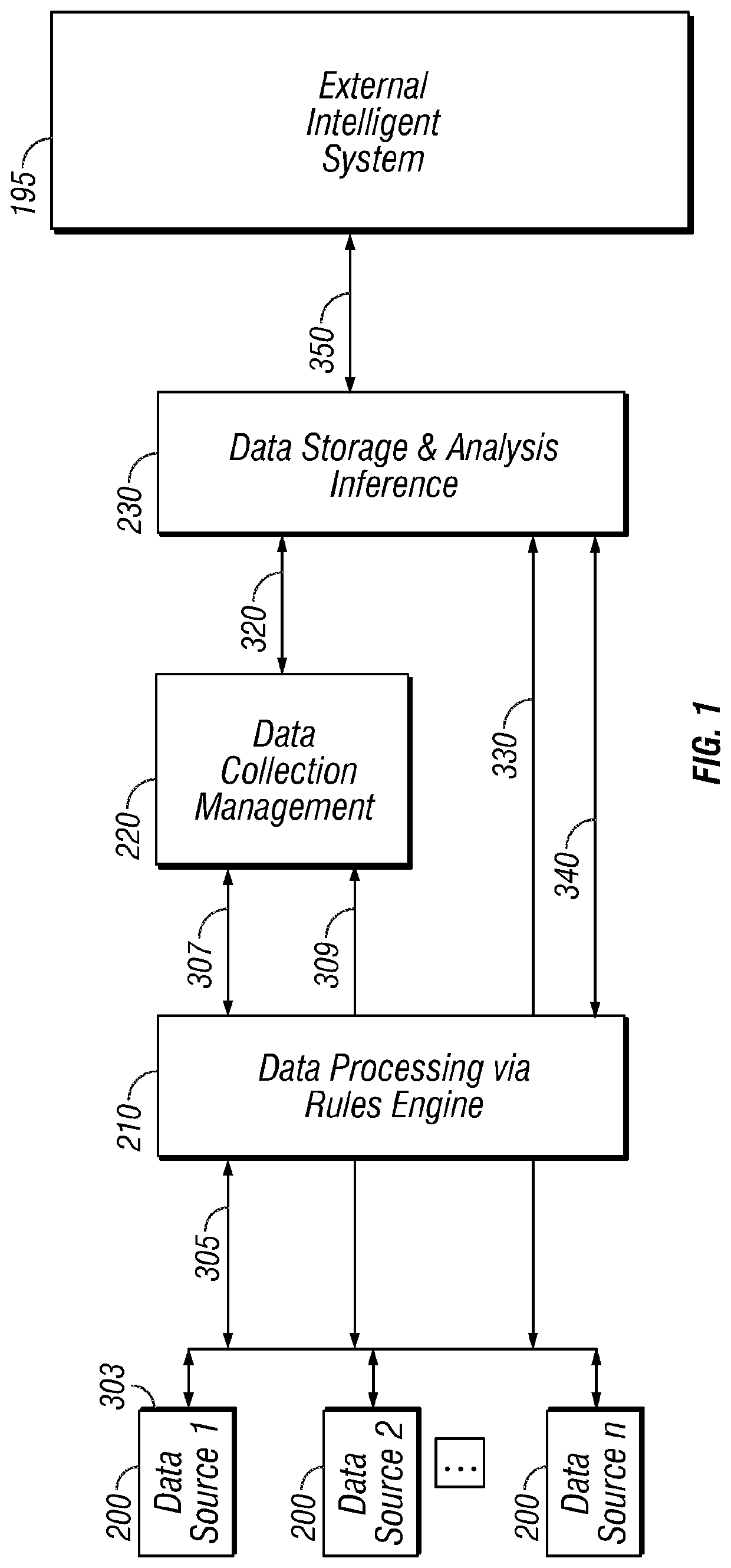


Edge Computing Integration for IoT Systems
Edge computing represents a paradigmatic shift in IoT architecture, fundamentally transforming how sensor data is processed and analyzed. By positioning computational resources closer to data sources, edge computing addresses the inherent limitations of centralized cloud processing, particularly in scenarios requiring real-time data capture and immediate response capabilities. This distributed computing model enables IoT sensors to perform local data processing, filtering, and preliminary analysis before transmitting refined information to central systems.
The integration of edge computing with IoT sensor networks creates a multi-tiered architecture that optimizes data flow and reduces network congestion. Edge nodes, equipped with processing capabilities, can handle time-sensitive operations locally while maintaining connectivity to broader network infrastructure. This approach significantly reduces latency from hundreds of milliseconds in cloud-based systems to single-digit milliseconds in edge-enabled deployments, making it particularly valuable for applications requiring instantaneous decision-making.
Modern edge computing frameworks support various deployment models, including fog computing, mobile edge computing, and micro data centers. These implementations allow for flexible resource allocation based on specific sensor deployment requirements and environmental constraints. Edge devices can range from simple gateway processors to sophisticated computing units capable of running machine learning algorithms and complex analytics in real-time.
The architectural benefits extend beyond latency reduction to include improved bandwidth utilization, enhanced data privacy, and increased system resilience. By processing data locally, edge computing reduces the volume of information transmitted over networks, lowering operational costs and minimizing potential points of failure. Additionally, sensitive data can be processed and anonymized at the edge, addressing privacy concerns while maintaining analytical capabilities.
Integration challenges include standardization across heterogeneous edge devices, ensuring consistent performance across distributed nodes, and maintaining synchronization between edge and cloud components. Successful implementation requires careful consideration of computational resource allocation, data consistency protocols, and failover mechanisms to ensure reliable operation across the entire IoT ecosystem.
The integration of edge computing with IoT sensor networks creates a multi-tiered architecture that optimizes data flow and reduces network congestion. Edge nodes, equipped with processing capabilities, can handle time-sensitive operations locally while maintaining connectivity to broader network infrastructure. This approach significantly reduces latency from hundreds of milliseconds in cloud-based systems to single-digit milliseconds in edge-enabled deployments, making it particularly valuable for applications requiring instantaneous decision-making.
Modern edge computing frameworks support various deployment models, including fog computing, mobile edge computing, and micro data centers. These implementations allow for flexible resource allocation based on specific sensor deployment requirements and environmental constraints. Edge devices can range from simple gateway processors to sophisticated computing units capable of running machine learning algorithms and complex analytics in real-time.
The architectural benefits extend beyond latency reduction to include improved bandwidth utilization, enhanced data privacy, and increased system resilience. By processing data locally, edge computing reduces the volume of information transmitted over networks, lowering operational costs and minimizing potential points of failure. Additionally, sensitive data can be processed and anonymized at the edge, addressing privacy concerns while maintaining analytical capabilities.
Integration challenges include standardization across heterogeneous edge devices, ensuring consistent performance across distributed nodes, and maintaining synchronization between edge and cloud components. Successful implementation requires careful consideration of computational resource allocation, data consistency protocols, and failover mechanisms to ensure reliable operation across the entire IoT ecosystem.
Energy Efficiency in Large-Scale IoT Networks
Energy efficiency represents a critical design consideration in large-scale IoT networks, particularly when optimizing sensor deployment for real-time data capture. The exponential growth of connected devices has intensified the need for sustainable power management strategies that can maintain continuous operation while minimizing energy consumption across distributed sensor networks.
Battery-powered IoT sensors face significant constraints in large-scale deployments, where manual maintenance and battery replacement become logistically challenging and economically unfeasible. Energy-efficient sensor placement strategies must balance coverage requirements with power consumption patterns, considering factors such as transmission distances, data processing loads, and sleep-wake cycles. Optimal deployment configurations can reduce overall network energy consumption by up to 40% through strategic positioning that minimizes communication overhead.
Adaptive duty cycling emerges as a fundamental technique for extending sensor network lifetime. By implementing intelligent scheduling algorithms, sensors can dynamically adjust their operational states based on environmental conditions and data criticality requirements. This approach enables sensors to enter low-power modes during periods of minimal activity while maintaining responsiveness for real-time data capture events.
Energy harvesting technologies increasingly complement traditional battery systems in large-scale IoT deployments. Solar panels, vibration harvesters, and thermal energy converters can provide supplementary power sources, particularly beneficial for sensors deployed in remote or inaccessible locations. Hybrid energy systems combining harvesting capabilities with efficient storage mechanisms can achieve near-perpetual operation under favorable environmental conditions.
Network topology optimization plays a crucial role in energy conservation across large-scale IoT infrastructures. Hierarchical clustering approaches and multi-hop communication protocols can significantly reduce transmission power requirements by enabling shorter-range communications between neighboring nodes. Edge computing integration further enhances energy efficiency by processing data locally, reducing the volume of information transmitted to central systems and minimizing communication-related power consumption throughout the network architecture.
Battery-powered IoT sensors face significant constraints in large-scale deployments, where manual maintenance and battery replacement become logistically challenging and economically unfeasible. Energy-efficient sensor placement strategies must balance coverage requirements with power consumption patterns, considering factors such as transmission distances, data processing loads, and sleep-wake cycles. Optimal deployment configurations can reduce overall network energy consumption by up to 40% through strategic positioning that minimizes communication overhead.
Adaptive duty cycling emerges as a fundamental technique for extending sensor network lifetime. By implementing intelligent scheduling algorithms, sensors can dynamically adjust their operational states based on environmental conditions and data criticality requirements. This approach enables sensors to enter low-power modes during periods of minimal activity while maintaining responsiveness for real-time data capture events.
Energy harvesting technologies increasingly complement traditional battery systems in large-scale IoT deployments. Solar panels, vibration harvesters, and thermal energy converters can provide supplementary power sources, particularly beneficial for sensors deployed in remote or inaccessible locations. Hybrid energy systems combining harvesting capabilities with efficient storage mechanisms can achieve near-perpetual operation under favorable environmental conditions.
Network topology optimization plays a crucial role in energy conservation across large-scale IoT infrastructures. Hierarchical clustering approaches and multi-hop communication protocols can significantly reduce transmission power requirements by enabling shorter-range communications between neighboring nodes. Edge computing integration further enhances energy efficiency by processing data locally, reducing the volume of information transmitted to central systems and minimizing communication-related power consumption throughout the network architecture.
Unlock deeper insights with Patsnap Eureka Quick Research — get a full tech report to explore trends and direct your research. Try now!
Generate Your Research Report Instantly with AI Agent
Supercharge your innovation with Patsnap Eureka AI Agent Platform!