

Optimize Polyethylene Terephthalate Durability in Bottles
FEB 27, 20269 MIN READ
Generate Your Research Report Instantly with AI Agent
PatSnap Eureka helps you evaluate technical feasibility & market potential.
PET Bottle Durability Enhancement Background and Objectives
Polyethylene Terephthalate (PET) has emerged as the dominant material for beverage packaging since its commercial introduction in the 1970s, revolutionizing the bottled water and soft drink industries. The widespread adoption of PET bottles stems from their exceptional combination of lightweight properties, transparency, chemical resistance, and recyclability. However, as global consumption of bottled beverages continues to surge, reaching over 500 billion units annually, the durability limitations of PET bottles have become increasingly apparent and economically significant.
The evolution of PET bottle technology has progressed through several distinct phases, beginning with basic stretch-blow molding techniques to today's sophisticated multi-layer barrier systems. Early PET bottles suffered from significant permeability issues, particularly carbon dioxide loss and oxygen ingress, which compromised product quality and shelf life. The introduction of barrier coatings and co-injection molding technologies in the 1990s marked a pivotal advancement, yet contemporary challenges demand more comprehensive solutions.
Current market pressures are driving unprecedented demands for enhanced PET bottle durability. Consumer expectations for extended shelf life, coupled with supply chain complexities requiring longer storage periods, have intensified the need for bottles that maintain structural integrity and barrier properties over extended timeframes. Additionally, the growing emphasis on sustainability has created dual objectives: improving durability to reduce waste while maintaining recyclability standards.
The primary technical challenges facing PET bottle durability encompass multiple degradation mechanisms. Hydrolytic degradation occurs when moisture penetrates the polymer matrix, causing chain scission and reducing molecular weight. Thermal degradation during processing and storage leads to acetaldehyde formation, affecting taste and structural properties. Mechanical stress from handling, transportation, and temperature fluctuations can cause micro-crack formation and stress whitening, compromising both appearance and barrier performance.
The strategic objectives for PET bottle durability enhancement focus on developing integrated solutions that address these multifaceted challenges. Key targets include extending shelf life from current 12-18 months to 24-36 months, reducing permeability rates by 40-60%, and improving stress crack resistance under various environmental conditions. These improvements must be achieved while maintaining cost-effectiveness, processing efficiency, and end-of-life recyclability to ensure commercial viability and environmental compliance in an increasingly competitive and regulated marketplace.
The evolution of PET bottle technology has progressed through several distinct phases, beginning with basic stretch-blow molding techniques to today's sophisticated multi-layer barrier systems. Early PET bottles suffered from significant permeability issues, particularly carbon dioxide loss and oxygen ingress, which compromised product quality and shelf life. The introduction of barrier coatings and co-injection molding technologies in the 1990s marked a pivotal advancement, yet contemporary challenges demand more comprehensive solutions.
Current market pressures are driving unprecedented demands for enhanced PET bottle durability. Consumer expectations for extended shelf life, coupled with supply chain complexities requiring longer storage periods, have intensified the need for bottles that maintain structural integrity and barrier properties over extended timeframes. Additionally, the growing emphasis on sustainability has created dual objectives: improving durability to reduce waste while maintaining recyclability standards.
The primary technical challenges facing PET bottle durability encompass multiple degradation mechanisms. Hydrolytic degradation occurs when moisture penetrates the polymer matrix, causing chain scission and reducing molecular weight. Thermal degradation during processing and storage leads to acetaldehyde formation, affecting taste and structural properties. Mechanical stress from handling, transportation, and temperature fluctuations can cause micro-crack formation and stress whitening, compromising both appearance and barrier performance.
The strategic objectives for PET bottle durability enhancement focus on developing integrated solutions that address these multifaceted challenges. Key targets include extending shelf life from current 12-18 months to 24-36 months, reducing permeability rates by 40-60%, and improving stress crack resistance under various environmental conditions. These improvements must be achieved while maintaining cost-effectiveness, processing efficiency, and end-of-life recyclability to ensure commercial viability and environmental compliance in an increasingly competitive and regulated marketplace.
Market Demand for Enhanced PET Bottle Performance
The global beverage packaging industry has witnessed unprecedented growth in demand for enhanced PET bottle performance, driven by evolving consumer preferences and stringent regulatory requirements. Beverage manufacturers increasingly prioritize packaging solutions that maintain product integrity throughout extended shelf life periods while ensuring optimal taste preservation and safety standards.
Consumer awareness regarding product quality has intensified market pressure for superior barrier properties in PET bottles. The demand extends beyond basic containment functionality to encompass enhanced resistance against permeation, thermal degradation, and mechanical stress. This shift reflects growing consumer expectations for premium packaging experiences across carbonated soft drinks, water, juices, and alcoholic beverages.
The carbonated beverage segment represents the most demanding application area for enhanced PET durability. Carbon dioxide retention capabilities directly impact product quality and consumer satisfaction, creating substantial market incentives for improved barrier technologies. Manufacturers face increasing pressure to extend product shelf life while maintaining carbonation levels and preventing flavor deterioration.
Sustainability concerns have amplified demand for durable PET bottles that support circular economy initiatives. Enhanced durability enables improved recyclability and supports lightweighting strategies without compromising structural integrity. This trend aligns with corporate sustainability commitments and regulatory frameworks promoting reduced environmental impact across packaging lifecycles.
Regional market dynamics reveal varying performance requirements based on climate conditions and distribution networks. Tropical markets demand superior thermal stability and UV resistance, while regions with extended supply chains prioritize enhanced barrier properties and mechanical durability. These geographic variations create diverse market opportunities for specialized PET enhancement technologies.
The premium beverage segment demonstrates willingness to invest in advanced packaging solutions that differentiate products through superior performance characteristics. This market segment values enhanced clarity, improved impact resistance, and extended shelf stability as key differentiators supporting premium positioning strategies.
E-commerce growth has intensified requirements for enhanced mechanical durability in PET bottles. Direct-to-consumer shipping environments subject packaging to increased handling stress and temperature variations, creating new performance benchmarks for durability optimization. This distribution channel evolution represents a significant growth driver for enhanced PET bottle technologies.
Consumer awareness regarding product quality has intensified market pressure for superior barrier properties in PET bottles. The demand extends beyond basic containment functionality to encompass enhanced resistance against permeation, thermal degradation, and mechanical stress. This shift reflects growing consumer expectations for premium packaging experiences across carbonated soft drinks, water, juices, and alcoholic beverages.
The carbonated beverage segment represents the most demanding application area for enhanced PET durability. Carbon dioxide retention capabilities directly impact product quality and consumer satisfaction, creating substantial market incentives for improved barrier technologies. Manufacturers face increasing pressure to extend product shelf life while maintaining carbonation levels and preventing flavor deterioration.
Sustainability concerns have amplified demand for durable PET bottles that support circular economy initiatives. Enhanced durability enables improved recyclability and supports lightweighting strategies without compromising structural integrity. This trend aligns with corporate sustainability commitments and regulatory frameworks promoting reduced environmental impact across packaging lifecycles.
Regional market dynamics reveal varying performance requirements based on climate conditions and distribution networks. Tropical markets demand superior thermal stability and UV resistance, while regions with extended supply chains prioritize enhanced barrier properties and mechanical durability. These geographic variations create diverse market opportunities for specialized PET enhancement technologies.
The premium beverage segment demonstrates willingness to invest in advanced packaging solutions that differentiate products through superior performance characteristics. This market segment values enhanced clarity, improved impact resistance, and extended shelf stability as key differentiators supporting premium positioning strategies.
E-commerce growth has intensified requirements for enhanced mechanical durability in PET bottles. Direct-to-consumer shipping environments subject packaging to increased handling stress and temperature variations, creating new performance benchmarks for durability optimization. This distribution channel evolution represents a significant growth driver for enhanced PET bottle technologies.
Current PET Durability Issues and Technical Barriers
PET bottles face significant durability challenges that limit their performance and lifecycle in commercial applications. The primary issue stems from the material's inherent susceptibility to environmental stress cracking, which manifests as microscopic fractures that propagate under mechanical stress and environmental exposure. This phenomenon is particularly pronounced in thin-walled bottle designs where material thickness constraints amplify stress concentration points.
Thermal degradation represents another critical barrier affecting PET bottle durability. During manufacturing processes and subsequent storage conditions, elevated temperatures can trigger chain scission reactions in the polymer backbone, leading to molecular weight reduction and compromised mechanical properties. This degradation is accelerated by the presence of moisture and oxygen, creating a cascading effect that progressively weakens the bottle structure.
Chemical resistance limitations pose substantial challenges for PET bottles containing aggressive substances or operating in harsh environments. The polymer matrix exhibits vulnerability to certain organic solvents, acids, and bases, which can cause swelling, plasticization, or chemical attack of the polymer chains. These interactions result in dimensional instability, reduced barrier properties, and potential failure of the container integrity.
Barrier property deterioration over time significantly impacts PET bottle performance, particularly for applications requiring extended shelf life. Gas permeability increases due to polymer chain mobility and micro-void formation, leading to oxygen ingress and carbon dioxide loss in beverage applications. This permeability enhancement is exacerbated by mechanical stress, temperature fluctuations, and UV exposure during storage and transportation.
Manufacturing-induced defects constitute a major technical barrier to achieving optimal PET bottle durability. Injection stretch blow molding processes can introduce orientation-related stress patterns, uneven wall thickness distribution, and residual stresses that create weak points susceptible to premature failure. Gate vestige areas and parting line regions often exhibit reduced mechanical properties compared to the main bottle body.
UV radiation exposure presents long-term durability challenges for PET bottles, particularly in outdoor storage or transparent packaging applications. Photodegradation mechanisms initiate polymer chain breakdown, leading to yellowing, brittleness, and mechanical property loss. The absence of effective UV stabilization systems in standard PET formulations leaves bottles vulnerable to solar radiation damage.
Recycling-related quality degradation emerges as an increasingly important barrier as circular economy principles drive higher recycled content requirements. Each recycling cycle introduces thermal history effects, contamination risks, and molecular weight reduction that compromise the durability of bottles manufactured from recycled PET resins.
Thermal degradation represents another critical barrier affecting PET bottle durability. During manufacturing processes and subsequent storage conditions, elevated temperatures can trigger chain scission reactions in the polymer backbone, leading to molecular weight reduction and compromised mechanical properties. This degradation is accelerated by the presence of moisture and oxygen, creating a cascading effect that progressively weakens the bottle structure.
Chemical resistance limitations pose substantial challenges for PET bottles containing aggressive substances or operating in harsh environments. The polymer matrix exhibits vulnerability to certain organic solvents, acids, and bases, which can cause swelling, plasticization, or chemical attack of the polymer chains. These interactions result in dimensional instability, reduced barrier properties, and potential failure of the container integrity.
Barrier property deterioration over time significantly impacts PET bottle performance, particularly for applications requiring extended shelf life. Gas permeability increases due to polymer chain mobility and micro-void formation, leading to oxygen ingress and carbon dioxide loss in beverage applications. This permeability enhancement is exacerbated by mechanical stress, temperature fluctuations, and UV exposure during storage and transportation.
Manufacturing-induced defects constitute a major technical barrier to achieving optimal PET bottle durability. Injection stretch blow molding processes can introduce orientation-related stress patterns, uneven wall thickness distribution, and residual stresses that create weak points susceptible to premature failure. Gate vestige areas and parting line regions often exhibit reduced mechanical properties compared to the main bottle body.
UV radiation exposure presents long-term durability challenges for PET bottles, particularly in outdoor storage or transparent packaging applications. Photodegradation mechanisms initiate polymer chain breakdown, leading to yellowing, brittleness, and mechanical property loss. The absence of effective UV stabilization systems in standard PET formulations leaves bottles vulnerable to solar radiation damage.
Recycling-related quality degradation emerges as an increasingly important barrier as circular economy principles drive higher recycled content requirements. Each recycling cycle introduces thermal history effects, contamination risks, and molecular weight reduction that compromise the durability of bottles manufactured from recycled PET resins.
Existing PET Durability Improvement Solutions
01 Copolymerization and molecular weight control for enhanced durability
Polyethylene terephthalate durability can be improved through copolymerization techniques that modify the polymer chain structure. By controlling molecular weight distribution and incorporating specific comonomers, the material exhibits enhanced resistance to degradation and improved mechanical properties. This approach allows for better thermal stability and resistance to environmental stress cracking, making the material more suitable for long-term applications.- Copolymerization and molecular weight control for enhanced durability: Polyethylene terephthalate durability can be improved through copolymerization techniques that modify the polymer chain structure. By controlling molecular weight distribution and incorporating specific comonomers, the material exhibits enhanced resistance to degradation and improved mechanical properties. This approach allows for better thermal stability and resistance to environmental stress cracking, making the material more suitable for long-term applications.
- Additive incorporation for UV and thermal resistance: The durability of polyethylene terephthalate can be significantly enhanced by incorporating various additives that provide protection against ultraviolet radiation and thermal degradation. These additives work by absorbing harmful radiation, scavenging free radicals, or creating protective barriers that prevent polymer chain breakdown. The resulting material demonstrates extended service life under harsh environmental conditions and maintains its physical properties over time.
- Crystallization control and orientation techniques: Enhancing polyethylene terephthalate durability through controlled crystallization processes and molecular orientation improves the material's structural integrity. By optimizing processing conditions such as temperature, cooling rates, and stretching parameters, the polymer develops a more ordered structure with improved barrier properties and mechanical strength. This results in materials with superior resistance to chemical attack and physical stress.
- Blending with reinforcing polymers and fillers: The durability of polyethylene terephthalate can be enhanced by blending it with reinforcing polymers or incorporating inorganic fillers. These composite formulations provide improved impact resistance, dimensional stability, and resistance to environmental degradation. The synergistic effects between components result in materials with enhanced load-bearing capacity and prolonged service life in demanding applications.
- Surface modification and coating technologies: Surface treatment and coating technologies can significantly improve polyethylene terephthalate durability by providing protective layers that resist chemical attack, abrasion, and environmental degradation. These modifications can include plasma treatment, chemical grafting, or application of barrier coatings that enhance the material's resistance to moisture, oxygen, and other degrading agents while maintaining the base polymer's desirable properties.
02 Additive incorporation for UV and thermal resistance
The durability of polyethylene terephthalate can be significantly enhanced by incorporating various additives that provide protection against ultraviolet radiation and thermal degradation. These additives work by absorbing harmful radiation, scavenging free radicals, or creating protective barriers that prevent polymer chain breakdown. The resulting material demonstrates extended service life under harsh environmental conditions and maintains its physical properties over time.Expand Specific Solutions03 Crystallization control and orientation techniques
Enhancing polyethylene terephthalate durability through controlled crystallization processes and molecular orientation improves the material's structural integrity. By optimizing processing conditions such as temperature, cooling rates, and stretching parameters, the polymer develops a more ordered structure with improved resistance to mechanical stress and chemical attack. This results in materials with superior dimensional stability and longer functional lifetime.Expand Specific Solutions04 Surface modification and coating technologies
Surface treatments and coating applications provide an effective method for improving polyethylene terephthalate durability by creating protective layers that shield the base material from environmental factors. These modifications can include plasma treatments, chemical grafting, or the application of barrier coatings that prevent moisture ingress, chemical attack, and physical abrasion. The enhanced surface properties contribute to extended material performance in demanding applications.Expand Specific Solutions05 Recycling and reprocessing methods maintaining durability
Advanced recycling and reprocessing techniques enable the maintenance of polyethylene terephthalate durability even after multiple use cycles. These methods involve careful control of depolymerization and repolymerization conditions, removal of contaminants, and restoration of molecular weight to ensure that recycled material retains properties comparable to virgin polymer. This approach supports sustainability while maintaining material performance standards.Expand Specific Solutions
Key Players in PET Bottle and Polymer Industry
The polyethylene terephthalate (PET) bottle durability optimization market represents a mature industry in the growth-to-consolidation phase, driven by increasing sustainability demands and regulatory pressures. The global PET resin market, valued at approximately $30 billion, shows steady expansion with rising beverage consumption and packaging needs. Technology maturity varies significantly across the competitive landscape. Chemical giants like DuPont, Eastman Chemical, and Toray Industries lead in advanced polymer science and additive technologies, demonstrating high technical sophistication. Asian manufacturers including Mitsui Chemicals, Toyobo, and China Petroleum & Chemical Corp. excel in large-scale production capabilities. Specialized players like Phoenix Technologies focus on recycled PET innovations, while packaging companies such as Amcor and Plastipak drive application-specific improvements. The industry exhibits strong vertical integration, with companies spanning from raw material production to final packaging solutions, indicating technological maturity and established supply chains.
The Coca-Cola Co.
Technical Solution: Coca-Cola has invested in PlantBottle technology and advanced PET formulations that incorporate bio-based materials while maintaining durability standards. Their approach focuses on supply chain collaboration to develop PET resins with improved environmental stress crack resistance and enhanced barrier properties for carbonated beverages. The company works with resin suppliers to optimize molecular weight and end-group chemistry to reduce acetaldehyde formation and improve taste preservation. Their sustainability-focused initiatives include the development of bottles with increased recycled content that maintain structural integrity and performance standards equivalent to virgin PET applications through careful material selection and processing optimization.
Strengths: Large-scale market influence and extensive real-world testing capabilities across diverse global markets. Weaknesses: Dependent on supplier partnerships for resin technology development rather than in-house polymer expertise.
Amcor Rigid Packaging USA LLC
Technical Solution: Amcor focuses on bottle design optimization and processing technologies that enhance PET durability through improved wall thickness distribution and stress management. Their approach combines advanced blow molding techniques with specialized preform designs to minimize stress concentration points that can lead to failure. The company has developed proprietary bottle geometries and base designs that improve drop impact resistance and top load strength. Their technology includes the use of barrier coatings and multilayer structures that protect the PET matrix from environmental degradation while maintaining recyclability. They also employ advanced modeling and simulation tools to predict bottle performance under various loading conditions.
Strengths: Extensive experience in bottle manufacturing and strong understanding of real-world performance requirements. Weaknesses: Limited control over base resin chemistry, relying primarily on processing and design optimization approaches.
Core Innovations in PET Molecular Structure Optimization
Multilayer structures of poly(1,3 propylene 2,6-naphthalate) and poly(ethylene terephthalate)
PatentInactiveUS20080220192A1
Innovation
- The use of poly(1,3-propylene 2,6-naphthalate) (3GN) as a resin layer in combination with PET, allowing for biaxial stretching at optimal PET processing temperatures (90-115°C) without the need for an adhesive tie layer, enhancing adhesion and maintaining transparency and barrier properties.


Delamination-resistant, barrier polyamide compositions for 3-layer pet beverage bottles
PatentInactiveUS20050009976A1
Innovation
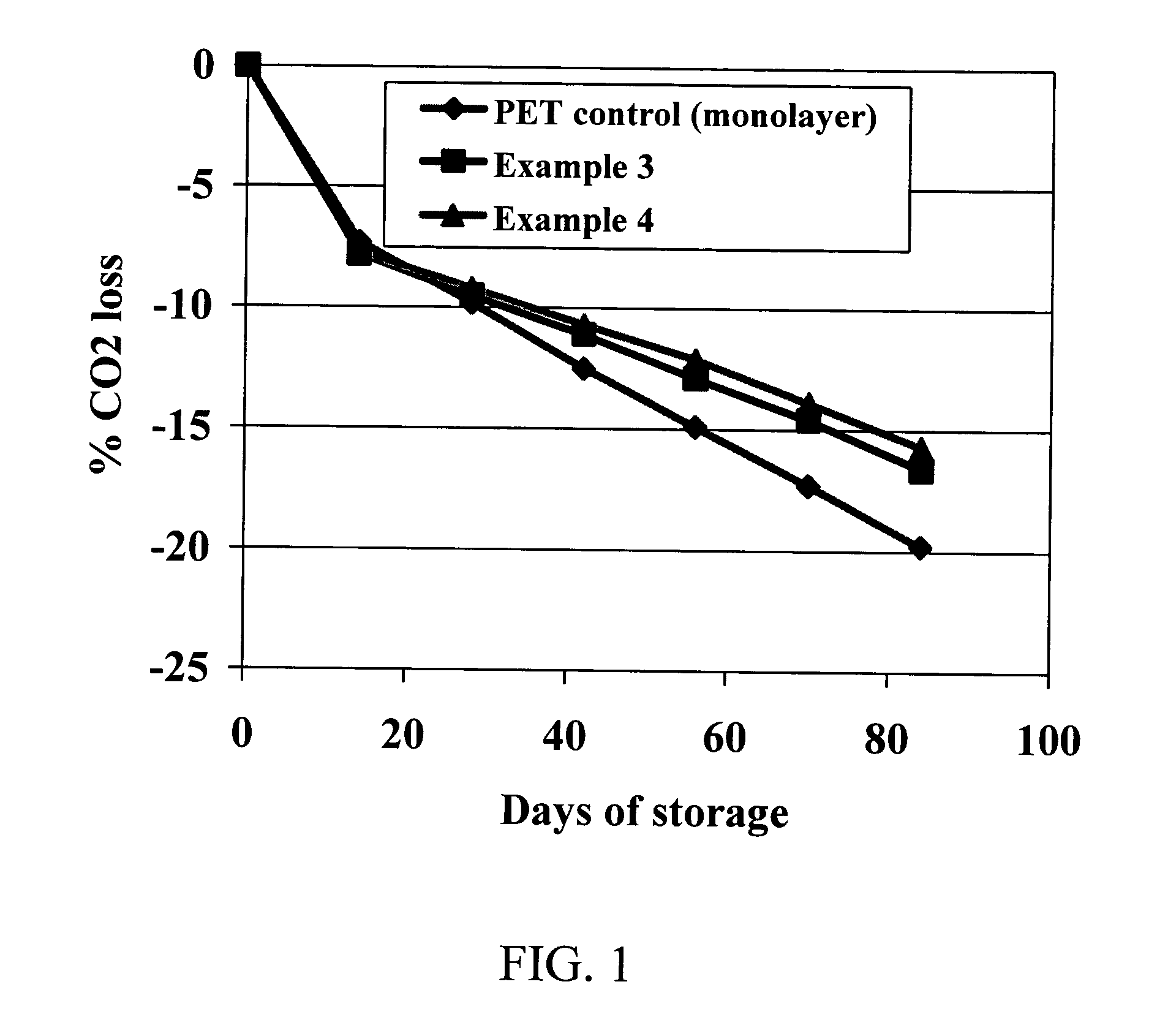
- A polyamide composition blend of aliphatic, semi-aromatic, and amorphous polyamides with a slow crystallization rate, suitable for coinjection stretch-blow molding with PET, providing high adhesion and delamination resistance without chemical coupling, maintaining gas barrier properties.

Environmental Regulations for PET Packaging Materials
The regulatory landscape for PET packaging materials has evolved significantly over the past decade, driven by growing environmental concerns and the need for sustainable packaging solutions. The European Union leads global regulatory efforts through its Single-Use Plastics Directive, which mandates that PET bottles contain at least 25% recycled content by 2025 and 30% by 2030. This regulation directly impacts durability optimization strategies, as manufacturers must balance recycled content integration with maintaining structural integrity and barrier properties.
In the United States, the FDA maintains strict guidelines for food-contact PET materials under the Food Contact Substance Notification program. These regulations require extensive migration testing and safety assessments for any chemical modifications aimed at enhancing durability. State-level initiatives, particularly California's SB 54, impose additional requirements for recyclability and recycled content, creating a complex compliance matrix for manufacturers seeking to optimize bottle performance.
Asian markets present diverse regulatory frameworks, with Japan's Plastic Resource Circulation Act and China's National Sword policy significantly influencing PET bottle design requirements. These regulations emphasize circular economy principles, requiring manufacturers to demonstrate end-of-life recyclability while maintaining product durability standards. The challenge lies in developing PET formulations that meet both performance criteria and regulatory recyclability thresholds.
Emerging regulations focus on chemical additives used in durability enhancement. The European Chemicals Agency's REACH regulation increasingly scrutinizes UV stabilizers, antioxidants, and barrier enhancement additives commonly employed in high-performance PET bottles. Manufacturers must navigate approval processes for new durability-enhancing compounds while ensuring compliance with migration limits and safety assessments.
Extended Producer Responsibility frameworks across multiple jurisdictions create additional compliance requirements. These regulations mandate that bottle manufacturers demonstrate product durability through standardized testing protocols while ensuring compatibility with existing recycling infrastructure. The regulatory trend toward harmonized testing standards for mechanical properties, barrier performance, and recyclability creates both opportunities and constraints for durability optimization initiatives.
Future regulatory developments indicate stricter requirements for lifecycle assessments and carbon footprint declarations, necessitating durability optimization strategies that consider both performance enhancement and environmental impact reduction throughout the product lifecycle.
In the United States, the FDA maintains strict guidelines for food-contact PET materials under the Food Contact Substance Notification program. These regulations require extensive migration testing and safety assessments for any chemical modifications aimed at enhancing durability. State-level initiatives, particularly California's SB 54, impose additional requirements for recyclability and recycled content, creating a complex compliance matrix for manufacturers seeking to optimize bottle performance.
Asian markets present diverse regulatory frameworks, with Japan's Plastic Resource Circulation Act and China's National Sword policy significantly influencing PET bottle design requirements. These regulations emphasize circular economy principles, requiring manufacturers to demonstrate end-of-life recyclability while maintaining product durability standards. The challenge lies in developing PET formulations that meet both performance criteria and regulatory recyclability thresholds.
Emerging regulations focus on chemical additives used in durability enhancement. The European Chemicals Agency's REACH regulation increasingly scrutinizes UV stabilizers, antioxidants, and barrier enhancement additives commonly employed in high-performance PET bottles. Manufacturers must navigate approval processes for new durability-enhancing compounds while ensuring compliance with migration limits and safety assessments.
Extended Producer Responsibility frameworks across multiple jurisdictions create additional compliance requirements. These regulations mandate that bottle manufacturers demonstrate product durability through standardized testing protocols while ensuring compatibility with existing recycling infrastructure. The regulatory trend toward harmonized testing standards for mechanical properties, barrier performance, and recyclability creates both opportunities and constraints for durability optimization initiatives.
Future regulatory developments indicate stricter requirements for lifecycle assessments and carbon footprint declarations, necessitating durability optimization strategies that consider both performance enhancement and environmental impact reduction throughout the product lifecycle.
Sustainability Impact of PET Bottle Lifecycle
The sustainability impact of PET bottle lifecycle represents a critical environmental consideration that directly influences durability optimization strategies. Enhanced PET bottle durability fundamentally reduces the frequency of replacement cycles, thereby decreasing overall material consumption and manufacturing energy requirements. When bottles maintain structural integrity for extended periods, the environmental burden per unit of service life diminishes significantly, creating a positive correlation between durability improvements and sustainability outcomes.
Carbon footprint analysis reveals that manufacturing processes account for approximately 60-70% of total PET bottle lifecycle emissions. Durability enhancements that extend bottle lifespan by even modest percentages can yield substantial reductions in cumulative carbon emissions. Advanced polymer stabilization techniques and barrier coating technologies not only improve mechanical properties but also reduce the need for frequent production cycles, translating to lower greenhouse gas emissions per functional unit.
Water consumption patterns throughout the PET lifecycle demonstrate similar optimization potential through durability improvements. Manufacturing processes require substantial water resources for polymerization, molding, and quality control procedures. Extended bottle durability reduces the frequency of these water-intensive manufacturing cycles, contributing to overall resource conservation efforts. Additionally, improved barrier properties minimize product waste due to premature degradation, further reducing the environmental impact associated with replacement production.
End-of-life considerations reveal complex sustainability dynamics influenced by durability characteristics. While enhanced durability typically improves recyclability through better material integrity preservation, it may also affect biodegradation timelines in natural environments. Advanced PET formulations incorporating durability-enhancing additives require careful evaluation to ensure compatibility with existing recycling infrastructure and circular economy principles.
The circular economy integration potential increases substantially with durability optimization. Bottles maintaining structural and aesthetic properties through multiple use cycles enable more effective reuse programs and extended producer responsibility initiatives. This creates economic incentives for manufacturers to invest in durability technologies while simultaneously reducing environmental impact through decreased virgin material demand and waste generation rates.
Carbon footprint analysis reveals that manufacturing processes account for approximately 60-70% of total PET bottle lifecycle emissions. Durability enhancements that extend bottle lifespan by even modest percentages can yield substantial reductions in cumulative carbon emissions. Advanced polymer stabilization techniques and barrier coating technologies not only improve mechanical properties but also reduce the need for frequent production cycles, translating to lower greenhouse gas emissions per functional unit.
Water consumption patterns throughout the PET lifecycle demonstrate similar optimization potential through durability improvements. Manufacturing processes require substantial water resources for polymerization, molding, and quality control procedures. Extended bottle durability reduces the frequency of these water-intensive manufacturing cycles, contributing to overall resource conservation efforts. Additionally, improved barrier properties minimize product waste due to premature degradation, further reducing the environmental impact associated with replacement production.
End-of-life considerations reveal complex sustainability dynamics influenced by durability characteristics. While enhanced durability typically improves recyclability through better material integrity preservation, it may also affect biodegradation timelines in natural environments. Advanced PET formulations incorporating durability-enhancing additives require careful evaluation to ensure compatibility with existing recycling infrastructure and circular economy principles.
The circular economy integration potential increases substantially with durability optimization. Bottles maintaining structural and aesthetic properties through multiple use cycles enable more effective reuse programs and extended producer responsibility initiatives. This creates economic incentives for manufacturers to invest in durability technologies while simultaneously reducing environmental impact through decreased virgin material demand and waste generation rates.
Unlock deeper insights with PatSnap Eureka Quick Research — get a full tech report to explore trends and direct your research. Try now!
Generate Your Research Report Instantly with AI Agent
Supercharge your innovation with PatSnap Eureka AI Agent Platform!