
Optimize Spin-Pumping Efficiency Using Ferromagnetic Resonance
MAR 7, 20269 MIN READ
Generate Your Research Report Instantly with AI Agent
Patsnap Eureka helps you evaluate technical feasibility & market potential.
Spin-Pumping Technology Background and Optimization Goals
Spin-pumping technology represents a fundamental mechanism in spintronics that enables the generation and manipulation of pure spin currents without accompanying charge currents. This phenomenon occurs when magnetization dynamics in a ferromagnetic material inject spin angular momentum into adjacent non-magnetic materials, creating a flow of spin-polarized electrons. The technology has emerged as a cornerstone for next-generation spintronic devices, offering unprecedented opportunities for energy-efficient information processing and quantum computing applications.
The historical development of spin-pumping began with theoretical predictions in the early 2000s, followed by experimental demonstrations that confirmed the ability to generate detectable spin currents through dynamic magnetization processes. Initial research focused on understanding the basic physics of spin injection and detection, establishing the foundation for more sophisticated applications. The field gained significant momentum with the discovery of efficient spin-to-charge conversion mechanisms, enabling practical device implementations.
Ferromagnetic resonance has evolved as the primary driving mechanism for spin-pumping due to its ability to create coherent, high-amplitude magnetization precession. When a ferromagnetic layer undergoes FMR, the precessing magnetization acts as a spin battery, continuously pumping spins into adjacent layers. This process generates pure spin currents with magnitudes proportional to the precession amplitude and frequency, making FMR-driven spin-pumping highly controllable and tunable.
Current optimization objectives center on maximizing spin-pumping efficiency while maintaining device stability and reproducibility. Key targets include enhancing the spin mixing conductance at ferromagnetic-nonmagnetic interfaces, minimizing spin relaxation losses, and achieving optimal impedance matching for microwave excitation. Advanced material engineering approaches focus on developing high-quality heterostructures with atomically sharp interfaces and reduced defect densities.
The primary technical goals encompass achieving spin-pumping efficiencies exceeding 10% of theoretical limits, extending operational frequency ranges beyond 100 GHz, and demonstrating room-temperature operation with minimal power consumption. These objectives require precise control over magnetic anisotropy, interface quality, and microwave coupling mechanisms. Success in these areas would enable practical spintronic devices for ultra-low-power computing, magnetic memory applications, and quantum information processing systems.
Market Demand for Spintronic Devices and Applications
The global spintronic devices market is experiencing unprecedented growth driven by the increasing demand for energy-efficient computing solutions and next-generation memory technologies. Traditional semiconductor devices face fundamental limitations in power consumption and processing speed, creating substantial market opportunities for spintronic alternatives that leverage electron spin properties alongside charge characteristics.
Data storage applications represent the largest market segment for spintronic devices, with magnetic random-access memory (MRAM) leading commercial adoption. Enterprise storage systems and automotive electronics increasingly require non-volatile memory solutions that combine high speed, low power consumption, and radiation resistance. The automotive sector particularly drives demand for spintronic memory in autonomous driving systems, where reliable data retention under extreme conditions is critical.
Quantum computing applications constitute an emerging high-value market segment where optimized spin-pumping efficiency directly impacts device performance. Quantum processors require precise spin manipulation and coherent spin transport, making ferromagnetic resonance-based spin pumping essential for quantum state initialization and readout operations. Research institutions and technology companies are investing heavily in spintronic quantum devices, creating specialized market demand for advanced spin-pumping solutions.
The telecommunications industry presents significant opportunities for spintronic devices in next-generation network infrastructure. High-frequency spintronic oscillators and detectors enable efficient signal processing in 5G and beyond-5G systems. Optimized spin-pumping efficiency enhances the performance of these devices by improving signal-to-noise ratios and reducing power consumption in base stations and mobile devices.
Neuromorphic computing represents a rapidly expanding application area where spintronic devices mimic biological neural networks. Brain-inspired computing architectures require synaptic devices with tunable resistance states and low-power operation. Spin-pumping mechanisms enable efficient implementation of synaptic plasticity, driving market demand from artificial intelligence and machine learning applications.
Industrial automation and Internet of Things applications increasingly adopt spintronic sensors for magnetic field detection and position sensing. These applications benefit from the enhanced sensitivity and reduced power consumption achieved through optimized spin-pumping efficiency, particularly in battery-powered sensor networks and remote monitoring systems.
Current FMR Spin-Pumping Efficiency Status and Challenges
Current ferromagnetic resonance (FMR) spin-pumping systems demonstrate significant potential for spintronic applications, yet efficiency levels remain substantially below theoretical predictions. Experimental measurements indicate that typical spin-pumping efficiency in metallic ferromagnet/normal metal bilayers ranges from 10-30% of the theoretical maximum, with considerable variation depending on material combinations and interface quality.
The fundamental challenge lies in the complex interplay between spin angular momentum transfer and energy dissipation mechanisms during FMR excitation. When ferromagnetic materials undergo resonant precession, the generated pure spin currents face substantial losses at interfaces due to spin-flip scattering, interface roughness, and impedance mismatches between ferromagnetic and non-magnetic layers.
Material-specific limitations significantly constrain current efficiency achievements. Permalloy-based systems, while extensively studied, suffer from relatively low spin-mixing conductance and substantial Gilbert damping enhancement when coupled with heavy metals like platinum or tantalum. Alternative ferromagnetic materials such as CoFeB and Heusler alloys show promise but introduce fabrication complexities and temperature stability concerns that limit practical implementation.
Interface engineering represents another critical bottleneck in current spin-pumping systems. Atomic-scale roughness, interdiffusion, and oxidation at ferromagnet/normal metal interfaces create spin-memory loss channels that dramatically reduce spin-current transmission efficiency. Current deposition techniques struggle to achieve the atomically sharp interfaces required for optimal spin transparency, particularly in large-scale manufacturing environments.
Temperature dependence poses additional challenges for practical applications. Most high-efficiency spin-pumping demonstrations occur under controlled laboratory conditions at specific temperatures, with performance degradation observed across broader operational ranges. Thermal fluctuations affect both the ferromagnetic resonance linewidth and spin-diffusion properties of adjacent materials, creating stability issues for device applications.
Measurement and characterization limitations further complicate efficiency optimization efforts. Current detection methods, including inverse spin Hall effect measurements and spin-torque ferromagnetic resonance techniques, introduce uncertainties that make precise efficiency quantification challenging. The lack of standardized measurement protocols across research groups contributes to inconsistent reported values and hampers systematic improvement efforts.
Scaling challenges emerge when transitioning from research-scale devices to practical applications. Maintaining uniform magnetic properties and interface quality across larger areas while preserving high spin-pumping efficiency remains technically demanding, limiting the technology's commercial viability for next-generation spintronic devices.
Existing FMR-Based Spin-Pumping Enhancement Solutions
01 Pump impeller design optimization for enhanced efficiency
Optimizing the geometric configuration of pump impellers, including blade angles, curvature, and spacing, can significantly improve spin-pumping efficiency. Advanced impeller designs focus on reducing turbulence and energy losses while maximizing fluid momentum transfer. Computational fluid dynamics and experimental testing are used to refine impeller geometries for specific operating conditions.- Pump impeller design optimization for enhanced efficiency: Optimizing the geometric configuration of pump impellers, including blade angles, curvature, and spacing, can significantly improve spin-pumping efficiency. Advanced impeller designs focus on reducing turbulence and energy losses while maximizing fluid momentum transfer. Computational fluid dynamics and experimental testing are used to refine impeller geometries for specific operating conditions.
- Variable speed drive systems for pump operation: Implementing variable frequency drives and adjustable speed control mechanisms allows pumps to operate at optimal efficiency across different flow rates and pressure requirements. These systems automatically adjust motor speed based on demand, reducing energy consumption during partial load conditions. Integration with sensors and control algorithms enables real-time optimization of pumping performance.
- Advanced bearing and seal technologies: Utilizing low-friction bearings, magnetic bearings, and improved seal designs minimizes mechanical losses in rotating pump components. These technologies reduce parasitic energy consumption and extend equipment lifespan. Material selection and lubrication systems are optimized to maintain efficiency under various operating temperatures and pressures.
- Hydraulic passage optimization and flow conditioning: Designing smooth internal flow passages with optimized cross-sectional areas and minimal directional changes reduces hydraulic losses. Flow conditioning devices such as guide vanes and diffusers help maintain laminar flow patterns and recover pressure energy. Surface treatments and coatings can further reduce friction losses in fluid contact areas.
- Multi-stage and series pump configurations: Employing multi-stage pump designs or series arrangements allows for efficient pressure multiplication while maintaining optimal operating conditions for each stage. This approach enables better matching of pump characteristics to system requirements and improves overall energy conversion efficiency. Stage-specific optimization addresses varying flow velocities and pressure differentials throughout the pumping process.
02 Variable speed drive systems for pump optimization
Implementing variable frequency drives and speed control mechanisms allows pumps to operate at optimal efficiency points across different flow rates and pressures. These systems adjust motor speed dynamically based on demand, reducing energy consumption and improving overall spin-pumping performance. Integration with sensors and control algorithms enables real-time optimization.Expand Specific Solutions03 Advanced bearing and seal technologies
Utilizing low-friction bearings and improved sealing systems minimizes mechanical losses in rotating pump components. Magnetic bearings, ceramic materials, and advanced lubrication systems reduce friction and wear, thereby enhancing spin-pumping efficiency. These technologies also extend equipment lifespan and reduce maintenance requirements.Expand Specific Solutions04 Hydraulic passage optimization and flow control
Designing optimized inlet and outlet passages, volute casings, and diffuser sections reduces hydraulic losses and improves energy transfer efficiency. Smooth transitions, proper sizing, and strategic placement of flow control elements minimize turbulence and pressure drops. Computational modeling helps identify and eliminate flow separation zones.Expand Specific Solutions05 Material selection and surface treatment for reduced losses
Selecting appropriate materials with low surface roughness and applying specialized coatings can reduce friction losses in pump components. Corrosion-resistant alloys, polymer composites, and surface treatments improve fluid flow characteristics and prevent degradation over time. These material innovations contribute to sustained high efficiency in spin-pumping applications.Expand Specific Solutions
Key Players in Spintronics and Magnetic Resonance Industry
The spin-pumping efficiency optimization field represents an emerging technology sector in its early development stage, characterized by significant research activity but limited commercial deployment. The market remains nascent with substantial growth potential as spintronics applications expand across data storage, quantum computing, and advanced electronics. Technology maturity varies considerably among key players, with established electronics giants like Intel Corp., TDK Corp., Hitachi Ltd., and Toshiba Corp. leveraging their semiconductor and magnetic device expertise to advance practical implementations. Research institutions including Centre National de la Recherche Scientifique, Swiss Federal Institute of Technology, and National University of Defense Technology are driving fundamental breakthroughs in ferromagnetic resonance mechanisms. Healthcare technology leaders such as Siemens Healthineers AG and Koninklijke Philips NV are exploring medical imaging applications, while specialized materials companies like Toda Kogyo Corp. and National Institute for Materials Science are developing optimized magnetic materials essential for enhanced spin-pumping performance.
TDK Corp.
Technical Solution: TDK has developed advanced ferromagnetic materials and multilayer structures specifically designed for spin-pumping applications. Their technology focuses on optimizing the Gilbert damping parameter and interfacial spin transparency in ferromagnetic/normal metal bilayers. The company utilizes precise control of magnetic anisotropy and resonance linewidth to enhance spin current generation efficiency. Their approach includes engineering of magnetic tunnel junctions with tailored ferromagnetic layers that exhibit reduced damping losses while maintaining high spin polarization. TDK's solutions incorporate temperature-stable ferromagnetic materials that maintain consistent spin-pumping performance across operational temperature ranges, making them suitable for industrial spintronics applications.
Strengths: Strong expertise in magnetic materials engineering and established manufacturing capabilities for precision magnetic components. Weaknesses: Limited focus on fundamental research compared to academic institutions, potentially slower adaptation to emerging theoretical developments.
Western Digital Technologies, Inc.
Technical Solution: Western Digital has developed spin-pumping optimization techniques primarily for data storage applications, focusing on spin-transfer torque mechanisms in magnetic recording heads. Their technology employs ferromagnetic resonance tuning to maximize spin current injection efficiency in perpendicular magnetic recording systems. The company's approach involves careful engineering of the ferromagnetic layer thickness and composition to achieve optimal resonance conditions while minimizing energy dissipation. Their solutions include advanced magnetic materials with controlled crystalline structure and reduced magnetic damping parameters. Western Digital's spin-pumping systems are designed to operate at high frequencies with minimal thermal noise, incorporating sophisticated feedback control mechanisms to maintain resonance conditions under varying operational parameters.
Strengths: Extensive experience in magnetic storage technologies and strong R&D capabilities in spintronic device development. Weaknesses: Primary focus on storage applications may limit broader spintronics market penetration and fundamental research scope.
Core Patents in Ferromagnetic Resonance Optimization
Electric field ferromagnetic resonance excitation method and magnetic function element employing same
PatentInactiveUS9460769B2
Innovation
- An electric field-driven type ferromagnetic resonance excitation method is introduced, where a specific magnetic field is applied to a laminate structure with an ultrathin ferromagnetic layer and a magnetic anisotropy control layer, and an electric field with a high-frequency component is applied between the magnetic anisotropy control layer and the electrode layer to excite ferromagnetic resonance, optimizing film thickness and material selection to minimize electric field shielding and maximize magnetic anisotropy change.
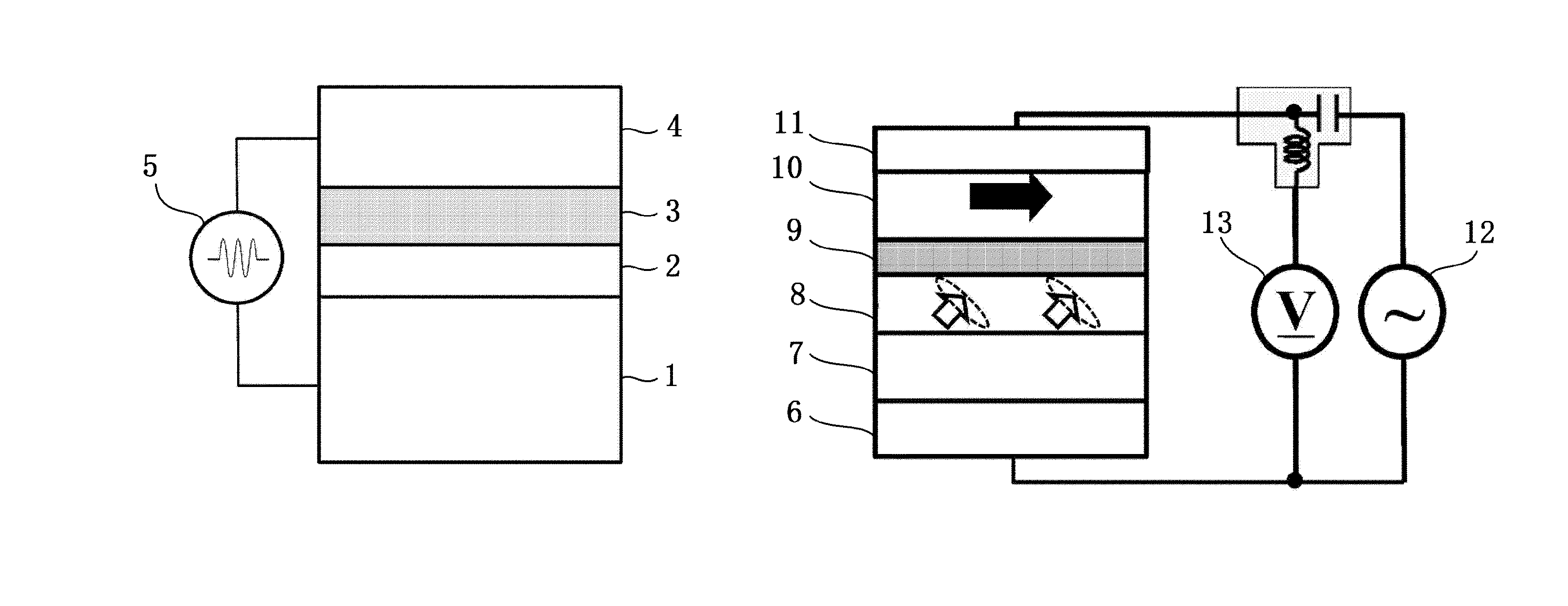
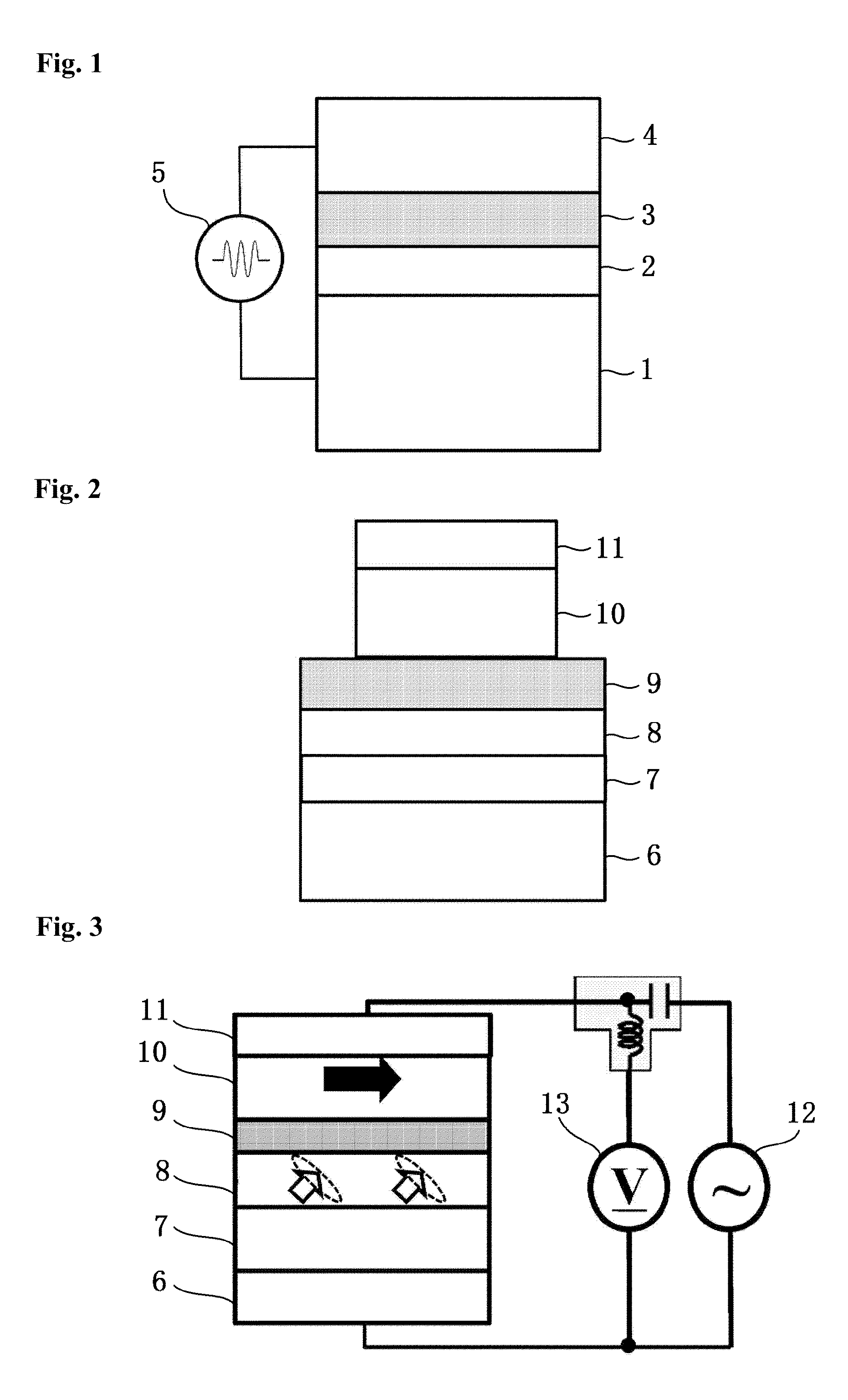
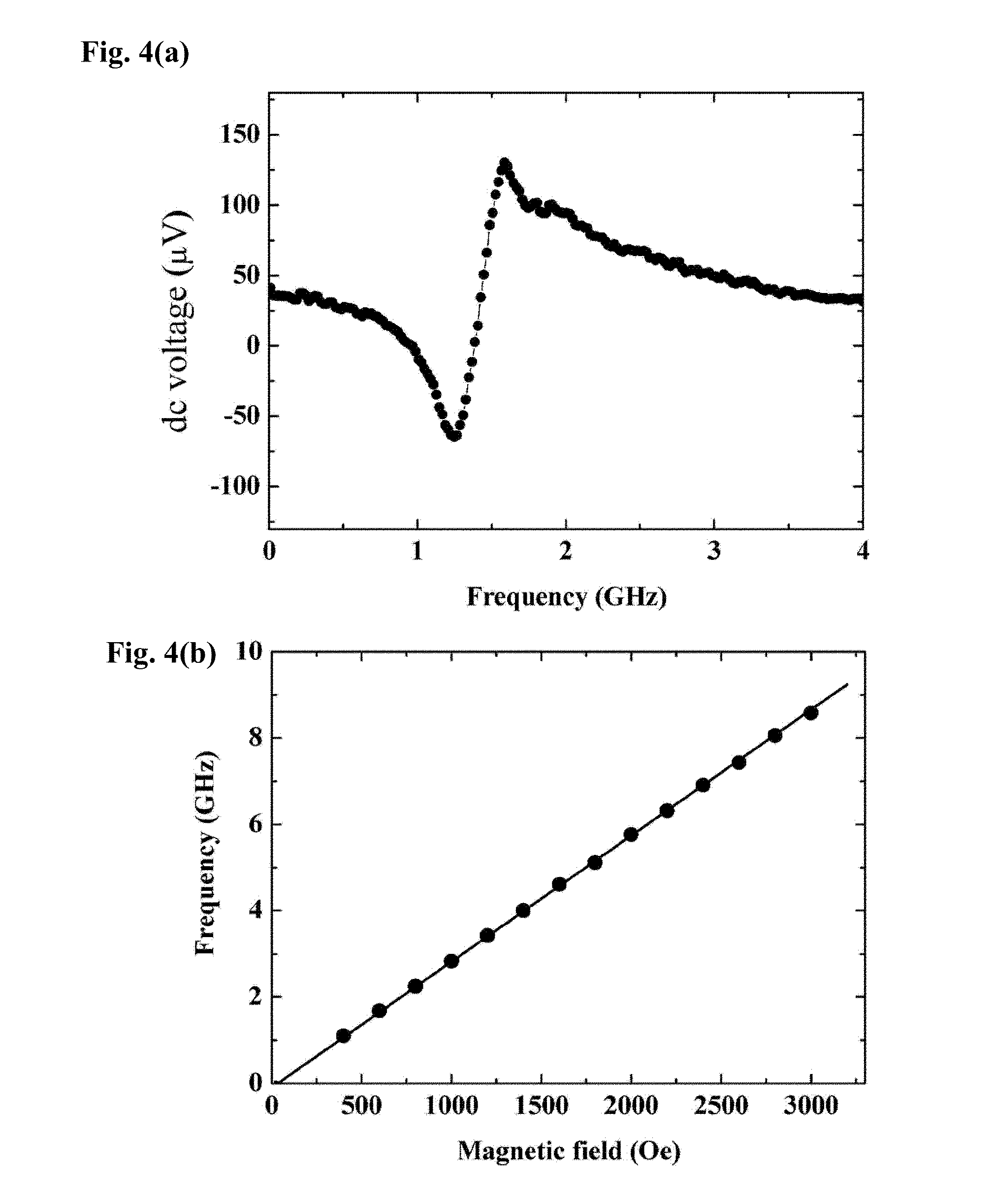

Ferromagnetic resonance device
PatentInactiveUS4983936A
Innovation
- The use of YIG thin film elements with major surfaces formed on (100) or (111) planes, having reduced uniaxial magnetic anisotropy constants, coupled with a bias magnetic field applied perpendicular to the major surface, and a suspended substrate strip line configuration to enhance the connection between YIG thin film elements and transmission lines, effectively lowering the external Q value and resonance frequency.


Material Engineering for Enhanced Spin Transport
Material engineering represents a critical pathway for enhancing spin transport efficiency in ferromagnetic resonance-based spin pumping systems. The fundamental approach involves designing and synthesizing materials with optimized magnetic, electronic, and interfacial properties that facilitate efficient spin current generation and transmission across heterostructure interfaces.
Interface engineering constitutes the primary focus area, where atomic-level control of ferromagnetic-nonmagnetic interfaces directly impacts spin mixing conductance and spin transparency. Advanced deposition techniques such as molecular beam epitaxy and atomic layer deposition enable precise control of interfacial roughness, interdiffusion, and crystallographic matching. These parameters significantly influence the spin-dependent scattering processes that govern spin pumping efficiency.
Heavy metal selection and optimization play crucial roles in spin transport enhancement. Materials with strong spin-orbit coupling, such as platinum, tantalum, and tungsten, serve as efficient spin sinks due to their large spin Hall angles. Recent investigations have explored topological materials and two-dimensional systems like graphene and transition metal dichalcogenides, which offer unique spin transport properties including long spin diffusion lengths and tunable spin-orbit interactions.
Ferromagnetic layer engineering focuses on materials with high magnetic moments, low damping parameters, and optimal anisotropy characteristics. Heusler alloys, particularly Co-based compounds, demonstrate exceptional spin polarization and low Gilbert damping, making them ideal candidates for efficient spin injection. Compositional tuning and structural optimization of these materials can significantly enhance their ferromagnetic resonance properties and subsequent spin pumping performance.
Multilayer architecture design enables sophisticated control over spin transport pathways. Engineered spin valve structures, synthetic antiferromagnets, and exchange-coupled systems provide additional degrees of freedom for optimizing spin current generation and detection. The incorporation of buffer layers and capping materials further refines interfacial properties and protects active layers from oxidation and contamination.
Emerging material platforms include magnetic insulators such as yttrium iron garnet, which eliminate charge current contributions while maintaining efficient spin transport. These materials enable pure spin current studies and offer potential advantages in low-power spintronic applications where charge-based losses must be minimized.
Interface Optimization in Magnetic Heterostructures
Interface optimization represents a critical pathway for enhancing spin-pumping efficiency in magnetic heterostructures utilizing ferromagnetic resonance. The quality of interfaces between ferromagnetic and non-magnetic layers fundamentally determines the effectiveness of spin current injection and detection, making interface engineering a paramount consideration in device design.
The atomic-scale structure at ferromagnetic-nonmagnetic interfaces directly influences spin transparency and mixing conductance parameters. Crystalline matching between adjacent layers minimizes interfacial defects that can scatter spin currents, while controlled interdiffusion creates optimal spin-orbit coupling conditions. Advanced deposition techniques such as molecular beam epitaxy and atomic layer deposition enable precise control over interface roughness, typically maintaining variations below 0.5 nanometers for optimal performance.
Material selection for interface layers significantly impacts spin injection efficiency. Heavy metal underlayers like platinum, tantalum, and tungsten provide strong spin-orbit coupling, while their positioning relative to the ferromagnetic layer affects both Gilbert damping enhancement and spin Hall angle optimization. Buffer layers of materials such as copper or silver can be strategically inserted to tune interfacial properties without compromising spin transport.
Surface treatment protocols before layer deposition prove crucial for interface quality. Ion beam cleaning, controlled oxidation, and chemical passivation techniques modify surface energy states and bonding configurations. These treatments directly influence magnetic anisotropy at interfaces, affecting both resonance linewidth and spin-pumping amplitude in ferromagnetic resonance measurements.
Thermal management during heterostructure fabrication prevents unwanted interdiffusion while promoting desired interfacial bonding. Controlled annealing processes can enhance crystalline ordering and reduce defect densities, though excessive temperatures may degrade interface sharpness. Post-deposition treatments using rapid thermal annealing or laser processing offer precise control over interfacial properties.
Interface characterization through advanced microscopy and spectroscopy techniques enables iterative optimization. High-resolution transmission electron microscopy reveals atomic-scale structure, while X-ray photoelectron spectroscopy identifies chemical bonding states. These analytical approaches guide systematic interface engineering strategies for maximizing spin-pumping efficiency in practical device applications.
Unlock deeper insights with Patsnap Eureka Quick Research — get a full tech report to explore trends and direct your research. Try now!
Generate Your Research Report Instantly with AI Agent
Supercharge your innovation with Patsnap Eureka AI Agent Platform!