

Optimizing Predictive Control in Industrial Robotics
APR 2, 20269 MIN READ
Generate Your Research Report Instantly with AI Agent
PatSnap Eureka helps you evaluate technical feasibility & market potential.
Industrial Robotics Predictive Control Background and Objectives
Industrial robotics has undergone remarkable transformation since its inception in the 1960s, evolving from simple programmable machines to sophisticated systems capable of complex autonomous operations. The integration of predictive control methodologies represents a pivotal advancement in this evolution, addressing the growing demands for precision, efficiency, and adaptability in modern manufacturing environments.
The historical development of industrial robotics control systems began with basic position control mechanisms and progressed through various stages including PID controllers, adaptive control systems, and eventually to model predictive control (MPC) frameworks. This technological progression has been driven by the increasing complexity of manufacturing processes and the need for robots to operate in dynamic, uncertain environments while maintaining high performance standards.
Current market dynamics reveal an unprecedented demand for intelligent automation solutions that can anticipate and respond to changing operational conditions. The fourth industrial revolution has intensified requirements for predictive capabilities in robotic systems, particularly in sectors such as automotive manufacturing, electronics assembly, and precision machining where microsecond-level accuracy and real-time adaptation are critical.
The primary objective of optimizing predictive control in industrial robotics centers on developing advanced algorithms that can accurately forecast system behavior and preemptively adjust control parameters to maintain optimal performance. This involves creating robust mathematical models that can predict robot dynamics, environmental interactions, and potential disturbances while accounting for system constraints and operational limitations.
Key technical goals include minimizing trajectory tracking errors, reducing energy consumption, enhancing system stability under varying load conditions, and improving overall operational efficiency. Additionally, the integration of machine learning techniques with traditional predictive control frameworks aims to enable continuous system improvement through adaptive learning from operational data.
The strategic importance of this technological advancement extends beyond immediate performance improvements, positioning organizations to achieve competitive advantages through enhanced productivity, reduced operational costs, and improved product quality consistency in increasingly automated industrial environments.
The historical development of industrial robotics control systems began with basic position control mechanisms and progressed through various stages including PID controllers, adaptive control systems, and eventually to model predictive control (MPC) frameworks. This technological progression has been driven by the increasing complexity of manufacturing processes and the need for robots to operate in dynamic, uncertain environments while maintaining high performance standards.
Current market dynamics reveal an unprecedented demand for intelligent automation solutions that can anticipate and respond to changing operational conditions. The fourth industrial revolution has intensified requirements for predictive capabilities in robotic systems, particularly in sectors such as automotive manufacturing, electronics assembly, and precision machining where microsecond-level accuracy and real-time adaptation are critical.
The primary objective of optimizing predictive control in industrial robotics centers on developing advanced algorithms that can accurately forecast system behavior and preemptively adjust control parameters to maintain optimal performance. This involves creating robust mathematical models that can predict robot dynamics, environmental interactions, and potential disturbances while accounting for system constraints and operational limitations.
Key technical goals include minimizing trajectory tracking errors, reducing energy consumption, enhancing system stability under varying load conditions, and improving overall operational efficiency. Additionally, the integration of machine learning techniques with traditional predictive control frameworks aims to enable continuous system improvement through adaptive learning from operational data.
The strategic importance of this technological advancement extends beyond immediate performance improvements, positioning organizations to achieve competitive advantages through enhanced productivity, reduced operational costs, and improved product quality consistency in increasingly automated industrial environments.
Market Demand for Advanced Robotic Automation Solutions
The global industrial robotics market is experiencing unprecedented growth driven by the increasing demand for precision, efficiency, and adaptability in manufacturing processes. Traditional robotic systems with basic control mechanisms are rapidly being replaced by advanced solutions that incorporate predictive control technologies, enabling robots to anticipate and respond to dynamic operational conditions with enhanced accuracy.
Manufacturing industries across automotive, electronics, pharmaceuticals, and consumer goods sectors are actively seeking robotic automation solutions that can handle complex tasks while maintaining consistent quality standards. The shift toward mass customization and flexible production lines has created substantial demand for robots capable of real-time adaptation and predictive decision-making capabilities.
The emergence of Industry 4.0 and smart manufacturing initiatives has significantly amplified market interest in predictive control systems for industrial robotics. Companies are increasingly recognizing that conventional reactive control approaches limit operational efficiency and product quality, particularly in high-speed assembly lines and precision manufacturing environments where millisecond-level response times are critical.
Supply chain disruptions and labor shortages have further accelerated adoption of advanced robotic automation solutions. Organizations are investing in predictive control technologies to reduce dependency on human operators while achieving higher throughput rates and minimizing production downtime through proactive maintenance and operational optimization.
The market demand extends beyond traditional manufacturing applications to include emerging sectors such as logistics, food processing, and healthcare. These industries require robotic systems with sophisticated predictive capabilities to handle variable product characteristics, environmental conditions, and safety requirements while maintaining operational continuity.
Small and medium-sized enterprises are increasingly entering the market for advanced robotic solutions as costs decrease and implementation complexity reduces. This democratization of robotic technology is expanding the addressable market significantly, creating opportunities for scalable predictive control solutions that can be deployed across diverse operational environments.
Quality assurance requirements and regulatory compliance standards are driving demand for robotic systems with enhanced predictive monitoring and control capabilities. Industries with stringent quality requirements are particularly interested in solutions that can predict and prevent defects before they occur, reducing waste and ensuring consistent product quality throughout production cycles.
Manufacturing industries across automotive, electronics, pharmaceuticals, and consumer goods sectors are actively seeking robotic automation solutions that can handle complex tasks while maintaining consistent quality standards. The shift toward mass customization and flexible production lines has created substantial demand for robots capable of real-time adaptation and predictive decision-making capabilities.
The emergence of Industry 4.0 and smart manufacturing initiatives has significantly amplified market interest in predictive control systems for industrial robotics. Companies are increasingly recognizing that conventional reactive control approaches limit operational efficiency and product quality, particularly in high-speed assembly lines and precision manufacturing environments where millisecond-level response times are critical.
Supply chain disruptions and labor shortages have further accelerated adoption of advanced robotic automation solutions. Organizations are investing in predictive control technologies to reduce dependency on human operators while achieving higher throughput rates and minimizing production downtime through proactive maintenance and operational optimization.
The market demand extends beyond traditional manufacturing applications to include emerging sectors such as logistics, food processing, and healthcare. These industries require robotic systems with sophisticated predictive capabilities to handle variable product characteristics, environmental conditions, and safety requirements while maintaining operational continuity.
Small and medium-sized enterprises are increasingly entering the market for advanced robotic solutions as costs decrease and implementation complexity reduces. This democratization of robotic technology is expanding the addressable market significantly, creating opportunities for scalable predictive control solutions that can be deployed across diverse operational environments.
Quality assurance requirements and regulatory compliance standards are driving demand for robotic systems with enhanced predictive monitoring and control capabilities. Industries with stringent quality requirements are particularly interested in solutions that can predict and prevent defects before they occur, reducing waste and ensuring consistent product quality throughout production cycles.
Current State and Challenges in Predictive Control Systems
Predictive control systems in industrial robotics have reached a significant level of maturity, with Model Predictive Control (MPC) emerging as the dominant paradigm for handling complex multi-variable control problems. Current implementations successfully address trajectory tracking, collision avoidance, and dynamic obstacle navigation in structured environments. Advanced algorithms now incorporate real-time optimization techniques, enabling robots to predict and adapt to changing operational conditions within millisecond timeframes.
The integration of machine learning with traditional predictive control has created hybrid systems that demonstrate improved performance in uncertain environments. Deep reinforcement learning algorithms are increasingly being combined with MPC frameworks to enhance prediction accuracy and reduce computational overhead. These systems show particular promise in applications requiring high-precision manipulation and adaptive behavior in manufacturing environments.
Despite these advances, several critical challenges continue to limit the widespread adoption of optimized predictive control systems. Computational complexity remains the primary bottleneck, particularly for systems requiring real-time performance with prediction horizons exceeding several seconds. The curse of dimensionality becomes pronounced when dealing with multi-robot coordination scenarios or robots with numerous degrees of freedom.
Model uncertainty presents another significant obstacle, as predictive controllers rely heavily on accurate system models. Variations in payload, wear and tear, and environmental factors can degrade control performance substantially. Current adaptive modeling techniques struggle to maintain accuracy across diverse operating conditions while preserving computational efficiency.
Real-time constraint handling poses additional challenges, especially when safety-critical constraints must be guaranteed under all operating conditions. Existing methods often resort to conservative approaches that sacrifice performance for safety assurance. The trade-off between optimality and robustness remains a fundamental challenge in practical implementations.
Communication delays and network uncertainties in distributed robotic systems further complicate predictive control implementation. Synchronization issues between multiple robots and central control systems can lead to suboptimal performance or system instability. Current solutions often rely on simplified models that may not capture the full complexity of networked robotic systems.
The scalability of predictive control algorithms represents another critical limitation. While current systems perform well with individual robots or small teams, extending these approaches to large-scale robotic networks introduces exponential complexity growth that existing computational frameworks cannot adequately address.
The integration of machine learning with traditional predictive control has created hybrid systems that demonstrate improved performance in uncertain environments. Deep reinforcement learning algorithms are increasingly being combined with MPC frameworks to enhance prediction accuracy and reduce computational overhead. These systems show particular promise in applications requiring high-precision manipulation and adaptive behavior in manufacturing environments.
Despite these advances, several critical challenges continue to limit the widespread adoption of optimized predictive control systems. Computational complexity remains the primary bottleneck, particularly for systems requiring real-time performance with prediction horizons exceeding several seconds. The curse of dimensionality becomes pronounced when dealing with multi-robot coordination scenarios or robots with numerous degrees of freedom.
Model uncertainty presents another significant obstacle, as predictive controllers rely heavily on accurate system models. Variations in payload, wear and tear, and environmental factors can degrade control performance substantially. Current adaptive modeling techniques struggle to maintain accuracy across diverse operating conditions while preserving computational efficiency.
Real-time constraint handling poses additional challenges, especially when safety-critical constraints must be guaranteed under all operating conditions. Existing methods often resort to conservative approaches that sacrifice performance for safety assurance. The trade-off between optimality and robustness remains a fundamental challenge in practical implementations.
Communication delays and network uncertainties in distributed robotic systems further complicate predictive control implementation. Synchronization issues between multiple robots and central control systems can lead to suboptimal performance or system instability. Current solutions often rely on simplified models that may not capture the full complexity of networked robotic systems.
The scalability of predictive control algorithms represents another critical limitation. While current systems perform well with individual robots or small teams, extending these approaches to large-scale robotic networks introduces exponential complexity growth that existing computational frameworks cannot adequately address.
Existing Predictive Control Algorithms and Implementations
01 Model Predictive Control (MPC) algorithms for system optimization
Model Predictive Control is a widely used advanced control strategy that utilizes mathematical models to predict future system behavior and optimize control actions accordingly. This approach involves solving optimization problems at each control interval to determine optimal control inputs while satisfying system constraints. The method enables proactive control by anticipating future disturbances and system dynamics, leading to improved performance in complex industrial processes and dynamic systems.- Model Predictive Control (MPC) algorithms for system optimization: Model Predictive Control is a widely used advanced control strategy that utilizes mathematical models to predict future system behavior and optimize control actions accordingly. This approach involves solving optimization problems at each control interval to determine optimal control inputs while satisfying system constraints. The method can handle multi-variable systems, incorporate feedforward and feedback control, and adapt to changing operating conditions for improved performance.
- Real-time optimization and adaptive control strategies: Real-time optimization techniques enable continuous adjustment of control parameters based on current system states and performance metrics. These strategies incorporate adaptive algorithms that learn from system behavior and automatically tune control parameters to maintain optimal performance under varying conditions. The approach includes online parameter estimation, recursive optimization, and dynamic constraint handling to ensure robust control performance.
- Multi-objective optimization in predictive control systems: Multi-objective optimization frameworks balance multiple competing objectives such as energy efficiency, performance accuracy, and operational costs simultaneously. These methods employ weighted objective functions, Pareto optimization, or hierarchical optimization structures to find optimal trade-offs between different control goals. The approach enables flexible priority management and can adapt to changing operational requirements.
- Constraint handling and feasibility optimization: Advanced constraint management techniques ensure that control actions remain within safe and feasible operating regions while maximizing performance. These methods include soft constraints, constraint relaxation strategies, and feasibility recovery mechanisms that prevent control failures due to infeasible optimization problems. The approach incorporates safety margins, priority-based constraint satisfaction, and emergency handling procedures.
- Computational efficiency and optimization solver improvements: Optimization of computational algorithms and solver techniques reduces the processing time required for predictive control calculations, enabling faster control cycles and real-time implementation. These improvements include efficient matrix operations, parallel processing capabilities, warm-start initialization, and simplified optimization formulations that maintain accuracy while reducing computational burden. The methods are particularly important for embedded systems and applications with strict timing requirements.
02 Machine learning and artificial intelligence integration in predictive control
Advanced predictive control systems incorporate machine learning algorithms and artificial intelligence techniques to enhance prediction accuracy and optimization performance. These systems can learn from historical data, adapt to changing operating conditions, and improve control strategies over time. The integration enables better handling of nonlinear systems, uncertainty management, and real-time decision making in complex control scenarios.Expand Specific Solutions03 Multi-objective optimization in predictive control frameworks
Predictive control systems can be designed to simultaneously optimize multiple conflicting objectives such as energy efficiency, production quality, safety constraints, and economic performance. These frameworks employ sophisticated optimization algorithms that balance trade-offs between different objectives while maintaining system stability and meeting operational requirements. The approach is particularly valuable in industrial applications where multiple performance criteria must be considered.Expand Specific Solutions04 Distributed and hierarchical predictive control architectures
Large-scale systems benefit from distributed and hierarchical control structures where predictive control is implemented across multiple subsystems or control layers. These architectures decompose complex optimization problems into smaller, manageable subproblems that can be solved in parallel or sequentially. This approach improves computational efficiency, scalability, and robustness while maintaining coordination between different control units.Expand Specific Solutions05 Robust and adaptive predictive control under uncertainty
Predictive control systems can be enhanced with robust and adaptive mechanisms to handle model uncertainties, parameter variations, and external disturbances. These methods incorporate uncertainty quantification, constraint tightening, and online model adaptation to ensure reliable performance under varying operating conditions. The techniques improve system resilience and maintain optimal performance even when faced with unpredictable changes in system dynamics or environmental conditions.Expand Specific Solutions
Key Players in Industrial Robotics and Control Technology
The industrial robotics predictive control optimization sector represents a mature, high-growth market driven by Industry 4.0 demands and autonomous manufacturing trends. The market demonstrates substantial scale with established global players like ABB Ltd., Siemens AG, FANUC Corp., and Rockwell Automation Technologies leading traditional automation solutions. Technology maturity varies significantly across the competitive landscape - while established giants like Honeywell International, Mitsubishi Electric Corp., and OMRON Corp. offer proven but conventional control systems, emerging players such as ArtiMinds Robotics GmbH, oPRO.ai Inc., and FRANKA EMIKA GmbH are pioneering AI-driven predictive algorithms and adaptive control technologies. The sector shows clear bifurcation between legacy hardware-centric approaches from companies like KUKA Laboratories and Yamaha Motor, versus software-first solutions from newer entrants leveraging machine learning and real-time optimization capabilities for enhanced precision and efficiency.
ABB Ltd.
Technical Solution: ABB's RobotStudio and IRC5 controller platform implements sophisticated predictive control algorithms that optimize robot motion planning through advanced trajectory optimization and dynamic modeling. Their solution employs multi-objective optimization techniques that simultaneously minimize energy consumption, cycle time, and mechanical stress while maintaining precision requirements. The system utilizes predictive analytics to anticipate system behavior under varying load conditions, implementing adaptive control strategies that adjust in real-time based on sensor feedback and learned operational patterns. Their OmniCore controller architecture supports distributed predictive control across multiple robot cells, enabling coordinated optimization of complex manufacturing processes with improved overall equipment effectiveness.
Strengths: Strong global presence in industrial automation, comprehensive robot portfolio with integrated control solutions. Weaknesses: Complex system integration requirements, high initial investment costs for advanced predictive control features.
Rockwell Automation Technologies, Inc.
Technical Solution: Rockwell Automation's FactoryTalk Analytics platform integrates predictive control optimization through their Studio 5000 environment, implementing advanced process control (APC) algorithms specifically designed for robotic manufacturing systems. Their solution combines model-based predictive control with machine learning algorithms that continuously optimize control parameters based on historical performance data and real-time system feedback. The platform supports multi-loop control optimization, enabling coordinated control of multiple robotic systems while maintaining individual performance objectives. Their predictive control framework incorporates digital twin technology for virtual validation and optimization before deployment, reducing commissioning time and improving control performance reliability in industrial robotic applications.
Strengths: Comprehensive industrial IoT integration, strong focus on manufacturing optimization and digital transformation. Weaknesses: Primarily focused on discrete manufacturing, limited applicability in continuous process industries.
Core Innovations in Model Predictive Control for Robotics
Robot Control Using Model-Predictive Interaction
PatentInactiveUS20210138652A1
Innovation
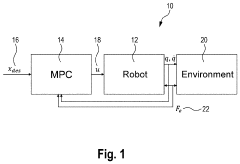
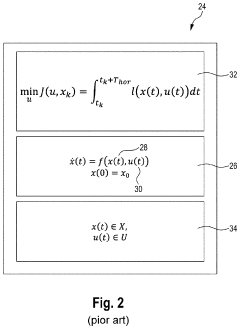
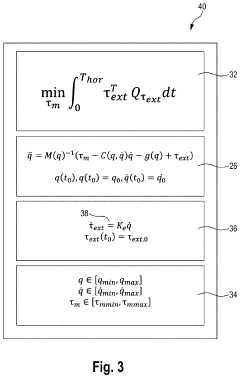
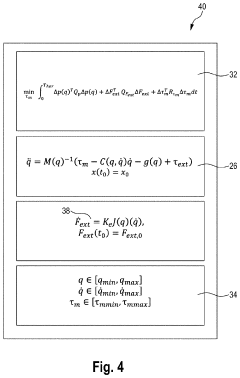
- The method integrates interaction dynamics into model predictive control, allowing for the consideration of forces that arise during human-robot interaction, enabling a unified approach for yield, force, and motion control through an optimization problem that weights interaction forces and adapts to different applications.
Apparatus and method for model predictive control (MPC) using approximate window-based estimators
PatentInactiveUS20120109620A1
Innovation
- The implementation of model predictive control (MPC) using approximate window-based estimators, which involve obtaining measurements, linearizing process models, and generating control signals through MPC logic, allowing for continuous online updates and efficient handling of constraints, thereby improving computational speed and reliability.


Safety Standards and Regulations for Industrial Robotics
The implementation of optimized predictive control systems in industrial robotics operates within a comprehensive framework of safety standards and regulations designed to protect human operators, equipment, and production environments. These regulatory frameworks have evolved significantly as predictive control technologies have become more sophisticated and autonomous.
International safety standards form the foundation of regulatory compliance for predictive control systems in industrial robotics. ISO 10218 series establishes fundamental safety requirements for industrial robots, while ISO 13849 defines safety-related parts of control systems. The emerging ISO/TS 15066 specifically addresses collaborative robot operations, which is particularly relevant for predictive control systems that enable closer human-robot interaction. These standards mandate specific safety functions including emergency stops, protective stops, and speed and separation monitoring.
Functional safety requirements under IEC 61508 and its robotics-specific derivative IEC 62061 establish systematic approaches for safety lifecycle management in predictive control systems. These standards require comprehensive hazard analysis, risk assessment, and the implementation of safety integrity levels that directly impact the design of predictive algorithms. Control systems must demonstrate fail-safe behaviors and maintain safety functions even when predictive models encounter unexpected scenarios or computational failures.
Regional regulatory variations significantly impact the deployment of predictive control systems. European machinery directives mandate CE marking and comprehensive risk assessments, while OSHA regulations in the United States focus on workplace safety and lockout/tagout procedures. Asian markets, particularly Japan and South Korea, have developed specific guidelines for collaborative robotics that influence predictive control implementation strategies.
Emerging regulatory challenges center on the validation and verification of machine learning components within predictive control systems. Traditional deterministic safety analysis methods struggle to address the probabilistic nature of predictive algorithms, leading to new approaches for safety case development. Regulatory bodies are developing frameworks for continuous monitoring and adaptive safety systems that can respond to evolving operational conditions.
Compliance verification requires extensive documentation of predictive model behavior, including training data provenance, algorithm transparency, and performance boundaries. Safety-certified predictive control systems must demonstrate consistent behavior across operational scenarios and provide clear audit trails for regulatory inspection and post-incident analysis.
International safety standards form the foundation of regulatory compliance for predictive control systems in industrial robotics. ISO 10218 series establishes fundamental safety requirements for industrial robots, while ISO 13849 defines safety-related parts of control systems. The emerging ISO/TS 15066 specifically addresses collaborative robot operations, which is particularly relevant for predictive control systems that enable closer human-robot interaction. These standards mandate specific safety functions including emergency stops, protective stops, and speed and separation monitoring.
Functional safety requirements under IEC 61508 and its robotics-specific derivative IEC 62061 establish systematic approaches for safety lifecycle management in predictive control systems. These standards require comprehensive hazard analysis, risk assessment, and the implementation of safety integrity levels that directly impact the design of predictive algorithms. Control systems must demonstrate fail-safe behaviors and maintain safety functions even when predictive models encounter unexpected scenarios or computational failures.
Regional regulatory variations significantly impact the deployment of predictive control systems. European machinery directives mandate CE marking and comprehensive risk assessments, while OSHA regulations in the United States focus on workplace safety and lockout/tagout procedures. Asian markets, particularly Japan and South Korea, have developed specific guidelines for collaborative robotics that influence predictive control implementation strategies.
Emerging regulatory challenges center on the validation and verification of machine learning components within predictive control systems. Traditional deterministic safety analysis methods struggle to address the probabilistic nature of predictive algorithms, leading to new approaches for safety case development. Regulatory bodies are developing frameworks for continuous monitoring and adaptive safety systems that can respond to evolving operational conditions.
Compliance verification requires extensive documentation of predictive model behavior, including training data provenance, algorithm transparency, and performance boundaries. Safety-certified predictive control systems must demonstrate consistent behavior across operational scenarios and provide clear audit trails for regulatory inspection and post-incident analysis.
Real-time Performance Optimization Strategies
Real-time performance optimization in predictive control systems for industrial robotics requires sophisticated computational strategies that balance accuracy with execution speed. The fundamental challenge lies in solving complex optimization problems within strict temporal constraints, typically ranging from microseconds to milliseconds depending on the application requirements. Modern industrial robots demand control frequencies of 1-8 kHz for high-precision tasks, necessitating optimization algorithms that can converge rapidly while maintaining solution quality.
Computational efficiency gains are primarily achieved through advanced numerical methods and algorithmic innovations. Fast gradient-based optimization techniques, such as accelerated proximal gradient methods and quasi-Newton approaches, significantly reduce computational overhead compared to traditional quadratic programming solvers. These methods exploit the structure of predictive control problems, utilizing warm-starting strategies where previous solutions serve as initial guesses for subsequent optimization cycles.
Parallel processing architectures offer substantial performance improvements for multi-axis robotic systems. Graphics Processing Units (GPUs) and Field-Programmable Gate Arrays (FPGAs) enable simultaneous computation of control actions across multiple degrees of freedom. Distributed optimization frameworks partition large-scale control problems into smaller subproblems, allowing concurrent processing while maintaining coordination through consensus algorithms or decomposition methods.
Adaptive horizon strategies dynamically adjust prediction and control horizons based on system operating conditions and computational resources. During steady-state operations, shorter horizons reduce computational burden while maintaining adequate performance. Conversely, during transient phases or disturbance rejection scenarios, extended horizons improve control quality at the expense of increased computational cost.
Model approximation techniques balance computational complexity with control performance through reduced-order modeling and linearization strategies. Piecewise linear approximations of nonlinear dynamics enable the use of efficient linear programming solvers, while maintaining sufficient accuracy for most industrial applications. Machine learning-based surrogate models can replace computationally expensive physics-based models during real-time execution, with periodic updates ensuring model fidelity.
Hardware-software co-design approaches optimize the entire control pipeline from sensor acquisition to actuator commands. Dedicated control processors with optimized instruction sets, custom silicon implementations of critical algorithms, and real-time operating systems with deterministic scheduling ensure consistent performance under varying computational loads and external disturbances.
Computational efficiency gains are primarily achieved through advanced numerical methods and algorithmic innovations. Fast gradient-based optimization techniques, such as accelerated proximal gradient methods and quasi-Newton approaches, significantly reduce computational overhead compared to traditional quadratic programming solvers. These methods exploit the structure of predictive control problems, utilizing warm-starting strategies where previous solutions serve as initial guesses for subsequent optimization cycles.
Parallel processing architectures offer substantial performance improvements for multi-axis robotic systems. Graphics Processing Units (GPUs) and Field-Programmable Gate Arrays (FPGAs) enable simultaneous computation of control actions across multiple degrees of freedom. Distributed optimization frameworks partition large-scale control problems into smaller subproblems, allowing concurrent processing while maintaining coordination through consensus algorithms or decomposition methods.
Adaptive horizon strategies dynamically adjust prediction and control horizons based on system operating conditions and computational resources. During steady-state operations, shorter horizons reduce computational burden while maintaining adequate performance. Conversely, during transient phases or disturbance rejection scenarios, extended horizons improve control quality at the expense of increased computational cost.
Model approximation techniques balance computational complexity with control performance through reduced-order modeling and linearization strategies. Piecewise linear approximations of nonlinear dynamics enable the use of efficient linear programming solvers, while maintaining sufficient accuracy for most industrial applications. Machine learning-based surrogate models can replace computationally expensive physics-based models during real-time execution, with periodic updates ensuring model fidelity.
Hardware-software co-design approaches optimize the entire control pipeline from sensor acquisition to actuator commands. Dedicated control processors with optimized instruction sets, custom silicon implementations of critical algorithms, and real-time operating systems with deterministic scheduling ensure consistent performance under varying computational loads and external disturbances.
Unlock deeper insights with PatSnap Eureka Quick Research — get a full tech report to explore trends and direct your research. Try now!
Generate Your Research Report Instantly with AI Agent
Supercharge your innovation with PatSnap Eureka AI Agent Platform!