
Optimizing Wheatstone Bridge Sensitivity for Barometric Pressure Sensors
MAR 24, 20269 MIN READ
Generate Your Research Report Instantly with AI Agent
Patsnap Eureka helps you evaluate technical feasibility & market potential.
Wheatstone Bridge Barometric Sensor Background and Objectives
Wheatstone bridge circuits have served as fundamental sensing elements in pressure measurement applications for over a century, with their origins tracing back to Sir Charles Wheatstone's electrical measurement innovations in the 1840s. The integration of these circuits with piezoresistive materials revolutionized barometric pressure sensing, enabling precise atmospheric pressure measurements essential for weather forecasting, altitude determination, and industrial process control.
The evolution of barometric pressure sensors has progressed through distinct technological phases, beginning with mechanical aneroid barometers and advancing to modern semiconductor-based piezoresistive sensors. Silicon-based Wheatstone bridge configurations emerged in the 1970s as microelectromechanical systems (MEMS) technology matured, offering superior accuracy, miniaturization potential, and cost-effectiveness compared to traditional mechanical approaches.
Contemporary barometric pressure sensors utilizing Wheatstone bridge architectures face increasing demands for enhanced sensitivity, reduced temperature drift, and improved long-term stability. These requirements stem from emerging applications in consumer electronics, automotive systems, and Internet of Things (IoT) devices, where precise pressure measurements must be achieved within stringent power consumption and form factor constraints.
The primary technical objective centers on maximizing the sensitivity coefficient of Wheatstone bridge configurations while maintaining measurement accuracy across operational temperature ranges typically spanning -40°C to +85°C. This involves optimizing the piezoresistive coefficient of sensing elements, minimizing parasitic resistances, and achieving optimal stress concentration on active sensing areas.
Secondary objectives encompass reducing cross-sensitivity to environmental factors such as humidity and electromagnetic interference, while simultaneously improving manufacturing yield and cost-effectiveness. Advanced signal conditioning techniques and compensation algorithms represent critical enablers for achieving these performance targets.
The strategic importance of sensitivity optimization extends beyond immediate performance improvements, as enhanced sensor capabilities enable new application domains including precision altimetry for unmanned aerial vehicles, building automation systems, and medical devices requiring accurate atmospheric pressure references for physiological monitoring applications.
The evolution of barometric pressure sensors has progressed through distinct technological phases, beginning with mechanical aneroid barometers and advancing to modern semiconductor-based piezoresistive sensors. Silicon-based Wheatstone bridge configurations emerged in the 1970s as microelectromechanical systems (MEMS) technology matured, offering superior accuracy, miniaturization potential, and cost-effectiveness compared to traditional mechanical approaches.
Contemporary barometric pressure sensors utilizing Wheatstone bridge architectures face increasing demands for enhanced sensitivity, reduced temperature drift, and improved long-term stability. These requirements stem from emerging applications in consumer electronics, automotive systems, and Internet of Things (IoT) devices, where precise pressure measurements must be achieved within stringent power consumption and form factor constraints.
The primary technical objective centers on maximizing the sensitivity coefficient of Wheatstone bridge configurations while maintaining measurement accuracy across operational temperature ranges typically spanning -40°C to +85°C. This involves optimizing the piezoresistive coefficient of sensing elements, minimizing parasitic resistances, and achieving optimal stress concentration on active sensing areas.
Secondary objectives encompass reducing cross-sensitivity to environmental factors such as humidity and electromagnetic interference, while simultaneously improving manufacturing yield and cost-effectiveness. Advanced signal conditioning techniques and compensation algorithms represent critical enablers for achieving these performance targets.
The strategic importance of sensitivity optimization extends beyond immediate performance improvements, as enhanced sensor capabilities enable new application domains including precision altimetry for unmanned aerial vehicles, building automation systems, and medical devices requiring accurate atmospheric pressure references for physiological monitoring applications.
Market Demand for High-Precision Pressure Sensing Applications
The global market for high-precision pressure sensing applications has experienced substantial growth driven by increasing demands across multiple industrial sectors. Aerospace and aviation industries represent one of the most critical segments, where barometric pressure sensors with optimized Wheatstone bridge configurations are essential for altitude measurement, cabin pressure control, and weather monitoring systems. The stringent accuracy requirements in these applications necessitate sensors capable of detecting minute pressure variations with exceptional stability and reliability.
Automotive applications constitute another rapidly expanding market segment, particularly with the advancement of autonomous vehicles and sophisticated engine management systems. Modern vehicles require precise barometric pressure measurements for altitude compensation in fuel injection systems, turbocharger control, and advanced driver assistance systems. The automotive industry's shift toward electric vehicles has further intensified the demand for high-precision sensors to optimize battery performance and thermal management systems.
Industrial automation and process control sectors demonstrate increasing reliance on high-precision pressure sensing technologies. Manufacturing facilities, chemical processing plants, and pharmaceutical production environments require sensors capable of maintaining accuracy within tight tolerances to ensure product quality and operational safety. The integration of Industry 4.0 technologies has amplified the need for sensors that can provide real-time, highly accurate pressure data for predictive maintenance and process optimization.
Weather monitoring and meteorological applications represent a traditional yet continuously growing market for precision barometric sensors. Climate research, weather forecasting, and environmental monitoring stations require sensors with enhanced sensitivity to detect subtle atmospheric pressure changes that influence weather patterns and climate models.
The healthcare and medical device sector has emerged as a significant growth driver, with applications ranging from respiratory monitoring equipment to implantable devices. Medical applications demand exceptional precision and long-term stability, creating opportunities for advanced Wheatstone bridge optimization techniques.
Consumer electronics markets, including smartphones, wearable devices, and IoT applications, have created new demand patterns for miniaturized high-precision pressure sensors. These applications require sensors that maintain accuracy while operating under space and power constraints, driving innovation in sensitivity optimization approaches.
Automotive applications constitute another rapidly expanding market segment, particularly with the advancement of autonomous vehicles and sophisticated engine management systems. Modern vehicles require precise barometric pressure measurements for altitude compensation in fuel injection systems, turbocharger control, and advanced driver assistance systems. The automotive industry's shift toward electric vehicles has further intensified the demand for high-precision sensors to optimize battery performance and thermal management systems.
Industrial automation and process control sectors demonstrate increasing reliance on high-precision pressure sensing technologies. Manufacturing facilities, chemical processing plants, and pharmaceutical production environments require sensors capable of maintaining accuracy within tight tolerances to ensure product quality and operational safety. The integration of Industry 4.0 technologies has amplified the need for sensors that can provide real-time, highly accurate pressure data for predictive maintenance and process optimization.
Weather monitoring and meteorological applications represent a traditional yet continuously growing market for precision barometric sensors. Climate research, weather forecasting, and environmental monitoring stations require sensors with enhanced sensitivity to detect subtle atmospheric pressure changes that influence weather patterns and climate models.
The healthcare and medical device sector has emerged as a significant growth driver, with applications ranging from respiratory monitoring equipment to implantable devices. Medical applications demand exceptional precision and long-term stability, creating opportunities for advanced Wheatstone bridge optimization techniques.
Consumer electronics markets, including smartphones, wearable devices, and IoT applications, have created new demand patterns for miniaturized high-precision pressure sensors. These applications require sensors that maintain accuracy while operating under space and power constraints, driving innovation in sensitivity optimization approaches.
Current Limitations in Wheatstone Bridge Sensitivity Performance
Traditional Wheatstone bridge configurations in barometric pressure sensors face significant sensitivity constraints that limit their performance in precision measurement applications. The fundamental limitation stems from the inherent trade-off between sensitivity and stability, where increasing bridge sensitivity often results in reduced temperature stability and increased noise susceptibility. Current implementations typically achieve sensitivity levels of 1-3 mV/V/bar, which proves insufficient for high-precision meteorological and industrial applications requiring sub-millibar resolution.
Temperature coefficient variations represent a critical challenge in existing Wheatstone bridge designs. The resistive elements within the bridge exhibit different temperature dependencies, leading to thermal drift that can exceed 0.1% per degree Celsius. This thermal sensitivity often overshadows the pressure-induced resistance changes, particularly in applications requiring measurements across wide temperature ranges. Conventional compensation techniques using additional temperature sensors introduce complexity and potential error sources while failing to address the fundamental mismatch in thermal coefficients.
Manufacturing tolerances and material property variations significantly impact bridge sensitivity performance. Silicon-based piezoresistive elements, commonly used in pressure sensors, exhibit batch-to-batch variations in piezoresistive coefficients that can vary by 10-15%. These variations necessitate individual calibration procedures and limit the achievable sensitivity uniformity across production volumes. Additionally, stress concentration effects and mechanical coupling inefficiencies between the pressure-sensing diaphragm and resistive elements reduce the effective sensitivity transfer.
Signal conditioning limitations further constrain the practical sensitivity of Wheatstone bridge pressure sensors. The low-level output signals require high-gain amplification, which introduces noise and offset drift issues. Current amplifier technologies struggle to maintain stability at the gain levels necessary to achieve sub-millibar resolution, particularly in the presence of electromagnetic interference and power supply variations. The bandwidth limitations of high-gain amplifiers also restrict the dynamic response characteristics of the sensor system.
Parasitic effects including lead resistance, thermal EMF, and mechanical stress coupling create additional sensitivity degradation mechanisms. Lead resistance variations can introduce measurement errors comparable to the pressure-induced signal changes, while thermal EMF generated at material junctions creates offset drift that masks small pressure variations. These parasitic effects become increasingly problematic as sensitivity requirements increase, establishing practical limits on achievable performance levels in conventional bridge configurations.
Temperature coefficient variations represent a critical challenge in existing Wheatstone bridge designs. The resistive elements within the bridge exhibit different temperature dependencies, leading to thermal drift that can exceed 0.1% per degree Celsius. This thermal sensitivity often overshadows the pressure-induced resistance changes, particularly in applications requiring measurements across wide temperature ranges. Conventional compensation techniques using additional temperature sensors introduce complexity and potential error sources while failing to address the fundamental mismatch in thermal coefficients.
Manufacturing tolerances and material property variations significantly impact bridge sensitivity performance. Silicon-based piezoresistive elements, commonly used in pressure sensors, exhibit batch-to-batch variations in piezoresistive coefficients that can vary by 10-15%. These variations necessitate individual calibration procedures and limit the achievable sensitivity uniformity across production volumes. Additionally, stress concentration effects and mechanical coupling inefficiencies between the pressure-sensing diaphragm and resistive elements reduce the effective sensitivity transfer.
Signal conditioning limitations further constrain the practical sensitivity of Wheatstone bridge pressure sensors. The low-level output signals require high-gain amplification, which introduces noise and offset drift issues. Current amplifier technologies struggle to maintain stability at the gain levels necessary to achieve sub-millibar resolution, particularly in the presence of electromagnetic interference and power supply variations. The bandwidth limitations of high-gain amplifiers also restrict the dynamic response characteristics of the sensor system.
Parasitic effects including lead resistance, thermal EMF, and mechanical stress coupling create additional sensitivity degradation mechanisms. Lead resistance variations can introduce measurement errors comparable to the pressure-induced signal changes, while thermal EMF generated at material junctions creates offset drift that masks small pressure variations. These parasitic effects become increasingly problematic as sensitivity requirements increase, establishing practical limits on achievable performance levels in conventional bridge configurations.
Existing Bridge Sensitivity Enhancement Solutions
01 Bridge circuit configuration and component selection for enhanced sensitivity
The sensitivity of a Wheatstone bridge can be improved through careful selection and arrangement of resistive elements, including the use of matched resistor pairs and optimized resistance ratios. The configuration of the bridge arms and the selection of appropriate resistance values directly affect the bridge's ability to detect small changes in measured parameters. Proper component matching and temperature compensation techniques help minimize drift and improve measurement accuracy.- Bridge circuit configuration and component arrangement for enhanced sensitivity: The sensitivity of Wheatstone bridge circuits can be improved through optimized circuit configurations and strategic arrangement of resistive components. This includes the use of matched resistor pairs, precision resistor networks, and specific geometric layouts that minimize thermal effects and maximize the detection of small resistance changes. Advanced configurations may incorporate multiple bridge arms with carefully selected resistance ratios to achieve higher sensitivity in measurement applications.
- Temperature compensation techniques for stability improvement: Temperature variations significantly affect Wheatstone bridge sensitivity and accuracy. Various compensation methods have been developed including the use of temperature-matched resistors, thermistor-based compensation circuits, and active temperature control systems. These techniques help maintain consistent bridge sensitivity across different operating temperatures by counteracting thermal drift and ensuring stable output signals even in varying environmental conditions.
- Signal amplification and conditioning circuits: The effective sensitivity of Wheatstone bridges can be enhanced through specialized signal processing circuits. These include differential amplifiers, instrumentation amplifiers, and analog-to-digital conversion systems that amplify the small voltage differences produced by the bridge. Advanced signal conditioning techniques incorporate noise filtering, offset correction, and gain adjustment mechanisms to improve the overall measurement sensitivity and signal-to-noise ratio.
- Sensor integration and transducer coupling methods: Wheatstone bridge sensitivity is directly influenced by how sensing elements are integrated into the bridge configuration. This includes the use of strain gauges, piezoresistive sensors, and other transducers as bridge components. Optimal coupling methods ensure maximum transfer of the measured physical parameter into resistance changes, thereby improving overall sensitivity. Techniques include proper bonding methods, mechanical coupling designs, and selection of appropriate sensor materials with high gauge factors.
- Digital processing and calibration algorithms: Modern Wheatstone bridge systems employ digital signal processing and sophisticated calibration algorithms to enhance sensitivity and accuracy. These methods include digital filtering, linearization algorithms, multi-point calibration routines, and adaptive compensation techniques. Software-based approaches allow for real-time adjustment of bridge parameters, correction of non-linearities, and implementation of advanced measurement algorithms that significantly improve the effective sensitivity beyond what is achievable through hardware alone.
02 Signal conditioning and amplification techniques
Enhancing Wheatstone bridge sensitivity involves implementing specialized signal conditioning circuits and amplification stages to process the bridge output. Differential amplifiers and instrumentation amplifiers are employed to amplify the small voltage differences produced by the bridge while rejecting common-mode noise. Advanced filtering and signal processing methods help extract meaningful measurements from low-level signals and improve the overall signal-to-noise ratio.Expand Specific Solutions03 Temperature compensation and environmental stability
Temperature variations significantly affect Wheatstone bridge sensitivity and accuracy. Compensation methods include the use of temperature-matched resistors, thermistor networks, and active compensation circuits that adjust for thermal effects. Environmental factors such as humidity and mechanical stress are also addressed through protective enclosures and strain isolation techniques to maintain consistent bridge performance across varying operating conditions.Expand Specific Solutions04 Sensor integration and transducer coupling
The sensitivity of Wheatstone bridge circuits is enhanced through optimal integration with various sensing elements such as strain gauges, pressure sensors, and temperature sensors. The mechanical and electrical coupling between the transducer and the bridge circuit affects the overall system sensitivity. Proper mounting techniques, adhesive selection, and geometric arrangements ensure efficient transfer of the measured parameter to the bridge elements while minimizing parasitic effects.Expand Specific Solutions05 Digital processing and calibration methods
Modern Wheatstone bridge systems employ digital signal processing and microcontroller-based calibration to enhance sensitivity and accuracy. Analog-to-digital conversion with high resolution, digital filtering algorithms, and software-based linearization techniques compensate for non-linearities in the bridge response. Automated calibration routines and self-diagnostic features enable real-time adjustment of bridge parameters to maintain optimal sensitivity throughout the operational lifetime.Expand Specific Solutions
Key Players in MEMS Pressure Sensor Industry
The barometric pressure sensor market utilizing Wheatstone bridge optimization represents a mature yet evolving technological landscape. The industry has reached a consolidation phase with established players like Robert Bosch GmbH, Honeywell International, and TDK Corp dominating through extensive R&D investments and manufacturing capabilities. Market size continues expanding driven by automotive, industrial IoT, and consumer electronics applications. Technology maturity varies significantly across segments - while traditional silicon-based MEMS pressure sensors from companies like Samsung Electronics, NXP USA, and Semiconductor Components Industries have achieved high reliability, emerging players like Wuxi Xinganzhi Semiconductor are advancing next-generation sensitivity optimization techniques. Specialized firms including Endress+Hauser and CTS Corp focus on niche industrial applications, while automotive suppliers like Aisin KK integrate sensors into broader system solutions, creating a competitive ecosystem spanning from component-level innovation to system integration.
Robert Bosch GmbH
Technical Solution: Bosch employs advanced MEMS fabrication techniques to optimize Wheatstone bridge configurations for barometric pressure sensors. Their approach focuses on precise piezoresistive element placement and temperature compensation circuits integrated directly on the silicon substrate. The company utilizes proprietary doping profiles and stress concentration geometries to maximize sensitivity while maintaining linearity across the operating pressure range. Their sensors incorporate differential amplification stages with programmable gain settings and digital calibration algorithms to enhance signal-to-noise ratio and compensate for manufacturing variations.
Strengths: Industry-leading MEMS expertise, comprehensive temperature compensation, high-volume manufacturing capabilities. Weaknesses: Higher cost due to complex fabrication processes, potential sensitivity to electromagnetic interference in automotive applications.
Honeywell International Technologies Ltd.
Technical Solution: Honeywell implements a multi-layer approach for Wheatstone bridge optimization in barometric sensors, combining silicon-on-insulator (SOI) technology with advanced packaging techniques. Their design features symmetrical resistor layouts with matched thermal coefficients and integrated guard rings to minimize parasitic effects. The company employs laser trimming for precise resistance matching and incorporates on-chip reference voltage sources. Their sensors utilize hermetic packaging with controlled internal atmospheres to enhance long-term stability and reduce drift. Digital signal processing algorithms provide real-time calibration and linearization.
Strengths: Excellent long-term stability, robust packaging solutions, strong aerospace heritage. Weaknesses: Limited customization options for specific applications, higher power consumption compared to competitors.
Core Patents in Wheatstone Bridge Optimization Techniques
Micromechanical pressure sensor device and corresponding measurement system
PatentInactiveUS20040079159A1
Innovation
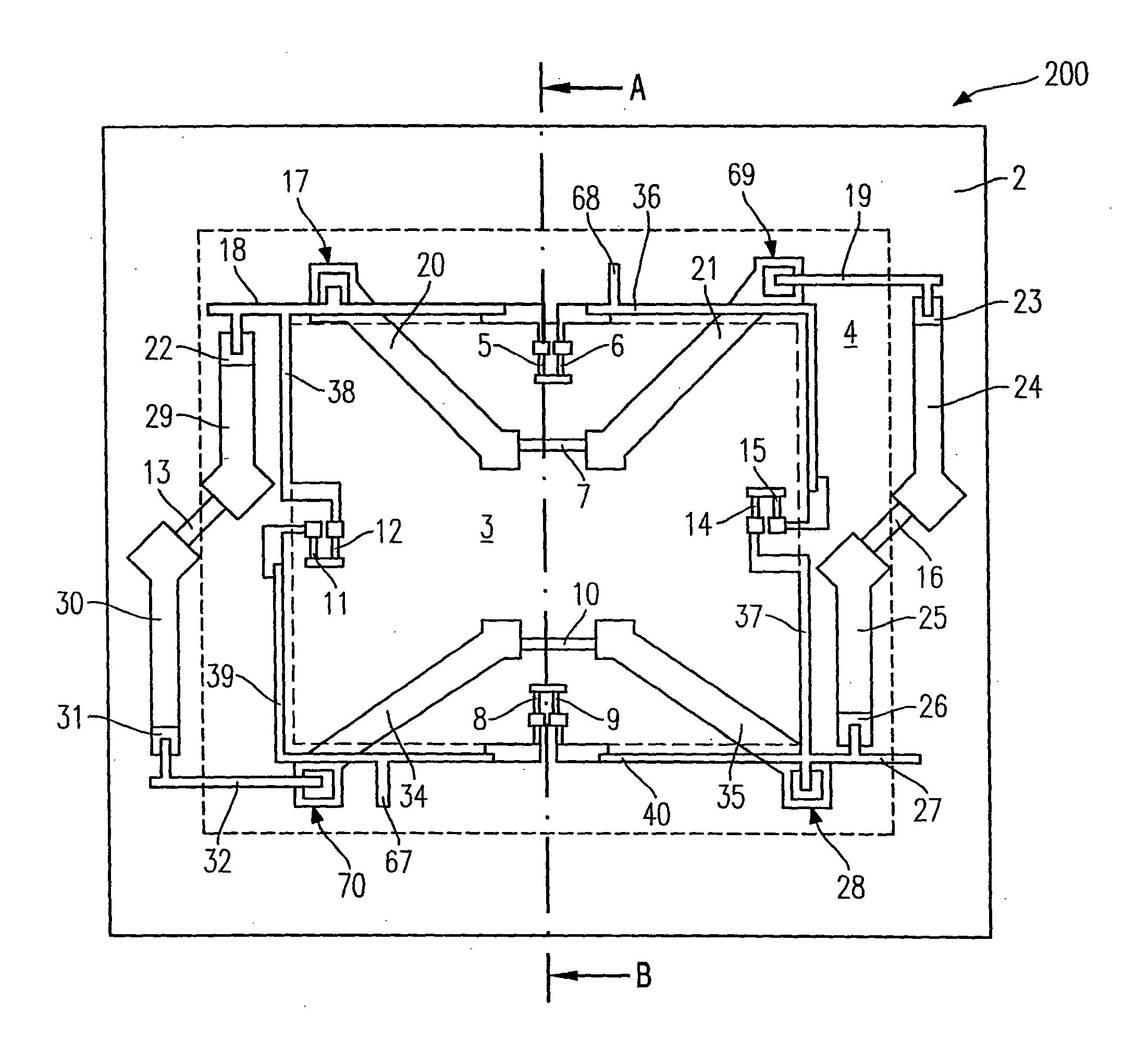
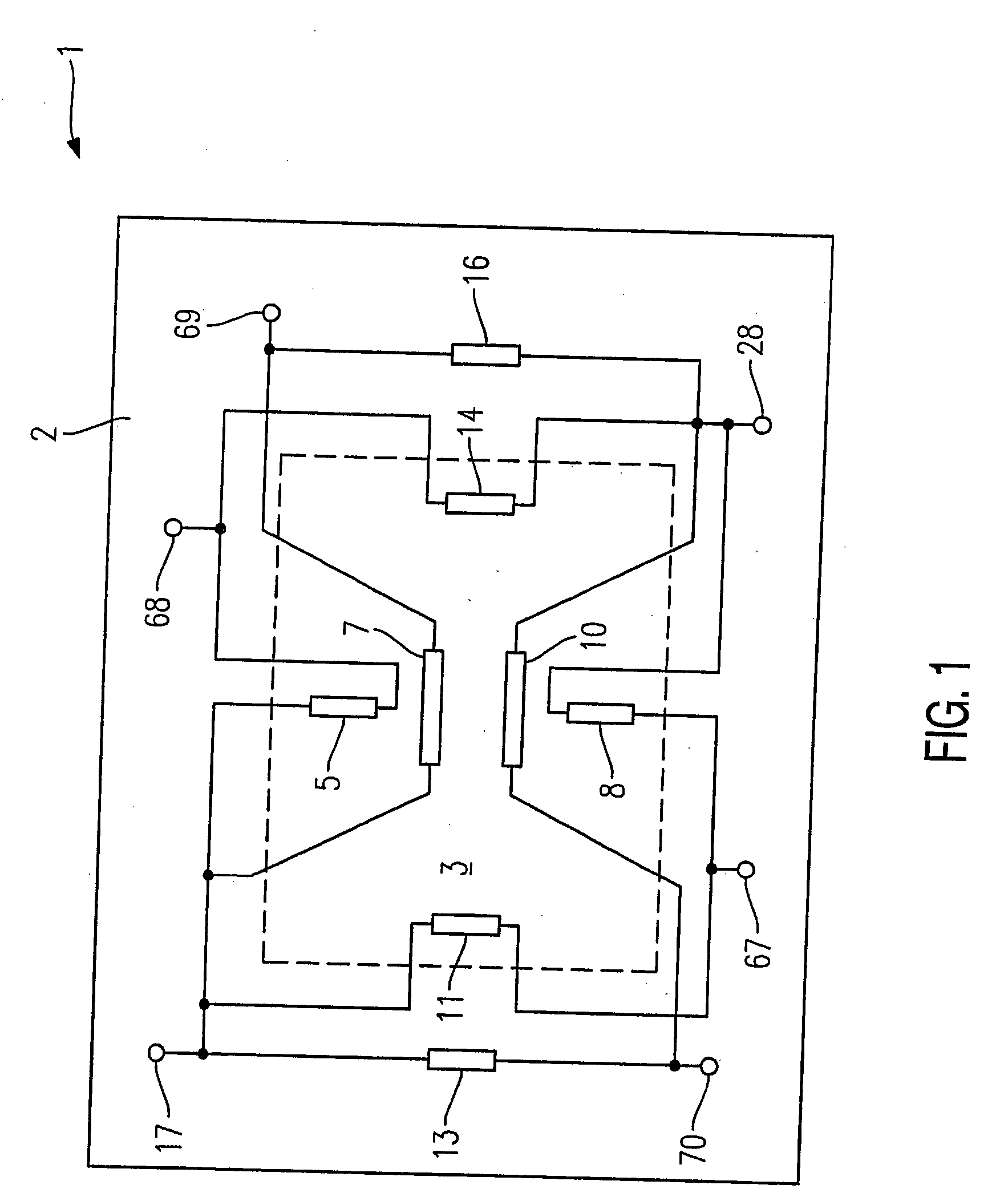
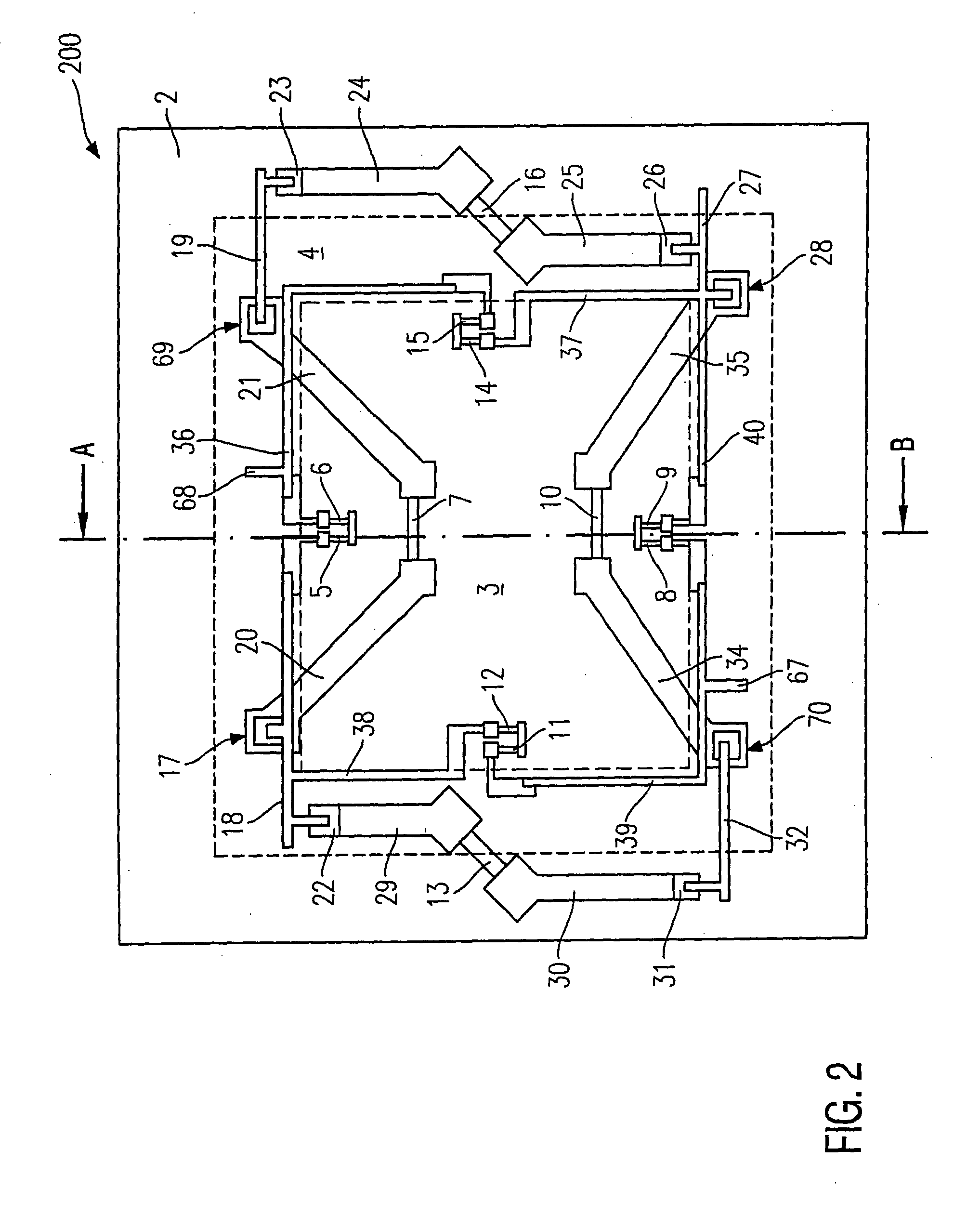
- The micromechanical pressure sensor design incorporates compensating resistors positioned to account for both radial and tangential stresses, with measuring resistors placed at locations of maximum bending stress and compensating resistors at locations with predominantly quadratic stress dependence, allowing for electronic compensation of the output signal to achieve linearity.

Pressure and temperature sensing element
PatentInactiveUS7278319B2
Innovation
- A single piezo-resistive sensing element operates as both a radial and tangential resistor when current flow is radial and tangential to the element respectively, using a constant current source to measure pressure and temperature independently, eliminating the need for separate Wheatstone bridges and reducing the number of implant elements and pins.


Calibration Standards for Barometric Pressure Sensors
Calibration standards for barometric pressure sensors utilizing Wheatstone bridge configurations represent a critical foundation for ensuring measurement accuracy and reliability across diverse applications. These standards encompass both primary and secondary reference systems, with primary standards typically based on mercury manometers or deadweight testers that provide traceability to fundamental physical constants. Secondary standards include precision digital pressure calibrators and automated pressure controllers that offer enhanced convenience while maintaining acceptable uncertainty levels.
The establishment of calibration hierarchies follows international guidelines set forth by organizations such as NIST, PTB, and other national metrology institutes. These hierarchies define uncertainty budgets ranging from 0.01% of reading for primary standards to 0.05-0.1% for working standards used in routine calibration procedures. For Wheatstone bridge-based barometric sensors, particular attention must be paid to temperature coefficients and long-term stability characteristics during calibration processes.
Traceability requirements mandate that all calibration standards maintain documented uncertainty chains linking back to SI units through recognized measurement standards. This involves regular recalibration intervals, typically ranging from 12 to 24 months depending on the standard's classification and usage frequency. Environmental conditions during calibration must be strictly controlled, with temperature stability within ±0.1°C and relative humidity maintained below 60% to minimize measurement uncertainties.
Specialized calibration protocols have been developed specifically for piezoresistive pressure sensors employing Wheatstone bridge architectures. These protocols address unique characteristics such as bridge excitation voltage dependencies, thermal hysteresis effects, and nonlinearity corrections. Multi-point calibration procedures typically involve pressure points distributed across the full measurement range, with additional emphasis on atmospheric pressure regions for barometric applications.
Emerging calibration technologies incorporate automated systems capable of performing comprehensive characterization including temperature compensation, linearity assessment, and hysteresis evaluation. These advanced systems utilize precision pressure sources combined with environmental chambers to simulate operational conditions while maintaining calibration standard requirements. Integration with digital communication protocols enables automated data collection and uncertainty analysis, significantly improving calibration efficiency and documentation quality.
The establishment of calibration hierarchies follows international guidelines set forth by organizations such as NIST, PTB, and other national metrology institutes. These hierarchies define uncertainty budgets ranging from 0.01% of reading for primary standards to 0.05-0.1% for working standards used in routine calibration procedures. For Wheatstone bridge-based barometric sensors, particular attention must be paid to temperature coefficients and long-term stability characteristics during calibration processes.
Traceability requirements mandate that all calibration standards maintain documented uncertainty chains linking back to SI units through recognized measurement standards. This involves regular recalibration intervals, typically ranging from 12 to 24 months depending on the standard's classification and usage frequency. Environmental conditions during calibration must be strictly controlled, with temperature stability within ±0.1°C and relative humidity maintained below 60% to minimize measurement uncertainties.
Specialized calibration protocols have been developed specifically for piezoresistive pressure sensors employing Wheatstone bridge architectures. These protocols address unique characteristics such as bridge excitation voltage dependencies, thermal hysteresis effects, and nonlinearity corrections. Multi-point calibration procedures typically involve pressure points distributed across the full measurement range, with additional emphasis on atmospheric pressure regions for barometric applications.
Emerging calibration technologies incorporate automated systems capable of performing comprehensive characterization including temperature compensation, linearity assessment, and hysteresis evaluation. These advanced systems utilize precision pressure sources combined with environmental chambers to simulate operational conditions while maintaining calibration standard requirements. Integration with digital communication protocols enables automated data collection and uncertainty analysis, significantly improving calibration efficiency and documentation quality.
Temperature Compensation Strategies for Bridge Circuits
Temperature compensation represents one of the most critical challenges in optimizing Wheatstone bridge sensitivity for barometric pressure sensors. Temperature variations directly affect the electrical properties of bridge components, including resistance values, strain gauge factors, and semiconductor characteristics, leading to measurement errors that can significantly compromise sensor accuracy and reliability.
The fundamental approach to temperature compensation involves understanding thermal coefficients of resistance (TCR) in bridge elements. Silicon-based piezoresistive sensors exhibit temperature-dependent resistance changes that follow predictable patterns, typically ranging from 1000 to 3000 ppm/°C. These variations create offset drift and sensitivity changes that must be systematically addressed through both hardware and software compensation techniques.
Hardware compensation strategies primarily focus on incorporating temperature-sensitive resistors within the bridge circuit itself. Passive compensation utilizes carefully selected resistor networks with opposing temperature coefficients to counteract thermal drift. This method involves placing compensation resistors in series or parallel with active gauge elements, creating a self-balancing system that maintains stable output across temperature ranges.
Active compensation employs dedicated temperature sensing elements, such as thermistors or RTDs, integrated directly into the sensor package. These elements provide real-time temperature feedback that enables dynamic adjustment of bridge excitation voltage or output signal conditioning. Advanced implementations utilize multi-point calibration data stored in non-volatile memory, allowing for polynomial correction algorithms that account for non-linear temperature responses.
Digital compensation techniques leverage microprocessor-based signal processing to implement sophisticated correction algorithms. These systems continuously monitor both pressure and temperature signals, applying mathematical models that compensate for thermal effects in real-time. Machine learning approaches are increasingly being explored to develop adaptive compensation models that can account for aging effects and manufacturing variations.
Hybrid compensation strategies combine multiple approaches to achieve superior performance across extended temperature ranges. These systems typically employ coarse hardware compensation for primary thermal effects, supplemented by fine digital correction for residual errors and non-linear behaviors.
The fundamental approach to temperature compensation involves understanding thermal coefficients of resistance (TCR) in bridge elements. Silicon-based piezoresistive sensors exhibit temperature-dependent resistance changes that follow predictable patterns, typically ranging from 1000 to 3000 ppm/°C. These variations create offset drift and sensitivity changes that must be systematically addressed through both hardware and software compensation techniques.
Hardware compensation strategies primarily focus on incorporating temperature-sensitive resistors within the bridge circuit itself. Passive compensation utilizes carefully selected resistor networks with opposing temperature coefficients to counteract thermal drift. This method involves placing compensation resistors in series or parallel with active gauge elements, creating a self-balancing system that maintains stable output across temperature ranges.
Active compensation employs dedicated temperature sensing elements, such as thermistors or RTDs, integrated directly into the sensor package. These elements provide real-time temperature feedback that enables dynamic adjustment of bridge excitation voltage or output signal conditioning. Advanced implementations utilize multi-point calibration data stored in non-volatile memory, allowing for polynomial correction algorithms that account for non-linear temperature responses.
Digital compensation techniques leverage microprocessor-based signal processing to implement sophisticated correction algorithms. These systems continuously monitor both pressure and temperature signals, applying mathematical models that compensate for thermal effects in real-time. Machine learning approaches are increasingly being explored to develop adaptive compensation models that can account for aging effects and manufacturing variations.
Hybrid compensation strategies combine multiple approaches to achieve superior performance across extended temperature ranges. These systems typically employ coarse hardware compensation for primary thermal effects, supplemented by fine digital correction for residual errors and non-linear behaviors.
Unlock deeper insights with Patsnap Eureka Quick Research — get a full tech report to explore trends and direct your research. Try now!
Generate Your Research Report Instantly with AI Agent
Supercharge your innovation with Patsnap Eureka AI Agent Platform!