

Proton Exchange Membrane vs Alkaline: Efficiency Analysis
MAR 10, 20269 MIN READ
Generate Your Research Report Instantly with AI Agent
PatSnap Eureka helps you evaluate technical feasibility & market potential.
PEM vs Alkaline Fuel Cell Technology Background and Objectives
Fuel cell technology has emerged as a critical component in the global transition toward sustainable energy systems, with two dominant electrochemical approaches leading the commercial landscape: Proton Exchange Membrane (PEM) and Alkaline fuel cells. Both technologies convert chemical energy directly into electrical energy through electrochemical reactions, yet they employ fundamentally different operating principles and materials that significantly impact their efficiency characteristics.
The historical development of fuel cell technology spans over 180 years, beginning with Sir William Grove's initial demonstration in 1839. Alkaline fuel cells gained prominence during the 1960s space program, where NASA successfully deployed them in Apollo missions due to their high efficiency and reliability in controlled environments. Meanwhile, PEM fuel cells experienced rapid advancement in the 1990s, driven by automotive industry investments and the development of advanced polymer electrolyte membranes.
Current technological evolution trends indicate a growing emphasis on efficiency optimization across diverse operating conditions. PEM fuel cells demonstrate superior performance in dynamic load applications and rapid startup scenarios, making them particularly suitable for transportation and portable power applications. Their efficiency typically ranges from 40-60% under varying operational conditions, with peak performance achieved at moderate temperatures between 60-80°C.
Alkaline fuel cells traditionally exhibit higher theoretical efficiency, often reaching 60-70% in optimal conditions, primarily due to faster oxygen reduction reaction kinetics in alkaline environments. However, their efficiency advantage becomes less pronounced in real-world applications due to sensitivity to carbon dioxide contamination and longer startup times.
The primary technical objectives driving current research focus on bridging the efficiency gap between laboratory conditions and practical applications. Key targets include improving catalyst utilization, reducing parasitic losses, enhancing thermal management, and developing more durable membrane materials. Additionally, system-level efficiency improvements through better balance-of-plant components and control strategies represent critical development priorities.
Understanding the efficiency characteristics of both technologies requires comprehensive analysis of their electrochemical fundamentals, operational parameters, and system integration challenges, which directly influence their commercial viability and market adoption potential.
The historical development of fuel cell technology spans over 180 years, beginning with Sir William Grove's initial demonstration in 1839. Alkaline fuel cells gained prominence during the 1960s space program, where NASA successfully deployed them in Apollo missions due to their high efficiency and reliability in controlled environments. Meanwhile, PEM fuel cells experienced rapid advancement in the 1990s, driven by automotive industry investments and the development of advanced polymer electrolyte membranes.
Current technological evolution trends indicate a growing emphasis on efficiency optimization across diverse operating conditions. PEM fuel cells demonstrate superior performance in dynamic load applications and rapid startup scenarios, making them particularly suitable for transportation and portable power applications. Their efficiency typically ranges from 40-60% under varying operational conditions, with peak performance achieved at moderate temperatures between 60-80°C.
Alkaline fuel cells traditionally exhibit higher theoretical efficiency, often reaching 60-70% in optimal conditions, primarily due to faster oxygen reduction reaction kinetics in alkaline environments. However, their efficiency advantage becomes less pronounced in real-world applications due to sensitivity to carbon dioxide contamination and longer startup times.
The primary technical objectives driving current research focus on bridging the efficiency gap between laboratory conditions and practical applications. Key targets include improving catalyst utilization, reducing parasitic losses, enhancing thermal management, and developing more durable membrane materials. Additionally, system-level efficiency improvements through better balance-of-plant components and control strategies represent critical development priorities.
Understanding the efficiency characteristics of both technologies requires comprehensive analysis of their electrochemical fundamentals, operational parameters, and system integration challenges, which directly influence their commercial viability and market adoption potential.
Market Demand Analysis for Fuel Cell Efficiency Solutions
The global fuel cell market is experiencing unprecedented growth driven by the urgent need for clean energy solutions and decarbonization initiatives across multiple industries. Transportation sectors, particularly automotive and heavy-duty applications, represent the largest demand segment for high-efficiency fuel cell technologies. The automotive industry's transition toward zero-emission vehicles has created substantial market opportunities, with major manufacturers investing heavily in fuel cell electric vehicles (FCEVs) as alternatives to battery electric vehicles for long-range and heavy-duty applications.
Industrial applications constitute another significant demand driver, where fuel cells serve as reliable backup power systems and primary energy sources for critical infrastructure. Data centers, telecommunications facilities, and manufacturing plants increasingly require uninterrupted power supplies with minimal environmental impact. The efficiency characteristics of different fuel cell technologies directly influence their adoption rates in these applications, as operational costs and reliability remain paramount considerations for industrial users.
Stationary power generation markets demonstrate growing interest in fuel cell efficiency solutions, particularly for distributed energy systems and grid stabilization applications. Residential and commercial buildings seek energy independence through fuel cell installations, where efficiency directly correlates with economic viability and return on investment. The comparative efficiency between proton exchange membrane and alkaline technologies significantly impacts market penetration in these segments.
Maritime and aerospace industries represent emerging high-value markets where fuel cell efficiency becomes critical for operational success. Ships and aircraft require power systems with optimal energy density and reliability, making efficiency analysis essential for technology selection. These applications often justify premium costs for superior efficiency performance, creating opportunities for advanced fuel cell technologies.
Regional market dynamics reveal varying demand patterns based on government policies, infrastructure development, and industrial priorities. Asian markets demonstrate strong demand for automotive fuel cell applications, while European markets emphasize industrial and stationary applications. North American markets show balanced demand across multiple sectors, with particular emphasis on heavy-duty transportation and backup power systems.
The increasing focus on total cost of ownership rather than initial capital costs has elevated the importance of efficiency analysis in fuel cell technology selection. End users now prioritize long-term operational efficiency, maintenance requirements, and system longevity when evaluating fuel cell solutions, making comparative efficiency studies crucial for market success.
Industrial applications constitute another significant demand driver, where fuel cells serve as reliable backup power systems and primary energy sources for critical infrastructure. Data centers, telecommunications facilities, and manufacturing plants increasingly require uninterrupted power supplies with minimal environmental impact. The efficiency characteristics of different fuel cell technologies directly influence their adoption rates in these applications, as operational costs and reliability remain paramount considerations for industrial users.
Stationary power generation markets demonstrate growing interest in fuel cell efficiency solutions, particularly for distributed energy systems and grid stabilization applications. Residential and commercial buildings seek energy independence through fuel cell installations, where efficiency directly correlates with economic viability and return on investment. The comparative efficiency between proton exchange membrane and alkaline technologies significantly impacts market penetration in these segments.
Maritime and aerospace industries represent emerging high-value markets where fuel cell efficiency becomes critical for operational success. Ships and aircraft require power systems with optimal energy density and reliability, making efficiency analysis essential for technology selection. These applications often justify premium costs for superior efficiency performance, creating opportunities for advanced fuel cell technologies.
Regional market dynamics reveal varying demand patterns based on government policies, infrastructure development, and industrial priorities. Asian markets demonstrate strong demand for automotive fuel cell applications, while European markets emphasize industrial and stationary applications. North American markets show balanced demand across multiple sectors, with particular emphasis on heavy-duty transportation and backup power systems.
The increasing focus on total cost of ownership rather than initial capital costs has elevated the importance of efficiency analysis in fuel cell technology selection. End users now prioritize long-term operational efficiency, maintenance requirements, and system longevity when evaluating fuel cell solutions, making comparative efficiency studies crucial for market success.
Current Status and Challenges in PEM and Alkaline Technologies
Proton Exchange Membrane (PEM) fuel cells have achieved significant technological maturity, particularly in automotive applications. Current PEM systems demonstrate high power density ranging from 1.0 to 1.5 kW/L and operate efficiently at relatively low temperatures (60-80°C). Leading manufacturers like Toyota, Hyundai, and Honda have successfully commercialized PEM fuel cell vehicles, with system efficiencies reaching 50-60%. However, PEM technology faces substantial challenges including high platinum catalyst costs, membrane degradation under cycling conditions, and complex water management requirements.
Alkaline fuel cells represent one of the oldest fuel cell technologies, with proven reliability in space applications for over five decades. Modern alkaline systems achieve efficiencies of 60-70% and benefit from the ability to use non-precious metal catalysts, significantly reducing costs. Recent developments in alkaline anion exchange membranes have addressed traditional liquid electrolyte limitations, enabling more compact and practical designs. Companies like AFC Energy and Advent Technologies are advancing alkaline fuel cell commercialization for stationary power applications.
The primary challenge for PEM technology lies in catalyst durability and cost reduction. Platinum loading remains a critical bottleneck, with current systems requiring 0.1-0.3 mg/cm² of platinum group metals. Membrane degradation mechanisms, including chemical and mechanical stress, limit operational lifetimes to approximately 5,000-8,000 hours in automotive applications. Additionally, cold-start capabilities and freeze tolerance present ongoing engineering challenges for widespread deployment.
Alkaline fuel cells confront different technical obstacles, primarily related to CO2 sensitivity and electrolyte management. Atmospheric CO2 can form carbonates that reduce ionic conductivity and system performance over time. Traditional liquid alkaline systems suffer from electrolyte weeping and require complex fluid management systems. While solid alkaline membranes address these issues, they currently exhibit lower ionic conductivity compared to PEM membranes, particularly at lower operating temperatures.
Manufacturing scalability represents a shared challenge for both technologies. PEM systems require sophisticated membrane electrode assembly processes and precise quality control for catalyst layer uniformity. Alkaline systems, while potentially simpler in design, lack established large-scale manufacturing infrastructure. Both technologies must achieve significant cost reductions to compete effectively with conventional power generation systems in commercial markets.
Alkaline fuel cells represent one of the oldest fuel cell technologies, with proven reliability in space applications for over five decades. Modern alkaline systems achieve efficiencies of 60-70% and benefit from the ability to use non-precious metal catalysts, significantly reducing costs. Recent developments in alkaline anion exchange membranes have addressed traditional liquid electrolyte limitations, enabling more compact and practical designs. Companies like AFC Energy and Advent Technologies are advancing alkaline fuel cell commercialization for stationary power applications.
The primary challenge for PEM technology lies in catalyst durability and cost reduction. Platinum loading remains a critical bottleneck, with current systems requiring 0.1-0.3 mg/cm² of platinum group metals. Membrane degradation mechanisms, including chemical and mechanical stress, limit operational lifetimes to approximately 5,000-8,000 hours in automotive applications. Additionally, cold-start capabilities and freeze tolerance present ongoing engineering challenges for widespread deployment.
Alkaline fuel cells confront different technical obstacles, primarily related to CO2 sensitivity and electrolyte management. Atmospheric CO2 can form carbonates that reduce ionic conductivity and system performance over time. Traditional liquid alkaline systems suffer from electrolyte weeping and require complex fluid management systems. While solid alkaline membranes address these issues, they currently exhibit lower ionic conductivity compared to PEM membranes, particularly at lower operating temperatures.
Manufacturing scalability represents a shared challenge for both technologies. PEM systems require sophisticated membrane electrode assembly processes and precise quality control for catalyst layer uniformity. Alkaline systems, while potentially simpler in design, lack established large-scale manufacturing infrastructure. Both technologies must achieve significant cost reductions to compete effectively with conventional power generation systems in commercial markets.
Current Technical Solutions for Fuel Cell Efficiency
01 Membrane composition and structure optimization
Proton exchange membranes can be optimized through specific polymer compositions, reinforcement structures, and composite materials to enhance proton conductivity and mechanical stability. The membrane structure may include multiple layers, porous substrates, or reinforced frameworks that improve ion transport while maintaining durability. Various polymer blends and cross-linking methods are employed to achieve optimal balance between conductivity and mechanical properties.- Proton exchange membrane materials and compositions: Development of advanced proton exchange membrane materials using various polymer compositions, including sulfonated polymers, fluorinated polymers, and composite materials. These materials are designed to enhance proton conductivity while maintaining chemical and mechanical stability. The membranes may incorporate reinforcing agents, cross-linking structures, or hybrid organic-inorganic components to improve overall performance and durability in fuel cell applications.
- Alkaline membrane electrolytes and anion exchange membranes: Alkaline anion exchange membranes designed for use in alkaline fuel cells and electrolyzers. These membranes facilitate hydroxide ion transport and operate efficiently in alkaline environments. The technology focuses on developing membranes with high ionic conductivity, chemical stability in alkaline conditions, and resistance to degradation. Various polymer backbones and functional groups are employed to achieve optimal performance in alkaline electrochemical systems.
- Membrane electrode assembly and fabrication methods: Techniques for manufacturing and assembling membrane electrode assemblies that integrate proton exchange membranes with catalyst layers and gas diffusion layers. The methods include hot pressing, coating processes, and layer-by-layer assembly techniques to ensure proper interfacial contact and minimize resistance. Optimization of catalyst loading, distribution, and bonding to the membrane surface is emphasized to maximize electrochemical efficiency and reduce manufacturing costs.
- Enhanced durability and stability of ion exchange membranes: Strategies to improve the long-term durability and chemical stability of ion exchange membranes under operating conditions. This includes development of membranes resistant to oxidative degradation, mechanical stress, and dimensional changes during hydration cycles. Approaches involve chemical modification of polymer structures, incorporation of stabilizing additives, and design of reinforced membrane architectures that maintain performance over extended operational lifetimes.
- Water management and humidification in membrane systems: Technologies addressing water management within proton exchange membrane systems to maintain optimal hydration levels for efficient proton transport. This includes membrane designs with controlled water uptake properties, self-humidifying membranes, and systems that balance water production and removal. Proper water management prevents membrane dehydration or flooding, both of which can significantly reduce efficiency and performance in fuel cell and electrolyzer applications.
02 Catalyst layer design for improved efficiency
The catalyst layer configuration plays a crucial role in enhancing electrochemical efficiency in both proton exchange membrane and alkaline systems. Optimization involves controlling catalyst loading, distribution, and particle size to maximize active surface area. The interface between the membrane and catalyst layer is engineered to reduce resistance and improve ion transport, thereby increasing overall system efficiency.Expand Specific Solutions03 Alkaline membrane electrolyte systems
Alkaline membrane systems utilize anion exchange membranes that conduct hydroxide ions instead of protons. These systems offer advantages in terms of catalyst selection and cost reduction by enabling the use of non-precious metal catalysts. The membrane materials are designed to provide high hydroxide conductivity while maintaining chemical stability in alkaline environments, contributing to improved overall efficiency.Expand Specific Solutions04 Membrane durability and degradation resistance
Long-term efficiency of membrane systems depends on resistance to chemical and mechanical degradation. Strategies include incorporating stabilizing additives, developing chemically resistant polymer backbones, and implementing protective coatings. Enhanced durability ensures sustained performance over extended operational periods, maintaining high efficiency throughout the membrane lifetime.Expand Specific Solutions05 Hybrid and composite membrane technologies
Hybrid membrane systems combine different materials or integrate inorganic fillers into polymer matrices to achieve superior performance characteristics. These composite approaches can simultaneously improve proton or hydroxide conductivity, mechanical strength, and thermal stability. The synergistic effects of multiple components result in membranes with enhanced efficiency for both proton exchange and alkaline applications.Expand Specific Solutions
Major Players in PEM and Alkaline Fuel Cell Markets
The proton exchange membrane (PEM) versus alkaline electrolysis technology landscape represents a rapidly evolving market in the early-to-mature development stage, driven by the global transition to green hydrogen production. The market demonstrates significant growth potential with increasing investments from both established industrial players and emerging specialists. Technology maturity varies considerably across the competitive landscape, with companies like Robert Bosch GmbH and BYD Co., Ltd. leveraging their automotive and industrial expertise to advance PEM technologies, while specialized firms such as Power To Hydrogen LLC and 1s1 Energy Inc. focus on hybrid anion exchange membrane solutions that bridge PEM and alkaline approaches. Research institutions including Shanghai Jiao Tong University, KIST Corp., and CEA contribute fundamental innovations, while material suppliers like Shandong Dongyue Polymer and Arkema France SA provide critical membrane components. The efficiency analysis reveals that PEM systems offer superior load-following capabilities and high-purity output, making them suitable for intermittent renewable integration, whereas alkaline systems provide cost advantages but with slower response times, creating distinct market segments based on application requirements.
Beijing SinoHytec Co., Ltd.
Technical Solution: SinoHytec specializes in PEM fuel cell systems for commercial vehicles and has developed fuel cell engines with power outputs ranging from 30kW to 120kW. Their technology achieves system efficiency of approximately 50-55% with focus on durability and cost reduction. The company has implemented advanced stack design and balance of plant optimization to improve overall system performance in harsh operating conditions.
Strengths: Commercial vehicle focus, robust design for harsh conditions, cost optimization efforts. Weaknesses: Lower efficiency compared to leading competitors, limited passenger vehicle applications.
Industrial Technology Research Institute
Technical Solution: ITRI has developed both PEM and alkaline fuel cell technologies with emphasis on materials research and system optimization. Their PEM systems achieve efficiency rates of 50-58% while their alkaline research focuses on advanced electrolyte formulations and electrode materials. The institute conducts comparative studies on efficiency trade-offs between the two technologies, particularly examining performance under varying load conditions and environmental factors.
Strengths: Strong R&D capabilities, comprehensive technology comparison expertise, advanced materials research. Weaknesses: Limited commercial scale production, primarily research-focused rather than market-ready products.
Core Patents in PEM vs Alkaline Efficiency Research
Systems including ion exchange membranes and methods of making the same
PatentActiveUS20220384833A1
Innovation
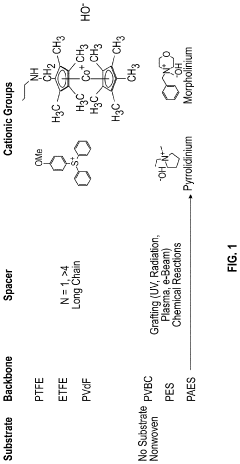
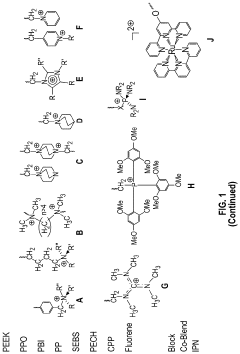
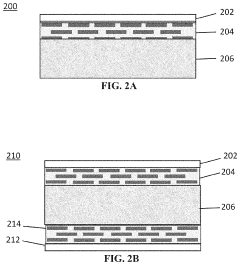
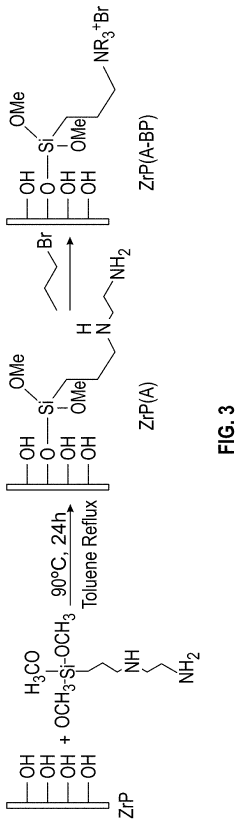
- A composite anion exchange membrane structure is developed, incorporating a layer of inorganic nanosheets, such as ZrP or LDH, on one or both sides of a polymeric AEM layer, along with a porous polymer binder layer, to enhance chemical stability and oxidation resistance.
Electrochemical cell and method of using same
PatentActiveUS20210036352A1
Innovation
- A cell design combining a gas-impermeable Anion Exchange Membrane (AEM) with a liquid electrolyte, where at least one electrode is not flooded by liquid, allowing for high-rate gas flow and using a porous matrix or nickel metal foam to separate the electrodes, enabling efficient hydrogen production and storage while minimizing corrosion and degradation.
Environmental Impact Assessment of Fuel Cell Technologies
The environmental implications of fuel cell technologies represent a critical consideration in the transition toward sustainable energy systems. Both Proton Exchange Membrane (PEM) and Alkaline fuel cells present distinct environmental profiles that must be evaluated across their complete lifecycle, from material extraction through manufacturing, operation, and end-of-life disposal.
PEM fuel cells demonstrate superior environmental performance during operational phases due to their higher efficiency rates and reduced auxiliary system requirements. The technology's ability to operate at lower temperatures results in decreased thermal emissions and reduced cooling system demands. However, the environmental burden shifts significantly when considering manufacturing processes, particularly the platinum catalyst requirements that necessitate intensive mining operations and energy-intensive refining procedures.
Alkaline fuel cell systems present a contrasting environmental profile characterized by lower manufacturing impact due to reduced reliance on precious metals. The nickel-based catalysts commonly employed in alkaline systems require substantially less energy-intensive extraction and processing compared to platinum group metals. Additionally, the longer operational lifespan typical of alkaline systems contributes to improved lifecycle environmental performance through extended service intervals.
Water management considerations reveal important environmental distinctions between these technologies. PEM systems generate pure water as a byproduct, potentially offering beneficial applications in water-scarce regions. Conversely, alkaline systems require careful electrolyte management, with potassium hydroxide solutions presenting specific handling and disposal challenges that must be addressed through appropriate waste management protocols.
Carbon footprint analysis indicates that PEM fuel cells typically achieve lower overall emissions during operation due to their enhanced efficiency characteristics. However, the embedded carbon associated with platinum mining and processing can offset these operational advantages, particularly in applications with shorter operational lifecycles or lower utilization rates.
The recyclability potential differs markedly between these technologies. PEM systems offer valuable platinum recovery opportunities, creating economic incentives for comprehensive recycling programs. Alkaline systems, while containing fewer precious metals, present more straightforward material recovery processes for steel and nickel components, though with lower economic drivers for systematic recycling implementation.
Regional environmental impacts vary significantly based on local electricity grid compositions used in manufacturing processes. Areas with high renewable energy penetration demonstrate substantially reduced environmental burdens for both technologies, while regions dependent on fossil fuel-based electricity generation show amplified manufacturing-phase environmental impacts, particularly affecting platinum-intensive PEM systems.
PEM fuel cells demonstrate superior environmental performance during operational phases due to their higher efficiency rates and reduced auxiliary system requirements. The technology's ability to operate at lower temperatures results in decreased thermal emissions and reduced cooling system demands. However, the environmental burden shifts significantly when considering manufacturing processes, particularly the platinum catalyst requirements that necessitate intensive mining operations and energy-intensive refining procedures.
Alkaline fuel cell systems present a contrasting environmental profile characterized by lower manufacturing impact due to reduced reliance on precious metals. The nickel-based catalysts commonly employed in alkaline systems require substantially less energy-intensive extraction and processing compared to platinum group metals. Additionally, the longer operational lifespan typical of alkaline systems contributes to improved lifecycle environmental performance through extended service intervals.
Water management considerations reveal important environmental distinctions between these technologies. PEM systems generate pure water as a byproduct, potentially offering beneficial applications in water-scarce regions. Conversely, alkaline systems require careful electrolyte management, with potassium hydroxide solutions presenting specific handling and disposal challenges that must be addressed through appropriate waste management protocols.
Carbon footprint analysis indicates that PEM fuel cells typically achieve lower overall emissions during operation due to their enhanced efficiency characteristics. However, the embedded carbon associated with platinum mining and processing can offset these operational advantages, particularly in applications with shorter operational lifecycles or lower utilization rates.
The recyclability potential differs markedly between these technologies. PEM systems offer valuable platinum recovery opportunities, creating economic incentives for comprehensive recycling programs. Alkaline systems, while containing fewer precious metals, present more straightforward material recovery processes for steel and nickel components, though with lower economic drivers for systematic recycling implementation.
Regional environmental impacts vary significantly based on local electricity grid compositions used in manufacturing processes. Areas with high renewable energy penetration demonstrate substantially reduced environmental burdens for both technologies, while regions dependent on fossil fuel-based electricity generation show amplified manufacturing-phase environmental impacts, particularly affecting platinum-intensive PEM systems.
Cost-Benefit Analysis Framework for Fuel Cell Selection
The cost-benefit analysis framework for fuel cell selection between Proton Exchange Membrane (PEM) and Alkaline technologies requires a comprehensive evaluation methodology that encompasses both quantitative financial metrics and qualitative operational factors. This framework serves as a decision-making tool for organizations seeking to optimize their fuel cell investments based on specific application requirements and operational constraints.
Initial capital expenditure represents the primary cost component in fuel cell selection. PEM fuel cells typically command higher upfront costs due to their platinum-based catalysts and specialized membrane materials, with system costs ranging from $1,000 to $3,000 per kilowatt. Alkaline fuel cells demonstrate lower initial investment requirements, typically $500 to $1,500 per kilowatt, primarily due to their use of non-precious metal catalysts and simpler electrolyte systems.
Operational expenditure analysis reveals distinct cost profiles for each technology. PEM systems require high-purity hydrogen and deionized water, increasing operational complexity and costs. However, their rapid startup capabilities and load-following characteristics reduce auxiliary power consumption. Alkaline systems tolerate lower hydrogen purity levels, reducing fuel preprocessing costs, but require careful electrolyte management and longer startup times that may increase overall operational expenses.
Maintenance cost considerations significantly impact long-term economic viability. PEM fuel cells benefit from solid-state electrolytes that eliminate liquid handling requirements, reducing maintenance complexity and associated labor costs. Alkaline systems require periodic electrolyte replacement and more frequent maintenance interventions, though component replacement costs are generally lower due to less expensive materials.
Performance-based benefit quantification must account for efficiency variations across operating conditions. PEM systems maintain stable efficiency across varying loads and temperatures, providing consistent energy output and predictable revenue streams. Alkaline systems demonstrate peak efficiency under steady-state conditions but experience performance degradation during frequent cycling operations.
Lifecycle cost modeling should incorporate degradation rates and replacement schedules. PEM fuel cells typically achieve 40,000 to 80,000 operating hours depending on application, while alkaline systems may require more frequent component replacements but offer lower replacement costs. The framework must weight these factors against expected utilization patterns and revenue generation potential.
Risk assessment within the cost-benefit framework addresses technology maturity and supply chain stability. PEM technology benefits from established manufacturing infrastructure and proven reliability records, reducing investment risk premiums. Alkaline technology presents opportunities for cost reduction through emerging manufacturing processes but carries higher technical risk factors that must be quantified in the economic analysis.
Initial capital expenditure represents the primary cost component in fuel cell selection. PEM fuel cells typically command higher upfront costs due to their platinum-based catalysts and specialized membrane materials, with system costs ranging from $1,000 to $3,000 per kilowatt. Alkaline fuel cells demonstrate lower initial investment requirements, typically $500 to $1,500 per kilowatt, primarily due to their use of non-precious metal catalysts and simpler electrolyte systems.
Operational expenditure analysis reveals distinct cost profiles for each technology. PEM systems require high-purity hydrogen and deionized water, increasing operational complexity and costs. However, their rapid startup capabilities and load-following characteristics reduce auxiliary power consumption. Alkaline systems tolerate lower hydrogen purity levels, reducing fuel preprocessing costs, but require careful electrolyte management and longer startup times that may increase overall operational expenses.
Maintenance cost considerations significantly impact long-term economic viability. PEM fuel cells benefit from solid-state electrolytes that eliminate liquid handling requirements, reducing maintenance complexity and associated labor costs. Alkaline systems require periodic electrolyte replacement and more frequent maintenance interventions, though component replacement costs are generally lower due to less expensive materials.
Performance-based benefit quantification must account for efficiency variations across operating conditions. PEM systems maintain stable efficiency across varying loads and temperatures, providing consistent energy output and predictable revenue streams. Alkaline systems demonstrate peak efficiency under steady-state conditions but experience performance degradation during frequent cycling operations.
Lifecycle cost modeling should incorporate degradation rates and replacement schedules. PEM fuel cells typically achieve 40,000 to 80,000 operating hours depending on application, while alkaline systems may require more frequent component replacements but offer lower replacement costs. The framework must weight these factors against expected utilization patterns and revenue generation potential.
Risk assessment within the cost-benefit framework addresses technology maturity and supply chain stability. PEM technology benefits from established manufacturing infrastructure and proven reliability records, reducing investment risk premiums. Alkaline technology presents opportunities for cost reduction through emerging manufacturing processes but carries higher technical risk factors that must be quantified in the economic analysis.
Unlock deeper insights with PatSnap Eureka Quick Research — get a full tech report to explore trends and direct your research. Try now!
Generate Your Research Report Instantly with AI Agent
Supercharge your innovation with PatSnap Eureka AI Agent Platform!