

Prussian Blue Cathodes vs Spinel-Based Cathodes: Cycle-Life Analysis
MAY 15, 20269 MIN READ
Generate Your Research Report Instantly with AI Agent
PatSnap Eureka helps you evaluate technical feasibility & market potential.
Prussian Blue vs Spinel Cathode Technology Background and Goals
The evolution of cathode materials represents one of the most critical frontiers in battery technology development, with Prussian Blue and spinel-based cathodes emerging as two distinct yet promising pathways for next-generation energy storage solutions. Both material families have garnered significant attention from researchers and industry stakeholders due to their unique structural properties and potential to address current limitations in battery performance, particularly regarding cycle life and long-term stability.
Prussian Blue cathodes, characterized by their open framework crystal structure, have demonstrated remarkable potential in sodium-ion and potassium-ion battery applications. The technology traces its origins to the 18th century pigment discovery, but its electrochemical applications have only gained momentum in recent decades. The three-dimensional framework structure of Prussian Blue analogues provides large interstitial spaces that facilitate rapid ion transport, making them particularly attractive for applications requiring high power density and extended cycling capability.
Spinel-based cathodes represent a more established technology pathway, with lithium manganese oxide (LiMn2O4) serving as the archetypal example. The spinel crystal structure, defined by its cubic close-packed arrangement of oxygen atoms with cations occupying tetrahedral and octahedral sites, has been extensively studied since the 1980s. This structural configuration offers inherent stability advantages and has been successfully commercialized in various battery applications, though challenges related to manganese dissolution and capacity fade have driven continuous innovation efforts.
The primary technological objective driving research in both cathode families centers on achieving superior cycle life performance while maintaining competitive energy density and cost-effectiveness. Current lithium-ion battery technologies face fundamental limitations in cycle life, particularly under demanding operating conditions such as high temperatures, deep discharge cycles, and rapid charging protocols. Both Prussian Blue and spinel-based cathodes offer distinct structural advantages that could potentially overcome these limitations through different mechanisms.
The strategic importance of developing cathodes with extended cycle life extends beyond mere performance metrics, encompassing broader sustainability goals and economic considerations. Enhanced cycle life directly translates to reduced battery replacement frequency, lower lifecycle costs, and decreased environmental impact through reduced material consumption and waste generation. This alignment with global sustainability initiatives has elevated cycle life optimization to a primary research priority across both academic and industrial research programs.
Prussian Blue cathodes, characterized by their open framework crystal structure, have demonstrated remarkable potential in sodium-ion and potassium-ion battery applications. The technology traces its origins to the 18th century pigment discovery, but its electrochemical applications have only gained momentum in recent decades. The three-dimensional framework structure of Prussian Blue analogues provides large interstitial spaces that facilitate rapid ion transport, making them particularly attractive for applications requiring high power density and extended cycling capability.
Spinel-based cathodes represent a more established technology pathway, with lithium manganese oxide (LiMn2O4) serving as the archetypal example. The spinel crystal structure, defined by its cubic close-packed arrangement of oxygen atoms with cations occupying tetrahedral and octahedral sites, has been extensively studied since the 1980s. This structural configuration offers inherent stability advantages and has been successfully commercialized in various battery applications, though challenges related to manganese dissolution and capacity fade have driven continuous innovation efforts.
The primary technological objective driving research in both cathode families centers on achieving superior cycle life performance while maintaining competitive energy density and cost-effectiveness. Current lithium-ion battery technologies face fundamental limitations in cycle life, particularly under demanding operating conditions such as high temperatures, deep discharge cycles, and rapid charging protocols. Both Prussian Blue and spinel-based cathodes offer distinct structural advantages that could potentially overcome these limitations through different mechanisms.
The strategic importance of developing cathodes with extended cycle life extends beyond mere performance metrics, encompassing broader sustainability goals and economic considerations. Enhanced cycle life directly translates to reduced battery replacement frequency, lower lifecycle costs, and decreased environmental impact through reduced material consumption and waste generation. This alignment with global sustainability initiatives has elevated cycle life optimization to a primary research priority across both academic and industrial research programs.
Market Demand Analysis for Advanced Battery Cathode Materials
The global battery cathode materials market is experiencing unprecedented growth driven by the rapid expansion of electric vehicle adoption and energy storage system deployment. Electric vehicle manufacturers are increasingly demanding cathode materials that can deliver extended cycle life while maintaining cost competitiveness, creating substantial market opportunities for both Prussian Blue and spinel-based cathode technologies.
Consumer electronics manufacturers continue to seek cathode materials that can support longer device lifespans and faster charging capabilities. The proliferation of portable devices, smartphones, and laptops has created a sustained demand for cathode materials with superior cycle stability. This market segment particularly values the balance between performance longevity and manufacturing cost efficiency.
Grid-scale energy storage applications represent an emerging high-growth market segment where cycle life performance directly impacts project economics. Utility companies and renewable energy developers require cathode materials capable of withstanding thousands of charge-discharge cycles over decades of operation. The economic viability of these large-scale installations depends heavily on cathode material durability and degradation resistance.
Industrial equipment and power tool manufacturers are driving demand for cathode materials that can withstand harsh operating conditions while delivering consistent performance throughout extended operational periods. These applications often involve high-rate charging and discharging scenarios that place significant stress on cathode materials, making cycle life analysis particularly critical for material selection decisions.
The automotive sector's transition toward electrification has created the largest single market driver for advanced cathode materials. Vehicle manufacturers require cathode technologies that can maintain capacity retention over hundreds of thousands of miles while meeting stringent safety and performance standards. Battery warranty requirements typically extend beyond eight years, necessitating cathode materials with exceptional long-term stability.
Emerging applications in aerospace, marine, and stationary backup power systems are generating additional market demand for cathode materials with proven cycle life performance. These specialized applications often require materials that can operate reliably in extreme environments while maintaining predictable performance degradation patterns over extended service periods.
Market research indicates that cycle life performance has become a primary differentiating factor in cathode material procurement decisions across all application segments. End users increasingly prioritize total cost of ownership calculations that incorporate cycle life projections, creating competitive advantages for cathode technologies that demonstrate superior longevity characteristics through rigorous testing and real-world validation.
Consumer electronics manufacturers continue to seek cathode materials that can support longer device lifespans and faster charging capabilities. The proliferation of portable devices, smartphones, and laptops has created a sustained demand for cathode materials with superior cycle stability. This market segment particularly values the balance between performance longevity and manufacturing cost efficiency.
Grid-scale energy storage applications represent an emerging high-growth market segment where cycle life performance directly impacts project economics. Utility companies and renewable energy developers require cathode materials capable of withstanding thousands of charge-discharge cycles over decades of operation. The economic viability of these large-scale installations depends heavily on cathode material durability and degradation resistance.
Industrial equipment and power tool manufacturers are driving demand for cathode materials that can withstand harsh operating conditions while delivering consistent performance throughout extended operational periods. These applications often involve high-rate charging and discharging scenarios that place significant stress on cathode materials, making cycle life analysis particularly critical for material selection decisions.
The automotive sector's transition toward electrification has created the largest single market driver for advanced cathode materials. Vehicle manufacturers require cathode technologies that can maintain capacity retention over hundreds of thousands of miles while meeting stringent safety and performance standards. Battery warranty requirements typically extend beyond eight years, necessitating cathode materials with exceptional long-term stability.
Emerging applications in aerospace, marine, and stationary backup power systems are generating additional market demand for cathode materials with proven cycle life performance. These specialized applications often require materials that can operate reliably in extreme environments while maintaining predictable performance degradation patterns over extended service periods.
Market research indicates that cycle life performance has become a primary differentiating factor in cathode material procurement decisions across all application segments. End users increasingly prioritize total cost of ownership calculations that incorporate cycle life projections, creating competitive advantages for cathode technologies that demonstrate superior longevity characteristics through rigorous testing and real-world validation.
Current Status and Cycle-Life Challenges in Cathode Technologies
Cathode technologies represent a critical component in determining the overall performance and longevity of lithium-ion batteries. Currently, the market is dominated by several cathode chemistries, with spinel-based materials like lithium manganese oxide (LiMn2O4) and lithium nickel manganese oxide (LiNi0.5Mn1.5O4) holding significant market share due to their established manufacturing processes and relatively stable performance characteristics. These materials have been extensively commercialized and integrated into various battery applications ranging from consumer electronics to electric vehicles.
Prussian Blue cathodes, representing a newer class of materials based on metal hexacyanoferrate frameworks, have emerged as promising alternatives with unique structural properties. These materials offer theoretical advantages including high ionic conductivity, structural stability during cycling, and the potential for multi-electron transfer reactions. However, their commercial adoption remains limited compared to conventional cathode technologies, primarily existing in research and early development phases.
The primary cycle-life challenge facing both cathode technologies centers around capacity degradation mechanisms during repeated charge-discharge cycles. Spinel-based cathodes suffer from manganese dissolution in the electrolyte, particularly at elevated temperatures, leading to active material loss and impedance growth. Additionally, the Jahn-Teller distortion effect in certain spinel structures causes lattice strain and particle cracking, further compromising cycle stability.
Prussian Blue cathodes encounter distinct degradation pathways, including framework collapse due to repeated ion insertion and extraction, water molecule coordination effects that can destabilize the crystal structure, and potential iron dissolution under certain operating conditions. The presence of structural water and defects in the Prussian Blue framework significantly influences the cycling stability and capacity retention.
Current research efforts focus on addressing these fundamental limitations through various approaches. For spinel cathodes, surface coating strategies, doping with stabilizing elements, and electrolyte optimization have shown promise in extending cycle life. Prussian Blue cathode development emphasizes synthesis optimization to reduce defects, surface modification to prevent water coordination, and electrolyte compatibility improvements.
The comparative analysis reveals that while spinel-based cathodes offer more mature technology with established supply chains, Prussian Blue cathodes present opportunities for breakthrough performance improvements, particularly in applications requiring extended cycle life and enhanced safety characteristics.
Prussian Blue cathodes, representing a newer class of materials based on metal hexacyanoferrate frameworks, have emerged as promising alternatives with unique structural properties. These materials offer theoretical advantages including high ionic conductivity, structural stability during cycling, and the potential for multi-electron transfer reactions. However, their commercial adoption remains limited compared to conventional cathode technologies, primarily existing in research and early development phases.
The primary cycle-life challenge facing both cathode technologies centers around capacity degradation mechanisms during repeated charge-discharge cycles. Spinel-based cathodes suffer from manganese dissolution in the electrolyte, particularly at elevated temperatures, leading to active material loss and impedance growth. Additionally, the Jahn-Teller distortion effect in certain spinel structures causes lattice strain and particle cracking, further compromising cycle stability.
Prussian Blue cathodes encounter distinct degradation pathways, including framework collapse due to repeated ion insertion and extraction, water molecule coordination effects that can destabilize the crystal structure, and potential iron dissolution under certain operating conditions. The presence of structural water and defects in the Prussian Blue framework significantly influences the cycling stability and capacity retention.
Current research efforts focus on addressing these fundamental limitations through various approaches. For spinel cathodes, surface coating strategies, doping with stabilizing elements, and electrolyte optimization have shown promise in extending cycle life. Prussian Blue cathode development emphasizes synthesis optimization to reduce defects, surface modification to prevent water coordination, and electrolyte compatibility improvements.
The comparative analysis reveals that while spinel-based cathodes offer more mature technology with established supply chains, Prussian Blue cathodes present opportunities for breakthrough performance improvements, particularly in applications requiring extended cycle life and enhanced safety characteristics.
Current Cycle-Life Enhancement Solutions for Both Cathode Types
01 Prussian blue cathode material optimization and synthesis methods
Various synthesis methods and material optimization techniques are employed to improve the structural stability and electrochemical performance of Prussian blue cathodes. These approaches focus on controlling crystal structure, particle size, and morphology to enhance the overall battery performance. Advanced preparation methods including sol-gel processes, hydrothermal synthesis, and co-precipitation techniques are utilized to achieve better material properties.- Prussian blue cathode material optimization and synthesis methods: Various synthesis methods and material optimization techniques are employed to enhance the performance of Prussian blue cathodes. These approaches focus on controlling crystal structure, particle size, and morphology to improve electrochemical properties. Advanced preparation methods including hydrothermal synthesis, co-precipitation, and template-assisted synthesis are utilized to achieve better structural stability and enhanced cycling performance.
- Spinel-based cathode materials and structural modifications: Spinel-based cathode materials are developed with various structural modifications to improve their cycle life and electrochemical performance. These modifications include doping with different elements, surface coating techniques, and crystal structure engineering. The focus is on maintaining the three-dimensional framework structure while enhancing ion diffusion pathways and reducing structural degradation during cycling.
- Cycle life enhancement through electrolyte and interface engineering: Improvements in cycle life are achieved through careful engineering of the electrolyte composition and electrode-electrolyte interface. This includes the development of specialized electrolyte additives, interface stabilization techniques, and protective coating layers. These approaches help minimize side reactions, reduce capacity fade, and maintain structural integrity during repeated charge-discharge cycles.
- Composite cathode materials and hybrid structures: Composite cathode materials combining Prussian blue or spinel structures with other active materials are developed to leverage the advantages of different components. These hybrid structures aim to achieve synergistic effects that enhance overall electrochemical performance, including improved capacity retention, better rate capability, and extended cycle life. The composite approach helps overcome individual material limitations.
- Advanced characterization and performance evaluation methods: Comprehensive characterization techniques and performance evaluation methods are employed to assess the cycle life and degradation mechanisms of cathode materials. These include in-situ and ex-situ analytical techniques, electrochemical impedance spectroscopy, and long-term cycling tests. Advanced diagnostic methods help understand failure modes and guide the development of more durable cathode materials with improved cycle stability.
02 Spinel-based cathode material development and modification
Spinel-structured cathode materials are developed and modified through various approaches including doping, coating, and structural engineering. These modifications aim to improve the cycling stability, rate capability, and capacity retention of spinel cathodes. Surface treatments and bulk modifications are applied to address issues such as manganese dissolution and structural degradation during cycling.Expand Specific Solutions03 Cycle life enhancement through electrolyte and interface engineering
Electrolyte formulations and electrode-electrolyte interface modifications play crucial roles in extending the cycle life of both cathode types. Specialized additives, electrolyte compositions, and interface stabilization techniques are employed to minimize side reactions and maintain structural integrity during repeated charge-discharge cycles. These approaches focus on reducing capacity fade and improving long-term stability.Expand Specific Solutions04 Composite cathode structures and hybrid systems
Composite cathode materials combining different active materials or incorporating conductive additives are developed to leverage the advantages of multiple components. These hybrid systems aim to achieve better overall performance by compensating for individual material limitations. The composite approach includes core-shell structures, mixed active materials, and carbon-based composites to improve both capacity and cycling stability.Expand Specific Solutions05 Advanced characterization and performance evaluation methods
Comprehensive testing protocols and characterization techniques are employed to evaluate the cycle life performance of cathode materials. These methods include accelerated aging tests, in-situ monitoring techniques, and post-mortem analysis to understand degradation mechanisms. Advanced analytical tools help identify failure modes and guide material design improvements for enhanced cycle life performance.Expand Specific Solutions
Major Players in Prussian Blue and Spinel Cathode Industries
The Prussian Blue versus spinel-based cathodes competition represents an emerging battleground in next-generation battery technology, currently in early commercialization stages with significant growth potential. The market remains nascent but shows promise for applications requiring cost-effective, sustainable energy storage solutions. Technology maturity varies considerably across players: established battery manufacturers like Contemporary Amperex Technology (CATL) and material specialists such as Ningbo Ronbay leverage extensive lithium-ion expertise to explore both cathode chemistries, while innovative companies like Altris AB focus specifically on Prussian Blue commercialization for sodium-ion applications. Research institutions including University of Chicago and Tokyo University of Science drive fundamental breakthroughs in cycle-life optimization. The competitive landscape features traditional lithium battery leaders adapting existing spinel knowledge against specialized Prussian Blue developers, creating a dynamic technology race where cycle-life performance will ultimately determine market adoption across energy storage segments.
Contemporary Amperex Technology Co., Ltd.
Technical Solution: CATL has developed advanced Prussian Blue cathode materials with enhanced cycle stability through structural optimization and electrolyte engineering. Their technology focuses on mitigating the structural degradation issues commonly associated with Prussian Blue cathodes by implementing protective coatings and optimized synthesis methods. The company has achieved over 3000 charge-discharge cycles with capacity retention above 80% in their latest Prussian Blue formulations. They have also developed comparative analysis frameworks for evaluating Prussian Blue versus spinel-based cathodes, particularly focusing on long-term cycling performance under various temperature and C-rate conditions. Their research indicates that while spinel cathodes traditionally offer better cycle life, their optimized Prussian Blue cathodes can achieve competitive performance with lower material costs.
Strengths: Leading battery manufacturer with extensive R&D capabilities and proven track record in cathode material optimization. Weaknesses: Still facing challenges in matching the cycle life performance of established spinel cathodes.
The Regents of the University of California
Technical Solution: UC researchers have conducted fundamental studies on the cycle-life mechanisms of both Prussian Blue and spinel-based cathodes, contributing significant scientific understanding to the field. Their research focuses on the structural evolution during cycling, identifying key factors that limit cycle life in both cathode types. Through advanced in-situ characterization techniques, they have mapped the degradation pathways and developed strategies for improving cycle stability. Their comparative analysis includes detailed electrochemical impedance spectroscopy studies and post-mortem analysis of cycled electrodes. The research has led to the development of modified Prussian Blue structures with enhanced cycle life performance, approaching that of spinel cathodes under certain conditions. Their work provides fundamental insights into the trade-offs between cost, performance, and cycle life in both cathode systems, informing the development of next-generation battery materials.
Strengths: Leading academic research institution with cutting-edge characterization capabilities and fundamental scientific expertise. Weaknesses: Academic focus may limit direct commercial application and scale-up of developed technologies.
Core Patents in Prussian Blue vs Spinel Cycle-Life Technologies
"B" AND "O" SITE DOPED AB2O4 SPINEL CATHODE MATERIAL, METHOD OF PREPARING THE SAME, AND RECHARGEABLE LITHIUM AND Li-ION ELECTROCHEMICAL SYSTEMS CONTAINING THE SAME
PatentActiveUS20160260968A1
Innovation
- A Group VIII Period 4 element (iron, cobalt, or nickel) and chlorine-modified lithium manganese-based AB2O4 spinel cathode material is developed, which exhibits overvoltage and under-voltage tolerance, maintaining reversibility and cycle life through a nitrate flame synthesis process followed by calcining, reducing processing time and temperature, and ensuring uniform distribution of modifiers.


Cathode for proton batteries and method of manufacture
PatentWO2024119235A1
Innovation
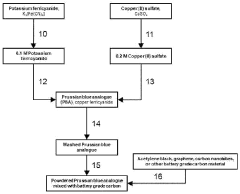
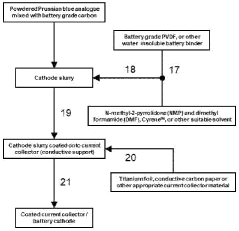
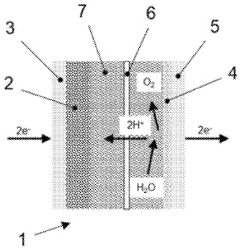
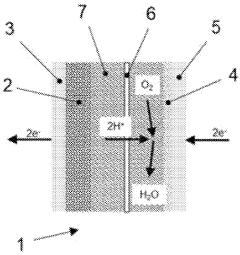
- A cathode for proton batteries comprising a Prussian blue analogue (PBA) coated on a current collector, combined with battery-grade carbon nanoparticles and a non-water-soluble binder, utilizing a copper hexacyanoferrate or manganese hexacyanoferrate structure for enhanced proton intercalation and storage capabilities, along with a suitable current collector and electrolyte system.
Battery Safety Standards and Cathode Material Regulations
The regulatory landscape for battery cathode materials has evolved significantly in response to growing safety concerns and the widespread adoption of lithium-ion batteries across various applications. Current safety standards primarily focus on thermal stability, toxicity levels, and environmental impact of cathode materials. Both Prussian Blue and spinel-based cathodes must comply with international standards such as IEC 62133, UN 38.3, and UL 1642, which establish fundamental safety requirements for portable batteries.
Prussian Blue cathodes benefit from relatively favorable regulatory positioning due to their inherently safer chemical composition. These materials typically exhibit lower toxicity profiles compared to traditional transition metal oxides, as they contain iron-based compounds that are generally considered less hazardous. The absence of cobalt in most Prussian Blue formulations eliminates concerns related to cobalt mining ethics and supply chain regulations, which have become increasingly stringent in recent years.
Spinel-based cathodes, particularly lithium manganese oxide (LiMn2O4), face more complex regulatory challenges. While manganese is generally considered safer than cobalt or nickel, spinel cathodes often require additional safety measures due to their higher operating temperatures and potential for manganese dissolution. Regulatory bodies have established specific limits for manganese content in consumer applications, particularly for devices with potential human contact.
Environmental regulations significantly impact both cathode technologies. The European Union's Battery Regulation (2023/1542) mandates strict recycling requirements and carbon footprint declarations for battery materials. Prussian Blue cathodes may have advantages in meeting these requirements due to their simpler chemical composition and potentially lower environmental impact during production and disposal.
Transportation regulations under the Dangerous Goods Act affect both cathode types differently. Prussian Blue cathodes generally demonstrate better thermal stability, potentially qualifying for less restrictive shipping classifications. Spinel-based cathodes may require additional packaging and handling precautions due to their thermal runaway characteristics at elevated temperatures.
Emerging regulations focus on supply chain transparency and conflict mineral sourcing. Both cathode technologies must comply with due diligence requirements, though Prussian Blue cathodes may face fewer restrictions due to their reliance on more abundant and ethically sourced materials like iron and sodium.
Prussian Blue cathodes benefit from relatively favorable regulatory positioning due to their inherently safer chemical composition. These materials typically exhibit lower toxicity profiles compared to traditional transition metal oxides, as they contain iron-based compounds that are generally considered less hazardous. The absence of cobalt in most Prussian Blue formulations eliminates concerns related to cobalt mining ethics and supply chain regulations, which have become increasingly stringent in recent years.
Spinel-based cathodes, particularly lithium manganese oxide (LiMn2O4), face more complex regulatory challenges. While manganese is generally considered safer than cobalt or nickel, spinel cathodes often require additional safety measures due to their higher operating temperatures and potential for manganese dissolution. Regulatory bodies have established specific limits for manganese content in consumer applications, particularly for devices with potential human contact.
Environmental regulations significantly impact both cathode technologies. The European Union's Battery Regulation (2023/1542) mandates strict recycling requirements and carbon footprint declarations for battery materials. Prussian Blue cathodes may have advantages in meeting these requirements due to their simpler chemical composition and potentially lower environmental impact during production and disposal.
Transportation regulations under the Dangerous Goods Act affect both cathode types differently. Prussian Blue cathodes generally demonstrate better thermal stability, potentially qualifying for less restrictive shipping classifications. Spinel-based cathodes may require additional packaging and handling precautions due to their thermal runaway characteristics at elevated temperatures.
Emerging regulations focus on supply chain transparency and conflict mineral sourcing. Both cathode technologies must comply with due diligence requirements, though Prussian Blue cathodes may face fewer restrictions due to their reliance on more abundant and ethically sourced materials like iron and sodium.
Environmental Impact Assessment of Cathode Material Production
The environmental implications of cathode material production represent a critical consideration in the comparative analysis between Prussian Blue and spinel-based cathodes, particularly as the battery industry faces increasing scrutiny regarding sustainability practices. Manufacturing processes for both cathode types involve distinct environmental footprints that significantly influence their long-term viability in commercial applications.
Prussian Blue cathode production demonstrates relatively favorable environmental characteristics due to its straightforward synthesis pathway. The manufacturing process typically employs aqueous precipitation methods at ambient temperatures, requiring minimal energy input compared to high-temperature ceramic processing. Raw material extraction for Prussian Blue cathodes primarily involves iron and cyanide compounds, where iron represents an abundant and recyclable resource. However, cyanide handling requires stringent safety protocols and waste management systems to prevent environmental contamination.
Spinel-based cathode production, particularly for lithium manganese oxide (LiMn2O4) and lithium nickel manganese oxide (LNMO) variants, involves more energy-intensive manufacturing processes. High-temperature calcination steps, typically ranging from 700°C to 900°C, contribute significantly to carbon emissions and energy consumption. The extraction and processing of manganese and nickel ores present additional environmental challenges, including habitat disruption and potential heavy metal contamination of water sources.
Water consumption patterns differ substantially between the two cathode types. Prussian Blue synthesis requires extensive washing cycles to remove impurities, generating considerable wastewater volumes that necessitate treatment before discharge. Conversely, spinel-based cathode production involves less water usage during synthesis but requires significant cooling water for high-temperature processing equipment.
Waste generation profiles reveal contrasting environmental impacts. Prussian Blue production generates primarily aqueous waste streams containing residual cyanide compounds, requiring specialized treatment facilities. Spinel cathode manufacturing produces solid waste materials including unreacted precursors and off-specification products, which can often be recycled back into the production process.
The carbon footprint analysis indicates that Prussian Blue cathodes generally exhibit lower greenhouse gas emissions during production, primarily due to reduced energy requirements for synthesis. Spinel-based cathodes demonstrate higher initial carbon footprints but may offset this disadvantage through superior cycle life performance, potentially reducing overall environmental impact per unit of energy storage capacity delivered over the battery's operational lifetime.
Prussian Blue cathode production demonstrates relatively favorable environmental characteristics due to its straightforward synthesis pathway. The manufacturing process typically employs aqueous precipitation methods at ambient temperatures, requiring minimal energy input compared to high-temperature ceramic processing. Raw material extraction for Prussian Blue cathodes primarily involves iron and cyanide compounds, where iron represents an abundant and recyclable resource. However, cyanide handling requires stringent safety protocols and waste management systems to prevent environmental contamination.
Spinel-based cathode production, particularly for lithium manganese oxide (LiMn2O4) and lithium nickel manganese oxide (LNMO) variants, involves more energy-intensive manufacturing processes. High-temperature calcination steps, typically ranging from 700°C to 900°C, contribute significantly to carbon emissions and energy consumption. The extraction and processing of manganese and nickel ores present additional environmental challenges, including habitat disruption and potential heavy metal contamination of water sources.
Water consumption patterns differ substantially between the two cathode types. Prussian Blue synthesis requires extensive washing cycles to remove impurities, generating considerable wastewater volumes that necessitate treatment before discharge. Conversely, spinel-based cathode production involves less water usage during synthesis but requires significant cooling water for high-temperature processing equipment.
Waste generation profiles reveal contrasting environmental impacts. Prussian Blue production generates primarily aqueous waste streams containing residual cyanide compounds, requiring specialized treatment facilities. Spinel cathode manufacturing produces solid waste materials including unreacted precursors and off-specification products, which can often be recycled back into the production process.
The carbon footprint analysis indicates that Prussian Blue cathodes generally exhibit lower greenhouse gas emissions during production, primarily due to reduced energy requirements for synthesis. Spinel-based cathodes demonstrate higher initial carbon footprints but may offset this disadvantage through superior cycle life performance, potentially reducing overall environmental impact per unit of energy storage capacity delivered over the battery's operational lifetime.
Unlock deeper insights with PatSnap Eureka Quick Research — get a full tech report to explore trends and direct your research. Try now!
Generate Your Research Report Instantly with AI Agent
Supercharge your innovation with PatSnap Eureka AI Agent Platform!