

Quantify Tunable Dispersion Using 2D Hyperbolic Metamaterial Crystals
MAY 14, 20269 MIN READ
Generate Your Research Report Instantly with AI Agent
PatSnap Eureka helps you evaluate technical feasibility & market potential.
Hyperbolic Metamaterial Background and Dispersion Goals
Hyperbolic metamaterials represent a revolutionary class of artificially engineered structures that exhibit extraordinary electromagnetic properties not found in natural materials. These metamaterials are characterized by their hyperbolic dispersion relation, where the permittivity tensor components possess opposite signs along different spatial directions. This unique property enables unprecedented control over electromagnetic wave propagation, making them highly attractive for advanced photonic applications.
The fundamental principle underlying hyperbolic metamaterials lies in their anisotropic optical response. Unlike conventional materials with elliptical dispersion relations, hyperbolic metamaterials support propagating modes with arbitrarily large wave vectors, leading to an infinite photonic density of states. This characteristic opens up possibilities for enhanced light-matter interactions, super-resolution imaging, and novel waveguiding mechanisms.
Two-dimensional hyperbolic metamaterial crystals have emerged as particularly promising platforms due to their enhanced design flexibility and fabrication feasibility. These structures typically consist of periodic arrangements of metallic and dielectric components, creating effective medium properties that can be precisely engineered through geometric parameters. The 2D configuration allows for better control over in-plane and out-of-plane optical responses while maintaining compatibility with existing nanofabrication techniques.
The evolution of hyperbolic metamaterials has progressed from initial theoretical predictions to experimental demonstrations across various frequency ranges. Early implementations focused on multilayer metal-dielectric stacks, while recent advances have explored more sophisticated architectures including wire arrays, fishnet structures, and graphene-based systems. Each approach offers distinct advantages in terms of operational bandwidth, loss characteristics, and tunability mechanisms.
Current research efforts are increasingly focused on achieving dynamic control over hyperbolic dispersion properties. Traditional metamaterial designs provide fixed optical responses determined by their geometric parameters, limiting their practical applications. The integration of tunable elements such as liquid crystals, phase-change materials, or electrically controllable components represents a significant advancement toward reconfigurable hyperbolic metamaterials.
The primary goal of quantifying tunable dispersion in 2D hyperbolic metamaterial crystals centers on establishing precise relationships between control parameters and resulting optical properties. This involves developing comprehensive characterization methodologies that can accurately measure dispersion curves under various tuning conditions. Such quantification is essential for predictive design capabilities and optimization of metamaterial performance for specific applications.
Achieving reliable dispersion control requires addressing several technical challenges including maintaining low optical losses, ensuring broad operational bandwidth, and implementing practical tuning mechanisms. The ultimate objective is to create metamaterial platforms that offer real-time, reversible control over their hyperbolic dispersion characteristics while preserving the fundamental advantages of these exotic optical materials.
The fundamental principle underlying hyperbolic metamaterials lies in their anisotropic optical response. Unlike conventional materials with elliptical dispersion relations, hyperbolic metamaterials support propagating modes with arbitrarily large wave vectors, leading to an infinite photonic density of states. This characteristic opens up possibilities for enhanced light-matter interactions, super-resolution imaging, and novel waveguiding mechanisms.
Two-dimensional hyperbolic metamaterial crystals have emerged as particularly promising platforms due to their enhanced design flexibility and fabrication feasibility. These structures typically consist of periodic arrangements of metallic and dielectric components, creating effective medium properties that can be precisely engineered through geometric parameters. The 2D configuration allows for better control over in-plane and out-of-plane optical responses while maintaining compatibility with existing nanofabrication techniques.
The evolution of hyperbolic metamaterials has progressed from initial theoretical predictions to experimental demonstrations across various frequency ranges. Early implementations focused on multilayer metal-dielectric stacks, while recent advances have explored more sophisticated architectures including wire arrays, fishnet structures, and graphene-based systems. Each approach offers distinct advantages in terms of operational bandwidth, loss characteristics, and tunability mechanisms.
Current research efforts are increasingly focused on achieving dynamic control over hyperbolic dispersion properties. Traditional metamaterial designs provide fixed optical responses determined by their geometric parameters, limiting their practical applications. The integration of tunable elements such as liquid crystals, phase-change materials, or electrically controllable components represents a significant advancement toward reconfigurable hyperbolic metamaterials.
The primary goal of quantifying tunable dispersion in 2D hyperbolic metamaterial crystals centers on establishing precise relationships between control parameters and resulting optical properties. This involves developing comprehensive characterization methodologies that can accurately measure dispersion curves under various tuning conditions. Such quantification is essential for predictive design capabilities and optimization of metamaterial performance for specific applications.
Achieving reliable dispersion control requires addressing several technical challenges including maintaining low optical losses, ensuring broad operational bandwidth, and implementing practical tuning mechanisms. The ultimate objective is to create metamaterial platforms that offer real-time, reversible control over their hyperbolic dispersion characteristics while preserving the fundamental advantages of these exotic optical materials.
Market Demand for Tunable Optical Metamaterials
The global optical metamaterials market is experiencing unprecedented growth driven by increasing demand for advanced photonic devices and next-generation optical systems. Telecommunications infrastructure modernization, particularly the deployment of 5G networks and fiber-optic communications, represents the largest market segment requiring tunable optical components. The ability to dynamically control light propagation through metamaterial structures addresses critical needs in wavelength division multiplexing, optical switching, and signal processing applications.
Defense and aerospace sectors constitute another significant market driver, where tunable metamaterials enable advanced radar systems, stealth technologies, and adaptive optical devices. Military applications demand precise control over electromagnetic wave manipulation, making hyperbolic metamaterial crystals particularly valuable for their ability to support highly directional wave propagation and enhanced light-matter interactions.
The consumer electronics industry increasingly requires miniaturized optical components for augmented reality devices, advanced camera systems, and display technologies. Tunable metamaterials offer unprecedented control over light behavior in compact form factors, enabling new functionalities in smartphones, tablets, and wearable devices. The growing market for virtual and augmented reality systems specifically demands lightweight, efficient optical elements that can dynamically adjust their properties.
Medical and biomedical applications represent an emerging high-value market segment. Tunable optical metamaterials enable advanced imaging systems, therapeutic devices, and diagnostic equipment with enhanced sensitivity and specificity. The ability to precisely control light-tissue interactions opens new possibilities for minimally invasive medical procedures and real-time biological monitoring.
Research institutions and academic laboratories drive demand for specialized metamaterial platforms that enable fundamental studies of light-matter interactions. These applications require highly customizable optical properties and precise tunability ranges, often serving as testbeds for future commercial applications.
The industrial sensing and monitoring market increasingly relies on tunable optical systems for quality control, environmental monitoring, and process optimization. Metamaterial-based sensors offer superior sensitivity and selectivity compared to conventional optical devices, particularly in harsh industrial environments where traditional components may fail.
Market growth is further accelerated by the convergence of artificial intelligence and photonics, where tunable metamaterials enable neuromorphic computing architectures and all-optical processing systems. These applications demand rapid reconfiguration capabilities and precise control over optical properties, driving innovation in metamaterial design and fabrication techniques.
Defense and aerospace sectors constitute another significant market driver, where tunable metamaterials enable advanced radar systems, stealth technologies, and adaptive optical devices. Military applications demand precise control over electromagnetic wave manipulation, making hyperbolic metamaterial crystals particularly valuable for their ability to support highly directional wave propagation and enhanced light-matter interactions.
The consumer electronics industry increasingly requires miniaturized optical components for augmented reality devices, advanced camera systems, and display technologies. Tunable metamaterials offer unprecedented control over light behavior in compact form factors, enabling new functionalities in smartphones, tablets, and wearable devices. The growing market for virtual and augmented reality systems specifically demands lightweight, efficient optical elements that can dynamically adjust their properties.
Medical and biomedical applications represent an emerging high-value market segment. Tunable optical metamaterials enable advanced imaging systems, therapeutic devices, and diagnostic equipment with enhanced sensitivity and specificity. The ability to precisely control light-tissue interactions opens new possibilities for minimally invasive medical procedures and real-time biological monitoring.
Research institutions and academic laboratories drive demand for specialized metamaterial platforms that enable fundamental studies of light-matter interactions. These applications require highly customizable optical properties and precise tunability ranges, often serving as testbeds for future commercial applications.
The industrial sensing and monitoring market increasingly relies on tunable optical systems for quality control, environmental monitoring, and process optimization. Metamaterial-based sensors offer superior sensitivity and selectivity compared to conventional optical devices, particularly in harsh industrial environments where traditional components may fail.
Market growth is further accelerated by the convergence of artificial intelligence and photonics, where tunable metamaterials enable neuromorphic computing architectures and all-optical processing systems. These applications demand rapid reconfiguration capabilities and precise control over optical properties, driving innovation in metamaterial design and fabrication techniques.
Current State of 2D Hyperbolic Crystal Fabrication
The fabrication of 2D hyperbolic metamaterial crystals has evolved significantly over the past decade, driven by advances in nanofabrication techniques and materials science. Current manufacturing approaches primarily rely on electron beam lithography (EBL) and focused ion beam (FIB) milling for creating precise nanostructures with the required anisotropic optical properties. These methods enable the production of metal-dielectric multilayer structures and periodic nanorod arrays that exhibit hyperbolic dispersion characteristics in the visible and near-infrared spectral ranges.
Leading fabrication facilities worldwide have demonstrated the ability to create 2D hyperbolic crystals with feature sizes down to 10-20 nanometers, utilizing materials such as silver, gold, and aluminum combined with dielectric substrates like silicon dioxide and aluminum oxide. The most advanced implementations employ multi-step lithographic processes that allow for precise control over the geometric parameters critical for tunable dispersion properties.
However, significant manufacturing challenges persist in achieving consistent quality across large-scale production. The primary technical bottlenecks include maintaining uniform thickness in multilayer deposition processes, controlling surface roughness at interfaces, and minimizing defects that can significantly impact optical performance. Current fabrication yields for high-quality 2D hyperbolic crystals remain relatively low, typically ranging from 60-80% for research-grade samples.
Scalability represents another major constraint, as most existing fabrication methods are inherently serial processes that limit throughput. Recent developments in nanoimprint lithography and self-assembly techniques show promise for addressing these limitations, though they require further optimization to achieve the precision necessary for quantifiable dispersion tuning applications.
The geographical distribution of advanced fabrication capabilities is concentrated in major research institutions and semiconductor facilities in North America, Europe, and East Asia, with limited accessibility for broader research communities due to high equipment costs and specialized expertise requirements.
Leading fabrication facilities worldwide have demonstrated the ability to create 2D hyperbolic crystals with feature sizes down to 10-20 nanometers, utilizing materials such as silver, gold, and aluminum combined with dielectric substrates like silicon dioxide and aluminum oxide. The most advanced implementations employ multi-step lithographic processes that allow for precise control over the geometric parameters critical for tunable dispersion properties.
However, significant manufacturing challenges persist in achieving consistent quality across large-scale production. The primary technical bottlenecks include maintaining uniform thickness in multilayer deposition processes, controlling surface roughness at interfaces, and minimizing defects that can significantly impact optical performance. Current fabrication yields for high-quality 2D hyperbolic crystals remain relatively low, typically ranging from 60-80% for research-grade samples.
Scalability represents another major constraint, as most existing fabrication methods are inherently serial processes that limit throughput. Recent developments in nanoimprint lithography and self-assembly techniques show promise for addressing these limitations, though they require further optimization to achieve the precision necessary for quantifiable dispersion tuning applications.
The geographical distribution of advanced fabrication capabilities is concentrated in major research institutions and semiconductor facilities in North America, Europe, and East Asia, with limited accessibility for broader research communities due to high equipment costs and specialized expertise requirements.
Existing Methods for Quantifying Tunable Dispersion
01 Metamaterial structure design and fabrication methods
Various approaches for designing and fabricating metamaterial structures that exhibit hyperbolic dispersion properties. These methods focus on creating periodic arrangements of subwavelength elements that can manipulate electromagnetic wave propagation in two-dimensional configurations. The structures are engineered to achieve specific dispersion characteristics through careful control of geometry, material composition, and spatial arrangement.- Metamaterial structure design and fabrication methods: Various approaches for designing and fabricating metamaterial structures that exhibit hyperbolic dispersion properties. These methods focus on creating periodic arrangements of subwavelength elements that can manipulate electromagnetic wave propagation in two-dimensional configurations. The structures are engineered to achieve specific dispersion characteristics through careful control of geometry, material composition, and dimensional parameters.
- Tunable dispersion control mechanisms: Techniques for actively controlling and tuning the dispersion properties of hyperbolic metamaterials through various mechanisms. These approaches enable dynamic modification of the material's optical properties by adjusting external parameters or incorporating active elements. The tuning capabilities allow for real-time optimization of electromagnetic wave behavior and adaptive response to different operating conditions.
- Electromagnetic wave manipulation and propagation: Methods for controlling electromagnetic wave propagation through hyperbolic metamaterial crystals with engineered dispersion properties. These techniques focus on achieving specific wave behaviors such as enhanced transmission, reflection control, and directional propagation. The approaches utilize the unique dispersion characteristics to manipulate wave interactions and achieve desired electromagnetic responses.
- Optical device applications and implementations: Applications of hyperbolic metamaterial crystals in various optical devices and systems that require tunable dispersion properties. These implementations leverage the unique characteristics of the metamaterials to create functional devices with enhanced performance capabilities. The applications span across different optical technologies where controlled dispersion is essential for optimal operation.
- Characterization and measurement techniques: Methods and systems for characterizing and measuring the dispersion properties of hyperbolic metamaterial crystals. These techniques enable accurate determination of the material's electromagnetic response and validation of theoretical predictions. The characterization approaches provide essential feedback for optimizing design parameters and verifying performance specifications.
02 Tunable dispersion control mechanisms
Techniques for actively controlling and tuning the dispersion properties of hyperbolic metamaterials through various mechanisms. These approaches enable dynamic modification of the material's optical properties, allowing for real-time adjustment of wave propagation characteristics. The tuning can be achieved through external stimuli or integrated control systems that modify the metamaterial's response.Expand Specific Solutions03 Photonic crystal integration with metamaterial properties
Methods for combining photonic crystal structures with metamaterial characteristics to create hybrid systems with enhanced dispersion control. These integrated approaches leverage the periodic nature of photonic crystals while incorporating metamaterial elements to achieve hyperbolic dispersion behavior. The combination allows for improved wave manipulation and enhanced functionality.Expand Specific Solutions04 Electromagnetic wave manipulation and beam steering
Applications and methods for manipulating electromagnetic waves using hyperbolic metamaterial crystals, particularly for beam steering and wave direction control. These techniques exploit the unique dispersion properties to achieve precise control over wave propagation direction and focusing. The systems can be designed for specific frequency ranges and applications requiring dynamic beam control.Expand Specific Solutions05 Optical device applications and implementations
Practical implementations of hyperbolic metamaterial crystals in optical devices and systems. These applications include various optical components that benefit from the unique dispersion properties, such as enhanced transmission, filtering, and wave processing capabilities. The devices are designed to exploit the metamaterial properties for improved performance in optical systems.Expand Specific Solutions
Key Players in Metamaterial and Photonic Crystal Industry
The competitive landscape for quantifying tunable dispersion using 2D hyperbolic metamaterial crystals represents an emerging research field in its early development stage. The market remains nascent with limited commercial applications, primarily driven by academic institutions and research organizations. Leading players include prestigious universities such as MIT, Purdue Research Foundation, Georgia Tech Research Corp., and international institutions like Zhejiang University and City University of Hong Kong, alongside government research entities like the Institute of Microelectronics of Chinese Academy of Sciences and Korea Research Institute of Standards & Science. Technology maturity is in the fundamental research phase, with these organizations focusing on theoretical frameworks and experimental validation. Corporate involvement from Sharp Corp. and AGC Inc. suggests potential industrial applications in display and optical technologies, though commercial viability remains years away.
Purdue Research Foundation
Technical Solution: Purdue has developed comprehensive characterization protocols for quantifying tunable dispersion in 2D hyperbolic metamaterial crystals, focusing on practical measurement techniques and device integration strategies. Their research program emphasizes the development of robust metrology approaches that can accurately determine dispersion parameters under various operating conditions. The foundation's work includes advanced simulation tools coupled with experimental validation methods to ensure reliable quantification of metamaterial optical properties for next-generation photonic applications.
Strengths: Strong engineering focus with practical device development capabilities and industry connections. Weaknesses: May lack the fundamental research depth compared to top-tier research institutions.
Georgia Tech Research Corp.
Technical Solution: Georgia Tech has established sophisticated experimental and computational frameworks for measuring and controlling tunable dispersion in 2D hyperbolic metamaterial crystals. Their approach integrates advanced materials science with precision optical measurements to achieve quantitative characterization of metamaterial dispersion properties. The research corporation's methodology includes development of novel fabrication techniques for creating high-quality metamaterial structures with controllable anisotropic properties, enabling systematic studies of dispersion tunability mechanisms and their applications in advanced photonic systems.
Strengths: Excellent materials science capabilities and strong industry partnerships for technology development. Weaknesses: Research scope may be more application-focused rather than fundamental breakthrough-oriented.
Core Innovations in 2D Hyperbolic Metamaterial Design
Tunable hyperbolic metamaterials
PatentInactiveUS11048023B2
Innovation
- A tunable hyperbolic metamaterial is formed using a 2D array of metal nanowires embedded in an optically tunable material, such as a phase-change material (PCM), where current pulses are used to switch the PCM between crystalline and amorphous phases, thereby dynamically reconfiguring the optical properties through Joule heating.


Tunable optical metamaterial
PatentInactiveUS20150062691A1
Innovation
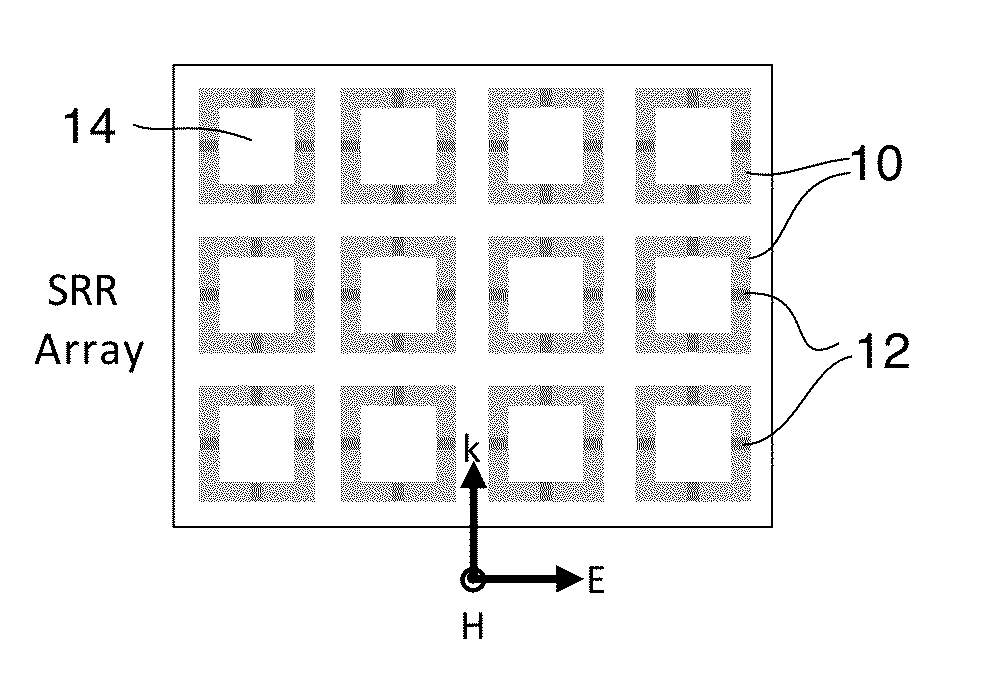
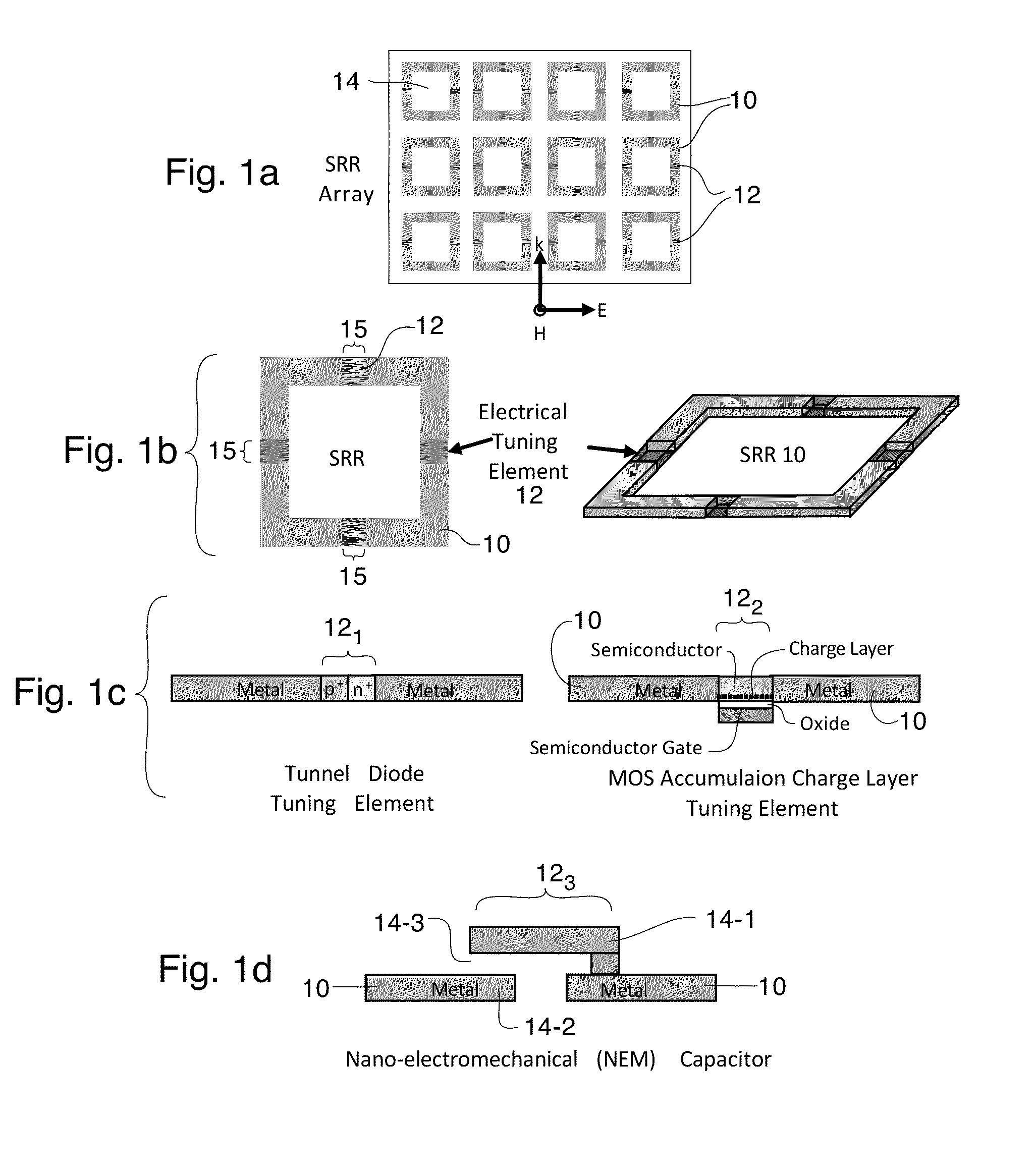
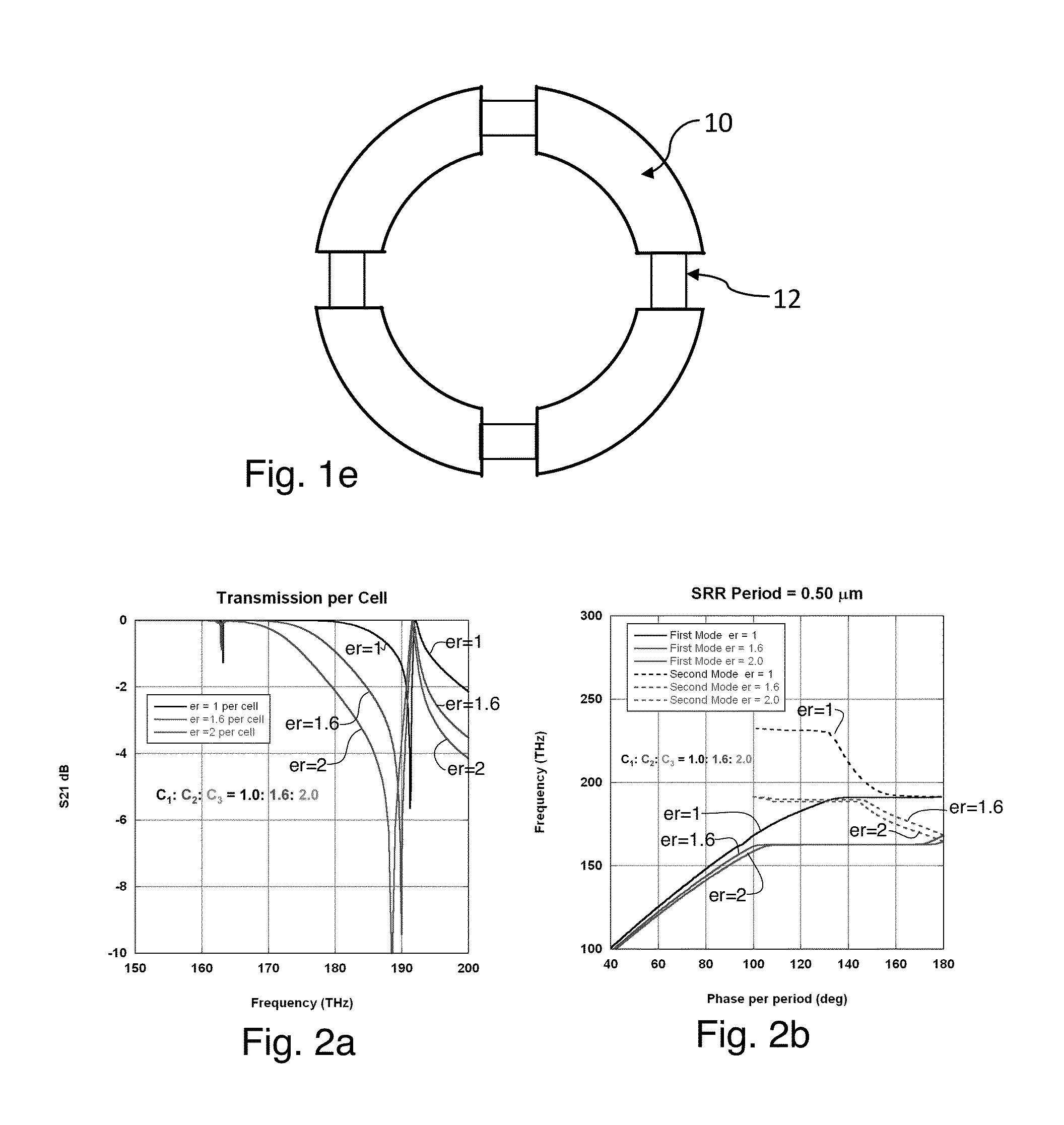
- A tunable optical metamaterial with a two-dimensional array of sub-wavelength-scale resonant metallic structures and nano-scale voltage-controllable electrical tuning elements, allowing for spatial programming of the effective refractive index to achieve fast and efficient beam steering without grating lobes.

Nanofabrication Standards for Metamaterial Devices
The development of standardized nanofabrication protocols for 2D hyperbolic metamaterial crystals represents a critical foundation for achieving reproducible and quantifiable tunable dispersion properties. Current industry practices lack unified specifications for the precise geometric parameters, material tolerances, and fabrication methodologies essential for metamaterial device consistency across different research institutions and manufacturing facilities.
Dimensional accuracy standards must address the sub-wavelength feature requirements inherent to hyperbolic metamaterials, where structural periodicities typically range from 50 to 500 nanometers. The fabrication tolerance specifications should maintain geometric variations within ±5% of target dimensions to preserve the designed dispersion characteristics. Critical parameters include layer thickness uniformity, interface roughness below 2 nm RMS, and lateral feature alignment accuracy within 10 nm across the entire device area.
Material purity and composition standards play equally important roles in ensuring predictable optical properties. Metal components require purity levels exceeding 99.9%, while dielectric layers must exhibit minimal optical losses and controlled refractive indices with variations less than ±0.01. Substrate preparation protocols should specify surface cleaning procedures, adhesion layer requirements, and thermal treatment conditions to minimize interface defects that could compromise device performance.
Process control standards encompass lithographic exposure parameters, etching selectivity ratios, and deposition rate specifications. Electron beam lithography systems should maintain beam current stability within ±2%, while plasma etching processes require gas flow rate control within ±1% and chamber pressure variations below ±0.1 mTorr. These stringent controls ensure reproducible pattern transfer and minimize process-induced variations in the final metamaterial structures.
Quality assurance protocols must incorporate real-time monitoring capabilities and post-fabrication characterization standards. In-situ ellipsometry measurements during deposition processes provide immediate feedback on layer thickness and optical properties. Scanning electron microscopy inspection standards should define minimum resolution requirements, measurement protocols, and statistical sampling methods for dimensional verification across fabricated devices.
Dimensional accuracy standards must address the sub-wavelength feature requirements inherent to hyperbolic metamaterials, where structural periodicities typically range from 50 to 500 nanometers. The fabrication tolerance specifications should maintain geometric variations within ±5% of target dimensions to preserve the designed dispersion characteristics. Critical parameters include layer thickness uniformity, interface roughness below 2 nm RMS, and lateral feature alignment accuracy within 10 nm across the entire device area.
Material purity and composition standards play equally important roles in ensuring predictable optical properties. Metal components require purity levels exceeding 99.9%, while dielectric layers must exhibit minimal optical losses and controlled refractive indices with variations less than ±0.01. Substrate preparation protocols should specify surface cleaning procedures, adhesion layer requirements, and thermal treatment conditions to minimize interface defects that could compromise device performance.
Process control standards encompass lithographic exposure parameters, etching selectivity ratios, and deposition rate specifications. Electron beam lithography systems should maintain beam current stability within ±2%, while plasma etching processes require gas flow rate control within ±1% and chamber pressure variations below ±0.1 mTorr. These stringent controls ensure reproducible pattern transfer and minimize process-induced variations in the final metamaterial structures.
Quality assurance protocols must incorporate real-time monitoring capabilities and post-fabrication characterization standards. In-situ ellipsometry measurements during deposition processes provide immediate feedback on layer thickness and optical properties. Scanning electron microscopy inspection standards should define minimum resolution requirements, measurement protocols, and statistical sampling methods for dimensional verification across fabricated devices.
Applications in Next-Generation Photonic Systems
The quantifiable tunable dispersion properties of 2D hyperbolic metamaterial crystals present transformative opportunities for next-generation photonic systems across multiple application domains. These engineered structures enable unprecedented control over electromagnetic wave propagation, opening pathways for revolutionary photonic devices that surpass conventional material limitations.
In optical communication networks, tunable hyperbolic metamaterials offer dynamic bandwidth management capabilities through real-time dispersion control. By electrically or optically adjusting the metamaterial parameters, communication systems can adaptively compensate for chromatic dispersion in fiber optic links, enabling higher data transmission rates and extended reach without traditional dispersion compensation modules. This technology particularly benefits wavelength division multiplexing systems where different channels require independent dispersion management.
Quantum photonic applications represent another frontier where controllable dispersion becomes critical. The ability to precisely engineer group velocity dispersion enables enhanced photon pair generation in spontaneous parametric down-conversion processes. Hyperbolic metamaterial platforms can create tailored dispersion profiles that optimize phase-matching conditions for specific quantum states, improving the efficiency and quality of quantum light sources essential for quantum computing and cryptography systems.
Advanced sensing applications leverage the extreme sensitivity of hyperbolic modes to environmental changes. The tunable dispersion characteristics enable the development of ultra-sensitive refractive index sensors, biosensors, and chemical detection systems. By monitoring dispersion variations in response to analyte binding or environmental perturbations, these sensors achieve detection limits orders of magnitude better than conventional photonic sensors.
Nonlinear photonic applications benefit significantly from engineered dispersion control. The ability to achieve anomalous dispersion at desired wavelengths enables efficient supercontinuum generation, frequency comb synthesis, and optical parametric processes in compact integrated platforms. This capability is particularly valuable for on-chip photonic systems where traditional dispersion engineering through waveguide geometry becomes challenging.
Emerging applications in neuromorphic photonics and optical computing exploit the dynamic reconfigurability of metamaterial dispersion. These systems utilize the tunable properties to implement optical memory elements, logic gates, and neural network nodes, where dispersion control directly translates to computational functionality and information processing capabilities.
In optical communication networks, tunable hyperbolic metamaterials offer dynamic bandwidth management capabilities through real-time dispersion control. By electrically or optically adjusting the metamaterial parameters, communication systems can adaptively compensate for chromatic dispersion in fiber optic links, enabling higher data transmission rates and extended reach without traditional dispersion compensation modules. This technology particularly benefits wavelength division multiplexing systems where different channels require independent dispersion management.
Quantum photonic applications represent another frontier where controllable dispersion becomes critical. The ability to precisely engineer group velocity dispersion enables enhanced photon pair generation in spontaneous parametric down-conversion processes. Hyperbolic metamaterial platforms can create tailored dispersion profiles that optimize phase-matching conditions for specific quantum states, improving the efficiency and quality of quantum light sources essential for quantum computing and cryptography systems.
Advanced sensing applications leverage the extreme sensitivity of hyperbolic modes to environmental changes. The tunable dispersion characteristics enable the development of ultra-sensitive refractive index sensors, biosensors, and chemical detection systems. By monitoring dispersion variations in response to analyte binding or environmental perturbations, these sensors achieve detection limits orders of magnitude better than conventional photonic sensors.
Nonlinear photonic applications benefit significantly from engineered dispersion control. The ability to achieve anomalous dispersion at desired wavelengths enables efficient supercontinuum generation, frequency comb synthesis, and optical parametric processes in compact integrated platforms. This capability is particularly valuable for on-chip photonic systems where traditional dispersion engineering through waveguide geometry becomes challenging.
Emerging applications in neuromorphic photonics and optical computing exploit the dynamic reconfigurability of metamaterial dispersion. These systems utilize the tunable properties to implement optical memory elements, logic gates, and neural network nodes, where dispersion control directly translates to computational functionality and information processing capabilities.
Unlock deeper insights with PatSnap Eureka Quick Research — get a full tech report to explore trends and direct your research. Try now!
Generate Your Research Report Instantly with AI Agent
Supercharge your innovation with PatSnap Eureka AI Agent Platform!