

Quantifying Performance Metrics in Aluminum Ion Ecosystems
MAR 12, 202610 MIN READ
Generate Your Research Report Instantly with AI Agent
PatSnap Eureka helps you evaluate technical feasibility & market potential.
Aluminum Ion Battery Technology Background and Performance Goals
Aluminum ion batteries represent a promising alternative energy storage technology that has emerged from decades of electrochemical research. The fundamental concept leverages aluminum's trivalent nature, allowing each aluminum atom to contribute three electrons during the electrochemical process, theoretically providing higher charge density compared to conventional lithium-ion systems. This technology builds upon early work in molten salt electrolytes from the 1970s and has evolved through successive generations of ionic liquid electrolytes and novel cathode materials.
The historical development trajectory shows significant acceleration since 2015, when Stanford University demonstrated the first practical aluminum-ion battery prototype using graphitic foam cathodes and ionic liquid electrolytes. This breakthrough addressed previous limitations related to cathode material degradation and electrolyte stability that had plagued earlier aluminum battery research. Subsequent developments have focused on expanding the voltage window, improving cycling stability, and enhancing energy density through advanced material engineering.
Current performance targets for aluminum ion battery technology center on achieving energy densities exceeding 200 Wh/kg while maintaining the inherent safety advantages of aluminum-based systems. The technology aims to deliver power densities comparable to supercapacitors, with target values reaching 10,000 W/kg for high-rate applications. Cycle life objectives typically exceed 10,000 charge-discharge cycles with minimal capacity degradation, leveraging aluminum's resistance to dendrite formation and the reversible intercalation mechanisms in advanced cathode materials.
Temperature operational ranges represent another critical performance dimension, with targets spanning from -40°C to 80°C for practical applications. This wide operational window stems from the thermal stability of ionic liquid electrolytes and the robust nature of aluminum anodes. Cost targets focus on achieving material costs below $100/kWh, primarily driven by aluminum's abundance and the elimination of expensive lithium and cobalt components found in conventional battery systems.
The quantification framework for these performance metrics requires standardized testing protocols that account for the unique characteristics of aluminum ion systems. Voltage efficiency measurements must consider the multi-electron transfer processes and the specific electrochemical windows of ionic liquid electrolytes. Capacity retention metrics need to address the volumetric changes during aluminum stripping and plating, while power capability assessments must account for the ionic conductivity limitations inherent in current electrolyte formulations.
Safety performance goals emphasize the non-flammable nature of aluminum ion systems and their resistance to thermal runaway conditions. Environmental impact targets leverage aluminum's recyclability and the reduced toxicity of system components compared to conventional battery chemistries, supporting sustainable energy storage deployment across diverse applications.
The historical development trajectory shows significant acceleration since 2015, when Stanford University demonstrated the first practical aluminum-ion battery prototype using graphitic foam cathodes and ionic liquid electrolytes. This breakthrough addressed previous limitations related to cathode material degradation and electrolyte stability that had plagued earlier aluminum battery research. Subsequent developments have focused on expanding the voltage window, improving cycling stability, and enhancing energy density through advanced material engineering.
Current performance targets for aluminum ion battery technology center on achieving energy densities exceeding 200 Wh/kg while maintaining the inherent safety advantages of aluminum-based systems. The technology aims to deliver power densities comparable to supercapacitors, with target values reaching 10,000 W/kg for high-rate applications. Cycle life objectives typically exceed 10,000 charge-discharge cycles with minimal capacity degradation, leveraging aluminum's resistance to dendrite formation and the reversible intercalation mechanisms in advanced cathode materials.
Temperature operational ranges represent another critical performance dimension, with targets spanning from -40°C to 80°C for practical applications. This wide operational window stems from the thermal stability of ionic liquid electrolytes and the robust nature of aluminum anodes. Cost targets focus on achieving material costs below $100/kWh, primarily driven by aluminum's abundance and the elimination of expensive lithium and cobalt components found in conventional battery systems.
The quantification framework for these performance metrics requires standardized testing protocols that account for the unique characteristics of aluminum ion systems. Voltage efficiency measurements must consider the multi-electron transfer processes and the specific electrochemical windows of ionic liquid electrolytes. Capacity retention metrics need to address the volumetric changes during aluminum stripping and plating, while power capability assessments must account for the ionic conductivity limitations inherent in current electrolyte formulations.
Safety performance goals emphasize the non-flammable nature of aluminum ion systems and their resistance to thermal runaway conditions. Environmental impact targets leverage aluminum's recyclability and the reduced toxicity of system components compared to conventional battery chemistries, supporting sustainable energy storage deployment across diverse applications.
Market Demand for Advanced Aluminum Ion Energy Storage
The global energy storage market is experiencing unprecedented growth driven by the urgent need for sustainable energy solutions and grid modernization initiatives. Aluminum ion battery technology has emerged as a compelling alternative to traditional lithium-ion systems, particularly in applications requiring high safety standards, rapid charging capabilities, and cost-effective large-scale deployment. The market demand for advanced aluminum ion energy storage is primarily fueled by the technology's inherent advantages including non-flammability, abundant raw material availability, and superior thermal stability.
Industrial and commercial energy storage applications represent the most promising market segment for aluminum ion technology. Data centers, manufacturing facilities, and commercial buildings are increasingly seeking energy storage solutions that can provide reliable backup power while supporting peak shaving and load balancing operations. The technology's ability to withstand extreme operating conditions and deliver consistent performance across thousands of charge-discharge cycles makes it particularly attractive for these demanding applications.
Grid-scale energy storage deployment is driving significant market interest, especially in regions with aggressive renewable energy integration targets. Utility companies are evaluating aluminum ion systems for frequency regulation, voltage support, and renewable energy smoothing applications. The technology's rapid response characteristics and long cycle life align well with grid stability requirements, while the lower material costs compared to lithium-ion systems present compelling economic advantages for large-scale installations.
The automotive sector presents a substantial long-term market opportunity, particularly for electric vehicle applications where fast charging and safety are paramount concerns. While current energy density limitations restrict immediate widespread adoption, ongoing research into advanced electrode materials and electrolyte formulations is progressively addressing these constraints. Fleet operators and commercial vehicle manufacturers are showing particular interest due to the technology's potential for reducing total cost of ownership through extended operational lifespans.
Emerging markets in developing economies are demonstrating strong demand for aluminum ion energy storage solutions, driven by the need for reliable and affordable energy infrastructure. The technology's simplified manufacturing requirements and reduced dependence on scarce materials make it well-suited for local production and deployment in regions with limited access to traditional energy storage technologies.
Consumer electronics applications, while currently limited by energy density considerations, represent a growing market segment as miniaturization advances continue. Portable devices requiring rapid charging capabilities and enhanced safety profiles are driving research investments and early-stage product development initiatives across the industry.
Industrial and commercial energy storage applications represent the most promising market segment for aluminum ion technology. Data centers, manufacturing facilities, and commercial buildings are increasingly seeking energy storage solutions that can provide reliable backup power while supporting peak shaving and load balancing operations. The technology's ability to withstand extreme operating conditions and deliver consistent performance across thousands of charge-discharge cycles makes it particularly attractive for these demanding applications.
Grid-scale energy storage deployment is driving significant market interest, especially in regions with aggressive renewable energy integration targets. Utility companies are evaluating aluminum ion systems for frequency regulation, voltage support, and renewable energy smoothing applications. The technology's rapid response characteristics and long cycle life align well with grid stability requirements, while the lower material costs compared to lithium-ion systems present compelling economic advantages for large-scale installations.
The automotive sector presents a substantial long-term market opportunity, particularly for electric vehicle applications where fast charging and safety are paramount concerns. While current energy density limitations restrict immediate widespread adoption, ongoing research into advanced electrode materials and electrolyte formulations is progressively addressing these constraints. Fleet operators and commercial vehicle manufacturers are showing particular interest due to the technology's potential for reducing total cost of ownership through extended operational lifespans.
Emerging markets in developing economies are demonstrating strong demand for aluminum ion energy storage solutions, driven by the need for reliable and affordable energy infrastructure. The technology's simplified manufacturing requirements and reduced dependence on scarce materials make it well-suited for local production and deployment in regions with limited access to traditional energy storage technologies.
Consumer electronics applications, while currently limited by energy density considerations, represent a growing market segment as miniaturization advances continue. Portable devices requiring rapid charging capabilities and enhanced safety profiles are driving research investments and early-stage product development initiatives across the industry.
Current State and Challenges in Aluminum Ion Performance Metrics
The aluminum ion battery ecosystem currently faces significant challenges in establishing standardized performance metrics, creating substantial barriers to technology advancement and commercial adoption. Unlike lithium-ion systems with well-established benchmarks, aluminum ion technologies lack universally accepted measurement protocols, leading to inconsistent reporting across research institutions and industrial laboratories.
Current performance evaluation methods vary dramatically between different research groups, with some focusing primarily on theoretical capacity calculations while others emphasize practical cycling stability. This fragmentation has resulted in conflicting data interpretations and difficulty in comparing technological breakthroughs across different aluminum ion chemistries. The absence of standardized testing conditions, including temperature ranges, current densities, and electrolyte compositions, further complicates meaningful performance comparisons.
Electrochemical characterization presents particular challenges due to the unique three-electron transfer mechanism of aluminum ions, which differs fundamentally from single-electron lithium systems. Traditional metrics such as coulombic efficiency and rate capability require recalibration for aluminum systems, as conventional measurement techniques may not accurately capture the complex intercalation and deintercalation processes occurring at aluminum electrodes.
The corrosive nature of aluminum ion electrolytes introduces additional measurement complexities, as standard testing equipment may degrade during extended evaluation periods. This degradation can lead to artifacts in performance data, making it difficult to distinguish between actual battery performance limitations and measurement system failures. Many research facilities lack specialized equipment designed specifically for aluminum ion systems, forcing researchers to adapt lithium-ion testing protocols that may not be entirely appropriate.
International standardization efforts remain in early stages, with limited coordination between major research centers in North America, Europe, and Asia. The lack of consensus on fundamental parameters such as voltage windows, capacity normalization methods, and aging protocols has slowed the development of reliable performance benchmarks. This situation is further complicated by the diversity of aluminum ion chemistries under investigation, each requiring potentially different evaluation approaches.
Industrial adoption faces additional hurdles due to the absence of established safety testing standards and regulatory frameworks specific to aluminum ion technologies. Without clear performance metrics and safety protocols, manufacturers struggle to develop commercial products that meet market requirements and regulatory compliance standards.
Current performance evaluation methods vary dramatically between different research groups, with some focusing primarily on theoretical capacity calculations while others emphasize practical cycling stability. This fragmentation has resulted in conflicting data interpretations and difficulty in comparing technological breakthroughs across different aluminum ion chemistries. The absence of standardized testing conditions, including temperature ranges, current densities, and electrolyte compositions, further complicates meaningful performance comparisons.
Electrochemical characterization presents particular challenges due to the unique three-electron transfer mechanism of aluminum ions, which differs fundamentally from single-electron lithium systems. Traditional metrics such as coulombic efficiency and rate capability require recalibration for aluminum systems, as conventional measurement techniques may not accurately capture the complex intercalation and deintercalation processes occurring at aluminum electrodes.
The corrosive nature of aluminum ion electrolytes introduces additional measurement complexities, as standard testing equipment may degrade during extended evaluation periods. This degradation can lead to artifacts in performance data, making it difficult to distinguish between actual battery performance limitations and measurement system failures. Many research facilities lack specialized equipment designed specifically for aluminum ion systems, forcing researchers to adapt lithium-ion testing protocols that may not be entirely appropriate.
International standardization efforts remain in early stages, with limited coordination between major research centers in North America, Europe, and Asia. The lack of consensus on fundamental parameters such as voltage windows, capacity normalization methods, and aging protocols has slowed the development of reliable performance benchmarks. This situation is further complicated by the diversity of aluminum ion chemistries under investigation, each requiring potentially different evaluation approaches.
Industrial adoption faces additional hurdles due to the absence of established safety testing standards and regulatory frameworks specific to aluminum ion technologies. Without clear performance metrics and safety protocols, manufacturers struggle to develop commercial products that meet market requirements and regulatory compliance standards.
Existing Performance Quantification Methods for Aluminum Ion Systems
01 Aluminum-ion battery performance monitoring and management systems
Systems and methods for monitoring and managing the performance of aluminum-ion battery ecosystems, including real-time tracking of battery health, charge/discharge cycles, and operational efficiency. These systems utilize sensors and data analytics to optimize battery performance and predict maintenance needs. Performance metrics include capacity retention, cycle life, and energy efficiency measurements.- Aluminum-ion battery performance monitoring and management systems: Systems and methods for monitoring and managing the performance of aluminum-ion battery ecosystems, including real-time tracking of battery health, charge/discharge cycles, and operational efficiency. These systems utilize sensors and data analytics to optimize battery performance and predict maintenance needs. Performance metrics include capacity retention, cycle life, and energy efficiency measurements.
- Electrochemical performance evaluation metrics for aluminum-ion systems: Methods and apparatus for evaluating electrochemical performance characteristics of aluminum-ion based energy storage systems. Key metrics include ionic conductivity, charge transfer resistance, coulombic efficiency, and voltage stability. Testing protocols measure the electrochemical behavior under various operating conditions to assess system reliability and longevity.
- Environmental and sustainability metrics for aluminum-ion technologies: Assessment frameworks for evaluating the environmental impact and sustainability of aluminum-ion energy systems. Metrics encompass carbon footprint analysis, recyclability rates, resource utilization efficiency, and lifecycle environmental costs. These evaluations help determine the ecological benefits compared to conventional battery technologies.
- Data collection and analytics platforms for aluminum-ion ecosystem monitoring: Integrated platforms for collecting, processing, and analyzing performance data from aluminum-ion battery systems. These platforms employ cloud-based infrastructure, machine learning algorithms, and visualization tools to provide comprehensive insights into system behavior. Metrics tracked include operational parameters, degradation patterns, and predictive maintenance indicators.
- Safety and reliability performance indicators for aluminum-ion applications: Performance indicators and testing methodologies focused on safety and reliability aspects of aluminum-ion energy storage systems. Metrics include thermal stability measurements, failure rate analysis, safety event monitoring, and compliance with industry standards. These indicators ensure safe operation across various application scenarios and environmental conditions.
02 Environmental impact assessment and sustainability metrics for aluminum systems
Methods and frameworks for evaluating the environmental performance and sustainability of aluminum-based systems and ecosystems. This includes measuring carbon footprint, resource utilization efficiency, recyclability rates, and lifecycle environmental impacts. Metrics focus on quantifying ecological benefits and environmental compliance of aluminum production and usage.Expand Specific Solutions03 Data collection and analytics platforms for ecosystem performance evaluation
Integrated platforms and systems for collecting, processing, and analyzing performance data across complex ecosystems. These platforms employ advanced analytics, machine learning algorithms, and visualization tools to generate actionable insights. Key metrics include system efficiency, resource optimization, and predictive performance indicators.Expand Specific Solutions04 Quality control and testing methodologies for aluminum-based materials
Comprehensive testing and quality assurance methods for evaluating aluminum materials and components in various applications. These methodologies include mechanical property testing, corrosion resistance evaluation, and structural integrity assessment. Performance metrics encompass strength characteristics, durability measures, and compliance with industry standards.Expand Specific Solutions05 Network and infrastructure performance monitoring for distributed systems
Technologies for monitoring and optimizing the performance of distributed networks and infrastructure systems. These solutions track system availability, throughput, latency, and resource utilization across multiple nodes. Performance metrics include network efficiency, system reliability, scalability measurements, and operational benchmarks for maintaining optimal ecosystem functionality.Expand Specific Solutions
Key Players in Aluminum Ion Battery Industry
The aluminum ion ecosystem represents an emerging technology sector currently in its early development stage, characterized by significant research activity but limited commercial deployment. The market remains nascent with substantial growth potential, particularly driven by applications in energy storage and metal processing industries. Technology maturity varies considerably across different applications, with companies like Albemarle Corp. and Applied Materials leading in established aluminum processing technologies, while innovative players such as Phinergy Ltd. pioneer aluminum-air battery systems. Academic institutions including Central South University, Wuhan University, and University of South Florida contribute foundational research, while industrial giants like State Grid Corp. of China explore grid-scale applications. Equipment manufacturers such as Shimadzu Corp., Hitachi High-Tech America, and Axcelis Technologies provide essential analytical and processing tools. The competitive landscape shows a mix of established materials companies, emerging battery technology firms, and research institutions, indicating a technology transition from laboratory research toward commercial viability, though widespread market adoption remains several years away.
Applied Materials, Inc.
Technical Solution: Applied Materials has developed advanced process control and metrology solutions for aluminum ion battery manufacturing that enable real-time performance quantification through integrated sensor networks and data analytics platforms. Their approach utilizes in-situ monitoring technologies including plasma diagnostics, thin-film analysis, and electrochemical impedance measurements to quantify aluminum deposition rates, electrode uniformity, and interface quality metrics. The company's performance measurement framework incorporates machine learning algorithms for predictive analytics, enabling optimization of aluminum ion battery manufacturing processes while maintaining quality control standards with measurement repeatability within 2% variation and real-time feedback capabilities for process adjustment and performance enhancement.
Strengths: Advanced semiconductor manufacturing expertise applicable to battery production; sophisticated process control and measurement technologies. Weaknesses: Limited direct battery chemistry experience; focus primarily on manufacturing equipment rather than battery performance optimization.
Shimadzu Corp.
Technical Solution: Shimadzu Corporation provides advanced analytical instrumentation solutions for quantifying performance metrics in aluminum ion ecosystems through their comprehensive suite of electrochemical analyzers, mass spectrometers, and chromatography systems. Their integrated measurement platform enables precise quantification of aluminum ion concentration, electrolyte composition analysis, and electrochemical reaction kinetics monitoring. The company's analytical solutions support performance characterization including coulombic efficiency measurements, capacity fade analysis, and impedance spectroscopy for aluminum ion batteries, with measurement precision typically within 0.1% accuracy for ionic concentration and sub-milliohm resolution for resistance measurements across temperature ranges from -20°C to 80°C.
Strengths: Leading analytical instrumentation technology with high precision measurement capabilities; established global service and support network. Weaknesses: Equipment supplier rather than battery developer; high capital investment requirements for comprehensive analytical systems.
Core Innovations in Aluminum Ion Performance Measurement
Aqueous aluminum ion batteries, hybrid battery-capacitors, compositions of said batteries and battery-capacitors, and associated methods of manufacture and use
PatentPendingUS20250174711A1
Innovation
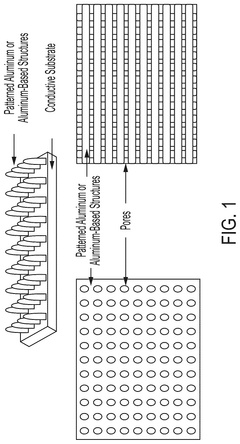
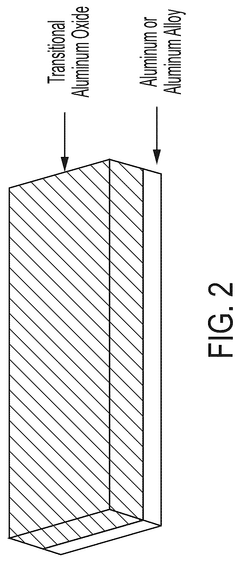
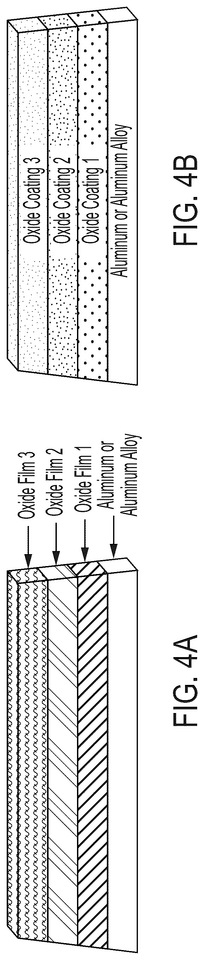
- The development of aqueous aluminum ion batteries featuring an aluminum or aluminum alloy anode, an aqueous electrolyte, and a manganese oxide, aluminosilicate, or polymer-based cathode, which facilitates the transport of aluminum ions through electrochemical reactions.

Method and device for the quantification of target ion species
PatentActiveGB2610912A
Innovation
- A method involving the use of quantification functions to sum weighted signals from target ion species, allowing for the determination of quantification parameters without requiring mass-resolved signals, using lookup tables and direct numerical methods to solve systems of equations, enabling rapid quantification even with low mass resolution analyzers.
Environmental Impact Assessment of Aluminum Ion Ecosystems
The environmental implications of aluminum ion battery ecosystems represent a critical consideration in the transition toward sustainable energy storage solutions. Unlike conventional lithium-ion systems, aluminum ion technologies present unique environmental challenges and opportunities that require comprehensive assessment across multiple impact categories.
Life cycle analysis of aluminum ion ecosystems reveals significant environmental advantages in raw material extraction phases. Aluminum represents the third most abundant element in Earth's crust, substantially reducing mining pressure compared to scarce lithium resources. The extraction processes for aluminum typically generate lower carbon footprints per unit mass, though energy-intensive refining processes remain a concern. Additionally, aluminum's established recycling infrastructure provides inherent circularity benefits, with recycled aluminum requiring only 5% of the energy needed for primary production.
Water resource impact assessment demonstrates mixed environmental outcomes for aluminum ion systems. While aluminum processing traditionally requires substantial water consumption, advanced electrolyte formulations in aluminum ion batteries often utilize aqueous solutions, potentially reducing toxic solvent dependencies. However, aluminum refining processes can generate significant wastewater streams containing dissolved metals and processing chemicals, necessitating robust treatment protocols to prevent ecosystem contamination.
Carbon footprint analysis reveals complex environmental trade-offs throughout aluminum ion ecosystem lifecycles. Manufacturing phases typically exhibit higher initial carbon intensities due to aluminum smelting requirements, yet operational phases demonstrate superior environmental performance through enhanced safety profiles and reduced thermal management needs. End-of-life scenarios present substantial environmental benefits, as aluminum components maintain high recyclability rates and established recovery networks.
Ecosystem toxicity assessments indicate generally favorable environmental profiles for aluminum ion technologies. Aluminum-based electrolytes typically exhibit lower acute toxicity compared to organic carbonate systems, reducing potential environmental harm from accidental releases. However, certain aluminum compounds can demonstrate persistence in soil systems, requiring careful consideration of disposal pathways and potential bioaccumulation effects in terrestrial ecosystems.
Comparative environmental impact studies position aluminum ion ecosystems as environmentally competitive alternatives to conventional battery technologies, particularly in applications requiring enhanced safety margins and extended operational lifespans, where their environmental benefits become increasingly pronounced over extended deployment periods.
Life cycle analysis of aluminum ion ecosystems reveals significant environmental advantages in raw material extraction phases. Aluminum represents the third most abundant element in Earth's crust, substantially reducing mining pressure compared to scarce lithium resources. The extraction processes for aluminum typically generate lower carbon footprints per unit mass, though energy-intensive refining processes remain a concern. Additionally, aluminum's established recycling infrastructure provides inherent circularity benefits, with recycled aluminum requiring only 5% of the energy needed for primary production.
Water resource impact assessment demonstrates mixed environmental outcomes for aluminum ion systems. While aluminum processing traditionally requires substantial water consumption, advanced electrolyte formulations in aluminum ion batteries often utilize aqueous solutions, potentially reducing toxic solvent dependencies. However, aluminum refining processes can generate significant wastewater streams containing dissolved metals and processing chemicals, necessitating robust treatment protocols to prevent ecosystem contamination.
Carbon footprint analysis reveals complex environmental trade-offs throughout aluminum ion ecosystem lifecycles. Manufacturing phases typically exhibit higher initial carbon intensities due to aluminum smelting requirements, yet operational phases demonstrate superior environmental performance through enhanced safety profiles and reduced thermal management needs. End-of-life scenarios present substantial environmental benefits, as aluminum components maintain high recyclability rates and established recovery networks.
Ecosystem toxicity assessments indicate generally favorable environmental profiles for aluminum ion technologies. Aluminum-based electrolytes typically exhibit lower acute toxicity compared to organic carbonate systems, reducing potential environmental harm from accidental releases. However, certain aluminum compounds can demonstrate persistence in soil systems, requiring careful consideration of disposal pathways and potential bioaccumulation effects in terrestrial ecosystems.
Comparative environmental impact studies position aluminum ion ecosystems as environmentally competitive alternatives to conventional battery technologies, particularly in applications requiring enhanced safety margins and extended operational lifespans, where their environmental benefits become increasingly pronounced over extended deployment periods.
Safety Standards and Testing Protocols for Aluminum Ion Batteries
The establishment of comprehensive safety standards for aluminum ion batteries represents a critical foundation for their commercial viability and widespread adoption. Current safety frameworks draw heavily from lithium-ion battery protocols while incorporating specific considerations for aluminum-based electrochemistry. The International Electrotechnical Commission (IEC) and Underwriters Laboratories (UL) have begun developing specialized standards that address the unique characteristics of aluminum ion systems, including their aqueous and non-aqueous electrolyte variants.
Thermal safety testing protocols constitute the primary focus of current standardization efforts. Unlike lithium-ion batteries, aluminum ion batteries exhibit different thermal runaway characteristics due to their distinct electrochemical reactions. Standard thermal abuse tests include thermal shock cycling between -40°C and 85°C, thermal ramp testing at controlled heating rates, and isothermal storage at elevated temperatures. These protocols evaluate electrolyte stability, electrode material degradation, and gas generation patterns specific to aluminum ion chemistry.
Mechanical integrity testing addresses the structural robustness of aluminum ion battery systems under various stress conditions. Standardized procedures include crush tests with specified force applications, puncture resistance evaluations using standardized probes, and vibration testing protocols that simulate transportation and operational environments. These tests are particularly crucial for aluminum ion batteries given their potential use in automotive and aerospace applications where mechanical reliability is paramount.
Electrical safety protocols encompass overcharge protection, short-circuit behavior, and reverse polarity testing. Aluminum ion batteries require specialized overcharge testing due to their unique voltage characteristics and aluminum plating/stripping mechanisms. Standard protocols evaluate cell behavior under continuous overcharge conditions, monitoring for electrolyte decomposition, gas evolution, and potential fire hazards. Short-circuit testing examines current limitation capabilities and thermal management under fault conditions.
Environmental safety assessments focus on electrolyte leakage, corrosion resistance, and long-term stability under various atmospheric conditions. Testing protocols evaluate seal integrity, material compatibility, and environmental impact of potential electrolyte release. These standards are particularly important for aluminum ion batteries containing ionic liquid electrolytes or aqueous solutions with specific pH requirements.
Certification processes for aluminum ion batteries involve multi-stage validation including component-level testing, cell-level evaluation, and system-level integration assessments. Regulatory bodies are developing tiered certification approaches that accommodate the diverse aluminum ion battery chemistries currently under development, ensuring safety standards remain adaptable to emerging technological variations while maintaining rigorous safety requirements.
Thermal safety testing protocols constitute the primary focus of current standardization efforts. Unlike lithium-ion batteries, aluminum ion batteries exhibit different thermal runaway characteristics due to their distinct electrochemical reactions. Standard thermal abuse tests include thermal shock cycling between -40°C and 85°C, thermal ramp testing at controlled heating rates, and isothermal storage at elevated temperatures. These protocols evaluate electrolyte stability, electrode material degradation, and gas generation patterns specific to aluminum ion chemistry.
Mechanical integrity testing addresses the structural robustness of aluminum ion battery systems under various stress conditions. Standardized procedures include crush tests with specified force applications, puncture resistance evaluations using standardized probes, and vibration testing protocols that simulate transportation and operational environments. These tests are particularly crucial for aluminum ion batteries given their potential use in automotive and aerospace applications where mechanical reliability is paramount.
Electrical safety protocols encompass overcharge protection, short-circuit behavior, and reverse polarity testing. Aluminum ion batteries require specialized overcharge testing due to their unique voltage characteristics and aluminum plating/stripping mechanisms. Standard protocols evaluate cell behavior under continuous overcharge conditions, monitoring for electrolyte decomposition, gas evolution, and potential fire hazards. Short-circuit testing examines current limitation capabilities and thermal management under fault conditions.
Environmental safety assessments focus on electrolyte leakage, corrosion resistance, and long-term stability under various atmospheric conditions. Testing protocols evaluate seal integrity, material compatibility, and environmental impact of potential electrolyte release. These standards are particularly important for aluminum ion batteries containing ionic liquid electrolytes or aqueous solutions with specific pH requirements.
Certification processes for aluminum ion batteries involve multi-stage validation including component-level testing, cell-level evaluation, and system-level integration assessments. Regulatory bodies are developing tiered certification approaches that accommodate the diverse aluminum ion battery chemistries currently under development, ensuring safety standards remain adaptable to emerging technological variations while maintaining rigorous safety requirements.
Unlock deeper insights with PatSnap Eureka Quick Research — get a full tech report to explore trends and direct your research. Try now!
Generate Your Research Report Instantly with AI Agent
Supercharge your innovation with PatSnap Eureka AI Agent Platform!