
Quantifying Surface Energy in Composites for Enhanced Strength
FEB 26, 20269 MIN READ
Generate Your Research Report Instantly with AI Agent
Patsnap Eureka helps you evaluate technical feasibility & market potential.
Composite Surface Energy Background and Objectives
Surface energy quantification in composite materials represents a critical frontier in materials science, fundamentally addressing the interfacial phenomena that govern mechanical performance at the molecular level. The surface energy of composite constituents directly influences adhesion mechanisms, load transfer efficiency, and ultimately the structural integrity of the final material system. This field has evolved from basic thermodynamic principles established in the mid-20th century to sophisticated characterization techniques capable of measuring nanoscale interfacial interactions.
The historical development of surface energy research in composites traces back to the foundational work on wetting theory and adhesion science in the 1960s. Early investigations focused primarily on understanding how surface treatments could improve fiber-matrix bonding in glass fiber reinforced plastics. The introduction of carbon fiber composites in aerospace applications during the 1970s intensified research efforts, as engineers recognized that interfacial properties were often the limiting factor in achieving theoretical strength predictions.
Contemporary composite design faces increasing demands for lightweight, high-performance materials across aerospace, automotive, and renewable energy sectors. Traditional approaches to composite optimization have largely relied on empirical testing and macroscopic property measurements, often overlooking the fundamental role of surface energetics in determining failure mechanisms. This gap between molecular-level understanding and engineering application has created significant opportunities for innovation through quantitative surface energy characterization.
The primary objective of quantifying surface energy in composites centers on establishing predictive relationships between interfacial thermodynamics and bulk mechanical properties. By developing robust measurement methodologies and theoretical frameworks, researchers aim to enable rational design of composite systems with enhanced strength, durability, and reliability. This approach promises to reduce development cycles, optimize material selection, and unlock new performance capabilities.
Specific technical goals include developing standardized protocols for surface energy measurement across different composite architectures, establishing correlations between surface energy parameters and critical mechanical properties such as interlaminar shear strength and fracture toughness, and creating computational models that can predict composite performance based on constituent surface characteristics. These objectives collectively support the broader vision of transitioning composite design from empirical iteration to science-based engineering, ultimately enabling the next generation of advanced materials for critical applications.
The historical development of surface energy research in composites traces back to the foundational work on wetting theory and adhesion science in the 1960s. Early investigations focused primarily on understanding how surface treatments could improve fiber-matrix bonding in glass fiber reinforced plastics. The introduction of carbon fiber composites in aerospace applications during the 1970s intensified research efforts, as engineers recognized that interfacial properties were often the limiting factor in achieving theoretical strength predictions.
Contemporary composite design faces increasing demands for lightweight, high-performance materials across aerospace, automotive, and renewable energy sectors. Traditional approaches to composite optimization have largely relied on empirical testing and macroscopic property measurements, often overlooking the fundamental role of surface energetics in determining failure mechanisms. This gap between molecular-level understanding and engineering application has created significant opportunities for innovation through quantitative surface energy characterization.
The primary objective of quantifying surface energy in composites centers on establishing predictive relationships between interfacial thermodynamics and bulk mechanical properties. By developing robust measurement methodologies and theoretical frameworks, researchers aim to enable rational design of composite systems with enhanced strength, durability, and reliability. This approach promises to reduce development cycles, optimize material selection, and unlock new performance capabilities.
Specific technical goals include developing standardized protocols for surface energy measurement across different composite architectures, establishing correlations between surface energy parameters and critical mechanical properties such as interlaminar shear strength and fracture toughness, and creating computational models that can predict composite performance based on constituent surface characteristics. These objectives collectively support the broader vision of transitioning composite design from empirical iteration to science-based engineering, ultimately enabling the next generation of advanced materials for critical applications.
Market Demand for High-Strength Composite Materials
The global composite materials market has experienced substantial growth driven by increasing demand for lightweight, high-strength materials across multiple industries. Aerospace and defense sectors represent the largest consumers of advanced composites, where weight reduction directly translates to fuel efficiency and enhanced performance capabilities. Commercial aviation manufacturers continuously seek materials that can withstand extreme operational conditions while maintaining structural integrity over extended service periods.
Automotive industry transformation toward electric vehicles has created unprecedented demand for high-strength composites. Battery electric vehicles require materials that maximize range through weight reduction while ensuring passenger safety through superior crash performance. Traditional steel components are increasingly replaced by carbon fiber reinforced plastics and glass fiber composites in body panels, chassis components, and interior structures.
Wind energy sector expansion has generated significant demand for large-scale composite structures. Modern wind turbine blades require materials capable of withstanding cyclic loading, environmental degradation, and extreme weather conditions over decades of operation. The push toward larger turbine designs necessitates composites with enhanced fatigue resistance and predictable long-term performance characteristics.
Marine and offshore applications demand composites with exceptional corrosion resistance and mechanical durability. Hull construction, propeller systems, and offshore platform components require materials that maintain strength properties in harsh saltwater environments. The growing offshore renewable energy sector further amplifies demand for reliable composite solutions.
Infrastructure applications increasingly utilize high-strength composites for bridge construction, building reinforcement, and seismic retrofitting projects. These applications require materials with predictable mechanical properties and long-term durability under varying environmental conditions. The ability to quantify surface energy relationships directly impacts material selection criteria and performance predictions.
Sports and recreation markets continue expanding, demanding composites with optimized strength-to-weight ratios for equipment manufacturing. Golf clubs, tennis rackets, bicycle frames, and protective gear require precise material property control to achieve desired performance characteristics.
The convergence of these market demands creates substantial opportunities for composite technologies that can accurately predict and control interfacial properties. Enhanced understanding of surface energy relationships enables material designers to optimize fiber-matrix interactions, leading to superior mechanical performance and expanded application possibilities across diverse industrial sectors.
Automotive industry transformation toward electric vehicles has created unprecedented demand for high-strength composites. Battery electric vehicles require materials that maximize range through weight reduction while ensuring passenger safety through superior crash performance. Traditional steel components are increasingly replaced by carbon fiber reinforced plastics and glass fiber composites in body panels, chassis components, and interior structures.
Wind energy sector expansion has generated significant demand for large-scale composite structures. Modern wind turbine blades require materials capable of withstanding cyclic loading, environmental degradation, and extreme weather conditions over decades of operation. The push toward larger turbine designs necessitates composites with enhanced fatigue resistance and predictable long-term performance characteristics.
Marine and offshore applications demand composites with exceptional corrosion resistance and mechanical durability. Hull construction, propeller systems, and offshore platform components require materials that maintain strength properties in harsh saltwater environments. The growing offshore renewable energy sector further amplifies demand for reliable composite solutions.
Infrastructure applications increasingly utilize high-strength composites for bridge construction, building reinforcement, and seismic retrofitting projects. These applications require materials with predictable mechanical properties and long-term durability under varying environmental conditions. The ability to quantify surface energy relationships directly impacts material selection criteria and performance predictions.
Sports and recreation markets continue expanding, demanding composites with optimized strength-to-weight ratios for equipment manufacturing. Golf clubs, tennis rackets, bicycle frames, and protective gear require precise material property control to achieve desired performance characteristics.
The convergence of these market demands creates substantial opportunities for composite technologies that can accurately predict and control interfacial properties. Enhanced understanding of surface energy relationships enables material designers to optimize fiber-matrix interactions, leading to superior mechanical performance and expanded application possibilities across diverse industrial sectors.
Current State of Surface Energy Quantification Methods
Surface energy quantification in composite materials has evolved significantly over the past decades, with multiple methodologies emerging to address the complex interfacial phenomena that govern composite performance. The field currently employs both direct and indirect measurement techniques, each offering distinct advantages and limitations in characterizing surface energetic properties.
Contact angle measurement remains the most widely adopted approach for surface energy determination in composite systems. This technique utilizes the Young-Dupré equation and various theoretical models, including Owens-Wendt, Wu, and van Oss-Chaudhury-Good methods, to calculate surface energy components from liquid droplet behavior on solid surfaces. Modern goniometers equipped with automated dispensing systems and high-resolution imaging capabilities have enhanced measurement precision and reproducibility.
Inverse gas chromatography has gained prominence as a powerful tool for characterizing surface energy heterogeneity in fibrous composites. This technique enables the determination of dispersive and specific surface energy components by analyzing the retention behavior of probe molecules with varying polarities. The method proves particularly valuable for characterizing individual fiber surfaces and understanding fiber-matrix compatibility at the molecular level.
Atomic force microscopy-based approaches have revolutionized nanoscale surface energy mapping in composite materials. Force-distance curve analysis and chemical force microscopy techniques provide spatially resolved surface energy information, enabling researchers to correlate local surface properties with mechanical performance. These methods offer unprecedented insights into interfacial phenomena at length scales directly relevant to composite failure mechanisms.
Computational methods have emerged as complementary tools for surface energy prediction and validation. Molecular dynamics simulations and density functional theory calculations provide theoretical frameworks for understanding surface energetic behavior, particularly in cases where experimental measurements face technical limitations. These approaches enable the exploration of surface modification effects and interfacial design optimization.
Despite significant advances, current quantification methods face several challenges. Measurement standardization remains inconsistent across different techniques, leading to discrepancies in reported values. Environmental factors, including temperature, humidity, and surface contamination, significantly influence measurement accuracy. Additionally, the dynamic nature of composite interfaces during processing and service conditions complicates the establishment of representative surface energy values for predictive modeling applications.
Contact angle measurement remains the most widely adopted approach for surface energy determination in composite systems. This technique utilizes the Young-Dupré equation and various theoretical models, including Owens-Wendt, Wu, and van Oss-Chaudhury-Good methods, to calculate surface energy components from liquid droplet behavior on solid surfaces. Modern goniometers equipped with automated dispensing systems and high-resolution imaging capabilities have enhanced measurement precision and reproducibility.
Inverse gas chromatography has gained prominence as a powerful tool for characterizing surface energy heterogeneity in fibrous composites. This technique enables the determination of dispersive and specific surface energy components by analyzing the retention behavior of probe molecules with varying polarities. The method proves particularly valuable for characterizing individual fiber surfaces and understanding fiber-matrix compatibility at the molecular level.
Atomic force microscopy-based approaches have revolutionized nanoscale surface energy mapping in composite materials. Force-distance curve analysis and chemical force microscopy techniques provide spatially resolved surface energy information, enabling researchers to correlate local surface properties with mechanical performance. These methods offer unprecedented insights into interfacial phenomena at length scales directly relevant to composite failure mechanisms.
Computational methods have emerged as complementary tools for surface energy prediction and validation. Molecular dynamics simulations and density functional theory calculations provide theoretical frameworks for understanding surface energetic behavior, particularly in cases where experimental measurements face technical limitations. These approaches enable the exploration of surface modification effects and interfacial design optimization.
Despite significant advances, current quantification methods face several challenges. Measurement standardization remains inconsistent across different techniques, leading to discrepancies in reported values. Environmental factors, including temperature, humidity, and surface contamination, significantly influence measurement accuracy. Additionally, the dynamic nature of composite interfaces during processing and service conditions complicates the establishment of representative surface energy values for predictive modeling applications.
Existing Surface Energy Measurement Techniques
01 Surface modification techniques for composites
Various surface modification methods can be employed to alter the surface energy of composite materials. These techniques include plasma treatment, chemical etching, and corona discharge treatment. Surface modification enhances the wettability and adhesion properties of composites by increasing surface energy, which improves bonding between composite layers and with other materials. These methods are particularly useful in aerospace and automotive applications where strong interfacial adhesion is critical.- Surface modification techniques for composites: Various surface modification methods can be employed to alter the surface energy of composite materials. These techniques include plasma treatment, chemical etching, and corona discharge treatment. Surface modification enhances the wettability and adhesion properties of composites by increasing surface roughness and introducing functional groups. These methods are particularly effective for improving interfacial bonding between composite layers and enhancing overall material performance.
- Coating applications to control surface energy: Application of specialized coatings can effectively modify the surface energy characteristics of composite materials. These coatings may include polymeric films, nanoparticle-based layers, or hybrid organic-inorganic materials. The coating process allows for precise control over surface properties such as hydrophobicity, hydrophilicity, and chemical resistance. This approach is widely used to tailor composite surfaces for specific applications requiring controlled wetting behavior and improved durability.
- Fiber-matrix interface engineering: The interface between reinforcing fibers and matrix materials plays a crucial role in determining composite surface energy. Interface engineering involves treating fiber surfaces with coupling agents, sizing materials, or functional coatings to optimize adhesion. These treatments modify the surface chemistry and energy of fibers, leading to improved stress transfer and mechanical properties. Proper interface design ensures enhanced composite performance and longevity.
- Nanoparticle incorporation for surface energy modification: Incorporation of nanoparticles into composite materials offers a method to tune surface energy properties. Nanoparticles such as silica, carbon nanotubes, or metal oxides can be dispersed within the matrix or applied as surface treatments. These nanoscale additives alter surface roughness, chemical composition, and energy characteristics. The resulting composites exhibit enhanced properties including improved adhesion, reduced friction, and controlled wetting behavior.
- Measurement and characterization methods for composite surface energy: Accurate measurement and characterization of surface energy in composites require specialized analytical techniques. Methods include contact angle measurements, surface tension analysis, and atomic force microscopy. These techniques provide quantitative data on surface properties, enabling optimization of composite formulations and processing conditions. Comprehensive characterization ensures that composite materials meet specific performance requirements for various industrial applications.
02 Coating applications to control surface energy
Application of specialized coatings on composite surfaces can effectively control and modify surface energy characteristics. These coatings may include polymer-based films, nanoparticle dispersions, or hybrid organic-inorganic materials. The coatings can be designed to either increase or decrease surface energy depending on the desired application, such as improving paint adhesion or creating hydrophobic surfaces. This approach is widely used in marine, construction, and consumer product industries.Expand Specific Solutions03 Fiber-matrix interface engineering
The interface between reinforcing fibers and matrix materials in composites plays a crucial role in determining overall surface energy properties. Engineering this interface through sizing agents, coupling agents, or surface functionalization of fibers can significantly impact the composite's surface characteristics. Proper interface engineering ensures optimal load transfer, improved mechanical properties, and controlled surface energy for subsequent processing or bonding operations.Expand Specific Solutions04 Nanoparticle incorporation for surface energy modification
Incorporation of nanoparticles into composite materials or their surfaces can dramatically alter surface energy properties. Nanoparticles such as silica, carbon nanotubes, or metal oxides can be dispersed within the matrix or applied as surface treatments. This approach allows for precise control of surface energy, enabling the creation of superhydrophobic or superhydrophilic surfaces. The technique is applicable in self-cleaning surfaces, anti-fouling applications, and advanced adhesive systems.Expand Specific Solutions05 Measurement and characterization methods for composite surface energy
Accurate measurement and characterization of surface energy in composites require specialized techniques and methodologies. Contact angle measurements, inverse gas chromatography, and atomic force microscopy are commonly employed to determine surface energy components. Understanding these measurements is essential for quality control, process optimization, and predicting composite behavior in various applications. Standardized testing protocols ensure consistency in evaluating surface properties across different composite systems.Expand Specific Solutions
Key Players in Advanced Composite Manufacturing
The composite surface energy quantification field represents an emerging technology area in the early-to-mid development stage, with significant growth potential driven by aerospace and automotive industry demands for enhanced material performance. The market is experiencing steady expansion as manufacturers seek stronger, lighter composite materials for critical applications. Technology maturity varies considerably across the competitive landscape, with established aerospace leaders like Boeing and industrial giants such as Robert Bosch GmbH and Mitsubishi Materials Corp. demonstrating advanced capabilities in composite engineering and surface characterization. Research institutions including Shanghai Jiao Tong University, Harbin Institute of Technology, and Technion Research & Development Foundation are driving fundamental breakthroughs in surface energy measurement techniques. Specialized materials companies like 3B Fiberglass, Saint-Gobain Performance Plastics, and NGK Insulators are developing practical applications, while emerging players such as Anhui Xiangbang Composite Materials focus on specific composite solutions, creating a diverse ecosystem spanning from basic research to commercial implementation.
The Boeing Co.
Technical Solution: Boeing has developed advanced surface energy quantification methods for aerospace composites, focusing on carbon fiber-epoxy systems. Their approach utilizes contact angle measurements and inverse gas chromatography to determine surface energy components, enabling optimization of fiber-matrix interfaces. The company employs surface treatment protocols including plasma activation and chemical functionalization to enhance interfacial bonding strength by up to 40%. Boeing's methodology incorporates real-time monitoring of surface energy changes during manufacturing processes, ensuring consistent composite quality. Their research emphasizes correlating surface energy parameters with mechanical properties such as interlaminar shear strength and fracture toughness, leading to improved damage tolerance in aircraft structures.
Strengths: Extensive aerospace application experience, proven track record in large-scale composite manufacturing, strong correlation between surface energy and mechanical performance. Weaknesses: High implementation costs, complex manufacturing processes requiring specialized equipment.
Mitsubishi Materials Corp.
Technical Solution: Mitsubishi Materials has developed innovative surface energy quantification methods for ceramic-matrix composites and metal-matrix composites. Their approach utilizes advanced spectroscopic techniques combined with thermodynamic modeling to predict interfacial bonding strength. The company employs surface functionalization using organosilane treatments and nanoparticle modifications to enhance surface energy compatibility between reinforcement and matrix phases. Their methodology includes high-temperature surface energy measurements relevant to aerospace and industrial applications, achieving strength improvements of 25-30%. Mitsubishi's research focuses on correlating surface energy parameters with thermal stability and oxidation resistance of composite materials under extreme operating conditions.
Strengths: Expertise in ceramic and metal-matrix composites, high-temperature applications capability, strong materials science foundation. Weaknesses: Limited focus on polymer-matrix composites, complex processing requirements.
Core Innovations in Composite Interface Analysis
Encapsulating composition
PatentActiveUS20190309160A1
Innovation
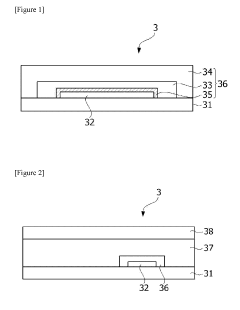
- An encapsulating composition comprising an epoxy compound with an oxetane group and a photoinitiator, suitable for inkjet application, forms a sealing layer that provides excellent moisture barrier properties, adhesive strength, and curing sensitivity, enabling effective protection of organic electronic devices from external moisture and oxygen.
Environmental Impact of Composite Manufacturing
The manufacturing of composites with quantified surface energy properties presents significant environmental challenges that require comprehensive assessment and mitigation strategies. Traditional composite manufacturing processes, particularly those involving fiber-reinforced polymers, generate substantial carbon emissions through energy-intensive production methods and the use of petroleum-based matrix materials. The quantification of surface energy often necessitates specialized surface treatments and chemical modifications, which introduce additional environmental burdens through solvent usage and chemical waste generation.
Energy consumption represents a critical environmental concern in composite manufacturing. The production of high-performance fibers such as carbon fiber requires temperatures exceeding 2000°C, resulting in energy consumption rates approximately 10-15 times higher than conventional materials like steel or aluminum. Surface energy enhancement processes, including plasma treatments, chemical etching, and sizing applications, further increase energy demands by 15-25% compared to standard composite manufacturing protocols.
Chemical waste generation poses another significant environmental challenge. Surface modification techniques employed to optimize interfacial bonding often utilize hazardous chemicals including chromic acid, silane coupling agents, and organic solvents. These processes generate contaminated wastewater requiring specialized treatment facilities, with disposal costs representing 8-12% of total manufacturing expenses. The quantification of surface energy through contact angle measurements and surface analysis techniques also contributes to laboratory waste streams containing testing fluids and cleaning solvents.
Volatile organic compound emissions during composite curing processes present air quality concerns, particularly in facilities processing large volumes of thermoset matrices. Advanced surface energy optimization often requires controlled atmospheric conditions and extended curing cycles, potentially increasing VOC emissions by 20-30% compared to conventional processing methods.
However, emerging sustainable manufacturing approaches show promise for reducing environmental impact. Bio-based matrix materials derived from renewable resources can maintain comparable surface energy characteristics while reducing carbon footprint by up to 40%. Waterborne surface treatments and plasma-based modification techniques eliminate solvent usage, significantly reducing chemical waste generation. Additionally, the enhanced mechanical properties achieved through optimized surface energy can extend composite service life, improving overall environmental performance through reduced replacement frequency and material consumption over product lifecycles.
Energy consumption represents a critical environmental concern in composite manufacturing. The production of high-performance fibers such as carbon fiber requires temperatures exceeding 2000°C, resulting in energy consumption rates approximately 10-15 times higher than conventional materials like steel or aluminum. Surface energy enhancement processes, including plasma treatments, chemical etching, and sizing applications, further increase energy demands by 15-25% compared to standard composite manufacturing protocols.
Chemical waste generation poses another significant environmental challenge. Surface modification techniques employed to optimize interfacial bonding often utilize hazardous chemicals including chromic acid, silane coupling agents, and organic solvents. These processes generate contaminated wastewater requiring specialized treatment facilities, with disposal costs representing 8-12% of total manufacturing expenses. The quantification of surface energy through contact angle measurements and surface analysis techniques also contributes to laboratory waste streams containing testing fluids and cleaning solvents.
Volatile organic compound emissions during composite curing processes present air quality concerns, particularly in facilities processing large volumes of thermoset matrices. Advanced surface energy optimization often requires controlled atmospheric conditions and extended curing cycles, potentially increasing VOC emissions by 20-30% compared to conventional processing methods.
However, emerging sustainable manufacturing approaches show promise for reducing environmental impact. Bio-based matrix materials derived from renewable resources can maintain comparable surface energy characteristics while reducing carbon footprint by up to 40%. Waterborne surface treatments and plasma-based modification techniques eliminate solvent usage, significantly reducing chemical waste generation. Additionally, the enhanced mechanical properties achieved through optimized surface energy can extend composite service life, improving overall environmental performance through reduced replacement frequency and material consumption over product lifecycles.
Quality Standards for Composite Surface Properties
The establishment of comprehensive quality standards for composite surface properties represents a critical framework for ensuring consistent performance and reliability in advanced material applications. These standards encompass multiple measurement protocols, testing methodologies, and acceptance criteria that collectively define the benchmarks for surface energy quantification and related surface characteristics in composite materials.
International standardization bodies, including ASTM International and ISO, have developed specific testing protocols for composite surface characterization. ASTM D7334 provides guidelines for surface energy measurement using contact angle methods, while ISO 15989 establishes procedures for determining surface tension components. These standards define precise environmental conditions, sample preparation requirements, and measurement protocols to ensure reproducibility across different laboratories and manufacturing facilities.
Surface roughness parameters constitute another essential component of quality standards, with Ra, Rz, and Rq values serving as primary metrics for topographical assessment. The standards typically specify acceptable ranges for these parameters based on intended applications, with aerospace composites requiring Ra values below 0.8 micrometers and automotive applications allowing higher tolerances up to 3.2 micrometers.
Chemical composition standards focus on surface contamination limits and functional group density measurements. X-ray photoelectron spectroscopy protocols define acceptable levels of carbon, oxygen, and nitrogen concentrations, while Fourier-transform infrared spectroscopy standards establish baseline requirements for hydroxyl and carbonyl group presence on composite surfaces.
Adhesion strength criteria represent the ultimate validation of surface quality, with standards defining minimum bond strength values ranging from 15 MPa for general applications to 45 MPa for critical structural components. These standards incorporate environmental aging requirements, including thermal cycling, humidity exposure, and UV radiation testing to ensure long-term performance reliability.
Quality control procedures mandate statistical sampling protocols, with typical requirements specifying testing frequencies of one sample per production batch or every 100 square meters of manufactured composite material, ensuring consistent adherence to established surface property benchmarks throughout the manufacturing process.
International standardization bodies, including ASTM International and ISO, have developed specific testing protocols for composite surface characterization. ASTM D7334 provides guidelines for surface energy measurement using contact angle methods, while ISO 15989 establishes procedures for determining surface tension components. These standards define precise environmental conditions, sample preparation requirements, and measurement protocols to ensure reproducibility across different laboratories and manufacturing facilities.
Surface roughness parameters constitute another essential component of quality standards, with Ra, Rz, and Rq values serving as primary metrics for topographical assessment. The standards typically specify acceptable ranges for these parameters based on intended applications, with aerospace composites requiring Ra values below 0.8 micrometers and automotive applications allowing higher tolerances up to 3.2 micrometers.
Chemical composition standards focus on surface contamination limits and functional group density measurements. X-ray photoelectron spectroscopy protocols define acceptable levels of carbon, oxygen, and nitrogen concentrations, while Fourier-transform infrared spectroscopy standards establish baseline requirements for hydroxyl and carbonyl group presence on composite surfaces.
Adhesion strength criteria represent the ultimate validation of surface quality, with standards defining minimum bond strength values ranging from 15 MPa for general applications to 45 MPa for critical structural components. These standards incorporate environmental aging requirements, including thermal cycling, humidity exposure, and UV radiation testing to ensure long-term performance reliability.
Quality control procedures mandate statistical sampling protocols, with typical requirements specifying testing frequencies of one sample per production batch or every 100 square meters of manufactured composite material, ensuring consistent adherence to established surface property benchmarks throughout the manufacturing process.
Unlock deeper insights with Patsnap Eureka Quick Research — get a full tech report to explore trends and direct your research. Try now!
Generate Your Research Report Instantly with AI Agent
Supercharge your innovation with Patsnap Eureka AI Agent Platform!