

Quantum Sensors in Predictive Analytics: Real-time Processing
APR 20, 20269 MIN READ
Generate Your Research Report Instantly with AI Agent
PatSnap Eureka helps you evaluate technical feasibility & market potential.
Quantum Sensing Technology Background and Predictive Analytics Goals
Quantum sensing technology represents a revolutionary advancement in measurement science, leveraging quantum mechanical phenomena to achieve unprecedented precision in detecting physical quantities such as magnetic fields, electric fields, temperature, pressure, and acceleration. This technology exploits quantum properties like superposition, entanglement, and quantum interference to surpass the sensitivity limits of classical sensors by several orders of magnitude.
The foundational principles of quantum sensing emerged from decades of research in atomic physics and quantum optics. Key quantum systems utilized include nitrogen-vacancy centers in diamond, trapped ions, cold atoms, superconducting quantum interference devices, and photonic systems. These platforms enable detection capabilities approaching the fundamental quantum limit, where measurement precision is constrained only by quantum noise rather than classical technical limitations.
The evolution of quantum sensing has been marked by significant milestones, beginning with early demonstrations of atomic magnetometry in the 1970s and progressing through the development of sophisticated quantum control techniques. Recent advances in quantum error correction, decoherence mitigation, and scalable quantum architectures have positioned quantum sensors as viable solutions for real-world applications requiring extreme sensitivity and precision.
Predictive analytics represents the convergence of statistical modeling, machine learning, and big data processing to forecast future events and trends from historical and real-time data. The integration of quantum sensors into predictive analytics frameworks aims to revolutionize decision-making processes across multiple industries by providing unprecedented data quality and temporal resolution.
The primary goal of incorporating quantum sensors into predictive analytics is to achieve real-time processing capabilities that can capture and analyze subtle environmental changes, material properties, or system behaviors that classical sensors cannot detect. This enhanced sensing capability enables the development of more accurate predictive models, particularly in applications where minute variations in physical parameters can significantly impact system performance or safety.
Strategic objectives include establishing quantum-enhanced early warning systems for critical infrastructure, developing precision agriculture solutions that can predict crop yields with molecular-level accuracy, and creating advanced medical diagnostic tools capable of detecting disease biomarkers at the cellular level. The ultimate vision encompasses building autonomous systems that can anticipate and respond to environmental changes in real-time, fundamentally transforming how industries approach risk management, quality control, and operational optimization.
The foundational principles of quantum sensing emerged from decades of research in atomic physics and quantum optics. Key quantum systems utilized include nitrogen-vacancy centers in diamond, trapped ions, cold atoms, superconducting quantum interference devices, and photonic systems. These platforms enable detection capabilities approaching the fundamental quantum limit, where measurement precision is constrained only by quantum noise rather than classical technical limitations.
The evolution of quantum sensing has been marked by significant milestones, beginning with early demonstrations of atomic magnetometry in the 1970s and progressing through the development of sophisticated quantum control techniques. Recent advances in quantum error correction, decoherence mitigation, and scalable quantum architectures have positioned quantum sensors as viable solutions for real-world applications requiring extreme sensitivity and precision.
Predictive analytics represents the convergence of statistical modeling, machine learning, and big data processing to forecast future events and trends from historical and real-time data. The integration of quantum sensors into predictive analytics frameworks aims to revolutionize decision-making processes across multiple industries by providing unprecedented data quality and temporal resolution.
The primary goal of incorporating quantum sensors into predictive analytics is to achieve real-time processing capabilities that can capture and analyze subtle environmental changes, material properties, or system behaviors that classical sensors cannot detect. This enhanced sensing capability enables the development of more accurate predictive models, particularly in applications where minute variations in physical parameters can significantly impact system performance or safety.
Strategic objectives include establishing quantum-enhanced early warning systems for critical infrastructure, developing precision agriculture solutions that can predict crop yields with molecular-level accuracy, and creating advanced medical diagnostic tools capable of detecting disease biomarkers at the cellular level. The ultimate vision encompasses building autonomous systems that can anticipate and respond to environmental changes in real-time, fundamentally transforming how industries approach risk management, quality control, and operational optimization.
Market Demand for Real-time Quantum-Enhanced Predictive Systems
The market demand for real-time quantum-enhanced predictive systems is experiencing unprecedented growth across multiple industrial sectors, driven by the increasing complexity of data processing requirements and the limitations of classical computing approaches. Organizations are recognizing that traditional predictive analytics systems struggle to handle the volume, velocity, and complexity of modern data streams, creating a substantial market opportunity for quantum sensor technologies that can deliver real-time processing capabilities.
Financial services represent one of the most significant demand drivers, where millisecond advantages in predictive analytics can translate to substantial competitive benefits. High-frequency trading firms, risk management departments, and algorithmic trading platforms are actively seeking quantum-enhanced solutions that can process market data streams in real-time while maintaining superior accuracy compared to classical systems. The ability to detect subtle market patterns and correlations that classical sensors might miss has created strong pull-through demand in this sector.
Healthcare and pharmaceutical industries are demonstrating robust demand for quantum-enhanced predictive systems, particularly in real-time patient monitoring and drug discovery applications. Medical institutions require predictive systems capable of processing continuous streams of biometric data, imaging information, and genomic sequences to enable early disease detection and personalized treatment protocols. The quantum advantage in pattern recognition and correlation analysis addresses critical gaps in current healthcare predictive capabilities.
Manufacturing and industrial automation sectors are driving demand through requirements for predictive maintenance and quality control systems. Modern manufacturing environments generate massive amounts of sensor data from equipment, production lines, and supply chain operations. Quantum-enhanced predictive systems offer the potential to identify equipment failure patterns, optimize production parameters, and predict quality issues before they occur, addressing the limitations of existing industrial IoT solutions.
The telecommunications and network infrastructure market segment shows strong demand for quantum-enhanced predictive systems capable of managing network traffic, predicting congestion patterns, and optimizing resource allocation in real-time. As 5G networks and edge computing deployments expand, the complexity of network management has exceeded the capabilities of traditional predictive analytics, creating opportunities for quantum sensor solutions.
Energy sector demand is particularly strong in smart grid applications, renewable energy forecasting, and oil and gas exploration. Utility companies require predictive systems that can process real-time data from distributed energy resources, weather patterns, and consumption behaviors to optimize grid stability and energy distribution efficiency.
Financial services represent one of the most significant demand drivers, where millisecond advantages in predictive analytics can translate to substantial competitive benefits. High-frequency trading firms, risk management departments, and algorithmic trading platforms are actively seeking quantum-enhanced solutions that can process market data streams in real-time while maintaining superior accuracy compared to classical systems. The ability to detect subtle market patterns and correlations that classical sensors might miss has created strong pull-through demand in this sector.
Healthcare and pharmaceutical industries are demonstrating robust demand for quantum-enhanced predictive systems, particularly in real-time patient monitoring and drug discovery applications. Medical institutions require predictive systems capable of processing continuous streams of biometric data, imaging information, and genomic sequences to enable early disease detection and personalized treatment protocols. The quantum advantage in pattern recognition and correlation analysis addresses critical gaps in current healthcare predictive capabilities.
Manufacturing and industrial automation sectors are driving demand through requirements for predictive maintenance and quality control systems. Modern manufacturing environments generate massive amounts of sensor data from equipment, production lines, and supply chain operations. Quantum-enhanced predictive systems offer the potential to identify equipment failure patterns, optimize production parameters, and predict quality issues before they occur, addressing the limitations of existing industrial IoT solutions.
The telecommunications and network infrastructure market segment shows strong demand for quantum-enhanced predictive systems capable of managing network traffic, predicting congestion patterns, and optimizing resource allocation in real-time. As 5G networks and edge computing deployments expand, the complexity of network management has exceeded the capabilities of traditional predictive analytics, creating opportunities for quantum sensor solutions.
Energy sector demand is particularly strong in smart grid applications, renewable energy forecasting, and oil and gas exploration. Utility companies require predictive systems that can process real-time data from distributed energy resources, weather patterns, and consumption behaviors to optimize grid stability and energy distribution efficiency.
Current State and Challenges of Quantum Sensors in Analytics
Quantum sensors represent a revolutionary advancement in measurement technology, leveraging quantum mechanical phenomena such as superposition, entanglement, and quantum interference to achieve unprecedented sensitivity and precision. Currently, these sensors demonstrate remarkable capabilities in detecting minute changes in magnetic fields, gravitational forces, electric fields, and rotation rates, with sensitivity levels often surpassing classical sensors by several orders of magnitude.
The integration of quantum sensors into predictive analytics platforms has shown promising results in laboratory environments and controlled industrial settings. Leading quantum sensing technologies include nitrogen-vacancy centers in diamond, trapped ions, superconducting quantum interference devices, and atomic interferometers. These systems have successfully demonstrated real-time data acquisition capabilities in specialized applications such as geological surveying, medical imaging, and navigation systems.
However, significant technical challenges persist in scaling quantum sensors for widespread analytical applications. Environmental decoherence remains the primary obstacle, as quantum states are extremely fragile and susceptible to temperature fluctuations, electromagnetic interference, and mechanical vibrations. Current quantum sensors typically require sophisticated isolation systems, including ultra-high vacuum chambers, magnetic shielding, and cryogenic cooling, which substantially increase system complexity and operational costs.
Real-time processing capabilities face additional constraints due to the computational intensity required for quantum state readout and error correction. The time scales for quantum measurements often conflict with the rapid data processing demands of predictive analytics, creating bottlenecks in information flow. Current systems struggle to maintain quantum coherence while simultaneously achieving the millisecond response times required for real-time applications.
Geographical distribution of quantum sensor development shows concentration in North America, Europe, and Asia-Pacific regions, with significant research clusters around major universities and technology companies. The United States leads in fundamental research and military applications, while European initiatives focus on industrial integration and standardization. Asian markets, particularly Japan and China, emphasize manufacturing scalability and commercial deployment strategies.
The technological maturity varies significantly across different quantum sensing modalities. While some technologies like SQUIDs have achieved commercial viability in specialized markets, emerging platforms such as quantum-enhanced atomic sensors remain largely in research and development phases, requiring substantial technological breakthroughs before practical implementation in predictive analytics becomes feasible.
The integration of quantum sensors into predictive analytics platforms has shown promising results in laboratory environments and controlled industrial settings. Leading quantum sensing technologies include nitrogen-vacancy centers in diamond, trapped ions, superconducting quantum interference devices, and atomic interferometers. These systems have successfully demonstrated real-time data acquisition capabilities in specialized applications such as geological surveying, medical imaging, and navigation systems.
However, significant technical challenges persist in scaling quantum sensors for widespread analytical applications. Environmental decoherence remains the primary obstacle, as quantum states are extremely fragile and susceptible to temperature fluctuations, electromagnetic interference, and mechanical vibrations. Current quantum sensors typically require sophisticated isolation systems, including ultra-high vacuum chambers, magnetic shielding, and cryogenic cooling, which substantially increase system complexity and operational costs.
Real-time processing capabilities face additional constraints due to the computational intensity required for quantum state readout and error correction. The time scales for quantum measurements often conflict with the rapid data processing demands of predictive analytics, creating bottlenecks in information flow. Current systems struggle to maintain quantum coherence while simultaneously achieving the millisecond response times required for real-time applications.
Geographical distribution of quantum sensor development shows concentration in North America, Europe, and Asia-Pacific regions, with significant research clusters around major universities and technology companies. The United States leads in fundamental research and military applications, while European initiatives focus on industrial integration and standardization. Asian markets, particularly Japan and China, emphasize manufacturing scalability and commercial deployment strategies.
The technological maturity varies significantly across different quantum sensing modalities. While some technologies like SQUIDs have achieved commercial viability in specialized markets, emerging platforms such as quantum-enhanced atomic sensors remain largely in research and development phases, requiring substantial technological breakthroughs before practical implementation in predictive analytics becomes feasible.
Current Quantum Sensor Solutions for Real-time Data Processing
01 Quantum sensor data acquisition and signal processing architectures
Systems and methods for acquiring quantum sensor data with specialized signal processing architectures that enable real-time or near real-time processing. These architectures incorporate dedicated processing units, optimized data pipelines, and hardware accelerators designed specifically for handling the unique characteristics of quantum sensor outputs. The processing frameworks support high-speed data conversion, noise filtering, and signal conditioning to prepare quantum measurements for immediate analysis.- Quantum sensor signal acquisition and digitization: Real-time processing of quantum sensors requires efficient signal acquisition and digitization methods. The quantum sensor outputs are converted from analog to digital signals using high-speed analog-to-digital converters. These systems employ specialized circuitry to capture weak quantum signals with minimal noise and latency, enabling immediate processing of quantum measurements. The digitization process is optimized to preserve quantum information integrity while achieving the sampling rates necessary for real-time applications.
- Parallel processing architectures for quantum sensor data: To achieve real-time performance, parallel processing architectures are implemented using field-programmable gate arrays and application-specific integrated circuits. These architectures distribute computational tasks across multiple processing units, allowing simultaneous analysis of quantum sensor data streams. The parallel approach reduces processing latency and enables handling of high-bandwidth quantum sensor outputs. Hardware acceleration techniques are employed to perform complex quantum state estimation and error correction in real-time.
- Machine learning algorithms for quantum sensor data interpretation: Advanced machine learning algorithms are applied to interpret quantum sensor data in real-time. Neural networks and deep learning models are trained to recognize patterns in quantum measurements and extract relevant physical parameters. These algorithms can perform real-time classification, regression, and anomaly detection on quantum sensor outputs. The machine learning approach enables adaptive processing that improves accuracy and reduces computational overhead compared to traditional analytical methods.
- Edge computing integration for distributed quantum sensor networks: Edge computing frameworks are integrated with quantum sensor networks to enable distributed real-time processing. Processing capabilities are deployed at the network edge, close to quantum sensors, to minimize data transmission delays and bandwidth requirements. This architecture allows for local preprocessing, filtering, and feature extraction before transmitting results to central systems. The edge computing approach supports scalable deployment of multiple quantum sensors with coordinated real-time processing across the network.
- Quantum error mitigation in real-time processing pipelines: Real-time quantum error mitigation techniques are incorporated into processing pipelines to improve measurement accuracy. These methods identify and correct errors arising from environmental noise, decoherence, and imperfect quantum operations during data acquisition. Adaptive filtering and calibration algorithms run continuously to compensate for drift and systematic errors in quantum sensors. The error mitigation strategies are optimized for low-latency implementation to maintain real-time processing capabilities while enhancing signal quality.
02 Real-time quantum state measurement and readout techniques
Techniques for performing rapid quantum state measurements and readout operations that minimize latency between sensing events and data availability. These methods employ fast readout circuits, optimized measurement protocols, and parallel processing approaches to extract quantum information quickly. The techniques address challenges such as measurement-induced decoherence and enable continuous monitoring of quantum sensor states with minimal delay.Expand Specific Solutions03 Edge computing and distributed processing for quantum sensor networks
Distributed computing architectures that process quantum sensor data at the edge or across networked nodes to achieve real-time performance. These systems distribute computational tasks across multiple processing units located near the sensors, reducing communication overhead and enabling faster response times. The approaches include federated processing schemes, local preprocessing modules, and hierarchical computing structures tailored for quantum sensing applications.Expand Specific Solutions04 Machine learning and AI-accelerated quantum data processing
Integration of machine learning algorithms and artificial intelligence techniques to accelerate the processing and interpretation of quantum sensor data in real-time. These methods employ neural networks, pattern recognition algorithms, and adaptive learning systems to rapidly classify, filter, and extract meaningful information from quantum measurements. The AI-enhanced processing enables automated decision-making and predictive analytics based on quantum sensor inputs.Expand Specific Solutions05 Quantum error correction and noise mitigation in real-time processing
Methods for implementing quantum error correction and noise mitigation during real-time processing of quantum sensor data. These techniques identify and correct errors introduced by environmental factors, hardware imperfections, and quantum decoherence while maintaining processing speed requirements. The approaches include adaptive filtering, dynamic calibration, error syndrome detection, and real-time compensation algorithms that preserve measurement fidelity without introducing significant latency.Expand Specific Solutions
Key Players in Quantum Sensing and Predictive Analytics Industry
The quantum sensors in predictive analytics market represents an emerging technological frontier currently in its early development stage, characterized by significant growth potential but limited commercial deployment. The market remains relatively nascent with modest current valuations, though projections indicate substantial expansion as quantum sensing technologies mature and integrate with real-time analytics platforms. Technology maturity varies considerably across market participants, with established tech giants like Google, Intel, and Microsoft leveraging their quantum computing expertise alongside specialized quantum companies such as Origin Quantum and Rigetti demonstrating advanced sensor capabilities. Traditional industrial players including Siemens and Oracle are integrating quantum sensing into existing analytics frameworks, while research institutions like Kyoto University and China Institute of Atomic Energy drive fundamental innovations. The competitive landscape reflects a convergence of quantum hardware developers, software integrators, and analytics specialists, with real-time processing capabilities becoming the key differentiator for practical implementation across industries.
Google LLC
Technical Solution: Google has developed quantum sensors integrated with their quantum computing platform, focusing on superconducting qubits and quantum error correction for real-time data processing. Their quantum sensors utilize advanced magnetometry and atomic interferometry techniques to achieve unprecedented sensitivity levels in measuring magnetic fields, gravitational waves, and other physical phenomena. The company's quantum sensing technology is built on their Sycamore processor architecture, enabling coherent quantum state manipulation for predictive analytics applications. Google's approach combines machine learning algorithms with quantum sensing data to provide real-time insights for various industrial applications including navigation, medical imaging, and geological surveying.
Strengths: Leading quantum computing infrastructure, strong AI integration capabilities, extensive research resources. Weaknesses: Limited commercial availability, high operational complexity, requires specialized expertise.
Intel Corp.
Technical Solution: Intel has developed quantum sensor technologies based on silicon spin qubits and photonic quantum systems for real-time predictive analytics applications. Their Horse Ridge cryogenic control chip enables precise control of quantum sensors operating at millikelvin temperatures, facilitating continuous monitoring and data collection. Intel's quantum sensing platform integrates with classical computing infrastructure to process sensor data in real-time, utilizing advanced signal processing algorithms and machine learning models. The company focuses on scalable quantum sensor arrays for industrial IoT applications, environmental monitoring, and precision manufacturing. Their approach emphasizes practical deployment scenarios where quantum sensors can provide competitive advantages over classical sensing technologies.
Strengths: Strong semiconductor manufacturing capabilities, established classical computing integration, scalable production potential. Weaknesses: Early stage quantum technology development, limited quantum sensing portfolio compared to specialized companies.
Core Quantum Sensing Patents for Predictive Analytics Applications
Quantum data processing system
PatentWO2022232140A1
Innovation
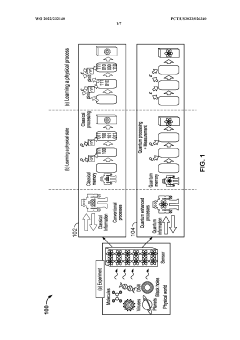
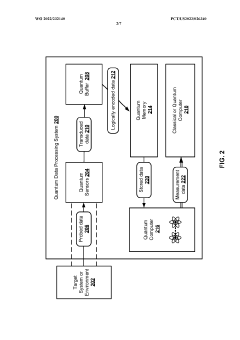
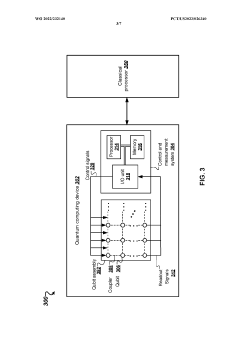
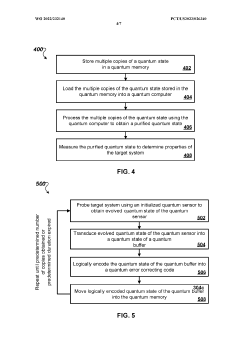
- The quantum data processing system interfaces quantum sensors with quantum devices for transduction and storage, implementing quantum error correction and linear distillation techniques to store and process multiple copies of quantum states, reducing the need for measurement and enhancing sensitivity and noise reduction.
Brain activity sensing and computer interfacing
PatentPendingEP4332843A1
Innovation
- A method using machine learning pipelines, either classical or quantum, to process brain activity measurements from sensors like electroencephalograms, which are trained with specific datasets to establish relationships between brain activity and intended commands or thoughts, enabling more accurate decoding and control of electronic devices.


Quantum Computing Infrastructure Requirements for Deployment
The deployment of quantum sensors for predictive analytics with real-time processing capabilities demands a sophisticated quantum computing infrastructure that addresses multiple technical and operational requirements. The infrastructure must support the unique characteristics of quantum sensor systems while ensuring reliable data processing and analysis capabilities.
Quantum sensor deployment requires specialized cryogenic systems capable of maintaining ultra-low temperatures, typically below 100 millikelvin for superconducting quantum sensors. These systems must incorporate dilution refrigerators with sufficient cooling power and thermal stability to support continuous operation. The infrastructure should include redundant cooling systems and temperature monitoring networks to prevent quantum decoherence and maintain sensor sensitivity.
The quantum computing infrastructure must feature high-fidelity quantum processors with sufficient qubit counts to handle complex predictive analytics algorithms. Current implementations require systems with at least 50-100 logical qubits, supported by error correction protocols and quantum error mitigation techniques. The processors should demonstrate gate fidelities exceeding 99.9% and coherence times sufficient for real-time computational tasks.
Classical computing integration represents a critical infrastructure component, requiring high-performance computing clusters capable of hybrid quantum-classical processing. These systems must support quantum circuit compilation, optimization algorithms, and classical post-processing of quantum sensor data. The infrastructure should include specialized quantum control electronics with nanosecond-precision timing and low-latency communication protocols.
Network connectivity infrastructure must support secure quantum communication channels and classical data transmission with minimal latency. This includes quantum key distribution systems for secure data transfer and high-bandwidth classical networks capable of handling large volumes of sensor data. The infrastructure should incorporate edge computing capabilities to enable distributed processing and reduce communication overhead.
Power and environmental control systems require uninterruptible power supplies, electromagnetic shielding, and vibration isolation to maintain quantum sensor stability. The infrastructure must include comprehensive monitoring systems for environmental parameters and automated control mechanisms to respond to operational anomalies in real-time processing scenarios.
Quantum sensor deployment requires specialized cryogenic systems capable of maintaining ultra-low temperatures, typically below 100 millikelvin for superconducting quantum sensors. These systems must incorporate dilution refrigerators with sufficient cooling power and thermal stability to support continuous operation. The infrastructure should include redundant cooling systems and temperature monitoring networks to prevent quantum decoherence and maintain sensor sensitivity.
The quantum computing infrastructure must feature high-fidelity quantum processors with sufficient qubit counts to handle complex predictive analytics algorithms. Current implementations require systems with at least 50-100 logical qubits, supported by error correction protocols and quantum error mitigation techniques. The processors should demonstrate gate fidelities exceeding 99.9% and coherence times sufficient for real-time computational tasks.
Classical computing integration represents a critical infrastructure component, requiring high-performance computing clusters capable of hybrid quantum-classical processing. These systems must support quantum circuit compilation, optimization algorithms, and classical post-processing of quantum sensor data. The infrastructure should include specialized quantum control electronics with nanosecond-precision timing and low-latency communication protocols.
Network connectivity infrastructure must support secure quantum communication channels and classical data transmission with minimal latency. This includes quantum key distribution systems for secure data transfer and high-bandwidth classical networks capable of handling large volumes of sensor data. The infrastructure should incorporate edge computing capabilities to enable distributed processing and reduce communication overhead.
Power and environmental control systems require uninterruptible power supplies, electromagnetic shielding, and vibration isolation to maintain quantum sensor stability. The infrastructure must include comprehensive monitoring systems for environmental parameters and automated control mechanisms to respond to operational anomalies in real-time processing scenarios.
Data Privacy and Security in Quantum Predictive Systems
The integration of quantum sensors in predictive analytics systems introduces unprecedented data privacy and security challenges that require comprehensive protection frameworks. Quantum sensing technologies generate highly sensitive measurement data with extraordinary precision, creating new attack vectors and vulnerabilities that traditional cybersecurity measures cannot adequately address.
Quantum predictive systems face unique privacy risks due to the inherent properties of quantum information processing. The quantum superposition and entanglement states used in these systems can potentially leak information through side-channel attacks, where adversaries exploit physical implementations rather than algorithmic weaknesses. Additionally, the continuous real-time data streams from quantum sensors create persistent exposure windows that malicious actors could exploit to extract sensitive information about system operations or underlying data patterns.
Current security frameworks for quantum predictive systems primarily rely on quantum key distribution protocols and post-quantum cryptographic algorithms. These approaches leverage the fundamental principles of quantum mechanics to detect eavesdropping attempts and ensure secure communication channels between quantum sensors and processing units. However, implementation challenges arise from the need to maintain quantum coherence while applying security measures, as decoherence can compromise both sensing accuracy and security effectiveness.
Data anonymization in quantum systems presents particular complexities due to the probabilistic nature of quantum measurements. Traditional anonymization techniques may inadvertently preserve quantum correlations that could be exploited to reverse-engineer original data. Advanced differential privacy mechanisms specifically designed for quantum environments are being developed to address these concerns, incorporating noise injection methods that preserve quantum statistical properties while protecting individual data points.
The real-time processing requirements of quantum predictive systems create additional security constraints, as encryption and authentication processes must operate within strict latency bounds. Lightweight quantum-safe protocols are essential to maintain system responsiveness while ensuring data integrity. Furthermore, the distributed nature of many quantum sensing networks necessitates secure multi-party computation protocols that can handle quantum information without compromising the predictive accuracy of the overall system.
Regulatory compliance frameworks for quantum predictive systems remain in early development stages, with emerging standards focusing on quantum-specific privacy protection requirements and cross-border data transfer protocols for quantum information.
Quantum predictive systems face unique privacy risks due to the inherent properties of quantum information processing. The quantum superposition and entanglement states used in these systems can potentially leak information through side-channel attacks, where adversaries exploit physical implementations rather than algorithmic weaknesses. Additionally, the continuous real-time data streams from quantum sensors create persistent exposure windows that malicious actors could exploit to extract sensitive information about system operations or underlying data patterns.
Current security frameworks for quantum predictive systems primarily rely on quantum key distribution protocols and post-quantum cryptographic algorithms. These approaches leverage the fundamental principles of quantum mechanics to detect eavesdropping attempts and ensure secure communication channels between quantum sensors and processing units. However, implementation challenges arise from the need to maintain quantum coherence while applying security measures, as decoherence can compromise both sensing accuracy and security effectiveness.
Data anonymization in quantum systems presents particular complexities due to the probabilistic nature of quantum measurements. Traditional anonymization techniques may inadvertently preserve quantum correlations that could be exploited to reverse-engineer original data. Advanced differential privacy mechanisms specifically designed for quantum environments are being developed to address these concerns, incorporating noise injection methods that preserve quantum statistical properties while protecting individual data points.
The real-time processing requirements of quantum predictive systems create additional security constraints, as encryption and authentication processes must operate within strict latency bounds. Lightweight quantum-safe protocols are essential to maintain system responsiveness while ensuring data integrity. Furthermore, the distributed nature of many quantum sensing networks necessitates secure multi-party computation protocols that can handle quantum information without compromising the predictive accuracy of the overall system.
Regulatory compliance frameworks for quantum predictive systems remain in early development stages, with emerging standards focusing on quantum-specific privacy protection requirements and cross-border data transfer protocols for quantum information.
Unlock deeper insights with PatSnap Eureka Quick Research — get a full tech report to explore trends and direct your research. Try now!
Generate Your Research Report Instantly with AI Agent
Supercharge your innovation with PatSnap Eureka AI Agent Platform!