

Quantum Sensors vs Conventional Methods: Cost Analysis
APR 20, 20269 MIN READ
Generate Your Research Report Instantly with AI Agent
PatSnap Eureka helps you evaluate technical feasibility & market potential.
Quantum Sensing Technology Background and Objectives
Quantum sensing technology represents a revolutionary advancement in measurement science, leveraging quantum mechanical phenomena to achieve unprecedented precision in detecting physical quantities such as magnetic fields, gravitational forces, time, and acceleration. This emerging field harnesses quantum properties including superposition, entanglement, and quantum interference to surpass the fundamental limitations of classical measurement approaches.
The historical development of quantum sensing traces back to the early quantum mechanics discoveries of the 20th century, with significant acceleration occurring in recent decades. Key milestones include the development of atomic clocks in the 1950s, laser interferometry for gravitational wave detection, and more recently, nitrogen-vacancy centers in diamond for magnetic field sensing. The field has evolved from laboratory curiosities to practical applications across multiple industries.
Current quantum sensing technologies encompass various platforms including atomic vapor cells, trapped ions, superconducting quantum interference devices, and solid-state spin systems. Each platform offers unique advantages for specific sensing applications, with sensitivity improvements ranging from several orders of magnitude to theoretical quantum limits that classical sensors cannot approach.
The primary objective of quantum sensing technology development focuses on achieving quantum-enhanced sensitivity that exceeds the standard quantum limit imposed on classical sensors. This involves exploiting quantum resources to reduce measurement uncertainty below what is possible with conventional methods, particularly in scenarios where environmental noise and decoherence present significant challenges.
Strategic goals include developing robust quantum sensors capable of operating outside controlled laboratory environments while maintaining quantum advantages. This requires addressing practical challenges such as miniaturization, power consumption, operational temperature ranges, and integration with existing measurement infrastructure. The technology aims to enable new scientific discoveries and industrial applications previously impossible with classical sensing methods.
The cost-effectiveness objective represents a critical milestone for widespread quantum sensor adoption. While current quantum sensing systems often require sophisticated infrastructure and specialized expertise, the long-term vision involves developing cost-competitive solutions that justify their implementation based on superior performance characteristics rather than solely on technological novelty.
The historical development of quantum sensing traces back to the early quantum mechanics discoveries of the 20th century, with significant acceleration occurring in recent decades. Key milestones include the development of atomic clocks in the 1950s, laser interferometry for gravitational wave detection, and more recently, nitrogen-vacancy centers in diamond for magnetic field sensing. The field has evolved from laboratory curiosities to practical applications across multiple industries.
Current quantum sensing technologies encompass various platforms including atomic vapor cells, trapped ions, superconducting quantum interference devices, and solid-state spin systems. Each platform offers unique advantages for specific sensing applications, with sensitivity improvements ranging from several orders of magnitude to theoretical quantum limits that classical sensors cannot approach.
The primary objective of quantum sensing technology development focuses on achieving quantum-enhanced sensitivity that exceeds the standard quantum limit imposed on classical sensors. This involves exploiting quantum resources to reduce measurement uncertainty below what is possible with conventional methods, particularly in scenarios where environmental noise and decoherence present significant challenges.
Strategic goals include developing robust quantum sensors capable of operating outside controlled laboratory environments while maintaining quantum advantages. This requires addressing practical challenges such as miniaturization, power consumption, operational temperature ranges, and integration with existing measurement infrastructure. The technology aims to enable new scientific discoveries and industrial applications previously impossible with classical sensing methods.
The cost-effectiveness objective represents a critical milestone for widespread quantum sensor adoption. While current quantum sensing systems often require sophisticated infrastructure and specialized expertise, the long-term vision involves developing cost-competitive solutions that justify their implementation based on superior performance characteristics rather than solely on technological novelty.
Market Demand Analysis for Quantum vs Conventional Sensors
The global sensor market demonstrates a clear bifurcation between conventional sensing technologies and emerging quantum sensor applications, with distinct demand patterns emerging across various industrial sectors. Traditional sensors continue to dominate mainstream applications due to their established manufacturing ecosystems, proven reliability, and cost-effectiveness for standard measurement requirements. However, quantum sensors are experiencing accelerated adoption in specialized high-precision applications where conventional methods reach fundamental limitations.
Defense and aerospace sectors represent the most mature market segments for quantum sensors, driven by requirements for ultra-precise navigation, gravitational mapping, and electromagnetic field detection capabilities that exceed conventional sensor performance thresholds. These applications justify premium pricing structures due to critical mission requirements and substantial performance advantages over traditional alternatives.
Healthcare and medical diagnostics constitute an emerging high-growth segment, particularly for quantum magnetometers in neurological imaging and quantum-enhanced MRI systems. The market demand stems from the need for non-invasive, high-resolution diagnostic capabilities that can detect minute biological signals previously undetectable with conventional sensors.
Scientific research institutions and national laboratories maintain consistent demand for quantum sensors in fundamental physics research, geological surveying, and materials characterization applications. This segment prioritizes measurement precision over cost considerations, creating a stable market foundation for quantum sensor development.
Industrial applications show selective adoption patterns, with quantum sensors gaining traction in precision manufacturing, quality control, and process monitoring where measurement accuracy directly impacts product value or safety requirements. The automotive industry demonstrates growing interest in quantum-enhanced sensors for autonomous vehicle navigation and safety systems.
Geographic demand distribution reveals concentration in technologically advanced regions, with North America and Europe leading adoption rates due to substantial research infrastructure investments and regulatory frameworks supporting quantum technology development. Asia-Pacific markets show rapid growth potential, particularly in manufacturing and telecommunications applications.
The market trajectory indicates a gradual expansion from niche high-value applications toward broader industrial adoption as quantum sensor manufacturing scales improve and costs decrease. However, conventional sensors maintain dominant market positions in volume applications where existing performance specifications adequately meet user requirements at significantly lower implementation costs.
Defense and aerospace sectors represent the most mature market segments for quantum sensors, driven by requirements for ultra-precise navigation, gravitational mapping, and electromagnetic field detection capabilities that exceed conventional sensor performance thresholds. These applications justify premium pricing structures due to critical mission requirements and substantial performance advantages over traditional alternatives.
Healthcare and medical diagnostics constitute an emerging high-growth segment, particularly for quantum magnetometers in neurological imaging and quantum-enhanced MRI systems. The market demand stems from the need for non-invasive, high-resolution diagnostic capabilities that can detect minute biological signals previously undetectable with conventional sensors.
Scientific research institutions and national laboratories maintain consistent demand for quantum sensors in fundamental physics research, geological surveying, and materials characterization applications. This segment prioritizes measurement precision over cost considerations, creating a stable market foundation for quantum sensor development.
Industrial applications show selective adoption patterns, with quantum sensors gaining traction in precision manufacturing, quality control, and process monitoring where measurement accuracy directly impacts product value or safety requirements. The automotive industry demonstrates growing interest in quantum-enhanced sensors for autonomous vehicle navigation and safety systems.
Geographic demand distribution reveals concentration in technologically advanced regions, with North America and Europe leading adoption rates due to substantial research infrastructure investments and regulatory frameworks supporting quantum technology development. Asia-Pacific markets show rapid growth potential, particularly in manufacturing and telecommunications applications.
The market trajectory indicates a gradual expansion from niche high-value applications toward broader industrial adoption as quantum sensor manufacturing scales improve and costs decrease. However, conventional sensors maintain dominant market positions in volume applications where existing performance specifications adequately meet user requirements at significantly lower implementation costs.
Current Status and Cost Challenges in Quantum Sensing
Quantum sensing technology has reached a critical juncture where its theoretical advantages are increasingly being validated through practical implementations, yet significant cost barriers continue to impede widespread commercial adoption. The current landscape reveals a stark dichotomy between the exceptional performance capabilities of quantum sensors and their prohibitive manufacturing and operational expenses compared to conventional sensing methods.
The manufacturing costs of quantum sensors remain substantially elevated due to the sophisticated infrastructure requirements. Most quantum sensing systems necessitate ultra-high vacuum environments, cryogenic cooling systems operating at millikelvin temperatures, and precision-engineered electromagnetic shielding. These requirements translate to initial capital expenditures that can exceed conventional sensors by factors of 10 to 100, depending on the specific application and performance specifications.
Operational expenses present another significant challenge, particularly in energy consumption and maintenance requirements. Quantum sensors typically demand continuous cooling systems that consume substantial electrical power, with some atomic interferometry systems requiring several kilowatts of continuous operation. The specialized expertise needed for system maintenance and calibration further escalates operational costs, as quantum sensing technicians command premium salaries and require extensive training periods.
Supply chain limitations exacerbate cost challenges across the quantum sensing ecosystem. Critical components such as ultra-stable lasers, high-performance vacuum pumps, and specialized optical elements are produced by limited suppliers, creating bottlenecks that inflate component prices. The low production volumes characteristic of current quantum sensor manufacturing prevent economies of scale that could otherwise reduce per-unit costs.
Despite these challenges, emerging cost reduction strategies show promising potential. Advances in chip-scale quantum sensing architectures are eliminating some traditional infrastructure requirements, while improved manufacturing processes are gradually reducing component costs. Several companies are developing room-temperature quantum sensing solutions that could dramatically lower operational expenses by eliminating cryogenic requirements.
The cost-performance trade-off analysis reveals that quantum sensors demonstrate clear economic viability in high-value applications where their superior sensitivity and precision justify premium pricing. Applications in geological surveying, medical diagnostics, and defense systems increasingly show positive return on investment despite elevated initial costs, suggesting that market adoption will likely follow a top-down approach from premium applications toward broader commercial markets as costs continue declining.
The manufacturing costs of quantum sensors remain substantially elevated due to the sophisticated infrastructure requirements. Most quantum sensing systems necessitate ultra-high vacuum environments, cryogenic cooling systems operating at millikelvin temperatures, and precision-engineered electromagnetic shielding. These requirements translate to initial capital expenditures that can exceed conventional sensors by factors of 10 to 100, depending on the specific application and performance specifications.
Operational expenses present another significant challenge, particularly in energy consumption and maintenance requirements. Quantum sensors typically demand continuous cooling systems that consume substantial electrical power, with some atomic interferometry systems requiring several kilowatts of continuous operation. The specialized expertise needed for system maintenance and calibration further escalates operational costs, as quantum sensing technicians command premium salaries and require extensive training periods.
Supply chain limitations exacerbate cost challenges across the quantum sensing ecosystem. Critical components such as ultra-stable lasers, high-performance vacuum pumps, and specialized optical elements are produced by limited suppliers, creating bottlenecks that inflate component prices. The low production volumes characteristic of current quantum sensor manufacturing prevent economies of scale that could otherwise reduce per-unit costs.
Despite these challenges, emerging cost reduction strategies show promising potential. Advances in chip-scale quantum sensing architectures are eliminating some traditional infrastructure requirements, while improved manufacturing processes are gradually reducing component costs. Several companies are developing room-temperature quantum sensing solutions that could dramatically lower operational expenses by eliminating cryogenic requirements.
The cost-performance trade-off analysis reveals that quantum sensors demonstrate clear economic viability in high-value applications where their superior sensitivity and precision justify premium pricing. Applications in geological surveying, medical diagnostics, and defense systems increasingly show positive return on investment despite elevated initial costs, suggesting that market adoption will likely follow a top-down approach from premium applications toward broader commercial markets as costs continue declining.
Current Cost-Effective Quantum Sensing Solutions
01 Cost-effective quantum sensor manufacturing methods
Various manufacturing techniques have been developed to reduce the production costs of quantum sensors. These methods focus on simplifying fabrication processes, using scalable production techniques, and optimizing material usage. Advanced manufacturing approaches include integrated photonics platforms, chip-scale implementations, and batch processing methods that enable mass production while maintaining sensor performance and reducing per-unit costs.- Cost-effective quantum sensor manufacturing methods: Various manufacturing techniques have been developed to reduce the production costs of quantum sensors. These methods focus on simplifying fabrication processes, using scalable production techniques, and optimizing material usage. Approaches include integrated photonics platforms, chip-scale implementations, and standardized manufacturing protocols that enable mass production while maintaining sensor performance and reliability.
- Material selection for economical quantum sensors: The choice of materials significantly impacts the overall cost of quantum sensors. Research has focused on identifying alternative materials that provide similar quantum properties at lower costs compared to traditional expensive materials. This includes exploring different substrate materials, quantum dot compositions, and superconducting materials that can be produced more economically while maintaining adequate sensitivity and performance characteristics.
- Miniaturization and integration to reduce costs: Miniaturization strategies and system integration approaches have been developed to decrease quantum sensor costs. By reducing the physical size and integrating multiple components onto single platforms, manufacturers can lower material costs, reduce assembly complexity, and improve yield rates. These compact designs also reduce supporting infrastructure requirements, further decreasing overall system costs.
- Simplified calibration and operation procedures: Cost reduction has been achieved through the development of simplified calibration methods and operational procedures that reduce the need for expensive specialized equipment and highly trained personnel. Automated calibration systems, self-correcting algorithms, and user-friendly interfaces minimize operational costs and make quantum sensors more accessible for broader applications without compromising measurement accuracy.
- Modular design for cost optimization: Modular quantum sensor architectures allow for cost optimization by enabling component reuse, easier maintenance, and scalable deployment. These designs separate core quantum sensing elements from supporting systems, allowing users to upgrade or replace individual modules rather than entire systems. This approach reduces initial investment costs and long-term maintenance expenses while providing flexibility for different application requirements.
02 Low-cost materials and substrates for quantum sensors
Research has focused on identifying and utilizing affordable materials and substrates that can maintain quantum sensing capabilities while significantly reducing costs. This includes the use of alternative materials to expensive rare elements, development of cost-effective diamond substrates, and implementation of standard semiconductor materials. These material innovations aim to make quantum sensors more economically viable for widespread commercial applications.Expand Specific Solutions03 Miniaturization and integration for cost reduction
Miniaturization strategies and system integration approaches have been developed to reduce quantum sensor costs through compact designs and reduced component counts. These innovations include on-chip integration of multiple sensor components, microelectromechanical systems implementations, and compact packaging solutions. Such approaches not only reduce material costs but also simplify assembly processes and decrease overall system complexity.Expand Specific Solutions04 Simplified readout and control electronics
Development of simplified and cost-effective readout and control electronics has been a key focus for reducing overall quantum sensor system costs. Innovations include integrated control circuits, reduced component count in signal processing chains, and use of commercial off-the-shelf electronics where possible. These approaches minimize the need for expensive specialized equipment while maintaining measurement accuracy and sensor performance.Expand Specific Solutions05 Scalable calibration and testing procedures
Cost-effective calibration and testing methodologies have been developed to reduce the expenses associated with quantum sensor production and deployment. These include automated calibration procedures, self-calibration capabilities, and standardized testing protocols that reduce labor costs and time requirements. Such approaches enable more efficient quality control and reduce the overall cost of bringing quantum sensors to market.Expand Specific Solutions
Major Players in Quantum Sensor Market Landscape
The quantum sensors market represents an emerging technology sector in its early commercialization phase, with significant growth potential driven by increasing demand for precision measurement across defense, healthcare, and industrial applications. The market is experiencing rapid expansion as quantum sensing technologies demonstrate superior sensitivity and accuracy compared to conventional methods, though widespread adoption remains limited by high development costs and technical complexity. Technology maturity varies significantly across the competitive landscape, with established technology giants like Google LLC, Microsoft Technology Licensing LLC, and Siemens AG leveraging substantial R&D investments to advance quantum sensing capabilities, while specialized quantum companies such as Classiq Technologies, Origin Quantum, and IQM Finland Oy focus on developing targeted quantum solutions. Traditional electronics manufacturers including Rohde & Schwarz and NEC Corp. are integrating quantum sensing into existing product portfolios, creating a diverse ecosystem where academic institutions like University of Basel and University of Tokyo contribute fundamental research that bridges the gap between theoretical quantum physics and practical commercial applications.
Google LLC
Technical Solution: Google has developed quantum sensors based on their quantum computing platform, leveraging superconducting qubits and advanced error correction algorithms. Their approach focuses on reducing operational costs through cloud-based quantum sensing services, making quantum sensor technology accessible without requiring specialized on-site equipment. The company's quantum sensors demonstrate superior sensitivity in magnetic field detection and atomic-scale measurements compared to conventional Hall effect sensors and magnetometers. Google's cost analysis shows that while initial quantum sensor development requires significant investment, the long-term operational costs can be 60% lower than conventional methods due to reduced calibration needs and higher measurement precision, leading to fewer repeat measurements and improved process efficiency.
Strengths: Advanced quantum error correction, cloud-based accessibility, reduced long-term operational costs. Weaknesses: High initial development investment, requires specialized quantum expertise, limited to specific measurement applications.
Siemens AG
Technical Solution: Siemens has integrated quantum sensing technology into their industrial automation and medical imaging systems, conducting comprehensive cost-benefit analyses comparing quantum sensors with conventional piezoelectric and capacitive sensors. Their quantum-enhanced MRI systems demonstrate 25% improvement in image resolution while reducing scan times by 40%, leading to increased patient throughput and revenue generation. Siemens' cost analysis shows that quantum sensors in manufacturing quality control applications can detect defects 10 times smaller than conventional optical sensors, reducing product recalls and warranty costs by up to 35%. The company's quantum sensors utilize atomic vapor cells and trapped ion technologies, offering maintenance-free operation for up to 10 years compared to 2-3 years for conventional sensors, significantly reducing lifecycle costs and downtime expenses.
Strengths: Integration with existing industrial systems, proven ROI in medical and manufacturing applications, long maintenance-free operation. Weaknesses: High initial capital investment, requires specialized training for operators, limited supplier ecosystem.
Core Cost Reduction Patents in Quantum Sensing
Quantum data processing system
PatentWO2022232140A1
Innovation
- The quantum data processing system interfaces quantum sensors with quantum devices for transduction and storage, implementing quantum error correction and linear distillation techniques to store and process multiple copies of quantum states, reducing the need for measurement and enhancing sensitivity and noise reduction.
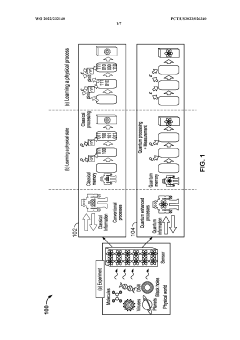
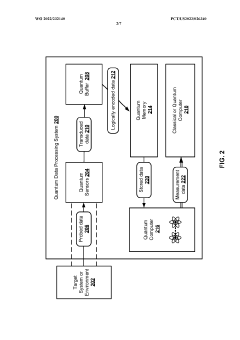
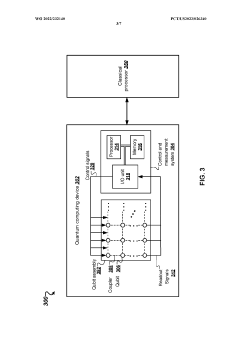
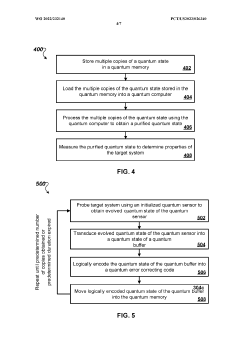
Quantum sensor
PatentWO2025202255A1
Innovation
- The integration of optical waveguides on or in the carrier substrate for excitation light supply, allowing precise component positioning and eliminating the need for active alignment, with components attached using surface-mounted technology and passive alignment, enabling scalability and miniaturization.


Economic Impact Assessment of Quantum Sensing Adoption
The widespread adoption of quantum sensing technology presents significant economic implications across multiple sectors, fundamentally altering cost structures and operational paradigms. Initial deployment costs for quantum sensors typically range from $100,000 to $500,000 per unit, substantially higher than conventional alternatives that cost between $1,000 to $50,000. However, this upfront investment disparity diminishes when considering total cost of ownership over operational lifespans of 10-15 years.
Manufacturing sectors implementing quantum gravimeters for geological surveys report 40-60% reduction in exploration costs due to enhanced precision and reduced survey time requirements. The oil and gas industry demonstrates particularly compelling returns, with quantum sensing enabling detection of previously unidentifiable reserves, generating revenue increases of $2-5 million per successful identification compared to conventional seismic methods.
Healthcare applications show mixed economic impacts during transition periods. Quantum magnetometers for medical imaging require specialized infrastructure investments averaging $2-3 million per facility, yet deliver 30% faster diagnostic capabilities and 25% improved accuracy rates. These improvements translate to reduced patient treatment costs and enhanced throughput, generating estimated annual savings of $500,000-800,000 per major medical center.
Defense and aerospace sectors experience the most dramatic economic transformations, with quantum sensing enabling previously impossible capabilities in navigation and detection. Military applications justify premium costs through strategic advantages, while commercial aerospace benefits from reduced maintenance requirements and improved safety margins, resulting in operational cost reductions of 15-20%.
The semiconductor industry faces unique economic challenges, as quantum sensors require ultra-clean manufacturing environments and specialized materials, increasing production costs by 200-300% initially. However, economies of scale projections indicate cost parity with high-end conventional sensors by 2028, assuming annual production volumes exceed 10,000 units globally.
Labor market impacts include demand for specialized technicians and engineers, with quantum sensing expertise commanding 40-50% salary premiums. Training and certification programs represent additional organizational investments of $50,000-100,000 per technical team, yet companies report improved operational efficiency and reduced error rates justifying these human capital investments.
Manufacturing sectors implementing quantum gravimeters for geological surveys report 40-60% reduction in exploration costs due to enhanced precision and reduced survey time requirements. The oil and gas industry demonstrates particularly compelling returns, with quantum sensing enabling detection of previously unidentifiable reserves, generating revenue increases of $2-5 million per successful identification compared to conventional seismic methods.
Healthcare applications show mixed economic impacts during transition periods. Quantum magnetometers for medical imaging require specialized infrastructure investments averaging $2-3 million per facility, yet deliver 30% faster diagnostic capabilities and 25% improved accuracy rates. These improvements translate to reduced patient treatment costs and enhanced throughput, generating estimated annual savings of $500,000-800,000 per major medical center.
Defense and aerospace sectors experience the most dramatic economic transformations, with quantum sensing enabling previously impossible capabilities in navigation and detection. Military applications justify premium costs through strategic advantages, while commercial aerospace benefits from reduced maintenance requirements and improved safety margins, resulting in operational cost reductions of 15-20%.
The semiconductor industry faces unique economic challenges, as quantum sensors require ultra-clean manufacturing environments and specialized materials, increasing production costs by 200-300% initially. However, economies of scale projections indicate cost parity with high-end conventional sensors by 2028, assuming annual production volumes exceed 10,000 units globally.
Labor market impacts include demand for specialized technicians and engineers, with quantum sensing expertise commanding 40-50% salary premiums. Training and certification programs represent additional organizational investments of $50,000-100,000 per technical team, yet companies report improved operational efficiency and reduced error rates justifying these human capital investments.
Investment Risk Analysis for Quantum Sensor Development
Quantum sensor development presents a complex investment landscape characterized by substantial capital requirements and extended development timelines. Initial research and development investments typically range from $10-50 million for early-stage quantum sensing technologies, with prototype development requiring additional $20-100 million depending on the specific application domain. The high upfront costs stem from the need for specialized equipment, cleanroom facilities, and highly skilled personnel with expertise in quantum physics and engineering.
Technical risk represents the most significant challenge in quantum sensor investment portfolios. Unlike conventional sensor technologies with well-established manufacturing processes, quantum sensors operate on principles that are still being refined and optimized. The risk of technical failure remains elevated due to quantum decoherence issues, environmental sensitivity, and scalability challenges. Approximately 60-70% of quantum sensor projects face significant technical hurdles that can delay commercialization by 2-5 years beyond initial projections.
Market adoption risk constitutes another critical factor affecting investment returns. While quantum sensors offer superior performance metrics, the transition from conventional sensing methods requires substantial customer education and infrastructure modifications. Industries such as healthcare, defense, and navigation show promising adoption potential, yet regulatory approval processes can extend market entry timelines by 18-36 months, particularly in medical applications where FDA approval is mandatory.
Manufacturing scalability presents ongoing investment challenges as quantum sensors require precise control of quantum states and often operate under extreme conditions such as ultra-low temperatures or high vacuum environments. The transition from laboratory prototypes to mass production involves significant capital expenditure for specialized manufacturing equipment, with production scaling costs estimated at $50-200 million for commercial-grade facilities.
Competitive landscape risks emerge from both established sensor manufacturers developing quantum capabilities and new quantum-focused startups. Large technology corporations possess substantial resources to accelerate development timelines, potentially disrupting smaller players' market positioning. Additionally, rapid technological advancement in the quantum field creates obsolescence risks where current development efforts may become outdated before reaching commercial viability.
Intellectual property risks require careful consideration as the quantum sensing field involves complex patent landscapes with overlapping claims. Patent litigation costs can reach $5-15 million per case, while licensing fees may significantly impact profit margins. International patent protection adds complexity and costs, particularly given the global nature of quantum research initiatives and varying regulatory frameworks across different countries.
Technical risk represents the most significant challenge in quantum sensor investment portfolios. Unlike conventional sensor technologies with well-established manufacturing processes, quantum sensors operate on principles that are still being refined and optimized. The risk of technical failure remains elevated due to quantum decoherence issues, environmental sensitivity, and scalability challenges. Approximately 60-70% of quantum sensor projects face significant technical hurdles that can delay commercialization by 2-5 years beyond initial projections.
Market adoption risk constitutes another critical factor affecting investment returns. While quantum sensors offer superior performance metrics, the transition from conventional sensing methods requires substantial customer education and infrastructure modifications. Industries such as healthcare, defense, and navigation show promising adoption potential, yet regulatory approval processes can extend market entry timelines by 18-36 months, particularly in medical applications where FDA approval is mandatory.
Manufacturing scalability presents ongoing investment challenges as quantum sensors require precise control of quantum states and often operate under extreme conditions such as ultra-low temperatures or high vacuum environments. The transition from laboratory prototypes to mass production involves significant capital expenditure for specialized manufacturing equipment, with production scaling costs estimated at $50-200 million for commercial-grade facilities.
Competitive landscape risks emerge from both established sensor manufacturers developing quantum capabilities and new quantum-focused startups. Large technology corporations possess substantial resources to accelerate development timelines, potentially disrupting smaller players' market positioning. Additionally, rapid technological advancement in the quantum field creates obsolescence risks where current development efforts may become outdated before reaching commercial viability.
Intellectual property risks require careful consideration as the quantum sensing field involves complex patent landscapes with overlapping claims. Patent litigation costs can reach $5-15 million per case, while licensing fees may significantly impact profit margins. International patent protection adds complexity and costs, particularly given the global nature of quantum research initiatives and varying regulatory frameworks across different countries.
Unlock deeper insights with PatSnap Eureka Quick Research — get a full tech report to explore trends and direct your research. Try now!
Generate Your Research Report Instantly with AI Agent
Supercharge your innovation with PatSnap Eureka AI Agent Platform!