

Quantum Network Scalability vs Data Throughput: Strategic Alignments
APR 21, 20269 MIN READ
Generate Your Research Report Instantly with AI Agent
Patsnap Eureka helps you evaluate technical feasibility & market potential.
Quantum Network Evolution and Scalability Goals
Quantum networking has emerged from theoretical foundations laid in the 1980s with early quantum cryptography concepts, evolving through decades of incremental breakthroughs in quantum mechanics applications. The field gained momentum in the 1990s with the development of quantum key distribution protocols, establishing the groundwork for secure quantum communications. Early implementations were limited to point-to-point connections over short distances, primarily focusing on proof-of-concept demonstrations rather than scalable network architectures.
The transition from laboratory experiments to practical quantum networks began in the early 2000s, marked by the first metropolitan quantum networks in Vienna and Geneva. These pioneering implementations demonstrated the feasibility of quantum communication over fiber optic infrastructure, though they remained constrained by distance limitations and low data throughput rates. The evolution accelerated with the introduction of quantum repeaters and entanglement swapping techniques, addressing fundamental challenges in long-distance quantum communication.
Contemporary quantum network development has shifted focus toward achieving true scalability while maintaining quantum advantages. The current paradigm emphasizes hybrid classical-quantum architectures that can support multiple users simultaneously without compromising security or coherence properties. Recent advances in quantum memory systems and error correction protocols have enabled more robust network topologies capable of handling increased traffic loads.
The strategic alignment between scalability and data throughput has become increasingly critical as quantum networks transition from research tools to commercial infrastructure. Modern quantum network architectures must balance the preservation of quantum properties with practical requirements for bandwidth and user capacity. This evolution has driven innovations in multiplexing techniques, network protocols, and hardware optimization specifically designed for quantum information processing.
Current scalability goals center on achieving continental-scale quantum networks capable of supporting thousands of simultaneous users while maintaining quantum security guarantees. The integration of satellite-based quantum communication links represents a pivotal advancement, enabling global quantum network coverage that transcends terrestrial infrastructure limitations. These developments position quantum networks as foundational technology for future secure communications, distributed quantum computing, and advanced sensing applications across multiple industries and government sectors.
The transition from laboratory experiments to practical quantum networks began in the early 2000s, marked by the first metropolitan quantum networks in Vienna and Geneva. These pioneering implementations demonstrated the feasibility of quantum communication over fiber optic infrastructure, though they remained constrained by distance limitations and low data throughput rates. The evolution accelerated with the introduction of quantum repeaters and entanglement swapping techniques, addressing fundamental challenges in long-distance quantum communication.
Contemporary quantum network development has shifted focus toward achieving true scalability while maintaining quantum advantages. The current paradigm emphasizes hybrid classical-quantum architectures that can support multiple users simultaneously without compromising security or coherence properties. Recent advances in quantum memory systems and error correction protocols have enabled more robust network topologies capable of handling increased traffic loads.
The strategic alignment between scalability and data throughput has become increasingly critical as quantum networks transition from research tools to commercial infrastructure. Modern quantum network architectures must balance the preservation of quantum properties with practical requirements for bandwidth and user capacity. This evolution has driven innovations in multiplexing techniques, network protocols, and hardware optimization specifically designed for quantum information processing.
Current scalability goals center on achieving continental-scale quantum networks capable of supporting thousands of simultaneous users while maintaining quantum security guarantees. The integration of satellite-based quantum communication links represents a pivotal advancement, enabling global quantum network coverage that transcends terrestrial infrastructure limitations. These developments position quantum networks as foundational technology for future secure communications, distributed quantum computing, and advanced sensing applications across multiple industries and government sectors.
Market Demand for Scalable Quantum Communication
The quantum communication market is experiencing unprecedented growth driven by escalating cybersecurity threats and the urgent need for unconditionally secure data transmission. Financial institutions, government agencies, and critical infrastructure operators are increasingly recognizing quantum key distribution as the ultimate solution for protecting sensitive communications against both current and future quantum computing attacks. This demand is particularly acute in sectors handling classified information, financial transactions, and intellectual property where data breaches carry catastrophic consequences.
Enterprise adoption patterns reveal a strong preference for scalable quantum communication solutions that can integrate seamlessly with existing network infrastructures. Organizations are seeking quantum networks capable of supporting multiple simultaneous users while maintaining high data throughput rates. The banking sector leads this demand, requiring quantum-secured channels for inter-branch communications and international financial transfers. Healthcare organizations follow closely, driven by stringent patient data protection requirements and the need for secure telemedicine communications.
Government initiatives worldwide are accelerating market demand through substantial investments in quantum communication infrastructure. National quantum networks are being deployed to secure government communications, creating a ripple effect that drives commercial adoption. Defense contractors and aerospace companies are mandating quantum-secured communications for sensitive project collaborations, establishing new market segments focused on high-security applications.
The telecommunications industry represents the largest potential market for scalable quantum communication systems. Service providers are exploring quantum communication as a premium security offering, targeting enterprise customers willing to pay significant premiums for quantum-grade protection. Network operators require solutions that can scale from metropolitan areas to intercontinental distances while maintaining commercially viable data rates.
Market research indicates strong demand for hybrid quantum-classical communication systems that optimize the balance between security, scalability, and throughput. Organizations prefer solutions offering flexible deployment models, from point-to-point links to complex multi-node networks. The ability to dynamically allocate quantum resources based on real-time security requirements and traffic patterns has become a critical market differentiator.
Emerging applications in cloud computing and distributed ledger technologies are creating new demand vectors for scalable quantum communication. Cloud service providers are investigating quantum-secured data center interconnections, while blockchain networks explore quantum communication for consensus mechanisms requiring absolute security guarantees.
Enterprise adoption patterns reveal a strong preference for scalable quantum communication solutions that can integrate seamlessly with existing network infrastructures. Organizations are seeking quantum networks capable of supporting multiple simultaneous users while maintaining high data throughput rates. The banking sector leads this demand, requiring quantum-secured channels for inter-branch communications and international financial transfers. Healthcare organizations follow closely, driven by stringent patient data protection requirements and the need for secure telemedicine communications.
Government initiatives worldwide are accelerating market demand through substantial investments in quantum communication infrastructure. National quantum networks are being deployed to secure government communications, creating a ripple effect that drives commercial adoption. Defense contractors and aerospace companies are mandating quantum-secured communications for sensitive project collaborations, establishing new market segments focused on high-security applications.
The telecommunications industry represents the largest potential market for scalable quantum communication systems. Service providers are exploring quantum communication as a premium security offering, targeting enterprise customers willing to pay significant premiums for quantum-grade protection. Network operators require solutions that can scale from metropolitan areas to intercontinental distances while maintaining commercially viable data rates.
Market research indicates strong demand for hybrid quantum-classical communication systems that optimize the balance between security, scalability, and throughput. Organizations prefer solutions offering flexible deployment models, from point-to-point links to complex multi-node networks. The ability to dynamically allocate quantum resources based on real-time security requirements and traffic patterns has become a critical market differentiator.
Emerging applications in cloud computing and distributed ledger technologies are creating new demand vectors for scalable quantum communication. Cloud service providers are investigating quantum-secured data center interconnections, while blockchain networks explore quantum communication for consensus mechanisms requiring absolute security guarantees.
Current Quantum Network Scalability Limitations
Quantum networks face fundamental scalability constraints that stem from the inherent fragility of quantum states and the probabilistic nature of quantum operations. Current quantum communication systems are limited by decoherence effects, where quantum information degrades rapidly over time and distance. This degradation becomes exponentially more challenging as network size increases, creating a critical bottleneck for large-scale deployment.
The probabilistic success rates of quantum operations present another significant limitation. Quantum entanglement distribution, a cornerstone of quantum networking, typically achieves success rates below 50% in current implementations. When scaling to networks with multiple nodes and longer transmission distances, these low success rates compound multiplicatively, resulting in dramatically reduced overall network efficiency and reliability.
Distance limitations pose severe constraints on quantum network expansion. Current quantum key distribution systems are practically limited to approximately 100-200 kilometers for fiber-based transmission without quantum repeaters. While satellite-based quantum communication can extend this range, atmospheric interference and pointing accuracy requirements introduce additional complexity and reliability challenges that limit scalability.
Node connectivity represents a critical architectural limitation in existing quantum networks. Most current implementations support only point-to-point connections or simple star topologies. Creating mesh networks with arbitrary connectivity patterns requires sophisticated quantum switching capabilities that remain largely theoretical. The inability to efficiently route quantum information through intermediate nodes severely restricts network topology options and scalability potential.
Quantum memory limitations further constrain network scalability. Current quantum storage technologies can maintain quantum states for only microseconds to milliseconds, which is insufficient for complex multi-hop routing scenarios or network-wide synchronization requirements. This temporal limitation forces quantum networks to operate in near real-time, eliminating the buffering and store-and-forward capabilities that enable classical network scalability.
Error accumulation presents an increasingly severe challenge as quantum networks scale. Unlike classical networks where errors can be detected and corrected through redundancy, quantum error correction requires complex encoding schemes that significantly increase resource overhead. The quantum no-cloning theorem prevents simple duplication of quantum states for error detection, necessitating sophisticated quantum error correction protocols that are not yet practical for large-scale implementation.
Resource allocation and management become exponentially complex in scaled quantum networks. Coordinating entanglement distribution, managing quantum memory resources, and synchronizing quantum operations across multiple nodes requires classical control systems that can quickly become bottlenecks. The hybrid quantum-classical nature of these networks introduces additional latency and complexity that limits overall system performance and scalability potential.
The probabilistic success rates of quantum operations present another significant limitation. Quantum entanglement distribution, a cornerstone of quantum networking, typically achieves success rates below 50% in current implementations. When scaling to networks with multiple nodes and longer transmission distances, these low success rates compound multiplicatively, resulting in dramatically reduced overall network efficiency and reliability.
Distance limitations pose severe constraints on quantum network expansion. Current quantum key distribution systems are practically limited to approximately 100-200 kilometers for fiber-based transmission without quantum repeaters. While satellite-based quantum communication can extend this range, atmospheric interference and pointing accuracy requirements introduce additional complexity and reliability challenges that limit scalability.
Node connectivity represents a critical architectural limitation in existing quantum networks. Most current implementations support only point-to-point connections or simple star topologies. Creating mesh networks with arbitrary connectivity patterns requires sophisticated quantum switching capabilities that remain largely theoretical. The inability to efficiently route quantum information through intermediate nodes severely restricts network topology options and scalability potential.
Quantum memory limitations further constrain network scalability. Current quantum storage technologies can maintain quantum states for only microseconds to milliseconds, which is insufficient for complex multi-hop routing scenarios or network-wide synchronization requirements. This temporal limitation forces quantum networks to operate in near real-time, eliminating the buffering and store-and-forward capabilities that enable classical network scalability.
Error accumulation presents an increasingly severe challenge as quantum networks scale. Unlike classical networks where errors can be detected and corrected through redundancy, quantum error correction requires complex encoding schemes that significantly increase resource overhead. The quantum no-cloning theorem prevents simple duplication of quantum states for error detection, necessitating sophisticated quantum error correction protocols that are not yet practical for large-scale implementation.
Resource allocation and management become exponentially complex in scaled quantum networks. Coordinating entanglement distribution, managing quantum memory resources, and synchronizing quantum operations across multiple nodes requires classical control systems that can quickly become bottlenecks. The hybrid quantum-classical nature of these networks introduces additional latency and complexity that limits overall system performance and scalability potential.
Existing Quantum Network Scaling Solutions
01 Quantum key distribution protocols for secure scalable networks
Implementation of quantum key distribution (QKD) protocols enables secure communication channels in quantum networks while maintaining scalability. These protocols utilize quantum mechanical properties to establish cryptographic keys between network nodes, allowing for expansion of network size without compromising security. Advanced QKD systems incorporate error correction and privacy amplification techniques to ensure reliable key generation across multiple network nodes, supporting both point-to-point and multi-node network architectures.- Quantum key distribution protocols for secure scalable networks: Implementation of quantum key distribution (QKD) protocols enables secure communication channels in quantum networks while maintaining scalability. These protocols utilize quantum mechanical properties to establish cryptographic keys between network nodes, allowing for expansion of network size without compromising security. Advanced QKD systems incorporate error correction and privacy amplification techniques to ensure reliable key generation across multiple network nodes, supporting both point-to-point and multi-node network architectures.
- Quantum repeater architectures for extended network range: Quantum repeater systems enable long-distance quantum communication by overcoming photon loss and decoherence limitations. These architectures employ quantum memory units and entanglement swapping techniques to extend the effective range of quantum networks. The repeater nodes facilitate quantum state transfer across multiple segments, allowing networks to scale geographically while maintaining quantum coherence. Integration of error correction at repeater stations ensures data integrity throughout extended network paths.
- Multiplexing techniques for enhanced quantum data throughput: Advanced multiplexing methods increase quantum network data throughput by enabling simultaneous transmission of multiple quantum channels. These techniques include wavelength division multiplexing, time-bin encoding, and spatial mode multiplexing to maximize channel capacity. Implementation of these methods allows parallel processing of quantum information streams, significantly improving overall network throughput. Sophisticated demultiplexing and detection systems ensure accurate separation and measurement of multiplexed quantum signals.
- Network topology optimization for quantum information routing: Optimized network topologies and routing protocols enhance scalability and efficiency of quantum networks. These designs incorporate mesh, star, and hybrid configurations to balance connectivity requirements with resource constraints. Dynamic routing algorithms adapt to network conditions and optimize path selection for quantum state transmission. The topology designs consider factors such as entanglement distribution, node connectivity, and fault tolerance to ensure robust network operation at scale.
- Quantum network management and resource allocation systems: Comprehensive management systems coordinate quantum network resources to optimize throughput and scalability. These systems implement intelligent scheduling algorithms for entanglement distribution, qubit allocation, and channel assignment across network nodes. Real-time monitoring and adaptive control mechanisms ensure efficient utilization of quantum resources while maintaining quality of service. Integration of classical control networks with quantum data planes enables coordinated operation of large-scale quantum network infrastructures.
02 Quantum repeater architectures for extended network range
Quantum repeater systems enable long-distance quantum communication by overcoming photon loss and decoherence limitations. These architectures employ quantum memory units and entanglement swapping techniques to extend the effective range of quantum networks. The repeater nodes facilitate quantum state transfer across multiple segments, enabling scalable network topologies that span greater distances while maintaining quantum coherence and high data fidelity.Expand Specific Solutions03 Multiplexing techniques for enhanced quantum data throughput
Advanced multiplexing methods increase quantum network data throughput by enabling simultaneous transmission of multiple quantum channels. These techniques include wavelength division multiplexing, time-bin encoding, and spatial mode multiplexing to maximize the information capacity of quantum communication links. Implementation of these multiplexing strategies allows for parallel processing of quantum information streams, significantly improving overall network bandwidth and data transfer rates.Expand Specific Solutions04 Network topology optimization for quantum routing efficiency
Optimized network topologies and routing protocols enhance quantum network scalability by efficiently managing quantum resource allocation and entanglement distribution. These systems employ dynamic routing algorithms that adapt to network conditions, node availability, and traffic demands. Advanced topology designs incorporate mesh, star, and hybrid configurations to balance network connectivity, minimize latency, and maximize throughput while accommodating network growth and varying communication requirements.Expand Specific Solutions05 Error correction and fault-tolerant protocols for reliable quantum transmission
Quantum error correction codes and fault-tolerant protocols ensure reliable data transmission in scalable quantum networks by mitigating the effects of noise and decoherence. These mechanisms detect and correct quantum errors without destroying quantum information, maintaining data integrity across network operations. Implementation of concatenated codes, surface codes, and topological error correction enables robust quantum communication even as network complexity increases, supporting high-fidelity data throughput in large-scale quantum network deployments.Expand Specific Solutions
Key Players in Quantum Networking Industry
The quantum network scalability versus data throughput research field represents an emerging technology sector in its early developmental stage, characterized by significant market potential but limited commercial maturity. The market remains nascent with substantial growth projections as quantum communication networks transition from laboratory demonstrations to practical implementations. Technology maturity varies considerably across different player categories, with leading technology corporations like Intel Corp., IBM, Google LLC, and Samsung Electronics driving hardware and infrastructure development, while specialized quantum companies such as Terra Quantum AG and Anhui Asky Quantum Technology focus on dedicated quantum solutions. Academic institutions including MIT, Delft University of Technology, and University of Waterloo contribute fundamental research breakthroughs, particularly in quantum networking protocols and scalability algorithms. The competitive landscape shows a hybrid ecosystem where traditional telecommunications giants like Nokia Technologies, Orange SA, and AT&T explore quantum integration alongside pure-play quantum startups, creating a dynamic environment where technological advancement outpaces standardization and commercial deployment remains largely experimental.
Intel Corp.
Technical Solution: Intel's quantum network strategy focuses on silicon-based quantum computing technology that leverages their semiconductor manufacturing expertise to create scalable quantum networks with high data throughput capabilities. Their Horse Ridge cryogenic control chip enables precise control of quantum systems while reducing the complexity of quantum network infrastructure. Intel's approach emphasizes hot qubits that operate at higher temperatures than traditional quantum systems, potentially reducing cooling requirements and improving network scalability. The company develops quantum interconnect technologies that support high-bandwidth communication between quantum processors, enabling distributed quantum computing architectures. Their strategic alignment includes partnerships with research institutions to develop quantum networking protocols that optimize both scalability and performance for commercial applications. Intel's quantum network solutions target telecommunications, financial services, and logistics optimization where both scale and throughput are critical requirements.
Strengths: Advanced semiconductor manufacturing capabilities, innovative hot qubit technology, strong industry partnerships. Weaknesses: Silicon quantum technology still emerging, limited demonstrated quantum advantages, competition from superconducting approaches.
International Business Machines Corp.
Technical Solution: IBM has developed a comprehensive quantum network architecture that addresses scalability through their Quantum Network initiative, which connects over 200 members globally including academic institutions and enterprises. Their approach focuses on distributed quantum computing where multiple quantum processors are interconnected to handle larger computational tasks while maintaining data throughput efficiency. IBM's quantum network utilizes superconducting qubits with gate fidelities exceeding 99.9% and implements error correction protocols that enable reliable data transmission across quantum channels. The company has demonstrated quantum volume improvements of 2x annually, supporting both near-term NISQ applications and long-term fault-tolerant quantum computing scenarios. Their strategic alignment emphasizes hybrid classical-quantum workflows that optimize data processing pipelines for enterprise applications.
Strengths: Industry-leading quantum hardware with high gate fidelities, extensive partner ecosystem, proven scalability roadmap. Weaknesses: Limited coherence times, high operational costs, dependency on cryogenic infrastructure.
Core Innovations in Quantum Throughput Optimization
Dual-type Qubits System, Quantum Network and Construction Method Thereof
PatentActiveUS20220129778A1
Innovation
- A dual-type qubit system utilizing the same species of ions with at least two sets of long-lived energy levels, where ancillary qubits operate on operational levels and data qubits on storage levels, with spectrally separated excitation and emission frequencies greater than 20 GHz, allowing coherent conversion between the two types without spatial movement or increased system complexity.


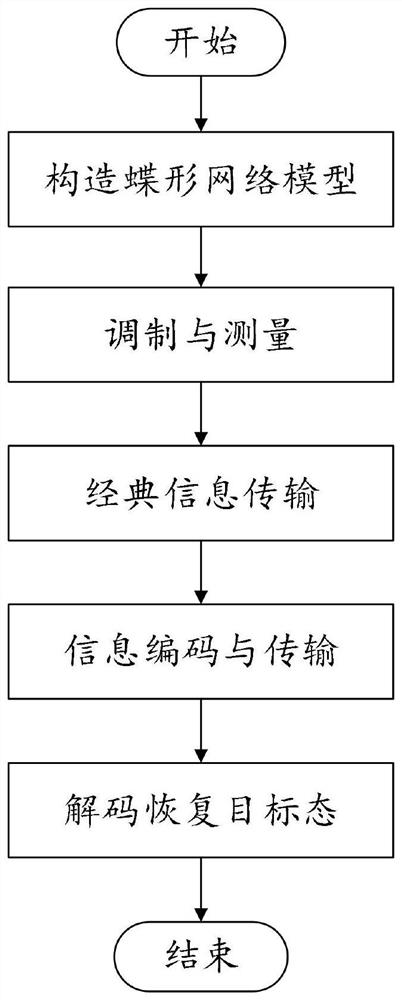
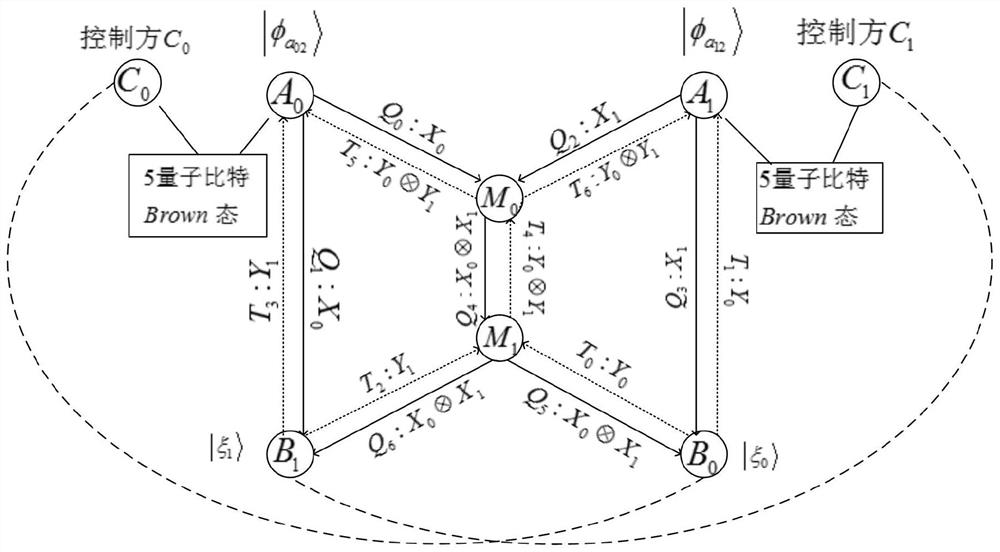
Butterfly network coding method based on bidirectional mixed quantum information exchange
PatentActiveCN112953648A
Innovation
- The butterfly network coding method based on two-way hybrid quantum information exchange is used to achieve two-way information exchange through a five-bit Brown state channel. The classical channel is used to transmit measurement information and auxiliary information, and coding is performed at the intermediate node to restore the original state, combined with quantum invisibility. State transmission and remote state preparation methods improve channel utilization.


Quantum Communication Security Standards
The establishment of robust quantum communication security standards represents a critical foundation for addressing the complex interplay between network scalability and data throughput in quantum networks. Current standardization efforts focus on creating comprehensive frameworks that can accommodate varying network architectures while maintaining stringent security protocols across different operational scales.
International standardization bodies, including ITU-T and ETSI, have initiated collaborative frameworks to define quantum key distribution (QKD) protocols that can scale effectively across metropolitan and wide-area networks. These standards emphasize the integration of classical authentication mechanisms with quantum cryptographic protocols, ensuring that security measures do not become bottlenecks as network complexity increases.
The emerging standards address critical security parameters including key generation rates, error correction thresholds, and authentication protocols that must adapt to varying network topologies. Particular attention is given to defining security metrics that remain consistent regardless of network size, ensuring that larger quantum networks do not compromise fundamental security guarantees for improved throughput performance.
Multi-layer security architectures are being standardized to support heterogeneous quantum network environments where different segments may operate at varying throughput capacities. These standards define interoperability requirements between high-throughput quantum channels and security-optimized segments, enabling strategic alignment between performance and protection objectives.
Certification frameworks are being developed to validate quantum communication systems against established security benchmarks while accommodating scalability requirements. These frameworks include testing methodologies for evaluating how security protocols perform under different network loads and expansion scenarios, ensuring that strategic alignments between scalability and throughput do not compromise cryptographic integrity.
The standardization process also encompasses post-quantum cryptographic integration, preparing quantum networks for hybrid security models that can maintain protection levels as networks scale. This forward-looking approach ensures that current security investments remain viable as quantum network infrastructure expands and throughput demands increase across diverse application domains.
International standardization bodies, including ITU-T and ETSI, have initiated collaborative frameworks to define quantum key distribution (QKD) protocols that can scale effectively across metropolitan and wide-area networks. These standards emphasize the integration of classical authentication mechanisms with quantum cryptographic protocols, ensuring that security measures do not become bottlenecks as network complexity increases.
The emerging standards address critical security parameters including key generation rates, error correction thresholds, and authentication protocols that must adapt to varying network topologies. Particular attention is given to defining security metrics that remain consistent regardless of network size, ensuring that larger quantum networks do not compromise fundamental security guarantees for improved throughput performance.
Multi-layer security architectures are being standardized to support heterogeneous quantum network environments where different segments may operate at varying throughput capacities. These standards define interoperability requirements between high-throughput quantum channels and security-optimized segments, enabling strategic alignment between performance and protection objectives.
Certification frameworks are being developed to validate quantum communication systems against established security benchmarks while accommodating scalability requirements. These frameworks include testing methodologies for evaluating how security protocols perform under different network loads and expansion scenarios, ensuring that strategic alignments between scalability and throughput do not compromise cryptographic integrity.
The standardization process also encompasses post-quantum cryptographic integration, preparing quantum networks for hybrid security models that can maintain protection levels as networks scale. This forward-looking approach ensures that current security investments remain viable as quantum network infrastructure expands and throughput demands increase across diverse application domains.
Strategic Investment in Quantum Infrastructure
Strategic investment in quantum infrastructure represents a critical foundation for achieving optimal balance between network scalability and data throughput in quantum communication systems. The infrastructure requirements for quantum networks differ fundamentally from classical networks, demanding specialized hardware, environmental controls, and maintenance protocols that require substantial upfront capital allocation.
The primary infrastructure components requiring strategic investment include quantum repeaters, which serve as essential nodes for extending quantum communication range while maintaining entanglement fidelity. These devices represent significant cost centers but are indispensable for scaling quantum networks beyond current distance limitations of approximately 100 kilometers for direct quantum key distribution.
Cryogenic systems constitute another major investment category, as most quantum hardware operates at temperatures near absolute zero. The infrastructure must support continuous cooling operations, backup systems, and specialized maintenance protocols. Investment strategies should consider the total cost of ownership, including energy consumption patterns and operational complexity over extended deployment periods.
Fiber optic infrastructure specifically designed for quantum applications requires different specifications compared to classical telecommunications networks. Quantum-grade optical fibers must minimize photon loss and maintain polarization stability, necessitating premium materials and installation techniques that increase infrastructure costs by approximately 30-40% compared to conventional networks.
Investment timing strategies should align with technological maturity curves, as premature infrastructure deployment may result in stranded assets when next-generation quantum technologies emerge. Conversely, delayed investment could result in competitive disadvantages as quantum communication capabilities become commercially viable.
Risk mitigation approaches should incorporate modular infrastructure designs that allow for incremental capacity expansion and technology upgrades. This strategy enables organizations to balance immediate operational requirements with long-term scalability objectives while managing capital exposure in an rapidly evolving technological landscape.
Public-private partnership models are emerging as viable mechanisms for sharing infrastructure investment risks and accelerating deployment timelines. These collaborative approaches can distribute financial burdens while ensuring access to cutting-edge quantum communication capabilities across multiple stakeholders.
The primary infrastructure components requiring strategic investment include quantum repeaters, which serve as essential nodes for extending quantum communication range while maintaining entanglement fidelity. These devices represent significant cost centers but are indispensable for scaling quantum networks beyond current distance limitations of approximately 100 kilometers for direct quantum key distribution.
Cryogenic systems constitute another major investment category, as most quantum hardware operates at temperatures near absolute zero. The infrastructure must support continuous cooling operations, backup systems, and specialized maintenance protocols. Investment strategies should consider the total cost of ownership, including energy consumption patterns and operational complexity over extended deployment periods.
Fiber optic infrastructure specifically designed for quantum applications requires different specifications compared to classical telecommunications networks. Quantum-grade optical fibers must minimize photon loss and maintain polarization stability, necessitating premium materials and installation techniques that increase infrastructure costs by approximately 30-40% compared to conventional networks.
Investment timing strategies should align with technological maturity curves, as premature infrastructure deployment may result in stranded assets when next-generation quantum technologies emerge. Conversely, delayed investment could result in competitive disadvantages as quantum communication capabilities become commercially viable.
Risk mitigation approaches should incorporate modular infrastructure designs that allow for incremental capacity expansion and technology upgrades. This strategy enables organizations to balance immediate operational requirements with long-term scalability objectives while managing capital exposure in an rapidly evolving technological landscape.
Public-private partnership models are emerging as viable mechanisms for sharing infrastructure investment risks and accelerating deployment timelines. These collaborative approaches can distribute financial burdens while ensuring access to cutting-edge quantum communication capabilities across multiple stakeholders.
Unlock deeper insights with Patsnap Eureka Quick Research — get a full tech report to explore trends and direct your research. Try now!
Generate Your Research Report Instantly with AI Agent
Supercharge your innovation with Patsnap Eureka AI Agent Platform!