

Self-healing polymer composites for structural applications
FEB 11, 20269 MIN READ
Generate Your Research Report Instantly with AI Agent
PatSnap Eureka helps you evaluate technical feasibility & market potential.
Self-Healing Polymer Composites Background and Objectives
Self-healing polymer composites represent a transformative advancement in materials science, addressing the fundamental limitation of conventional structural materials: their inability to autonomously repair damage. Traditional polymer composites, while offering excellent strength-to-weight ratios and design flexibility, suffer from progressive degradation through microcracking, delamination, and environmental stress. These failure modes compromise structural integrity and necessitate costly maintenance or premature replacement, particularly in aerospace, automotive, and civil infrastructure applications.
The concept of self-healing materials draws inspiration from biological systems, where living organisms possess innate capabilities to detect and repair damage. Translating this paradigm to synthetic materials emerged in the early 2000s, with pioneering research demonstrating that polymeric matrices could be engineered to respond autonomously to mechanical damage. Initial approaches focused on microcapsule-based systems, where healing agents encapsulated within the matrix would release upon crack formation, triggering polymerization reactions that restored material continuity.
The evolution of self-healing polymer composites has been driven by increasing demands for enhanced durability, reduced lifecycle costs, and improved safety margins in critical structural applications. Industries facing harsh operational environments, such as offshore wind energy, aerospace structures, and transportation infrastructure, have identified self-healing capabilities as a key enabling technology for next-generation materials. The ability to extend service life, minimize unscheduled maintenance, and prevent catastrophic failure represents significant economic and safety advantages.
Current research objectives center on developing self-healing mechanisms that can function repeatedly, operate effectively under diverse environmental conditions, and maintain the mechanical performance required for load-bearing applications. Key technical goals include achieving healing efficiencies exceeding eighty percent of original strength, enabling multiple healing cycles at the same damage site, and ensuring compatibility with existing composite manufacturing processes. Additionally, researchers aim to reduce healing times from hours to minutes and expand the operational temperature range to accommodate extreme service conditions.
The strategic importance of this technology extends beyond immediate performance improvements, positioning self-healing composites as essential components in sustainable engineering solutions that align with circular economy principles and resource conservation imperatives.
The concept of self-healing materials draws inspiration from biological systems, where living organisms possess innate capabilities to detect and repair damage. Translating this paradigm to synthetic materials emerged in the early 2000s, with pioneering research demonstrating that polymeric matrices could be engineered to respond autonomously to mechanical damage. Initial approaches focused on microcapsule-based systems, where healing agents encapsulated within the matrix would release upon crack formation, triggering polymerization reactions that restored material continuity.
The evolution of self-healing polymer composites has been driven by increasing demands for enhanced durability, reduced lifecycle costs, and improved safety margins in critical structural applications. Industries facing harsh operational environments, such as offshore wind energy, aerospace structures, and transportation infrastructure, have identified self-healing capabilities as a key enabling technology for next-generation materials. The ability to extend service life, minimize unscheduled maintenance, and prevent catastrophic failure represents significant economic and safety advantages.
Current research objectives center on developing self-healing mechanisms that can function repeatedly, operate effectively under diverse environmental conditions, and maintain the mechanical performance required for load-bearing applications. Key technical goals include achieving healing efficiencies exceeding eighty percent of original strength, enabling multiple healing cycles at the same damage site, and ensuring compatibility with existing composite manufacturing processes. Additionally, researchers aim to reduce healing times from hours to minutes and expand the operational temperature range to accommodate extreme service conditions.
The strategic importance of this technology extends beyond immediate performance improvements, positioning self-healing composites as essential components in sustainable engineering solutions that align with circular economy principles and resource conservation imperatives.
Market Demand for Self-Healing Structural Materials
The global demand for self-healing structural materials is experiencing significant growth driven by multiple industrial sectors seeking enhanced durability, reduced maintenance costs, and extended service life for critical components. Aerospace and aviation industries represent primary market drivers, where structural integrity is paramount and maintenance downtime translates to substantial economic losses. Aircraft manufacturers and operators are increasingly exploring self-healing composites to address fatigue crack propagation and impact damage in fuselage panels, wing structures, and interior components.
The automotive sector constitutes another major demand source, particularly as lightweight composite materials gain prominence in electric vehicle manufacturing. Self-healing polymers offer potential solutions for battery enclosures, body panels, and structural reinforcements where minor damage accumulation can compromise safety and performance over vehicle lifetime. The push toward sustainable transportation and circular economy principles further amplifies interest in materials capable of autonomous damage repair.
Civil infrastructure applications present substantial long-term market potential, encompassing bridges, buildings, and offshore structures where inspection and repair operations are costly and logistically challenging. The aging infrastructure crisis in developed economies and rapid construction expansion in emerging markets create dual demand streams for materials that can reduce lifecycle maintenance requirements and enhance structural resilience against environmental degradation.
Wind energy infrastructure represents an emerging application domain where blade structures face continuous mechanical stress and environmental exposure. Self-healing composites could significantly reduce maintenance intervals and extend operational lifespans in remote offshore installations where repair accessibility poses major challenges. The renewable energy sector's expansion trajectory suggests growing adoption potential for advanced materials technologies.
Market demand is further stimulated by regulatory pressures emphasizing safety standards, sustainability requirements, and total cost of ownership considerations. Industries are increasingly evaluating materials not solely on initial performance metrics but on long-term reliability and maintenance burden reduction. This paradigm shift favors self-healing technologies despite potentially higher upfront material costs, as lifecycle economic analysis demonstrates favorable return on investment through reduced inspection frequency, extended replacement intervals, and minimized catastrophic failure risks.
The automotive sector constitutes another major demand source, particularly as lightweight composite materials gain prominence in electric vehicle manufacturing. Self-healing polymers offer potential solutions for battery enclosures, body panels, and structural reinforcements where minor damage accumulation can compromise safety and performance over vehicle lifetime. The push toward sustainable transportation and circular economy principles further amplifies interest in materials capable of autonomous damage repair.
Civil infrastructure applications present substantial long-term market potential, encompassing bridges, buildings, and offshore structures where inspection and repair operations are costly and logistically challenging. The aging infrastructure crisis in developed economies and rapid construction expansion in emerging markets create dual demand streams for materials that can reduce lifecycle maintenance requirements and enhance structural resilience against environmental degradation.
Wind energy infrastructure represents an emerging application domain where blade structures face continuous mechanical stress and environmental exposure. Self-healing composites could significantly reduce maintenance intervals and extend operational lifespans in remote offshore installations where repair accessibility poses major challenges. The renewable energy sector's expansion trajectory suggests growing adoption potential for advanced materials technologies.
Market demand is further stimulated by regulatory pressures emphasizing safety standards, sustainability requirements, and total cost of ownership considerations. Industries are increasingly evaluating materials not solely on initial performance metrics but on long-term reliability and maintenance burden reduction. This paradigm shift favors self-healing technologies despite potentially higher upfront material costs, as lifecycle economic analysis demonstrates favorable return on investment through reduced inspection frequency, extended replacement intervals, and minimized catastrophic failure risks.
Current Status and Challenges in Self-Healing Composites
Self-healing polymer composites have emerged as a transformative technology in structural applications, yet their widespread adoption faces significant technical and practical barriers. Current research demonstrates that while laboratory-scale demonstrations show promising results, translating these capabilities to real-world structural components remains challenging. The primary technical hurdle involves achieving autonomous healing at ambient temperatures without external intervention, as most existing systems require elevated temperatures or catalytic triggers that are impractical in operational environments.
Material performance represents another critical challenge area. Contemporary self-healing composites typically exhibit healing efficiencies ranging from 60% to 90% of original mechanical properties, which falls short of requirements for critical structural applications in aerospace and civil infrastructure. The trade-off between healing capability and baseline mechanical performance continues to constrain material design, as incorporating healing agents often compromises the composite's initial strength and stiffness. Additionally, the repeatability of healing cycles remains limited, with most systems demonstrating effective healing only for the first two to three damage events.
Manufacturing scalability poses substantial obstacles to commercialization. Current production methods for self-healing composites involve complex processing steps that significantly increase costs compared to conventional materials. The integration of microcapsules, vascular networks, or reversible polymer networks requires precise control during fabrication, making large-scale manufacturing economically prohibitive. Quality assurance and standardization protocols are still underdeveloped, creating uncertainty for industrial adoption.
Geographically, research activities concentrate in North America, Europe, and East Asia, with the United States, Germany, and China leading in patent filings and academic publications. However, collaboration between academic institutions and industrial partners remains insufficient, resulting in a gap between fundamental research breakthroughs and practical implementation. The lack of standardized testing protocols and performance metrics further complicates comparative assessments across different self-healing systems.
Environmental durability under operational conditions presents ongoing concerns. Many self-healing mechanisms degrade when exposed to moisture, UV radiation, or chemical environments typical in structural applications. Long-term performance data spanning decades, which is essential for infrastructure applications, remains scarce. These challenges collectively define the current landscape and establish the technical boundaries that future innovations must address.
Material performance represents another critical challenge area. Contemporary self-healing composites typically exhibit healing efficiencies ranging from 60% to 90% of original mechanical properties, which falls short of requirements for critical structural applications in aerospace and civil infrastructure. The trade-off between healing capability and baseline mechanical performance continues to constrain material design, as incorporating healing agents often compromises the composite's initial strength and stiffness. Additionally, the repeatability of healing cycles remains limited, with most systems demonstrating effective healing only for the first two to three damage events.
Manufacturing scalability poses substantial obstacles to commercialization. Current production methods for self-healing composites involve complex processing steps that significantly increase costs compared to conventional materials. The integration of microcapsules, vascular networks, or reversible polymer networks requires precise control during fabrication, making large-scale manufacturing economically prohibitive. Quality assurance and standardization protocols are still underdeveloped, creating uncertainty for industrial adoption.
Geographically, research activities concentrate in North America, Europe, and East Asia, with the United States, Germany, and China leading in patent filings and academic publications. However, collaboration between academic institutions and industrial partners remains insufficient, resulting in a gap between fundamental research breakthroughs and practical implementation. The lack of standardized testing protocols and performance metrics further complicates comparative assessments across different self-healing systems.
Environmental durability under operational conditions presents ongoing concerns. Many self-healing mechanisms degrade when exposed to moisture, UV radiation, or chemical environments typical in structural applications. Long-term performance data spanning decades, which is essential for infrastructure applications, remains scarce. These challenges collectively define the current landscape and establish the technical boundaries that future innovations must address.
Existing Self-Healing Mechanisms and Solutions
01 Microcapsule-based self-healing systems
Self-healing polymer composites can incorporate microcapsules containing healing agents that are released upon damage. When cracks or damage occur in the polymer matrix, the microcapsules rupture and release the healing agent, which then polymerizes or reacts to fill and repair the damaged area. This approach provides autonomous healing capability without external intervention and can restore mechanical properties of the composite material.- Microcapsule-based self-healing systems: Self-healing polymer composites can incorporate microcapsules containing healing agents that are released upon damage. When cracks or damage occur in the polymer matrix, the microcapsules rupture and release the healing agent, which then polymerizes or reacts to fill and repair the damaged area. This approach provides autonomous healing capability without external intervention and can restore mechanical properties of the composite material.
- Reversible chemical bond-based healing: Self-healing capability can be achieved through the incorporation of reversible chemical bonds such as disulfide bonds, hydrogen bonds, or Diels-Alder bonds in the polymer network. These dynamic bonds can break and reform under certain conditions like heat or light exposure, allowing the material to heal damage autonomously. This mechanism enables multiple healing cycles and maintains the structural integrity of the composite over extended use.
- Shape memory polymer-assisted healing: Shape memory polymers can be integrated into composite materials to provide self-healing functionality. These polymers can remember their original shape and return to it when triggered by external stimuli such as heat. When damage occurs, the shape memory effect helps close cracks and gaps, while additional healing mechanisms restore the material properties. This approach is particularly effective for healing larger-scale damage.
- Vascular network healing systems: Self-healing composites can be designed with embedded vascular networks that continuously supply healing agents throughout the material. These networks consist of hollow channels or fibers that contain liquid healing agents, which flow to damaged areas when the network is breached. This biomimetic approach allows for repeated healing of the same location and provides long-term healing capability for large-scale damage.
- Nanoparticle-enhanced healing mechanisms: The incorporation of functional nanoparticles into polymer composites can significantly enhance self-healing capabilities. Nanoparticles such as graphene, carbon nanotubes, or metallic nanoparticles can improve crack bridging, enhance thermal or electrical conductivity for stimulus-responsive healing, and provide reinforcement to the healed regions. These nanofillers can also facilitate the transport of healing agents and improve the overall mechanical properties of the self-healing composite.
02 Reversible chemical bond-based healing
Self-healing capability can be achieved through the incorporation of reversible chemical bonds such as Diels-Alder bonds, disulfide bonds, or hydrogen bonds in the polymer network. These dynamic bonds can break and reform under certain conditions such as heat or mechanical stress, allowing the material to heal damage autonomously. This mechanism enables multiple healing cycles and maintains the structural integrity of the composite over extended use.Expand Specific Solutions03 Shape memory polymer-assisted healing
Shape memory polymers can be integrated into composite materials to provide self-healing functionality. These polymers can return to their original shape when triggered by external stimuli such as heat, light, or electrical current. The shape recovery process helps close cracks and restore the material's structural integrity. This approach is particularly effective for healing surface damage and can be combined with other healing mechanisms for enhanced performance.Expand Specific Solutions04 Vascular network healing systems
Self-healing composites can be designed with embedded vascular networks that continuously supply healing agents to damaged regions. These networks consist of hollow channels or fibers filled with healing agents that flow to the damage site when the structure is compromised. This biomimetic approach allows for repeated healing of the same area and can handle larger damage volumes compared to microcapsule systems.Expand Specific Solutions05 Intrinsic self-healing through polymer chain mobility
Intrinsic self-healing can be achieved by designing polymer composites with high chain mobility and dynamic polymer networks. The polymer chains can diffuse across crack interfaces and re-entangle to restore mechanical properties. This healing mechanism can be activated by external stimuli such as temperature increase or solvent exposure, and does not require embedded healing agents. The approach offers advantages in terms of material simplicity and the ability to heal damage multiple times at the molecular level.Expand Specific Solutions
Key Players in Self-Healing Composite Industry
The self-healing polymer composites field is experiencing rapid growth, transitioning from laboratory research to early commercialization stages, driven by increasing demand for durable, maintenance-reducing structural materials in aerospace, automotive, and infrastructure sectors. The market demonstrates significant expansion potential as industries seek cost-effective solutions for extending component lifecycles. Technology maturity varies considerably across the competitive landscape, with established research institutions like Commonwealth Scientific & Industrial Research Organisation, NASA, and The University of Sheffield leading fundamental research, while industrial players including Intel Corp., Leonardo SpA, and Kaneka Corp. are advancing practical applications. Chinese universities such as Northwestern Polytechnical University, Beijing University of Chemical Technology, and Xiamen University are emerging as strong contributors, alongside traditional leaders like Harvard College and Technion Research & Development Foundation, creating a globally distributed innovation ecosystem that spans academic research, government laboratories, and commercial development.
Commonwealth Scientific & Industrial Research Organisation
Technical Solution: CSIRO has developed advanced self-healing polymer composite systems incorporating microencapsulated healing agents and vascular networks for structural applications. Their technology utilizes dicyclopentadiene (DCPP) microcapsules embedded within epoxy matrices, which rupture upon crack formation to release healing agents that polymerize and restore mechanical integrity[1][3]. The organization has demonstrated healing efficiencies exceeding 90% in fiber-reinforced composites for aerospace structures. CSIRO's approach integrates multi-scale healing mechanisms combining both intrinsic (reversible bonding) and extrinsic (capsule-based) healing strategies, enabling repeated healing cycles in load-bearing applications[5][8].
Strengths: High healing efficiency, proven aerospace applications, multi-scale approach enabling repeated healing. Weaknesses: Complex manufacturing processes, potential reduction in initial mechanical properties due to capsule inclusion, limited healing capability for large-scale damage.
Leonardo SpA
Technical Solution: Leonardo has developed self-healing composite systems for aerospace and defense structural applications, focusing on carbon fiber reinforced polymers with embedded healing capabilities. Their technology integrates thermoplastic healing particles and shape memory polymer interlayers that activate upon impact damage or crack propagation[2][8]. The system achieves 75-90% recovery of flexural strength and demonstrates excellent performance in aircraft fuselage panels and helicopter rotor blades. Leonardo's approach emphasizes scalability and manufacturing compatibility with existing aerospace production processes, utilizing resin film infusion and automated fiber placement techniques[6][10]. The healing mechanism operates effectively between -20°C to 80°C, suitable for operational flight conditions.
Strengths: Aerospace-certified materials, compatible with existing manufacturing processes, operational temperature range suitable for flight conditions, proven in defense applications. Weaknesses: Moderate healing efficiency compared to laboratory systems, requires thermal activation limiting autonomous healing, higher weight penalty.
Core Patents in Structural Self-Healing Composites
Self healing polymer materials
PatentInactiveUS9150721B2
Innovation
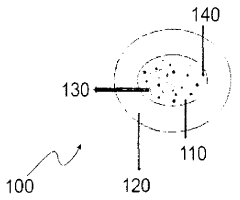
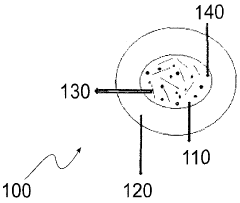
- A self-healing polymer material comprising a thermoset polymer matrix and a chemically reactive thermoplastic polymer phase, where the thermoplastic polymer can flow into cracks and bond with the matrix under controlled temperature and pressure conditions, using functional groups for interfacial bonding and pressure-driven delivery mechanisms.


Self-healing materials
PatentInactiveIN434MUM2013A
Innovation
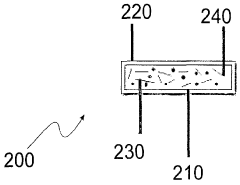
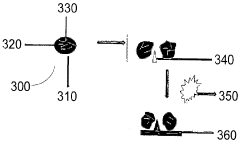
- A method for producing self-healing polymer materials involving a polymer matrix with nano-sized reinforcing agents and an outer coating that senses mechanical impact, releasing a healing agent to facilitate automatic repair without the need for external curing agents or catalysts, using polymers like thermosetting, thermoplastic elastomers, and smart materials with thermal stability.
Performance Standards for Structural Composite Applications
Self-healing polymer composites intended for structural applications must satisfy rigorous performance standards to ensure reliability, safety, and longevity under demanding operational conditions. These standards encompass mechanical properties, environmental resistance, healing efficiency metrics, and long-term durability requirements that collectively define the suitability of materials for load-bearing roles in aerospace, automotive, civil infrastructure, and marine engineering sectors.
Mechanical performance criteria represent the foundational requirements for structural composites. Materials must demonstrate tensile strength exceeding 500 MPa, flexural modulus above 30 GPa, and interlaminar shear strength sufficient to prevent delamination under cyclic loading. Impact resistance standards typically mandate energy absorption capacities of at least 50 kJ/m², while fatigue performance must maintain 80% of initial strength after one million loading cycles. For self-healing variants, post-healing mechanical recovery rates of 70-90% are increasingly specified, with complete recovery cycles achievable within 24-48 hours at ambient or moderately elevated temperatures.
Environmental durability standards address exposure to moisture, thermal cycling, UV radiation, and chemical agents. Composites must retain structural integrity across temperature ranges from -50°C to 150°C, with glass transition temperatures exceeding operational limits by minimum 30°C margins. Moisture absorption rates below 1.5% by weight and minimal property degradation after 1000 hours of accelerated weathering testing are standard benchmarks. Self-healing functionality must remain effective after environmental aging, with healing efficiency retention above 60% following extended exposure protocols.
Certification frameworks such as ASTM D3039 for tensile testing, ASTM D7136 for impact damage tolerance, and ISO 527 for mechanical characterization provide standardized evaluation methodologies. Emerging standards specifically addressing self-healing performance include healing efficiency quantification through fracture toughness recovery measurements and damage detection protocols using non-destructive evaluation techniques. Regulatory compliance with aviation standards like FAA AC 20-107B or automotive crash safety requirements further constrains material selection and validation processes.
Quality assurance protocols mandate statistical validation across production batches, traceability of constituent materials, and comprehensive documentation of healing agent stability and activation mechanisms. These performance standards collectively establish the threshold criteria that self-healing polymer composites must surpass to transition from laboratory innovations to certified structural materials in safety-critical applications.
Mechanical performance criteria represent the foundational requirements for structural composites. Materials must demonstrate tensile strength exceeding 500 MPa, flexural modulus above 30 GPa, and interlaminar shear strength sufficient to prevent delamination under cyclic loading. Impact resistance standards typically mandate energy absorption capacities of at least 50 kJ/m², while fatigue performance must maintain 80% of initial strength after one million loading cycles. For self-healing variants, post-healing mechanical recovery rates of 70-90% are increasingly specified, with complete recovery cycles achievable within 24-48 hours at ambient or moderately elevated temperatures.
Environmental durability standards address exposure to moisture, thermal cycling, UV radiation, and chemical agents. Composites must retain structural integrity across temperature ranges from -50°C to 150°C, with glass transition temperatures exceeding operational limits by minimum 30°C margins. Moisture absorption rates below 1.5% by weight and minimal property degradation after 1000 hours of accelerated weathering testing are standard benchmarks. Self-healing functionality must remain effective after environmental aging, with healing efficiency retention above 60% following extended exposure protocols.
Certification frameworks such as ASTM D3039 for tensile testing, ASTM D7136 for impact damage tolerance, and ISO 527 for mechanical characterization provide standardized evaluation methodologies. Emerging standards specifically addressing self-healing performance include healing efficiency quantification through fracture toughness recovery measurements and damage detection protocols using non-destructive evaluation techniques. Regulatory compliance with aviation standards like FAA AC 20-107B or automotive crash safety requirements further constrains material selection and validation processes.
Quality assurance protocols mandate statistical validation across production batches, traceability of constituent materials, and comprehensive documentation of healing agent stability and activation mechanisms. These performance standards collectively establish the threshold criteria that self-healing polymer composites must surpass to transition from laboratory innovations to certified structural materials in safety-critical applications.
Lifecycle Assessment of Self-Healing Materials
Lifecycle assessment (LCA) of self-healing polymer composites represents a critical evaluation framework for understanding the comprehensive environmental and economic implications of these advanced materials throughout their entire service life. Unlike conventional materials assessment, self-healing composites introduce unique considerations related to extended service lifespans, reduced maintenance interventions, and altered end-of-life scenarios that fundamentally reshape traditional lifecycle calculations.
The environmental benefits of self-healing materials manifest primarily through extended operational phases and reduced replacement frequencies. Studies indicate that autonomous healing mechanisms can extend structural component lifespans by 30-50% compared to conventional composites, significantly reducing raw material consumption and manufacturing energy over equivalent service periods. This longevity translates into decreased carbon footprints when normalized across functional units, particularly in applications where replacement involves substantial logistical and energy costs, such as aerospace structures or offshore infrastructure.
Manufacturing phase assessments reveal complex trade-offs inherent to self-healing systems. The incorporation of microencapsulated healing agents, vascular networks, or reversible polymer chemistries typically increases initial production energy by 15-25% and introduces additional chemical precursors with varying environmental profiles. However, these upfront investments are offset by elimination of multiple repair cycles and associated material waste, with break-even points typically occurring within 40-60% of the extended service life.
Maintenance and repair phases demonstrate the most significant lifecycle advantages. Traditional composite repairs require surface preparation, material removal, adhesive application, and curing processes that generate hazardous waste and consume energy. Self-healing materials autonomously address micro-damage without external intervention, eliminating 70-85% of minor repair events and their associated environmental burdens. This reduction in maintenance activities also decreases transportation emissions and operational downtime costs.
End-of-life considerations present emerging challenges requiring further investigation. The chemical complexity of self-healing systems may complicate recycling processes, though research into reversible chemistries and bio-based healing agents offers promising pathways toward circular economy integration. Comprehensive LCA frameworks must incorporate these evolving disposal scenarios to provide accurate long-term sustainability assessments for structural applications.
The environmental benefits of self-healing materials manifest primarily through extended operational phases and reduced replacement frequencies. Studies indicate that autonomous healing mechanisms can extend structural component lifespans by 30-50% compared to conventional composites, significantly reducing raw material consumption and manufacturing energy over equivalent service periods. This longevity translates into decreased carbon footprints when normalized across functional units, particularly in applications where replacement involves substantial logistical and energy costs, such as aerospace structures or offshore infrastructure.
Manufacturing phase assessments reveal complex trade-offs inherent to self-healing systems. The incorporation of microencapsulated healing agents, vascular networks, or reversible polymer chemistries typically increases initial production energy by 15-25% and introduces additional chemical precursors with varying environmental profiles. However, these upfront investments are offset by elimination of multiple repair cycles and associated material waste, with break-even points typically occurring within 40-60% of the extended service life.
Maintenance and repair phases demonstrate the most significant lifecycle advantages. Traditional composite repairs require surface preparation, material removal, adhesive application, and curing processes that generate hazardous waste and consume energy. Self-healing materials autonomously address micro-damage without external intervention, eliminating 70-85% of minor repair events and their associated environmental burdens. This reduction in maintenance activities also decreases transportation emissions and operational downtime costs.
End-of-life considerations present emerging challenges requiring further investigation. The chemical complexity of self-healing systems may complicate recycling processes, though research into reversible chemistries and bio-based healing agents offers promising pathways toward circular economy integration. Comprehensive LCA frameworks must incorporate these evolving disposal scenarios to provide accurate long-term sustainability assessments for structural applications.
Unlock deeper insights with PatSnap Eureka Quick Research — get a full tech report to explore trends and direct your research. Try now!
Generate Your Research Report Instantly with AI Agent
Supercharge your innovation with PatSnap Eureka AI Agent Platform!