

Semipermeable Membranes Vs Electrodialysis Technology: Application Guide
JUN 8, 20269 MIN READ
Generate Your Research Report Instantly with AI Agent
PatSnap Eureka helps you evaluate technical feasibility & market potential.
Membrane Separation Technology Background and Objectives
Membrane separation technology has emerged as a cornerstone of modern industrial processes, fundamentally transforming how industries approach separation, purification, and concentration challenges. This technology leverages selective permeability principles to separate components based on molecular size, charge, or chemical affinity, offering energy-efficient alternatives to traditional separation methods such as distillation, crystallization, and extraction.
The historical development of membrane technology traces back to the 1950s when reverse osmosis membranes were first developed for desalination applications. Since then, the field has expanded exponentially, encompassing diverse membrane types including microfiltration, ultrafiltration, nanofiltration, reverse osmosis, and electrodialysis systems. Each technology variant addresses specific separation requirements across molecular weight ranges from simple ions to complex macromolecules.
Semipermeable membranes operate through size exclusion and solution-diffusion mechanisms, where selective transport occurs based on molecular dimensions and solubility characteristics. These membranes have revolutionized water treatment, pharmaceutical manufacturing, food processing, and biotechnology applications. The technology's evolution has been driven by advances in polymer science, surface chemistry, and manufacturing processes, resulting in membranes with enhanced selectivity, permeability, and durability.
Electrodialysis technology represents a specialized branch of membrane separation that utilizes ion-exchange membranes combined with electrical driving forces. This electrochemical process enables selective ion transport through alternating cation and anion exchange membranes, making it particularly effective for desalination, concentration of ionic solutions, and recovery of valuable electrolytes from industrial streams.
The primary objectives driving membrane separation technology development include achieving higher separation efficiency, reducing energy consumption, minimizing environmental impact, and expanding application versatility. Current research focuses on developing next-generation membranes with improved fouling resistance, enhanced chemical stability, and tailored selectivity for emerging applications in carbon capture, lithium extraction, and pharmaceutical purification.
The convergence of nanotechnology, materials science, and process engineering continues to push the boundaries of membrane performance, positioning these technologies as critical enablers for sustainable industrial processes and environmental remediation solutions.
The historical development of membrane technology traces back to the 1950s when reverse osmosis membranes were first developed for desalination applications. Since then, the field has expanded exponentially, encompassing diverse membrane types including microfiltration, ultrafiltration, nanofiltration, reverse osmosis, and electrodialysis systems. Each technology variant addresses specific separation requirements across molecular weight ranges from simple ions to complex macromolecules.
Semipermeable membranes operate through size exclusion and solution-diffusion mechanisms, where selective transport occurs based on molecular dimensions and solubility characteristics. These membranes have revolutionized water treatment, pharmaceutical manufacturing, food processing, and biotechnology applications. The technology's evolution has been driven by advances in polymer science, surface chemistry, and manufacturing processes, resulting in membranes with enhanced selectivity, permeability, and durability.
Electrodialysis technology represents a specialized branch of membrane separation that utilizes ion-exchange membranes combined with electrical driving forces. This electrochemical process enables selective ion transport through alternating cation and anion exchange membranes, making it particularly effective for desalination, concentration of ionic solutions, and recovery of valuable electrolytes from industrial streams.
The primary objectives driving membrane separation technology development include achieving higher separation efficiency, reducing energy consumption, minimizing environmental impact, and expanding application versatility. Current research focuses on developing next-generation membranes with improved fouling resistance, enhanced chemical stability, and tailored selectivity for emerging applications in carbon capture, lithium extraction, and pharmaceutical purification.
The convergence of nanotechnology, materials science, and process engineering continues to push the boundaries of membrane performance, positioning these technologies as critical enablers for sustainable industrial processes and environmental remediation solutions.
Market Demand for Advanced Membrane Separation Solutions
The global membrane separation market is experiencing unprecedented growth driven by increasing environmental regulations and the urgent need for sustainable water treatment solutions. Industries worldwide are facing mounting pressure to reduce water consumption, minimize waste discharge, and implement circular economy principles, creating substantial demand for advanced separation technologies including semipermeable membranes and electrodialysis systems.
Water scarcity affects billions of people globally, intensifying the demand for efficient desalination and water purification technologies. Municipal water treatment facilities are increasingly adopting membrane-based solutions to meet stringent water quality standards while managing growing urban populations. The industrial sector, particularly chemical processing, pharmaceuticals, and food production, requires precise separation capabilities that advanced membrane technologies can provide.
The energy sector presents significant opportunities for membrane separation applications, especially in produced water treatment from oil and gas operations. Environmental compliance requirements are driving adoption of electrodialysis systems for selective ion removal and resource recovery. Mining operations increasingly utilize membrane technologies for metal recovery and tailings management, creating new market segments for specialized separation solutions.
Emerging applications in biotechnology and pharmaceutical manufacturing are expanding market boundaries. Protein purification, cell harvesting, and sterile filtration processes require sophisticated membrane systems with precise molecular weight cutoffs and high selectivity. The growing biopharmaceutical industry particularly values membrane technologies that can maintain product integrity while achieving required purity levels.
Regional market dynamics vary significantly, with developed economies focusing on infrastructure upgrades and emerging markets prioritizing basic water access. Asia-Pacific regions show particularly strong growth in industrial applications, while North American and European markets emphasize advanced treatment capabilities and regulatory compliance.
The shift toward decentralized treatment systems is creating demand for modular, scalable membrane solutions. Remote communities and industrial facilities increasingly prefer on-site treatment capabilities rather than centralized infrastructure. This trend favors flexible membrane technologies that can be customized for specific applications and scaled according to capacity requirements.
Cost considerations remain critical market drivers, with end-users seeking solutions that balance capital investment with operational efficiency. Energy consumption, membrane replacement costs, and maintenance requirements significantly influence technology selection decisions across all market segments.
Water scarcity affects billions of people globally, intensifying the demand for efficient desalination and water purification technologies. Municipal water treatment facilities are increasingly adopting membrane-based solutions to meet stringent water quality standards while managing growing urban populations. The industrial sector, particularly chemical processing, pharmaceuticals, and food production, requires precise separation capabilities that advanced membrane technologies can provide.
The energy sector presents significant opportunities for membrane separation applications, especially in produced water treatment from oil and gas operations. Environmental compliance requirements are driving adoption of electrodialysis systems for selective ion removal and resource recovery. Mining operations increasingly utilize membrane technologies for metal recovery and tailings management, creating new market segments for specialized separation solutions.
Emerging applications in biotechnology and pharmaceutical manufacturing are expanding market boundaries. Protein purification, cell harvesting, and sterile filtration processes require sophisticated membrane systems with precise molecular weight cutoffs and high selectivity. The growing biopharmaceutical industry particularly values membrane technologies that can maintain product integrity while achieving required purity levels.
Regional market dynamics vary significantly, with developed economies focusing on infrastructure upgrades and emerging markets prioritizing basic water access. Asia-Pacific regions show particularly strong growth in industrial applications, while North American and European markets emphasize advanced treatment capabilities and regulatory compliance.
The shift toward decentralized treatment systems is creating demand for modular, scalable membrane solutions. Remote communities and industrial facilities increasingly prefer on-site treatment capabilities rather than centralized infrastructure. This trend favors flexible membrane technologies that can be customized for specific applications and scaled according to capacity requirements.
Cost considerations remain critical market drivers, with end-users seeking solutions that balance capital investment with operational efficiency. Energy consumption, membrane replacement costs, and maintenance requirements significantly influence technology selection decisions across all market segments.
Current State and Challenges of Membrane Technologies
Membrane technologies have reached significant maturity in various industrial applications, with semipermeable membranes and electrodialysis representing two distinct yet complementary approaches to separation processes. Semipermeable membranes, including reverse osmosis, nanofiltration, and ultrafiltration systems, have achieved widespread commercial deployment across water treatment, food processing, and pharmaceutical industries. These technologies demonstrate excellent performance in removing contaminants, concentrating solutions, and purifying products with energy efficiency improvements of 30-50% compared to traditional thermal separation methods.
Electrodialysis technology has established itself as a robust solution for ionic separation applications, particularly in desalination, food processing, and chemical recovery operations. Current electrodialysis systems achieve salt removal efficiencies exceeding 95% while maintaining relatively low energy consumption for brackish water treatment. The technology has evolved to include bipolar membrane electrodialysis, enabling acid and base production from salt solutions, expanding its industrial utility significantly.
Despite technological advances, both membrane categories face substantial challenges that limit broader adoption and optimal performance. Membrane fouling remains the most critical operational challenge, reducing system efficiency by 20-40% and necessitating frequent cleaning cycles or membrane replacement. Biofouling, scaling, and organic fouling create complex maintenance requirements that increase operational costs and system downtime across all membrane applications.
Selectivity limitations present another significant challenge, particularly for semipermeable membranes handling complex feed streams containing multiple contaminants of varying molecular sizes. Current membrane materials struggle to achieve precise molecular weight cutoffs while maintaining high permeability, forcing operators to compromise between separation efficiency and throughput capacity.
Energy consumption optimization continues to challenge electrodialysis systems, especially when treating high-salinity feeds or achieving ultra-low conductivity targets. Stack resistance increases and current efficiency decreases create operational limitations that restrict economic viability in certain applications. Additionally, membrane stack design complexity and the need for specialized ion-exchange membranes increase capital costs significantly.
Manufacturing scalability and cost reduction represent ongoing challenges for both technologies. Advanced membrane materials, including graphene-based and biomimetic membranes, remain expensive to produce at commercial scales. Quality control consistency across large membrane areas and long-term stability under varying operational conditions continue to pose manufacturing challenges that affect widespread technology deployment and reliability in industrial applications.
Electrodialysis technology has established itself as a robust solution for ionic separation applications, particularly in desalination, food processing, and chemical recovery operations. Current electrodialysis systems achieve salt removal efficiencies exceeding 95% while maintaining relatively low energy consumption for brackish water treatment. The technology has evolved to include bipolar membrane electrodialysis, enabling acid and base production from salt solutions, expanding its industrial utility significantly.
Despite technological advances, both membrane categories face substantial challenges that limit broader adoption and optimal performance. Membrane fouling remains the most critical operational challenge, reducing system efficiency by 20-40% and necessitating frequent cleaning cycles or membrane replacement. Biofouling, scaling, and organic fouling create complex maintenance requirements that increase operational costs and system downtime across all membrane applications.
Selectivity limitations present another significant challenge, particularly for semipermeable membranes handling complex feed streams containing multiple contaminants of varying molecular sizes. Current membrane materials struggle to achieve precise molecular weight cutoffs while maintaining high permeability, forcing operators to compromise between separation efficiency and throughput capacity.
Energy consumption optimization continues to challenge electrodialysis systems, especially when treating high-salinity feeds or achieving ultra-low conductivity targets. Stack resistance increases and current efficiency decreases create operational limitations that restrict economic viability in certain applications. Additionally, membrane stack design complexity and the need for specialized ion-exchange membranes increase capital costs significantly.
Manufacturing scalability and cost reduction represent ongoing challenges for both technologies. Advanced membrane materials, including graphene-based and biomimetic membranes, remain expensive to produce at commercial scales. Quality control consistency across large membrane areas and long-term stability under varying operational conditions continue to pose manufacturing challenges that affect widespread technology deployment and reliability in industrial applications.
Current Membrane Separation Technology Solutions
01 Ion-selective membrane materials and compositions
Development of specialized membrane materials with enhanced ion selectivity properties for electrodialysis applications. These materials are designed to allow selective passage of specific ions while blocking others, improving separation efficiency and process performance. The membranes typically incorporate specific polymeric structures and functional groups to achieve desired selectivity characteristics.- Membrane composition and structure for electrodialysis: Development of specialized membrane materials with specific ionic selectivity and permeability characteristics for electrodialysis applications. These membranes are designed with particular polymer compositions, cross-linking structures, and functional groups to optimize ion transport while maintaining mechanical stability and chemical resistance in electrodialysis processes.
- Electrodialysis apparatus and system design: Configuration and arrangement of electrodialysis equipment including electrode assemblies, membrane stacks, and flow distribution systems. These designs focus on optimizing current efficiency, minimizing energy consumption, and ensuring uniform flow distribution across membrane surfaces for enhanced separation performance.
- Ion-selective membrane manufacturing processes: Methods for producing semipermeable membranes with controlled porosity, thickness, and surface properties specifically for electrodialysis applications. These manufacturing techniques involve polymer processing, surface modification, and quality control measures to ensure consistent membrane performance and durability.
- Electrodialysis process optimization and control: Techniques for monitoring and controlling electrodialysis operations including current density management, pH control, temperature regulation, and flow rate optimization. These methods aim to maximize separation efficiency while preventing membrane fouling and extending operational lifetime of the electrodialysis system.
- Applications in water treatment and desalination: Utilization of semipermeable membranes and electrodialysis technology for various water treatment applications including brackish water desalination, industrial wastewater treatment, and selective ion removal. These applications demonstrate the practical implementation of electrodialysis systems for environmental and industrial purposes.
02 Electrodialysis stack design and configuration
Innovations in the structural design and arrangement of electrodialysis stacks to optimize ion transport and separation processes. This includes improvements in electrode placement, membrane spacing, flow channel design, and overall stack architecture to enhance mass transfer efficiency and reduce energy consumption during operation.Expand Specific Solutions03 Process optimization and operational parameters
Methods for controlling and optimizing various operational parameters in electrodialysis systems including voltage application, flow rates, temperature control, and concentration management. These approaches focus on maximizing separation efficiency while minimizing energy consumption and operational costs through systematic process control strategies.Expand Specific Solutions04 Membrane surface modification and treatment
Techniques for modifying membrane surfaces to improve their performance characteristics including enhanced permeability, reduced fouling, and increased durability. These modifications involve chemical treatments, coating applications, or structural alterations to optimize membrane functionality for specific electrodialysis applications.Expand Specific Solutions05 Industrial applications and system integration
Implementation of electrodialysis technology in various industrial processes including water treatment, chemical separation, and purification applications. This encompasses system integration approaches, scaling considerations, and adaptation of the technology for specific industrial requirements and processing conditions.Expand Specific Solutions
Key Players in Membrane Technology Industry
The semipermeable membranes versus electrodialysis technology landscape represents a mature yet evolving market segment within water treatment and separation technologies. The industry has reached commercial maturity with established applications across desalination, wastewater treatment, and industrial processing, supported by a global market valued in billions annually. Technology maturity varies significantly among key players, with established manufacturers like Toray Industries and Industrie De Nora demonstrating advanced commercial-scale capabilities, while research institutions including MIT and Caltech drive fundamental innovations. Asian companies such as Hangzhou Lanran Technology and Huazhi New Materials are emerging as competitive forces, particularly in electrodialysis applications. European entities like Fraunhofer-Gesellschaft and CEA contribute advanced R&D capabilities, while specialized firms including Asahi Kasei Medical focus on niche medical applications. The competitive landscape shows consolidation around proven technologies while innovation continues in membrane materials and system integration.
Toray Industries, Inc.
Technical Solution: Toray Industries develops advanced semipermeable membrane technologies including reverse osmosis (RO) and nanofiltration membranes for water treatment applications. Their membrane solutions feature high salt rejection rates exceeding 99.5% and superior permeability performance. The company's proprietary polyamide thin-film composite membranes are designed for seawater desalination, brackish water treatment, and industrial water purification. Toray's membranes incorporate advanced surface modification techniques to enhance fouling resistance and extend operational lifespan, making them suitable for large-scale municipal and industrial water treatment facilities.
Strengths: Market-leading membrane performance with high salt rejection and flux rates, extensive manufacturing capabilities. Weaknesses: Higher capital costs compared to electrodialysis for specific brackish water applications.
Ide Water Technologies Ltd
Technical Solution: IDE Water Technologies specializes in both membrane-based desalination and electrodialysis systems for water treatment applications. Their electrodialysis technology utilizes selective ion-exchange membranes to remove dissolved salts from brackish water with energy consumption as low as 1.5-3 kWh/m³. The company's integrated approach combines electrodialysis reversal (EDR) systems with advanced membrane pretreatment for optimal performance. IDE's solutions are particularly effective for treating water with total dissolved solids (TDS) levels between 500-5000 ppm, offering competitive operational costs compared to reverse osmosis in this range.
Strengths: Proven expertise in both technologies, energy-efficient EDR systems for brackish water treatment. Weaknesses: Limited effectiveness for high-salinity applications compared to RO membranes.
Core Innovations in Membrane Design and Materials
Semipermeable membrane system for magnetic particle fractions
PatentInactiveUS20080035541A1
Innovation
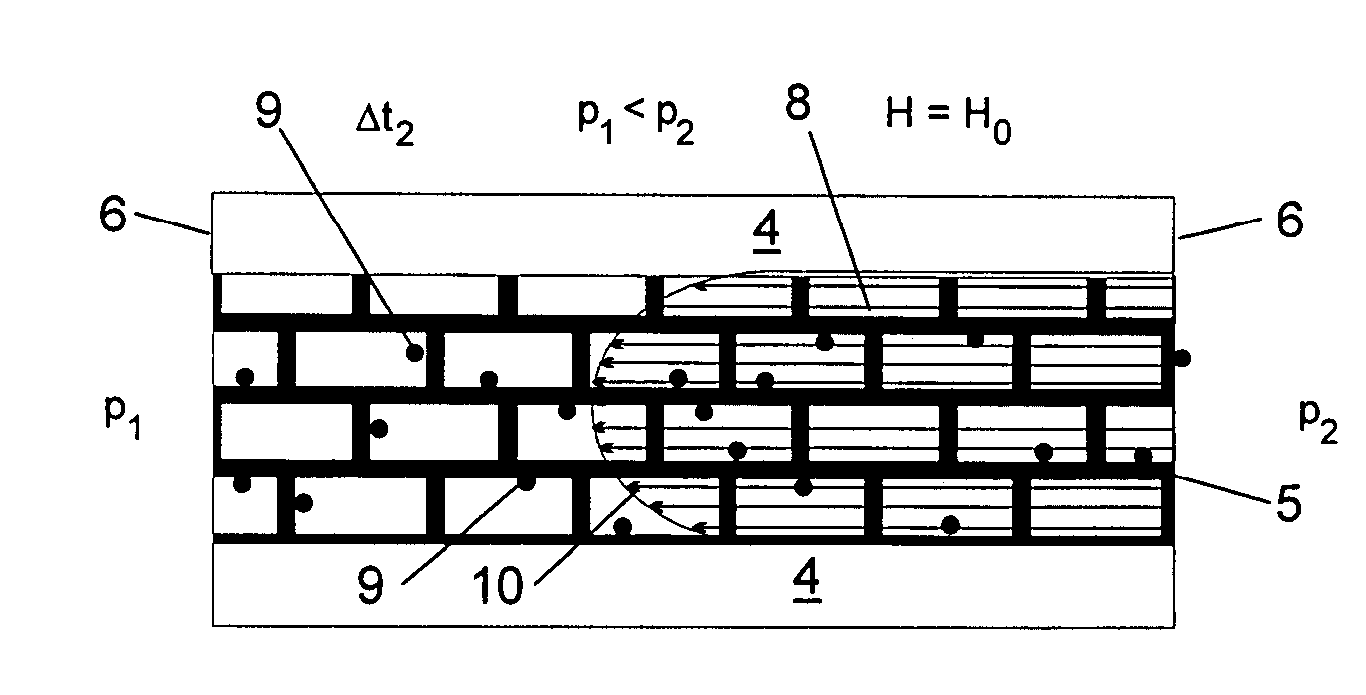
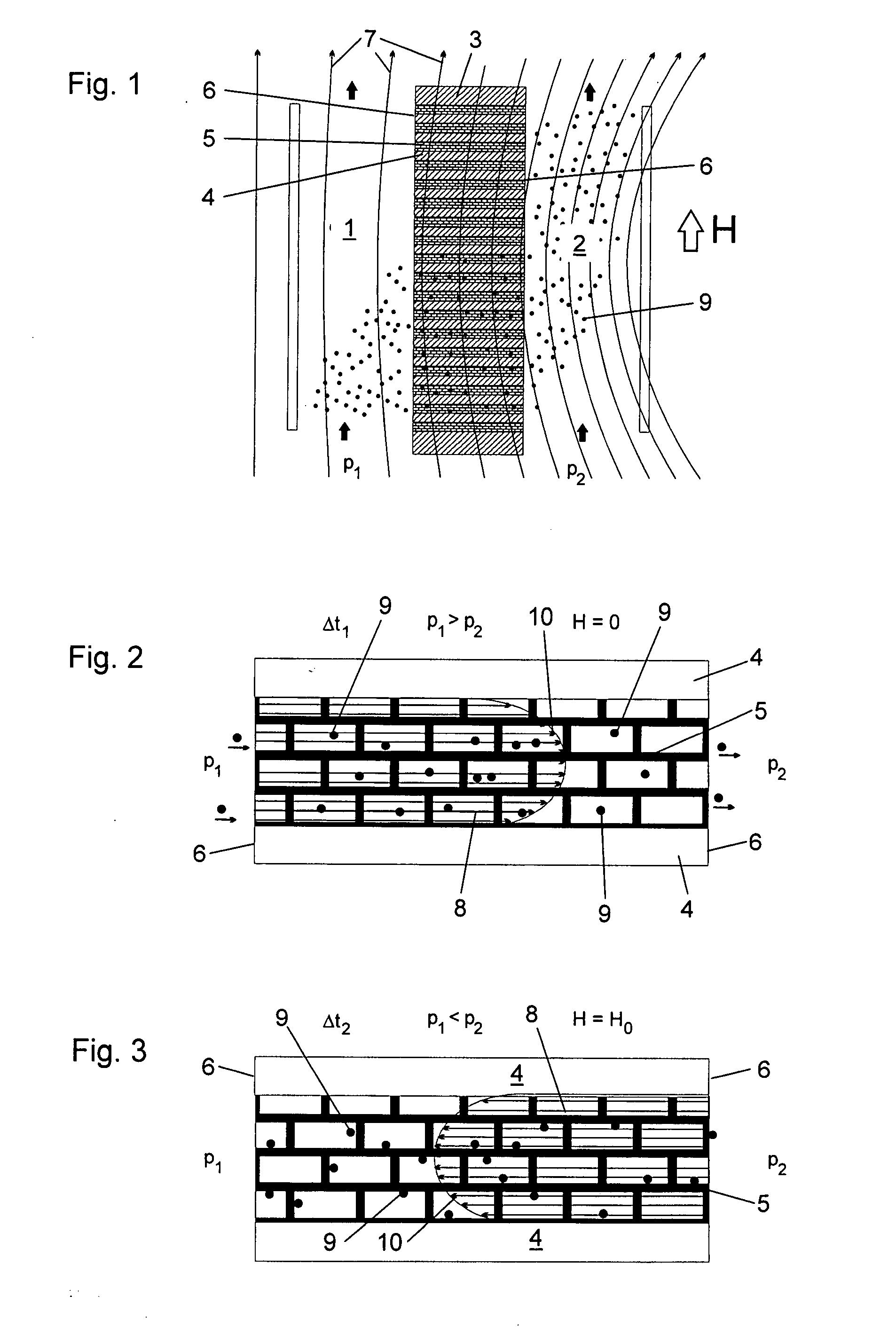
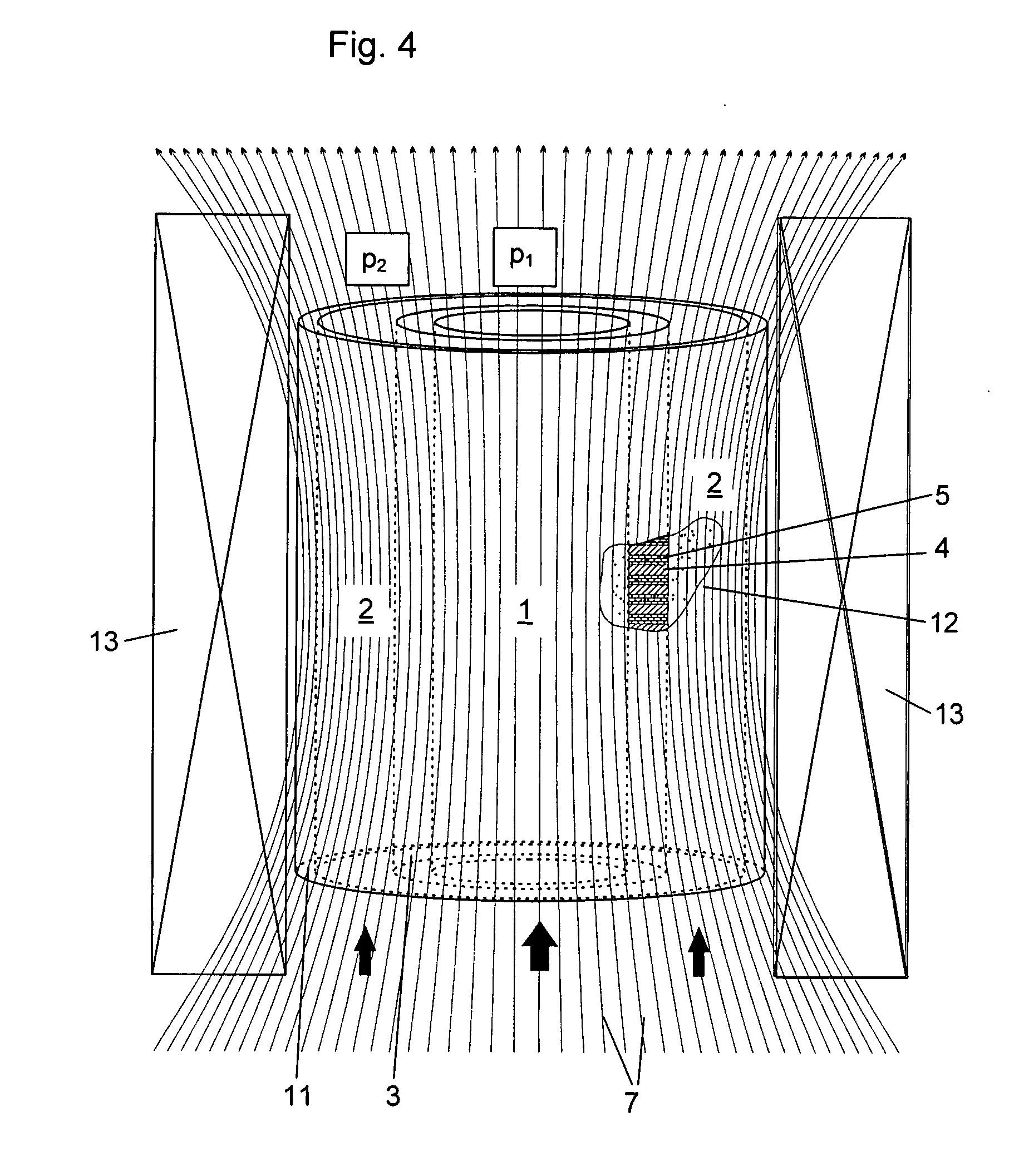
- A semi-permeable membrane system that generates a reversible pressure differential and alternates a magnetic field to control the flow of magnetic particles, allowing continuous passage of magnetic particles from one fluid to another while preventing non-magnetic components from crossing, using a membrane with magnetic materials and channels that attract magnetic particles when the field is active.

Process and device for desalinating water
PatentWO2014121316A1
Innovation
- The use of electrically conductive, non-ion-selective membranes connected in pairs to create a potential-free space between them, with a voltage applied below electrolysis levels to prevent gas formation, allowing salt enrichment between membranes and depletion outside, reducing membrane contamination and increasing efficiency.


Environmental Impact Assessment of Membrane Technologies
The environmental implications of membrane technologies, particularly semipermeable membranes and electrodialysis systems, present a complex landscape of benefits and challenges that require comprehensive assessment. Both technologies demonstrate significant potential for reducing industrial environmental footprints while introducing distinct operational considerations that influence their overall sustainability profiles.
Semipermeable membrane systems exhibit favorable environmental characteristics through their passive separation mechanisms, which typically require minimal chemical additives and generate relatively low volumes of concentrated waste streams. The primary environmental advantage lies in their energy efficiency, as these systems rely predominantly on pressure differentials rather than thermal or electrical energy inputs. However, membrane fouling and the subsequent need for chemical cleaning agents introduce potential environmental concerns, particularly regarding the disposal of cleaning solutions and replaced membrane materials.
Electrodialysis technology presents a different environmental profile, characterized by higher energy consumption due to electrical requirements for ion migration across selective membranes. The technology's environmental impact is closely tied to the source of electrical power, with renewable energy integration significantly improving its sustainability credentials. The absence of chemical regeneration requirements represents a notable environmental advantage, as electrodialysis systems can operate continuously without introducing additional chemical waste streams.
Water consumption patterns differ substantially between these technologies, with semipermeable membranes typically requiring higher water volumes for backwashing and cleaning procedures. Electrodialysis systems demonstrate more efficient water utilization, though their electrical energy demands may result in higher indirect water consumption through power generation processes.
Waste generation characteristics vary significantly across applications. Semipermeable membrane systems produce concentrated reject streams that require careful management, particularly in industrial applications involving hazardous substances. Electrodialysis generates more predictable waste streams with higher concentration factors, potentially reducing overall waste volumes while requiring specialized handling protocols.
The lifecycle environmental impact assessment reveals that membrane manufacturing processes contribute substantially to the overall environmental footprint of both technologies. Material selection, production energy requirements, and end-of-life disposal considerations significantly influence long-term sustainability outcomes, with emerging biodegradable membrane materials showing promise for reducing these impacts.
Semipermeable membrane systems exhibit favorable environmental characteristics through their passive separation mechanisms, which typically require minimal chemical additives and generate relatively low volumes of concentrated waste streams. The primary environmental advantage lies in their energy efficiency, as these systems rely predominantly on pressure differentials rather than thermal or electrical energy inputs. However, membrane fouling and the subsequent need for chemical cleaning agents introduce potential environmental concerns, particularly regarding the disposal of cleaning solutions and replaced membrane materials.
Electrodialysis technology presents a different environmental profile, characterized by higher energy consumption due to electrical requirements for ion migration across selective membranes. The technology's environmental impact is closely tied to the source of electrical power, with renewable energy integration significantly improving its sustainability credentials. The absence of chemical regeneration requirements represents a notable environmental advantage, as electrodialysis systems can operate continuously without introducing additional chemical waste streams.
Water consumption patterns differ substantially between these technologies, with semipermeable membranes typically requiring higher water volumes for backwashing and cleaning procedures. Electrodialysis systems demonstrate more efficient water utilization, though their electrical energy demands may result in higher indirect water consumption through power generation processes.
Waste generation characteristics vary significantly across applications. Semipermeable membrane systems produce concentrated reject streams that require careful management, particularly in industrial applications involving hazardous substances. Electrodialysis generates more predictable waste streams with higher concentration factors, potentially reducing overall waste volumes while requiring specialized handling protocols.
The lifecycle environmental impact assessment reveals that membrane manufacturing processes contribute substantially to the overall environmental footprint of both technologies. Material selection, production energy requirements, and end-of-life disposal considerations significantly influence long-term sustainability outcomes, with emerging biodegradable membrane materials showing promise for reducing these impacts.
Cost-Benefit Analysis for Membrane Technology Selection
The economic evaluation of semipermeable membranes versus electrodialysis technology requires comprehensive analysis of both capital expenditure and operational costs throughout the system lifecycle. Initial capital investments for semipermeable membrane systems typically range from $800 to $1,500 per cubic meter of daily capacity, while electrodialysis installations generally require $1,200 to $2,200 per cubic meter, reflecting the higher complexity of electrical infrastructure and specialized electrode materials.
Operational expenditures present contrasting profiles between these technologies. Semipermeable membrane systems demonstrate lower energy consumption at 2-4 kWh per cubic meter of treated water, primarily driven by hydraulic pressure requirements. Conversely, electrodialysis systems consume 3-6 kWh per cubic meter due to electrical current demands for ion migration, though this energy requirement scales more favorably with higher salinity feedwater concentrations.
Membrane replacement costs constitute a significant operational factor, with semipermeable membranes requiring replacement every 3-5 years at approximately $150-300 per square meter. Electrodialysis membranes typically last 5-8 years but cost $200-400 per square meter for replacement. However, electrodialysis systems require additional electrode maintenance and periodic acid cleaning, adding $0.15-0.25 per cubic meter to operational costs.
The economic advantage shifts based on application parameters. For brackish water desalination with total dissolved solids below 3,000 mg/L, semipermeable membranes demonstrate superior cost-effectiveness with total cost of ownership 15-25% lower than electrodialysis. However, for selective ion removal applications or feedwater with TDS exceeding 5,000 mg/L, electrodialysis systems achieve better economic performance due to their concentration-independent energy consumption characteristics.
Return on investment calculations favor semipermeable membranes for continuous operation scenarios, typically achieving payback periods of 3-4 years compared to 4-6 years for electrodialysis systems. However, electrodialysis technology offers superior economic resilience in variable demand applications due to its ability to operate efficiently at partial loads without significant performance degradation.
Operational expenditures present contrasting profiles between these technologies. Semipermeable membrane systems demonstrate lower energy consumption at 2-4 kWh per cubic meter of treated water, primarily driven by hydraulic pressure requirements. Conversely, electrodialysis systems consume 3-6 kWh per cubic meter due to electrical current demands for ion migration, though this energy requirement scales more favorably with higher salinity feedwater concentrations.
Membrane replacement costs constitute a significant operational factor, with semipermeable membranes requiring replacement every 3-5 years at approximately $150-300 per square meter. Electrodialysis membranes typically last 5-8 years but cost $200-400 per square meter for replacement. However, electrodialysis systems require additional electrode maintenance and periodic acid cleaning, adding $0.15-0.25 per cubic meter to operational costs.
The economic advantage shifts based on application parameters. For brackish water desalination with total dissolved solids below 3,000 mg/L, semipermeable membranes demonstrate superior cost-effectiveness with total cost of ownership 15-25% lower than electrodialysis. However, for selective ion removal applications or feedwater with TDS exceeding 5,000 mg/L, electrodialysis systems achieve better economic performance due to their concentration-independent energy consumption characteristics.
Return on investment calculations favor semipermeable membranes for continuous operation scenarios, typically achieving payback periods of 3-4 years compared to 4-6 years for electrodialysis systems. However, electrodialysis technology offers superior economic resilience in variable demand applications due to its ability to operate efficiently at partial loads without significant performance degradation.
Unlock deeper insights with PatSnap Eureka Quick Research — get a full tech report to explore trends and direct your research. Try now!
Generate Your Research Report Instantly with AI Agent
Supercharge your innovation with PatSnap Eureka AI Agent Platform!