

Silicon-Carbon Anodes Vs Cobalt-Based Designs: Longevity Testing
MAY 19, 20269 MIN READ
Generate Your Research Report Instantly with AI Agent
PatSnap Eureka helps you evaluate technical feasibility & market potential.
Silicon-Carbon Anode Technology Background and Objectives
Silicon-carbon anode technology represents a pivotal advancement in lithium-ion battery development, emerging from the fundamental limitations of traditional graphite anodes. The evolution of this technology stems from the urgent need to enhance energy density while maintaining structural integrity during charge-discharge cycles. Silicon's theoretical specific capacity of 4,200 mAh/g significantly exceeds graphite's 372 mAh/g, making it an attractive candidate for next-generation battery applications.
The development trajectory of silicon-carbon anodes has been driven by the semiconductor industry's deep understanding of silicon materials and the growing demand for high-performance energy storage solutions. Early research in the 1970s identified silicon's potential, but practical implementation was hindered by severe volume expansion issues during lithiation processes. The integration of carbon materials emerged as a strategic solution to mitigate these challenges while preserving silicon's high capacity advantages.
Contemporary silicon-carbon anode development focuses on addressing the fundamental trade-off between energy density enhancement and cycle life stability. The technology aims to overcome the 300-400% volume expansion that occurs when silicon absorbs lithium ions, which traditionally leads to particle pulverization, solid electrolyte interphase instability, and rapid capacity degradation. Carbon incorporation serves multiple functions including providing structural support, enhancing electrical conductivity, and creating buffer zones for volume changes.
The primary technical objectives center on achieving sustainable capacity retention above 80% after 1,000 cycles while maintaining energy densities exceeding 350 Wh/kg at the cell level. This performance target directly challenges cobalt-based cathode designs, which face supply chain constraints and cost volatility. Silicon-carbon anodes offer a pathway to reduce reliance on cobalt while potentially achieving superior longevity metrics through advanced material engineering approaches.
Current research priorities include optimizing silicon particle size distribution, developing novel carbon matrix architectures, and implementing advanced binder systems that accommodate mechanical stress. The technology roadmap emphasizes scalable manufacturing processes that can transition from laboratory-scale synthesis to industrial production while maintaining performance consistency and cost competitiveness in commercial battery applications.
The development trajectory of silicon-carbon anodes has been driven by the semiconductor industry's deep understanding of silicon materials and the growing demand for high-performance energy storage solutions. Early research in the 1970s identified silicon's potential, but practical implementation was hindered by severe volume expansion issues during lithiation processes. The integration of carbon materials emerged as a strategic solution to mitigate these challenges while preserving silicon's high capacity advantages.
Contemporary silicon-carbon anode development focuses on addressing the fundamental trade-off between energy density enhancement and cycle life stability. The technology aims to overcome the 300-400% volume expansion that occurs when silicon absorbs lithium ions, which traditionally leads to particle pulverization, solid electrolyte interphase instability, and rapid capacity degradation. Carbon incorporation serves multiple functions including providing structural support, enhancing electrical conductivity, and creating buffer zones for volume changes.
The primary technical objectives center on achieving sustainable capacity retention above 80% after 1,000 cycles while maintaining energy densities exceeding 350 Wh/kg at the cell level. This performance target directly challenges cobalt-based cathode designs, which face supply chain constraints and cost volatility. Silicon-carbon anodes offer a pathway to reduce reliance on cobalt while potentially achieving superior longevity metrics through advanced material engineering approaches.
Current research priorities include optimizing silicon particle size distribution, developing novel carbon matrix architectures, and implementing advanced binder systems that accommodate mechanical stress. The technology roadmap emphasizes scalable manufacturing processes that can transition from laboratory-scale synthesis to industrial production while maintaining performance consistency and cost competitiveness in commercial battery applications.
Market Demand for Advanced Battery Longevity Solutions
The global battery market is experiencing unprecedented growth driven by the rapid expansion of electric vehicles, renewable energy storage systems, and portable electronics. This surge has intensified focus on battery longevity as a critical performance metric that directly impacts total cost of ownership and environmental sustainability. Extended battery life cycles reduce replacement frequency, lower maintenance costs, and minimize electronic waste generation.
Electric vehicle manufacturers face mounting pressure to deliver batteries that maintain performance over extended periods, with consumers expecting battery packs to retain substantial capacity after years of operation. The automotive sector particularly demands solutions that can withstand thousands of charge-discharge cycles while maintaining safety standards and energy density requirements. Fleet operators and individual consumers alike prioritize longevity as a key purchasing criterion.
Energy storage applications for grid-scale renewable integration present another significant demand driver for long-lasting battery technologies. Utility companies require battery systems capable of daily cycling over decades, making longevity testing and validation essential for technology selection. The economics of large-scale energy storage projects depend heavily on battery lifespan projections and degradation rates.
Consumer electronics markets continue pushing for thinner devices with longer usage periods between charges, creating demand for batteries that maintain capacity over extended operational lifespans. Smartphone and laptop manufacturers seek battery technologies that resist capacity fade while supporting fast charging capabilities without compromising cycle life.
The comparison between silicon-carbon anodes and cobalt-based cathode designs addresses fundamental market needs for improved longevity solutions. Silicon-carbon anodes offer potential for enhanced capacity retention through reduced volume expansion during cycling, while cobalt-based designs provide proven stability characteristics. Market adoption depends on comprehensive longevity testing that validates real-world performance under various operating conditions.
Regulatory frameworks increasingly emphasize battery durability standards, with governments implementing requirements for minimum capacity retention over specified periods. These regulations drive market demand for thoroughly tested, long-lasting battery technologies that meet stringent performance criteria while supporting sustainability goals through extended operational lifespans.
Electric vehicle manufacturers face mounting pressure to deliver batteries that maintain performance over extended periods, with consumers expecting battery packs to retain substantial capacity after years of operation. The automotive sector particularly demands solutions that can withstand thousands of charge-discharge cycles while maintaining safety standards and energy density requirements. Fleet operators and individual consumers alike prioritize longevity as a key purchasing criterion.
Energy storage applications for grid-scale renewable integration present another significant demand driver for long-lasting battery technologies. Utility companies require battery systems capable of daily cycling over decades, making longevity testing and validation essential for technology selection. The economics of large-scale energy storage projects depend heavily on battery lifespan projections and degradation rates.
Consumer electronics markets continue pushing for thinner devices with longer usage periods between charges, creating demand for batteries that maintain capacity over extended operational lifespans. Smartphone and laptop manufacturers seek battery technologies that resist capacity fade while supporting fast charging capabilities without compromising cycle life.
The comparison between silicon-carbon anodes and cobalt-based cathode designs addresses fundamental market needs for improved longevity solutions. Silicon-carbon anodes offer potential for enhanced capacity retention through reduced volume expansion during cycling, while cobalt-based designs provide proven stability characteristics. Market adoption depends on comprehensive longevity testing that validates real-world performance under various operating conditions.
Regulatory frameworks increasingly emphasize battery durability standards, with governments implementing requirements for minimum capacity retention over specified periods. These regulations drive market demand for thoroughly tested, long-lasting battery technologies that meet stringent performance criteria while supporting sustainability goals through extended operational lifespans.
Current State of Silicon-Carbon vs Cobalt-Based Anode Technologies
Silicon-carbon composite anodes represent a significant advancement in lithium-ion battery technology, offering theoretical specific capacities of up to 4,200 mAh/g compared to traditional graphite anodes at 372 mAh/g. Current commercial implementations typically achieve 600-800 mAh/g while maintaining acceptable cycle stability. Major manufacturers like Tesla, Panasonic, and CATL have integrated silicon-carbon anodes into their battery systems, with silicon content ranging from 5-15% to balance capacity gains with volume expansion challenges.
The primary technical hurdle for silicon-carbon anodes remains the substantial volume expansion during lithiation cycles, reaching up to 300% compared to silicon's theoretical 400%. Advanced binder systems, including polyacrylic acid (PAA) and carboxymethyl cellulose (CMC), have been developed to accommodate this expansion. Nanostructured silicon particles and silicon nanowires are increasingly employed to mitigate mechanical stress and improve cycle life.
Cobalt-based cathode technologies, particularly lithium cobalt oxide (LiCoO2), continue to dominate high-energy applications despite supply chain concerns and cost volatility. LiCoO2 delivers energy densities of 150-200 Wh/kg with excellent rate capability and voltage stability at 3.7V nominal. However, cobalt's limited global reserves and ethical sourcing challenges have accelerated development of reduced-cobalt alternatives like NCM811 (80% nickel, 10% cobalt, 10% manganese) and NCA compositions.
Current longevity testing protocols for silicon-carbon anodes focus on capacity retention over 1,000-3,000 cycles, with leading designs achieving 80% capacity retention after 1,500 cycles under standard conditions. Temperature cycling between -20°C to 60°C reveals silicon-carbon's sensitivity to thermal stress, requiring sophisticated thermal management systems. Fast-charging capabilities remain limited due to lithium plating risks at high current densities.
Cobalt-based systems demonstrate superior cycle stability, routinely exceeding 2,000 cycles with minimal capacity fade. Their thermal stability and abuse tolerance make them preferred choices for consumer electronics and electric vehicles requiring high reliability. However, calendar aging studies indicate gradual performance degradation due to electrolyte decomposition and transition metal dissolution, particularly at elevated temperatures above 45°C.
The primary technical hurdle for silicon-carbon anodes remains the substantial volume expansion during lithiation cycles, reaching up to 300% compared to silicon's theoretical 400%. Advanced binder systems, including polyacrylic acid (PAA) and carboxymethyl cellulose (CMC), have been developed to accommodate this expansion. Nanostructured silicon particles and silicon nanowires are increasingly employed to mitigate mechanical stress and improve cycle life.
Cobalt-based cathode technologies, particularly lithium cobalt oxide (LiCoO2), continue to dominate high-energy applications despite supply chain concerns and cost volatility. LiCoO2 delivers energy densities of 150-200 Wh/kg with excellent rate capability and voltage stability at 3.7V nominal. However, cobalt's limited global reserves and ethical sourcing challenges have accelerated development of reduced-cobalt alternatives like NCM811 (80% nickel, 10% cobalt, 10% manganese) and NCA compositions.
Current longevity testing protocols for silicon-carbon anodes focus on capacity retention over 1,000-3,000 cycles, with leading designs achieving 80% capacity retention after 1,500 cycles under standard conditions. Temperature cycling between -20°C to 60°C reveals silicon-carbon's sensitivity to thermal stress, requiring sophisticated thermal management systems. Fast-charging capabilities remain limited due to lithium plating risks at high current densities.
Cobalt-based systems demonstrate superior cycle stability, routinely exceeding 2,000 cycles with minimal capacity fade. Their thermal stability and abuse tolerance make them preferred choices for consumer electronics and electric vehicles requiring high reliability. However, calendar aging studies indicate gradual performance degradation due to electrolyte decomposition and transition metal dissolution, particularly at elevated temperatures above 45°C.
Existing Longevity Testing Methods for Battery Anodes
01 Silicon-carbon composite anode materials and structures
Silicon-carbon composite materials are developed to combine the high capacity of silicon with the structural stability of carbon. These composites utilize various carbon matrices including graphene, carbon nanotubes, and porous carbon to accommodate silicon expansion during cycling. The carbon component provides electrical conductivity and mechanical support, while silicon contributes to high theoretical capacity for lithium storage.- Silicon-carbon composite anode materials and structures: Silicon-carbon composite materials are developed to combine the high capacity of silicon with the structural stability of carbon. These composites utilize various carbon matrices including graphene, carbon nanotubes, and porous carbon to accommodate silicon expansion during cycling. The carbon component provides electrical conductivity and mechanical support, while silicon contributes to high theoretical capacity for lithium storage.
- Cobalt-based cathode materials for enhanced cycle life: Cobalt-based designs focus on lithium cobalt oxide and cobalt-containing layered cathode materials that provide stable electrochemical performance over extended cycling. These materials are engineered with specific morphologies, doping strategies, and surface modifications to improve structural integrity and reduce capacity fade during charge-discharge cycles.
- Surface coating and interface engineering techniques: Advanced surface treatment methods are employed to protect both silicon-carbon anodes and cobalt-based cathodes from electrolyte degradation and structural deterioration. These techniques include protective coatings, artificial solid electrolyte interfaces, and surface functionalization to minimize side reactions and maintain electrode integrity throughout battery operation.
- Electrolyte optimization and additive formulations: Specialized electrolyte systems and additives are developed to enhance the compatibility between silicon-carbon anodes and cobalt-based cathodes. These formulations include film-forming additives, stabilizing agents, and ionic conductivity enhancers that promote stable electrode-electrolyte interfaces and reduce parasitic reactions that contribute to capacity loss.
- Battery management and cycling protocols: Advanced battery management strategies and optimized charging protocols are implemented to maximize the longevity of batteries containing silicon-carbon anodes and cobalt-based cathodes. These approaches include controlled charging rates, temperature management, depth of discharge optimization, and real-time monitoring systems to prevent degradation mechanisms and extend operational lifetime.
02 Cobalt-based cathode materials for enhanced cycle life
Cobalt-based designs focus on lithium cobalt oxide and modified cobalt compounds that provide stable electrochemical performance over extended cycling. These materials are engineered with specific crystal structures and surface modifications to maintain structural integrity during charge-discharge cycles. Advanced synthesis methods and doping strategies are employed to optimize the cobalt-based cathodes for longevity.Expand Specific Solutions03 Surface coating and interface engineering techniques
Surface modification strategies involve applying protective coatings and interface layers to prevent degradation of both silicon-carbon anodes and cobalt-based cathodes. These techniques include atomic layer deposition, polymer coatings, and inorganic barrier layers that minimize electrolyte decomposition and maintain electrode stability. Interface engineering helps control solid electrolyte interphase formation and reduces capacity fade.Expand Specific Solutions04 Electrolyte optimization and additive formulations
Specialized electrolyte systems and additives are developed to enhance the compatibility between silicon-carbon anodes and cobalt-based cathodes. These formulations include film-forming additives, stabilizing agents, and ionic conductivity enhancers that promote stable cycling performance. The electrolyte chemistry is tailored to minimize side reactions and maintain electrode integrity over thousands of cycles.Expand Specific Solutions05 Battery cell design and manufacturing processes
Advanced cell architectures and manufacturing techniques are implemented to maximize the longevity of batteries containing silicon-carbon anodes and cobalt-based cathodes. These approaches include optimized electrode thickness, controlled porosity, and specialized assembly methods that accommodate volume changes during cycling. Manufacturing processes focus on achieving uniform material distribution and minimizing defects that could lead to premature failure.Expand Specific Solutions
Key Players in Silicon-Carbon and Cobalt-Based Battery Industry
The silicon-carbon anode versus cobalt-based battery technology landscape represents a rapidly evolving competitive arena in the advanced battery materials sector. The industry is transitioning from early-stage research to commercial deployment, with significant market potential driven by electric vehicle adoption and energy storage demands. Technology maturity varies considerably across players, with established manufacturers like LG Energy Solution, Contemporary Amperex Technology (CATL), and Panasonic leading in cobalt-based designs, while specialized companies such as Sicona Battery Technologies, NanoGraf Corp., and BattFlex Technologies are pioneering silicon-carbon anode innovations. Research institutions including Georgia Tech Research Corp. and Korea Advanced Institute of Science & Technology are advancing fundamental breakthroughs. The competitive dynamics show traditional battery giants leveraging manufacturing scale and established supply chains, while emerging silicon-carbon specialists focus on next-generation performance improvements, creating a bifurcated market with distinct technological pathways competing for dominance.
Sicona Battery Technologies Pty Ltd.
Technical Solution: Sicona has developed proprietary silicon-carbon composite anode technology that addresses the volume expansion challenges of silicon anodes through advanced nanostructuring and carbon matrix integration. Their technology focuses on creating stable silicon-carbon composites that maintain structural integrity during charge-discharge cycles, significantly improving cycle life compared to pure silicon anodes. The company's approach involves sophisticated particle engineering and surface modification techniques to optimize the silicon-carbon interface, resulting in enhanced electrochemical performance and reduced capacity fade over extended cycling periods.
Strengths: Specialized expertise in silicon-carbon composite technology with proven cycle life improvements. Weaknesses: Limited manufacturing scale and higher production costs compared to conventional graphite anodes.
LG Energy Solution Ltd.
Technical Solution: LG Energy Solution has developed advanced silicon-carbon anode technology integrated with their NCM (Nickel Cobalt Manganese) cathode systems for comprehensive longevity testing. Their approach combines silicon nanowires with carbon coating to create hybrid anodes that deliver higher energy density while maintaining cycle stability. The company conducts extensive longevity testing protocols comparing silicon-carbon anodes against traditional cobalt-based designs, focusing on capacity retention, thermal stability, and degradation mechanisms. Their testing methodology includes accelerated aging tests, temperature cycling, and real-world simulation conditions to evaluate long-term performance characteristics and predict battery lifespan under various operating conditions.
Strengths: Comprehensive testing infrastructure and extensive experience in battery manufacturing with proven track record in longevity assessment. Weaknesses: Higher material costs and complex manufacturing processes compared to conventional anode technologies.
Core Patents in Silicon-Carbon Anode Longevity Enhancement
Thermally disproportionated anode active material including turbostratic carbon coating
PatentWO2021137938A2
Innovation
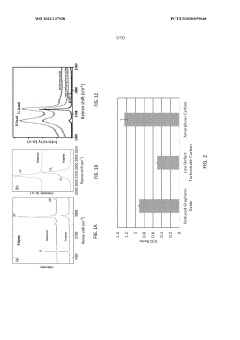
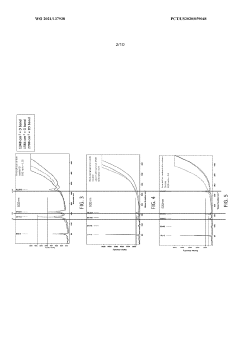
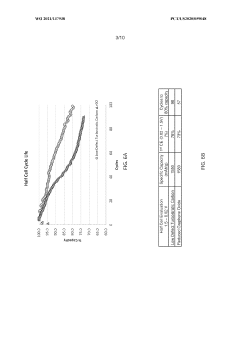
- The development of composite particles with thermally disproportionated silicon oxide primary particles coated with low-defect turbostratic carbon, which provides a conductive network that buffers volume expansion and maintains intimate contact with silicon particles, enhancing cycling stability and rate performance.

Silicon-based carbon composite, preparation method therefor, and anode active material comprising same
PatentPendingUS20230238514A1
Innovation
- A silicon-based-carbon composite with a core-shell structure is developed, where the core comprises silicon, silicon oxide, and magnesium silicate, and the shell consists of two carbon layers, including a first carbon layer and a second carbon layer made of reduced graphene oxide, to enhance mechanical stability and electrical conductivity, thereby minimizing volume changes and maintaining high capacity retention.

Environmental Impact Assessment of Anode Materials
The environmental implications of anode material selection in lithium-ion batteries present significant considerations for sustainable energy storage development. Silicon-carbon composite anodes and cobalt-based designs exhibit markedly different environmental footprints throughout their lifecycle, from raw material extraction to end-of-life disposal.
Silicon-carbon anodes demonstrate superior environmental credentials primarily due to silicon's abundance as the second most prevalent element in Earth's crust. The extraction and processing of silicon require substantially lower energy inputs compared to cobalt mining operations, which often involve environmentally destructive practices in geographically concentrated regions. Silicon purification processes, while energy-intensive, utilize established semiconductor industry infrastructure and can leverage renewable energy sources more effectively than remote cobalt mining operations.
Carbon materials used in silicon-carbon composites can be sourced from various precursors, including biomass-derived sources, offering potential for carbon-neutral or even carbon-negative material cycles. Advanced processing techniques enable the utilization of recycled carbon materials, further reducing environmental impact. The manufacturing process generates fewer toxic byproducts compared to cobalt-based electrode production, which involves complex chemical treatments and generates hazardous waste streams.
Cobalt-based anode designs face significant environmental challenges, particularly regarding mining practices in the Democratic Republic of Congo, which supplies approximately 70% of global cobalt. These operations frequently result in soil contamination, water pollution, and ecosystem disruption. The energy-intensive refining processes required to produce battery-grade cobalt compounds contribute substantially to carbon emissions and require extensive chemical processing facilities.
Water consumption patterns differ significantly between the two approaches. Silicon-carbon anode production typically requires less water-intensive processing compared to cobalt extraction and refinement, which demands substantial water resources for ore processing and chemical purification. Additionally, the geographic concentration of cobalt resources creates supply chain vulnerabilities and environmental justice concerns in mining regions.
End-of-life considerations favor silicon-carbon systems due to improved recyclability potential. Silicon can be recovered and repurposed for various applications, while carbon components can undergo thermal treatment for regeneration. Cobalt recycling, while economically valuable, requires complex hydrometallurgical processes that generate additional environmental burdens and energy consumption.
The longevity testing implications directly impact environmental assessments, as extended cycle life reduces the frequency of battery replacement and associated material consumption. Silicon-carbon anodes, despite initial capacity fade challenges, demonstrate potential for improved environmental performance through enhanced durability and reduced material throughput over extended operational periods.
Silicon-carbon anodes demonstrate superior environmental credentials primarily due to silicon's abundance as the second most prevalent element in Earth's crust. The extraction and processing of silicon require substantially lower energy inputs compared to cobalt mining operations, which often involve environmentally destructive practices in geographically concentrated regions. Silicon purification processes, while energy-intensive, utilize established semiconductor industry infrastructure and can leverage renewable energy sources more effectively than remote cobalt mining operations.
Carbon materials used in silicon-carbon composites can be sourced from various precursors, including biomass-derived sources, offering potential for carbon-neutral or even carbon-negative material cycles. Advanced processing techniques enable the utilization of recycled carbon materials, further reducing environmental impact. The manufacturing process generates fewer toxic byproducts compared to cobalt-based electrode production, which involves complex chemical treatments and generates hazardous waste streams.
Cobalt-based anode designs face significant environmental challenges, particularly regarding mining practices in the Democratic Republic of Congo, which supplies approximately 70% of global cobalt. These operations frequently result in soil contamination, water pollution, and ecosystem disruption. The energy-intensive refining processes required to produce battery-grade cobalt compounds contribute substantially to carbon emissions and require extensive chemical processing facilities.
Water consumption patterns differ significantly between the two approaches. Silicon-carbon anode production typically requires less water-intensive processing compared to cobalt extraction and refinement, which demands substantial water resources for ore processing and chemical purification. Additionally, the geographic concentration of cobalt resources creates supply chain vulnerabilities and environmental justice concerns in mining regions.
End-of-life considerations favor silicon-carbon systems due to improved recyclability potential. Silicon can be recovered and repurposed for various applications, while carbon components can undergo thermal treatment for regeneration. Cobalt recycling, while economically valuable, requires complex hydrometallurgical processes that generate additional environmental burdens and energy consumption.
The longevity testing implications directly impact environmental assessments, as extended cycle life reduces the frequency of battery replacement and associated material consumption. Silicon-carbon anodes, despite initial capacity fade challenges, demonstrate potential for improved environmental performance through enhanced durability and reduced material throughput over extended operational periods.
Safety Standards for Advanced Battery Longevity Testing
The establishment of comprehensive safety standards for advanced battery longevity testing has become increasingly critical as silicon-carbon anodes and cobalt-based designs push the boundaries of energy density and cycle life. Current international frameworks, including IEC 62133, UL 2054, and UN 38.3, provide foundational safety protocols but require significant enhancement to address the unique challenges posed by next-generation battery chemistries during extended testing periods.
Silicon-carbon anode systems present distinct safety considerations during longevity testing due to their substantial volume expansion characteristics, which can reach up to 300% during lithiation cycles. This expansion creates mechanical stress that may lead to separator damage, internal short circuits, or electrolyte decomposition over extended cycling periods. Safety protocols must incorporate real-time monitoring of cell swelling, internal pressure variations, and acoustic emission detection to identify potential failure modes before catastrophic events occur.
Cobalt-based cathode designs, while offering superior thermal stability compared to other high-energy chemistries, require specialized safety measures during accelerated aging tests. The thermal runaway threshold for cobalt-based systems typically occurs at temperatures between 180-220°C, necessitating precise temperature control and rapid thermal response systems during longevity testing protocols. Safety standards must mandate continuous thermal imaging, multi-point temperature sensing, and automated shutdown mechanisms when predetermined thermal limits are approached.
Environmental chamber specifications for longevity testing must incorporate enhanced ventilation systems capable of handling potential gas emissions from both silicon-carbon and cobalt-based cells. Hydrogen, carbon monoxide, and various organic compounds may be released during extended cycling, requiring specialized gas detection arrays and emergency evacuation protocols. Chamber designs should include explosion-proof electrical systems and inert gas flooding capabilities for immediate fire suppression.
Personnel safety protocols during extended longevity testing demand specialized training programs addressing the unique hazards associated with advanced battery chemistries. Testing facilities must implement restricted access zones, mandatory personal protective equipment including flame-resistant clothing and respiratory protection, and emergency response procedures specific to lithium-ion battery incidents. Regular safety audits and certification programs ensure compliance with evolving industry standards and regulatory requirements for advanced battery testing operations.
Silicon-carbon anode systems present distinct safety considerations during longevity testing due to their substantial volume expansion characteristics, which can reach up to 300% during lithiation cycles. This expansion creates mechanical stress that may lead to separator damage, internal short circuits, or electrolyte decomposition over extended cycling periods. Safety protocols must incorporate real-time monitoring of cell swelling, internal pressure variations, and acoustic emission detection to identify potential failure modes before catastrophic events occur.
Cobalt-based cathode designs, while offering superior thermal stability compared to other high-energy chemistries, require specialized safety measures during accelerated aging tests. The thermal runaway threshold for cobalt-based systems typically occurs at temperatures between 180-220°C, necessitating precise temperature control and rapid thermal response systems during longevity testing protocols. Safety standards must mandate continuous thermal imaging, multi-point temperature sensing, and automated shutdown mechanisms when predetermined thermal limits are approached.
Environmental chamber specifications for longevity testing must incorporate enhanced ventilation systems capable of handling potential gas emissions from both silicon-carbon and cobalt-based cells. Hydrogen, carbon monoxide, and various organic compounds may be released during extended cycling, requiring specialized gas detection arrays and emergency evacuation protocols. Chamber designs should include explosion-proof electrical systems and inert gas flooding capabilities for immediate fire suppression.
Personnel safety protocols during extended longevity testing demand specialized training programs addressing the unique hazards associated with advanced battery chemistries. Testing facilities must implement restricted access zones, mandatory personal protective equipment including flame-resistant clothing and respiratory protection, and emergency response procedures specific to lithium-ion battery incidents. Regular safety audits and certification programs ensure compliance with evolving industry standards and regulatory requirements for advanced battery testing operations.
Unlock deeper insights with PatSnap Eureka Quick Research — get a full tech report to explore trends and direct your research. Try now!
Generate Your Research Report Instantly with AI Agent
Supercharge your innovation with PatSnap Eureka AI Agent Platform!