

Single-Molecule Sensing with Plasmonic Sensors: Feasibility Analysis
MAY 11, 20269 MIN READ
Generate Your Research Report Instantly with AI Agent
PatSnap Eureka helps you evaluate technical feasibility & market potential.
Plasmonic Single-Molecule Sensing Background and Objectives
Plasmonic single-molecule sensing represents a revolutionary advancement in analytical chemistry and biomedical diagnostics, emerging from the convergence of nanophotonics, surface plasmonics, and molecular detection technologies. This field has evolved from early surface-enhanced Raman spectroscopy (SERS) demonstrations in the 1970s to sophisticated single-molecule detection platforms capable of real-time molecular analysis. The fundamental principle relies on the extraordinary electromagnetic field enhancement generated by localized surface plasmon resonances (LSPRs) in metallic nanostructures, which can amplify optical signals by factors exceeding 10^10.
The historical development trajectory began with the discovery of surface plasmon phenomena, progressed through the understanding of hot spots in plasmonic nanostructures, and culminated in the demonstration of single-molecule sensitivity. Key milestones include the first single-molecule SERS detection in 1997, the development of plasmonic nanoantennas in the 2000s, and recent advances in tip-enhanced spectroscopy and plasmonic nanocavities. These developments have been driven by advances in nanofabrication techniques, computational electromagnetics, and ultra-sensitive detection instrumentation.
Current technological objectives focus on achieving reproducible single-molecule detection with high spatial and temporal resolution while maintaining practical applicability. The primary goal is to develop plasmonic sensing platforms that can reliably detect individual biomolecules, drug compounds, and environmental contaminants without requiring fluorescent labeling or amplification steps. This capability would enable real-time monitoring of molecular interactions, early disease detection through single biomarker identification, and ultra-sensitive environmental monitoring.
The overarching vision encompasses the creation of portable, cost-effective sensing devices that combine the sensitivity of laboratory-grade instruments with the convenience of point-of-care diagnostics. Future objectives include extending detection capabilities to a broader range of molecular species, improving signal stability and reproducibility, and integrating artificial intelligence for automated molecular identification and quantification in complex biological matrices.
The historical development trajectory began with the discovery of surface plasmon phenomena, progressed through the understanding of hot spots in plasmonic nanostructures, and culminated in the demonstration of single-molecule sensitivity. Key milestones include the first single-molecule SERS detection in 1997, the development of plasmonic nanoantennas in the 2000s, and recent advances in tip-enhanced spectroscopy and plasmonic nanocavities. These developments have been driven by advances in nanofabrication techniques, computational electromagnetics, and ultra-sensitive detection instrumentation.
Current technological objectives focus on achieving reproducible single-molecule detection with high spatial and temporal resolution while maintaining practical applicability. The primary goal is to develop plasmonic sensing platforms that can reliably detect individual biomolecules, drug compounds, and environmental contaminants without requiring fluorescent labeling or amplification steps. This capability would enable real-time monitoring of molecular interactions, early disease detection through single biomarker identification, and ultra-sensitive environmental monitoring.
The overarching vision encompasses the creation of portable, cost-effective sensing devices that combine the sensitivity of laboratory-grade instruments with the convenience of point-of-care diagnostics. Future objectives include extending detection capabilities to a broader range of molecular species, improving signal stability and reproducibility, and integrating artificial intelligence for automated molecular identification and quantification in complex biological matrices.
Market Demand for Ultra-Sensitive Molecular Detection
The global demand for ultra-sensitive molecular detection technologies has experienced unprecedented growth across multiple sectors, driven by the increasing need for precision diagnostics, environmental monitoring, and advanced research applications. Healthcare represents the largest market segment, where early disease detection and personalized medicine require detection capabilities at the single-molecule level. The ability to identify biomarkers, pathogens, and therapeutic targets with extreme sensitivity has become critical for improving patient outcomes and reducing healthcare costs.
Pharmaceutical and biotechnology industries constitute another major demand driver, particularly in drug discovery and development processes. Single-molecule detection enables researchers to study drug-target interactions, monitor cellular processes in real-time, and validate therapeutic efficacy with unprecedented precision. This capability significantly accelerates research timelines and reduces development costs, making it highly valuable for pharmaceutical companies seeking competitive advantages.
Environmental monitoring applications have emerged as a rapidly growing market segment, especially following increased regulatory requirements for water quality assessment, air pollution monitoring, and food safety testing. The ability to detect trace contaminants, toxins, and pollutants at molecular levels has become essential for ensuring public health and environmental protection. Regulatory agencies worldwide are increasingly mandating more stringent detection standards, further driving market demand.
The research and academic sector represents a substantial market opportunity, with universities and research institutions requiring advanced detection technologies for fundamental scientific studies. Applications span from materials science and nanotechnology to biochemistry and molecular biology, where understanding molecular-level phenomena is crucial for breakthrough discoveries.
Market growth is further accelerated by the increasing adoption of point-of-care testing devices, which require miniaturized yet highly sensitive detection systems. The convergence of healthcare digitization, personalized medicine trends, and the growing emphasis on preventive healthcare creates a favorable environment for ultra-sensitive detection technologies.
Emerging applications in food safety, homeland security, and industrial process monitoring continue to expand the addressable market. The demand for real-time, on-site detection capabilities across these diverse sectors underscores the significant commercial potential for plasmonic single-molecule sensing technologies.
Pharmaceutical and biotechnology industries constitute another major demand driver, particularly in drug discovery and development processes. Single-molecule detection enables researchers to study drug-target interactions, monitor cellular processes in real-time, and validate therapeutic efficacy with unprecedented precision. This capability significantly accelerates research timelines and reduces development costs, making it highly valuable for pharmaceutical companies seeking competitive advantages.
Environmental monitoring applications have emerged as a rapidly growing market segment, especially following increased regulatory requirements for water quality assessment, air pollution monitoring, and food safety testing. The ability to detect trace contaminants, toxins, and pollutants at molecular levels has become essential for ensuring public health and environmental protection. Regulatory agencies worldwide are increasingly mandating more stringent detection standards, further driving market demand.
The research and academic sector represents a substantial market opportunity, with universities and research institutions requiring advanced detection technologies for fundamental scientific studies. Applications span from materials science and nanotechnology to biochemistry and molecular biology, where understanding molecular-level phenomena is crucial for breakthrough discoveries.
Market growth is further accelerated by the increasing adoption of point-of-care testing devices, which require miniaturized yet highly sensitive detection systems. The convergence of healthcare digitization, personalized medicine trends, and the growing emphasis on preventive healthcare creates a favorable environment for ultra-sensitive detection technologies.
Emerging applications in food safety, homeland security, and industrial process monitoring continue to expand the addressable market. The demand for real-time, on-site detection capabilities across these diverse sectors underscores the significant commercial potential for plasmonic single-molecule sensing technologies.
Current State and Challenges of Plasmonic Sensing Technology
Plasmonic sensing technology has achieved remarkable progress in recent years, establishing itself as a powerful platform for label-free detection of biomolecules and chemical species. Current plasmonic sensors primarily rely on surface plasmon resonance (SPR) and localized surface plasmon resonance (LSPR) phenomena, which enable real-time monitoring of molecular interactions through changes in refractive index near metallic surfaces. Commercial SPR systems have demonstrated detection limits in the picomolar range for protein detection, while advanced nanoplasmonic structures have pushed sensitivity boundaries even further.
The field has witnessed significant advancement in nanostructure fabrication techniques, including electron beam lithography, focused ion beam milling, and self-assembly methods. These approaches have enabled the creation of sophisticated plasmonic architectures such as nanoantennas, gap plasmons, and metamaterial structures that concentrate electromagnetic fields into nanoscale volumes. Recent developments in tip-enhanced Raman spectroscopy and plasmonic nanoapertures have demonstrated the ability to detect single molecules under specific conditions.
Despite these achievements, single-molecule detection with plasmonic sensors faces substantial technical barriers. The primary challenge lies in achieving sufficient signal-to-noise ratio to distinguish single-molecule binding events from background fluctuations. Thermal noise, mechanical vibrations, and electronic noise in detection systems often mask the weak signals generated by individual molecules. Additionally, the stochastic nature of molecular binding and unbinding creates temporal variations that complicate signal interpretation.
Another critical limitation involves the spatial confinement of electromagnetic fields. While plasmonic hotspots can enhance local field intensities by several orders of magnitude, the effective sensing volume remains larger than individual molecules, leading to reduced detection probability. The mismatch between molecular dimensions and plasmonic mode volumes represents a fundamental scaling challenge that current technologies struggle to overcome.
Fabrication reproducibility poses additional constraints, as nanoscale variations in plasmonic structures significantly impact sensing performance. Current lithographic techniques, while precise, still introduce structural heterogeneities that affect field enhancement uniformity across sensor arrays. This variability complicates the establishment of reliable detection thresholds for single-molecule events.
Surface chemistry and molecular orientation effects further complicate single-molecule plasmonic sensing. The random orientation of target molecules relative to plasmonic field distributions creates detection probability variations, while surface fouling and non-specific binding generate false signals that interfere with single-molecule identification.
The field has witnessed significant advancement in nanostructure fabrication techniques, including electron beam lithography, focused ion beam milling, and self-assembly methods. These approaches have enabled the creation of sophisticated plasmonic architectures such as nanoantennas, gap plasmons, and metamaterial structures that concentrate electromagnetic fields into nanoscale volumes. Recent developments in tip-enhanced Raman spectroscopy and plasmonic nanoapertures have demonstrated the ability to detect single molecules under specific conditions.
Despite these achievements, single-molecule detection with plasmonic sensors faces substantial technical barriers. The primary challenge lies in achieving sufficient signal-to-noise ratio to distinguish single-molecule binding events from background fluctuations. Thermal noise, mechanical vibrations, and electronic noise in detection systems often mask the weak signals generated by individual molecules. Additionally, the stochastic nature of molecular binding and unbinding creates temporal variations that complicate signal interpretation.
Another critical limitation involves the spatial confinement of electromagnetic fields. While plasmonic hotspots can enhance local field intensities by several orders of magnitude, the effective sensing volume remains larger than individual molecules, leading to reduced detection probability. The mismatch between molecular dimensions and plasmonic mode volumes represents a fundamental scaling challenge that current technologies struggle to overcome.
Fabrication reproducibility poses additional constraints, as nanoscale variations in plasmonic structures significantly impact sensing performance. Current lithographic techniques, while precise, still introduce structural heterogeneities that affect field enhancement uniformity across sensor arrays. This variability complicates the establishment of reliable detection thresholds for single-molecule events.
Surface chemistry and molecular orientation effects further complicate single-molecule plasmonic sensing. The random orientation of target molecules relative to plasmonic field distributions creates detection probability variations, while surface fouling and non-specific binding generate false signals that interfere with single-molecule identification.
Existing Plasmonic Single-Molecule Detection Solutions
01 Surface plasmon resonance based single-molecule detection systems
Advanced plasmonic sensor configurations utilize surface plasmon resonance phenomena to achieve single-molecule detection capabilities. These systems employ specialized optical arrangements and signal processing techniques to detect individual molecular binding events through changes in plasmonic field properties. The detection mechanism relies on the interaction between target molecules and plasmonic surfaces, enabling real-time monitoring of molecular interactions with unprecedented sensitivity.- Surface plasmon resonance based single-molecule detection systems: Advanced plasmonic sensor configurations utilize surface plasmon resonance phenomena to achieve single-molecule detection capabilities. These systems employ specialized optical arrangements and signal processing techniques to detect individual molecular binding events on plasmonic surfaces. The detection mechanism relies on changes in refractive index at the sensor surface when single molecules interact with the plasmonic structure, enabling real-time monitoring of molecular interactions with unprecedented sensitivity.
- Nanostructured plasmonic substrates for enhanced sensitivity: Engineered nanostructures such as nanoantennas, nanoparticles, and metamaterials are designed to concentrate electromagnetic fields and enhance plasmonic effects for single-molecule sensing applications. These substrates feature optimized geometries and materials that amplify the optical response to individual molecular binding events. The nanostructured surfaces provide localized field enhancement zones that significantly improve the signal-to-noise ratio for single-molecule detection.
- Signal processing and detection algorithms for single-molecule identification: Sophisticated computational methods and signal processing algorithms are employed to identify and characterize single-molecule binding events from plasmonic sensor data. These techniques include noise reduction, pattern recognition, and statistical analysis methods that can distinguish genuine single-molecule signals from background noise. Advanced data processing enables real-time analysis and quantification of molecular interactions at the single-molecule level.
- Microfluidic integration for controlled single-molecule delivery: Microfluidic systems are integrated with plasmonic sensors to provide precise control over molecular delivery and environmental conditions for single-molecule sensing experiments. These platforms enable controlled flow rates, concentration gradients, and sample handling that are essential for reliable single-molecule measurements. The integration allows for automated sample processing and reduces external interference that could affect sensitive single-molecule detection.
- Multi-modal plasmonic sensing platforms: Combined sensing approaches that integrate plasmonic detection with other analytical techniques to provide comprehensive single-molecule characterization. These platforms may incorporate fluorescence detection, electrical measurements, or spectroscopic analysis alongside plasmonic sensing to obtain multiple types of information from individual molecules. The multi-modal approach enhances measurement reliability and provides complementary data for thorough molecular analysis.
02 Nanostructured plasmonic substrates for enhanced sensitivity
Engineered nanostructures such as nanoantennas, nanoparticles, and metamaterials are designed to amplify plasmonic signals for single-molecule sensing applications. These substrates feature optimized geometries and material compositions that concentrate electromagnetic fields at hotspots, dramatically increasing the detection sensitivity. The nanostructured approach enables the detection of individual molecules through enhanced light-matter interactions at the nanoscale.Expand Specific Solutions03 Optical detection and signal processing methods
Sophisticated optical detection schemes and signal processing algorithms are employed to extract single-molecule information from plasmonic sensor outputs. These methods include advanced photodetection systems, noise reduction techniques, and real-time data analysis capabilities. The optical systems are designed to capture weak signals generated by individual molecular interactions while minimizing background interference and false positives.Expand Specific Solutions04 Functionalization strategies for molecular recognition
Chemical and biological functionalization approaches are developed to provide specific molecular recognition capabilities on plasmonic sensor surfaces. These strategies involve the attachment of recognition elements such as antibodies, aptamers, or synthetic receptors to enable selective binding of target molecules. The functionalization process is optimized to maintain high binding affinity while preserving the plasmonic properties required for single-molecule detection.Expand Specific Solutions05 Integrated sensor platforms and device architectures
Complete sensor platforms integrate plasmonic sensing elements with microfluidics, electronics, and data processing components to create practical single-molecule detection devices. These integrated systems feature miniaturized architectures that combine sample handling, sensing, and analysis functions in compact formats. The platforms are designed for various applications including biomedical diagnostics, environmental monitoring, and fundamental research in molecular interactions.Expand Specific Solutions
Key Players in Plasmonic Sensor and Nanophotonics Industry
The single-molecule sensing with plasmonic sensors field represents an emerging technology sector in the early commercialization stage, with significant growth potential driven by applications in healthcare diagnostics, environmental monitoring, and biotechnology research. The market remains relatively nascent but shows promising expansion as demand increases for ultra-sensitive detection capabilities in medical and research applications. Technology maturity varies significantly across the competitive landscape, with established electronics giants like Samsung Electronics and OMRON Corp. leveraging their manufacturing expertise, while specialized companies such as Integrated Plasmonics Corp. focus exclusively on plasmonic sensing solutions. Leading research institutions including California Institute of Technology, Tsinghua University, and École Polytechnique Fédérale de Lausanne are driving fundamental breakthroughs in sensitivity and selectivity. Japanese companies like FUJIFILM Corp., ROHM Co., and Olympus Corp. are advancing practical implementations, particularly in medical imaging and diagnostic applications, while government research organizations such as the National Research Council of Canada and Korea Research Institute of Standards & Science are establishing measurement standards and validation protocols essential for commercial adoption.
Samsung Electronics Co., Ltd.
Technical Solution: Samsung has developed plasmonic biosensor technologies integrated into their semiconductor manufacturing processes, focusing on CMOS-compatible plasmonic structures for portable diagnostic devices. Their approach utilizes gold nanoparticle arrays fabricated using standard lithography techniques to create reproducible plasmonic hotspots. The technology incorporates machine learning algorithms for signal processing to distinguish single-molecule events from background noise. Samsung's platform demonstrates detection sensitivity approaching single-molecule levels for specific biomarkers, with integration capabilities for smartphone-based readout systems and point-of-care applications.
Strengths: Strong manufacturing capabilities and integration with consumer electronics platforms for widespread deployment. Weaknesses: Primary focus on commercial applications rather than fundamental research, potentially limiting sensitivity optimization.
Integrated Plasmonics Corp.
Technical Solution: Integrated Plasmonics Corp. specializes in developing advanced plasmonic sensor platforms specifically designed for single-molecule detection applications. Their technology leverages surface plasmon resonance (SPR) enhancement to achieve detection limits down to individual molecular interactions. The company's proprietary nanostructured metallic surfaces create highly localized electromagnetic field enhancements that can amplify optical signals from single molecules by factors of 10^6 to 10^8. Their sensor architecture incorporates real-time monitoring capabilities with sub-nanometer resolution, enabling direct observation of molecular binding events, conformational changes, and enzymatic activities at the single-molecule level.
Strengths: Specialized focus on plasmonic sensing with proven single-molecule detection capabilities and strong IP portfolio. Weaknesses: Limited market presence and higher costs compared to ensemble measurement techniques.
Core Innovations in Plasmonic Enhancement Mechanisms
Individual molecule detection by plasmonic nanoparticles
PatentInactiveEP2587252A1
Innovation
- A method and apparatus using plasmonic nanoparticles that detect shifts in plasmon resonance frequency with enhanced sensitivity, employing a white light laser and dark-field spectroscopy to identify individual molecular binding events, allowing for the study of protein folding dynamics and kinetics with improved signal-to-noise ratio.


Plasmonic biosensor
PatentActiveUS20210048435A1
Innovation
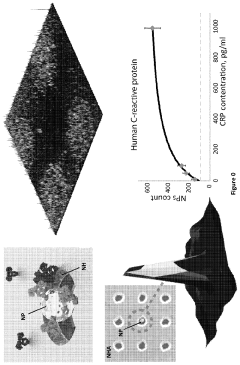
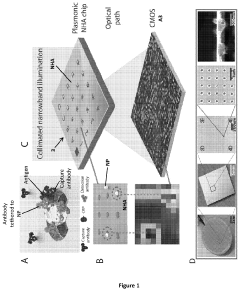
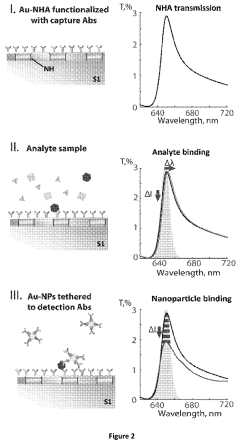
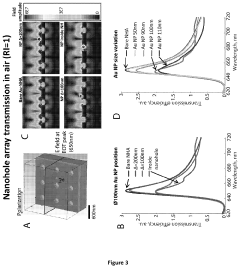
- A nanoparticle-enhanced plasmonic biosensor system using gold nano-hole arrays (Au-NHAs) that visualizes single sub-wavelength nanoparticles under bright-field imaging, enabling digital quantification and localization of individual nanoparticle-labeled molecules through local extraordinary optical transmission quenching, allowing for the detection of biomarkers at much lower concentrations, such as 10 pg/ml for biotinylated bovine serum albumin and 27 pg/ml for human C-reactive protein.
Manufacturing Scalability of Plasmonic Nanostructures
The manufacturing scalability of plasmonic nanostructures represents a critical bottleneck in the practical implementation of single-molecule sensing platforms. Current fabrication methods face significant challenges in achieving the precision, reproducibility, and cost-effectiveness required for commercial viability. Traditional top-down approaches such as electron beam lithography and focused ion beam milling, while capable of producing high-quality nanostructures with sub-10 nanometer features, suffer from inherently low throughput and prohibitive costs when scaled to industrial production volumes.
Nanoimprint lithography has emerged as a promising intermediate solution, offering improved throughput compared to direct-write techniques while maintaining reasonable feature resolution. However, the technology still faces limitations in achieving the sub-5 nanometer gap dimensions often required for optimal single-molecule detection sensitivity. The fabrication of consistent hot spots with reproducible enhancement factors across large substrate areas remains technically challenging, with yield rates typically below 70% for structures meeting stringent performance specifications.
Bottom-up synthesis approaches, including colloidal assembly and DNA-directed assembly, present alternative pathways for scalable production. These methods can potentially achieve lower per-unit costs and higher throughput, but currently lack the precise spatial control necessary for deterministic sensor placement. The inherent variability in self-assembled structures results in broad distributions of enhancement factors, complicating the development of standardized sensing protocols.
Recent advances in hybrid manufacturing strategies show promise for addressing scalability challenges. Template-assisted synthesis combined with selective deposition techniques enables the production of uniform nanostructure arrays with controlled geometries. Additionally, the development of roll-to-roll compatible processes and the integration of advanced metrology systems for real-time quality control are beginning to address the reproducibility requirements for commercial sensor applications.
The economic viability of scaled manufacturing depends critically on achieving production costs below $0.10 per sensor element while maintaining performance specifications. Current projections suggest that breakthrough improvements in either lithographic resolution or assembly precision will be necessary to meet both technical and economic targets for widespread single-molecule sensing applications.
Nanoimprint lithography has emerged as a promising intermediate solution, offering improved throughput compared to direct-write techniques while maintaining reasonable feature resolution. However, the technology still faces limitations in achieving the sub-5 nanometer gap dimensions often required for optimal single-molecule detection sensitivity. The fabrication of consistent hot spots with reproducible enhancement factors across large substrate areas remains technically challenging, with yield rates typically below 70% for structures meeting stringent performance specifications.
Bottom-up synthesis approaches, including colloidal assembly and DNA-directed assembly, present alternative pathways for scalable production. These methods can potentially achieve lower per-unit costs and higher throughput, but currently lack the precise spatial control necessary for deterministic sensor placement. The inherent variability in self-assembled structures results in broad distributions of enhancement factors, complicating the development of standardized sensing protocols.
Recent advances in hybrid manufacturing strategies show promise for addressing scalability challenges. Template-assisted synthesis combined with selective deposition techniques enables the production of uniform nanostructure arrays with controlled geometries. Additionally, the development of roll-to-roll compatible processes and the integration of advanced metrology systems for real-time quality control are beginning to address the reproducibility requirements for commercial sensor applications.
The economic viability of scaled manufacturing depends critically on achieving production costs below $0.10 per sensor element while maintaining performance specifications. Current projections suggest that breakthrough improvements in either lithographic resolution or assembly precision will be necessary to meet both technical and economic targets for widespread single-molecule sensing applications.
Signal Processing and Data Analysis for Single-Molecule Events
Signal processing and data analysis represent critical bottlenecks in translating raw plasmonic sensor outputs into meaningful single-molecule detection events. The inherently weak optical signals generated by individual molecular interactions with plasmonic nanostructures require sophisticated computational approaches to extract reliable information from noise-dominated environments. Traditional signal processing methods often prove inadequate for single-molecule applications due to the stochastic nature of molecular binding events and the complex interference patterns characteristic of plasmonic systems.
Real-time signal acquisition demands high-frequency sampling rates, typically exceeding 10 kHz, to capture transient molecular binding and unbinding events that may occur on millisecond timescales. Advanced filtering algorithms, including Kalman filters and wavelet transforms, have emerged as essential tools for separating genuine molecular signals from thermal fluctuations and instrumental drift. Machine learning approaches, particularly deep neural networks, show promising capabilities in pattern recognition for distinguishing single-molecule events from background noise.
Statistical analysis frameworks must account for the probabilistic nature of molecular interactions, requiring robust algorithms capable of handling non-Gaussian noise distributions and temporal correlations in the data streams. Hidden Markov models and change-point detection algorithms have demonstrated effectiveness in identifying discrete molecular states and transition events. The integration of multiple detection channels and cross-correlation analysis enhances signal reliability and reduces false positive rates.
Data preprocessing pipelines typically incorporate baseline correction, drift compensation, and artifact removal procedures specifically tailored to plasmonic sensor characteristics. The development of standardized analysis protocols remains crucial for ensuring reproducibility across different experimental setups and research groups. Cloud-based processing platforms are increasingly adopted to handle the substantial computational demands associated with continuous high-resolution data streams from multiplexed sensor arrays.
Real-time signal acquisition demands high-frequency sampling rates, typically exceeding 10 kHz, to capture transient molecular binding and unbinding events that may occur on millisecond timescales. Advanced filtering algorithms, including Kalman filters and wavelet transforms, have emerged as essential tools for separating genuine molecular signals from thermal fluctuations and instrumental drift. Machine learning approaches, particularly deep neural networks, show promising capabilities in pattern recognition for distinguishing single-molecule events from background noise.
Statistical analysis frameworks must account for the probabilistic nature of molecular interactions, requiring robust algorithms capable of handling non-Gaussian noise distributions and temporal correlations in the data streams. Hidden Markov models and change-point detection algorithms have demonstrated effectiveness in identifying discrete molecular states and transition events. The integration of multiple detection channels and cross-correlation analysis enhances signal reliability and reduces false positive rates.
Data preprocessing pipelines typically incorporate baseline correction, drift compensation, and artifact removal procedures specifically tailored to plasmonic sensor characteristics. The development of standardized analysis protocols remains crucial for ensuring reproducibility across different experimental setups and research groups. Cloud-based processing platforms are increasingly adopted to handle the substantial computational demands associated with continuous high-resolution data streams from multiplexed sensor arrays.
Unlock deeper insights with PatSnap Eureka Quick Research — get a full tech report to explore trends and direct your research. Try now!
Generate Your Research Report Instantly with AI Agent
Supercharge your innovation with PatSnap Eureka AI Agent Platform!