

Smart Irrigation Controllers: Performance Under Extreme Weather
FEB 27, 20269 MIN READ
Generate Your Research Report Instantly with AI Agent
Patsnap Eureka helps you evaluate technical feasibility & market potential.
Smart Irrigation Tech Background and Climate Goals
Smart irrigation technology has evolved significantly over the past two decades, transforming from basic timer-based systems to sophisticated sensor-driven networks capable of real-time environmental monitoring and adaptive water management. The foundational development began in the early 2000s with soil moisture sensors and weather station integration, establishing the groundwork for precision agriculture applications.
The technological progression accelerated through the integration of wireless communication protocols, Internet of Things connectivity, and machine learning algorithms. Modern smart irrigation controllers now incorporate multiple data streams including soil moisture levels, weather forecasts, plant growth stages, and evapotranspiration rates to optimize water delivery with unprecedented precision.
Climate change has fundamentally altered the operational requirements for irrigation systems, introducing extreme weather patterns that challenge traditional water management approaches. Rising global temperatures, irregular precipitation cycles, and increased frequency of drought and flood events have created urgent demands for adaptive irrigation technologies capable of responding to rapidly changing environmental conditions.
The primary climate-related goals driving smart irrigation development center on water conservation efficiency, drought resilience, and flood mitigation capabilities. These systems must demonstrate robust performance during heat waves exceeding historical temperature records, extended drought periods lasting multiple growing seasons, and sudden extreme precipitation events that can saturate soils within hours.
Water scarcity concerns have intensified the focus on precision application technologies that minimize waste while maintaining crop productivity. Current climate projections indicate that agricultural regions will face increasingly unpredictable weather patterns, requiring irrigation controllers to process complex environmental data and make autonomous decisions without human intervention during critical periods.
The integration of climate adaptation strategies into smart irrigation design has become essential for agricultural sustainability. These technologies must balance immediate crop water needs with long-term resource conservation, incorporating predictive analytics to anticipate extreme weather events and adjust irrigation schedules proactively rather than reactively responding to environmental stress conditions.
The technological progression accelerated through the integration of wireless communication protocols, Internet of Things connectivity, and machine learning algorithms. Modern smart irrigation controllers now incorporate multiple data streams including soil moisture levels, weather forecasts, plant growth stages, and evapotranspiration rates to optimize water delivery with unprecedented precision.
Climate change has fundamentally altered the operational requirements for irrigation systems, introducing extreme weather patterns that challenge traditional water management approaches. Rising global temperatures, irregular precipitation cycles, and increased frequency of drought and flood events have created urgent demands for adaptive irrigation technologies capable of responding to rapidly changing environmental conditions.
The primary climate-related goals driving smart irrigation development center on water conservation efficiency, drought resilience, and flood mitigation capabilities. These systems must demonstrate robust performance during heat waves exceeding historical temperature records, extended drought periods lasting multiple growing seasons, and sudden extreme precipitation events that can saturate soils within hours.
Water scarcity concerns have intensified the focus on precision application technologies that minimize waste while maintaining crop productivity. Current climate projections indicate that agricultural regions will face increasingly unpredictable weather patterns, requiring irrigation controllers to process complex environmental data and make autonomous decisions without human intervention during critical periods.
The integration of climate adaptation strategies into smart irrigation design has become essential for agricultural sustainability. These technologies must balance immediate crop water needs with long-term resource conservation, incorporating predictive analytics to anticipate extreme weather events and adjust irrigation schedules proactively rather than reactively responding to environmental stress conditions.
Market Demand for Weather-Resilient Irrigation Systems
The global agricultural sector faces mounting pressure from increasingly unpredictable weather patterns, driving substantial demand for weather-resilient irrigation systems. Climate change has intensified the frequency and severity of extreme weather events, including prolonged droughts, sudden temperature fluctuations, and irregular precipitation patterns. These conditions create urgent needs for irrigation technologies that can maintain operational effectiveness while protecting crop yields under adverse environmental circumstances.
Agricultural producers worldwide are experiencing significant economic losses due to inadequate irrigation infrastructure during extreme weather events. Traditional irrigation systems often fail to adapt quickly to rapidly changing conditions, resulting in either water waste during unexpected rainfall or insufficient coverage during heat waves and drought periods. This vulnerability has created a compelling market opportunity for smart irrigation controllers specifically designed to withstand and respond effectively to extreme weather conditions.
The commercial agriculture sector represents the largest demand segment, particularly among large-scale farming operations growing high-value crops such as fruits, vegetables, and specialty grains. These operations require sophisticated irrigation management to maintain consistent product quality and yield stability regardless of weather variability. Greenhouse and controlled environment agriculture facilities also demonstrate strong demand, as they need precise environmental control systems that can compensate for external weather extremes.
Regional demand patterns reflect varying climate vulnerabilities and agricultural practices. Mediterranean climate regions, including parts of California, Australia, and Southern Europe, show particularly strong market interest due to their susceptibility to drought cycles and wildfire risks. Similarly, areas experiencing desertification or water scarcity issues, such as parts of the Middle East and North Africa, represent emerging high-growth markets for weather-resilient irrigation technologies.
The residential and commercial landscaping sectors contribute additional market demand, driven by water conservation regulations and sustainability initiatives. Property managers and homeowners in drought-prone regions increasingly seek irrigation solutions that can maintain landscape aesthetics while complying with water usage restrictions during extreme weather periods.
Market growth drivers include expanding awareness of water resource limitations, increasing insurance costs related to weather-related crop losses, and growing regulatory pressure for sustainable agricultural practices. Government incentive programs promoting water-efficient technologies further accelerate adoption rates, particularly in regions where agriculture represents a significant economic sector.
The integration requirements for weather-resilient systems create demand for comprehensive solutions rather than standalone products. Customers increasingly expect irrigation controllers that can interface with weather monitoring networks, soil sensors, and farm management software platforms to provide holistic environmental response capabilities.
Agricultural producers worldwide are experiencing significant economic losses due to inadequate irrigation infrastructure during extreme weather events. Traditional irrigation systems often fail to adapt quickly to rapidly changing conditions, resulting in either water waste during unexpected rainfall or insufficient coverage during heat waves and drought periods. This vulnerability has created a compelling market opportunity for smart irrigation controllers specifically designed to withstand and respond effectively to extreme weather conditions.
The commercial agriculture sector represents the largest demand segment, particularly among large-scale farming operations growing high-value crops such as fruits, vegetables, and specialty grains. These operations require sophisticated irrigation management to maintain consistent product quality and yield stability regardless of weather variability. Greenhouse and controlled environment agriculture facilities also demonstrate strong demand, as they need precise environmental control systems that can compensate for external weather extremes.
Regional demand patterns reflect varying climate vulnerabilities and agricultural practices. Mediterranean climate regions, including parts of California, Australia, and Southern Europe, show particularly strong market interest due to their susceptibility to drought cycles and wildfire risks. Similarly, areas experiencing desertification or water scarcity issues, such as parts of the Middle East and North Africa, represent emerging high-growth markets for weather-resilient irrigation technologies.
The residential and commercial landscaping sectors contribute additional market demand, driven by water conservation regulations and sustainability initiatives. Property managers and homeowners in drought-prone regions increasingly seek irrigation solutions that can maintain landscape aesthetics while complying with water usage restrictions during extreme weather periods.
Market growth drivers include expanding awareness of water resource limitations, increasing insurance costs related to weather-related crop losses, and growing regulatory pressure for sustainable agricultural practices. Government incentive programs promoting water-efficient technologies further accelerate adoption rates, particularly in regions where agriculture represents a significant economic sector.
The integration requirements for weather-resilient systems create demand for comprehensive solutions rather than standalone products. Customers increasingly expect irrigation controllers that can interface with weather monitoring networks, soil sensors, and farm management software platforms to provide holistic environmental response capabilities.
Current State and Extreme Weather Challenges
Smart irrigation controllers have evolved significantly over the past decade, transitioning from basic timer-based systems to sophisticated IoT-enabled devices that integrate multiple sensor technologies. Current market leaders include Rain Bird, Hunter Industries, Netafim, and emerging tech companies like Rachio and Orbit. These systems typically incorporate soil moisture sensors, weather station data, and satellite-based evapotranspiration calculations to optimize water delivery.
The global smart irrigation market has reached approximately $1.8 billion in 2023, with projected growth to $4.2 billion by 2028. North America and Europe dominate adoption rates, while Asia-Pacific regions show the fastest growth trajectory. Agricultural applications account for roughly 70% of market share, with residential and commercial landscaping comprising the remainder.
Contemporary smart irrigation controllers face significant performance degradation under extreme weather conditions. High-temperature events exceeding 40°C frequently cause sensor malfunctions and communication failures in wireless networks. During heatwaves, soil moisture sensors often provide inaccurate readings due to rapid surface evaporation, leading to over-irrigation or inadequate water delivery.
Extreme precipitation events present equally challenging scenarios. Heavy rainfall can overwhelm drainage systems and cause waterlogging, while controllers struggle to adjust irrigation schedules in real-time. Many existing systems lack robust precipitation forecasting integration, resulting in unnecessary watering during or immediately before storm events.
Freezing conditions pose additional technical challenges, particularly for systems operating in temperate climates. Sub-zero temperatures can damage exposed sensors and irrigation infrastructure, while frozen soil conditions render moisture measurements unreliable. Current controllers often lack sophisticated freeze protection algorithms, leading to system shutdowns during critical periods.
Wind-related challenges include physical damage to above-ground sensors and communication equipment, as well as altered evapotranspiration rates that existing algorithms fail to account for accurately. Dust storms and extreme humidity fluctuations further compromise sensor accuracy and system reliability.
The primary technical limitations stem from inadequate weatherproofing standards, insufficient data processing capabilities for extreme event scenarios, and limited integration with advanced meteorological forecasting systems. Most current solutions rely on historical weather patterns rather than predictive modeling for extreme events, creating significant performance gaps during unprecedented weather conditions.
The global smart irrigation market has reached approximately $1.8 billion in 2023, with projected growth to $4.2 billion by 2028. North America and Europe dominate adoption rates, while Asia-Pacific regions show the fastest growth trajectory. Agricultural applications account for roughly 70% of market share, with residential and commercial landscaping comprising the remainder.
Contemporary smart irrigation controllers face significant performance degradation under extreme weather conditions. High-temperature events exceeding 40°C frequently cause sensor malfunctions and communication failures in wireless networks. During heatwaves, soil moisture sensors often provide inaccurate readings due to rapid surface evaporation, leading to over-irrigation or inadequate water delivery.
Extreme precipitation events present equally challenging scenarios. Heavy rainfall can overwhelm drainage systems and cause waterlogging, while controllers struggle to adjust irrigation schedules in real-time. Many existing systems lack robust precipitation forecasting integration, resulting in unnecessary watering during or immediately before storm events.
Freezing conditions pose additional technical challenges, particularly for systems operating in temperate climates. Sub-zero temperatures can damage exposed sensors and irrigation infrastructure, while frozen soil conditions render moisture measurements unreliable. Current controllers often lack sophisticated freeze protection algorithms, leading to system shutdowns during critical periods.
Wind-related challenges include physical damage to above-ground sensors and communication equipment, as well as altered evapotranspiration rates that existing algorithms fail to account for accurately. Dust storms and extreme humidity fluctuations further compromise sensor accuracy and system reliability.
The primary technical limitations stem from inadequate weatherproofing standards, insufficient data processing capabilities for extreme event scenarios, and limited integration with advanced meteorological forecasting systems. Most current solutions rely on historical weather patterns rather than predictive modeling for extreme events, creating significant performance gaps during unprecedented weather conditions.
Existing Weather-Adaptive Irrigation Solutions
01 Sensor-based soil moisture monitoring and control systems
Smart irrigation controllers utilize various sensors to monitor soil moisture levels, temperature, and other environmental parameters in real-time. These systems automatically adjust watering schedules based on actual soil conditions rather than predetermined timers. The controllers can integrate multiple sensor types including capacitive moisture sensors, tensiometers, and weather stations to optimize water delivery. Advanced algorithms process sensor data to determine precise irrigation needs, preventing over-watering and under-watering conditions.- Sensor-based soil moisture monitoring and control systems: Smart irrigation controllers utilize various sensors to monitor soil moisture levels, temperature, and environmental conditions in real-time. These systems automatically adjust watering schedules based on actual soil conditions rather than predetermined timers. The sensors can detect moisture content at different depths and transmit data to the controller for optimal irrigation decisions. This technology helps prevent over-watering and under-watering by providing precise measurements of soil conditions and plant water requirements.
- Weather-responsive irrigation scheduling: Advanced irrigation controllers integrate weather data and forecasting information to optimize watering schedules. These systems can access local weather stations, satellite data, or internet-based weather services to adjust irrigation based on rainfall predictions, temperature, humidity, and evapotranspiration rates. The controllers can automatically skip or delay watering cycles when rain is expected or has occurred, significantly reducing water waste and improving irrigation efficiency.
- Remote monitoring and mobile application control: Modern smart irrigation systems feature wireless connectivity and mobile application interfaces that allow users to monitor and control irrigation remotely. These systems enable real-time status updates, manual override capabilities, and system diagnostics from smartphones or tablets. Users can receive alerts about system malfunctions, adjust watering schedules, and view historical water usage data through intuitive mobile interfaces, providing convenience and enhanced system management capabilities.
- Zone-specific irrigation management: Smart controllers implement zone-based irrigation strategies that account for different plant types, soil conditions, sun exposure, and slope variations across the landscape. These systems can independently control multiple irrigation zones with customized watering schedules and durations for each area. The technology optimizes water distribution by recognizing that different zones have varying water requirements, ensuring each area receives appropriate irrigation while maximizing overall water efficiency.
- Water conservation and efficiency optimization algorithms: Smart irrigation controllers employ sophisticated algorithms and machine learning techniques to continuously optimize water usage and improve irrigation efficiency. These systems analyze historical data, seasonal patterns, and plant growth cycles to refine watering schedules over time. The controllers can calculate precise water requirements based on multiple variables and automatically adjust to minimize water consumption while maintaining healthy plant growth. Performance metrics and water savings reports help users track conservation achievements.
02 Weather-based irrigation scheduling and prediction
Controllers incorporate weather forecasting data and historical climate information to predict irrigation requirements. These systems connect to meteorological services to receive real-time weather updates including rainfall predictions, temperature forecasts, and evapotranspiration rates. By analyzing weather patterns, the controllers can preemptively adjust watering schedules to account for upcoming rain events or temperature changes. This predictive capability significantly reduces water waste while maintaining optimal plant health.Expand Specific Solutions03 Remote monitoring and mobile application control
Modern smart irrigation systems feature wireless connectivity enabling remote access and control through mobile applications and web interfaces. Users can monitor system status, adjust settings, and receive alerts from anywhere with internet connectivity. The systems support various communication protocols including WiFi, cellular networks, and IoT platforms for seamless integration. Cloud-based data storage allows for historical analysis and performance tracking over extended periods.Expand Specific Solutions04 Zone-specific and multi-valve management systems
Advanced controllers manage multiple irrigation zones independently, allowing customized watering schedules for different areas based on plant types, soil conditions, and sun exposure. The systems can control numerous valves simultaneously or sequentially, optimizing water pressure and distribution across large properties. Zone-based management enables precise water allocation, ensuring each area receives appropriate irrigation without affecting other zones. Integration with flow meters helps detect leaks and system malfunctions in specific zones.Expand Specific Solutions05 Water conservation and efficiency optimization algorithms
Smart controllers employ sophisticated algorithms to maximize water conservation while maintaining landscape health. These systems calculate optimal irrigation duration and frequency based on multiple variables including plant water requirements, root depth, soil type, and slope. Machine learning capabilities allow the controllers to adapt and improve performance over time based on observed results. Water usage analytics provide detailed reports on consumption patterns, helping identify opportunities for further efficiency improvements.Expand Specific Solutions
Key Players in Smart Irrigation and Weather Tech
The smart irrigation controller market is experiencing rapid growth driven by increasing water scarcity concerns and extreme weather events, positioning the industry in an expansion phase with significant technological advancement opportunities. Market leaders like Rain Bird Corp., The Toro Co., and Hunter Industries demonstrate mature hardware capabilities, while technology integrators such as Trimble Inc. are advancing IoT connectivity and precision agriculture solutions. The competitive landscape shows varying technology maturity levels, with established irrigation companies focusing on weather-resistant hardware development and newer entrants like Hainan BaoXiu Water-saving Science and Technology Co. emphasizing smart agricultural management systems. Research institutions including Agricultural University of Hebei and Gansu Agricultural University are contributing to performance optimization under extreme conditions, indicating strong innovation pipeline support for next-generation weather-adaptive irrigation technologies.
Rain Bird Corp.
Technical Solution: Rain Bird has developed advanced smart irrigation controllers featuring weather-based ET (evapotranspiration) technology that automatically adjusts watering schedules based on real-time weather data including temperature, humidity, wind, and solar radiation. Their ESP-TM2 controllers incorporate freeze protection algorithms that shut down irrigation when temperatures drop below 37°F, preventing pipe damage during extreme cold weather events. The system utilizes wireless connectivity to receive local weather forecasts and can delay or skip irrigation cycles during predicted storms or high wind conditions. Additionally, their controllers feature rain sensors and soil moisture monitoring capabilities that work in conjunction with weather data to optimize irrigation performance during drought conditions and extreme heat waves.
Strengths: Industry-leading weather integration technology, robust freeze protection systems, extensive dealer network. Weaknesses: Higher cost compared to basic controllers, requires reliable internet connectivity for optimal performance.
The Toro Co.
Technical Solution: Toro's Lynx Smart Hub platform integrates advanced weather monitoring with predictive analytics to manage irrigation systems during extreme weather conditions. The system employs machine learning algorithms to analyze historical weather patterns and current meteorological data to predict optimal irrigation timing. During extreme heat events, the controllers automatically increase watering frequency while adjusting application rates to prevent runoff. The platform includes storm detection capabilities that can shut down irrigation systems up to 48 hours before predicted severe weather events. Toro's controllers also feature temperature-based scheduling that modifies irrigation cycles based on ambient temperature readings, ensuring efficient water application during both extreme cold and heat conditions while maintaining turf health.
Strengths: Advanced predictive analytics, comprehensive weather integration, strong commercial market presence. Weaknesses: Complex setup requirements, premium pricing for advanced features.
Core Innovations in Extreme Weather Sensing
Irrigation water conservation with automated water budgeting and time of use technology
PatentInactiveUS20110093123A1
Innovation
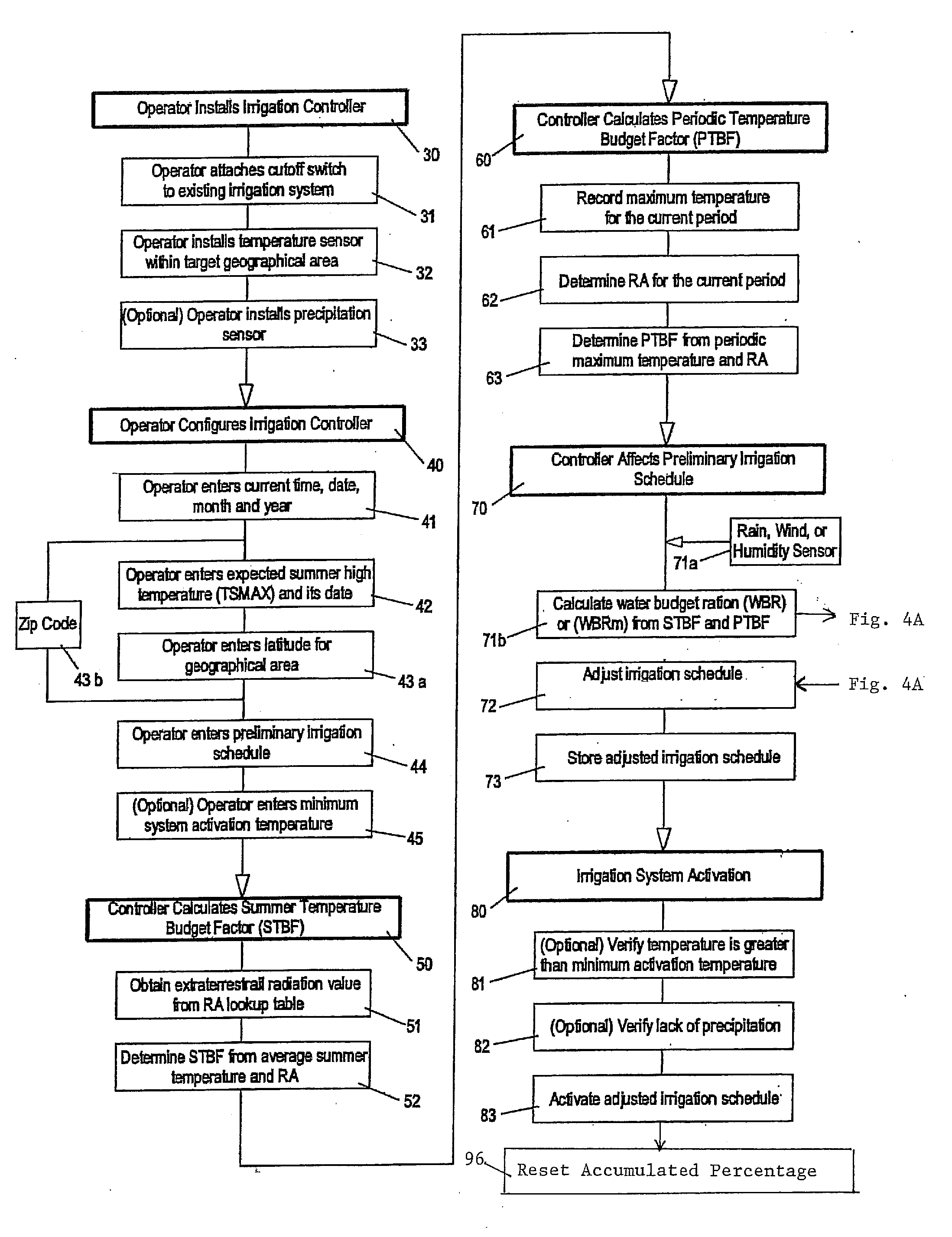
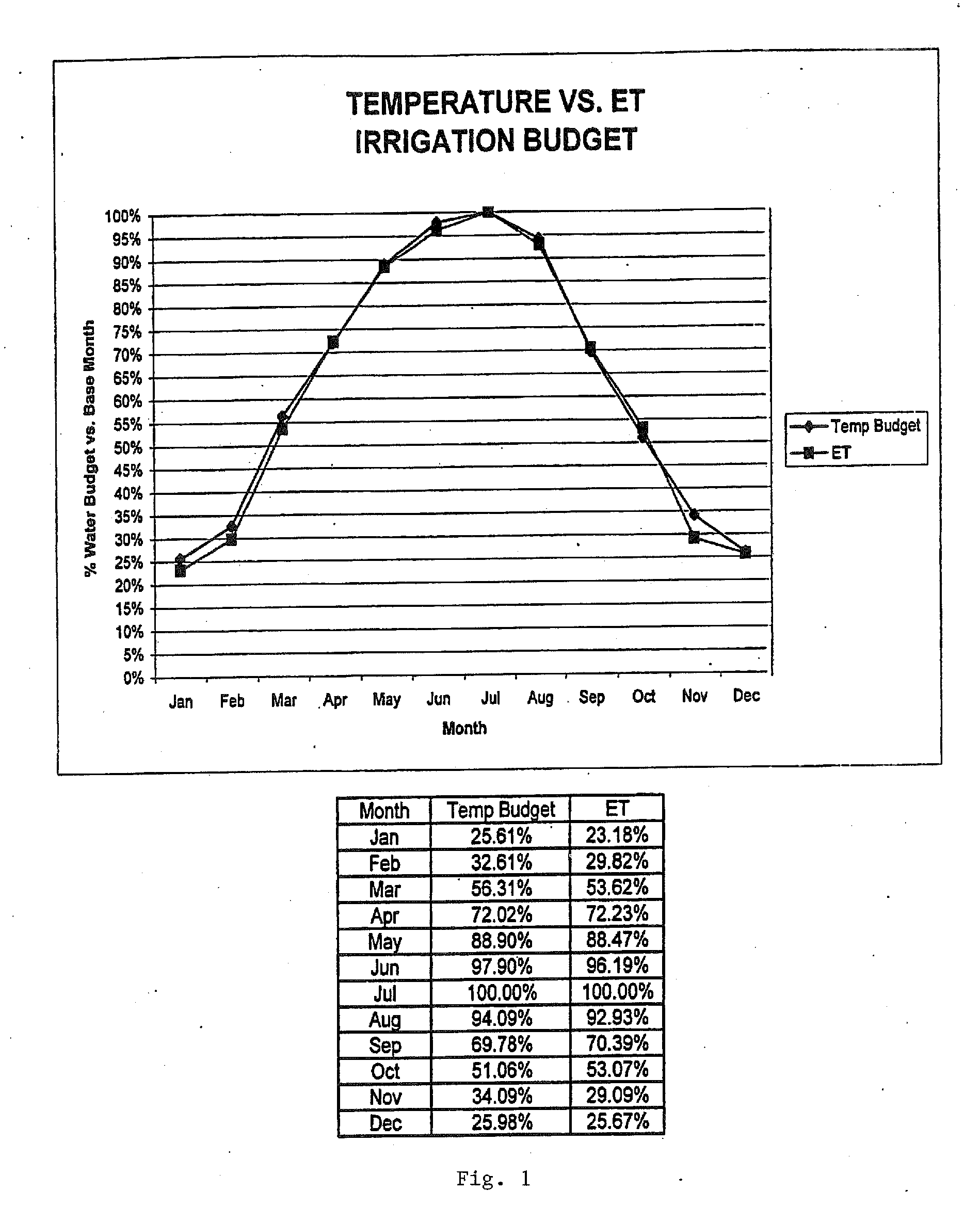
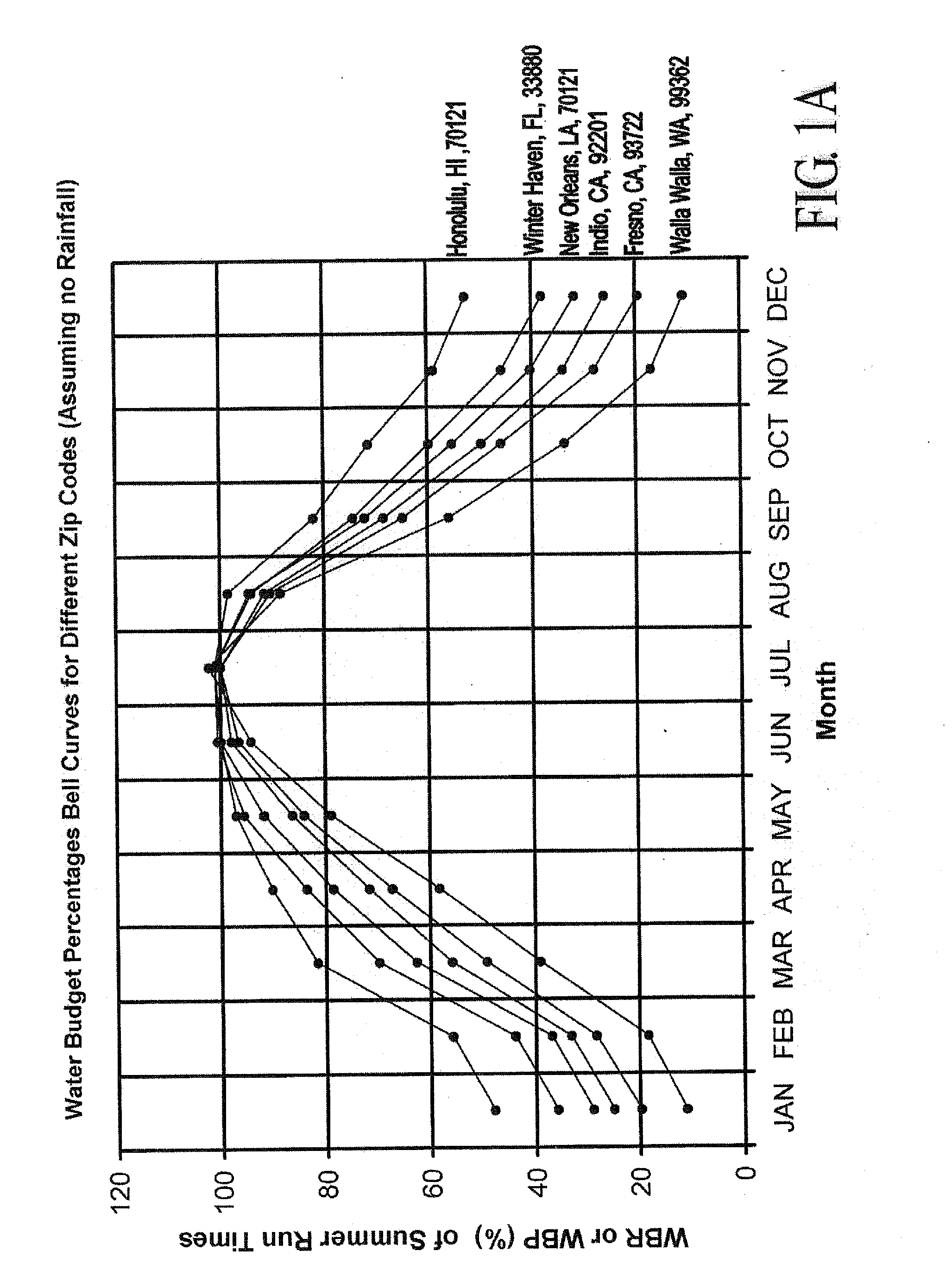
- The implementation of automated water budgeting methods using temperature budgeting, soil moisture, or historical ET data to adjust irrigation schedules, eliminating the need for complex ET calculations and reducing the reliance on expensive weather stations and sensors, allowing for simple, intuitive water conservation through pre-determined periodic adjustments.

Methods and systems for irrigation control
PatentActiveUS20190307084A1
Innovation
- A wireless monitoring and control system that utilizes a network of sensor nodes and a remote server to collect data on environmental and soil conditions, allowing for real-time adjustments to irrigation schedules based on weather, soil moisture, and evapotranspiration rates, enabling remote access and control through cellular or satellite networks.


Environmental Regulations for Water Management
Environmental regulations for water management have become increasingly stringent as governments worldwide recognize the critical importance of water conservation and sustainable agricultural practices. These regulatory frameworks directly impact the deployment and operation of smart irrigation controllers, particularly in extreme weather scenarios where water scarcity and conservation measures are most critical.
The regulatory landscape encompasses multiple levels of governance, from international water management treaties to local municipal water use ordinances. At the federal level, regulations such as the Clean Water Act in the United States and the Water Framework Directive in the European Union establish baseline standards for water quality and usage efficiency. These frameworks mandate specific water conservation targets and require agricultural operations to demonstrate measurable improvements in irrigation efficiency, creating a favorable regulatory environment for smart irrigation technology adoption.
Regional water management authorities have implemented tiered water pricing structures and usage restrictions that become more severe during drought conditions. California's Model Water Efficient Landscape Ordinance, for example, requires new irrigation systems to meet specific efficiency standards and mandates the use of weather-based irrigation controllers in commercial applications. Similar regulations in Australia's Murray-Darling Basin require real-time monitoring and reporting of water usage, making smart controllers essential for compliance.
Extreme weather events have prompted emergency water use regulations that can be activated rapidly during crisis periods. These temporary measures often include mandatory irrigation scheduling restrictions, complete watering bans during specific hours, and requirements for immediate system shutdowns during severe weather warnings. Smart irrigation controllers must be capable of receiving and implementing these regulatory commands automatically to ensure compliance.
Certification and standards compliance represent another crucial regulatory dimension. Organizations such as the Irrigation Association and EPA WaterSense program have established performance criteria that smart controllers must meet to qualify for rebates and regulatory approval. These standards specifically address performance during extreme weather conditions, requiring controllers to demonstrate reliable operation during temperature extremes, high winds, and precipitation events.
The regulatory trend is moving toward mandatory integration with regional water management systems, requiring controllers to communicate with centralized monitoring networks and respond to real-time regulatory directives during extreme weather emergencies.
The regulatory landscape encompasses multiple levels of governance, from international water management treaties to local municipal water use ordinances. At the federal level, regulations such as the Clean Water Act in the United States and the Water Framework Directive in the European Union establish baseline standards for water quality and usage efficiency. These frameworks mandate specific water conservation targets and require agricultural operations to demonstrate measurable improvements in irrigation efficiency, creating a favorable regulatory environment for smart irrigation technology adoption.
Regional water management authorities have implemented tiered water pricing structures and usage restrictions that become more severe during drought conditions. California's Model Water Efficient Landscape Ordinance, for example, requires new irrigation systems to meet specific efficiency standards and mandates the use of weather-based irrigation controllers in commercial applications. Similar regulations in Australia's Murray-Darling Basin require real-time monitoring and reporting of water usage, making smart controllers essential for compliance.
Extreme weather events have prompted emergency water use regulations that can be activated rapidly during crisis periods. These temporary measures often include mandatory irrigation scheduling restrictions, complete watering bans during specific hours, and requirements for immediate system shutdowns during severe weather warnings. Smart irrigation controllers must be capable of receiving and implementing these regulatory commands automatically to ensure compliance.
Certification and standards compliance represent another crucial regulatory dimension. Organizations such as the Irrigation Association and EPA WaterSense program have established performance criteria that smart controllers must meet to qualify for rebates and regulatory approval. These standards specifically address performance during extreme weather conditions, requiring controllers to demonstrate reliable operation during temperature extremes, high winds, and precipitation events.
The regulatory trend is moving toward mandatory integration with regional water management systems, requiring controllers to communicate with centralized monitoring networks and respond to real-time regulatory directives during extreme weather emergencies.
Climate Change Impact on Irrigation Technology
Climate change represents one of the most significant challenges facing modern irrigation technology, fundamentally altering the operational parameters and performance requirements for smart irrigation systems. Rising global temperatures, shifting precipitation patterns, and increased frequency of extreme weather events are creating unprecedented demands on agricultural water management systems that were originally designed for more predictable climatic conditions.
The intensification of weather extremes directly impacts the reliability and effectiveness of smart irrigation controllers. Extended drought periods require these systems to operate with minimal water resources while maintaining crop productivity, pushing sensor accuracy and water optimization algorithms to their limits. Conversely, sudden intense rainfall events can overwhelm soil moisture sensors and disrupt communication networks, leading to system malfunctions and inappropriate irrigation scheduling.
Temperature fluctuations pose additional challenges for irrigation technology performance. Extreme heat can cause sensor drift, reduce battery life in wireless components, and affect the accuracy of evapotranspiration calculations that form the basis of intelligent irrigation decisions. Cold snaps can freeze water lines, damage electronic components, and render soil moisture measurements unreliable due to ice formation in the soil matrix.
The changing climate also affects crop water requirements in ways that existing irrigation algorithms may not adequately address. Traditional models based on historical weather data become less reliable as climate patterns shift, requiring continuous recalibration and adaptive learning capabilities in smart irrigation systems. This necessitates more sophisticated predictive modeling that can account for climate variability and uncertainty.
Furthermore, climate change impacts extend beyond immediate weather effects to include long-term shifts in growing seasons, crop selection, and regional water availability. Smart irrigation controllers must evolve to accommodate these broader changes, incorporating climate projection data and adaptive management strategies that can respond to both short-term weather variations and long-term climatic trends.
The integration of climate resilience into irrigation technology design has become essential for ensuring agricultural sustainability and food security in an era of unprecedented environmental change.
The intensification of weather extremes directly impacts the reliability and effectiveness of smart irrigation controllers. Extended drought periods require these systems to operate with minimal water resources while maintaining crop productivity, pushing sensor accuracy and water optimization algorithms to their limits. Conversely, sudden intense rainfall events can overwhelm soil moisture sensors and disrupt communication networks, leading to system malfunctions and inappropriate irrigation scheduling.
Temperature fluctuations pose additional challenges for irrigation technology performance. Extreme heat can cause sensor drift, reduce battery life in wireless components, and affect the accuracy of evapotranspiration calculations that form the basis of intelligent irrigation decisions. Cold snaps can freeze water lines, damage electronic components, and render soil moisture measurements unreliable due to ice formation in the soil matrix.
The changing climate also affects crop water requirements in ways that existing irrigation algorithms may not adequately address. Traditional models based on historical weather data become less reliable as climate patterns shift, requiring continuous recalibration and adaptive learning capabilities in smart irrigation systems. This necessitates more sophisticated predictive modeling that can account for climate variability and uncertainty.
Furthermore, climate change impacts extend beyond immediate weather effects to include long-term shifts in growing seasons, crop selection, and regional water availability. Smart irrigation controllers must evolve to accommodate these broader changes, incorporating climate projection data and adaptive management strategies that can respond to both short-term weather variations and long-term climatic trends.
The integration of climate resilience into irrigation technology design has become essential for ensuring agricultural sustainability and food security in an era of unprecedented environmental change.
Unlock deeper insights with Patsnap Eureka Quick Research — get a full tech report to explore trends and direct your research. Try now!
Generate Your Research Report Instantly with AI Agent
Supercharge your innovation with Patsnap Eureka AI Agent Platform!