Solid-State Lidar vs Microwave Sensors: Efficiency in Target Tracking
APR 27, 20269 MIN READ
Generate Your Research Report Instantly with AI Agent
PatSnap Eureka helps you evaluate technical feasibility & market potential.
Solid-State Lidar and Microwave Sensor Technology Background
Solid-state lidar technology emerged from the evolution of traditional mechanical scanning lidar systems, addressing critical limitations in durability, size, and cost-effectiveness. Unlike conventional rotating lidar systems that rely on mechanical components, solid-state variants utilize electronic beam steering mechanisms, including optical phased arrays, MEMS mirrors, and flash illumination techniques. This technological shift began gaining momentum in the early 2010s, driven by automotive industry demands for reliable autonomous driving sensors.
The development trajectory of solid-state lidar has been marked by significant breakthroughs in semiconductor manufacturing and photonic integration. Key milestones include the miniaturization of laser sources, advancement in silicon photonics, and the integration of time-of-flight measurement circuits on single chips. These innovations have enabled manufacturers to produce compact, robust sensors capable of generating high-resolution 3D point clouds for precise target detection and tracking applications.
Microwave sensor technology, conversely, has a longer developmental history rooted in radar applications dating back to World War II. Modern microwave sensors for target tracking leverage continuous wave and frequency-modulated continuous wave principles, operating primarily in the 24GHz, 77GHz, and 79GHz frequency bands. The technology has evolved from bulky military radar systems to compact automotive and industrial sensors through advances in millimeter-wave integrated circuits and antenna design.
The convergence of these technologies in target tracking applications represents a significant technological milestone. Solid-state lidar excels in providing precise spatial resolution and detailed environmental mapping, while microwave sensors offer superior performance in adverse weather conditions and long-range detection capabilities. The integration challenges involve synchronizing different data acquisition rates, coordinate system alignment, and real-time processing of heterogeneous sensor data.
Current technological objectives focus on achieving seamless sensor fusion architectures that leverage the complementary strengths of both technologies. Research efforts concentrate on developing unified processing algorithms, reducing power consumption, and enhancing detection accuracy across diverse environmental conditions. The ultimate goal involves creating cost-effective, reliable target tracking systems that maintain high performance standards while meeting stringent automotive and industrial safety requirements.
The development trajectory of solid-state lidar has been marked by significant breakthroughs in semiconductor manufacturing and photonic integration. Key milestones include the miniaturization of laser sources, advancement in silicon photonics, and the integration of time-of-flight measurement circuits on single chips. These innovations have enabled manufacturers to produce compact, robust sensors capable of generating high-resolution 3D point clouds for precise target detection and tracking applications.
Microwave sensor technology, conversely, has a longer developmental history rooted in radar applications dating back to World War II. Modern microwave sensors for target tracking leverage continuous wave and frequency-modulated continuous wave principles, operating primarily in the 24GHz, 77GHz, and 79GHz frequency bands. The technology has evolved from bulky military radar systems to compact automotive and industrial sensors through advances in millimeter-wave integrated circuits and antenna design.
The convergence of these technologies in target tracking applications represents a significant technological milestone. Solid-state lidar excels in providing precise spatial resolution and detailed environmental mapping, while microwave sensors offer superior performance in adverse weather conditions and long-range detection capabilities. The integration challenges involve synchronizing different data acquisition rates, coordinate system alignment, and real-time processing of heterogeneous sensor data.
Current technological objectives focus on achieving seamless sensor fusion architectures that leverage the complementary strengths of both technologies. Research efforts concentrate on developing unified processing algorithms, reducing power consumption, and enhancing detection accuracy across diverse environmental conditions. The ultimate goal involves creating cost-effective, reliable target tracking systems that maintain high performance standards while meeting stringent automotive and industrial safety requirements.
Market Demand Analysis for Advanced Target Tracking Systems
The global target tracking systems market is experiencing unprecedented growth driven by escalating security concerns, autonomous vehicle development, and industrial automation requirements. Defense and aerospace sectors represent the largest demand segment, where precision tracking capabilities are critical for surveillance, missile defense, and unmanned aerial vehicle operations. The increasing geopolitical tensions and modernization of military infrastructure worldwide have intensified the need for advanced tracking technologies that can operate effectively in diverse environmental conditions.
Automotive industry demand is rapidly expanding as manufacturers accelerate autonomous driving development programs. Advanced driver assistance systems and fully autonomous vehicles require robust target tracking capabilities to detect and monitor pedestrians, vehicles, and obstacles in real-time. The transition from traditional mechanical scanning systems to solid-state solutions is particularly pronounced in this sector, where reliability, compact form factor, and cost-effectiveness are paramount considerations.
Industrial automation and robotics applications constitute another significant demand driver, particularly in manufacturing, logistics, and warehouse operations. Automated guided vehicles, robotic arms, and conveyor systems require precise object detection and tracking capabilities to optimize operational efficiency and ensure safety protocols. The growing adoption of Industry 4.0 principles has accelerated the integration of advanced sensing technologies across manufacturing facilities globally.
Smart city initiatives and infrastructure monitoring represent emerging demand segments with substantial growth potential. Traffic management systems, perimeter security, and crowd monitoring applications require sophisticated tracking capabilities that can distinguish between different target types while maintaining high accuracy rates. The integration of tracking systems with artificial intelligence and machine learning algorithms has enhanced their appeal for municipal and commercial security applications.
Weather monitoring and environmental sensing applications have created specialized demand for tracking systems capable of operating in harsh conditions. Meteorological organizations and research institutions require sensors that can track precipitation, wind patterns, and atmospheric phenomena with high precision. The ability to differentiate between various environmental targets while maintaining consistent performance across temperature and humidity variations has become increasingly important.
The market exhibits distinct regional variations in demand patterns, with North America and Europe leading in defense applications, while Asia-Pacific demonstrates the strongest growth in automotive and industrial segments. Emerging markets are increasingly adopting advanced tracking technologies for border security and critical infrastructure protection, creating new opportunities for both solid-state lidar and microwave sensor technologies.
Automotive industry demand is rapidly expanding as manufacturers accelerate autonomous driving development programs. Advanced driver assistance systems and fully autonomous vehicles require robust target tracking capabilities to detect and monitor pedestrians, vehicles, and obstacles in real-time. The transition from traditional mechanical scanning systems to solid-state solutions is particularly pronounced in this sector, where reliability, compact form factor, and cost-effectiveness are paramount considerations.
Industrial automation and robotics applications constitute another significant demand driver, particularly in manufacturing, logistics, and warehouse operations. Automated guided vehicles, robotic arms, and conveyor systems require precise object detection and tracking capabilities to optimize operational efficiency and ensure safety protocols. The growing adoption of Industry 4.0 principles has accelerated the integration of advanced sensing technologies across manufacturing facilities globally.
Smart city initiatives and infrastructure monitoring represent emerging demand segments with substantial growth potential. Traffic management systems, perimeter security, and crowd monitoring applications require sophisticated tracking capabilities that can distinguish between different target types while maintaining high accuracy rates. The integration of tracking systems with artificial intelligence and machine learning algorithms has enhanced their appeal for municipal and commercial security applications.
Weather monitoring and environmental sensing applications have created specialized demand for tracking systems capable of operating in harsh conditions. Meteorological organizations and research institutions require sensors that can track precipitation, wind patterns, and atmospheric phenomena with high precision. The ability to differentiate between various environmental targets while maintaining consistent performance across temperature and humidity variations has become increasingly important.
The market exhibits distinct regional variations in demand patterns, with North America and Europe leading in defense applications, while Asia-Pacific demonstrates the strongest growth in automotive and industrial segments. Emerging markets are increasingly adopting advanced tracking technologies for border security and critical infrastructure protection, creating new opportunities for both solid-state lidar and microwave sensor technologies.
Current Challenges in Lidar vs Microwave Sensor Efficiency
Solid-state lidar systems face significant challenges in achieving optimal target tracking efficiency, particularly in adverse weather conditions. Rain, fog, and snow can severely attenuate laser signals, reducing detection range and accuracy. The shorter wavelengths used in lidar systems make them more susceptible to scattering effects, leading to decreased performance when atmospheric particles interfere with optical transmission paths.
Power consumption remains a critical constraint for solid-state lidar implementations. Current systems require substantial energy to generate high-intensity laser pulses while maintaining adequate refresh rates for real-time tracking applications. This limitation becomes particularly pronounced in mobile platforms where battery life directly impacts operational duration and system viability.
Microwave sensors encounter distinct efficiency challenges related to resolution limitations and interference susceptibility. The longer wavelengths inherent to microwave technology result in lower spatial resolution compared to optical systems, making precise target discrimination difficult in cluttered environments. Multi-target scenarios present additional complexity as overlapping radar returns can create ambiguous tracking situations.
Signal processing complexity represents a shared challenge across both technologies. Solid-state lidar systems must handle massive point cloud datasets in real-time, requiring sophisticated algorithms to extract meaningful target information while filtering environmental noise. The computational overhead associated with processing three-dimensional spatial data often exceeds available processing capabilities in resource-constrained applications.
Microwave sensors struggle with clutter rejection and false alarm rates, particularly in urban environments where metallic structures create multiple reflection paths. Ground clutter and weather-related backscatter further complicate target identification processes, requiring advanced signal processing techniques that increase system complexity and cost.
Cost-performance optimization presents ongoing challenges for both sensor types. Solid-state lidar components, particularly laser sources and detector arrays, remain expensive despite recent manufacturing advances. Microwave systems face similar economic pressures related to high-frequency component costs and specialized signal processing hardware requirements.
Integration challenges emerge when attempting to combine multiple sensor modalities for enhanced tracking performance. Synchronization issues, data fusion complexity, and calibration requirements create additional technical hurdles that must be addressed to achieve optimal system efficiency in practical deployment scenarios.
Power consumption remains a critical constraint for solid-state lidar implementations. Current systems require substantial energy to generate high-intensity laser pulses while maintaining adequate refresh rates for real-time tracking applications. This limitation becomes particularly pronounced in mobile platforms where battery life directly impacts operational duration and system viability.
Microwave sensors encounter distinct efficiency challenges related to resolution limitations and interference susceptibility. The longer wavelengths inherent to microwave technology result in lower spatial resolution compared to optical systems, making precise target discrimination difficult in cluttered environments. Multi-target scenarios present additional complexity as overlapping radar returns can create ambiguous tracking situations.
Signal processing complexity represents a shared challenge across both technologies. Solid-state lidar systems must handle massive point cloud datasets in real-time, requiring sophisticated algorithms to extract meaningful target information while filtering environmental noise. The computational overhead associated with processing three-dimensional spatial data often exceeds available processing capabilities in resource-constrained applications.
Microwave sensors struggle with clutter rejection and false alarm rates, particularly in urban environments where metallic structures create multiple reflection paths. Ground clutter and weather-related backscatter further complicate target identification processes, requiring advanced signal processing techniques that increase system complexity and cost.
Cost-performance optimization presents ongoing challenges for both sensor types. Solid-state lidar components, particularly laser sources and detector arrays, remain expensive despite recent manufacturing advances. Microwave systems face similar economic pressures related to high-frequency component costs and specialized signal processing hardware requirements.
Integration challenges emerge when attempting to combine multiple sensor modalities for enhanced tracking performance. Synchronization issues, data fusion complexity, and calibration requirements create additional technical hurdles that must be addressed to achieve optimal system efficiency in practical deployment scenarios.
Current Target Tracking Solutions and Methodologies
01 Solid-state lidar system design and architecture
Advanced solid-state lidar systems utilize innovative architectural designs to improve detection efficiency and reliability. These systems incorporate specialized optical components, beam steering mechanisms, and integrated circuits to eliminate moving parts while maintaining high-performance sensing capabilities. The designs focus on compact form factors, enhanced durability, and improved signal processing for various applications including autonomous vehicles and industrial automation.- Solid-state lidar system design and architecture: Advanced solid-state lidar systems utilize innovative architectures to improve detection efficiency and reliability. These systems eliminate mechanical moving parts through electronic beam steering and advanced optical components, resulting in enhanced durability and reduced maintenance requirements. The designs focus on optimizing light detection and ranging capabilities while maintaining compact form factors suitable for various applications.
- Microwave sensor signal processing and detection methods: Microwave sensors employ sophisticated signal processing techniques to enhance detection accuracy and reduce false alarms. These methods include advanced filtering algorithms, noise reduction techniques, and multi-frequency analysis to improve sensor performance in various environmental conditions. The processing systems are designed to handle complex signal patterns and provide reliable detection capabilities.
- Integration and fusion of lidar and microwave sensor technologies: Combined sensor systems integrate both lidar and microwave technologies to achieve superior detection performance through sensor fusion techniques. These hybrid approaches leverage the complementary strengths of both sensing modalities, providing enhanced accuracy, range, and reliability. The integration methods focus on optimizing data correlation and processing efficiency between different sensor types.
- Power management and energy efficiency optimization: Energy-efficient designs for sensor systems focus on reducing power consumption while maintaining high performance levels. These approaches include intelligent power management circuits, adaptive sensing modes, and optimized operational algorithms that extend battery life and reduce thermal generation. The systems are designed to balance performance requirements with energy conservation needs.
- Environmental adaptation and performance enhancement: Sensor systems incorporate adaptive mechanisms to maintain efficiency across varying environmental conditions including weather, temperature, and interference scenarios. These enhancements include automatic calibration systems, environmental compensation algorithms, and robust design features that ensure consistent performance. The technologies focus on maintaining sensor accuracy and reliability in challenging operational environments.
02 Microwave sensor signal processing and detection methods
Microwave sensors employ sophisticated signal processing techniques to enhance detection accuracy and reduce interference. These methods include advanced filtering algorithms, frequency modulation techniques, and multi-channel processing to improve target identification and range measurement. The processing systems are designed to handle complex electromagnetic environments while maintaining high sensitivity and selectivity.Expand Specific Solutions03 Hybrid sensor fusion and integration technologies
Integration of solid-state lidar and microwave sensors creates synergistic sensing systems that leverage the strengths of both technologies. These hybrid approaches combine the precise distance measurement capabilities of lidar with the weather-resistant properties of microwave sensors. The fusion algorithms process data from multiple sensor types to provide enhanced environmental perception and improved reliability under various operating conditions.Expand Specific Solutions04 Power management and efficiency optimization
Efficient power management systems are crucial for maximizing the operational efficiency of solid-state lidar and microwave sensors. These systems implement dynamic power control, sleep modes, and optimized duty cycles to reduce energy consumption while maintaining performance standards. Advanced power management includes thermal regulation, voltage optimization, and intelligent scheduling of sensor operations.Expand Specific Solutions05 Environmental adaptation and calibration techniques
Adaptive calibration and environmental compensation methods ensure consistent sensor performance across varying conditions. These techniques include automatic gain control, temperature compensation, atmospheric correction algorithms, and real-time calibration adjustments. The systems are designed to maintain accuracy and reliability in challenging environments such as extreme weather, varying lighting conditions, and electromagnetic interference scenarios.Expand Specific Solutions
Major Players in Lidar and Microwave Sensor Markets
The solid-state LiDAR versus microwave sensors competition for target tracking represents a rapidly evolving market in the growth phase, driven by autonomous vehicle development and industrial automation demands. The market demonstrates significant scale potential, with established players like Hesai Technology, Huawei, and Bosch leading LiDAR innovations, while companies such as NEC, Intel, and Samsung advance microwave sensor technologies. Technology maturity varies considerably - solid-state LiDAR shows promising advancement through companies like Ouster Technologies and RoboSense, offering higher resolution and precision for target tracking, while microwave sensors provide cost-effective, weather-resistant solutions. The competitive landscape features diverse participants from specialized LiDAR manufacturers like Hybrid Lidar Systems to electronics giants like Sony Semiconductor Solutions and automotive suppliers including ZF and Astemo, indicating strong market validation and investment confidence across both sensing modalities.
Hesai Technology Co. Ltd.
Technical Solution: Hesai develops advanced solid-state lidar systems utilizing hybrid solid-state architecture with rotating mirror technology. Their AT128 lidar features 128-channel detection with 200-meter range capability and 0.1-degree angular resolution for precise target tracking. The system employs advanced signal processing algorithms with multi-echo detection and velocity measurement capabilities, enabling accurate tracking of multiple targets simultaneously. Their lidar technology demonstrates superior performance in adverse weather conditions compared to traditional microwave sensors, with millimeter-level precision in distance measurement and enhanced object classification through point cloud density analysis.
Strengths: High precision tracking with millimeter accuracy, excellent weather resistance, superior object classification capabilities. Weaknesses: Higher power consumption compared to microwave sensors, more expensive manufacturing costs, potential interference from ambient light conditions.
Huawei Technologies Co., Ltd.
Technical Solution: Huawei develops intelligent sensing solutions combining solid-state lidar with millimeter-wave radar technology for comprehensive target tracking systems. Their approach utilizes 96-channel solid-state lidar with 150-meter detection range integrated with 79GHz microwave sensors for complementary sensing capabilities. The system features AI-powered sensor fusion algorithms that dynamically optimize between lidar and radar data based on environmental conditions and target characteristics. Their solution achieves 95% tracking accuracy in various weather conditions while maintaining low latency of less than 50ms for real-time applications, particularly optimized for smart city and autonomous vehicle applications.
Strengths: Advanced AI-powered sensor fusion, optimized for smart city applications, low latency performance. Weaknesses: Dependency on complex AI algorithms, potential performance degradation in extreme weather, high computational requirements.
Core Patents in Solid-State Lidar and Microwave Integration
Solid-state electronic light detection and ranging (LIDAR)
PatentActiveEP3289383A1
Innovation
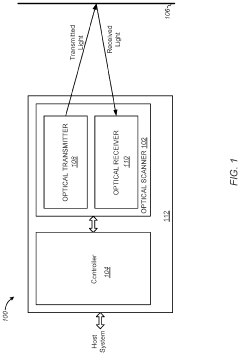
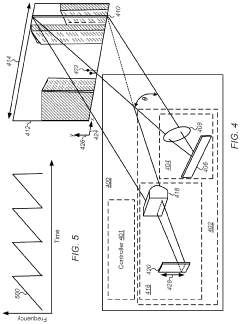
- A solid-state electronic LIDAR system utilizing electrically controllable light-direction-changing elements to generate successive diffraction grating patterns, allowing for precise control of a laser beam's direction and intensity maxima across a field of view without mechanical moving parts.
High Contrast MEMS Phased-Array
PatentActiveUS20220260687A1
Innovation
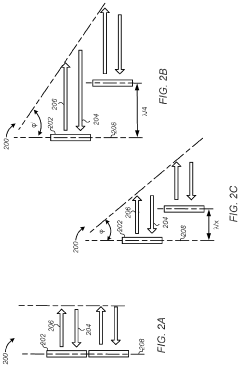
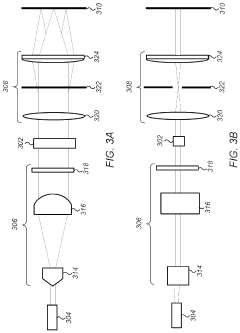
- The implementation of a microelectromechanical system (MEMS) phased-array optical system that uses a light source with a Gaussian-profile illumination and ribbon MEMS phased-arrays with offset ribbons from a blaze pattern to minimize side-lobes, enhancing contrast and beam steering capabilities within a defined field of view.
Automotive Safety Standards for Advanced Driver Systems
The automotive industry's integration of solid-state LiDAR and microwave sensors for target tracking applications must comply with a comprehensive framework of safety standards designed to ensure reliable performance in advanced driver assistance systems. These standards establish critical benchmarks for sensor accuracy, response times, and fail-safe mechanisms that directly impact the effectiveness of both sensing technologies.
ISO 26262, the functional safety standard for automotive systems, provides the foundational framework governing the development and deployment of both solid-state LiDAR and microwave sensor systems. This standard mandates rigorous hazard analysis and risk assessment procedures, requiring manufacturers to demonstrate that sensor-based target tracking systems can achieve appropriate Safety Integrity Levels (SIL) ranging from ASIL-A to ASIL-D depending on the criticality of the application.
The ISO 21448 standard, specifically addressing Safety of the Intended Functionality (SOTIF), becomes particularly relevant when comparing LiDAR and microwave sensor performance in target tracking scenarios. This standard addresses potential hazards arising from performance limitations and foreseeable misuse, requiring comprehensive validation of sensor capabilities across diverse environmental conditions including adverse weather, lighting variations, and complex traffic scenarios.
SAE J3016 levels of driving automation establish performance requirements that both sensor technologies must meet for different autonomous driving applications. Level 2 and Level 3 systems require sensors to maintain continuous monitoring capabilities with defined performance envelopes, while Level 4 and Level 5 applications demand higher reliability standards and redundancy measures that influence sensor selection criteria.
The UN-ECE WP.29 regulations, particularly those addressing Automated Lane Keeping Systems (ALKS) and other automated driving functions, specify minimum performance requirements for environmental perception systems. These regulations establish standardized test procedures for evaluating sensor performance in target detection, classification, and tracking accuracy under various operational design domains.
NHTSA guidelines and IIHS testing protocols provide additional safety benchmarks that influence the comparative evaluation of solid-state LiDAR versus microwave sensors. These standards emphasize real-world performance validation through standardized test scenarios that assess sensor reliability in preventing collisions and maintaining safe following distances during target tracking operations.
ISO 26262, the functional safety standard for automotive systems, provides the foundational framework governing the development and deployment of both solid-state LiDAR and microwave sensor systems. This standard mandates rigorous hazard analysis and risk assessment procedures, requiring manufacturers to demonstrate that sensor-based target tracking systems can achieve appropriate Safety Integrity Levels (SIL) ranging from ASIL-A to ASIL-D depending on the criticality of the application.
The ISO 21448 standard, specifically addressing Safety of the Intended Functionality (SOTIF), becomes particularly relevant when comparing LiDAR and microwave sensor performance in target tracking scenarios. This standard addresses potential hazards arising from performance limitations and foreseeable misuse, requiring comprehensive validation of sensor capabilities across diverse environmental conditions including adverse weather, lighting variations, and complex traffic scenarios.
SAE J3016 levels of driving automation establish performance requirements that both sensor technologies must meet for different autonomous driving applications. Level 2 and Level 3 systems require sensors to maintain continuous monitoring capabilities with defined performance envelopes, while Level 4 and Level 5 applications demand higher reliability standards and redundancy measures that influence sensor selection criteria.
The UN-ECE WP.29 regulations, particularly those addressing Automated Lane Keeping Systems (ALKS) and other automated driving functions, specify minimum performance requirements for environmental perception systems. These regulations establish standardized test procedures for evaluating sensor performance in target detection, classification, and tracking accuracy under various operational design domains.
NHTSA guidelines and IIHS testing protocols provide additional safety benchmarks that influence the comparative evaluation of solid-state LiDAR versus microwave sensors. These standards emphasize real-world performance validation through standardized test scenarios that assess sensor reliability in preventing collisions and maintaining safe following distances during target tracking operations.
Environmental Impact of Solid-State Sensing Technologies
The environmental implications of solid-state sensing technologies, particularly solid-state LiDAR and microwave sensors used in target tracking applications, present a complex landscape of both benefits and challenges that require careful consideration across their entire lifecycle.
Manufacturing processes for solid-state LiDAR systems typically involve semiconductor fabrication techniques that consume significant energy and utilize various chemical compounds. The production of gallium arsenide and indium gallium arsenide components, commonly used in laser diodes, requires rare earth elements whose extraction can result in substantial environmental disruption. However, the absence of mechanical moving parts in solid-state designs reduces manufacturing complexity compared to traditional mechanical LiDAR systems, potentially lowering the overall carbon footprint during production.
Microwave sensor manufacturing generally demonstrates a more favorable environmental profile during production phases. These systems primarily utilize silicon-based semiconductors and standard electronic components, which have established recycling pathways and require less energy-intensive manufacturing processes. The simpler antenna structures and RF components typically involve more abundant materials, reducing dependency on rare earth elements.
Operational energy consumption patterns reveal significant differences between these technologies. Solid-state LiDAR systems typically require higher power consumption due to laser emission requirements and complex signal processing algorithms. Peak power demands can reach 15-30 watts for automotive-grade systems, contributing to increased energy consumption in battery-powered applications. Conversely, microwave sensors operate at substantially lower power levels, often consuming less than 5 watts, making them more suitable for energy-constrained environments.
The longevity and durability characteristics of solid-state technologies offer substantial environmental advantages over their mechanical counterparts. Solid-state LiDAR systems demonstrate enhanced resistance to vibration, temperature fluctuations, and mechanical wear, potentially extending operational lifespans to 10-15 years in automotive applications. This extended lifecycle reduces replacement frequency and associated environmental impacts from manufacturing and disposal processes.
End-of-life considerations present both opportunities and challenges for solid-state sensing technologies. While these systems contain valuable materials suitable for recovery and recycling, the integration of multiple material types within compact packages can complicate separation processes. Microwave sensors generally offer simpler recycling pathways due to their predominantly silicon-based composition and standard electronic packaging formats.
Manufacturing processes for solid-state LiDAR systems typically involve semiconductor fabrication techniques that consume significant energy and utilize various chemical compounds. The production of gallium arsenide and indium gallium arsenide components, commonly used in laser diodes, requires rare earth elements whose extraction can result in substantial environmental disruption. However, the absence of mechanical moving parts in solid-state designs reduces manufacturing complexity compared to traditional mechanical LiDAR systems, potentially lowering the overall carbon footprint during production.
Microwave sensor manufacturing generally demonstrates a more favorable environmental profile during production phases. These systems primarily utilize silicon-based semiconductors and standard electronic components, which have established recycling pathways and require less energy-intensive manufacturing processes. The simpler antenna structures and RF components typically involve more abundant materials, reducing dependency on rare earth elements.
Operational energy consumption patterns reveal significant differences between these technologies. Solid-state LiDAR systems typically require higher power consumption due to laser emission requirements and complex signal processing algorithms. Peak power demands can reach 15-30 watts for automotive-grade systems, contributing to increased energy consumption in battery-powered applications. Conversely, microwave sensors operate at substantially lower power levels, often consuming less than 5 watts, making them more suitable for energy-constrained environments.
The longevity and durability characteristics of solid-state technologies offer substantial environmental advantages over their mechanical counterparts. Solid-state LiDAR systems demonstrate enhanced resistance to vibration, temperature fluctuations, and mechanical wear, potentially extending operational lifespans to 10-15 years in automotive applications. This extended lifecycle reduces replacement frequency and associated environmental impacts from manufacturing and disposal processes.
End-of-life considerations present both opportunities and challenges for solid-state sensing technologies. While these systems contain valuable materials suitable for recovery and recycling, the integration of multiple material types within compact packages can complicate separation processes. Microwave sensors generally offer simpler recycling pathways due to their predominantly silicon-based composition and standard electronic packaging formats.
Unlock deeper insights with PatSnap Eureka Quick Research — get a full tech report to explore trends and direct your research. Try now!
Generate Your Research Report Instantly with AI Agent
Supercharge your innovation with PatSnap Eureka AI Agent Platform!