
Structural Steel vs. Composite Materials: Weight Efficiency in Design
JUN 9, 20269 MIN READ
Generate Your Research Report Instantly with AI Agent
Patsnap Eureka helps you evaluate technical feasibility & market potential.
Steel vs Composite Materials Background and Design Goals
The evolution of structural materials has been fundamentally driven by the perpetual quest for enhanced performance-to-weight ratios in engineering applications. Traditional structural steel, which dominated construction and manufacturing for over a century, established the foundation of modern infrastructure through its exceptional strength, ductility, and cost-effectiveness. However, the increasing demands for lightweight structures in aerospace, automotive, and advanced construction sectors have catalyzed the development and adoption of composite materials as viable alternatives.
Structural steel's historical significance stems from its predictable mechanical properties, established manufacturing processes, and comprehensive design codes that have been refined through decades of practical application. The material's homogeneous nature provides consistent strength characteristics, while its ability to undergo plastic deformation before failure offers inherent safety margins in structural design. These attributes have made steel the benchmark against which alternative materials are measured.
The emergence of composite materials, particularly fiber-reinforced polymers, represents a paradigm shift in material selection philosophy. These engineered materials combine high-strength fibers with polymer matrices to achieve superior strength-to-weight ratios compared to conventional metals. The directional properties of composites enable designers to optimize material placement according to load paths, potentially achieving significant weight reductions while maintaining structural integrity.
Contemporary design goals increasingly emphasize sustainability, energy efficiency, and performance optimization across multiple criteria. Weight reduction has become a critical objective, particularly in transportation applications where reduced mass directly translates to improved fuel efficiency and reduced environmental impact. In aerospace applications, every kilogram saved in structural weight enables increased payload capacity or extended range capabilities.
The comparative evaluation between steel and composite materials extends beyond simple weight considerations to encompass factors such as fatigue resistance, environmental durability, manufacturing complexity, and lifecycle costs. Modern design methodologies seek to leverage the unique advantages of each material class while mitigating their respective limitations through innovative design approaches and hybrid solutions.
Current technological objectives focus on developing comprehensive frameworks for material selection that consider not only immediate performance requirements but also long-term sustainability, repairability, and end-of-life considerations. The integration of advanced computational tools and multi-physics simulation capabilities enables more sophisticated optimization strategies that can fully exploit the potential of both traditional and advanced materials in achieving optimal weight efficiency.
Structural steel's historical significance stems from its predictable mechanical properties, established manufacturing processes, and comprehensive design codes that have been refined through decades of practical application. The material's homogeneous nature provides consistent strength characteristics, while its ability to undergo plastic deformation before failure offers inherent safety margins in structural design. These attributes have made steel the benchmark against which alternative materials are measured.
The emergence of composite materials, particularly fiber-reinforced polymers, represents a paradigm shift in material selection philosophy. These engineered materials combine high-strength fibers with polymer matrices to achieve superior strength-to-weight ratios compared to conventional metals. The directional properties of composites enable designers to optimize material placement according to load paths, potentially achieving significant weight reductions while maintaining structural integrity.
Contemporary design goals increasingly emphasize sustainability, energy efficiency, and performance optimization across multiple criteria. Weight reduction has become a critical objective, particularly in transportation applications where reduced mass directly translates to improved fuel efficiency and reduced environmental impact. In aerospace applications, every kilogram saved in structural weight enables increased payload capacity or extended range capabilities.
The comparative evaluation between steel and composite materials extends beyond simple weight considerations to encompass factors such as fatigue resistance, environmental durability, manufacturing complexity, and lifecycle costs. Modern design methodologies seek to leverage the unique advantages of each material class while mitigating their respective limitations through innovative design approaches and hybrid solutions.
Current technological objectives focus on developing comprehensive frameworks for material selection that consider not only immediate performance requirements but also long-term sustainability, repairability, and end-of-life considerations. The integration of advanced computational tools and multi-physics simulation capabilities enables more sophisticated optimization strategies that can fully exploit the potential of both traditional and advanced materials in achieving optimal weight efficiency.
Market Demand for Lightweight Structural Solutions
The global construction and manufacturing industries are experiencing unprecedented pressure to reduce structural weight while maintaining safety and performance standards. This demand stems from multiple converging factors that are reshaping material selection criteria across various sectors.
Environmental regulations and sustainability mandates are driving the construction industry toward lighter structural solutions. Building codes increasingly emphasize energy efficiency, where reduced structural weight directly correlates with lower foundation requirements, decreased transportation costs, and reduced carbon footprints during construction phases. Green building certifications now factor material efficiency as a critical component, creating market incentives for lightweight alternatives.
The aerospace and automotive sectors continue to be primary drivers of lightweight structural material demand. Fuel efficiency requirements and emission reduction targets necessitate continuous weight optimization without compromising structural integrity. These industries serve as testing grounds for advanced composite materials, creating spillover effects into construction and infrastructure applications.
Infrastructure modernization projects worldwide are increasingly specifying weight-efficient materials to extend service life and reduce maintenance requirements. Aging bridge networks, particularly in developed economies, require rehabilitation solutions that minimize additional load on existing foundations while providing enhanced durability. This creates substantial market opportunities for both advanced steel alloys and composite material systems.
The renewable energy sector presents significant growth potential for lightweight structural solutions. Wind turbine towers, solar panel mounting systems, and offshore platforms require materials that optimize strength-to-weight ratios while withstanding environmental stresses. Composite materials are gaining traction in these applications due to their corrosion resistance and design flexibility.
Market demand is also influenced by labor cost considerations and construction speed requirements. Lighter materials enable faster installation, reduced crane capacity requirements, and smaller construction crews, translating to significant cost savings in labor-intensive markets. This economic advantage is particularly pronounced in urban construction projects where site access and construction timeframes are constrained.
Emerging markets are driving demand for cost-effective lightweight solutions that can be manufactured locally while meeting international performance standards. This creates opportunities for hybrid approaches that combine traditional steel construction techniques with selective composite reinforcement in critical load-bearing applications.
Environmental regulations and sustainability mandates are driving the construction industry toward lighter structural solutions. Building codes increasingly emphasize energy efficiency, where reduced structural weight directly correlates with lower foundation requirements, decreased transportation costs, and reduced carbon footprints during construction phases. Green building certifications now factor material efficiency as a critical component, creating market incentives for lightweight alternatives.
The aerospace and automotive sectors continue to be primary drivers of lightweight structural material demand. Fuel efficiency requirements and emission reduction targets necessitate continuous weight optimization without compromising structural integrity. These industries serve as testing grounds for advanced composite materials, creating spillover effects into construction and infrastructure applications.
Infrastructure modernization projects worldwide are increasingly specifying weight-efficient materials to extend service life and reduce maintenance requirements. Aging bridge networks, particularly in developed economies, require rehabilitation solutions that minimize additional load on existing foundations while providing enhanced durability. This creates substantial market opportunities for both advanced steel alloys and composite material systems.
The renewable energy sector presents significant growth potential for lightweight structural solutions. Wind turbine towers, solar panel mounting systems, and offshore platforms require materials that optimize strength-to-weight ratios while withstanding environmental stresses. Composite materials are gaining traction in these applications due to their corrosion resistance and design flexibility.
Market demand is also influenced by labor cost considerations and construction speed requirements. Lighter materials enable faster installation, reduced crane capacity requirements, and smaller construction crews, translating to significant cost savings in labor-intensive markets. This economic advantage is particularly pronounced in urban construction projects where site access and construction timeframes are constrained.
Emerging markets are driving demand for cost-effective lightweight solutions that can be manufactured locally while meeting international performance standards. This creates opportunities for hybrid approaches that combine traditional steel construction techniques with selective composite reinforcement in critical load-bearing applications.
Current State of Steel and Composite Material Technologies
Structural steel technology has reached remarkable maturity in the construction and engineering sectors, with high-strength low-alloy steels and advanced manufacturing processes enabling strength-to-weight ratios of approximately 200-300 MPa·cm³/g. Modern steel grades such as S690 and S960 offer yield strengths exceeding 690 MPa while maintaining excellent weldability and ductility. Current steel processing techniques include controlled rolling, quenching and tempering, and thermomechanical treatment, which optimize microstructural properties for specific applications.
Composite material technologies have experienced rapid advancement, particularly in carbon fiber reinforced polymers and glass fiber composites. State-of-the-art carbon fiber composites achieve strength-to-weight ratios exceeding 1000 MPa·cm³/g, representing a significant advantage over traditional steel. Manufacturing processes have evolved from hand lay-up methods to automated fiber placement, resin transfer molding, and pultrusion techniques, enabling consistent quality and reduced production costs.
The aerospace and automotive industries have driven substantial innovations in both material categories. Steel manufacturers have developed ultra-high-strength steels with tensile strengths approaching 2000 MPa, while composite producers have introduced hybrid materials combining multiple fiber types and matrix systems. Advanced steel alloys now incorporate microalloying elements and sophisticated heat treatment protocols to achieve optimal mechanical properties.
Current composite technologies encompass various fiber architectures including unidirectional, woven, and braided configurations, each optimized for specific loading conditions. Resin systems have progressed from traditional thermosets to high-performance thermoplastics, offering improved recyclability and processing flexibility. Nanocomposite technologies are emerging, incorporating carbon nanotubes and graphene to enhance mechanical and electrical properties.
Manufacturing scalability remains a critical differentiator between these material systems. Steel production benefits from established infrastructure and standardized processes, enabling cost-effective large-scale manufacturing. Composite production, while advancing rapidly, still faces challenges in achieving comparable production volumes and cost competitiveness for mass-market applications.
Quality control and testing methodologies have evolved significantly for both materials. Non-destructive testing techniques including ultrasonic inspection, thermography, and digital image correlation provide comprehensive material characterization. Standardization efforts through organizations like ASTM and ISO have established robust testing protocols ensuring consistent material performance across different suppliers and applications.
Composite material technologies have experienced rapid advancement, particularly in carbon fiber reinforced polymers and glass fiber composites. State-of-the-art carbon fiber composites achieve strength-to-weight ratios exceeding 1000 MPa·cm³/g, representing a significant advantage over traditional steel. Manufacturing processes have evolved from hand lay-up methods to automated fiber placement, resin transfer molding, and pultrusion techniques, enabling consistent quality and reduced production costs.
The aerospace and automotive industries have driven substantial innovations in both material categories. Steel manufacturers have developed ultra-high-strength steels with tensile strengths approaching 2000 MPa, while composite producers have introduced hybrid materials combining multiple fiber types and matrix systems. Advanced steel alloys now incorporate microalloying elements and sophisticated heat treatment protocols to achieve optimal mechanical properties.
Current composite technologies encompass various fiber architectures including unidirectional, woven, and braided configurations, each optimized for specific loading conditions. Resin systems have progressed from traditional thermosets to high-performance thermoplastics, offering improved recyclability and processing flexibility. Nanocomposite technologies are emerging, incorporating carbon nanotubes and graphene to enhance mechanical and electrical properties.
Manufacturing scalability remains a critical differentiator between these material systems. Steel production benefits from established infrastructure and standardized processes, enabling cost-effective large-scale manufacturing. Composite production, while advancing rapidly, still faces challenges in achieving comparable production volumes and cost competitiveness for mass-market applications.
Quality control and testing methodologies have evolved significantly for both materials. Non-destructive testing techniques including ultrasonic inspection, thermography, and digital image correlation provide comprehensive material characterization. Standardization efforts through organizations like ASTM and ISO have established robust testing protocols ensuring consistent material performance across different suppliers and applications.
Existing Weight Optimization Solutions and Design Methods
01 Lightweight composite material structures
Development of composite materials that combine high strength with reduced weight through advanced fiber reinforcement and matrix optimization. These materials utilize carbon fiber, glass fiber, or other reinforcing elements in polymer matrices to achieve superior strength-to-weight ratios compared to traditional steel structures.- Lightweight composite material structures: Development of composite materials that combine high strength with reduced weight through advanced fiber reinforcement and matrix optimization. These materials utilize carbon fiber, glass fiber, or other reinforcing elements within polymer or ceramic matrices to achieve superior strength-to-weight ratios compared to traditional steel structures.
- Steel alloy optimization for weight reduction: Advanced steel formulations and processing techniques that maintain structural integrity while reducing overall weight. This includes high-strength low-alloy steels, microalloyed steels, and specialized heat treatment processes that enhance mechanical properties without increasing material density.
- Hybrid steel-composite construction methods: Integration techniques that combine steel frameworks with composite materials to optimize both weight and structural performance. These methods involve strategic placement of composite elements in non-critical load areas while maintaining steel in high-stress regions, achieving overall weight efficiency.
- Structural design optimization for material efficiency: Engineering approaches that focus on geometric optimization, hollow sections, and strategic material distribution to minimize weight while maintaining required load-bearing capacity. These designs utilize advanced modeling and simulation to identify optimal material placement and cross-sectional configurations.
- Advanced manufacturing processes for weight-efficient structures: Manufacturing techniques including additive manufacturing, precision forming, and automated layup processes that enable the production of complex geometries with minimal material waste. These processes allow for the creation of structures with optimized material distribution and reduced overall weight.
02 Steel alloy optimization for weight reduction
Advanced steel formulations and processing techniques that maintain structural integrity while reducing overall weight. This includes high-strength low-alloy steels, microalloyed steels, and specialized heat treatment processes that enhance mechanical properties per unit weight.Expand Specific Solutions03 Hybrid steel-composite construction methods
Integration techniques that combine steel frameworks with composite materials to optimize weight distribution and structural performance. These methods leverage the benefits of both materials through strategic placement and connection systems that maximize efficiency.Expand Specific Solutions04 Structural design optimization algorithms
Computational methods and design approaches that optimize material distribution and structural geometry to achieve maximum strength with minimum weight. These include topology optimization, finite element analysis, and advanced modeling techniques for efficient structural design.Expand Specific Solutions05 Manufacturing processes for weight-efficient structures
Specialized fabrication and manufacturing techniques that enable the production of lightweight steel and composite structures. These processes include advanced forming methods, joining techniques, and quality control measures that ensure structural integrity while minimizing material usage.Expand Specific Solutions
Key Players in Steel and Composite Materials Industry
The structural steel versus composite materials competition represents a mature industry undergoing significant technological transformation, with the global lightweight materials market valued at approximately $180 billion and projected to grow substantially driven by automotive and aerospace demands. The industry is in a transitional phase where traditional steel manufacturers like Baoshan Iron & Steel, JFE Steel Corp., and Hyundai Steel Co. compete against advanced composite specialists such as Hexcel Corp. and CSP Innovations. Technology maturity varies significantly across sectors, with aerospace leaders like Boeing and automotive giants including BMW and Mercedes-Benz Group driving composite adoption for weight reduction, while research institutions like MIT and Caltech advance next-generation materials. Chemical companies BASF and DuPont provide critical material innovations, positioning the market between established steel dominance and emerging composite superiority.
The Boeing Co.
Technical Solution: Boeing has developed advanced composite material solutions for aerospace applications, utilizing carbon fiber reinforced polymers (CFRP) that achieve up to 50% weight reduction compared to traditional aluminum structures while maintaining superior strength-to-weight ratios. Their composite manufacturing processes include automated fiber placement (AFP) and resin transfer molding (RTM) technologies, enabling precise control over fiber orientation and resin distribution. Boeing's 787 Dreamliner incorporates approximately 50% composite materials by weight, demonstrating significant fuel efficiency improvements through structural weight optimization.
Strengths: Industry-leading expertise in large-scale composite manufacturing, proven track record in commercial aviation applications. Weaknesses: High initial tooling costs and complex repair procedures for composite structures.
DuPont de Nemours, Inc.
Technical Solution: DuPont develops high-performance polymer composites and advanced materials that bridge the gap between traditional steel and full composite solutions. Their Kevlar aramid fibers and Zytel nylon resins create hybrid composite systems achieving 30-40% weight savings over steel while maintaining cost-effectiveness. DuPont's material solutions include glass fiber reinforced thermoplastics and carbon fiber hybrid systems that offer improved impact resistance and recyclability compared to thermoset composites, making them suitable for automotive and industrial applications where weight reduction and sustainability are critical design factors.
Strengths: Diverse material portfolio with strong chemical expertise and established automotive industry partnerships. Weaknesses: Lower specific strength compared to aerospace-grade composites and limited high-temperature performance.
Core Innovations in Composite-Steel Hybrid Structures
Composite reinforcement of metallic structural elements
PatentInactiveUS20060283133A1
Innovation
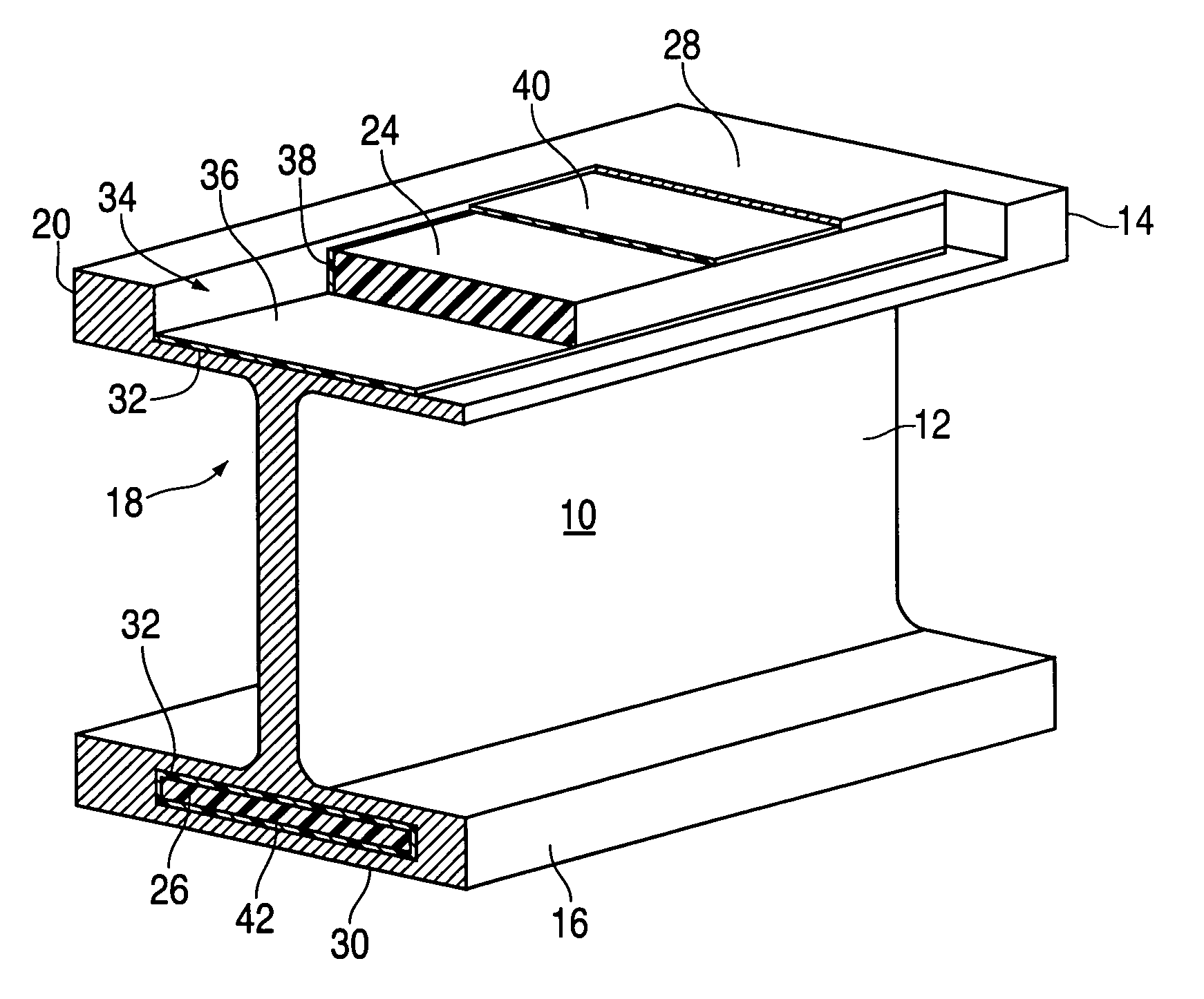
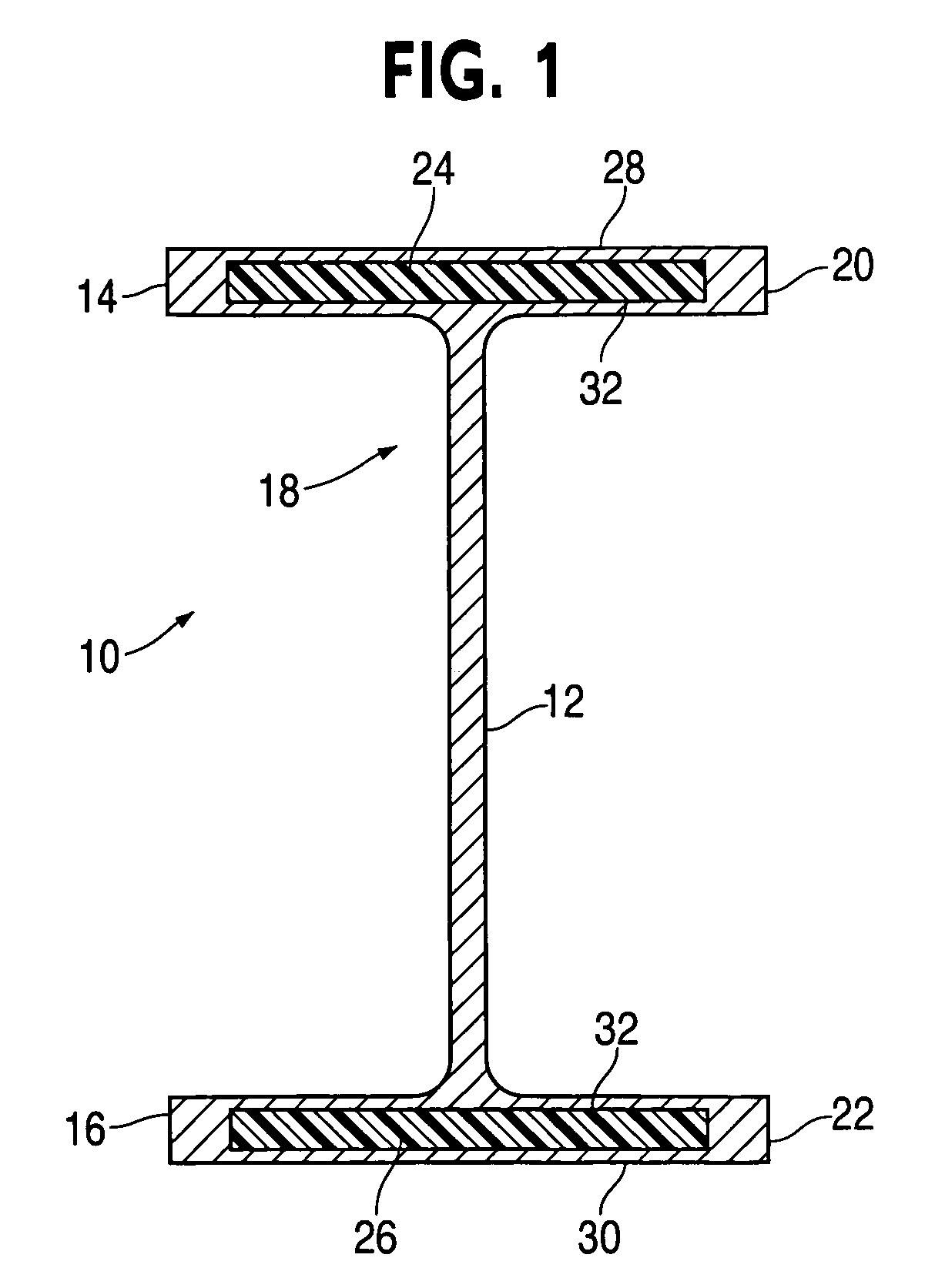
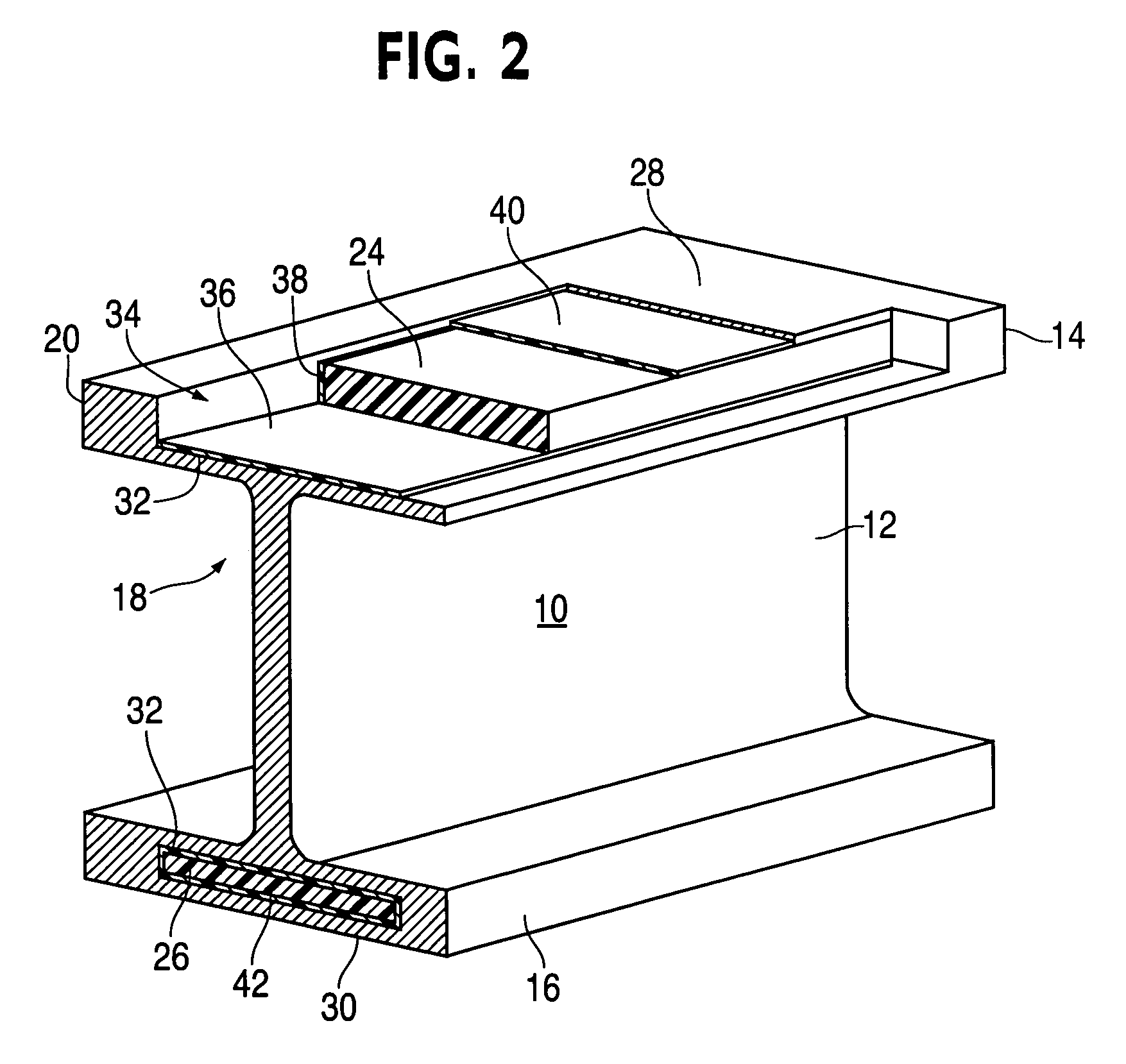
- The use of a radiation curing process to bond composite materials to metal elements, minimizing temperature increases and thereby reducing residual stresses at the bond interface, allowing for the creation of hybrid structural elements with combined metallic and composite properties.

Steel and reinforced concrete structures, particularly for producing girders, in particular girders used as purlins or girders with a large span
PatentInactiveEP0242238A1
Innovation
- A composite structure that optimally utilizes reinforced concrete for compressive forces and steel for tensile forces, with steel sections external to the concrete providing lateral rigidity and resistance to buckling, allowing for simplified assembly and reduced material usage by leveraging the concrete's compressive strength and steel's tensile strength.


Environmental Impact and Sustainability Considerations
The environmental implications of material selection between structural steel and composite materials represent a critical consideration in sustainable design practices. Steel production involves energy-intensive processes, including iron ore extraction, coking, and blast furnace operations, resulting in approximately 1.8-2.3 tons of CO2 emissions per ton of steel produced. However, steel's recyclability rate exceeds 90%, creating a circular economy advantage that significantly reduces long-term environmental impact through multiple lifecycle iterations.
Composite materials present a more complex environmental profile. Carbon fiber production requires substantial energy consumption, generating approximately 14-20 kg of CO2 per kilogram of fiber, primarily due to the high-temperature carbonization process. Glass fiber reinforced plastics demonstrate lower production emissions but face significant end-of-life challenges due to limited recycling infrastructure and thermoset matrix systems that resist conventional recycling methods.
The weight efficiency advantages of composites translate into substantial operational environmental benefits, particularly in transportation applications. Reduced structural weight directly correlates with decreased fuel consumption and lower operational emissions throughout the service life. In aerospace applications, every kilogram of weight reduction can save approximately 3,000 liters of fuel annually, creating compelling environmental justification for composite adoption despite higher production impacts.
Emerging sustainability initiatives are reshaping material selection criteria. Bio-based composite matrices derived from renewable sources offer potential pathways to reduce carbon footprints, while advanced steel grades incorporating higher recycled content and hydrogen-based production methods promise cleaner manufacturing processes. Mechanical recycling techniques for composites, including fiber recovery and reprocessing technologies, are gradually improving end-of-life sustainability profiles.
Life cycle assessment methodologies increasingly favor materials demonstrating superior performance-to-weight ratios when operational phase impacts dominate total environmental footprints. This paradigm particularly benefits composite materials in applications where weight reduction generates significant energy savings over extended service periods, offsetting higher initial production impacts through operational efficiency gains.
Composite materials present a more complex environmental profile. Carbon fiber production requires substantial energy consumption, generating approximately 14-20 kg of CO2 per kilogram of fiber, primarily due to the high-temperature carbonization process. Glass fiber reinforced plastics demonstrate lower production emissions but face significant end-of-life challenges due to limited recycling infrastructure and thermoset matrix systems that resist conventional recycling methods.
The weight efficiency advantages of composites translate into substantial operational environmental benefits, particularly in transportation applications. Reduced structural weight directly correlates with decreased fuel consumption and lower operational emissions throughout the service life. In aerospace applications, every kilogram of weight reduction can save approximately 3,000 liters of fuel annually, creating compelling environmental justification for composite adoption despite higher production impacts.
Emerging sustainability initiatives are reshaping material selection criteria. Bio-based composite matrices derived from renewable sources offer potential pathways to reduce carbon footprints, while advanced steel grades incorporating higher recycled content and hydrogen-based production methods promise cleaner manufacturing processes. Mechanical recycling techniques for composites, including fiber recovery and reprocessing technologies, are gradually improving end-of-life sustainability profiles.
Life cycle assessment methodologies increasingly favor materials demonstrating superior performance-to-weight ratios when operational phase impacts dominate total environmental footprints. This paradigm particularly benefits composite materials in applications where weight reduction generates significant energy savings over extended service periods, offsetting higher initial production impacts through operational efficiency gains.
Cost-Performance Trade-offs in Material Selection
The selection of materials in structural engineering involves complex cost-performance considerations that significantly impact project feasibility and long-term value. When comparing structural steel and composite materials, the initial material costs represent only a fraction of the total lifecycle expenses, necessitating a comprehensive evaluation framework that encompasses procurement, fabrication, installation, and maintenance costs over the structure's operational lifespan.
Structural steel typically demonstrates lower upfront material costs, with commodity pricing ranging from $600-1200 per ton depending on grade and market conditions. The established supply chains and standardized production processes contribute to predictable pricing structures. However, steel's susceptibility to corrosion introduces substantial maintenance costs, particularly in harsh environments where protective coatings and periodic treatments can account for 15-25% of total lifecycle costs.
Composite materials present a contrasting economic profile with significantly higher initial material costs, often 3-5 times that of equivalent steel components. Advanced carbon fiber reinforced polymers can exceed $15-30 per kilogram, while glass fiber composites range from $3-8 per kilogram. Despite these elevated material costs, composites offer compelling performance advantages including superior corrosion resistance, reduced maintenance requirements, and extended service life expectancy of 50-75 years compared to steel's typical 25-40 year maintenance cycles.
The fabrication and installation phases reveal additional cost differentials. Steel benefits from mature manufacturing infrastructure and skilled labor availability, resulting in lower fabrication costs and shorter lead times. Composite manufacturing requires specialized equipment and controlled environments, increasing production costs by 20-40%. However, the reduced weight of composite components can offset these costs through simplified transportation logistics and reduced crane requirements during installation.
Performance metrics must be weighted against cost implications to determine optimal material selection. Composites excel in strength-to-weight ratios, offering 40-60% weight reduction compared to steel while maintaining equivalent load-bearing capacity. This weight efficiency translates to reduced foundation requirements, lower seismic loads, and decreased structural complexity, potentially offsetting higher material costs through system-level savings.
The economic viability of composite materials becomes increasingly attractive in applications where weight reduction provides multiplicative benefits, such as aerospace structures, marine environments, or seismically active regions where reduced mass directly correlates to improved performance and safety margins.
Structural steel typically demonstrates lower upfront material costs, with commodity pricing ranging from $600-1200 per ton depending on grade and market conditions. The established supply chains and standardized production processes contribute to predictable pricing structures. However, steel's susceptibility to corrosion introduces substantial maintenance costs, particularly in harsh environments where protective coatings and periodic treatments can account for 15-25% of total lifecycle costs.
Composite materials present a contrasting economic profile with significantly higher initial material costs, often 3-5 times that of equivalent steel components. Advanced carbon fiber reinforced polymers can exceed $15-30 per kilogram, while glass fiber composites range from $3-8 per kilogram. Despite these elevated material costs, composites offer compelling performance advantages including superior corrosion resistance, reduced maintenance requirements, and extended service life expectancy of 50-75 years compared to steel's typical 25-40 year maintenance cycles.
The fabrication and installation phases reveal additional cost differentials. Steel benefits from mature manufacturing infrastructure and skilled labor availability, resulting in lower fabrication costs and shorter lead times. Composite manufacturing requires specialized equipment and controlled environments, increasing production costs by 20-40%. However, the reduced weight of composite components can offset these costs through simplified transportation logistics and reduced crane requirements during installation.
Performance metrics must be weighted against cost implications to determine optimal material selection. Composites excel in strength-to-weight ratios, offering 40-60% weight reduction compared to steel while maintaining equivalent load-bearing capacity. This weight efficiency translates to reduced foundation requirements, lower seismic loads, and decreased structural complexity, potentially offsetting higher material costs through system-level savings.
The economic viability of composite materials becomes increasingly attractive in applications where weight reduction provides multiplicative benefits, such as aerospace structures, marine environments, or seismically active regions where reduced mass directly correlates to improved performance and safety margins.
Unlock deeper insights with Patsnap Eureka Quick Research — get a full tech report to explore trends and direct your research. Try now!
Generate Your Research Report Instantly with AI Agent
Supercharge your innovation with Patsnap Eureka AI Agent Platform!