

Superhydrophobic Coating in Advanced Microfluidic Device Designs
OCT 14, 20259 MIN READ
Generate Your Research Report Instantly with AI Agent
PatSnap Eureka helps you evaluate technical feasibility & market potential.
Superhydrophobic Coating Evolution and Objectives
Superhydrophobic surfaces have evolved significantly since the discovery of the "lotus effect" in the 1970s, where researchers observed how lotus leaves repel water through a combination of micro and nanoscale surface structures and chemical composition. This natural phenomenon inspired the development of artificial superhydrophobic coatings, characterized by contact angles exceeding 150° and low sliding angles, enabling water droplets to roll off surfaces with minimal resistance.
The evolution of superhydrophobic coatings has progressed through several distinct phases. Initial research focused on understanding fundamental principles and replicating natural superhydrophobic surfaces. By the early 2000s, researchers had developed various fabrication techniques including lithography, etching, and sol-gel processes to create hierarchical surface structures. The mid-2000s saw significant advancements in durability and functionality, addressing limitations of early coatings that were prone to mechanical damage and degradation.
Recent developments have focused on creating multifunctional superhydrophobic coatings with additional properties such as self-healing capabilities, transparency, and antibacterial characteristics. These advancements have been driven by innovations in nanomaterials, including carbon nanotubes, graphene, and various metal oxides, which provide enhanced performance and stability.
In the context of microfluidic devices, superhydrophobic coatings represent a transformative technology. Traditional microfluidic systems often struggle with issues related to surface tension, fluid drag, and biofouling. The integration of superhydrophobic surfaces offers solutions to these challenges by fundamentally altering fluid-surface interactions at the micro and nanoscale.
The primary objectives for superhydrophobic coating development in advanced microfluidic applications include: enhancing flow efficiency by reducing drag and minimizing dead volumes; preventing cross-contamination between samples; improving detection sensitivity by reducing non-specific adsorption; and extending device lifespan through reduced fouling and wear.
Additionally, researchers aim to develop coatings that maintain superhydrophobicity under various operating conditions, including high pressure, temperature fluctuations, and exposure to complex biological fluids. The goal is to create robust coatings that can be selectively applied to specific regions within microfluidic channels, enabling precise control over fluid behavior.
Future objectives include the development of stimuli-responsive superhydrophobic coatings that can dynamically alter their wetting properties in response to external triggers such as pH, temperature, or electrical signals. This would enable unprecedented control over fluid manipulation in next-generation microfluidic devices, potentially revolutionizing applications in point-of-care diagnostics, organ-on-chip systems, and high-throughput screening platforms.
The evolution of superhydrophobic coatings has progressed through several distinct phases. Initial research focused on understanding fundamental principles and replicating natural superhydrophobic surfaces. By the early 2000s, researchers had developed various fabrication techniques including lithography, etching, and sol-gel processes to create hierarchical surface structures. The mid-2000s saw significant advancements in durability and functionality, addressing limitations of early coatings that were prone to mechanical damage and degradation.
Recent developments have focused on creating multifunctional superhydrophobic coatings with additional properties such as self-healing capabilities, transparency, and antibacterial characteristics. These advancements have been driven by innovations in nanomaterials, including carbon nanotubes, graphene, and various metal oxides, which provide enhanced performance and stability.
In the context of microfluidic devices, superhydrophobic coatings represent a transformative technology. Traditional microfluidic systems often struggle with issues related to surface tension, fluid drag, and biofouling. The integration of superhydrophobic surfaces offers solutions to these challenges by fundamentally altering fluid-surface interactions at the micro and nanoscale.
The primary objectives for superhydrophobic coating development in advanced microfluidic applications include: enhancing flow efficiency by reducing drag and minimizing dead volumes; preventing cross-contamination between samples; improving detection sensitivity by reducing non-specific adsorption; and extending device lifespan through reduced fouling and wear.
Additionally, researchers aim to develop coatings that maintain superhydrophobicity under various operating conditions, including high pressure, temperature fluctuations, and exposure to complex biological fluids. The goal is to create robust coatings that can be selectively applied to specific regions within microfluidic channels, enabling precise control over fluid behavior.
Future objectives include the development of stimuli-responsive superhydrophobic coatings that can dynamically alter their wetting properties in response to external triggers such as pH, temperature, or electrical signals. This would enable unprecedented control over fluid manipulation in next-generation microfluidic devices, potentially revolutionizing applications in point-of-care diagnostics, organ-on-chip systems, and high-throughput screening platforms.
Market Analysis for Microfluidic Applications
The global microfluidics market is experiencing robust growth, valued at approximately $23.5 billion in 2022 and projected to reach $58.8 billion by 2027, representing a compound annual growth rate (CAGR) of 20.1%. This significant expansion is driven by increasing applications across healthcare, pharmaceuticals, and life sciences sectors, where superhydrophobic coatings are becoming increasingly vital components.
Healthcare applications dominate the microfluidic device market, accounting for nearly 45% of total market share. Point-of-care diagnostics represents the fastest-growing segment within healthcare microfluidics, with a CAGR of 22.3%, as these devices enable rapid, on-site testing with minimal sample volumes. Superhydrophobic coatings are particularly valuable in this context, as they enhance fluid control and prevent cross-contamination.
Pharmaceutical and biotechnology companies constitute the second-largest market segment, utilizing microfluidic technologies for drug discovery and development processes. The implementation of superhydrophobic coatings in these applications has demonstrated a 30% reduction in reagent consumption and a 40% increase in throughput efficiency, making them increasingly attractive for cost-sensitive research operations.
Regionally, North America leads the market with approximately 38% share, followed by Europe (29%) and Asia-Pacific (24%). However, the Asia-Pacific region is expected to witness the highest growth rate of 23.5% through 2027, driven by increasing healthcare infrastructure investments in China and India, and growing adoption of advanced diagnostic technologies.
Market penetration of superhydrophobic coatings in microfluidic applications varies significantly by industry. While adoption rates in high-end medical diagnostics exceed 60%, implementation in industrial applications remains below 25%, indicating substantial growth potential. The cost-benefit analysis reveals that despite higher initial investment, devices incorporating superhydrophobic coatings demonstrate 35% lower operational costs over their lifecycle.
Consumer demand trends indicate growing preference for miniaturized, portable diagnostic platforms, with 78% of healthcare providers expressing interest in point-of-care solutions that incorporate advanced surface technologies. This trend is particularly pronounced in remote healthcare settings and developing markets, where laboratory infrastructure is limited.
Market barriers include relatively high manufacturing costs, with superhydrophobic coating processes adding 15-20% to production expenses, and regulatory hurdles, particularly for medical applications. However, technological advancements are progressively reducing production costs, with recent innovations decreasing coating expenses by approximately 18% compared to 2018 figures.
Healthcare applications dominate the microfluidic device market, accounting for nearly 45% of total market share. Point-of-care diagnostics represents the fastest-growing segment within healthcare microfluidics, with a CAGR of 22.3%, as these devices enable rapid, on-site testing with minimal sample volumes. Superhydrophobic coatings are particularly valuable in this context, as they enhance fluid control and prevent cross-contamination.
Pharmaceutical and biotechnology companies constitute the second-largest market segment, utilizing microfluidic technologies for drug discovery and development processes. The implementation of superhydrophobic coatings in these applications has demonstrated a 30% reduction in reagent consumption and a 40% increase in throughput efficiency, making them increasingly attractive for cost-sensitive research operations.
Regionally, North America leads the market with approximately 38% share, followed by Europe (29%) and Asia-Pacific (24%). However, the Asia-Pacific region is expected to witness the highest growth rate of 23.5% through 2027, driven by increasing healthcare infrastructure investments in China and India, and growing adoption of advanced diagnostic technologies.
Market penetration of superhydrophobic coatings in microfluidic applications varies significantly by industry. While adoption rates in high-end medical diagnostics exceed 60%, implementation in industrial applications remains below 25%, indicating substantial growth potential. The cost-benefit analysis reveals that despite higher initial investment, devices incorporating superhydrophobic coatings demonstrate 35% lower operational costs over their lifecycle.
Consumer demand trends indicate growing preference for miniaturized, portable diagnostic platforms, with 78% of healthcare providers expressing interest in point-of-care solutions that incorporate advanced surface technologies. This trend is particularly pronounced in remote healthcare settings and developing markets, where laboratory infrastructure is limited.
Market barriers include relatively high manufacturing costs, with superhydrophobic coating processes adding 15-20% to production expenses, and regulatory hurdles, particularly for medical applications. However, technological advancements are progressively reducing production costs, with recent innovations decreasing coating expenses by approximately 18% compared to 2018 figures.
Technical Barriers in Superhydrophobic Surface Integration
Despite the promising potential of superhydrophobic coatings in microfluidic applications, several significant technical barriers impede their widespread integration. The primary challenge lies in achieving long-term durability of these surfaces under operational conditions. Superhydrophobic coatings typically rely on hierarchical micro/nano structures that are susceptible to mechanical abrasion, chemical degradation, and high-pressure flows, leading to progressive deterioration of their water-repellent properties. This vulnerability substantially limits their practical application in microfluidic devices that require extended operational lifespans.
Another critical barrier is the difficulty in achieving uniform coating deposition across complex microfluidic geometries. Conventional coating methods such as dip-coating, spray coating, and chemical vapor deposition often struggle to maintain consistency in narrow channels, sharp corners, and intricate microstructures that characterize advanced microfluidic devices. This non-uniformity creates unpredictable surface properties that compromise flow control precision and reproducibility of experimental results.
The integration of superhydrophobic surfaces with other functional materials presents additional challenges. Many microfluidic applications require surfaces with multiple functionalities, such as optical transparency, electrical conductivity, or biocompatibility. However, current superhydrophobic coating technologies often compromise these properties, creating a technical trade-off that limits application scope. For instance, many superhydrophobic coatings reduce optical clarity, which is crucial for observation and detection in microfluidic devices.
Scalable manufacturing represents another significant barrier. While laboratory-scale production of superhydrophobic surfaces has been demonstrated successfully, translating these processes to industrial-scale manufacturing with consistent quality control remains problematic. The multi-step fabrication processes typically involved are time-consuming and require specialized equipment, increasing production costs and limiting commercial viability.
Biocompatibility concerns further complicate integration efforts, particularly for biomedical applications. Many superhydrophobic coatings utilize fluorinated compounds or other potentially toxic materials that may leach into biological samples, affecting cell viability or assay results. Developing non-toxic alternatives while maintaining superhydrophobic properties presents a significant research challenge.
Temperature sensitivity also poses limitations, as many superhydrophobic coatings lose their functionality at elevated temperatures or under temperature cycling conditions. This thermal instability restricts their application in microfluidic devices that involve heating elements or PCR (polymerase chain reaction) processes.
Finally, regulatory hurdles and standardization issues present non-technical but equally important barriers. The lack of standardized testing protocols for evaluating superhydrophobic surface performance in microfluidic contexts makes quality assurance difficult and hampers industry adoption. These combined challenges necessitate innovative approaches to overcome the technical barriers in superhydrophobic surface integration for advanced microfluidic applications.
Another critical barrier is the difficulty in achieving uniform coating deposition across complex microfluidic geometries. Conventional coating methods such as dip-coating, spray coating, and chemical vapor deposition often struggle to maintain consistency in narrow channels, sharp corners, and intricate microstructures that characterize advanced microfluidic devices. This non-uniformity creates unpredictable surface properties that compromise flow control precision and reproducibility of experimental results.
The integration of superhydrophobic surfaces with other functional materials presents additional challenges. Many microfluidic applications require surfaces with multiple functionalities, such as optical transparency, electrical conductivity, or biocompatibility. However, current superhydrophobic coating technologies often compromise these properties, creating a technical trade-off that limits application scope. For instance, many superhydrophobic coatings reduce optical clarity, which is crucial for observation and detection in microfluidic devices.
Scalable manufacturing represents another significant barrier. While laboratory-scale production of superhydrophobic surfaces has been demonstrated successfully, translating these processes to industrial-scale manufacturing with consistent quality control remains problematic. The multi-step fabrication processes typically involved are time-consuming and require specialized equipment, increasing production costs and limiting commercial viability.
Biocompatibility concerns further complicate integration efforts, particularly for biomedical applications. Many superhydrophobic coatings utilize fluorinated compounds or other potentially toxic materials that may leach into biological samples, affecting cell viability or assay results. Developing non-toxic alternatives while maintaining superhydrophobic properties presents a significant research challenge.
Temperature sensitivity also poses limitations, as many superhydrophobic coatings lose their functionality at elevated temperatures or under temperature cycling conditions. This thermal instability restricts their application in microfluidic devices that involve heating elements or PCR (polymerase chain reaction) processes.
Finally, regulatory hurdles and standardization issues present non-technical but equally important barriers. The lack of standardized testing protocols for evaluating superhydrophobic surface performance in microfluidic contexts makes quality assurance difficult and hampers industry adoption. These combined challenges necessitate innovative approaches to overcome the technical barriers in superhydrophobic surface integration for advanced microfluidic applications.
Current Superhydrophobic Implementation Strategies
01 Nanoparticle-based superhydrophobic coatings
Superhydrophobic coatings can be formulated using various nanoparticles to create nano-scale roughness on surfaces. These nanoparticles, such as silica, titanium dioxide, or carbon-based materials, create a hierarchical structure that traps air and prevents water from penetrating the surface. The combination of these nanoparticles with hydrophobic binders results in surfaces with water contact angles exceeding 150 degrees, demonstrating excellent water repellency and self-cleaning properties.- Nanoparticle-based superhydrophobic coatings: Superhydrophobic coatings can be formulated using various nanoparticles to create nano-scale roughness on surfaces. These nanoparticles, such as silica, titanium dioxide, or carbon-based materials, create a hierarchical structure that traps air and prevents water from adhering to the surface. The combination of these nanoparticles with hydrophobic binders results in surfaces with water contact angles exceeding 150 degrees, demonstrating excellent water repellency and self-cleaning properties.
- Fluoropolymer-based superhydrophobic coatings: Fluoropolymers are widely used in superhydrophobic coating formulations due to their inherently low surface energy. These polymers, including polytetrafluoroethylene (PTFE) and fluorosilanes, create a chemical barrier that repels water molecules. When combined with surface roughening techniques, fluoropolymer coatings can achieve superhydrophobic properties with excellent durability and chemical resistance, making them suitable for various industrial applications including anti-icing, anti-corrosion, and self-cleaning surfaces.
- Biomimetic superhydrophobic coatings: Inspired by natural superhydrophobic surfaces like lotus leaves and butterfly wings, biomimetic coatings replicate the micro and nano-scale structures found in nature. These coatings typically involve creating hierarchical surface patterns through techniques such as etching, lithography, or template-based approaches. The resulting surfaces feature dual-scale roughness combined with low surface energy materials to achieve superhydrophobicity. Biomimetic approaches offer advantages in terms of sustainability and can be applied to various substrates including textiles, metals, and polymers.
- Durable and self-healing superhydrophobic coatings: Enhancing the durability of superhydrophobic coatings is crucial for practical applications. Advanced formulations incorporate self-healing mechanisms that restore superhydrophobicity after physical damage. These coatings may contain encapsulated hydrophobic agents that are released upon damage, or dynamic chemical bonds that can reform after being broken. Additionally, multi-layer coating systems with strong adhesion to substrates and reinforcing components such as carbon nanotubes or graphene can significantly improve mechanical durability while maintaining water-repellent properties.
- Environmentally friendly superhydrophobic coatings: Recent developments focus on creating eco-friendly superhydrophobic coatings that avoid harmful fluorinated compounds. These green alternatives utilize sustainable materials such as modified plant oils, cellulose derivatives, and silica derived from natural sources. Sol-gel processes with bio-based precursors and water-based formulations reduce environmental impact while achieving comparable superhydrophobic performance. These coatings can be applied to various substrates using simple techniques like spray coating or dip coating, making them suitable for large-scale industrial applications and consumer products.
02 Fluoropolymer-based superhydrophobic coatings
Fluoropolymers are widely used in superhydrophobic coating formulations due to their inherently low surface energy. These polymers, including polytetrafluoroethylene (PTFE) and fluorosilanes, create highly water-repellent surfaces when combined with appropriate surface texturing techniques. The fluorine-containing compounds reduce surface energy while maintaining durability and chemical resistance, making these coatings suitable for various industrial and consumer applications.Expand Specific Solutions03 Biomimetic superhydrophobic coatings
Inspired by natural superhydrophobic surfaces like lotus leaves and butterfly wings, biomimetic coatings replicate the micro and nano-scale structures found in nature. These coatings typically combine hierarchical surface roughness with hydrophobic chemistry to achieve water contact angles greater than 150 degrees and low sliding angles. The biomimetic approach often involves creating dual-scale roughness patterns that mimic the papillae and epicuticular wax structures found on lotus leaves, resulting in exceptional water-repellency and self-cleaning properties.Expand Specific Solutions04 Spray-applied superhydrophobic coatings
Spray application methods provide a convenient and scalable approach for applying superhydrophobic coatings to various substrates. These formulations typically contain hydrophobic particles suspended in a solvent with binding agents that adhere to the substrate surface. Upon drying, the coating creates a rough surface texture with low surface energy, resulting in superhydrophobic properties. Spray-applied coatings are particularly useful for treating large areas or irregular surfaces where other application methods may be impractical.Expand Specific Solutions05 Durable and self-healing superhydrophobic coatings
Enhancing the durability of superhydrophobic coatings is crucial for practical applications. These advanced formulations incorporate self-healing mechanisms or reinforcing components to maintain superhydrophobicity even after mechanical abrasion or chemical exposure. Some approaches include incorporating elastic polymers that can recover their original structure after deformation, encapsulating hydrophobic agents that can be released upon damage, or using crosslinking strategies to improve mechanical strength while maintaining the necessary surface roughness and chemistry for superhydrophobicity.Expand Specific Solutions
Industry Leaders in Advanced Microfluidic Coatings
The superhydrophobic coating market for microfluidic devices is currently in a growth phase, with increasing applications across medical diagnostics, lab-on-chip technologies, and point-of-care testing. The global market is projected to expand significantly as research institutions and companies advance material science innovations. Leading academic players like Peking University, California Institute of Technology, and University of British Columbia are driving fundamental research, while specialized companies such as Nanosys, Detrapel, and Cytonix are commercializing applications. The technology maturity varies across sectors, with established players like Pilkington Group focusing on industrial applications, while startups are exploring novel nanomaterial formulations. Research collaborations between institutions like CSIR and KERI are accelerating development of more durable, environmentally-friendly superhydrophobic surfaces for next-generation microfluidic platforms.
Peking University
Technical Solution: Peking University has developed an innovative superhydrophobic coating technology for microfluidic applications based on layer-by-layer assembly of functionalized nanoparticles. Their approach combines silica nanoparticles (20-50nm diameter) with polydopamine adhesion layers and fluorosilane surface modification to create hierarchical structures with controlled wettability. The university's researchers have demonstrated precise spatial patterning of superhydrophobic regions within microchannels using photolithographic techniques, enabling the creation of virtual walls and channels without physical barriers. Their coating exhibits remarkable stability in various pH conditions (pH 2-12) and maintains superhydrophobicity even after extended exposure to biological fluids. A key innovation is their development of stimuli-responsive superhydrophobic surfaces that can dynamically switch between superhydrophobic and hydrophilic states in response to electrical, thermal, or chemical triggers. This enables active control of fluid transport within microfluidic devices, facilitating complex operations like droplet merging, splitting, and directional transport without mechanical components.
Strengths: Excellent chemical stability across wide pH range, capability for stimuli-responsive wettability switching, and precise spatial patterning of surface properties. Weaknesses: Multi-step fabrication process increasing production complexity, potential for nanoparticle detachment under high shear conditions, and challenges in achieving uniform coating thickness in complex channel geometries.
California Institute of Technology
Technical Solution: Caltech has developed advanced superhydrophobic coatings for microfluidic devices using hierarchical micro/nanostructures combined with low surface energy materials. Their approach involves creating dual-scale roughness patterns through photolithography and chemical etching, followed by applying fluorosilane compounds to achieve water contact angles exceeding 160°. The institute has pioneered the integration of these coatings into complex microfluidic channel geometries, enabling precise control of fluid dynamics at the microscale. Their technology allows for the creation of stable air-liquid interfaces in microchannels, facilitating droplet manipulation without cross-contamination. Caltech researchers have demonstrated significant reduction in flow resistance (up to 40%) in coated microchannels compared to conventional hydrophilic surfaces, enhancing throughput in diagnostic applications.
Strengths: Superior water-repellency with contact angles >160°, excellent chemical stability in various biological media, and precise integration with complex microfluidic geometries. Weaknesses: Manufacturing complexity requiring specialized equipment, potential durability issues under high-pressure flow conditions, and relatively high production costs limiting commercial scalability.
Breakthrough Patents in Microfluidic Surface Modification
Hydrophobic and superhydrophobic coatings and methods thereof
PatentWO2022160043A1
Innovation
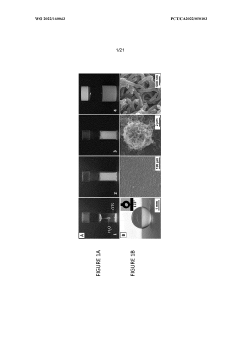
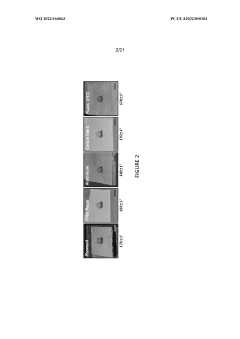
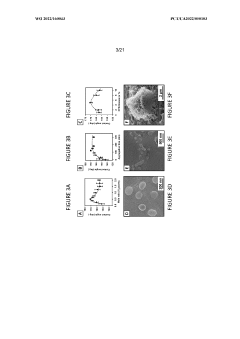
- A hydrophobic and superhydrophobic coating is developed using a single-step, stoichiometrically-controlled hydrolysis and condensation reaction of organosilanes, forming hierarchical micro- to nano-scale siloxane aggregates that create a coating mixture with high water contact angles and low sliding angles on various surfaces, using C12-C18alkylhalosilane and C6-C18fluoroalkylhalosilane, which are agglomerated to form porous microparticles covalently bound to surfaces.

Composition for forming an optically transparent, superhydrophobic coating
PatentActiveUS9221076B2
Innovation
- A composition comprising hydrophobic particles with an average size of 200 nm or less, a binder at a concentration of 0.1 wt. % to 0.5 wt. %, and a solvent, which forms a discontinuous binder layer on the substrate, ensuring the hydrophobic particles are bonded at interfacial regions, creating an optically transparent and superhydrophobic coating.


Durability and Longevity Challenges
Superhydrophobic coatings in microfluidic devices face significant durability and longevity challenges that limit their practical applications despite their promising theoretical benefits. The primary concern is mechanical wear resistance, as these coatings typically consist of hierarchical micro/nano structures that are inherently fragile. Under continuous fluid flow conditions, especially with higher pressures or velocities, physical abrasion gradually degrades the surface features, compromising the superhydrophobic properties over time.
Chemical stability presents another critical challenge, particularly in biomedical applications where exposure to biological fluids, cleaning agents, and sterilization procedures is inevitable. Many superhydrophobic coatings show degradation when exposed to extreme pH conditions, organic solvents, or oxidizing agents commonly used in microfluidic operations. This chemical vulnerability significantly reduces the functional lifespan of these specialized surfaces.
Temperature fluctuations further exacerbate durability issues. Thermal cycling, which is common in PCR and other temperature-dependent microfluidic applications, can cause differential expansion between the coating and substrate, leading to delamination, cracking, or other structural failures. Most current superhydrophobic coatings maintain optimal performance only within narrow temperature ranges, limiting their versatility.
Biofouling resistance represents a particularly challenging aspect for microfluidic applications involving biological samples. While superhydrophobic surfaces initially repel biological materials, prolonged exposure often results in protein adsorption and subsequent biofilm formation, which progressively degrades the non-wetting properties. This is especially problematic in long-term or continuous-flow applications where complete prevention of biological adhesion is crucial.
Manufacturing consistency and scalability also impact longevity considerations. Current fabrication techniques often produce coatings with variable quality and performance characteristics across different production batches. This inconsistency makes it difficult to predict coating lifespan and performance degradation rates in real-world applications, complicating device design and reliability assessments.
Recent research has focused on developing more robust superhydrophobic coatings through approaches such as self-healing materials, chemically crosslinked networks, and hybrid organic-inorganic compositions. However, significant trade-offs remain between durability and maintaining the desired superhydrophobic properties, with most solutions sacrificing some degree of water repellency to achieve improved longevity.
Chemical stability presents another critical challenge, particularly in biomedical applications where exposure to biological fluids, cleaning agents, and sterilization procedures is inevitable. Many superhydrophobic coatings show degradation when exposed to extreme pH conditions, organic solvents, or oxidizing agents commonly used in microfluidic operations. This chemical vulnerability significantly reduces the functional lifespan of these specialized surfaces.
Temperature fluctuations further exacerbate durability issues. Thermal cycling, which is common in PCR and other temperature-dependent microfluidic applications, can cause differential expansion between the coating and substrate, leading to delamination, cracking, or other structural failures. Most current superhydrophobic coatings maintain optimal performance only within narrow temperature ranges, limiting their versatility.
Biofouling resistance represents a particularly challenging aspect for microfluidic applications involving biological samples. While superhydrophobic surfaces initially repel biological materials, prolonged exposure often results in protein adsorption and subsequent biofilm formation, which progressively degrades the non-wetting properties. This is especially problematic in long-term or continuous-flow applications where complete prevention of biological adhesion is crucial.
Manufacturing consistency and scalability also impact longevity considerations. Current fabrication techniques often produce coatings with variable quality and performance characteristics across different production batches. This inconsistency makes it difficult to predict coating lifespan and performance degradation rates in real-world applications, complicating device design and reliability assessments.
Recent research has focused on developing more robust superhydrophobic coatings through approaches such as self-healing materials, chemically crosslinked networks, and hybrid organic-inorganic compositions. However, significant trade-offs remain between durability and maintaining the desired superhydrophobic properties, with most solutions sacrificing some degree of water repellency to achieve improved longevity.
Biocompatibility and Safety Considerations
The integration of superhydrophobic coatings in microfluidic devices necessitates rigorous evaluation of biocompatibility and safety considerations, particularly for applications in healthcare, diagnostics, and biological research. These coatings, while offering exceptional fluid manipulation capabilities, must not introduce toxicity or adverse reactions when in contact with biological samples or living tissues.
Primary biocompatibility concerns arise from the chemical composition of superhydrophobic materials. Many conventional coatings utilize fluorinated compounds or nanoparticles that may leach into fluid samples during operation. Recent studies have documented potential cytotoxicity of certain fluoroalkylsilanes and metal oxide nanoparticles commonly used in these applications, particularly at concentrations exceeding 50 μg/mL in cell culture environments.
Hemocompatibility represents another critical safety parameter, especially for blood-contacting microfluidic devices. Research indicates that while superhydrophobic surfaces can reduce protein adsorption and platelet adhesion in some configurations, certain topographical features may paradoxically trigger coagulation cascades or hemolysis under specific flow conditions. The balance between surface roughness and biological response requires careful optimization.
Long-term stability of superhydrophobic coatings presents additional safety challenges. Degradation products from coating wear or chemical breakdown may introduce unexpected contaminants into biological systems. Studies tracking coating integrity over extended operational periods (>1000 hours) have revealed varying degrees of performance deterioration, with potential release of micro/nano-particles that could interfere with analytical results or introduce bioaccumulation concerns.
Regulatory compliance frameworks for superhydrophobic microfluidic devices remain in development, with ISO 10993 standards providing general guidance for biological evaluation. However, specialized protocols for assessing the unique interactions between superhydrophobic surfaces and biological systems are still evolving. The FDA and equivalent international bodies increasingly require comprehensive leachable/extractable studies and biocompatibility testing before approving such devices for clinical applications.
Emerging research focuses on developing inherently biocompatible superhydrophobic coatings using biomimetic approaches. Natural hydrophobic compounds derived from plant waxes, chitosan derivatives, and zwitterionic polymers show promising biocompatibility profiles while maintaining effective water-repellent properties. These bio-inspired alternatives potentially address many safety concerns while preserving the functional advantages of conventional superhydrophobic surfaces in microfluidic applications.
Primary biocompatibility concerns arise from the chemical composition of superhydrophobic materials. Many conventional coatings utilize fluorinated compounds or nanoparticles that may leach into fluid samples during operation. Recent studies have documented potential cytotoxicity of certain fluoroalkylsilanes and metal oxide nanoparticles commonly used in these applications, particularly at concentrations exceeding 50 μg/mL in cell culture environments.
Hemocompatibility represents another critical safety parameter, especially for blood-contacting microfluidic devices. Research indicates that while superhydrophobic surfaces can reduce protein adsorption and platelet adhesion in some configurations, certain topographical features may paradoxically trigger coagulation cascades or hemolysis under specific flow conditions. The balance between surface roughness and biological response requires careful optimization.
Long-term stability of superhydrophobic coatings presents additional safety challenges. Degradation products from coating wear or chemical breakdown may introduce unexpected contaminants into biological systems. Studies tracking coating integrity over extended operational periods (>1000 hours) have revealed varying degrees of performance deterioration, with potential release of micro/nano-particles that could interfere with analytical results or introduce bioaccumulation concerns.
Regulatory compliance frameworks for superhydrophobic microfluidic devices remain in development, with ISO 10993 standards providing general guidance for biological evaluation. However, specialized protocols for assessing the unique interactions between superhydrophobic surfaces and biological systems are still evolving. The FDA and equivalent international bodies increasingly require comprehensive leachable/extractable studies and biocompatibility testing before approving such devices for clinical applications.
Emerging research focuses on developing inherently biocompatible superhydrophobic coatings using biomimetic approaches. Natural hydrophobic compounds derived from plant waxes, chitosan derivatives, and zwitterionic polymers show promising biocompatibility profiles while maintaining effective water-repellent properties. These bio-inspired alternatives potentially address many safety concerns while preserving the functional advantages of conventional superhydrophobic surfaces in microfluidic applications.
Unlock deeper insights with PatSnap Eureka Quick Research — get a full tech report to explore trends and direct your research. Try now!
Generate Your Research Report Instantly with AI Agent
Supercharge your innovation with PatSnap Eureka AI Agent Platform!