Technical Mechanisms in Neuromorphic Computing Material Regulation
OCT 27, 202510 MIN READ
Generate Your Research Report Instantly with AI Agent
Patsnap Eureka helps you evaluate technical feasibility & market potential.
Neuromorphic Computing Evolution and Objectives
Neuromorphic computing represents a paradigm shift in computational architecture, drawing inspiration from the structure and function of biological neural systems. The evolution of this field began in the late 1980s when Carver Mead introduced the concept of using analog circuits to mimic neurobiological architectures. This pioneering work established the foundation for hardware systems that could process information in ways similar to the human brain, emphasizing parallel processing, low power consumption, and adaptive learning capabilities.
Throughout the 1990s and early 2000s, neuromorphic computing remained primarily in academic research domains, with limited practical applications due to material and fabrication constraints. The field experienced a renaissance around 2010, coinciding with advancements in nanotechnology, materials science, and the increasing limitations of traditional von Neumann computing architectures in handling complex cognitive tasks and massive datasets.
The primary objective of neuromorphic computing is to develop computational systems that emulate the brain's efficiency in processing information, particularly in pattern recognition, sensory processing, and decision-making tasks. Unlike conventional computing systems that separate memory and processing units, neuromorphic architectures integrate these functions, significantly reducing energy consumption and increasing processing speed for specific applications.
Material regulation in neuromorphic computing represents a critical technical frontier, focusing on the development and precise control of materials that can effectively mimic synaptic plasticity and neuronal behavior. The goal is to create physical substrates capable of implementing neural network functions directly in hardware, rather than simulating them in software running on conventional processors.
Current objectives in the field include developing materials with tunable electrical, magnetic, or optical properties that can serve as artificial neurons and synapses. These materials must demonstrate key characteristics such as non-volatile memory, analog behavior, and the ability to modify their properties based on input history – essentially mimicking the learning and adaptation capabilities of biological neural systems.
The evolution trajectory points toward increasingly sophisticated integration of novel materials, including phase-change materials, memristive devices, spintronic elements, and organic compounds, each offering unique advantages for specific neuromorphic functions. The ultimate aim is to achieve brain-like computational efficiency, with systems capable of performing complex cognitive tasks while consuming only a fraction of the power required by traditional computing architectures.
Throughout the 1990s and early 2000s, neuromorphic computing remained primarily in academic research domains, with limited practical applications due to material and fabrication constraints. The field experienced a renaissance around 2010, coinciding with advancements in nanotechnology, materials science, and the increasing limitations of traditional von Neumann computing architectures in handling complex cognitive tasks and massive datasets.
The primary objective of neuromorphic computing is to develop computational systems that emulate the brain's efficiency in processing information, particularly in pattern recognition, sensory processing, and decision-making tasks. Unlike conventional computing systems that separate memory and processing units, neuromorphic architectures integrate these functions, significantly reducing energy consumption and increasing processing speed for specific applications.
Material regulation in neuromorphic computing represents a critical technical frontier, focusing on the development and precise control of materials that can effectively mimic synaptic plasticity and neuronal behavior. The goal is to create physical substrates capable of implementing neural network functions directly in hardware, rather than simulating them in software running on conventional processors.
Current objectives in the field include developing materials with tunable electrical, magnetic, or optical properties that can serve as artificial neurons and synapses. These materials must demonstrate key characteristics such as non-volatile memory, analog behavior, and the ability to modify their properties based on input history – essentially mimicking the learning and adaptation capabilities of biological neural systems.
The evolution trajectory points toward increasingly sophisticated integration of novel materials, including phase-change materials, memristive devices, spintronic elements, and organic compounds, each offering unique advantages for specific neuromorphic functions. The ultimate aim is to achieve brain-like computational efficiency, with systems capable of performing complex cognitive tasks while consuming only a fraction of the power required by traditional computing architectures.
Market Analysis for Brain-Inspired Computing Solutions
The neuromorphic computing market is experiencing significant growth, driven by increasing demand for AI applications that require efficient processing of complex neural networks. Current market projections indicate that the global neuromorphic computing market will reach approximately $8.9 billion by 2025, with a compound annual growth rate of 49.1% from 2020. This remarkable growth trajectory is fueled by the inherent advantages of brain-inspired computing architectures, which offer superior energy efficiency and parallel processing capabilities compared to traditional von Neumann architectures.
The market for neuromorphic computing solutions spans multiple sectors, with particularly strong demand emerging in autonomous vehicles, robotics, healthcare diagnostics, and edge computing applications. In the automotive sector, neuromorphic chips are increasingly valued for their ability to process sensory data in real-time with minimal power consumption, a critical requirement for advanced driver assistance systems and autonomous navigation. The healthcare sector represents another significant market opportunity, with neuromorphic systems showing promise in medical imaging analysis, patient monitoring, and drug discovery processes.
From a geographical perspective, North America currently dominates the neuromorphic computing market, accounting for approximately 42% of global market share. This leadership position is attributed to substantial investments from major technology companies and robust government funding for neuromorphic research initiatives. However, the Asia-Pacific region is projected to witness the fastest growth rate in the coming years, driven by increasing adoption of AI technologies in countries like China, Japan, and South Korea, coupled with expanding manufacturing capabilities for specialized hardware.
Market analysis reveals a notable shift in customer preferences toward integrated neuromorphic solutions that combine specialized hardware with optimized software frameworks. End-users increasingly demand complete ecosystems rather than standalone components, creating opportunities for companies that can deliver comprehensive platforms. This trend is particularly evident in enterprise applications, where organizations seek turnkey solutions that can be deployed with minimal disruption to existing infrastructure.
The competitive landscape is characterized by both established technology giants and innovative startups. Major semiconductor companies are leveraging their manufacturing expertise to develop commercial neuromorphic chips, while research-oriented startups are pioneering novel materials and architectures. Strategic partnerships between hardware manufacturers, software developers, and academic institutions have become increasingly common, accelerating the commercialization of neuromorphic technologies and expanding potential market applications.
The market for neuromorphic computing solutions spans multiple sectors, with particularly strong demand emerging in autonomous vehicles, robotics, healthcare diagnostics, and edge computing applications. In the automotive sector, neuromorphic chips are increasingly valued for their ability to process sensory data in real-time with minimal power consumption, a critical requirement for advanced driver assistance systems and autonomous navigation. The healthcare sector represents another significant market opportunity, with neuromorphic systems showing promise in medical imaging analysis, patient monitoring, and drug discovery processes.
From a geographical perspective, North America currently dominates the neuromorphic computing market, accounting for approximately 42% of global market share. This leadership position is attributed to substantial investments from major technology companies and robust government funding for neuromorphic research initiatives. However, the Asia-Pacific region is projected to witness the fastest growth rate in the coming years, driven by increasing adoption of AI technologies in countries like China, Japan, and South Korea, coupled with expanding manufacturing capabilities for specialized hardware.
Market analysis reveals a notable shift in customer preferences toward integrated neuromorphic solutions that combine specialized hardware with optimized software frameworks. End-users increasingly demand complete ecosystems rather than standalone components, creating opportunities for companies that can deliver comprehensive platforms. This trend is particularly evident in enterprise applications, where organizations seek turnkey solutions that can be deployed with minimal disruption to existing infrastructure.
The competitive landscape is characterized by both established technology giants and innovative startups. Major semiconductor companies are leveraging their manufacturing expertise to develop commercial neuromorphic chips, while research-oriented startups are pioneering novel materials and architectures. Strategic partnerships between hardware manufacturers, software developers, and academic institutions have become increasingly common, accelerating the commercialization of neuromorphic technologies and expanding potential market applications.
Current Challenges in Neuromorphic Material Science
Despite significant advancements in neuromorphic computing materials, several critical challenges continue to impede progress in this rapidly evolving field. The fundamental challenge lies in achieving true biomimetic functionality while maintaining manufacturability at scale. Current neuromorphic materials struggle to simultaneously exhibit the plasticity, energy efficiency, and reliability required for brain-like computing systems.
Material stability presents a significant obstacle, particularly in memristive devices where ionic migration mechanisms often lead to performance degradation over time. The trade-off between long-term stability and the dynamic range necessary for synaptic weight modulation remains unresolved. Researchers have observed that materials exhibiting excellent plasticity characteristics frequently demonstrate accelerated aging and reduced operational lifespans.
Scalability issues persist across multiple dimensions. The integration of novel neuromorphic materials with conventional CMOS technology introduces complex fabrication challenges, including thermal budget constraints and material compatibility problems. Additionally, the variability in device-to-device performance creates significant hurdles for large-scale implementation, as neuromorphic systems require consistent behavior across billions of artificial synapses and neurons.
Energy consumption optimization represents another critical challenge. While biological neural systems operate at remarkable energy efficiencies (approximately 20W for the human brain), current neuromorphic materials still consume orders of magnitude more power per computational task. The fundamental physics of charge-based computing creates an inherent limitation that researchers are attempting to overcome through novel material approaches and alternative computational mechanisms.
The multi-physics nature of neuromorphic materials adds complexity to both modeling and characterization efforts. The interplay between electrical, thermal, mechanical, and chemical properties creates emergent behaviors that are difficult to predict and control. Current simulation tools struggle to capture these complex interactions accurately, limiting the ability to design optimized materials through computational approaches.
Temporal dynamics present perhaps the most sophisticated challenge. Biological synapses exhibit complex time-dependent behaviors across multiple timescales, from milliseconds to years. Replicating this temporal richness in artificial materials requires sophisticated control over relaxation processes, state retention, and response characteristics. Most current materials excel at specific temporal regimes but fail to capture the full spectrum of biological timing mechanisms.
Finally, the interdisciplinary nature of neuromorphic material science creates communication barriers between specialists in materials science, electrical engineering, computer architecture, and neuroscience. This fragmentation slows progress as innovations in one domain often fail to translate effectively to others, highlighting the need for more integrated research approaches.
Material stability presents a significant obstacle, particularly in memristive devices where ionic migration mechanisms often lead to performance degradation over time. The trade-off between long-term stability and the dynamic range necessary for synaptic weight modulation remains unresolved. Researchers have observed that materials exhibiting excellent plasticity characteristics frequently demonstrate accelerated aging and reduced operational lifespans.
Scalability issues persist across multiple dimensions. The integration of novel neuromorphic materials with conventional CMOS technology introduces complex fabrication challenges, including thermal budget constraints and material compatibility problems. Additionally, the variability in device-to-device performance creates significant hurdles for large-scale implementation, as neuromorphic systems require consistent behavior across billions of artificial synapses and neurons.
Energy consumption optimization represents another critical challenge. While biological neural systems operate at remarkable energy efficiencies (approximately 20W for the human brain), current neuromorphic materials still consume orders of magnitude more power per computational task. The fundamental physics of charge-based computing creates an inherent limitation that researchers are attempting to overcome through novel material approaches and alternative computational mechanisms.
The multi-physics nature of neuromorphic materials adds complexity to both modeling and characterization efforts. The interplay between electrical, thermal, mechanical, and chemical properties creates emergent behaviors that are difficult to predict and control. Current simulation tools struggle to capture these complex interactions accurately, limiting the ability to design optimized materials through computational approaches.
Temporal dynamics present perhaps the most sophisticated challenge. Biological synapses exhibit complex time-dependent behaviors across multiple timescales, from milliseconds to years. Replicating this temporal richness in artificial materials requires sophisticated control over relaxation processes, state retention, and response characteristics. Most current materials excel at specific temporal regimes but fail to capture the full spectrum of biological timing mechanisms.
Finally, the interdisciplinary nature of neuromorphic material science creates communication barriers between specialists in materials science, electrical engineering, computer architecture, and neuroscience. This fragmentation slows progress as innovations in one domain often fail to translate effectively to others, highlighting the need for more integrated research approaches.
Current Approaches to Neuromorphic Material Regulation
01 Memristive materials for neuromorphic computing
Memristive materials are key components in neuromorphic computing systems, mimicking the behavior of biological synapses. These materials can change their resistance based on the history of applied voltage or current, enabling the implementation of learning and memory functions. Various metal oxides and phase-change materials are being developed to create efficient memristive devices with improved switching characteristics, endurance, and power consumption for neuromorphic applications.- Memristive materials for neuromorphic computing: Memristive materials are crucial for neuromorphic computing systems as they can mimic the behavior of biological synapses. These materials exhibit variable resistance states that can be modulated by electrical stimuli, allowing for the implementation of synaptic plasticity mechanisms such as spike-timing-dependent plasticity. Common memristive materials include metal oxides, phase-change materials, and ferroelectric materials that can be integrated into crossbar arrays to create artificial neural networks with high density and energy efficiency.
- Phase-change materials for neuromorphic devices: Phase-change materials (PCMs) offer unique properties for neuromorphic computing applications due to their ability to rapidly switch between amorphous and crystalline states. These materials, typically chalcogenide-based compounds, can store multiple resistance levels, making them suitable for implementing synaptic weights in artificial neural networks. The resistance changes in PCMs can be precisely controlled through careful regulation of current pulses, enabling analog-like computation necessary for brain-inspired computing architectures.
- Regulatory frameworks for neuromorphic materials: The development and deployment of neuromorphic computing materials are subject to various regulatory considerations, including environmental safety, toxicity assessments, and compliance with electronic waste directives. Materials used in neuromorphic systems often contain rare earth elements or potentially hazardous compounds that require careful handling and disposal. Regulatory frameworks are evolving to address the unique challenges posed by these advanced materials, with particular focus on sustainability, recyclability, and reduction of harmful substances in electronic components.
- 2D materials for energy-efficient neuromorphic computing: Two-dimensional (2D) materials such as graphene, transition metal dichalcogenides, and hexagonal boron nitride offer exceptional properties for neuromorphic computing applications. Their atomic-scale thickness enables ultra-low power consumption and high integration density. These materials exhibit tunable electronic properties that can be leveraged to create artificial synapses and neurons with minimal energy requirements. The unique quantum mechanical effects in 2D materials also allow for novel computational paradigms that can overcome limitations of traditional von Neumann architectures.
- Material interface engineering for neuromorphic systems: Interface engineering between different materials is critical for optimizing neuromorphic computing performance. The boundaries between electrodes, active materials, and insulators significantly impact device characteristics such as switching speed, endurance, and reliability. Techniques such as atomic layer deposition, interface doping, and barrier layer insertion are employed to control charge transport mechanisms and reduce variability in neuromorphic devices. Proper interface design also mitigates issues like ion migration and electrochemical reactions that can degrade device performance over time.
02 Phase-change materials for synaptic devices
Phase-change materials (PCMs) offer unique properties for neuromorphic computing applications, particularly in creating artificial synapses. These materials can rapidly switch between amorphous and crystalline states, providing multiple resistance levels needed for synaptic weight storage. The controlled crystallization process allows for precise tuning of conductance states, enabling spike-timing-dependent plasticity and other learning mechanisms essential for neural network implementations.Expand Specific Solutions03 Regulatory frameworks for neuromorphic materials
As neuromorphic computing materials advance, regulatory frameworks are being developed to address safety, environmental impact, and standardization concerns. These regulations focus on the use of potentially hazardous elements in some neuromorphic materials, manufacturing processes, and end-of-life disposal considerations. Compliance with these regulations is becoming increasingly important for researchers and manufacturers developing next-generation neuromorphic computing systems.Expand Specific Solutions04 2D materials for neuromorphic architectures
Two-dimensional (2D) materials such as graphene, transition metal dichalcogenides, and hexagonal boron nitride are emerging as promising candidates for neuromorphic computing applications. These atomically thin materials offer unique electronic properties, high carrier mobility, and tunable bandgaps that can be leveraged to create energy-efficient synaptic devices. Their compatibility with existing semiconductor fabrication processes makes them particularly attractive for large-scale integration in neuromorphic systems.Expand Specific Solutions05 Neuromorphic hardware implementation techniques
Advanced techniques for implementing neuromorphic computing hardware focus on optimizing material properties and device architectures. These include novel fabrication methods for creating crossbar arrays, 3D integration approaches for increased density, and specialized circuit designs that leverage the unique properties of neuromorphic materials. Innovations in this area aim to overcome challenges related to device variability, reliability, and scalability while maintaining energy efficiency and computational performance.Expand Specific Solutions
Leading Organizations in Neuromorphic Computing Research
Neuromorphic computing material regulation is currently in an early growth phase, with the market expected to expand significantly as AI applications proliferate. The global market size is projected to reach several billion dollars by 2030, driven by increasing demand for energy-efficient computing solutions. Leading players like IBM, Intel, and Samsung are advancing the technical maturity through significant R&D investments, with IBM pioneering neuromorphic architectures and Intel developing specialized chips. Emerging companies such as Syntiant and Innatera Nanosystems are introducing innovative approaches to neuromorphic material design. Academic institutions including Arizona State University and Beijing Institute of Technology are collaborating with industry partners to bridge fundamental research and commercial applications. The technology is progressing from experimental to early commercial deployment, with specialized applications in edge computing and sensor processing showing the most immediate promise.
International Business Machines Corp.
Technical Solution: IBM has pioneered neuromorphic computing through its TrueNorth and subsequent Brain-Inspired Computing architectures. Their approach focuses on creating hardware that mimics neural networks using phase-change memory (PCM) materials as artificial synapses. IBM's neuromorphic chips utilize specialized materials that can change their physical properties (resistance states) to simulate synaptic plasticity. Their material regulation techniques involve precise control of chalcogenide-based PCM cells that can achieve multiple resistance states, enabling analog-like computation with digital precision[1]. IBM has also developed specialized programming techniques for these materials that allow for spike-timing-dependent plasticity (STDP), a fundamental learning mechanism in biological neural systems[3]. Their recent advancements include the integration of carbon nanotubes with phase-change materials to create more efficient neuromorphic devices with lower power consumption and higher density[7].
Strengths: Industry-leading expertise in neuromorphic architecture design; extensive research infrastructure; proven scalability with chips containing millions of neurons. Weaknesses: Higher power consumption compared to some newer approaches; challenges in manufacturing consistency of novel materials at scale; complexity in programming paradigms for neuromorphic systems.
Samsung Electronics Co., Ltd.
Technical Solution: Samsung has developed advanced neuromorphic computing materials based on resistive random-access memory (RRAM) technology. Their approach utilizes metal-oxide materials, particularly hafnium oxide compounds, to create artificial synapses with multiple conductance states. Samsung's material regulation mechanism involves precise control of oxygen vacancies within these oxide layers, allowing for analog-like weight updates similar to biological synapses[2]. Their neuromorphic devices feature a crossbar array architecture where each intersection contains a memristive element that can be individually programmed. Samsung has demonstrated successful implementation of spike-timing-dependent plasticity (STDP) learning rules directly in hardware using these materials[4]. Recent innovations include three-dimensional stacking of these neuromorphic elements to increase density and computational capacity while maintaining energy efficiency. Samsung has also pioneered the integration of these neuromorphic materials with conventional CMOS technology, creating hybrid systems that leverage the strengths of both paradigms[8].
Strengths: Strong manufacturing capabilities for scaling neuromorphic materials; excellent integration with existing semiconductor technology; significant progress in reliability and endurance of memristive materials. Weaknesses: Still facing challenges with device-to-device variability in large arrays; limited demonstration of complex learning algorithms on their hardware platforms; higher power consumption during weight update operations compared to theoretical limits.
Key Patents in Neuromorphic Material Control Mechanisms
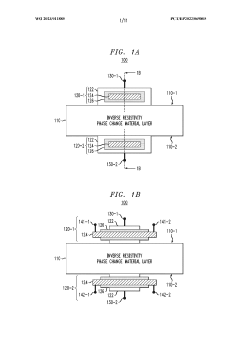
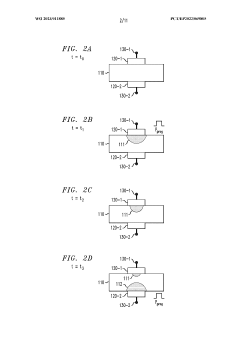
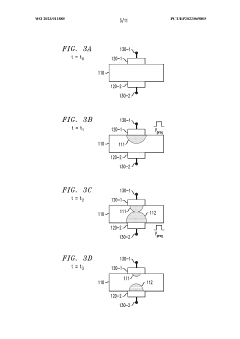
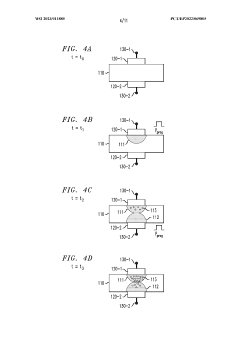
Spike-timing-dependent plasticity using inverse resistivity phase-change material
PatentWO2023011885A1
Innovation
- The use of inverse resistivity phase-change material devices, which exhibit a high-resistance crystalline state and low-resistance amorphous state, allowing for a conductance change mechanism that depends on the time difference between spike events, enabling precise adjustment of synaptic weights.
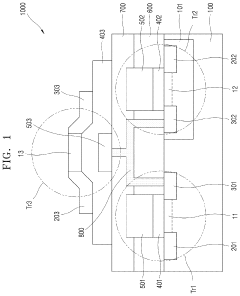
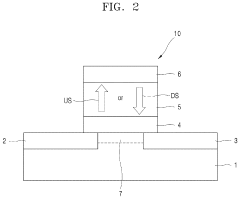
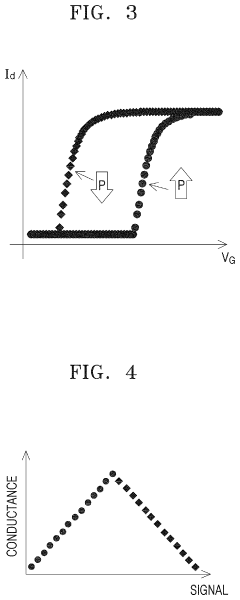
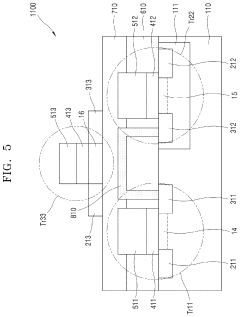
Semiconductor device including ferroelectric material, neuromorphic circuit including the semiconductor device, and neuromorphic computing apparatus including the neuromorphic circuit
PatentActiveUS11887989B2
Innovation
- The development of semiconductor devices and neuromorphic circuits incorporating ferroelectric materials, which enable efficient data processing by simulating synaptic functions, allowing for parallel processing and improved data storage and retrieval, thereby enhancing the accuracy and speed of data processing.
Energy Efficiency Considerations in Neuromorphic Systems
Energy efficiency represents a critical consideration in the development and implementation of neuromorphic computing systems. Traditional von Neumann architectures face significant energy constraints due to the physical separation between processing and memory units, creating a bottleneck that consumes substantial power. Neuromorphic systems, inspired by the brain's energy-efficient information processing capabilities, offer promising alternatives that can operate at a fraction of the energy cost.
The human brain, despite its remarkable computational power, consumes merely 20 watts of power. This extraordinary efficiency stems from its unique architecture and signaling mechanisms. Neuromorphic systems aim to replicate this efficiency through specialized hardware designs and novel materials that enable low-power computation and memory integration.
Material selection plays a pivotal role in determining the energy profile of neuromorphic systems. Emerging materials such as phase-change memory (PCM), resistive random-access memory (RRAM), and magnetic tunnel junctions (MTJs) demonstrate significant advantages in power consumption compared to conventional CMOS technologies. These materials enable non-volatile memory capabilities that eliminate standby power requirements and reduce the energy needed for state transitions.
Dynamic power scaling represents another crucial aspect of energy-efficient neuromorphic design. By implementing variable precision computation and activity-dependent power management, these systems can allocate energy resources based on computational demands. This approach mirrors the brain's ability to modulate energy consumption according to task complexity.
Spike-based communication protocols further enhance energy efficiency by transmitting information only when necessary. Unlike traditional systems that continuously process data regardless of significance, neuromorphic architectures utilizing sparse, event-driven communication can reduce power consumption by orders of magnitude. This approach is particularly effective for applications with temporal sparsity, such as sensor networks and real-time monitoring systems.
Thermal management considerations also impact the overall energy profile of neuromorphic systems. Novel cooling techniques and thermally-aware design methodologies help mitigate heat-related performance degradation while maintaining operational efficiency. Materials with favorable thermal properties contribute significantly to system stability under varying computational loads.
The integration of energy harvesting capabilities represents an emerging frontier in neuromorphic computing. Self-powered neuromorphic systems that can extract energy from their environment offer transformative possibilities for edge computing applications where battery replacement is impractical or impossible. Recent advances in piezoelectric, thermoelectric, and photovoltaic materials show promise for enabling autonomous neuromorphic devices with minimal external energy requirements.
The human brain, despite its remarkable computational power, consumes merely 20 watts of power. This extraordinary efficiency stems from its unique architecture and signaling mechanisms. Neuromorphic systems aim to replicate this efficiency through specialized hardware designs and novel materials that enable low-power computation and memory integration.
Material selection plays a pivotal role in determining the energy profile of neuromorphic systems. Emerging materials such as phase-change memory (PCM), resistive random-access memory (RRAM), and magnetic tunnel junctions (MTJs) demonstrate significant advantages in power consumption compared to conventional CMOS technologies. These materials enable non-volatile memory capabilities that eliminate standby power requirements and reduce the energy needed for state transitions.
Dynamic power scaling represents another crucial aspect of energy-efficient neuromorphic design. By implementing variable precision computation and activity-dependent power management, these systems can allocate energy resources based on computational demands. This approach mirrors the brain's ability to modulate energy consumption according to task complexity.
Spike-based communication protocols further enhance energy efficiency by transmitting information only when necessary. Unlike traditional systems that continuously process data regardless of significance, neuromorphic architectures utilizing sparse, event-driven communication can reduce power consumption by orders of magnitude. This approach is particularly effective for applications with temporal sparsity, such as sensor networks and real-time monitoring systems.
Thermal management considerations also impact the overall energy profile of neuromorphic systems. Novel cooling techniques and thermally-aware design methodologies help mitigate heat-related performance degradation while maintaining operational efficiency. Materials with favorable thermal properties contribute significantly to system stability under varying computational loads.
The integration of energy harvesting capabilities represents an emerging frontier in neuromorphic computing. Self-powered neuromorphic systems that can extract energy from their environment offer transformative possibilities for edge computing applications where battery replacement is impractical or impossible. Recent advances in piezoelectric, thermoelectric, and photovoltaic materials show promise for enabling autonomous neuromorphic devices with minimal external energy requirements.
Standardization Efforts for Neuromorphic Computing Materials
The standardization of neuromorphic computing materials has become increasingly critical as the field advances from research laboratories toward commercial applications. Currently, several international organizations are leading efforts to establish common frameworks, including the IEEE Neuromorphic Computing Standards Working Group and the International Electrotechnical Commission (IEC) Technical Committee on Nanotechnology. These bodies are developing specifications for material characterization, performance metrics, and interoperability protocols essential for industry-wide adoption.
A significant focus of standardization efforts is the establishment of uniform testing methodologies for neuromorphic materials. This includes standardized procedures for measuring synaptic plasticity, spike-timing-dependent plasticity (STDP), and retention characteristics of memristive devices. The JEDEC Solid State Technology Association has recently initiated a task force specifically addressing reliability standards for resistive memory technologies used in neuromorphic systems, establishing accelerated testing protocols that can predict long-term material stability.
Material composition reporting standards represent another crucial area of development. The International Union of Pure and Applied Chemistry (IUPAC) is collaborating with neuromorphic computing stakeholders to create nomenclature guidelines for novel materials and compounds. These standards aim to ensure consistent reporting of material compositions, dopants, and structural characteristics across research publications and commercial specifications, facilitating reproducibility and technology transfer.
Interoperability standards are emerging to address the integration challenges between different neuromorphic material platforms. The Neuromorphic Engineering Community Consortium has proposed a reference architecture that defines standard interfaces between biological materials, memristive arrays, and conventional CMOS circuitry. This framework includes specifications for signal transduction, power requirements, and thermal management considerations specific to different material classes.
Safety and environmental standards for neuromorphic materials are also gaining prominence. The European Materials Characterisation Council has published preliminary guidelines for risk assessment of novel neuromorphic materials, particularly those incorporating nanomaterials or biological components. These standards address biocompatibility, toxicity, and end-of-life disposal considerations, which are especially relevant for neuromorphic systems intended for biomedical applications or widespread consumer deployment.
Calibration and benchmarking standards are being developed to enable fair comparison between different neuromorphic material implementations. The National Institute of Standards and Technology (NIST) has established a Neuromorphic Computing Metrology program that provides reference materials and measurement protocols for evaluating key performance indicators such as switching energy, endurance, and noise characteristics across diverse material platforms.
A significant focus of standardization efforts is the establishment of uniform testing methodologies for neuromorphic materials. This includes standardized procedures for measuring synaptic plasticity, spike-timing-dependent plasticity (STDP), and retention characteristics of memristive devices. The JEDEC Solid State Technology Association has recently initiated a task force specifically addressing reliability standards for resistive memory technologies used in neuromorphic systems, establishing accelerated testing protocols that can predict long-term material stability.
Material composition reporting standards represent another crucial area of development. The International Union of Pure and Applied Chemistry (IUPAC) is collaborating with neuromorphic computing stakeholders to create nomenclature guidelines for novel materials and compounds. These standards aim to ensure consistent reporting of material compositions, dopants, and structural characteristics across research publications and commercial specifications, facilitating reproducibility and technology transfer.
Interoperability standards are emerging to address the integration challenges between different neuromorphic material platforms. The Neuromorphic Engineering Community Consortium has proposed a reference architecture that defines standard interfaces between biological materials, memristive arrays, and conventional CMOS circuitry. This framework includes specifications for signal transduction, power requirements, and thermal management considerations specific to different material classes.
Safety and environmental standards for neuromorphic materials are also gaining prominence. The European Materials Characterisation Council has published preliminary guidelines for risk assessment of novel neuromorphic materials, particularly those incorporating nanomaterials or biological components. These standards address biocompatibility, toxicity, and end-of-life disposal considerations, which are especially relevant for neuromorphic systems intended for biomedical applications or widespread consumer deployment.
Calibration and benchmarking standards are being developed to enable fair comparison between different neuromorphic material implementations. The National Institute of Standards and Technology (NIST) has established a Neuromorphic Computing Metrology program that provides reference materials and measurement protocols for evaluating key performance indicators such as switching energy, endurance, and noise characteristics across diverse material platforms.
Unlock deeper insights with Patsnap Eureka Quick Research — get a full tech report to explore trends and direct your research. Try now!
Generate Your Research Report Instantly with AI Agent
Supercharge your innovation with Patsnap Eureka AI Agent Platform!