

Thrust Vector Control Techniques in Aerospike Engines: A Study
MAY 11, 20269 MIN READ
Generate Your Research Report Instantly with AI Agent
PatSnap Eureka helps you evaluate technical feasibility & market potential.
Aerospike Engine TVC Background and Objectives
Aerospike engines represent a revolutionary propulsion technology that has garnered significant attention in the aerospace industry due to their unique design characteristics and performance advantages. Unlike conventional bell-shaped rocket nozzles, aerospike engines feature an inverted nozzle configuration where the combustion gases expand against a central spike-shaped structure, creating a virtual bell through atmospheric pressure interaction. This innovative design enables altitude compensation, maintaining optimal performance across varying atmospheric conditions from sea level to vacuum.
The evolution of aerospike engine technology traces back to the 1960s when NASA and Rocketdyne began exploring linear and toroidal aerospike configurations. Early research focused on addressing the fundamental limitation of fixed-geometry rocket nozzles, which can only achieve optimal expansion ratio at one specific altitude. The aerospike concept promised to eliminate this constraint by allowing the exhaust plume to naturally adjust its expansion based on ambient pressure conditions.
Thrust vector control in aerospike engines presents unique challenges and opportunities compared to traditional rocket propulsion systems. Conventional engines typically employ gimbal mechanisms, differential throttling, or auxiliary thrusters for directional control. However, the aerospike's unconventional geometry necessitates innovative TVC approaches that can effectively manipulate thrust direction while preserving the engine's inherent altitude compensation benefits.
The primary objective of investigating thrust vector control techniques in aerospike engines centers on developing reliable, efficient, and responsive control mechanisms that can support diverse mission requirements. These objectives encompass achieving precise attitude control for launch vehicles, enabling controlled descent and landing capabilities for reusable spacecraft, and facilitating orbital maneuvering operations. The research aims to identify optimal TVC methodologies that maintain the aerospike's performance advantages while providing sufficient control authority for mission-critical applications.
Contemporary aerospace missions demand increasingly sophisticated propulsion systems capable of supporting complex flight profiles, including powered landings, orbital transfers, and precision trajectory corrections. The integration of effective thrust vector control with aerospike technology could unlock new possibilities for single-stage-to-orbit vehicles, lunar landers, and Mars exploration missions, where altitude compensation and precise control are equally critical for mission success.
The evolution of aerospike engine technology traces back to the 1960s when NASA and Rocketdyne began exploring linear and toroidal aerospike configurations. Early research focused on addressing the fundamental limitation of fixed-geometry rocket nozzles, which can only achieve optimal expansion ratio at one specific altitude. The aerospike concept promised to eliminate this constraint by allowing the exhaust plume to naturally adjust its expansion based on ambient pressure conditions.
Thrust vector control in aerospike engines presents unique challenges and opportunities compared to traditional rocket propulsion systems. Conventional engines typically employ gimbal mechanisms, differential throttling, or auxiliary thrusters for directional control. However, the aerospike's unconventional geometry necessitates innovative TVC approaches that can effectively manipulate thrust direction while preserving the engine's inherent altitude compensation benefits.
The primary objective of investigating thrust vector control techniques in aerospike engines centers on developing reliable, efficient, and responsive control mechanisms that can support diverse mission requirements. These objectives encompass achieving precise attitude control for launch vehicles, enabling controlled descent and landing capabilities for reusable spacecraft, and facilitating orbital maneuvering operations. The research aims to identify optimal TVC methodologies that maintain the aerospike's performance advantages while providing sufficient control authority for mission-critical applications.
Contemporary aerospace missions demand increasingly sophisticated propulsion systems capable of supporting complex flight profiles, including powered landings, orbital transfers, and precision trajectory corrections. The integration of effective thrust vector control with aerospike technology could unlock new possibilities for single-stage-to-orbit vehicles, lunar landers, and Mars exploration missions, where altitude compensation and precise control are equally critical for mission success.
Market Demand for Advanced Rocket Propulsion Systems
The global aerospace industry is experiencing unprecedented growth driven by the commercialization of space exploration, satellite deployment, and emerging space tourism markets. Traditional rocket propulsion systems face increasing pressure to deliver enhanced performance, cost-effectiveness, and operational flexibility. This demand surge has created substantial market opportunities for advanced propulsion technologies, particularly those offering superior thrust-to-weight ratios and adaptive performance characteristics.
Commercial space launch services represent the fastest-growing segment within the rocket propulsion market. Private aerospace companies are seeking propulsion solutions that can accommodate diverse payload requirements while maintaining competitive launch costs. The proliferation of small satellite constellations and frequent resupply missions to space stations has intensified the need for reusable and highly maneuverable propulsion systems.
Aerospike engines with advanced thrust vector control capabilities address critical market gaps that conventional bell nozzle engines cannot efficiently fill. The aerospace industry increasingly values propulsion systems capable of maintaining optimal performance across varying atmospheric conditions and flight profiles. This requirement stems from the growing complexity of modern space missions, including orbital insertion maneuvers, interplanetary transfers, and precision landing operations.
Military and defense applications constitute another significant demand driver for advanced rocket propulsion systems. Modern defense requirements emphasize rapid response capabilities, tactical flexibility, and mission adaptability. Propulsion systems with sophisticated thrust vector control enable enhanced maneuverability for missile defense systems, tactical rockets, and next-generation military spacecraft.
The emerging space tourism sector presents unique propulsion requirements that traditional systems struggle to meet. Safety, reliability, and passenger comfort considerations demand propulsion technologies with precise control authority and smooth operational characteristics. Aerospike engines with advanced thrust vector control offer potential solutions for suborbital and orbital tourism vehicles requiring exceptional flight profile flexibility.
International space agencies and government organizations continue investing heavily in next-generation propulsion technologies. These investments reflect strategic priorities for maintaining technological leadership in space exploration and national security applications. The market demand extends beyond performance improvements to include environmental considerations, operational sustainability, and long-term cost reduction objectives.
Commercial space launch services represent the fastest-growing segment within the rocket propulsion market. Private aerospace companies are seeking propulsion solutions that can accommodate diverse payload requirements while maintaining competitive launch costs. The proliferation of small satellite constellations and frequent resupply missions to space stations has intensified the need for reusable and highly maneuverable propulsion systems.
Aerospike engines with advanced thrust vector control capabilities address critical market gaps that conventional bell nozzle engines cannot efficiently fill. The aerospace industry increasingly values propulsion systems capable of maintaining optimal performance across varying atmospheric conditions and flight profiles. This requirement stems from the growing complexity of modern space missions, including orbital insertion maneuvers, interplanetary transfers, and precision landing operations.
Military and defense applications constitute another significant demand driver for advanced rocket propulsion systems. Modern defense requirements emphasize rapid response capabilities, tactical flexibility, and mission adaptability. Propulsion systems with sophisticated thrust vector control enable enhanced maneuverability for missile defense systems, tactical rockets, and next-generation military spacecraft.
The emerging space tourism sector presents unique propulsion requirements that traditional systems struggle to meet. Safety, reliability, and passenger comfort considerations demand propulsion technologies with precise control authority and smooth operational characteristics. Aerospike engines with advanced thrust vector control offer potential solutions for suborbital and orbital tourism vehicles requiring exceptional flight profile flexibility.
International space agencies and government organizations continue investing heavily in next-generation propulsion technologies. These investments reflect strategic priorities for maintaining technological leadership in space exploration and national security applications. The market demand extends beyond performance improvements to include environmental considerations, operational sustainability, and long-term cost reduction objectives.
Current State and Challenges of Aerospike TVC Technology
Aerospike engines represent a revolutionary propulsion technology that has garnered significant attention for their theoretical advantages in single-stage-to-orbit applications. However, the implementation of thrust vector control systems in aerospike configurations presents unique technical challenges that distinguish them from conventional bell nozzle engines. Current aerospike TVC technology remains in relatively early developmental stages, with limited flight-proven systems and substantial engineering hurdles yet to be overcome.
The fundamental challenge in aerospike TVC stems from the engine's distinctive geometry and flow characteristics. Unlike traditional rocket engines where exhaust gases are contained within a bell-shaped nozzle, aerospike engines utilize an external expansion surface that allows ambient pressure to act as the outer boundary of the expanding exhaust plume. This configuration complicates conventional TVC approaches, as the thrust vector must be controlled without disrupting the delicate pressure balance that enables the aerospike's altitude-compensating properties.
Current TVC implementations for aerospike engines primarily focus on three main approaches: differential throttling of multiple combustion chambers, mechanical deflection systems, and secondary injection methods. Differential throttling involves selectively varying the thrust output of individual thrust chambers arranged around the aerospike's circumference, creating asymmetric thrust patterns that generate control moments. However, this approach faces significant challenges in achieving precise control authority while maintaining optimal engine performance across varying flight conditions.
Mechanical deflection systems attempt to physically redirect portions of the exhaust flow through movable surfaces or deflector vanes positioned within or adjacent to the exhaust plume. These systems encounter severe thermal and structural challenges due to the extreme temperatures and dynamic pressures present in the aerospike's exhaust environment. Material limitations and mechanical complexity have hindered the practical implementation of such systems in operational vehicles.
Secondary injection TVC methods involve introducing pressurized gas or liquid into the exhaust stream to create lateral forces for vehicle control. While this approach offers potential advantages in terms of mechanical simplicity, it faces challenges related to injection system integration, propellant consumption penalties, and maintaining injection effectiveness across the aerospike's varying pressure field. The complex three-dimensional flow patterns characteristic of aerospike exhausts further complicate the prediction and optimization of injection-based control systems.
Manufacturing and testing constraints represent additional significant challenges in aerospike TVC development. The complex geometries required for integrated TVC systems increase manufacturing costs and complexity, while ground testing facilities capable of accurately simulating the altitude-compensating behavior of aerospike engines remain limited. These factors have contributed to the relatively slow pace of aerospike TVC technology maturation compared to conventional propulsion systems.
The fundamental challenge in aerospike TVC stems from the engine's distinctive geometry and flow characteristics. Unlike traditional rocket engines where exhaust gases are contained within a bell-shaped nozzle, aerospike engines utilize an external expansion surface that allows ambient pressure to act as the outer boundary of the expanding exhaust plume. This configuration complicates conventional TVC approaches, as the thrust vector must be controlled without disrupting the delicate pressure balance that enables the aerospike's altitude-compensating properties.
Current TVC implementations for aerospike engines primarily focus on three main approaches: differential throttling of multiple combustion chambers, mechanical deflection systems, and secondary injection methods. Differential throttling involves selectively varying the thrust output of individual thrust chambers arranged around the aerospike's circumference, creating asymmetric thrust patterns that generate control moments. However, this approach faces significant challenges in achieving precise control authority while maintaining optimal engine performance across varying flight conditions.
Mechanical deflection systems attempt to physically redirect portions of the exhaust flow through movable surfaces or deflector vanes positioned within or adjacent to the exhaust plume. These systems encounter severe thermal and structural challenges due to the extreme temperatures and dynamic pressures present in the aerospike's exhaust environment. Material limitations and mechanical complexity have hindered the practical implementation of such systems in operational vehicles.
Secondary injection TVC methods involve introducing pressurized gas or liquid into the exhaust stream to create lateral forces for vehicle control. While this approach offers potential advantages in terms of mechanical simplicity, it faces challenges related to injection system integration, propellant consumption penalties, and maintaining injection effectiveness across the aerospike's varying pressure field. The complex three-dimensional flow patterns characteristic of aerospike exhausts further complicate the prediction and optimization of injection-based control systems.
Manufacturing and testing constraints represent additional significant challenges in aerospike TVC development. The complex geometries required for integrated TVC systems increase manufacturing costs and complexity, while ground testing facilities capable of accurately simulating the altitude-compensating behavior of aerospike engines remain limited. These factors have contributed to the relatively slow pace of aerospike TVC technology maturation compared to conventional propulsion systems.
Existing TVC Solutions for Aerospike Configurations
01 Mechanical thrust vectoring systems for aerospike engines
Mechanical systems that physically redirect the exhaust flow of aerospike engines to achieve thrust vector control. These systems typically employ movable components such as deflector vanes, gimbal mechanisms, or adjustable nozzle sections that can be actuated to change the direction of thrust. The mechanical approach provides direct control over exhaust flow direction and can be integrated into the aerospike nozzle design.- Mechanical thrust vectoring systems for aerospike engines: Mechanical systems that physically redirect the exhaust flow of aerospike engines to achieve thrust vector control. These systems typically employ movable components such as deflector plates, vanes, or nozzle segments that can be actuated to change the direction of thrust. The mechanical approach provides direct control over exhaust flow direction and can be integrated into the aerospike nozzle design to maintain efficiency while enabling maneuverability.
- Fluid injection thrust vector control methods: Systems that use secondary fluid injection to control thrust direction in aerospike engines. This approach involves injecting gas or liquid into the exhaust flow at strategic locations to create differential pressure and redirect the thrust vector. The injection can be controlled electronically and provides rapid response times for attitude control without requiring large mechanical components.
- Gimbal-mounted aerospike engine systems: Complete engine mounting systems that allow the entire aerospike engine to be pivoted or rotated for thrust vector control. These systems use gimbal mechanisms that can tilt the engine in multiple axes to direct thrust as needed. This approach maintains the aerospike nozzle's optimal performance characteristics while providing comprehensive directional control through engine positioning.
- Electronic control systems for aerospike thrust vectoring: Advanced electronic control units and algorithms specifically designed to manage thrust vector control in aerospike engines. These systems integrate sensors, actuators, and control logic to automatically adjust thrust direction based on flight requirements or pilot input. The electronic systems can coordinate multiple thrust vectoring methods and provide precise, real-time control for optimal vehicle performance.
- Hybrid thrust vectoring configurations: Combined systems that integrate multiple thrust vector control methods within aerospike engine designs. These configurations may combine mechanical deflection with fluid injection or incorporate variable geometry components with electronic control systems. The hybrid approach aims to maximize control authority while maintaining engine efficiency and reliability across different operating conditions.
02 Fluid injection thrust vector control methods
Systems that use secondary fluid injection to control thrust direction in aerospike engines. This approach involves injecting gas or liquid into the exhaust flow at strategic locations around the aerospike to create differential pressure and redirect the primary exhaust stream. The injection can be controlled electronically to provide precise thrust vectoring without moving mechanical parts in the main nozzle.Expand Specific Solutions03 Variable geometry aerospike nozzle configurations
Aerospike engine designs that incorporate adjustable geometric features to enable thrust vector control. These configurations may include variable spike length, adjustable base area, or modifiable contour shapes that can be altered during operation. The geometric changes affect the exhaust flow pattern and pressure distribution, allowing for controlled thrust direction modification.Expand Specific Solutions04 Electronic control systems for aerospike thrust vectoring
Advanced electronic control architectures specifically designed for managing thrust vector control in aerospike engines. These systems integrate sensors, actuators, and control algorithms to provide real-time adjustment of thrust direction based on flight requirements. The electronic systems can coordinate multiple thrust vectoring methods and provide feedback control for precise maneuvering.Expand Specific Solutions05 Hybrid thrust vectoring approaches for aerospike propulsion
Combined methodologies that integrate multiple thrust vector control techniques in aerospike engine systems. These approaches may combine mechanical deflection with fluid injection, or integrate variable geometry with electronic control systems to achieve enhanced maneuverability and control authority. The hybrid systems aim to optimize performance across different operating conditions and mission requirements.Expand Specific Solutions
Key Players in Aerospike Engine and TVC Industry
The thrust vector control techniques in aerospike engines represent an emerging technology sector in its early development stage, characterized by limited commercial deployment but significant research momentum. The market remains nascent with substantial growth potential as space exploration and advanced propulsion systems gain prominence. Technology maturity varies considerably across stakeholders, with established aerospace giants like Boeing, Airbus Operations SAS, and Aerojet Rocketdyne leveraging decades of propulsion expertise, while government agencies including NASA and Japan Aerospace Exploration Agency drive fundamental research initiatives. Leading Chinese institutions such as Beihang University, Northwestern Polytechnical University, and Nanjing University of Aeronautics & Astronautics contribute substantial academic research, positioning the competitive landscape as a blend of industrial capability and research-driven innovation seeking breakthrough applications.
The Boeing Co.
Technical Solution: Boeing has developed integrated thrust vector control solutions for aerospike engines focusing on commercial space applications and next-generation launch vehicles. Their technical approach combines electro-mechanical actuator systems with advanced flight control software to provide precise thrust vectoring capabilities. The company's design philosophy emphasizes reliability and cost-effectiveness, incorporating redundant control pathways and fail-safe mechanisms. Boeing's aerospike thrust vector control systems utilize distributed sensor networks and predictive control algorithms to optimize performance across varying flight conditions, with particular attention to reducing mechanical complexity while maintaining high precision control authority.
Strengths: Strong systems integration capabilities and commercial aerospace experience with cost-effective solutions. Weaknesses: Limited heritage in aerospike-specific applications compared to traditional rocket nozzle systems.
National Aeronautics & Space Administration
Technical Solution: NASA has developed comprehensive thrust vector control systems for aerospike engines through advanced computational fluid dynamics modeling and experimental validation programs. Their approach integrates multi-axis gimbal systems with real-time feedback control algorithms to achieve precise thrust vectoring in aerospike configurations. The agency has pioneered the use of distributed control architectures that enable independent control of multiple thrust chambers in linear aerospike designs, allowing for enhanced maneuverability and attitude control in space vehicles. NASA's research includes innovative secondary injection techniques and mechanical deflection systems specifically optimized for the unique flow characteristics of aerospike nozzles.
Strengths: Extensive research heritage and proven space flight experience with advanced control systems. Weaknesses: High development costs and complex integration requirements for operational systems.
Core Patents in Aerospike Thrust Vector Control
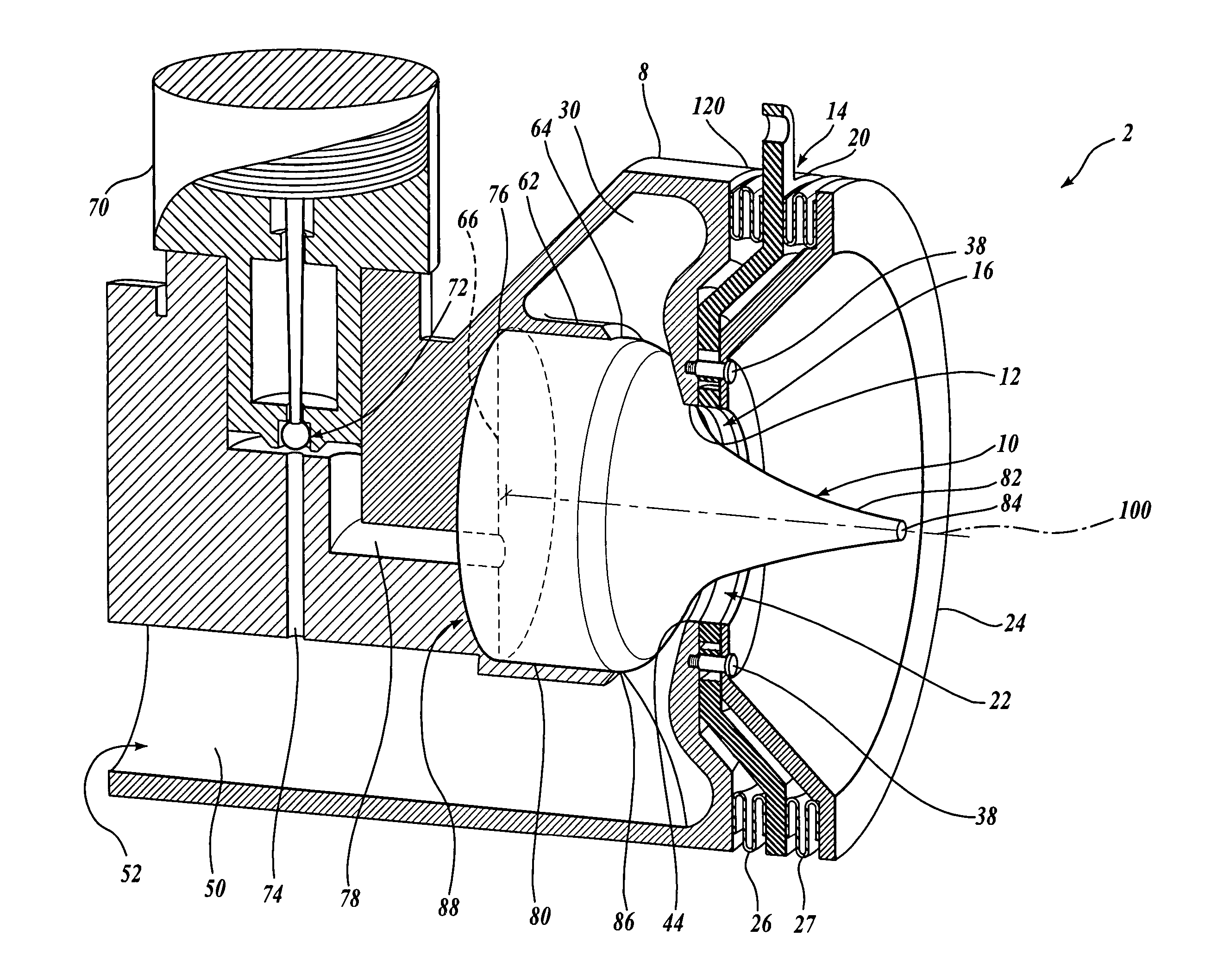
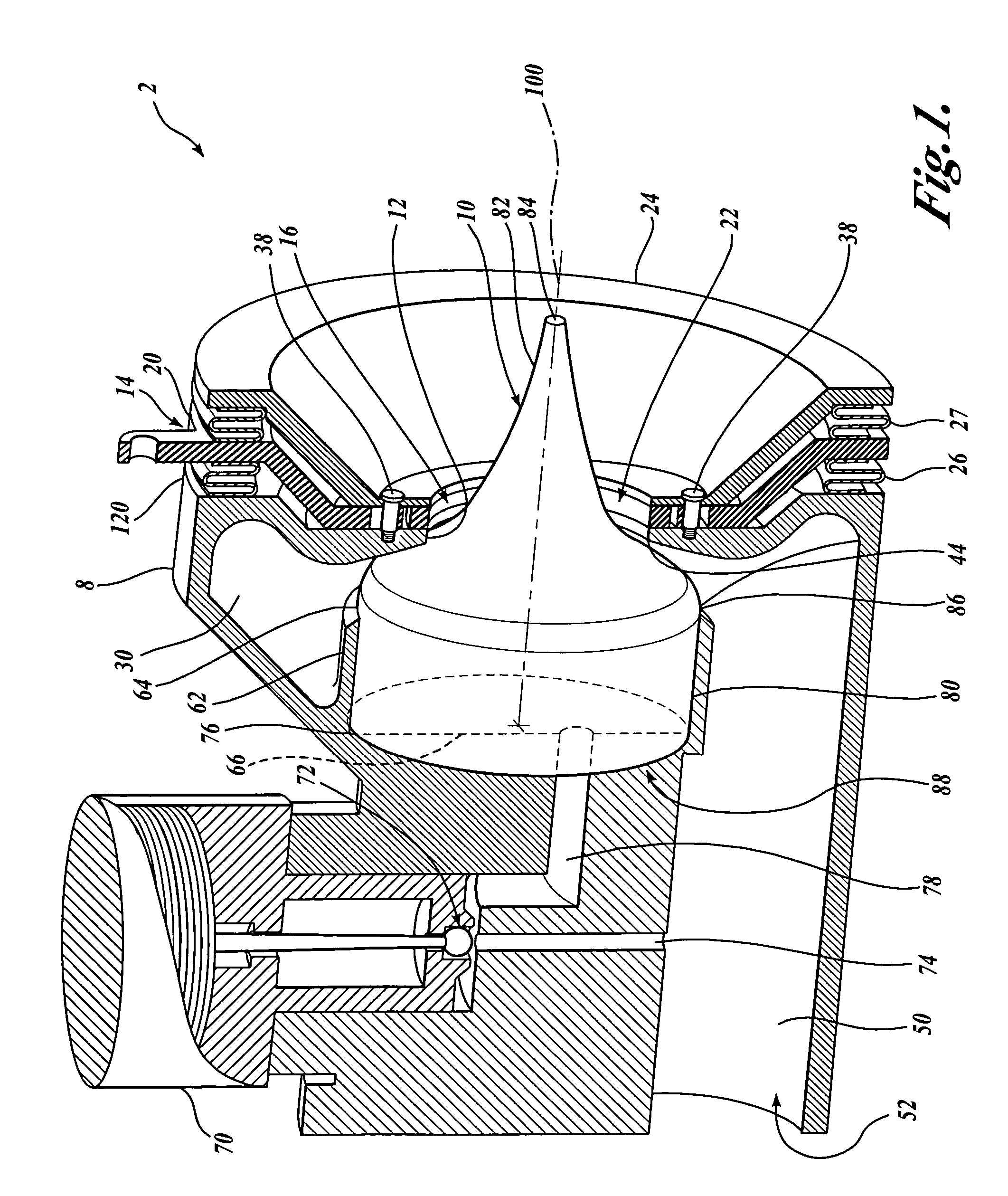
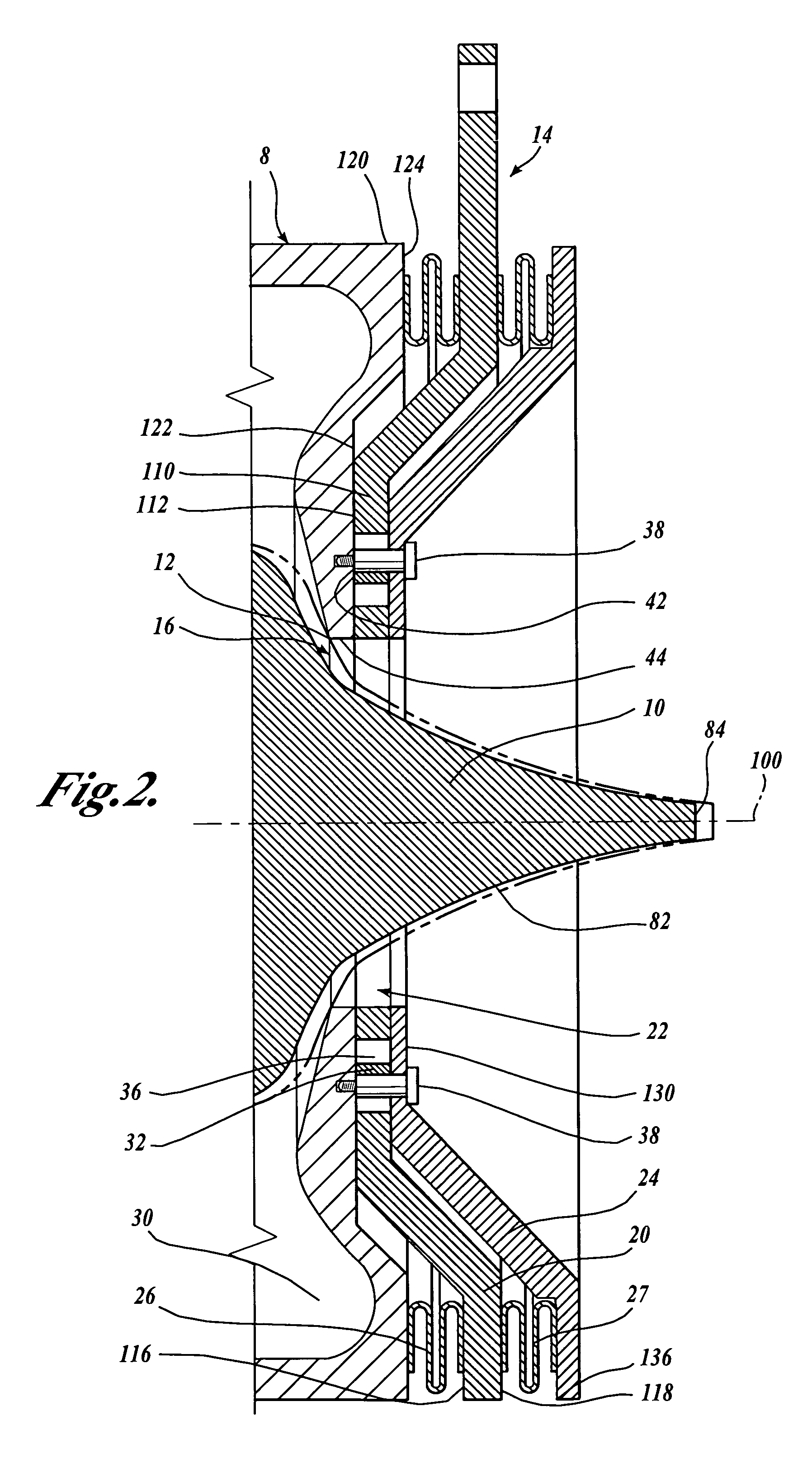
Thrust vector control system for a plug nozzle rocket engine
PatentInactiveUS7155898B2
Innovation
- A thrust vector control system that includes a housing with a nozzle throat and a moveable thrust diverter, which creates an asymmetric pressure distribution along the plug to deflect the thrust vector, using actuators to position the diverter in various planes perpendicular to the axis, allowing for rapid and efficient control of the thrust vector.

Thrust control apparatus of propulsion system
PatentActiveUS20200080517A1
Innovation
- A thrust control apparatus is introduced, featuring an aerospike pintle nozzle with a pintle, a driving motor, a thrust vectoring unit, and a cylinder that moves and rotates the thrust vectoring unit to control the nozzle neck gap, allowing simultaneous control of thrust magnitude and direction, and includes a purging mode to prevent particle deposition.


Aerospace Regulations for Advanced Propulsion Systems
The regulatory landscape for advanced propulsion systems, particularly aerospike engines with thrust vector control capabilities, presents a complex framework that significantly impacts development timelines and market entry strategies. Current aerospace regulations primarily stem from established agencies including the Federal Aviation Administration (FAA), European Union Aviation Safety Agency (EASA), and international bodies such as the International Civil Aviation Organization (ICAO). These organizations maintain certification standards originally designed for conventional rocket propulsion systems, creating regulatory gaps for innovative technologies like aerospike engines.
Existing certification processes require extensive documentation of propulsion system performance, safety margins, and failure mode analysis. For aerospike engines incorporating thrust vector control, regulatory bodies demand comprehensive testing data demonstrating system reliability across various operational scenarios. The certification pathway typically involves preliminary design reviews, critical design reviews, and extensive ground testing phases before flight qualification approval.
Environmental regulations impose additional constraints on advanced propulsion development. Emission standards, noise regulations, and environmental impact assessments must be satisfied before operational approval. Aerospike engines, while potentially offering improved efficiency, must demonstrate compliance with increasingly stringent environmental protection requirements. These regulations vary significantly across different jurisdictions, complicating international market access strategies.
Safety certification requirements for thrust vector control systems demand rigorous validation of control algorithms, actuator reliability, and fail-safe mechanisms. Regulatory authorities require demonstration of system performance under extreme conditions, including component failures and off-nominal operating scenarios. The certification process typically extends development timelines by 18-24 months and requires substantial financial investment in testing infrastructure.
International harmonization efforts aim to streamline certification processes across different regulatory domains. However, current regulatory frameworks often lag behind technological advancement, creating uncertainty for developers of innovative propulsion technologies. Future regulatory evolution will likely incorporate performance-based standards rather than prescriptive requirements, potentially accelerating certification timelines for advanced propulsion systems while maintaining safety standards.
Existing certification processes require extensive documentation of propulsion system performance, safety margins, and failure mode analysis. For aerospike engines incorporating thrust vector control, regulatory bodies demand comprehensive testing data demonstrating system reliability across various operational scenarios. The certification pathway typically involves preliminary design reviews, critical design reviews, and extensive ground testing phases before flight qualification approval.
Environmental regulations impose additional constraints on advanced propulsion development. Emission standards, noise regulations, and environmental impact assessments must be satisfied before operational approval. Aerospike engines, while potentially offering improved efficiency, must demonstrate compliance with increasingly stringent environmental protection requirements. These regulations vary significantly across different jurisdictions, complicating international market access strategies.
Safety certification requirements for thrust vector control systems demand rigorous validation of control algorithms, actuator reliability, and fail-safe mechanisms. Regulatory authorities require demonstration of system performance under extreme conditions, including component failures and off-nominal operating scenarios. The certification process typically extends development timelines by 18-24 months and requires substantial financial investment in testing infrastructure.
International harmonization efforts aim to streamline certification processes across different regulatory domains. However, current regulatory frameworks often lag behind technological advancement, creating uncertainty for developers of innovative propulsion technologies. Future regulatory evolution will likely incorporate performance-based standards rather than prescriptive requirements, potentially accelerating certification timelines for advanced propulsion systems while maintaining safety standards.
Environmental Impact of Aerospike Engine Technologies
Aerospike engine technologies represent a significant advancement in propulsion systems with substantial environmental implications that distinguish them from conventional rocket engines. The unique design characteristics of aerospike engines, particularly their altitude-compensating nozzle configuration, contribute to enhanced fuel efficiency and reduced environmental footprint across various operational parameters.
The primary environmental advantage of aerospike engines stems from their superior specific impulse performance throughout the entire flight envelope. Unlike traditional bell nozzles that operate optimally only at specific altitudes, aerospike engines maintain near-optimal expansion ratios from sea level to vacuum conditions. This efficiency translates directly into reduced propellant consumption, resulting in lower overall emissions per unit of payload delivered to orbit.
Combustion efficiency improvements in aerospike engines lead to more complete fuel burning, reducing unburned hydrocarbon emissions and carbon monoxide production. The enhanced mixing characteristics inherent in the aerospike design promote more thorough combustion processes, minimizing the release of partially oxidized compounds that contribute to atmospheric pollution. Additionally, the reduced propellant requirements decrease the environmental impact associated with fuel production, transportation, and storage infrastructure.
The noise signature of aerospike engines presents another environmental consideration. The distributed exhaust pattern and altered shock wave formation characteristics can potentially reduce acoustic emissions compared to conventional rocket engines. This reduction in noise pollution benefits both wildlife habitats near launch facilities and surrounding human communities, addressing growing concerns about the environmental impact of increased launch frequencies.
However, aerospike engines also present unique environmental challenges. The complex cooling requirements and potential for increased surface temperatures may necessitate advanced thermal management systems, potentially involving exotic materials or cooling fluids with their own environmental implications. The manufacturing complexity of aerospike nozzles may also result in higher embodied energy and material consumption during production phases.
Long-term atmospheric effects require careful consideration, particularly regarding upper atmosphere interactions. While aerospike engines may reduce overall emission quantities, the altered exhaust plume characteristics and injection patterns could influence stratospheric chemistry differently than conventional engines. Research into these high-altitude environmental interactions remains ongoing, with particular attention to ozone depletion potential and greenhouse gas contributions.
The lifecycle environmental assessment of aerospike technologies must also account for reusability potential. The improved efficiency and reduced thermal stress characteristics of aerospike engines may enhance vehicle reusability, significantly reducing the environmental impact per mission through decreased manufacturing requirements and waste generation associated with expendable launch systems.
The primary environmental advantage of aerospike engines stems from their superior specific impulse performance throughout the entire flight envelope. Unlike traditional bell nozzles that operate optimally only at specific altitudes, aerospike engines maintain near-optimal expansion ratios from sea level to vacuum conditions. This efficiency translates directly into reduced propellant consumption, resulting in lower overall emissions per unit of payload delivered to orbit.
Combustion efficiency improvements in aerospike engines lead to more complete fuel burning, reducing unburned hydrocarbon emissions and carbon monoxide production. The enhanced mixing characteristics inherent in the aerospike design promote more thorough combustion processes, minimizing the release of partially oxidized compounds that contribute to atmospheric pollution. Additionally, the reduced propellant requirements decrease the environmental impact associated with fuel production, transportation, and storage infrastructure.
The noise signature of aerospike engines presents another environmental consideration. The distributed exhaust pattern and altered shock wave formation characteristics can potentially reduce acoustic emissions compared to conventional rocket engines. This reduction in noise pollution benefits both wildlife habitats near launch facilities and surrounding human communities, addressing growing concerns about the environmental impact of increased launch frequencies.
However, aerospike engines also present unique environmental challenges. The complex cooling requirements and potential for increased surface temperatures may necessitate advanced thermal management systems, potentially involving exotic materials or cooling fluids with their own environmental implications. The manufacturing complexity of aerospike nozzles may also result in higher embodied energy and material consumption during production phases.
Long-term atmospheric effects require careful consideration, particularly regarding upper atmosphere interactions. While aerospike engines may reduce overall emission quantities, the altered exhaust plume characteristics and injection patterns could influence stratospheric chemistry differently than conventional engines. Research into these high-altitude environmental interactions remains ongoing, with particular attention to ozone depletion potential and greenhouse gas contributions.
The lifecycle environmental assessment of aerospike technologies must also account for reusability potential. The improved efficiency and reduced thermal stress characteristics of aerospike engines may enhance vehicle reusability, significantly reducing the environmental impact per mission through decreased manufacturing requirements and waste generation associated with expendable launch systems.
Unlock deeper insights with PatSnap Eureka Quick Research — get a full tech report to explore trends and direct your research. Try now!
Generate Your Research Report Instantly with AI Agent
Supercharge your innovation with PatSnap Eureka AI Agent Platform!