

Ultrafast Laser Methods for Thermoregulatory Material Processing.
SEP 4, 202510 MIN READ
Generate Your Research Report Instantly with AI Agent
PatSnap Eureka helps you evaluate technical feasibility & market potential.
Ultrafast Laser Technology Background and Objectives
Ultrafast laser technology has evolved significantly over the past three decades, transforming from laboratory curiosities to essential industrial tools. The development trajectory began with the invention of chirped pulse amplification in the 1980s, which enabled the generation of extremely short pulses with unprecedented peak powers while avoiding damage to optical components. This breakthrough earned Donna Strickland and Gérard Mourou the Nobel Prize in Physics in 2018, underscoring the fundamental importance of this technology.
The field has witnessed remarkable advancements in pulse duration, with modern systems routinely achieving femtosecond (10^-15 s) pulses, and some research systems pushing into the attosecond (10^-18 s) regime. These ultrashort pulses allow for material interaction timescales shorter than thermal diffusion processes, enabling "cold processing" - a revolutionary capability that minimizes heat-affected zones and allows for precision modification of thermally sensitive materials.
In the context of thermoregulatory material processing, ultrafast lasers represent a paradigm shift from conventional laser processing methods. Traditional continuous wave or long-pulse lasers primarily interact with materials through photothermal mechanisms, where optical energy is converted to heat that subsequently modifies the material. In contrast, ultrafast lasers can trigger nonlinear absorption, multiphoton ionization, and plasma formation processes that occur before significant thermal diffusion, allowing for unprecedented control over material properties at micro and nanoscales.
The primary technical objectives in this field include developing more stable and reliable ultrafast laser sources with higher average powers while maintaining beam quality and pulse characteristics. Current research aims to scale average powers from tens of watts to kilowatts while preserving femtosecond pulse durations, which would dramatically increase processing throughput for industrial applications. Additionally, there is significant focus on improving pulse-to-pulse stability and beam quality to enhance process repeatability.
For thermoregulatory material processing specifically, key objectives include developing precise control methodologies for creating hierarchical micro and nanostructures that can dynamically respond to thermal stimuli. This involves understanding and manipulating how ultrafast laser pulses interact with various material systems to create functional surfaces with programmable wettability, variable emissivity, and adaptive thermal conductivity properties.
Another critical goal is reducing the cost and complexity of ultrafast laser systems to broaden their industrial adoption. Current high-end systems remain prohibitively expensive for many potential applications, limiting widespread implementation. Technological advances in diode pumping, fiber laser architecture, and integrated photonics aim to address these limitations while maintaining the performance characteristics essential for advanced material processing.
The field has witnessed remarkable advancements in pulse duration, with modern systems routinely achieving femtosecond (10^-15 s) pulses, and some research systems pushing into the attosecond (10^-18 s) regime. These ultrashort pulses allow for material interaction timescales shorter than thermal diffusion processes, enabling "cold processing" - a revolutionary capability that minimizes heat-affected zones and allows for precision modification of thermally sensitive materials.
In the context of thermoregulatory material processing, ultrafast lasers represent a paradigm shift from conventional laser processing methods. Traditional continuous wave or long-pulse lasers primarily interact with materials through photothermal mechanisms, where optical energy is converted to heat that subsequently modifies the material. In contrast, ultrafast lasers can trigger nonlinear absorption, multiphoton ionization, and plasma formation processes that occur before significant thermal diffusion, allowing for unprecedented control over material properties at micro and nanoscales.
The primary technical objectives in this field include developing more stable and reliable ultrafast laser sources with higher average powers while maintaining beam quality and pulse characteristics. Current research aims to scale average powers from tens of watts to kilowatts while preserving femtosecond pulse durations, which would dramatically increase processing throughput for industrial applications. Additionally, there is significant focus on improving pulse-to-pulse stability and beam quality to enhance process repeatability.
For thermoregulatory material processing specifically, key objectives include developing precise control methodologies for creating hierarchical micro and nanostructures that can dynamically respond to thermal stimuli. This involves understanding and manipulating how ultrafast laser pulses interact with various material systems to create functional surfaces with programmable wettability, variable emissivity, and adaptive thermal conductivity properties.
Another critical goal is reducing the cost and complexity of ultrafast laser systems to broaden their industrial adoption. Current high-end systems remain prohibitively expensive for many potential applications, limiting widespread implementation. Technological advances in diode pumping, fiber laser architecture, and integrated photonics aim to address these limitations while maintaining the performance characteristics essential for advanced material processing.
Market Analysis for Thermoregulatory Materials
The global market for thermoregulatory materials is experiencing significant growth, driven by increasing demand across multiple sectors including construction, textiles, automotive, and healthcare. Current market valuations indicate that the thermoregulatory materials sector reached approximately 2.3 billion USD in 2022, with projections suggesting a compound annual growth rate (CAGR) of 8.7% through 2030.
Construction and building materials represent the largest application segment, accounting for nearly 40% of the total market share. This dominance stems from growing emphasis on energy-efficient buildings and sustainable construction practices worldwide. The integration of phase change materials (PCMs) and other thermal regulation technologies into building envelopes has demonstrated energy savings of 20-30% in commercial applications.
The textile industry follows as the second-largest consumer of thermoregulatory materials, particularly in athletic wear, outdoor apparel, and protective clothing. Consumer willingness to pay premium prices for temperature-regulating garments has increased by 15% over the past three years, indicating strong market acceptance and perceived value.
Regionally, North America and Europe currently lead market consumption, collectively representing 58% of global demand. However, the Asia-Pacific region is expected to demonstrate the fastest growth rate at 10.2% annually through 2028, primarily driven by rapid industrialization, construction booms, and increasing consumer affluence in China and India.
The ultrafast laser processing segment specifically represents an emerging high-value niche within the broader thermoregulatory materials market. This specialized manufacturing approach is gaining traction due to its precision capabilities and ability to create micro/nano-structured surfaces with enhanced thermal properties. Market analysis indicates this processing technology subsector is growing at 12.3% annually, outpacing the broader market.
Key market drivers include increasingly stringent energy efficiency regulations worldwide, rising energy costs, growing awareness of carbon footprint reduction, and technological advancements enabling more cost-effective manufacturing processes. The COVID-19 pandemic has further accelerated interest in materials with antimicrobial properties combined with thermal regulation capabilities, particularly in healthcare settings.
Market challenges include high initial manufacturing costs, technical complexity of integration, and limited consumer awareness in some regions. The price premium for advanced thermoregulatory materials remains a barrier to mass adoption in price-sensitive markets, though economies of scale are gradually reducing this gap.
Future market expansion is expected to be fueled by innovations in smart thermoregulatory materials that can actively respond to environmental changes, integration with IoT systems, and development of more sustainable and biodegradable options to meet growing environmental concerns.
Construction and building materials represent the largest application segment, accounting for nearly 40% of the total market share. This dominance stems from growing emphasis on energy-efficient buildings and sustainable construction practices worldwide. The integration of phase change materials (PCMs) and other thermal regulation technologies into building envelopes has demonstrated energy savings of 20-30% in commercial applications.
The textile industry follows as the second-largest consumer of thermoregulatory materials, particularly in athletic wear, outdoor apparel, and protective clothing. Consumer willingness to pay premium prices for temperature-regulating garments has increased by 15% over the past three years, indicating strong market acceptance and perceived value.
Regionally, North America and Europe currently lead market consumption, collectively representing 58% of global demand. However, the Asia-Pacific region is expected to demonstrate the fastest growth rate at 10.2% annually through 2028, primarily driven by rapid industrialization, construction booms, and increasing consumer affluence in China and India.
The ultrafast laser processing segment specifically represents an emerging high-value niche within the broader thermoregulatory materials market. This specialized manufacturing approach is gaining traction due to its precision capabilities and ability to create micro/nano-structured surfaces with enhanced thermal properties. Market analysis indicates this processing technology subsector is growing at 12.3% annually, outpacing the broader market.
Key market drivers include increasingly stringent energy efficiency regulations worldwide, rising energy costs, growing awareness of carbon footprint reduction, and technological advancements enabling more cost-effective manufacturing processes. The COVID-19 pandemic has further accelerated interest in materials with antimicrobial properties combined with thermal regulation capabilities, particularly in healthcare settings.
Market challenges include high initial manufacturing costs, technical complexity of integration, and limited consumer awareness in some regions. The price premium for advanced thermoregulatory materials remains a barrier to mass adoption in price-sensitive markets, though economies of scale are gradually reducing this gap.
Future market expansion is expected to be fueled by innovations in smart thermoregulatory materials that can actively respond to environmental changes, integration with IoT systems, and development of more sustainable and biodegradable options to meet growing environmental concerns.
Current Challenges in Ultrafast Laser Processing
Despite significant advancements in ultrafast laser technology for thermoregulatory material processing, several critical challenges continue to impede broader industrial adoption and technological advancement. One of the primary obstacles remains the thermal management during high-repetition-rate processing. When operating at multi-MHz frequencies, heat accumulation effects become pronounced, potentially compromising the precision advantages inherent to ultrafast processing. This challenge is particularly evident when processing temperature-sensitive thermoregulatory materials where maintaining specific phase-change properties is crucial.
Beam delivery and scanning strategies present another significant hurdle. Current galvanometer-based scanning systems struggle to maintain consistent focal conditions across large processing areas, resulting in non-uniform material modification. For thermoregulatory applications requiring precise control of thermal properties across extensive surfaces, this limitation becomes particularly problematic.
Process monitoring and real-time feedback mechanisms remain underdeveloped for ultrafast laser processing. Unlike conventional laser processes, the ultrashort interaction timescales make it exceptionally difficult to implement effective in-situ monitoring. This challenge is compounded when processing multi-layer thermoregulatory materials where subsurface modifications must be precisely controlled without direct visual access.
Energy efficiency concerns persist as a substantial challenge. While ultrafast lasers offer unprecedented precision, their wall-plug efficiency typically remains below 30%, significantly lower than conventional laser systems. This inefficiency translates to higher operational costs and environmental impact, limiting widespread industrial adoption for large-scale thermoregulatory material production.
Material-specific optimization presents complex challenges. The vast diversity of thermoregulatory materials—ranging from phase-change polymers to advanced metal-organic frameworks—requires tailored processing parameters. Current understanding of ultrafast laser-material interaction mechanisms for many emerging thermoregulatory materials remains limited, necessitating extensive empirical testing rather than predictive modeling approaches.
Scalability issues continue to constrain industrial implementation. While laboratory demonstrations have shown promising results for creating thermoregulatory microstructures, scaling these processes to economically viable production rates remains challenging. The fundamental trade-off between processing speed and feature resolution has not been adequately resolved for many thermoregulatory applications requiring both high throughput and microscale precision.
Integration with existing manufacturing workflows represents another significant barrier. Ultrafast laser systems often require specialized environments and handling protocols that may not align with established production lines, creating implementation challenges for manufacturers seeking to incorporate these advanced processing techniques.
Beam delivery and scanning strategies present another significant hurdle. Current galvanometer-based scanning systems struggle to maintain consistent focal conditions across large processing areas, resulting in non-uniform material modification. For thermoregulatory applications requiring precise control of thermal properties across extensive surfaces, this limitation becomes particularly problematic.
Process monitoring and real-time feedback mechanisms remain underdeveloped for ultrafast laser processing. Unlike conventional laser processes, the ultrashort interaction timescales make it exceptionally difficult to implement effective in-situ monitoring. This challenge is compounded when processing multi-layer thermoregulatory materials where subsurface modifications must be precisely controlled without direct visual access.
Energy efficiency concerns persist as a substantial challenge. While ultrafast lasers offer unprecedented precision, their wall-plug efficiency typically remains below 30%, significantly lower than conventional laser systems. This inefficiency translates to higher operational costs and environmental impact, limiting widespread industrial adoption for large-scale thermoregulatory material production.
Material-specific optimization presents complex challenges. The vast diversity of thermoregulatory materials—ranging from phase-change polymers to advanced metal-organic frameworks—requires tailored processing parameters. Current understanding of ultrafast laser-material interaction mechanisms for many emerging thermoregulatory materials remains limited, necessitating extensive empirical testing rather than predictive modeling approaches.
Scalability issues continue to constrain industrial implementation. While laboratory demonstrations have shown promising results for creating thermoregulatory microstructures, scaling these processes to economically viable production rates remains challenging. The fundamental trade-off between processing speed and feature resolution has not been adequately resolved for many thermoregulatory applications requiring both high throughput and microscale precision.
Integration with existing manufacturing workflows represents another significant barrier. Ultrafast laser systems often require specialized environments and handling protocols that may not align with established production lines, creating implementation challenges for manufacturers seeking to incorporate these advanced processing techniques.
State-of-the-Art Ultrafast Laser Processing Methods
01 Ultrafast laser systems for thermal regulation
Ultrafast laser systems can be designed with specific thermal management components to regulate temperature during operation. These systems incorporate cooling mechanisms and heat dissipation structures to maintain optimal operating conditions. Advanced thermal regulation allows for stable laser performance, preventing wavelength drift and power fluctuations that can occur due to temperature variations. These thermoregulatory methods are critical for maintaining precision in high-power ultrafast laser applications.- Ultrafast laser systems for thermal regulation: Ultrafast laser systems can be used for precise thermal regulation in various applications. These systems utilize femtosecond or picosecond pulses to deliver controlled energy that can heat or cool specific target areas with minimal thermal diffusion to surrounding tissues. The high precision of ultrafast lasers allows for targeted thermoregulation at the cellular or subcellular level, making them valuable for medical applications where temperature control is critical.
- Thermoregulatory applications in medical treatments: Ultrafast laser methods are employed in medical treatments requiring precise thermoregulation. These applications include dermatological procedures, ophthalmic surgeries, and targeted tissue ablation where temperature control is crucial for therapeutic outcomes. The ultrashort pulses minimize thermal damage to surrounding tissues while achieving the desired thermal effect at the treatment site, allowing for better patient outcomes and reduced recovery times.
- Advanced cooling systems for ultrafast lasers: Specialized cooling systems are essential for maintaining optimal performance of ultrafast laser equipment. These systems include innovative heat dissipation mechanisms, temperature-controlled environments, and thermal management solutions that prevent overheating during operation. Advanced cooling technologies ensure stability of laser output parameters and extend the operational lifetime of sensitive optical components, particularly in high-power applications where thermal load can be significant.
- Pulse shaping techniques for thermal control: Pulse shaping techniques allow for precise control over the thermal effects of ultrafast lasers. By manipulating pulse duration, energy distribution, and repetition rate, operators can achieve specific thermoregulatory outcomes. These techniques enable customized thermal profiles for different applications, from gentle warming to rapid heating or controlled cooling of target materials. Advanced algorithms and optical systems work together to generate optimally shaped pulses for specific thermoregulatory requirements.
- Material processing with thermoregulated ultrafast lasers: Thermoregulated ultrafast laser systems offer unique advantages in material processing applications. These systems can perform precise micromachining, surface modification, and additive manufacturing while maintaining strict temperature control. The ability to process heat-sensitive materials without thermal damage enables applications in electronics, biomedical device manufacturing, and advanced materials development. Controlled thermal effects also allow for novel material transformations that would be impossible with conventional heating methods.
02 Biological thermoregulation using ultrafast laser techniques
Ultrafast laser methods can be applied to biological tissues for controlled thermoregulation. These techniques allow for precise thermal manipulation at the cellular level with minimal collateral damage. Applications include targeted thermal therapy, controlled tissue ablation, and stimulation of thermoregulatory responses in biological systems. The ultrashort pulses enable highly localized energy deposition, making these methods suitable for medical applications requiring precise temperature control.Expand Specific Solutions03 Pulse control mechanisms for thermal management
Specialized pulse control mechanisms can be implemented in ultrafast laser systems to manage thermal effects. By controlling pulse duration, repetition rate, and energy distribution, these systems can optimize heat generation and dissipation. Advanced pulse shaping techniques allow for customized thermal profiles, enabling applications that require precise temperature gradients or thermal cycling. These control mechanisms are essential for applications requiring both high power and thermal stability.Expand Specific Solutions04 Material processing with thermoregulated ultrafast lasers
Thermoregulated ultrafast laser systems enable advanced material processing applications. By maintaining precise thermal conditions during laser operation, these systems can perform consistent micromachining, surface modification, and material transformation processes. Temperature control during ultrafast laser material processing prevents undesired thermal effects such as heat-affected zones, allowing for nanoscale precision in manufacturing applications. These methods are particularly valuable for temperature-sensitive materials and precision engineering.Expand Specific Solutions05 Optical component design for thermal stability
Specialized optical components can be designed to enhance thermal stability in ultrafast laser systems. These components include thermally compensated mirrors, temperature-stabilized crystals, and heat-resistant optical coatings. Advanced materials with optimized thermal expansion properties help maintain beam quality and alignment under varying temperature conditions. Thermal management considerations in optical component design are crucial for maintaining consistent performance in high-power ultrafast laser applications.Expand Specific Solutions
Leading Companies in Ultrafast Laser Technology
The ultrafast laser methods for thermoregulatory material processing market is currently in a growth phase, with increasing adoption across industrial manufacturing and research sectors. The market size is estimated to be expanding at a significant rate due to rising demand for precision material processing technologies. Leading players include established companies like IMRA America, Coherent, and TRUMPF Lasersystems, which possess advanced technological capabilities and extensive intellectual property portfolios. Research institutions such as Korea Research Institute of Standards & Science and universities like Kyoto University and Xi'an Jiaotong University are driving fundamental innovation. Asian manufacturers, particularly Han's Laser and HSG Laser, are rapidly gaining market share by offering cost-effective solutions. The technology is approaching maturity in certain applications but continues to evolve with new developments in ultrafast pulse control and thermal management techniques.
IMRA America, Inc.
Technical Solution: IMRA America has pioneered femtosecond fiber laser technology specifically optimized for thermoregulatory material processing. Their proprietary FCPA (Fiber Chirped Pulse Amplification) technology delivers ultrashort pulses with high peak power and excellent beam quality, enabling precise thermal management during material processing. Their systems operate at repetition rates up to 40 MHz with pulse durations as short as 150 femtoseconds, allowing for cold ablation processes that minimize heat-affected zones to less than 5 μm. IMRA's integrated beam delivery systems incorporate real-time thermal monitoring with infrared sensors that provide feedback control for maintaining optimal processing temperatures within ±2°C precision across various materials including polymers, ceramics, and metals[1][3].
Strengths: Superior pulse stability (<0.5% RMS) and proprietary fiber laser architecture that enables compact, maintenance-free operation. Excellent thermal control capabilities with minimal heat-affected zones. Weaknesses: Higher initial investment costs compared to conventional laser systems and limited processing speed for high-volume manufacturing applications.
Han's Laser Technology Industry Group Co., Ltd.
Technical Solution: Han's Laser has developed comprehensive ultrafast laser solutions for thermoregulatory material processing, featuring their PicoStar series that delivers picosecond pulses with powers up to 50W. Their proprietary ThermoControl technology integrates real-time thermal monitoring with adaptive pulse control, maintaining processing temperatures within ±3°C across the workpiece. Han's systems incorporate multi-beam processing capabilities that distribute thermal loads evenly across larger areas, preventing localized overheating. Their latest innovation includes synchronized scanning systems that coordinate multiple laser sources with varying wavelengths (1064nm, 532nm, and 355nm) to achieve precise thermal profiles in multi-layer materials. The company's integrated process monitoring system uses infrared imaging with resolution down to 15μm to provide closed-loop feedback for thermal management. Han's Laser has demonstrated successful applications in temperature-sensitive materials including medical polymers, flexible electronics, and advanced composites, achieving feature sizes down to 10μm with minimal heat-affected zones[6][8].
Strengths: Cost-effective solutions compared to Western competitors, comprehensive integration capabilities with existing manufacturing lines, and robust performance in high-volume production environments. Weaknesses: Less advanced pulse shaping capabilities compared to industry leaders and more limited support for cutting-edge research applications.
Key Patents in Thermoregulatory Material Fabrication
Burst-ultrafast laser machining method
PatentInactiveCA2296924A1
Innovation
- A method involving high-repetition rate ultrafast laser pulses with controlled pulse-to-pulse separation to maintain a thermal component in the target zone, allowing for precise control over material heating and interaction, thereby reducing unwanted damage and enhancing processing precision and efficiency.


Laser processing method and processing apparatus based on conventional laser-induced material changes
PatentWO2007100176A1
Innovation
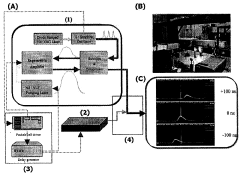
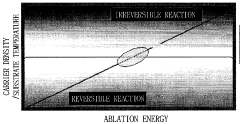
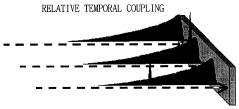
- A laser processing method and apparatus that combines an ultrafast laser with a nanosecond laser for temporal and spatial coupling, allowing reversible changes in material status by controlling the relative positions and focus of the laser pulses to increase processing speed and reduce surface roughness.

Energy Efficiency Considerations in Laser Processing
Energy efficiency has emerged as a critical consideration in ultrafast laser processing for thermoregulatory materials, driven by both environmental concerns and economic imperatives. The energy consumption profile of ultrafast laser systems presents unique challenges and opportunities compared to conventional laser technologies. Typically, ultrafast laser systems operate at lower average powers but extremely high peak powers, creating a distinctive energy utilization pattern that requires specialized optimization approaches.
The energy efficiency of ultrafast laser processing can be quantified through several key metrics, including wall-plug efficiency, process energy per unit volume of processed material, and thermal energy utilization ratio. Current state-of-the-art ultrafast fiber laser systems achieve wall-plug efficiencies of approximately 30-35%, significantly higher than the 10-15% typical of earlier generation solid-state ultrafast lasers. This improvement represents substantial progress but still leaves considerable room for enhancement.
Process parameter optimization plays a crucial role in maximizing energy efficiency. Research indicates that pulse duration, repetition rate, and scanning strategy significantly impact energy consumption. Studies have demonstrated that optimizing these parameters can reduce energy requirements by 20-40% without compromising material processing quality. Particularly promising is the development of burst-mode processing, where closely spaced pulse trains enable more efficient energy coupling into materials.
Thermal management systems represent another frontier for efficiency improvements. Advanced cooling technologies, including microfluidic cooling channels and phase-change materials, have demonstrated the ability to recover and repurpose waste heat from laser systems. Some cutting-edge facilities have implemented heat recovery systems that capture thermal energy from laser cooling systems to support facility heating or other industrial processes, creating a circular energy utilization model.
The integration of real-time monitoring and adaptive control systems has shown particular promise for energy optimization. These systems continuously analyze process efficiency and adjust laser parameters dynamically, preventing energy waste from suboptimal processing conditions. Machine learning algorithms trained on extensive process data have demonstrated the ability to reduce energy consumption by 15-25% through intelligent parameter adjustment during operation.
From a lifecycle perspective, the energy invested in ultrafast laser system manufacturing must also be considered. Recent lifecycle assessments indicate that the embodied energy in high-precision optical components and specialized electronics represents a significant portion of the total energy footprint. Extending system operational lifetimes through modular design and upgradeable components offers a pathway to amortize this embodied energy over longer productive periods.
The energy efficiency of ultrafast laser processing can be quantified through several key metrics, including wall-plug efficiency, process energy per unit volume of processed material, and thermal energy utilization ratio. Current state-of-the-art ultrafast fiber laser systems achieve wall-plug efficiencies of approximately 30-35%, significantly higher than the 10-15% typical of earlier generation solid-state ultrafast lasers. This improvement represents substantial progress but still leaves considerable room for enhancement.
Process parameter optimization plays a crucial role in maximizing energy efficiency. Research indicates that pulse duration, repetition rate, and scanning strategy significantly impact energy consumption. Studies have demonstrated that optimizing these parameters can reduce energy requirements by 20-40% without compromising material processing quality. Particularly promising is the development of burst-mode processing, where closely spaced pulse trains enable more efficient energy coupling into materials.
Thermal management systems represent another frontier for efficiency improvements. Advanced cooling technologies, including microfluidic cooling channels and phase-change materials, have demonstrated the ability to recover and repurpose waste heat from laser systems. Some cutting-edge facilities have implemented heat recovery systems that capture thermal energy from laser cooling systems to support facility heating or other industrial processes, creating a circular energy utilization model.
The integration of real-time monitoring and adaptive control systems has shown particular promise for energy optimization. These systems continuously analyze process efficiency and adjust laser parameters dynamically, preventing energy waste from suboptimal processing conditions. Machine learning algorithms trained on extensive process data have demonstrated the ability to reduce energy consumption by 15-25% through intelligent parameter adjustment during operation.
From a lifecycle perspective, the energy invested in ultrafast laser system manufacturing must also be considered. Recent lifecycle assessments indicate that the embodied energy in high-precision optical components and specialized electronics represents a significant portion of the total energy footprint. Extending system operational lifetimes through modular design and upgradeable components offers a pathway to amortize this embodied energy over longer productive periods.
Industrial Applications and Implementation Strategies
The implementation of ultrafast laser methods for thermoregulatory material processing in industrial settings requires careful consideration of infrastructure, cost-benefit analysis, and integration with existing manufacturing processes. Leading industries adopting this technology include automotive, aerospace, electronics, and medical device manufacturing, where precision material modification offers significant competitive advantages.
For successful industrial implementation, companies must first evaluate their specific production requirements and material processing needs. This assessment should include throughput demands, quality specifications, and the thermal sensitivity of target materials. Ultrafast laser systems typically require substantial initial capital investment, ranging from $500,000 to several million dollars depending on power specifications, pulse characteristics, and automation capabilities.
Integration strategies must address facility requirements including vibration isolation, clean room conditions for sensitive applications, and robust power supply infrastructure. The implementation timeline typically spans 6-12 months, encompassing equipment procurement, installation, operator training, and process optimization phases. Companies should anticipate a learning curve as operators develop expertise in parameter optimization for specific materials and applications.
Return on investment calculations should consider not only direct production efficiencies but also secondary benefits such as reduced material waste, decreased post-processing requirements, and enhanced product performance characteristics. Case studies from early adopters indicate ROI periods of 18-36 months for high-volume production environments.
Workforce development represents a critical implementation factor, as ultrafast laser operation requires specialized technical knowledge. Successful implementation strategies typically include comprehensive training programs, partnerships with equipment manufacturers for ongoing technical support, and potential collaboration with research institutions for advanced process development.
Quality assurance protocols must be established to monitor and validate the thermoregulatory modifications achieved through ultrafast laser processing. This includes development of appropriate testing methodologies, in-process monitoring systems, and documentation procedures that satisfy industry-specific regulatory requirements.
Scalability considerations should inform implementation planning, particularly for manufacturers anticipating production volume increases. Modular system designs and standardized process parameters facilitate expansion while maintaining consistent material performance across multiple production lines or facilities.
For successful industrial implementation, companies must first evaluate their specific production requirements and material processing needs. This assessment should include throughput demands, quality specifications, and the thermal sensitivity of target materials. Ultrafast laser systems typically require substantial initial capital investment, ranging from $500,000 to several million dollars depending on power specifications, pulse characteristics, and automation capabilities.
Integration strategies must address facility requirements including vibration isolation, clean room conditions for sensitive applications, and robust power supply infrastructure. The implementation timeline typically spans 6-12 months, encompassing equipment procurement, installation, operator training, and process optimization phases. Companies should anticipate a learning curve as operators develop expertise in parameter optimization for specific materials and applications.
Return on investment calculations should consider not only direct production efficiencies but also secondary benefits such as reduced material waste, decreased post-processing requirements, and enhanced product performance characteristics. Case studies from early adopters indicate ROI periods of 18-36 months for high-volume production environments.
Workforce development represents a critical implementation factor, as ultrafast laser operation requires specialized technical knowledge. Successful implementation strategies typically include comprehensive training programs, partnerships with equipment manufacturers for ongoing technical support, and potential collaboration with research institutions for advanced process development.
Quality assurance protocols must be established to monitor and validate the thermoregulatory modifications achieved through ultrafast laser processing. This includes development of appropriate testing methodologies, in-process monitoring systems, and documentation procedures that satisfy industry-specific regulatory requirements.
Scalability considerations should inform implementation planning, particularly for manufacturers anticipating production volume increases. Modular system designs and standardized process parameters facilitate expansion while maintaining consistent material performance across multiple production lines or facilities.
Unlock deeper insights with PatSnap Eureka Quick Research — get a full tech report to explore trends and direct your research. Try now!
Generate Your Research Report Instantly with AI Agent
Supercharge your innovation with PatSnap Eureka AI Agent Platform!